Blog

  • Ad Strat: Screw the couch

    Ryan Menezes, Chief Creative Officer, Percept/H


    1. Name of the Campaign:

    Screw the couch-Ditto TV.


    2. The Brief:

    To create immediate curiosity and interest in a new brand, Ditto TV, in this new category called OTT (Over the top) TV.


    3. Research insights:

    People are always alive to novel forms of engagement. They like completing stories in their heads and love checking on whether their answer ‘is right’.


    4. The thought process behind the creative:

    The ad had to be provocative. My idea was to play on the fact that Ditto TV allows you to do it anywhere, without specifying what the ‘it’ was, and allow people’s imagination to go wild.


    5. Media vehicles chosen:

    Front page jackets on Bombay Times, Bangalore Times, Delhi Times, DNA Mumbai and Pune.


    6. Key issues kept in mind while executing the ad:

    Key issues kept in mind while executing the ad. The ad had to be noticed, so I had to make it stand out. Hence the use of bold typography, minimal elements  The copy on the front page was written at one go, as I wanted it to sound like an angry rant, and not look like it was crafted. I used a broken couch as a visual to reinforce the double entendre that was already playing in the reader’s mind.


    7. Does the treatment do justice to the brief?

    It more than does justice to the brief, it takes it to another level.


    8. What is the differentiating factor about the ad?

    Its audacity, its single-minded message. It is well written and art directed, and most of all, it rewards the viewer.


    9. Market and client feedback:

    Ecstatic client, curious readers. The app Ditto TV became no. 3 on the Apple App store within 3 hours on day 1 of launch. More than 5000 registrations within 11am on day 1 and No.1 app on the most downloaded charts on Apple store within 3 days of launch.


  • Freaking News: Tendulkar upstages the budget extravaganza

    By Ranjona Banerji


    Pranab Mukherjee owes a big debt to Sachin Tendulkar. By the time Saturday morning dawned, the newspapers it seemed were far more excited about the century of centuries than they were about fisccons, indirect taxation and how do you solve a problem like Mamata.


    The Times of India, Uttarakhand, had “Sachin, Thanks a Ton” as its lead headline and story. The budget was tucked below the fold. The Hindu went with convention and the budget, “Dr Pranab’s bitter medicine” but there was Sachin’s “century of centuries just below the fold. The Hindustan Times (Delhi) put Sachin as a banner on top of the budget – “God of All Things” and then said, “Reforms on Rewind”.


    The Times of India’s Mumbai edition put Sachin at the top and the bottom. There was the banner “Tondulkar goes where no one ever has or ever will”, then a graphicked-up finance minister with the headline, “Face it. Life’s got a lot more taxing” and then “Thanks a ton, Sachin” at the bottom. DNA, Mumbai went with “Budget bores, Sachin scores” which about put the matter in perspective.


    As far as headlines go, I would say Hindustan Times has won, DNA has come second, Times has tried too hard and Hindu not at all.


    Interestingly, Hindustan Times, Mumbai’s Sachin banner read “Man of the Century” which perhaps proves that HT thinks that either no one in Mumbai will get the Arundhati Roy reference in the “God of All Things” or that people in Mumbai can’t do maths (man of 100 centuries, surely?) or that the Mumbai edition just felt it had to be different from Delhi. Now that’s a legitimate desire, surely?


    Even The Economic Times could not ignore Sachin and tied the two together into one headline, “On Budget Day, Sachin scores”. The Vodafone tax case also got a cricket reference “Vodafone may have to face Pranab’s Doosra”.


    Thus the nation’s fascination with cricket and Tendulkar managed to upstage the annual extravaganza that newspapers go through every year.


    * * *


    In fact, Saturday must have been a news editor’s nightmare, trying to decide which story was bigger. After all, we’ve spent almost a year going on and on about Tendulkar’s 100th century and couldn’t give it second place even if it arrived on budget day.


    As for what the newspapers said about the budget, it was more of the same – some people liked it and some didn’t. More than likely: all will be forgotten as Mamata Banerjee plays out some new drama and Akhilesh Yadav loses some of his sheen. Pranab Mukherjee will probably have the last laugh.


  • Utterly Butterly Tondulkarlicious: 25 Amul ads that tell the Tendlya story

    By A Correspondent

    While the news media reflects on current affairs and trends, one wouldn’t be incorrect in saying that the Amul Butter billboards are an excellent mirror of what’s top-of-mind in urban India. So even as headlines and captions in print do their jobs well, there’s nothing like the Amul ad, crafted by Rahul da Cunha and his team at da Cunha Communications for the Gujarat Cooperative Milk Marketing Federation Ltd.


    From the time he started out in the late ’80s, Sachin Tendulkar has been at it… breaking virtually every record at the book and regaling us with his splendid performance and commitment on the field. And off it.


    Last week, MxMIndia brought you the Amul ads with Rahul Dravid… here are a silver bunch of Amul ads telling you the Tendlya story. For his feats on field, and some off the field too. Enjoy!


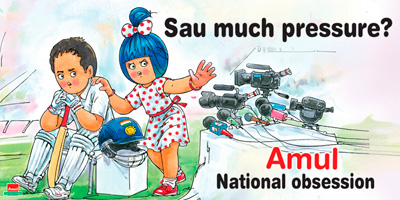
    Sau much pressure?

    India’s obsession with Sachin Tendulkar’s 100th hundred  (January 2012)


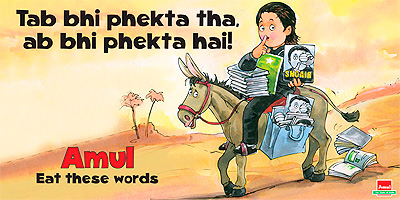
    Tab bhi phekta tha, ab bhi phekta hai

    Former Pakistani fast bowler Shoaib Akhtar’s ouburst against Sachin Tendulkar in his autobiography (September 2011)


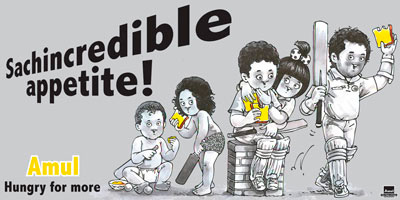
    Sachincredible appetite!

    Sachin Tendulkar, the first batsman to score 50 test centuries (December 2010)


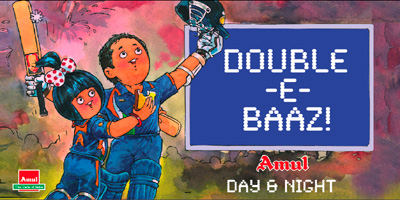
    DOUBLE -E- BAAZ!

    Sachin Tendulkar scores a double century against South Africa in the second one-dayer (February 2010)


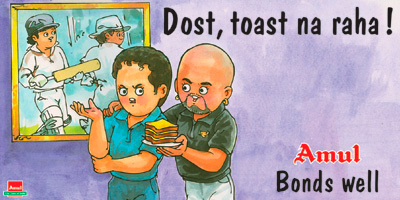
    Dost,toast na raha!

    Controversy surrounding the friendship of Sachin Tendulkar and Vinod Kambli (July 2009)


    Gilly, don’t be silly!

    Controversy surrounding Adam Gilchrist accusing Sachin Tendulkar of not having a sporting attitude & being a liar, in his about to be released autobiography (October 2008)


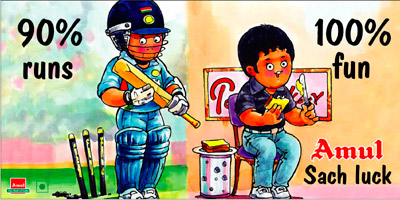
    90% runs 100% fun

    Indian master blaster Sachin Tendulkar missing century in cricket one-dayers.(November 2007)


    Maska Blaster!

    Indian batting maestro Sachin Tendulkar – the Master Blaster to appear as superhero in a new range of comic books, animation and games (March 2007)


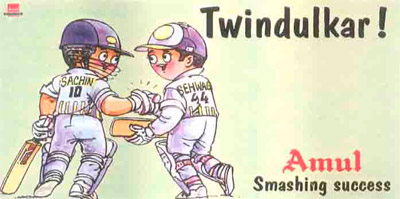
    Twindulkar

    Celebrating the smashing Sachin-Sehwag partnership


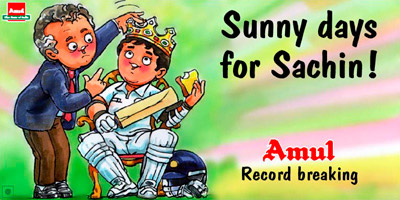
    Sunny days for Sachin!

    On master blaster Sachin Tendulkar’s 35th Test Hundred making him the highest century maker in the history of Test Cricket (December 2005)


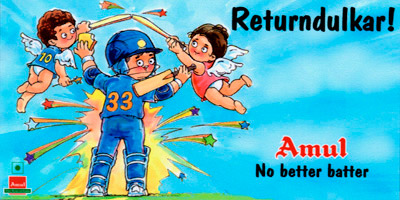
    Returndulkar

    Sachin Tendulkar marks his return to international cricket with a sparkling knock (October 2005)


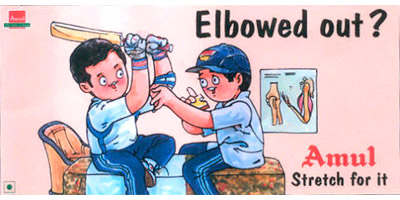
    Elbowed out?

    On Indian star batsman Sachin Tendulkar’s tennis elbow aliment which has kept him out of cricket (October 2004)


    What’s his duty?

    On the waiver of import duty on the Ferrari gifted to Sachin Tendulkar (September 2002)


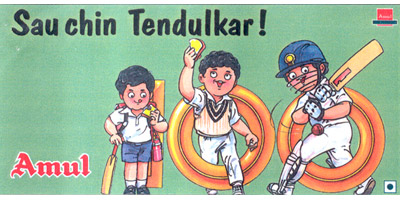
    Sau chin Tendulkar

    On Sachin Tendulkar playing his 100th Test Match (September 2002)


    Stunnedulkar!

    Sachin Tendulkar accused of ball tampering (November 2001)


    Madenness!

    Mike Denness finds Sachin Tendulkar guilty of ball tampering (November 2001)


    Unfeet?

    On Sachin Tendulkar’s foot injury (July 2001)


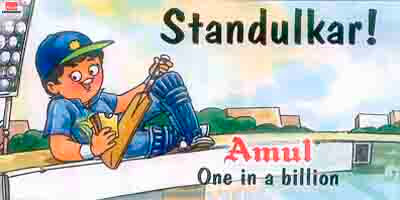
    Standulkar

    On a stand in a cricket stadium being named after Tendulkar and signing a billion rupee contract – May 2001


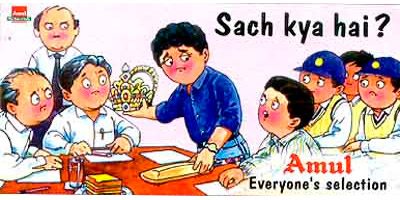
    Sach kya hai?

    Questions being raised on the resignation of Sachin Tendulkar from the captaincy of the Indian Cricket Team.” (Feb 2000)


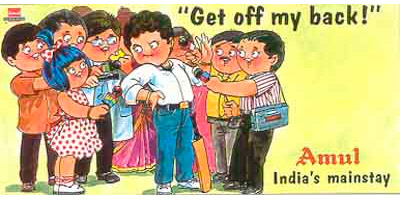
    Get off my back!

    Media speculations on Sachin Tendulkar’s back trouble affecting his future career (September 1999)


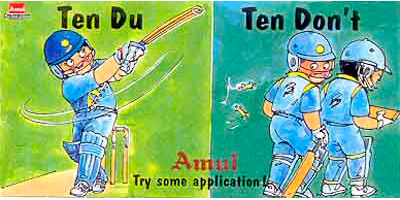
    Ten Du Ten Don’t

    On the lone success of Sachin Tendulkar, while his team-mates keep failing


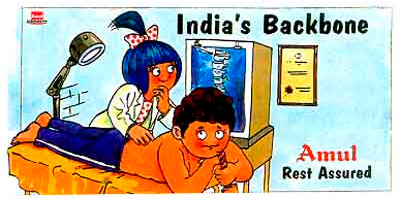
    India’s Backbone

    Sachin Tendulkar’s back injury


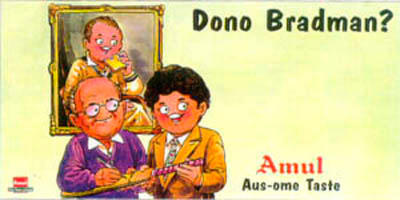
    Dono Bradman?

    About the similarities between Don Bradman and Sachin Tendulkar


    Tendul Car!

    On Sachin Tendulkar winning a car for the cricket finals between India & Australia


    Neeche cricket ke kaptan — Upar Sachin

    Ajit Wadekar wants Wonderkid Sachin Tendulkar to be given a flat in Sportsfield – a highrise specially built by the Government for sportsmen – as a gesture of appreciation


  • TRAI invites views on ads policy for broadcasters

    By A Correspondent


    It was bound to happen, only its timing – soon after the not-very-exciting Budget and the uncertainties thrown up by digitization staring in its face – could’ve been unfriendlier. On Day 3 of FICCI-Frames, Big brother Telecom Regulatory Authority of India (TRAI) released a consultation paper titled “Issues Related to Advertisements in TV Channels”.


    First some background, in TRAI’s words: “The advertisement revenue has been a substantial portion of the overall television industry revenues. Perhaps, this has led to the tendency of pushing more and more advertisements in the television programmes in both pay and FTA channels. The increasing duration and distracting formats of advertisements has, however, adversely affected the consumers’ viewing experience. This has been reflected in numerous consumer complaints and opinions being expressed at various fora.”


    The TRAI is hence reviewing the existing regulations on duration of ads and how they should be presented given complaints that these are not being followed. Here goes:


    1. The limits for the duration of the advertisements shall be regulated on a clock hour basis i.e. the prescribed limits shall be enforced on clock hour basis.

    2. No FTA channel shall carry advertisements exceeding 12 minutes in a clock hour. For pay channels, this limit shall be 6 minutes.

    3. The 12 minutes of advertisements will not be in more than 4 sessions in one hour. In other words, there will be continuous airing of the TV show for at least 12 minutes each. Not more than three advertisement breaks shall be allowed during telecast of a movie with the minimum gap of 30 minutes between consecutive advertisement breaks.

    4. In case of sporting events being telecast live, the advertisements shall only be carried during the interruptions in the sporting action i.e. half time in football or hockey match, lunch/ drinks break in cricket matches, game/set change in case of lawn tennis and so on.

    5. There shall only be full screen advertisements. Part screen advertisements will not be permitted. Drop down advertisements will also not be permitted.

    6. In so far as News and Current Affairs channels are concerned, they are allowed to run not more than two scrolls at the bottom of the screen and occupying not more than 10 per cent of the screen space for carrying non-commercial scrolls, tickers etc.

    7. The audio level of the advertisements shall not be higher than the audio level of the programme.


    The text of the Consultation Paper is available on TRAI’s website (http://www.trai.gov.in/WriteReadData/trai/upload/ConsultationPapers/289/ cp_aproved_Authority.pdf). Written comments on the issues raised in the Paper are invited from the stakeholders by March 27, 2012, and counter-comments by April 2.


  • @FF12: Integrated media best way fwd: Vikram Sakhuja

    Video and Text by Shruti Pushkarna


    On the fundamental powers of digital:

    In digital there are few things that are exciting. One is that digital has the potential to burst from a sampling kind of mindset into a census kind of a mindset. By that I mean that a lot of measurement we do in marketing today is very sample based and digital, whether it is through set-top boxes, or through online behaviour, it is possible now to get the data at a granular level. So that leads to targeting a million, one at a time kind of thing, which is exciting. The other inherent power of digital is interactivity. The third area is the ability to link multiple devices. Last is the real time query, whether it’s query or the consumption of content. Linked to that is the entire thing about being mobile. So these four or five inherent powers of digital are game changers for marketers.


    How to engage in an increasingly digital world?

    [youtube width=”400″ height=”250″]http://www.youtube.com/watch?v=sIj_VeYzlPo[/youtube]

    The engagement part comes from the kind of content you put up and the entire viral or social nature which comes up. The framework we talk about is paid, owned and earned media. An example of paid media is when Mindshare got Dhanush to sing an anthem for Sachin Tendulkar, post Kolaveri Di. Within four days we got ten million views, and the anthem, in turn, got a viral life of its own. So I think the way in which you can use content is how it becomes engaging.


    What is the way forward?

    I think integrated media is the best way forward. Today when people think of multimedia planning, they do a separate TV plan, print plan, radio plan, internet plan and so on. I believe that if you actually look at media agnostically and at common metrics of each cost per thousand impressions, these are the ways in which you can construct a media agnostic plan. What it does is, it suddenly gets more money into digital, and when more money can come into digital, that’s when focus is going to come in.


  • Anil Thakraney: Sachin coverage sucks

    By Anil Thakraney


    As expected, the entire Indian media went orgasmic as soon as ‘God’ hit that very elusive 100th hundred. Quite understandable. This man is a national hero and he needs to be celebrated.


    However, there were two aspects of the mad coverage I found quite annoying. One, each time Sachin reaches a milestone, the media (both, print and electronic) regurgitates the same old childhood pictures and the same old tired cliches about the man. And the same old ex-cricketers sing the same old praises. even in a euphoric state of mind, it becomes difficult to handle all this recycled stuff. Surely there’s an innovative way to celebrate the hero’s achievements. Surely there are untold incidents from the man’s life that can be dug out if one cares to do the hard work. Something to ponder on for editors and programming heads. Because, unwilling to retire, Tendlya will reach even bigger landmarks, and we need some freshness going.


    Having said that, I must point out that cricket expert Ayaz Memon was the only one who told us something refreshing about the cricketer. This was in his column for the Hindustan Times. Memon mentioned how, as a young lad, he (Sachin) would jump over the wall of a cricket ground rather than use the main entry door. The master’s reason? Why wait for something you enjoy so much in life. Superb. It gave you a powerful insight into the passion the player feels for the game, the reason he’s reluctant to retire even after two decades. We need more such gems in the media.


    Secondly, I was rather upset by the behaviour of the young TV reporters who were ‘granted’ quick interviews by the great man, soon after the mega ton. They were grovelling at his feet, like crazed fans. Guys and girls, that’s NOT the way the media is expected to conduct itself. Sure, the man enjoys a godly status, but a couple of tricky questions badly needed to be put to him. Like, did his search for the Big 100 bring the scoring rate down, which ultimately cost the team the match with Bangladesh? Does he agree with that?  Like, he claims personal landmarks are never on his mind. So then how come he closes his shop while batting in the nineties? Not one reporter would ask him these things. They were busy fawning. Repeat: That’s not the job of the media.


    Net net: Sachin Tendulkar is our biggest contemporary hero. No doubt about that. Now let’s pay him tributes that befit his own stature.


    ***


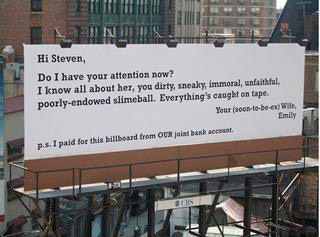
    PS: You should never, never piss her off. It’s worse than hell when she’s scorned. Here’s an American lady who passed on a sweet message to her philandering hubby through a hoarding. Wish Indian ladies did ditto. Tired of watching all those ugly thopdas of our politicians. 🙂


  • @FF12: Digitisation will allow broadcaster to make money off ground: Tarun Katial

    Video and Text by Shruti Pushkarna


    Tarun Katial, the CEO of the Reliance Broadcast Network Ltd, spoke to MxM about how the businesses will have to rework their monetising strategies in the wake of digitisation


    On reworking the business model for digital era

    [youtube width=”400″ height=”250″]http://www.youtube.com/watch?v=r_uR54g7cbI[/youtube]

    For television, it will be a combination of content as well as marketing. The old model which was a combination of carriage and product, as it stands today won’t work. The business plan which currently has a very high rate of carriage will obviously see the content taking precedence.


    On Digitization bringing in transparency

    By transparency, I mean, it will allow the broadcaster to know the number of households it’s getting into, getting paid for and which value tier plan it is present on. It’s not like analog, where you give Rs150 and you have 500 channels available. The broadcaster will be allowed revenue share, he will be allowed to make money off the ground.


  • @FF12: Turning 3 into 10, a percentage issue for digital

    By A Correspondent


    While much of the adex growth in 2011 came from the obvious sectors of television and print, it was digital that stole the thunder by recording the biggest and fastest growth among all mediums. Little wonder then that the session on “Innovations in the advertising industry in the Digital world” chose to focus on why the much sought after medium was still ignored by advertisers who preferred to seek refuge elsewhere. The panellists comprised Rajan Anandan, VP and MD Google India, Olivier Fleurot, CEO, MSL (Part of Publicis group), Frederic Josue, Executive Director, Havas Media, Vikram Sakhuja, CEO, South Asia, Group M and Kapil Agarwal, Jt MD, UFO Moviez and Varun Gupta, Director, strategy transaction services, KPMG India. The session was moderated by Rajiv Makhni, Managing Editor, Technology, NDTV.


    Mr Anandan initiated the discussion, stating that India is still an emerging market where web advertising is concerned and it still constitutes about 3 per cent of the overall advertising spends in India which is estimated to be around Rs 33,000 crore. The biggest driver of growth in advertising on the web would be through the rise in the number of users of smartphones, which is estimated to touch 100 million users in 4-5 years time. Smartphones alone could boost the growth of web advertising to about 8-10 per cent, he said.


    Mr Josue of Havas was of the view that it would be content that will drive the growth of the medium in the years to come. Havas has been at the forefront in investing behind content production as that would be the driver of growth for this medium. But the medium will face its share of issues which include multi-tasking across various platforms as an attempt will be have to be made to offer content seamlessly across various mediums. Also, engagement and loyalty would be the other key attributes that would make or break business for users of digital across the world, he said.


    Mr Fleurot began by stating how the marketing and communications industry was witnessing a profound disruption due to the invasion of technology and social media. This, he said, has led to an increased level of competition in the marketplace. Signalling the essence that data will bear on the survival of players in the communications space, Mr Fleurot said that big data will be at the core of all marketing initiatives in the future. He highlighted on how the space will see the emergence of many new publishers like Youtube et al that will challenge the livelihood of the existing players in the space. The challenge, he said, was that clients today are not yet organised for the 21st century as they still prefer to work in silos. But in the case of online, the model of working in silos will disappear as all the other mediums work as a single unit on the internet. Going forward, the two key factors that will determine the growth of this medium, he said, include the speed with which marketers communicate with their users through the digital medium and the transparency with which they operate on the medium.


    Vikram Sakhuja was at his jingoistic best as he began by questioning what the term innovation in advertising actually stood for. “Innovation is a term that is broader than creativity. It is a new way of doing something better,” he said. He outlined the current scenario by stating that technology today is an overestimated medium in the short term but is underestimated for the long term. The problem according to him is that the medium has been underestimated for a long time now and that it was about time the medium leapfrogged ahead of the others – go from the current 3 to 15 percent in the shortest possible timeframe.


    Outlining the four fundamental powers of digital, Mr Sakhuja said that the first and foremost is its ability to move from being something random to attaining a consensus. The second was the power of interactivity which includes communicating in a 2-way mechanism and communicating in a social world; the third was the ability to move seamlessly across devices and lastly, the ability to enhance real-time consumption of content.


    The implications that this would have on marketing include facilitating superior targeting, marketing content that would be more UGC-led, more use of apps and videos that will alter the way clients reach out to users – 30 second ads will make way for UGC videos and banner ads; use of word of mouth will see a predominant rise, and new sales and distribution models will evolve in digital that would enable advertisers to reach out to consumers in a more linear fashion.


    Mr Gupta of KPMG pointed out though digital was seeing an increasing levels of penetration, there was a disconnect where ad spends on the medium are concerned. Just 3 per cent of monies going to the medium is still unreasonable given the numbers being thrown up by markets in the West and Europe, which exceed 25 per cent and above. A large amount of growth in digital will come through mobile, he said.


    Mr Anandan added here that one of the industries that will see a downfall would be print as already there is a lot of transition that is being witnessed in terms of clients moving away from print to digital. Real estate clients and job classifieds are prominent examples where most of the ads are now being run on the digital medium putting the scope of print in a tight spot.


  • @FF12: Digital will decide the fate of TV

    [youtube width=”400″ height=”250″]http://www.youtube.com/watch?v=r_uR54g7cbI[/youtube]
    Video By Shruti Pushkarna

    By A Correspondent


    When you get a diverse set of panellists together to discuss a medium that’s been changing the way media functions in the country, there is bound to be endless debate on how the medium is preparing itself to face the oncoming challenges and opportunities of the future. And so when the panel discussion on ‘TV’s Many Personas: Evolution of Business Models and Technologies in the Digital Era’ took off, it was interesting to see the panellists move away from the usual banter surrounding the medium to the more serious and in-demand topic demanding attention – impact of digital on the medium of television. The panellists comprised Tarun Katial, CEO, Reliance Broadcast, Punitha Arumugam, Group CEO, Madison, LV Krishnan, CEO, TAM and Vishal Malhotra, Business Head – Digital, ZEEL. The session was moderated by Rajiv Makhni, Managing Editor, Technology, NDTV.


    LV Krishnan of TAM began by bringing to the fore his thoughts on audience measurement as he said, “As digitisation happens, it will be much easier to track consumers; this will be more easy to expedite than what analog does right now given the enormous constraints analog is faced with, including infrastructural challenges, pricing issues, reach, etc.” In fact Mr Krishnan provided a more bullish perspective as he said that in the US and UK, Nielsen had already made a significant progress as they already measure online content (videos), on the mobile and such evolved devices. It won’t be long before that becomes a reality in India too. He also went on to cite an example of a client – Unilever in the US, who was being exposed to the culture of GRPs, TRPs, etc – terms that are more endearing to the Indian setting.


    Tarun Katial provided a more holistic setting that his network BIG CBs was adapting to given the impending challenges that digital was casting on the broadcast industry. Mr Katial said that his network was focusing on a few key areas, namely, moving away from the traditional norm of selling DVDs in stores to selling them online and renewing focus around how does it revolutionise and monetise the content that it owns. Katial advocated that the way forward would be for broadcasters to analyse how much they are liked and needed by viewers, basis which they will be able to score an edge over peers in the business.


    Punitha Arumugam put forth her points as she bought to the fore 4Es that will redefine the way the industry will function in the future. She said that because of digitisation there is bound to be an expansion in ratings as viewership and reach is expected to rise because of digital. She cited the example of rural cities and towns that are seeing an increasing entry of DTH players in recent times. The second E that she put forth was on behalf of the planning industry as she said that agencies and advertisers were looking at engaging better with their consumers and be able to narrowcast. The third E was the need to bring about efficiency and lastly, the need to encompass all digital streams leading to better measurement. Highlighting the core issues of digital being a nascent medium to advertisers she said, “Clients are indeed excited about being on the digital medium but it is just 5 per cent of the total ad spends and therein lies the problem. This is because most clients still do not know how to go about engaging with digital but all this will change and 2012 is expected to show digital as being the third largest contributor of ad spends ranging between 6-7 per cent.”


    Vishal Malhotra, Business Head – Digital, ZEEL said that digital was a new avenue for Zee at the moment and that it had a lot of catching up to do with what other players were offering. But it was doing enough on its part to appease audiences watch content of their choice through Ditto TV, their newly launched venture.


    Mr Krishnan added further by stating that there were several myths that could be busted with digital. He said that there is a new concept of destination viewing that is evolving which will not necessarily guarantee more reach but it will guarantee enhanced reach. Another myth surrounds the viability to pay for content that is accessed, especially in the rural areas. With rural areas still finding it difficult to accept the high cost of service, the ability for content to go pay will need a revisit in marketing strategies especially in rural areas. And the biggest myth would be around measurement as content would be measured across multiple platforms like TV, iPads, mobile, etc and not through mediums as is being done now. That may bring about a significant shift in the viewing patterns of consumers, he said.


  • @FF12: Adapt to the digital tide or be left out

    By A Correspondent


    In keeping with the theme, ‘Embracing the Digital World’, FICCI Frames 2012 got off to a wishful start at Hotel Renaissance, Mumbai on March 14 with a welcome address by the Co-Chair of FICCI Entertainment Committee, Karan Johar. After Mr Johar’s welcome address, Uday Shankar, CEO, Star India & Chairman, FICCI Broadcast Forum, proceeded to present his perspective on the Event and the broadcast industry in general. Making a dash for the core topic of digital, Mr Shankar began by stating, “Digitization is a big reality which will revolutionise the way content (creation and distribution) is offered.” Even though he said that digitisation will create a level playing field for the broadcasters and the cable operators, he had a word of caution to add when he said that his biggest concern was “the chaos which will be caused by the broadcast industry’s inaction”.


    Prithviraj Chavan, Chief Minister of Maharashtra was next and began by assuring how the current era was an “exciting time to be living in”. He said that the challenge would be to adopt the regulatory framework to new technology and ensure that over regulation doesn’t kill a good thing. He also said that the move towards digitization will create a huge employment opportunity but there is a need to explore how technology can empower the field of education. The Chief Minister also touched upon the need for regulation and suggested that instead of the state regulating the media, the medium should look at regulating itself.


    Following the CM’s speech, the event witnessed the release of the FICCI-KPMG Indian Media and Entertainment Industry Report 2012; FICCI-Amarchand Lawbook and ‘Positivity: The impact of television on India’ by The Indian Broadcasting Foundation.


    Uday K Varma, Secretary, Ministry of I&B, opened his address next by stating that the concerns that the industry had over digitization and the Phase 3 of FM radio have been addressed by the move to allow 839 new FM stations and 500 community radio stations. He stressed that the government is committed to ensuring time bound digitization and said that come July 1, the four metros will switch over to the digital format and the plan is to ensure that the move to digitization is completed by December 31, 2014. He agreed that the challenge was mammoth – to convert 80 million analog connections to digital format, but added that it will ensure faster and deeper penetration. “This will address a plethora of issues facing the television industry, such as addressability, carriage fees, audience measurement and consumer preferences,” he said.


    Punit Goenka, CEO & MD, ZEEL too spoke about the pros and cons of digitization, how the ratings are inadequate and how self regulation was the need of the hour for the broadcast industry. Carolyn Everson, VP, Global Marketing Solutions, Facebook elaborated on how Facebook can benefit the media and entertainment industry and cited examples from music, gaming and films to drive home her point.


    Session highlights:

    Post the promises and pleasantries doled out by committee members and authorities, it was time for some serious discussion which began with a panel debate on ‘Addressable Digitization – The way forward’. Sanjay Gupta, COO – Star India, Sunil Lulla, CEO and MD Times Global Broadcasting, Sameer Manchanda, Founder – DEN Networks and Punit Goenka, MD and CEO, ZEEL comprised the panellists. The panellists agreed that digitization is the way forward and will soon be a reality. Uday K Varma, Secretary – I&B, put the ball in the industry’s court as he said that there were no political opposition to digitization and the parliament too passed the law in December 2011, therefore it is now incumbent upon the industry to make digitization a reality. Sunil Lulla pointed out that the there is greater good in digitization, but the industry has to do a lot of work over the next few years. Sameer Manchanda was of the view that digitization is a reality and that it will bring more number of channels. The session also discussed opportunities and challenges that digitization has to offer and how the industry was gearing for digitization – whether they are ready or not?


    A session on ‘Maximising the power of digital distribution’ saw industry leaders speak about the challenges that come along as the country is experiencing the much talked about shift – from analog to digital cable – the investments that goes into and many such challenges. Industry honchos such as K Jayraman of Hathway Cable and Datacom Ltd, SN Sharma of DEN, Anshuman Misra of Turner, Asia Pacific, Vikram Chandra of NDTV, Jagi Mangat Panda of Ortel, Prof Jonathan Askin, and Anita Wallgren, Government Attorney, US Department of Commerce made up for the panel.


    The panel agreed that while digitization comes in as a relief for broadcasters who will be benefitted from additional subscription revenue the relaxation on paying heavy carriage fees, and of course providing viewers with a superior content experience – MSOs and cable operators have to quickly respond to the digitization mandate by investing in set-top boxes – the cost that is only possible to recover after four years.


    Vikram Chandra talked about the difference digitization makes to the news industry. “Digitisation is important for news players. It is leading players in the news industry into areas they don’t want to be in. In the race of chasing TRPs, people are forgetting that digital has great potential that has to be tapped, a business model which needs to be looked at.” Mr Chandra also mentioned the role of tablets and high-end devices as new distribution platforms.


    Next was a session titled “Financing the Media and Entertainment Business” where the panellists comprised eminent personalities such as Prashant Jain of HDFC Mutual Fund, Mathew Cyriac of Blackstone, Soumo Ganguly of Moxie Entertainment Pvt Ltd and Daniel Dubiecki, Founder and Partner, The Allegiance Theatre, Hollywood.


    Mathew Cyriac started off the session by pointing out that majority of the investments within the media and entertainment industry were made in television and print as they represent a fairly large share  in terms of sheer numbers as against Internet and Radio. The Hindi GECs in TV is typically where a lot of money goes to, followed by regional GECs and sports channel. For print media, it was the regional publications that command a lot of attention as regional advertising is very robust and extracts a lot of profit.


    Prashant Jain pointed out that a lot of companies in India have managed to get good funding and that it is not reflective of the supposedly very, very sorry picture that was being talked about. “It’s not that all of India in the media entertainment space are not attracting funds. Companies like UTV and a few others have attracted investors.”


    In the session on ‘Protecting Copyrights, Infringements & New Trends i.e. Remake’, the panellists chose to rummage over the impediments surrounding copyright issues in the film and music industry in India. The panellists included Sai Krishna from Sai Krishna Associates, Deborah Benattar from the French Embassy, Jagdish Rajpurohit from RCL Motion Pictures, Bertrand Mouiller, former DG IFFPA and Amar Butala from UTV Motion Pictures.


    Sai Krishna provided a hopeful insight as he said, “The industry should take heart in knowing that the Copyright Amendment Bill is currently being debated in the parliament and is expected to be passed after the current Budget Session. There are provisions that can alter the way the entertainment industry functions in India.” But he cautioned that the Bill has its setbacks too, as there are no clear guidelines when it comes to copyright issues between the writer, music composer and the producer of a film.


    Mr Butala added, “We have made huge leaps in terms of legal paperwork with actors and performers where copyright issues are concerned. But it is just the start and the challenge will be to sort out legal issues and take the offenders to Court with the hope of finding a favourable outcome from the judiciary.” The panel proceeded to discuss the trend of moviemakers bagging rights for remaking movies and that there was a need for a law that would streamline procedures for the industry at large.


    Key takeaways:

    – Complete digitization makeover scheduled for December 31, 2014

    – Copyright Amendment Bill to be passed in Parliament soon

    – Digitization will encourage niche and differentiated content

    – Need for media to self-regulate self then wait for a nodal authority to do it

    – Digitization to create more employment opportunities
     

  • @FF12: No disadvantage of being a woman

    By A Correspondent


    The media and entertainment industry which at one point in time was dominated by the men has today more number of women not only working at the lower and mid-level but, have even taken on leadership roles, giving a tough competition to their male counterparts. Whether it is the film and television industry or in the news media, women are not shying away from taking on responsibilities and accomplishing tasks that were once considered to be only a ‘man’s job’. Day three of FICCI Frames 2012 held a session on ‘Women in Media & Entertainment circa 2012: Leading from the front’.


    The panel members of this session were Vidya Balan, Actor; Anurradha Prasad, Managing Director, BAG Films; Jenni Tosi, CEO Film Victoria; Ekta Kapoor, Creative Director, Balaji Telefilms; Barkha Dutt, Group Managing Editor, NDTV; and Usha Uthup, Singer. The session was moderated by Rajeev Masand, Entertainment Editor, CNN IBN.


    This session discussed the journey of each of the above eminent women personalities and the challenges they faced during their journey. The moderator, Rajeev Masand simply put it this way, “Traditional media for long was dominated by men, but not any longer. It’s become outdated.”


    All the eminent women personalities claimed that despite all their challenges they had an incredible journey and the results have been fruitful.


    Ms Tosi observed that there would always be obstacles in a woman’s journey but, at the same she also admitted that at times a little bit of luck and timing also plays a part in ones success nevertheless, she must also be hard working and committed to succeed.


    According to Ms Dutt, the real heroes are actually the women who came before them i.e. those who made a mark and their presence felt in the male dominated industry. They were the ones that needed to be saluted, she said.


    One of the topics discussed at the session was whether ambition for men meant one thing and another for women, and how society reacts to ambitious women. Ms Ekta Kapoor agreed that ambition for men is a virtue, but for women it is seen as something negative. “I never took being a woman as a disadvantage and frankly, I never even thought about it. Today I am successful not in spite of being a woman but, because I am a woman,” she added. Ms Kapoor was also quick to emphasize  that 40 per cent of talent in television today consists of women.


    Ms Prasad said, “Today women have become so much mature, and so have their families. Today women have to juggle multiple roles. Had I thought that since I am a woman, and hence I cannot take on a task then I would not have been successful. If you are happy with what you are doing and at peace with yourself you will be successful in life.”


    Ms Uthup was of the view that what has really changed is the audience. “The field of Arts has been a level playing field for women. In the field of Arts you really don’t have gender bias. It’s been a fantastic journey for me and I believe if we want change to take place the people need to notice first and they must be awakened. Men and women must work together, but then there are things that women can do and men can’t and there are things men can and women can’t do.”


    Ms Balan said, “The Indian actress today has been humanized. No longer is she seen as a hero’s heroine; the actress is getting to play a part in the story. I have never seen my gender as a disadvantage, all I knew was I had to be strong to move ahead in life. There is a wide variety of roles for women today and the fact that there is no model code for women any more is liberating.”


    While all these eminent women had plenty of inspiring stories to share, each of them have had to overcome their own tough challenges, change the societal mindset about women being weak and docile, to climb their way to the top.


  • @FF12: How relevant is newspaper content to the reader?

    By Archita Wagle


    N Ram, former Editor-in-Chief, The Hindu, opened his keynote address by stating that there is ‘anxiety and gloom’ over the fact that journalism is in ‘meltdown’.


    Speaking on ‘Building Deeper Reader Engagement- Sustaining Long Term Newspaper Loyalty over Regions’, Mr Ram said that news media is in crisis in the mature markets, due to which there has been a decrease in the circulation and readership of newspapers. But the fact to be noted was that the decline started in mature markets like theUSeven before advent of the Internet. He added that even the broadcast media, ‘the dominant player’, has also seen a sharp decline.


    Mr Ram outlined Two Media World Phenomenon next, where the less developed countries are witnessing increase in circulation of newspapers unlike the mature market. He illustrated his point with the example of the regional, especially the Hindi, newspapers which have seen increase in their circulation. But he added a word of caution when he said that TV, even in the developing world is going through a crisis which it has so far covered by showing entertainment as part of news. Inspite of this, Mr Ram was optimistic that the medium term prospects for the media industry are looking good.


    The key factor for the decline in the newspaper is the increasing popularity of the digital media. Mr Ram called this the Digital Age Paradox and added that in recent times the newspapers have seen an increase in the readership of their online editions. But he added that the recent paid content model will impact the readership in a big way.


    Mr Ram opined that the paid content model will not replace the old revenue model of the newspapers any time soon as a lion’s share of the revenue earned goes to the search engines like Google and content providers like iPad apps.


    He added that the paid content model has put a “double squeeze” on the newspapers’ revenue, as they have to subsidise digital journalism, which in turn is cannibalizing their circulation.


    Mr Ram was optimistic about Indian newspapers surviving the challenge of the Internet as he believed that India has a “new kind of advantage” due to its fact the media here is still growing at the time when it is faced by the Internet challenge. But he said that the media can’t afford to be complacent about the time before it faces ‘a mature market-like situation’, estimating that the newspapers have around 3-7 years before the negative trends overtake us.


    After taking the audience through a detailed study of the challenges being faced by the newspapers, Mr Ram turned his attention towards how the newspapers can engage the readers to sustain their loyalty.


    Mr Ram said that readers today have real time access to information and could check out the information that was provided by the newspapers. He was of the opinion that if the newspapers stuck to the basic principles of journalism – context, accuracy, perspective, fact checking and verification – they can build a relationship with the readers, which it can rent out to the advertisers. But he was emphatic that “newspapering” must not be reduced to consumer marketing of news.


    He advised the newspapers not to target “attractive demographics” which help in getting revenues, but to provide news for all sections. He said “trust is the key to good journalism”. He asked the newspapers to be clear about their identity, core values and focus on where they want to go and cautioned them against imitating anybody else.


    He said that the readers today want shorter articles and more analyses and editorial content and views, especially in the digital viewing context. But he expressly warned against “editorialising in the guise of news”.


    He concluded his address by stressing the importance of having an internal mechanism for correction of the mistakes that ran independent of the editorial and the advertisers which will help the newspapers to do the right thing.


    Director of the Dainik Bhaskar Group Mr Girish Agarwal took the stage next for a short but relevant address. He started off by stating that he agreed with Mr Ram about maintaining the standards and fundamentals of journalism but begged to differ from him by stating that Indian newspapers are growing in their circulation and readership.


    He said that India had a huge advantage in terms of number due to the gap between those who can read and those who actually read a newspaper.He spo


    ke about the need to engage the reader by asking “How relevant are we (newspapers) to the reader?” He said the need for an intellectual organisation like newspaper is external understanding and internal adaptation. He opined that a newspaper cannot rest on its past glory but should move ahead by acknowledging and understanding what the consumer wants and giving him what they think he needs.


    He also differed from Mr Ram when he empathetically suggested that newspapers need to be simplified and adapt themselves to the readers’ requirements. He ended by saying that newspapers should have global vision and hyper local content.


    After the speeches the floor was opened to the audience who questioned Mr Ram and Mr Agarwal about threat perception of the culture of medianet and media houses being bought over by MNCs


    Mr Ram denounced paid news as a rogue practice which has been rubbished by the Press Council and Mr Agarwal added that since only one company had this practice it was not fair to generalise about the industry. Mr Agarwal said that ethically media should report anything that may be perceived as defaming by the parent company but the ground reality is not always so rosy.