Blog

  • Brand race as Ormax study reveals Day After Cricket recall

    By A Correspondent


    According to Ormax Media’s Cricket Advertising Recall & Effectiveness research – Day After Cricket (DAC), the top recalled brands during IPL 4 were Vodafone, Pepsi, Coca-Cola, & Hero Honda.


    Ormax Media released topline findings of Day After Cricket for IPL 4, while announcing the launch of the research for IPL 5. The table below lists the top brands recalled by the viewers in the day-after recall research conducted during the fourth edition of the IPL.


    Top 10 Brands Recalled (IPL 4)
    Rank Brand
    1 Vodafone
    2 Pepsi
    3 Coca Cola
    4 Hero Honda
    5 Airtel
    6 Tata Docomo
    7 Kingfisher
    8 Idea
    9 Volkswagen
    10 Nokia


    The top 10 most liked campaigns or promotions in IPL 4 are listed in the table below.


    Top 10 Most Liked Campaigns (IPL 4)
    Rank Brand
    1 Vodafone
    2 Cadbury Dairy Milk
    3 Coca Cola
    4 Tata Docomo
    5 Volkswagen
    6 Thums Up
    7 Glucon D
    8 Hyundai
    9 Hero Honda
    10 Kingfisher


    Top 5 innovations with the highest brand recall for the sponsor were Karbonn Kamaal Katch, Maxx Mobile Strategic Time Out and Kingfisher Third Umpire Decision, Kingfisher Fair Play Award and DLF Maximum respectively Day After Cricket for IPL 5 will be conducted in two phases. The first phase involves daily day-after tracking of Ad Recall, Ad Likeability & Innovation Sponsor Recall. The second phase is the post-event association effectiveness measurement phase, customized for a brand.


  • Santoor goes golden for silver anniversary

    [youtube width=”400″ height=”200″]http://www.youtube.com/watch?v=FFcl8OCEd0c[/youtube]

    By A Correspondent


    Soap brand Santoor has decided to celebrate its 25th anniversary by documenting the journey of women who have changed with the world, achieving new heights and making a difference.


    Santoor started its journey as a sandal & turmeric soap focused on the ingredient benefits. Draftfcb Ulka crafted a benefit-led positioning of a ‘skin that lies about your age’. It was based on a universal insight that looking younger than their age is a big high for women. The creative idea of a mother being mistaken for someone younger has remained consistent for the last two decades. The creative execution however, has kept pace with the changing times and the portrayal of the Santoor protagonist has consistently been refreshed and modernized. The success of the brand – as India’s third largest soap today, is a testimony to the power of the idea.


    On the eve of its 25th Anniversary, Santoor has created a new identity for the brand with a new logo and a new pack. It was an opportunity to modernize the brand, make every Santoor user feel proud about the brand and appeal to a wider audience. It was also an opportunity to do something different, while adhering to the brand’s core values of offering younger looking skin. So, to unveil this new identity and create some sense of excitement about the new Santoor, Draftfcb Ulka, Bangalore has created an ad showcasing beautiful women of today, from different walks of life, a photographer, a choreographer, an executive, a musician and many more, all coming together to unveil the new ‘sunehra’ Santoor.  Shot in a picturesque natural surroundings, the films captures the essential nature of the brand promise, goodness of natural ingredients, that come together to offer great skin, that makes you look years younger.


    According to Chax, National Creative Director, Draftfcb Ulka, “The film not just celebrates the evolution of women but also celebrates beauty…as anenduring beauty”. According to Siddhi Desai, Copy Supervisor, Draftfcb Ulka, Bangalore, “The new Santoor film is a toast to all the women of today. It is something Santoor hasn’t seen before; it is something the beauty category has never seen before.”


    The music and a theme song has specially been composed by Anand for the film. There is a memorable two-line refrain that is bound to resonate with the consumers for a long time.


    Directed by Vishal Manglorkar of Milestone Films and shot by cinematographer Sejal Shah, this blockbuster, with its scale, lilting music and beauty is bound to make the brand appealing to an even wider audience and take the brand to a higher level of success.


    Credits:

    Agency: Draftfcb Ulka

    National Creative Director:K.S. Chakravarthy

    Creative Directors: Dharmesh Shah, Siddhi Desai

    Client Servicing: Deepak Kohli, Syed Imran, ArathiAravind and Celia Vincent

    Films Co-ordinators: AlpaJobalia, Stanley Christian

    Production house: Milestone Films

    Producer: Fareed Khan

    Director: Vishal Manglorkar

    Cinematographer: Sejal Shah

    Music Director: Anand


  • MxMIndia Comment: 101 days to digitization

    By Pradyuman Maheshwari


    Oh, yes. Just 101 more days to digitization. Day 100 is a holiday in the key market of Mumbai on account of Gudi Padwa, so we thought it was appropriate to kickstart MxMIndia’s countdown in digitization a day ahead.


    Not many have appreciated the true significance of digitization. To my mind (and that of various others in the country), it’s the next most important milestone after the advent of colour television and private satellite channels. In relevance, perhaps a shade lesser, but in terms of execution by far the biggest. Which is why there’s no overnight change as they have with petrol fares, and it’s being done in a phased manner with just the four metros of Chennai, Kolkata, Mumbai and New Delhi to start with. And that’s July 1. June 30 is the sunset date. The last day for analogue.


    So are we ready for digitization? Yes, we are getting there, most people will tell you. But the reality is that we are far from it. Loads need to be done in tough markets like Mumbai and Delhi. Awareness levels are low and there is no clear urgency.


    And to top it, last week’s Budget had no sops for set-top boxes, the all-important contraption you need to receive digital transmission. We’ve also had a joint I&B secretary announcing punishment for those who fail to comply.


    Starting today, MxMIndia will bring you updates and bytes from various stakeholders. We’ll tell you how channels are getting ready to retain viewers and cope with the transparency that the new mode of transmission will bring in. We’ll tell you more about how all of this will impact audience measurement and media buying.


    We’ll bring you the ringside view on the real issues. We may not be able to solve the problems, but we’ll do whatever it takes to highlight the problems and solutions.

    And, as always, we’ll tell you what’s good for you.

    Like we believe digitization is a boon for consumers and the industry.

    101 days to go.  Let’s go for it.


    Have a view on digitization? Write to us at editor@mxmindia.com.

    Buzz me if you have a story to tell. Confidentiality assured. There are various ways you can reach me: pradyumanm[at]mxmindia.com, BBM @ 23050B5D, Gtalk pradyumanm[at]gmail.com, @pmahesh, Whatsapp, 98338 76278.


  • The Anchor: 6 ways to measure the effectiveness of PR

    The blame game is interesting, for agencies want to blame the client for not giving a proper brief, and the clients want to blame the agencies for not understanding the brief, and attempt to take the campaign in a direction of chance.  Fingers pointed at both sides – for agencies have a credentials presentation replete with case studies that is akin to saying, I am xyzee and I scored a double century five years back, or a month back, and hence I am an accomplished person and suited for bagging your account. While the case studies are anecdotal and embellish an agency presentation, the client’s requirements may be completely different.


    So instead of mutual finger pointing, the attempt here is to be shaking hands.  As public relations increasingly influences corporate communications strategy, and regularly takes its place in the marketing communications ‘mix’, pressure has mounted, both from clients and from within the profession, to measure the effectiveness of PR.


    1. Questions for setting the right objectives

    Every one from the agency side tends to ask, please tell me the objective of your engaging us, but in actuality, What are your objectives is not the first question, it is in fact the last.  The questions to perhaps introspect to set the right objectives are: Where are we (company) starting from? Which audiences do we need to reach? What are the messages and the appropriate channels of communications? How do we want those audiences to respond or behave as a result? When do we need them to react? What do we need to measure to determine whether the objectives have been achieved and therefore whether the PR activity – including the cost of measurement – is worth the investment?


    In this context, the objectives must be viewed in the context of the total brief, and thus relate to the current environment, to intended audiences, messages, desired response and timescale. If all those elements are in place, then objectives can be measured and it becomes possible to say whether – and to what extent – the PR activity has succeeded.


    2. Selecting a PR Consultancy 

    Having done the most important step of determining your objective, one has to get into selecting a PR Consultancy through a process of systematic search that would involve steps like checking on the Expertise of the agency, specializations if any like Corporate, Financial Services, Technology, Lifestyle, Entertainment, Sports and Events, and so on, the  reach – as a national, regional, local or boutique agency.


    3. The process of short-listing

    Talking to a B2B segment or journalists that cover a specific beat related to you business could help in terms of getting some top of mind companies that could emerge in the shortlist. Of course, the conventional method requires one to send a RFP, asking the agencies of their credentials, background detail, resources and special skills possessed, the current clients and activities and significant achievements.


    At the time of the presentation, clients like to judge on the depth of the homework done by the clients, their perception of the PR Problem, and any creative routes to handle the same or just the usual listing of tools and media, the team and expertise offered, campaign effectiveness for other clients, and the infrastructure and facilities, and their modes of charging – project basis, monthly retainer, hourly basis, and/or rate card, and so on.


    Don’t be overly concerned with setting communications objectives, but being very clear about the organisation’s strategic aims, business objectives and how it wishes to be perceived, and rely on the PR professionals to develop the appropriate communications response like ‘defining PR objectives’;  ‘identifying the techniques’ to be deployed to reach the relevant audiences and messages, the ‘budget and resources’ required from the client, the ‘financials and service term’, and most important, ‘the resources’ offered by the agency.


    4. Identifying and sharing the strategic goals

    It is important to share with the prospective PR agency about the overall strategic goals, the business/marketing objectives, external or internal climate (social, political, competitive, industrial relations factor), the company’s present reputation and how does it want to be perceived, the objectives set for advertising and other communications disciplines, and the criteria by which we will judge the success of the communications programme?


    5. Tools to measure the content

    Publicity in print and broadcast media remains the biggest single products of public relations. Analysis of the content of media coverage is the most commonly used tool of measurement, but by no means the only one. Today, tools to measure presence in media as well a market research can be used to gauge PR effectiveness.


    With a scientific base, PR is more readily accepted as a valid communications tool, better able to justify its budget.  It helps to bring PR into the broader corporate decision making process and makes the PR practitioner a more credible advocate in the boardroom.


    6. Output, Out-take & Outcome

    Outcome could be a three pronged approach one could adopt as a measurement process.


    Outputs show whether the message was sent and aimed at the target audience through analysing media coverage including number of articles and interviews, prominence and message.


    Out-take refers the degree to which the audience is aware of the message, has retained and understand it through interviews among target audiences for instance, pre-and post-campaign stages – qualitative research and one-to-one depth interviews to assess reaction to a programme and future intentions.


    Output helps in knowing whether – and to what degree – public relations activity is actually helped in changing people’s opinions attitudes and behaviour, by detailed interviewing and focus groups among target audiences, research among representative samples of media and other opinion formers or simply observation of people’s behaviour.


    If measurable PR objectives are set, measurement and evaluation will enable the client to judge the cost/benefit of the investment in PR.  This provides the basis of PR planning helping the client and the PR adviser to build on the ideas that worked well, and modifying or abandoning those that did not. It helps clients take a longer-term view of PR’s potential contribution to corporate performance. It assists in judging the effectiveness of PR against other corporate communications and marketing techniques, ensuring the most efficient ‘mix’, and thus shaking hands rather than pointing fingers at one another!


    Sudarshan Srinivasan heads Prognosys Marcom Services that manages 7C’sContent-Creatives-Collaterals-Connect-Coaching-Conversations-Campaigns for their clients.


  • The plan is to keep rolling out & expanding our analytics expertise: Sue Moseley


    It’s been a few weeks since IPG Mediabrands made its formal entry into one of the most promising markets – India, but it is clear on the traits that would drive clients to engage in solutions of the future. Led largely by data and analytics, the company expects market dynamics to hit a high note once it finds favour with clients across a broad range of sectors. Sue Moseley, Worldwide Director, Research & Futures, Mediabrands IQ Creation on her maiden Indian trip reiterated the company’s global promise of making data an integral part of a client’s growth strategy, especially in a media environment that’s been evolving over the years.


    In conversation with Johnson Napier of MxM India, Ms Moseley outlines the many advantages that an analytics division provides to foster growth plans of clients, on how clients have been queuing up to secure research & analytics services of the company, on how social media would alter advertising options for clients, and the company’s global plans to expand operations in emerging markets. Excerpts:


    Q: You’ve just about taken off in India while you have been around in the other markets for a few years now. Could you elaborate on how Mediabrands has progressed as a sought-after media solutions provider, especially in the realm of research, data and analytics?

    Mediabrands is all about our media assets, with the main agencies being Lodestar UM and Lintas Media Group (Initiative) and around that we have a lot of different companies that bring different expertise to the table. So it is a group of expert and specialist companies engaging in media services. The big advantage that we have found is that by bringing collaboration within the group is that one, there is no duplication taking place and therefore you are able to reinvest in research and development for the good of the company. That’s been very effective with our media agencies where we have come across situations where they both are looking at similar offerings such as research panels and stuff like that – there is no point in both of them doing it separately. Also, Mediabrands has organized its companies into one-to-one marketing, one-to-some marketing and one-to-many marketing companies. So they have companies to effectively deliver on that front. My role in that is handling Mediabrands IQ which is about data, tools and analytics. So it is about making sure that all of the media companies around the world have access to the very best. So it is a combination of delivering global tools and helping the local markets as well. Also, it enables us to learn what the local markets have to tell us, build that into our global tools and then using those global tools to work with global industry tools.


    What the global teams can bring is the experience from other markets such as where we have being doing a lot of analytics where digital and social media is very well established. So we have made the mistakes of learning everywhere else so that we can apply the best practice here. The best example that can be quoted here is our team that we have at Mediabrands with shopper marketing expertise. With the limited interaction I have managed to have with the team here in India, modern retail will see an overhaul with the coming in big retail giants like Tesco, Wal-Mart, etc. And so we have created research tools which looks at the consumer (shopper) and work back the other way round. So we have been sharing the techniques which can be adopted very easily in this market so that they can have a leading edge over everybody else in terms of shopper marketing.


    Q: Do clients of today understand the criticality and importance that an analytics and research division serves towards achieving an imperious objective?

    The demand from our clients running analytics is growing exponentially. The minute they see the power of what we can do they just want to have more and more. So typically, we find that when we start with the client to do a market mix modelling project, which is really to understand what is driving sales and all the different aspects like what is the impact on pricing, promotion, distribution etc and by deconstructing that you can build a better solution going forward. And the intent of this is to help clients save 10-15 per cent of their marketing budget which is the same levels of sales because now you have this science and fact-based behind your planning. We are finding this particularly useful in fast developing markets where you want experimentation and you want to learn about new things but you do not want to damage any new and existing trends. So by doing market mix modelling you can have a 10 per cent budget that you can deploy into testing and understanding newer media, social and techniques which then can be measured and can be used to spiral continuous improvement for our clients.


    Q: How can research and analytics be applied uniformly across the mediums of television, print, radio, etc? What is unique about the way Mediabrands goes about offering solutions to each of these mediums?

    The market mix model we use will tell you the contribution of every single medium – it will tell you how different mediums like television, radio, outdoor, etc are performing. I think where we are different to other companies is that we do that analysis and are able to activate it because the team that built our Econometrics software also built our Planning software. So the planners here that are looking at future activity have software that helps them select channels and optimize effectiveness. Traditionally that would mean just looking at reach and frequency which is the best we’ve got but if we have done one of our big analytics project we automatically load that data into software. So rather than say what is the forecast of this plan in terms of reach and frequency they can then say what is this plan delivering in terms of sales. So we are now shifting from talking about reach to business outcomes in terms of our activities across all possible channels.


    Q: Has it got to do with the recent worldwide shift carried out internally at Mediabrands that saw you progress towards a pay-per-performance model?

    What is happening at Mediabrands is that we are moving towards pay-for-performance compensation model. The reason we feel confident in doing that is because we can take all of this data and analytics and have a good understanding of what is possible, what we can achieve and most importantly, how to achieve that outcome. Our CEO Matt Seiler is passionate about this model and he has the right to feel so – the minute your company is focused very much on your clients profitability it makes the whole culture change that’s much more focussed on that business and that is going to have a much more positive impact on the clients.


    Q: Could you share a few examples of clients who have been exposed and are content with your service offerings?

    We do a lot of modelling work for Chrysler, Hyundai etc in the automotive sector; we do a lot of work for J&J in the FMCG sector; we do analytics for Tesco etc. So we do analytics across a very broad range of sectors. I think the power of putting clever mathematicians in these hubs that we have set up around the world is that they actually like to be challenged. You give them a challenge and they’ll provide a mathematical outcome at the earliest.


    Q: Could you quantify the global growth in client numbers witnessed by Mediabrands over the years?

    The growth has been phenomenal. We started in North America and then we rolled out to Europe and now we are rolling out around the world. From year one where we had 20 clients that number today is in excess of 150 clients. The speed at which this takes root is quite scary. I think this is because it appeals very much to the CEOs and CFOs across companies and is helping them cut marketing budgets during recession because now they have evidence and hard facts around the contribution that communications is making to their sales.


    We have about 150-odd clients now and we expect by the end of the year that figure should go up by at least another 100. And this will come from all our key markets across the globe.


    Q: As you move across borders and from the West to the East, what are the key trends that one gets to observe that are changing the market dynamics where the domain of research and analytics is concerned?

    A market like US is certainly ahead in terms of digital and social media analytics. The big trend that I foresee is in the social media space. I think consumer research has been such a life-blood for our business and I think there is going to be a big switch from consumer research to really deeply mining the social media space.


    Q: There has been a rise in the number of clients who are opening up to the concept of real-time data. How do you view this trend as an analytics expert?

    Real-time requires analysis; what we are doing is trying to get a balance between getting data fast and some of the fast data streams we get are actually from social. So if we can understand and use social to track effectiveness — like say for the automotive industry, website visits and things like the use of car configurator on the site is a very good indicator of subsequent sales. So we can use that data to make much faster decisions because we understand their relationship with sales. But across your total marketing mix, unique things take time to take roots -it isn’t real real-time. I think real-time really means that time span needs to collapse and also it has a big impact in the way the clients work when they set their annual budgets – they now need to rethink maybe to have a more flexible and minimum budget and then do a 20-25 per cent more flexible budget. You cannot make a difference if you have your budget already set at the start of the year. So it’s going to mean big organisational changes within clients and the way they currently work around real-time.


    Q: What are the challenges that real-time technology throws up to research agencies like Mediabrands IQ?

    The biggest challenge we face right now is making sense of the data. It’s now about ‘x’ bytes of data and making sure that we get access to it. Also the computing technology world is progressing rapidly and we now have managers and heads talk about how we are in the clouds with our data storage. It’s a space race to be the first and we are investing very heavily in making sure that we have got the right tools to understand social media to really understand the consumer’s pathway. At the moment there is a risk within the digital space in the sense that the last click you did was search or the last thing you did before you went click and bought something…so all the effectiveness is attributed to the last thing that happened before you made your purchase but it could actually be the other thing including the video that you saw, the blog that you read or the conversation that you were a part of… So we are investing real heavily to do some real analysis to say which of these component parts of the digital stream are adding value etc. So it’s constantly finding new techniques to unravel the data so that we get the real answers. So that’s the real challenge at the moment but it is fun.


    Q: It is said that the future belongs to Asia and Asia is not just about India and China. Where do you see the next big global stories arising from the APAC market?

    Our planning tools are in all of our markets. So we have North America, which is US and Canada then we have the G-14 markets and then we have the World Markets. The G-14 markets are like-minded in their approach so as to bring together the management under one regional manager because as I said, they are like-minded, progressive, most moving forward and that’s where the demands from those markets are different from the world markets. So the G14 markets comprise of Australia, Brazil, China, France, Germany, India, Ireland, Italy, Japan, Mexico, Netherlands, Russia, Spain and UK and World Markets include all other markets from Europe, Middle East and Africa; Latin America; and Asia-Pacific.


    It was only in the middle of last year that we became a G-14 market and I think it’s a challenge in some of our markets – like our Thailand market is extremely progressive and I can imagine because of that and the work that they are doing therefore makes sense potentially for them to make way into the G-14 umbrella and further expand that number.


    Q: As you move forward, and given the economic gloom prevailing around, what is the roadmap you have drawn up to achieve commendable growth for your division?

    The roadmap is certainly about rolling out and expanding our analytics expertise – we are recruiting heavily to build up talent. So rolling out more into shopper marketing and sports analytics would be our core agenda. Also we have set up consumer panels which are now in 51 markets covering 41 million consumers worldwide – we are building on tools so that we are able to extract data and bring it in context to that of the rest of the global market. Also, the other big thing is that we are doing more mining into social media and looking at the sentiment which I think it is really dabbling around the edges because sentiment isn’t the right thing to look at; it is much better to understand strands of conversation, what those topics mean and that is where we are really building our tools around.

     

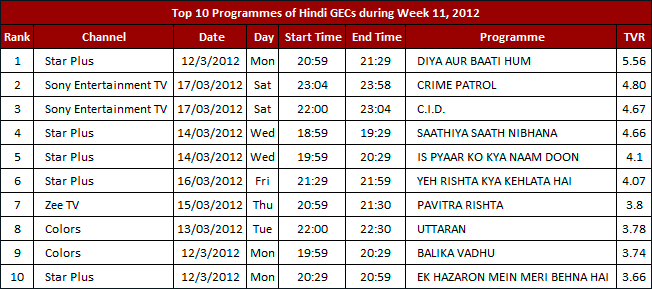
  • TAM data Top 10 programmes on HGEC – Wk 11 ’12


    Source: TAM Peoplemeter System
    TG: CS 4+ yrs
    Market: Hindi Speaking Market
    Period: Wk 11: Mar 11 to 17, 2012


    About TAM Media Research


    TAM is a joint venture between Nielsen Company & Kantar Media Research. Besides measuring TV Viewership, TAM also monitors Advertising Expenditure of Television, Print & Radio through its division AdEx India. Since 2004, it extended its presence in the PR Measurement & Analysis space for Corporate/Marketing Clients by setting up a separate division Eikona PR Measurement.


    In 2007, the joint venture introduced RAM (Radio Audio Measurement) service to track Radio Listenership for the Indian Radio Broadcast Industry. In year 2009, TAM launched a division, called TAM Sports that specializes in monitoring Sports Sponsorship ROI.


    TAM Media Research’s objective is to fuel media insights that will drive the growth of the Indian Media Industry.

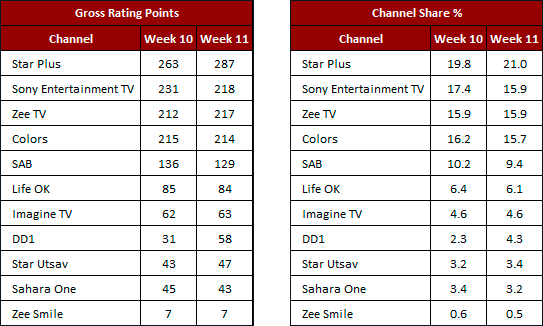
  • TAM Data (GRPs Channel shares of HGECs)- Wk 11 ’12


    Source: TAM Peoplemeter System
    TG: CS 4+ yrs
    Market: HSM
    Period: Wk 10: Mar 4 to Mar 10, 2012
    Period: Wk 11: Mar 11 to Mar 17, 2012


    About TAM Media Research


    TAM is a joint venture between Nielsen Company & Kantar Media Research. Besides measuring TV Viewership, TAM also monitors Advertising Expenditure of Television, Print & Radio through its division AdEx India. Since 2004, it extended its presence in the PR Measurement & Analysis space for Corporate/Marketing Clients by setting up a separate division Eikona PR Measurement.


    In 2007, the joint venture introduced RAM (Radio Audio Measurement) service to track Radio Listenership for the Indian Radio Broadcast Industry. In year 2009, TAM launched a division, called TAM Sports that specializes in monitoring Sports Sponsorship ROI.


    TAM Media Research’s objective is to fuel media insights that will drive the growth of the Indian Media Industry.

  • The Anchor: 4 reasons why radio needs content innovation

    By Amitabh Srivastava


    #1 Emerging Technologies:

    Keeping in view the emerging technologies, it is very important that everything is taken into consideration; for instance social media can be of great help in terms of getting more interactive with listeners.


    #2 To Engage Listeners:

    These days the maximum listenership is through moving vehicles, so if there is some innovation catering to those audiences, then it would be a very good option.


    #3 Rise of Internet Radio:

    Internet radio is fast growing all over the world, and India is no exception. Internet radio will be emerging as the big thing very shortly.


    #4 Two-Way Communication:

    This is most important because the moment you get interactive there will be an increase in participation from the listeners also.


    Amitabh Srivastava is the Country Manager – South Asia, Radio Netherlands Worldwide.


  • UTV Indiagames launches cricket games on iPhone, iPad

    By A Correspondent


    Gaming company UTV Indiagames has announced the launch of ‘WorldCup Cricket Fever’ for the iOS platform. WorldCup Cricket Fever is the first ever game to have special responsive and intuitive touch controls which provide a cricketing experience with ‘as good as real’ shots on the iPhone &iPad.


    With vibrant graphics, outstanding visuals and ultra-realistic animation, the game offers a cinematic experience with TV broadcast style-cameras.


    Speaking on the launch of WorldCup Cricket Fever, Vishal Gondal, CEO, UTV Indiagames said, “UTV Indiagames has always churned out the best of cricket games in the country. WorldCup Cricket Fever is the first ever cricket game developed with motion capture animation. This technology will give the user a ‘real’ experience of the sport with a wide variety in batting and bowling options. This cricket season, with a host of cricket games available, this game will surely stand out in terms of gameplay, graphics, precision and sound.”


    There are three game modes to choose from – Quick Match, Power Play and World Cup Championship. The game includes 14 teams, 6 stadiums (with day/night option) and three difficulty modes – which can all be customized.


    WorldCup Cricket Fever will soon be available on the Android, Windows and Java platforms as well.


  • Varun Kohli joins Mogae Media as Chief Monetisation Officer

    By A Correspondent


    Varun Kohli has joined Mogae Media as Chief Monetisation Officer, reporting to Sandeep Goyal, Chairman, Mogae Media. In his new role, Mr Kohli will be responsible for overseeing the sales of mobile, DTH (direct to home) and other inventory.


    “This is a great time for mobile marketing, especially in a country such as India. Mobile, as a medium, offers unique experience and lot of opportunities for advertisers. I am really excited and elated to be a part of Mogae Media, where I would be able to grow this media,” Mr Kohli said.


    Prior to this, Mr Kohli was with the India Today group as Associate Publisher for Mail Today for a year and a half.  He brings experience of over 18 years to Mogae. He had begun his career in 1993 with Indian Express and has worked significantly in the print industry with brands such as Amar Ujala, Deccan Chronicle, Hindustan and DainikBhaskar. Kohli is a management graduate from SIMS, Ghaziabad.


  • The road ahead for Excluzen.com

    By Shubhangi Mehta


    The e-commerce boom has attracted a new player, Excluzen.com, a Delhi-based company offering luxury brands on the web. Launched in Jan 2012, the company aims to offer exclusive, tailor-made and personalized experiences to its members.


    The current size of the e-commerce industry is $11.2 billion with 8-10 million transactions a year. A lot of international luxury brands are providing their products and services in India through e-commerce channel. In November 2011 itself, 27.2 million online users in the age group of 15 and above accessed retail category from home. The fact that nearly 3 out of 5 internet users shop online speaks volumes about the impact and growth prospects of this industry.


    Excluzen not only provides premium brands but also lays emphasis on experiences that no other e-commerce portal offers, such as personalized charters, yachts, or group and individual coaching with pro golfers around the world. Also, some of the offers which are solely made for Excluzen members are not available under the respective brands.


    Urvashi Bahuguna Sahay, CEO & founder, Excluzen.com, said, “We don’t believe in the word ‘competition’. Excluzen is not a regular discounted portal. Even though online, it can customize and personalize services, right down to individual customers needs. The key target audience for us is HNIS, Corporate, SMEs, NRIs and Expats. Excluzen provides exquisite experiences for the customers.our major focus area is to position Excluzen as the finest brand and lifestyle experiences on the web. We have roped in Perfect Relations for our media relations and India Bulls for Digital ”


    The marketing and ad spend for the company is 30-35 per cent of its investment cost. They are also looking at magazine advertising. Excluzen has been doing below-the line activities like running a contest on its Facebook page. Online advertising is geared towards a user base outside India. They are targeting 50,000 transactions by end of next fiscal. The company is not following any advertising model but function on profit sharing with their partners where they charge 10-20 per cent of the product value as commission. They also have an ‘exclusive’ offering every month where a select partner can promote a limited edition product at a premium price and for this service, they charge higher margins.


  • Rockstar triumphs at FICCI Frames Excellence Awards

    By A Correspondent


    The 13th edition of the FICCI Frames 2012 culminated with the FICCI Frames Excellence Awards 2012 at Hotel Renaissance, Mumbai recently. Celebrating excellence in the verticals of Film, Television and Radio, the FICCI Frames Excellence Awards was hosted by Mandira Bedi and featured stunning performances by the talented Usha Uthup and rock sensation Papon.


    Rockstar won a total of 4 awards making it the most prolific winner of the evening. Imtiaz Ali won Best Director for the film while Ranbir Kapoor bagged the Best Actor Award. A R Rahman was felicitated with the Best Music Director Award and Mohit Chauhan with Best Singer – Male for the same film.


    Farhan Akhtar and Ritesh Sidhwani walked away with the award for Best Film for the path-breaking movie Zindagi Na Milegi Dobara. Vidya Balan received the Best Actor – Female award for The Dirty Picture and newbie Parineeti Chopra got the Best Debut – Female for her comedic role in Ladies VS Ricky Behl. The Award for Best Debut – Male went to Vidyut Jamwal for Force and Abhinay Deo was adjudged Best Debut Director for the highly acclaimed Delhi Belly. Usha Uthup and Rekha Bhardwaj received the award for Best Singer Female for the film 7 Khoon Maaf. Prashant Panday of Radio Mirchi took home the award for Best Radio Channel while Big FM received the award for Largest Radio Network.


    Amitabh Bachchan was honoured with the Award for Maximum Impact made by a Personality while Sony received the award for Maximum Impact created by a Television Channel.


    Earlier, the convention was witness to the FICCI-BAF Awards on the second day of the event. While Redchillies.vfx won the Special Jury Award (VFX Shot of the Year) for Ra-One, Red Digital bagged the Special Jury Award (Open Category) for Lufthansa Park & Fly.


    FICCI FEAMES 2012 DAY ONE
    Digital attracts ‘desirable’ status on opening day
    Text of Star India CEO Uday Shankar’s Keynote
    Discovery to launch kids’ channel in India
    Financing, a cause for concern in media and entertainment
    IBF, ISA and AAAI announce launch of BARC, finally
    Inaugural session weighs pros & cons of digitization
    Entertainment has become a revolution
    TV influences life: IBF study


    FICCI FEAMES 2012 DAY TWO
    Price control equals creative shackles for broadcast: Hernan Lopez, Fox Intnl Channels
    No alternative to the cloud: Manish Agarwal
    Time to experiment with technology
    ‘Console gaming in India is in big trouble’
    Phase III will bring more innovation in radio
    Niche isn’t niche any more
    Dedicated tee time as Ten Golf is launched


    FICCI FEAMES 2012 DAY THREE
    How relevant is newspaper content to the reader?
    Integrated media best way fwd: Vikram Sakhuja
    Digitisation will allow broadcaster to make money off ground: Tarun Katial
    No disadvantage of being a woman
    CCI is an overall market regulator: Ashok Chawla
    Adapt to the digital tide or be left out
    Digital will decide the fate of TV
    Turning 3 into 10, a percentage issue for digital


    FICCI FEAMES 2012 wrap-ups and takeaways
    Counting on digital to be M&E’s trailblazer
    Day 1: Digital attracts ‘desirable’ status on Day 1
    Day 2: Seamless blending with traditional mediums – a big want!
    Day 3: Industry expects thoughts to lead to pertinent actions
    Takeaways: Digitization rules the roost @FICCI Frames 2012