Blog

  • A million Likes on 9XM Facebook page

    By A Correspondent


    Bollywood music channel 9XM has crossed the 1 million fans milestone on the channel’s Facebook community – www.facebook.com/9xm.in. The winning combination of super-hit Bollywood music, humour, animation, e-commerce and innovative content has catapulted 9XM to the 1 million fans club on Facebook.


    The colossal fan base on 9XM’s Facebook Community was achieved in just over a year’s time, by making it the one-stop destination for Bollywood news, humor and gossip presented in the true 9XM style. From the latest movie reviews to hot gossips on film stars and their parties to Bollywood fashion – it’s all there on the 9XM Facebook Community. The fans regularly voice their opinions, likes and dislikes on all the happenings in Bollywood, making the page the most preferred Bollywood hangout.


    Commenting on the achievement, Ms. Vibha Gosher VP-Digital 9X Media Group said “We are extremely thrilled to get over a million thumps ups from Bollywood Music Fans on 9XM’s Community on Facebook. Besides the 1 Million Fans that we have on the page, 9XM is showing unprecedented buzz amongst users. While all the Indian music channels on Facebook see 2-3% average level of buzz, 9XM sees more than 9%. When we talk about the engagement and user’s interest in the brand, 9XM towers above the others in the genre. The content on the 9XM community is 16% ‘Share-able’, whereas the top performing brands on this space have merely 10-13% viability. It produces minimum 1 mention every 22 minutes about the brand on the internet ecosystem. This is extremely motivating and reaffirms our commitment to connect and engage with our viewers and fans across all possible platforms.”


    9XM, the flagship channel of 9X Media Pvt. Ltd has a robust digital presence in India and has introduced many innovative concepts on the internet. 9XM is India’s first Music Channel to stream its content live on its website – www.9xm.in – and is available across various mobile TV platforms.


    In the recent past, 9XM in partnership with Hungama.com, has launched an online Bollywood Music Store – ‘9XM.Hungama.com’ and 9XM Radio – the on-the-move radio for Bollywood Songs, Celebrity interviews, Bade& Chote’s Bakwaas, etc. These services are available on web, WAP and IVR platforms.


    9XM also offers Caller Tunes, giving the viewers an instant opportunity to set caller tunes of the latest Bollywood songs aired on the channel. 9XM has launched ‘Mezza 9X’ the Ecommerce portal by the network selling quirky merchandise.


    9XM has also launched many games and applications for the iPad and iPhone users. Fans of 9XM’s animated characters can select and download their favourite games like the Angry 9XM Heroes, Silly Chicken and Talking Silly Chicken (India’s first talking application) from the IOS App store.


  • Rise of internet radio: What do traditional FM players think?

    By Robin Thomas


    The internet today has become the fastest growing medium in the country, and mobile has more or less become a necessity. So influential is the internet and mobile today that every medium is harping onto the digital bandwagon. The rise of internet and mobile has compelled even FM radio to spread their wings online. Radio Maska which plays 24×7 Hindi music claims to be India’s first Bollywood internet radio station, catering to Indian and NRI listeners.


    Besides, Timbre Media, a multi platform and multi genre radio company will soon be launching an internet radio station; VentureNet Partners, a Bengaluru based internet radio company will also launch Radiowalla, a premium model internet audio service that promises a variety of special interest internet radio channels. Realizing the potential of internet, even traditional FM radio stations have extended their reach online. Radio Mirchi for instance launched two internet radio stations- Meethi Mirchi, (plays contemporary melodies) and Purani Jeans (plays Hindi retro). Nearly 3.5 years ago, Radio City launched its music portal, PlanetRadiocity.com and only recently the music portal announced the launch of its new web radio genre, IndiPop Radio.


    Rachna Kanwar

    Rachna Kanwar – VP and Business Head, Digital Media and New Business, Radio City was of the view that the rise in internet radio stations is a reflection of people’s media consumption and the rising internet penetration in India and around the world. “More and more people are consuming music on the internet and therefore it is but natural that the potential has been tapped by players. While music has always been available illegally, today the whole process is getting legalized. Even music companies are realizing the potential of the digital platform and its demand and looking at the platform differently. This is the future of consumption and serious players realize they cannot ignore the phenomenon.”


    Prashant Panday

    For those complaining about lack of differentiation in FM radio, internet radio may have come as a huge relief as it promises variety in both music and non-music content. However, once FM phase III is rolled out, FM stations hope to witness more innovations along with differentiation in content. So, is there a scope for the two to co-exist or do traditional radio stations need to press the panic button? According to Prashant Panday, CEO Radio Mirchi, “No one needs to be worried about anything if they can adjust to the new realities. If an FM broadcaster prefers to remain only an FM broadcaster, it will be in trouble. But if it can seamlessly migrate to the internet platform, it will be able to maximize the combination of the two formats. So no….there is no need to worry.”


    Rabe T Iyer

    Rabe T Iyer, Business Head, BIG FM was of the opinion that online radio stations traditional FM stations need not worry about online radio and although there are limitations, online radio is an extension of traditional radio stations.


    Internationally, online radio stations augment terrestrial radio listening rather than substitute it. It’s augmented by users logging in from work and homes via the net and accessing their favourite stations. Yes, Online music with its niche music genre will fill the gap which traditional radio is unable to experiment with due to commercial consideration however traditional FM stations will not worry about growth of online radio.”


    In an earlier interaction with MxMIndia, M Sebastian, Co- founder and CEO, Timbre Media had said, “There is sufficient space for everyone to co-exist and grow. Rather than worrying, we need to identify areas of partnerships that lead to mutual benefit and faster growth and work towards realizing the full potential of the audio medium.”


    The listeners of internet radio stations are said to be those that are dissatisfied with the traditional FM radio stations however the market for internet radio is still small and currently caters to only specific or niche audience. Ashish Pherwani, Associate Director, Advisory Services, Ernst & Young believes that terrestrial FM radio stations will not have to worry about their internet radio counterparts at least for the next five years. He is also of the view that as a business there are many similarities as both internet radio and traditional FM radio stations are in the business of disseminating music.


    Speaking about the advantages and disadvantages of the internet radio and traditional radio stations, Mr Pherwani said, “As far as listening to radio is concerned, FM radio stations is absolutely free and this is where traditional radio has an upper hand over the internet radio. The disadvantage however is the fact that FM radio licenses are very expensive as a result many companies undergoing loses.”


    Unlike the traditional radio stations which do not charge listeners for listening to radio and is mainly advertising led, the business model of most internet radio stations are either subscription or advertising led or both depending on their radio channels. Like their traditional radio counterparts, internet radio stations too have to pay music royalty costs i.e. a minimum royalty and revenue sharing model. When asked to share his views on internet radio and the benefits it may have on the music companies, Rakesh Nigam, CEO, IPRS (The Indian Performing Right Society Limited) said, “Digital music in India is only picking up, with 3G and 4G services entering the market, internet radio stations will only grow. As a result the sale of music CD’s will only further decline as they will be heard online rather than be purchased. Thus there is potential for internet radio and as a result it will be a win-win situation for all including the music companies.”


    Although internet radio has been around for a while, it is still at a nascent stage in India and perhaps for many it is still a new format of radio station hence it needs to first spread awareness about its existence and features. Traditional FM players on the other hand have established themselves in the market and realizing the potential of the internet some of them have already taken their station online. Most of these FM players therefore find no reason to worry about the rising number of internet radio stations. They are of the opinion that differentiation and innovation in FM radio will further increase with phase III rollout and besides it will further increase the reach of traditional FM radio which the internet radio stations may find hard to match, at least initially.


  • Cheil Worldwide partners with a K-pop star for Cannes Lions 2012

    By A Correspondent


    Cheil Worldwide Inc. has teamed up with one of the K-pop (Korean pop) stars to speak at a seminar at the Cannes Lions International Festival of Creativity. Cheil will speak about “Korean wave through digital wave”; how K-pop is taking over the world through digital and social media; and what does it mean for advertising. The topic comes from the K-pop phenomenon being at the forefront of Korean wave, the global spread of the Korean culture.


    It is nothing new that K-pop is increasingly popular in many parts of the world. But it’s neither attributed to huge marketing spend nor to the interest in Korean culture. The single most decisive factor is the digital environment, which enables K-pop fans to circulate their favorite contents trans-culturally.


    SJ Kimm, Regional President of Cheil Worldwide Southeast Asia, will address how K-pop presents a new potential for global contents marketing. “K-pop has already established itself as one of the most sought-after marketing properties in Asia. The implication for the rest of the world is that it will provide marketers with a unique and differentiated marketing platform”, said Kimm.


    The seminar will also feature 2NE1, a four-member group, who will tell their own story about how they have emerged on the global stage with the help of digital media.


    This is the fifth year in a row that Cheil speaks at the Cannes Lions.


    Cheil Worldwide Inc, is Korea’s largest and one of the world’s leading advertising groups. Established in 1973 with headquarters in Seoul, South Korea, Cheil operates 49 offices in 27 countries with about 3,000 employees. Cheil offers a full portfolio of marketing communications services including advertising, PR, sports marketing, exhibition and display production, and production of large-scale performance events.


  • Pogo achieves highest GRP in kids genre

    By A Correspondent


    After holding the number 1 title in kids’ genre over the past 6 months (*Source: Tam, All India, Kids 4-14, Weekly GRP), Pogo has achieved the highest GRP of 174 in almost the last 6 years in the kids’ genre (Cartoon Network earned 181 GRP’s in week 21 of 2006).


    Also, the premier of the movie Chhota Bheem: Dholakpur to Kathmandu delivered a TVR of 2.4, the highest of any movie or show in 2012. This combination of GRP and TVR has led to POGO dominating the viewership pie with 25.6per cent relative share.


    Monica Tata, General Manager, Entertainment Networks, South Asia, Turner International India Pvt. Ltd. said: “We are elated with Pogo’s increasingly better performance, and the irrefutable contribution of Chhota Bheem in making the channel reach such a milestone. The response received from our viewers is nothing but an encouragement to continue to provide quality and engaging content so as to surpass these accomplishments.”


    Pogo, a multi-genre channel created exclusively for kids in India, was launched successfully by Turner on January 1, 2004 and is distributed by Media Pro Enterprise India Pvt. Ltd. POGO is available in over 24 million cable & satellite homes.


  • Border War Face Off gets one million downloads on Nokia

    By A Correspondent


    Border War Face-off, an arcade game made on patriotic lines by Jump Games (a part of Reliance Entertainment Digital and a leading developer and distributor of mobile games) was released in October 2011 across all leading operators like Vodafone, Docomo, Reliance, Idea, and others.


    The game is to save Mother India from enemies’ invasion by playing a courageous soldier defending our borders from an enemy invasion. This game is Jump’s own IP and is extremely popular among the youth gamers. The figures have been good from the very beginning but in mid-February Jump decided to ad wrap this game and put it up on Nokia OVS stores and by mid-March the game had over one million downloads.


    Since then Jump’s social website pages have been flooded with user requests to add innovations to the game. After the over whelming success of Border War Face Off and persistent user request Jump has now come up with the sequel called Border War-LOC.


    Border War Line of Control is the modern day rendition of an arcade classic. The gamer, as an Indian soldier, will have to protect the Indian borders with a new age weapon, Super Cannon.


    The various features of the game are:

    • A classic arcade game with very vivid and crystal clear graphics
    • A huge diversity in the type of enemies
    • Easy to use controls


    Speaking about this particular launch of the game, Chaitanya Prabhu, Business Head India, Jump Games said: “The game ideation started around august last year. We wanted to create games which are suitable for Indian audience and tap the Indian mentality, sensitivity and lifestyle. The game Border war, as the name suggests is based on patriotic lines with some great visual graphics. Jump has always believed in the motto of Think Global – Play Local. Now seeing the over whelming response of Border War -Face Off we have made a sequel to the same called Border War -LOC. It has a very engaging game play and we are expecting a similar or better response for the same.”


    The game, priced at Rs 50, will be available on all leading operators like Vodafone, BSNL, Idea, Docomo.


    Jump Games is a leading International developer and publisher of mobile games, apps and content. It is an integral part of Reliance Entertainment (Digital Business). Jump’s foray and expertise lies into the media and entertainment space.


    Jump’s experience and expertise in creating innovative and cutting-edge gaming content reflects in its client roster, which sports some of the best brands from across the world – Codemasters, GLU, Playboy Hands On / Connect 2 Media, Honest Entertainment (Fido Dido), Coca-Cola, Cartoon Network, and Konami to name a few.


    The company develops content across leading wireless platforms and its catalogue includes leading titles like Ben 10: Battle of the Omnitrix, Bloons, Putt-Putt Golf 3D, ICC World Cup, Ashes Cricket.


    Distributed across the US, Europe, South Africa, Australia, the Middle East, and Asia, Jump’s content can be accessed through 80 leading networks across 40 countries as well as global AppStores.

  • Brand India saving grace in time of crisis

    By Namrata Singh & Reeba Zachariah


    There’s more to India than just its over-emphasized status of being the most populous democracy in the world. Random economic facts like India being the largest producer of milk, the largest consumer of sugar and spices as also the largest consumer of gold till last year, crop up now and then.


    But there have been achievements in the last few years which have put India on the world map. Over the last couple of years, India has been seen stamping its presence in the league of global leaders by the strength of its economic power.


    Consider these facts: The Tata Group is the largest manufacturing employer in the UK; Ireland’s richest person — Pallonji Mistry — is an Indian ; Coal India is the single largest coal producer in the world; India is the largest whisky manufacturer in the world and the Taj Group is the largest chain of hotels in Asia.


    Despite a generous trickle of negative news, the list of these positives is also getting bigger.


    Brand India today is not just about economics. A significant way in which

    India is asserting itself is through its soft power.


    According to Bhaskar Chakravorti, senior associate dean of international business & finance, The Fletcher School, Tufts University, this “soft” presence is India’s greatest asset in making sure it counts on the world stage.


    Household brand names such as Citigroup, Pepsi and Motorola are associated with an Indian CEO. Clearly, India has moved on from being a nation of snake charmers and appears to be on its way to become an economic power.


    Soft power aside, it’s also working its way through innovations. The list includes , Nano, the cheapest car in the world from Tata Motors; Aakash, the cheapest tablet PC in the world, priced at $46; and other cheap tablet PC initiatives by private companies.


    However, there are some missing pieces too. “India should surely move forward in the area of innovation where we can capture the value from our intelligent cheap resources from being just a provider of cheap labour. As of today, most companies (Apple, Microsoft, Google, Intel, etc), especially in IT, that generate maximum value from innovation, rely on resources from India and we are clearly not getting the deserved share of the value created,” said Thomas Kuruvilla, MD, Arthur D Little, a consulting firm.


    Richard Rekhy, head of advisory practice at KPMG, a global consulting firm, however, believes India has some way to go. “But India, with 100 companies of over a billion dollar market cap, has established its position globally which is why GE set up its first R&D centre outside US in Bangalore. At the same time, Indian banks have only 2 per cent bad loans versus 20 per cent in China,” he said.


    In the mid-90 s, on a representation made by Indian exporters, the government had removed the mandatory use of the ‘Made in India’ tag from goods exported. The law still exists on paper. Ostensibly, Indian exporters were embarrassed of using it then. But, today, no one is shying away from using the tag.


    Source: The Economic Times
    Copyright © 2012, Bennett, Coleman & Co. Ltd. All Rights Reserved


  • [MJR] The night of January 16 strikes again!

    By Ranjona Banerji


    It seems to be a strange rule these days that no matter what happens, the Indian army has to upstage it in the news stakes. The Indian Express, with its story about army deployments towards New Delhi which “spooked’ the Government of India stole the focus away from the US’s $10 million bounty on Pakistan’s Hafiz Saeed.


    The newspaper has truly put the cat among the pigeons with its dramatically written story which implies that even if there wasn’t a coup attempt by the army, the government was definitely shaken.


    The timing of the movements of these two divisions, one airborne, towards the capital was also seen as suspect – January 16, the day the army chief filed his case in the Supreme Court over his age issue. According to the Express report, standard operating procedures about troop movements had not been followed.


    TV debates obviously went ballistic. But for all the bombast, the participants were skewed in favour of the army with lots of moustachioed gents pointed out how such a thing could never happen. Other participants – usually journalists – said that the Express story was not a surprise and that a website had come out with the facts in January itself. I did not manage to see Shekhar Gupta, editor of Indian Express on TV, but he was quoted by one of the channels as saying that once they got the story they could not suppress it from the people.


    This is from the Express website: “The Indian Express’ report ‘The January night Raisina Hill was spooked: Two key Army units moved towards Delhi without notifying Govt’ has, as expected, prompted widespread reaction.


    “The report is a meticulous reconstruction and a very sober interpretation of the movement of two key Army units towards New Delhi on the night of January 16-17. Investigated over six weeks and written by Editor-in-Chief Shekhar Gupta; Chief of Investigative Bureau Ritu Sarin and Deputy Editor and Chief of the National Bureau Pranab Dhal Samanta (with help from Assistant Editor in the Investigative Bureau Ajmer Singh), the report draws on highly credible sources.”


    “They have chosen to be anonymous and the newspaper is committed to protecting their identity. The Indian Express’ sent a detailed questionnaire to the Army and the Ministry of Defence and accurately reported their responses in the report. These responses were reiterated by them on Wednesday.” The note ends with: “And in the tradition of its commitment to journalism of courage and the readers’ right to know, it will continue its investigation into the events of January 16-17 and the questions these raise.”


    TV debates are often circumscribed by the need for bluster and “patriotism” of the sort that is worn on your sleeve is very common. Not a single panellist on Wednesday night could offer an explanation or even consider why a reputed newspaper would carry such a story without any proof. It is easy to understand that print journalists would be jealous of a scoop – though at a senior level you are expected to rise above that.


    It is also possible that “patriotism” even in the media means you have to draw a line somewhere about how much you can embarrass important institutions.


    I wonder. Jingoism which masquerades as love for your country is dangerous in any form. The job of the media is to ask uncomfortable questions. I find it very interesting that so many in the media are unable to ask the armed forces difficult questions.


    Members of governments and political parties are quizzed every night on TV. Why should anyone else be exempt?


    It seems apparent that there is a deep division between the army and the government. It is equally apparent that there are schisms within the army itself and different camps are batting for different generals. All this needs to be examined and exposed.


    There can be little doubt that the Indian Express has pushed a few boundaries and a few buttons here. TV is incapable of showing the depth to deal with this story. Let’s see how far print can take it.


  • Who’s better for brands – mascots or celebs?


    By Shubhangi Mehta


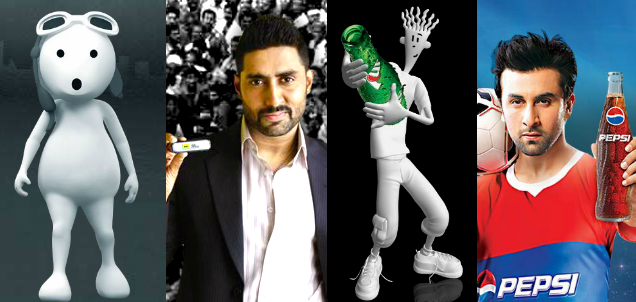
    Mascots can be regarded as the face of a brand. Be it the ‘Amul Girl’ who is a part of every household since 1967, ‘Chintamani’, 2005, the common man ‘RK Laxman’, 1954, ‘Maharaja’ 1946 or the latest ‘ZooZoo’. Mascots provide an identity to a brand which is equivalent to the brand itself.


    It was in the late ’90s when the advertising industry gained pace with more and more brands wanting to endorse themselves to reach out to the consumer is when the brands started associating with celebrities to create a mass appeal.  With Sachin Tendulkar, Amitabh Bachchan, Shahrukh Khan and every other celebrity promoting not one but half a dozen brands.


    So what does a consumer gets hooked to Sachin’s Pepsi commercial or Fido’s 7UP? Abhishek Bachchan for Idea or Zoozoos for Vodafone?


    Sameer Satpathy

    Says Sameer Satpathy, EVP & head, Marketing, Marico Ltd, “Choosing a celebrity or a mascot depends on your brand strategy. Both are a legitimate way to communicate your message.  The celebrity route has higher risk as you get both the positives & the negatives of your brand ambassador, but you can get results quicker as it only depends on the ability of your brand to leverage the equity of the celeb. The mascot needs to be built, invested into and in time can become a powerful and exclusive property. Also, certain categories lend themselves better to brand ambassadors like beauty brands and some categories to mascots for example brands targeted at children. For me the most memorable celebrity for a campaign would be Tiger Woods! J But for the wrong reasons.”


    Abhijit Avasthi

    According to Abhijit Avasthi, NCD, Ogilvy &Mather, “There is never a set rule whether a brand should go with a celebrity or a mascot. It mainly depends on the nature of the campaign. A well known celebrity face has its respective positives and so does a mascot. Though there is a great chance of a brand being lost in the clutter while using a celebrity. Mahendra Singh Dhoni is presently endorsing over 20-25 brands but when it comes to recalling a brand I can only think of 5-6 of those. Hence it is very important that the celebrity, if used, is used perfectly. For me the ‘Amul Girl’ and ‘Zoozoo’ are two of the most memorable mascots. When it comes to celebrities, I think Titan and Coke have used Amir Khan perfectly and so has Pepsi used Sachin.”


    It may be noted that a mascot is created by keeping in mind the brand whilst a celebrity being a mortal, may be a perfect choice to endorse a brand at a particular time but with time the image of the celebrity may change, which in return may or may not fit with the brand image.


    Ajay Kakar

    Says Ajay Kakar,CMO – Financial Services,Aditya Birla Group,, “It is true that a brand can ‘own’ a mascot. While a celebrity is an asset shared by many brands. But I do believe that both these mnemonics or devices are not necessarily interchangeable. Both of them have a unique role that they can play in the life of a brand. Now it depends on the specific brand, as to what is the desired role.


    “A celebrity can definitely create a more immediate pull for a brand, because the celebrity is already well known and has a fan following. On the other hand, a mascot may take time to ‘grow’ on its target audience. Similarly, a celebrity can help create a more emotional or personal connect, due to the ‘human’ factor. So, it is a question of horses for courses.


    “The Amul girl is a ‘mascot’ that immediately comes to mind. It has withstood the test of time, across ‘generations’. “As far as a celebrity-brand partnership is concerned, regrettably, today’s celebrities tend to take-on one too many brand associations, so it is difficult to associate them with any single brand. The two exceptions that do come to mind are Abhishek Bachchan and idea. And Yuvraj Singh and Birla Sun Life Insurance.”

    The fact also remains that a celebrity can give instant boost to a brand whereas a mascot needs time investment before it becomes a household name. At times a mascot may not click with the audience but the ‘non-click’ risk remains minimal in the case of a celebrity.


  • Rohit Samarth joins DDB MudraMax as Senior VP, Terra

    By A Correspondent


    Rohit Samarth has joined DDB MudraMax as Senior Vice President. He will head the operations of Terra, its rural marketing agency.


    Mr Samarth comes from Percept Out of Home, where he was the business head of its rural vertical responsible for all its communication and marketing strategies. With more than 25 years of experience in the industry, Mr Samarth has had the opportunity to work with some of the largest and the most recognized brands in the country.


    He started his career with Nestle India, and later worked with various other companies like Media Workshop India, Amar Ujala Prakashan, India Infrastructure Publishing, UCP Integrated Marketing Solutions, and Federation of Indian Chambers of Commerce and Industry (FICCI) and Linterland.


    Commenting on this new appointment, Mandeep Malhotra, President, DDB MudraMax said, “I am excited for the positive change brought into the BOP offerings at DDB MudraMax. Apart from great knowledge and experience, Rohit brings with him passion and energy to take the existing momentum of the team and the work to a whole new level.”


    Commenting on joining DDB MudraMax, Mr Samarth said: “I have some very exciting plans in mind and the focus this year will be to make DDB MudraMax a serious contender for the top spot in the BoP space. Development of strong teams in all disciplines is another of my initial focus areas. I have no doubt that Terra will grow to be one of the most preferred and specialized rural communication solutions provider within the next two years.”


    The DDB Mudra Group, a part of the Omnicom Group, is India’s largest integrated marketing communications and services network. The group comprises eight agencies – DDB Mudra, DDB MudraMax, Mudra, DDB Health &Lifestyle, RAPP, Tribal DDB, Water and Maatra.


    The DDB Mudra Group utilizes its deep understanding of Indian consumers, brands and media and a customized and collaborative approach to deliver inventive business solutions that help clients build valuable and enduring brands in India.


    DDB Mudra Group operates out of its offices in 15 leading cities and is represented in more than twenty other locations, giving it a comprehensive presence across the length and breadth of the country. It has more than 1,100 employees and a reach across 1,75,000 villages, 4000 towns, 3500 schools and nearly 7 million students.

    In 2011, DDB Mudra Group was India’s most awarded agency network at Cannes, Spikes and Abbys among others.


  • Anil Thakraney: Needed: Campaign against drunk driving

    By Anil Thakraney


    Two recent tragedies in Mumbai involving drunk driving have again put the problem in the spotlight. Despite all the policing and the possibility of doing jail time, people continue to hit the wheel inebriated. And this happens in all urban areas. The Mumbai police has once again taken to the roads with a vengeance, but clearly that’s not the solution.


    The change, as it’s usually the case, must come from within. And this is where marketers and ad agencies can play an important role. I cannot understand why the industry hasn’t yet thought of a powerful communication plan against drunk driving. In fact, it is a booze company that should take it up, and seize the opportunity to build one of its brands. And in addition, project an image of being a socially aware organization.


    Isn’t that far better than indulging in those silly (and unethical) ‘Make it large’ sort of surrogate ads? Where daaru is sold disguised as soda, water and playing cards. So much wiser to do a good deed. And yes, one would like to do business with people who care for humanity, or at least people who are perceived to be good souls. Like the Johnnie Walker guys, who have been running the international ‘Drink Responsibly’ campaign with positive results. Here’s one commercial which features cricket legend Vivian Richards:


    But for India, we need much more compelling stuff, as we desis tend to be enormously apathetic people. We seriously lack civic sense. And if the marketers don’t come forward, I would urge the ad agencies to take proactive measures, and create solid campaigns against drunk driving. And if social responsibility doesn’t sound like a hot enough proposition, the chance of winning major ad awards should be music to the ears. Whatever works. Because I do believe here’s one public problem where the industry can play a role. It’s not something policing will be able to tackle.


    [vimeo width=”400″ height=”200″]http://vimeo.com/11741651[/vimeo]

    So go for it, people. It’s a great opportunity to make a real difference out there. Cheers!


    ***


    PS: Ms Arundhati Roy is at it again. She’s written yet another looong essay in Outlook mag on how greedy corporates, in connivance with politicians, police and the bureaucrats, are damaging the lives of tribals through illegal and immoral mining operations. Here’s a rejoinder to her diatribe, and it points out glaring factual errors and other blunders in Roy’s scathing arguments. That is why I have always believed this very fine writer must stick to penning fiction.


    Link: http://girishshahane.blogspot.in/2012/04/annotating-arundhati.html


  • The Anchor: Monica Tata on 6 reasons why running a kids’ channel is no child’s play

    By Monica Tata


    The kids’ genre is the largest genre in terms of viewership after mass genres like GEC contributing to 18.3 per cent of the viewership pie (Source: TAM Media Research | TG: CS 4-14 | Market: All India | Period: 2010 – Wk 3 of 2012).


    Although it caters to kids, being a successful player in this genre is no child’s play. It is a competitive market where players need to have the ability to constantly create content that is engaging and innovative. They need to be adept at technological evolution and have the foresight to adapt content over multiple and mobile platforms.


    #1 Single TV Households

    One of the biggest concerns of special interest channels like kids’ channels is the phenomenon known as ‘The tyranny of the single TV households’. In India, a majority of households have only 1 TV set which are controlled by parents during prime time hours. This is why GECs dominate the television viewership pie. Today, over 85% of kids also tune in to GEC channels. Thus the task becomes even more challenging to sustain and increase the viewership of kids’ channels. Kids’ channels’ need to constantly reinvent their content and packaging so that there are novelty factors to the channel that excite kids and at the same time, maintain familiarity so that kids don’t lose connect with the channel.


    #2 Target audiences

    It is the only genre which is fortunate to receive a new set of target audience every five years. Kids between the ages of 4-14 years being the core target audience, content and programming needs to be aligned with their entertainment requirements, perceptions, behavior, social and cultural ideologies, geo-demographics, etc. Kids also change their mind very easily basis what they or their friends think is ‘cool’ or not. Thus, it becomes imperative to stay ahead of times and ensure that content created for the target audience has the potential to be molded and refreshed from time to time.


    One such shift noticed in 2011 with regard to the viewership habits of kids is that they prefer to watch fewer shows on kids’ channels than before and have begun to spend more time per show. Thus, although the viewership for the number of shows has reduced, the overall category viewership remains mostly unchanged.


    Gatekeepers are another important factor to consider while trying to reach the core TG. *48% of parents always exercise control over what their kids watch. This means that if the parents are not happy with the content that is being aired on your channel, chances are that the kids won’t be allowed to watch it. Content on the channel should be considered safe by the parents for their kids. Another way to expand the viewership pie is by creating content that can be viewed by adults as well.


    #3 Content

    With consumers having a much wider choice of channels, ownership of quality content is increasingly being seen as a key differentiator for broadcasters. Once, Cartoon Network was the only kids’ channel airing international content, fast forward to today, and there is a plethora of kids’ channels airing classic international content (like Tom and Jerry), anime cartoons (like Hagemaru), local live action shows (like M.A.D) and the latest craze – Indian animated content (like Roll No. 21 and Chhota Bheem).


    Another way to garner success for content is to make it fun and engaging for gatekeepers as well as 66% of parents watch TV together with their kids. For instance, POGO has continued to hold the title as ‘The No. 1 Kids and Family Channel’ thanks to shows like Chhota Bheem and Mr. Bean that are among the top three rated kids shows by kids and adults. *(Cartoon Network New Generations 2011) Engaging and innovative content with storytelling and strong characters at the core is the focus for broadcasters of kids’ entertainment.


    #4 Animation

    Creating animated content is a time consuming and expensive process. Although we have taken it up as our prerogative to boost this industry via our ‘Desi Toons’ strategy, there are several challenges. Firstly, in order to truly make animation travel across borders, the storyline and characters need to have global appeal and resonate with kids irrespective of cultural and geographical borders. In this scenario, it becomes difficult to make mythology content travel which is what a majority of studios pitch to us. We have had some success in terms of shows like Kumbh Karan and movies like Arjun: Adventures of the Ice Lotus which have managed to do well in other regions of Asia Pacific because their plot is more contemporary.


    Another challenge is the outsourcing business models that animation studios have in place. This model makes it reasonable for large film production houses to outsource animation to India but for broadcasters it becomes quite expensive. Animation studios and broadcasters need to arrive at a happy settlement wherein there is a cost effective quality model.


    #5 Role of language/dubbing

    India is a vastly multicultural and multilingual region. This factor, initially, proved to be a challenge to expansion of viewership markets as content available on kids’ channels consisted of international shows available in English. Broadcasters began to realize the potential of dubbing content in local languages so that the channel could be consumed by the masses across India. Thus subsequently, kids’ channels were made available in Hindi, then Tamil and Telugu and now even in Marathi and Bengali.


    Content providers are taking this a step further by now transcreating scripts of international shows in local languages and not merely translating them. Shows based on humor are that much more hilarious if they capture the colloquialism and nuances of the language.


    #6 Beyond Television

    In today’s multi-screen playground, it’s not uncommon for kids to consume content on more than one platform. This represents huge opportunities for broadcasters to expand the presence of a brand or a character in the mobile and online space through smart phones, tablets and computers. Moreover, broadcasters and content houses are increasingly working towards building anytime anywhere access to content.


    The contribution of content to the digital success cannot be undermined here as well. It is important to leverage popular content on television to these online and mobile platforms in appropriate formats that are engaging, innovative and unique. For instance, Chhota Bheem’s popularity on-air has definitely contributed largely to the success of www.pogo.tv. ‘Chhota Bheem Balloon Blaster’ is one of the most popular games on pogo.tv which allows fans to connect with their hero through a game. The site has seen immense success with about 500,000 unique viewers per month. Apart from prime television when it comes to appeasing kids, merchandising is one of the most powerful tools to connect with them.


    Merchandising, today, has transformed into a global arena; providing an array of international and local brands to choose from. We are witnessing a healthy rise of various kinds of merchandising in every product category. Kids want to have their favourite characters with them (in the form of stationary, bags, lunch box, bottles, clothes, toys, etc.) wherever they go; be it school or outside or at home!


    For instance, Cartoon Network Enterprises (CNE), the licensing and merchandising division for Cartoon Network and Pogo, has reflected the growth of the industry by reaping profits and growing by almost 70 per cent in 2011 and has added 680 SKUs. CNE Products are now available in over 5300 retail counters across India. With the advent of 3G and the digitization deadline in sight, the prospects of growth in terms of market penetration and revenue accountability from subscription models in nothing but encouraging to invest the kids’ genre.


    In spite of these challenges, the performance of the kids’ genre in 2011 is an indication of the potential and growth of this market with the right mix. The genre not only recorded growth but also saw the entrance of new channels like Sonic and growth in regional languages as well with Marathi and Bengali feeds. In Tamil, for example, the share of Kids is higher than News. Many automobile, telecom, financial services and grocery products now target kids as well, which means this genre will continue to be attractive to advertisers in years to come. From that perspective, there is no looking back for the kids genre with infinite growth possibilities provided ‘Content remains King’.


    Monica Tata is General Manager, Entertainment Networks, South Asia, Turner International India Pvt Ltd.


     

  • Twitter goes ‘laplap” for Center Fruit

    By A Correspondent


    The last evening of the financial year saw the start of something unique in the media space: celebrities using Twitter to seed in a viral video of a TV show which was scheduled later the same evening. The unique thing about it was that it was not only to promote the show tune-in, but to actually create awareness of a branded content segment by Center Fruit in the Mirchi Music Awards.


    Perfetti Van Melle India is credited with introducing some catch phrases through their advertising which have gone on to become common lingo amongst the Indian youth. After Center Fresh’s Zubaan Pe Lagaam and Mentos’ Dimaag ki Batti Jala De, this time Indian audiences were witness to something unique for Center Fruit on Mirchi Music Awards which was aired on Colors on Sat-Sun.


    Starting early evening before the show was supposed to premier on Colors prime time, a video was seeded through Twitter medium. It was not just a plain seeding. The campaign took the help of celebrities to seed in the video as a teaser. The video had the host of the award show Shaan being interviewed just before he was about to take the stage. In the middle of the interview, the journalist holds up the jar of Center Fruit, and off goes Shaan with his tongue-wagging act. This was similar to what happens in the brand commercial where a singer competing with a tabla player wins the battle when Center Fruit makes the singer go non-stop laplap with his jeebh (tongue).


    This was probably the first time a FMCG brand used the Celebrity tweet route to create a teaser online for amplifying a TV show scheduled later in the day. Commenting on the initiative, Sudarshan Saha, Client Leader, Maxus says that the idea came to his team when they saw top trending topics in the evenings in India recently tended to pick up what was being shown on Television. The agency team decided to turn the tables around, and used Twitter to seed in a tease before the show went on air, in this case. Sample this: Sophie Choudhrytweets – Does Darrling Luscious Lopez make your #Jeebhlaplap? or Poonam Pandey tweets -Shaan’s exclusive #jeebhlaplap backstage footage from MMA. Eesha Koppikar tweets -Enjoyed Shaan’s laplap secret. Watch Colors to see what makes Usha Uthup’s #jeebhlaplap.


    Perfetti Marketing Director Nikhil Sharma feels that the quality of innovation executed for Center Fruit pushes the benchmark further on how to use multiple mediums, especially Digital along with TV for FMCG brands. He leads marketing mandate for an array of impulse purchase brands in Perfetti, and treats Maxus as a long term partner to drive the growth agenda for his brands.