Blog

  • Divya Bhaskar’s Green Chronicles

    By A Correspondent


    Dainik Bhaskar Group’s Gujarati newspaper Divya Bhaskar has released a coffee table book – Green Chronicles – on the green initiatives adopted by corporates in Gujarat.


    Unlike what many people think that the power to curb pollution, to save precious resources, lies in the hands of experts, the real power lies in the hands of organizations which have the power to design and promote cleaner products and technologies and help society evolve to more sustainable lifestyles.


    Green Chronicles is an attempt to acknowledge the green efforts of the organisations in Gujarat. It brings alive some of the success stories of green technology and process aimed at better environment. It showcases 14 companies in Gujarat which have focused on eco-friendly sustainable development. The book talks about case studies such as AdaniPortsand Special Economic Zone, Gujarat Ambuja Exports, Naroda Enviro Projects Ltd, Gujarat State Electricity Corporation, ONCG Petro Additions Limited.


    Mr Saras Sethi, COO – Dainik Bhaskar Group, Gujarat , believes: “Green is the voluntary pursuit of any activity that encompasses concern for energy efficiency, environment management, water management, waste management and recycling. Green practices ultimately leads to sustainable development and equitable growth”.


    He commented on the release of the book: “This coffee table book is an attempt to highlight the environment-friendly approach adopted by the organizations in Gujarat, and thus, encouraging more people to understand the importance of keeping our nation green.”


    The book is circulated among the advertisers and business fraternity of Gujarat. It is one step ahead in celebrating and acknowledging the efforts of green organizations in Gujarat. Environmental responsibility is no longer just about donating money and services to needy groups. Business process, product development, and partnerships can all be perceived for better, more responsible alternatives. And if the responsible choice saves money in the long run, adds value to the product, and creates a positive culture, then it is definitely a good thing.


    The Dainik Bhaskar Group has a strong presence in newspapers, radio, event marketing, printing, short code, Digital, services andMobileapplication. Its flagship Hindi daily newspapers are Dainik Bhaskar, Divya Bhaskar, Divya Marathi and DNA. It covers 13 States with 64 editions reaching across 19 million readers every day.


    Additionally, it publishes 3 other newspaper – Business Bhaskar, DB Gold, DB Star. In magazine sphere it publishes Aha! Zindagi, Bal Bhaskar for young readers and Lakshay. The other media businesses includes MY FM ; FM Radio station network across 17 cities and IMCL (Digital services).


  • Debrief: Havells Fans: Masterstroke!

    By Anil Thakraney


    Very smart of Havells to rope in veteran actor Rajesh Khanna for their new ad for fans. And the treatment is cool too. I am usually not a fan of celebrity advertising, but this particular one simply rocks.


    The ad features Khanna boasting that the winds of change may blow, but that no one can take his fans away from him. A bit of an obvious pun on fans, but in this case it works. There are classical images of the star from his hey days as also from the present time. He even takes a thinly disguised dig at Bachchan, who dethroned the superstar in the seventies.


    Here’s why this ad works for me: For one, getting Khanna back from his long exile is serious lateral thinking. It makes the TVC surprising, noticeable and clutter breaking.


    The media has taken it up for coverage, and that’s a lot of free publicity for Havells. Imagine if they had used the done-to-death Big B. The ad would have passed by like Ogilvy’s ship in the dark. Also, the execution is pleasing. Khanna speaks with that famous drawl in the voice, a mixture of arrogance and self confidence. Something we identify with him. And his mannerisms are also the same. The laidback charm, the larger-than-life persona. Great stuff.


    In short, all that good advertising should be. As a bonus, the commercial makes you want to watch Khanna’s classics all over again.


    Rating: (On a scale of 1 to 5): 4. Surprising solution at its best.

  • Mediaah! Is our media free to report the truth?

    By Pradyuman Maheshwari


    It’s World Press Freedom Day today and I’m sure most journalists in India don’t even know that the day is celebrated as that. There will be a few speeches, an I&B ministry communiqué and a statement from the President or Prime Minister… at the time of writing even these haven’t come in.


    I guess in India the issue of press freedom isn’t as grave as it is in some countries. Though we’ve known even Chief Ministers and local leaders using brute force or the law on those who even attempt to be tongue-in-cheek in their cartoons, one wouldn’t say that democracy is under threat in the country.


    Earlier this week, the International Federation of Journalists (IFJ), an NGO that studies issues like press freedom, presented its annual report on press freedom in South Asia. Here’s the vital para on India: “India has, in its vastness, displayed diverse trends. There are parts of the country where journalism functions with few constraints and dangers apart from the constant pressure of commercialisation. In the conflict prone regions such as Kashmir, the North-Eastern states and the Maoist insurgency districts – where journalism that tells the full story could make a difference – tensions persist and dangers are ever present”.


    In an overall comment, the IFJ communiqué notes: “The shift towards contract and casual employment has led to a weakening of professional commitment and the growing influence of commercial and advertising departments in the functioning of media houses”.


    So, the report isn’t gloomy as I remember it was a few years back. However, there’s an uneasy calm. And with reason.


    Some months back, just after the Anna Hazare agitation, DNA’s editor-in-chief Aditya Sinha wrote in his column how his paper had lost government advertising thanks to its belligerent stand on the government in Anna’s fight against corruption.


    The malaise of using advertising revenues to stifle the media and ensure a positive media is widespread in the private sector. Nearly every other publisher will relate the story of how his or her publication lost vital revenues thanks to its editorial content.


    I have had ad managers do the same. Not yet at MxMIndia mercifully, but in the past and elsewhere, I do know how big and small business bullies the media.


    So with CNBC TV 18 and Bloomberg UTV part of the two Reliance groups and rumours of NDTV also having benefitted from some largesse (from a business house), there’s worry about how independent the biz channels will be. So far I don’t think there’s anything amiss, but you never know!


    On the Ambani investment in Network 18, the IFI report notes:  “Reasoned media debate on the matter has been suppressed by the enormous advertising clout that Reliance retains”. I don’t think that’s entire true. Save possibly Mint, Outlook magazine and independent voices like Moneylife and some bloggers, our media – mainstream or otherwise – seldom discusses the goings-on in other organizations.


    The pressures on the media come from various quarters. If you are in the business of conducting film awards, you can’t critique the stars as they may get upset and not attend your show. And that mind you is quite serious because the ratings and revenues can take a beating if there aren’t enough stars walking the red carpet. Ditto with municipal corporations, schools where the boss is seeking admission for his/her kid and the list could go on. There are just too many holy cows


    Often journalists must blame themselves for some of the pressures. We are too worried about upsetting sources and sensitivities. So, while at one level we may critique the world for its ills, we are worried about being on the wrong side of friends in high places. By doing so, journalists are devaluing themselves as the biggies they know will never really respect them for their true worth.


    It’s also vital for media owners to know that that by compromising on core journalistic values, they are only killing their own brand. One may argue that the publications that have been indulging in paid content publicly for over a decade are in fact prospering. Perhaps, yes, but that’s because the masses still don’t know what’s really up. However, the few who do will not forget it for a lifetime and will tend to discount the motives of every story that appears in the paper or channel.


    I don’t really know what’s the format of the Aamir Khan’s Satyamev Jayate. Perhaps he (and Star) must train their cameras on whether truth is actually allowed to prevail in the Indian media.


    Buzz/ping me if you have a story to tell. Confidentiality assured. There are various ways to do that: Mail: pradyumanm[at]mxmindia.com, BBM: 23050B5D, Gtalk: pradyumanm@gmail.com, Twitter: @pmahesh and the mobile: 98338 76278.


    Disclaimer: Although he is CEO and Editor-in-Chief of this site, Pradyuman Maheshwari’s views in Mediaah! are not necessarily those of the rest of the team and MxMIndia.com. And decidedly not those of the sales team 🙂


  • [MJR] A button to mute screeching panelists, please

    By Ranjona Banerji


    I make this plea on behalf of the ear drums of the nation. As the broadcasters’ association is worried about offensive content and the government is worried about sex, no one has the time to discuss our national loss of hearing. Even noise pollution activists, so worried about every tiny Diwali cracker, are silent on this one.


    Yet every night, guests on TV panel discussions yell at each other, sometimes all at the same time. This is not just confusing, but it is also painful. (And, it must be admitted, a bit embarrassing.)


    The answer I don’t think can be in teaching better manners to the panellists. We can’t now go back to their mummy-daddy and TV channels caught up in the non-stop cycle of breaking news barely have time activate their brains let alone start teaching etiquette.


    Instead, we need technology to come to our rescue. Instead of pleading with their guests to allow everyone to speak and not hog all the allotted time or politely trying to control a posse of middle-aged delinquents, TV anchors should just cut trouble-makers off. The worst offenders will be silenced mid-scream. To amuse viewers, their faces should still be on screen, so we can see them though not hear them screeching away. There is no guarantee that the screamers and yellers will ever learn and those who plead “give me 30 seconds more please” – how do they claim 30 seconds when they take many minutes? – will most likely start yelling “don’t cut me off”. But that doesn’t mean anyone has to listen to them. Anyway, you can barely hear what they’re saying.


    Also, our TV remotes could come with selective mute buttons so that we can filter out the sound from some sources while continuing to listen to others. This feature can be sold as a fun family game, as an alternative to birds killing pigs.


    And what about when the TV anchors annoy you? Now, that, dear viewer, is what the existing mute button is all about!


  • Press Freedom Day | ‘The free press can also lie’

    By Alain Gresh


    It was at the end of the 1980s, when Perestroika was in full swing. The Soviet Union was opening up towards pluralistic news coverage; discussions were raging in Moscow or in Leningrad. A delegation of Soviet journalists was invited to the US to study ‘freedom of the press’. They were brought around all the main media, travelled through various states and, at the end of the journey, received by journalists who asked them for their impressions. “It’s strange”, one of the Soviet delegation replied. “You don’t have a censor here, but still everyone thinks the same.”


    Apocryphal or not, this anecdote is revealing. It shows that the freedom of the media as well as of journalists is an issue, not just in the countries that officially limit press freedom, but also in democracies. In 2002-2003, when the US was preparing to go to war against Iraq, even such highly prestigious newspapers as the New York Times or the Washington Post uncritically published the lies of the Bush administration, thus acting as a carrier of propaganda – something which gave rise to self-criticism several months later.


    Already during the 1990-1991 war, many in the European and US media got caught up in the fabrications of the Allies’ propaganda: how Iraq had the ‘fourth-largest army in the world’, or how Iraqi soldiers unplugged incubators at a maternity hospital in Kuwait.


    These examples show that the situation of the media in the democratic world is far from simple. Two obstacles oppose their capacity to inform public opinion. Firstly, the question of ownership; some belong to private groups (Lagardere in France, General Electric in the US), others to weapons manufacturing companies. When I spoke to a colleague from Europe 1 radio about the repression of the Kurdish people under Saddam Hussein in Iraq, he answered that I must have forgotten who owns the radio station: Lagardere, a supplier of weapons to the Iraqi regime.


    The other obstacle is related to how the media operates in a ‘sensationalist society’, where nothing counts more than presentation, i.e. everything must be spectacular. How is it possible to explain, without images, in one minute on TV the crisis in Mali or the repression in Bahrain? How to generate understanding of the complex developments in Asia or the Near East when, for economic reasons, most daily newspapers are cutting their numbers of foreign correspondents?


    The question of the freedom of the press and of journalists throughout the world is important, especially in countries where colleagues are arrested, imprisoned, or even killed. But it must not distract from the fact that these questions arise, in different forms, in democracies and that they are also vital for the future of our societies.


    Footnote to the article:

    WAN-IFRA or the World Association of Newspapers and News Publishers shared with the media an editorial package of articles, analyses, photographs, cartoons and advertisements. This article by Alain Gresh, Deputy Director, Le Monde diplomatique and host of the blog ‘Nouvelles d’Orient’ is part of the package.

    Mr Gresh has published several books, including Les Cent clés du Proche-Orient, Fayard, 2011, and De quoi la Palestine est-elle le nom?, Les liens qui libèrent, 2010.

    MxMIndia stands committed to the freedom of the media and will do whatever it takes to combat any intrusion.


  • Indian consumers highly impatient with customer service execs: Study

    By Sagar Malviya & Maulik Vyas


    If you have been using foul language on the customer service associate, threatening to switch to competition, you aren’t the only one to do so. In fact, 64 per cent of Indians lose their temper with a customer service executive, far higher in comparison to an average of 48 per cent in other markets, says a survey that highlights the rising importance of customer service in the country.


    Nearly two in five Indians threatened to switch to a competitor while a third of them hung up the phone on customer care executives.


    While around 61 per cent insisted on speaking to a supervisor, 12 per cent of Indians use profanities or abusive language as against an average of 7 per cent globally, according to the survey by American Express and global research firm ‘echo’.


    “Great customer service is great business and positions a brand with staying power,” said Pradeep Kapur, Senior Vice President, World Service India & Process Excellence, American Express said.


    The American Express Global Customer Service Barometer – an annual survey of attitudes and preferences towards customer service in India and ten other countries -was done online among shoppers above 18 years of age.


    Over than a quarter of the survey participants said the whole ‘customer service experience’ that marketers talk about missed their expectations completely.


    “We are very relationship-oriented country and we love to know the name of the person and see the face of an individual who caters to us at other side of the phone call,” said Harish Bijoor, brand consultant and CEO of Harish Bijoor Consults Inc. “Moreover, Indians are very new to remote complain and data services, hence their aspirations will obliviously higher compare to other mature markets such as the US.”


    Indian consumers discuss good customer service more than any other nationals; 97 per cent of the participants talk about ‘after-sales service’. Indians are becoming quite vocal about poor quality service too as each one tells approximately 47 people about their bad experience. One out of every five consumers feels businesses pay less attention to providing good customer service. And four out of five believe that smaller businesses give more importance to customer service than large ones.


    “When customers know that a company is listening to them and addressing their needs quickly and responsively, they will not only spend more – they will spread the word to others as well,” added Mr Kapur of Amex.


    As per the survey, seven in ten consumers intended to conduct a business transaction or make a purchase, but decided against it due to poor service experience. This particularly applies to service sectors such as hospitality, healthcare, finance, telecom, airlines and retail that contribute around 60 per cent of the country’s GDP.


    Source: The Economic Times

    Copyright © 2012, Bennett, Coleman & Co. Ltd. All Rights Reserved


  • Big retailers offer discounts as growth slows

    By Dipti Jain


    Just like an unusual April in Delhi when temperatures remained below 40 degress, retailers are dishing out discounts and special offers to attract buyers in early summer. From Future Group’s Big Bazaar to Lifestyle and Marks & Spencer, almost all retailers are courting buyers through special offers as growth remained muted in March and April. With the overall economy looking weak, customers are tightening their purse strings amid low increments.


    Big Bazaar just concluded its first-ever public holiday sales, while Marks & Spencer is offering 30 per cent discount to liquidate stocks. Ditto for FMCG major Godrej that has announced offers for its furniture brand. Woodland says it has intensified its promotional activities, Lifestyle Retail is offering discounts and freebies and Shoppers Stop is offering higher rewards.


    Although retailers are choosing not to talk at the moment, numbers point to slower offtake. For instance, Shoppers Stop, which reported an 87 per cent decline in fourth quarter net profit, has seen a 3 per cent rise in transaction size, despite the average selling price going up 9 per cent. Even conversion rate is down 5 per cent despite footfalls rising 29 per cent during the fourth quarter.


    Spencer’s Retail says its same store sales growth has moderated from 12-13 per cent during 2011 to around 8 per cent during January-March 2012. Same store sales is a measure used to gauge how sales have been in stores that were operational in the previous year.


    While brands are aiming to revive buying sentiments, for some the offers are intended to make up for the backlog from the last season. A store manager at a Pantaloon Retail outlet in Delhi said while it had increased prices by 12 per cent last year, in some cases the company has been forced to slash prices by around 20 per cent to boost sales.


    “Buyers are waiting for the sale period to make purchases as things have become more expensive. We have to offer some incentives to retain customers even though our profit margins have reduced,” said the Pantaloon store manager.


    “It has become more challenging for a retailer to keep his customers engaged. Buyers are now more demanding and are always looking for offers and discounts,” said Harkirat Singh, MD, Woodland.


    Godrej Interio associate VP Subodh Mehta said offers tend to get customers to purchase. With sales growth around 25 per cent, compared to the 30 per cent target, the company is not just offering discounts of up to 20 per cent on furniture but is jacking up ad spend by close to 20 per cent. Godrejs’ same store sales grew 15 per cent (3 per cent below target).


    “Buying sentiments will remain choppy due to the uncertain economic scenario. Customers need to get back disposable income to start spending again,” said Ankur Bisen, associate director (retail) at Technopak.


    Source: The Economic Times

    Copyright © 2012, Bennett, Coleman & Co. Ltd. All Rights Reserved


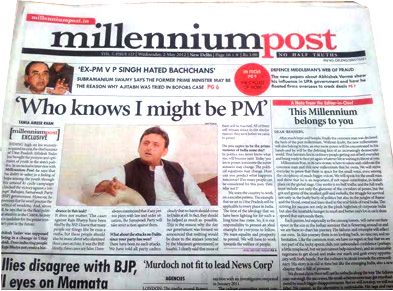
  • No half-truths with Millennium Post: Ganguly

    By A Correspondent


    Readers in New Delhi woke up to a new newspaper offering on the morning of May 2. Millennium Post, the all-colour daily was rolled out by Durbar Ganguly – promoted by Frontrow Media – who will act as the Publisher & editor-in-chief of the newspaper.


    In fact, the paper is not new and existed in a small way since 2005. Highlighting the takeover from its previous owners Mr Ganguly asserted: “The paper was in existence in a small way in 2005. We have taken over the management and the ownership of the title from its owners. Since much of the ground work for the launch had already been laid, we decided to go ahead with the same title. But having said that, the content, team and positioning would be different from what it previously was.”


    Though the team went low-profile with their promotional activities, what is assuring is the positioning that they have zeroed down on, which reads: thinking man’s newspaper. Mr Ganguly said: “We are positioning it as a thinking man’s newspaper. We don’t call it a pro-reach paper – in the sense that if you have breezed through our content you will see that this millennium belongs to the common man. When you say the thinking people they are those who believe in invention, are educated and upwardly mobile, and so on. At the same time, it is not like other large papers such as The Economic Times that are only promoting the cause of big people. So that’s how we plan to be different.”


    When asked on how they plan to measure up to the known players who have already made a mark in the capital, Mr Ganguly said: “Honestly, we are not competing in any way with any of the big players and want to create a niche of our own. If you see, people, in general, are getting fed up with the quality of journalism being provided – as I call it, sponsored corporate journalism. They have converted journalism into extension counters of PR activity. So our core focus would be to promote good quality journalism.”


    Going a step further with its promise, Mr Ganguly affirmed that one of the biggest positioning stands that it has adopted is ‘No half truths’. “Most papers today do not present the whole fact as it is and that’s what we refer to as ‘half truths.’ Our focus would be to present certain issues that others do not take up at all.”


    Alongside its physical presence, the company also plans to lay emphasis on providing content through the web. And the reason for that is rather different too. “We’d really like to promote ourselves in a big way in the digital space because we believe that after certain point of time we wouldn’t be able to expand our paper so much to other areas due to financial limitations. That’s one of the reasons we want to go heavy on the web with our content.”


    The newspaper has already found favour with advertisers, who have evinced interest and advertised in the inaugural issue itself. Mr Ganguly said: “The advertisers have been appreciative of our product and have supported us in a big way from the very first issue itself. We are very excited with the initial response that the paper has managed to evoke amongst the fraternity. We have been receiving queries from many advertisers since we launched yesterday and in the days to come you will see an increased participation from their end.”


    As of now, the paper would be circulated only in Delhi – the print run of which stands at 75,000 copies. Going ahead, the plan would be to launch it in Lucknow, Ranchi, Bhubaneshwar and Chandigarh. But that’s for later; right now the focus would be on establishing Millennium Post firmly in Delhi, affirmed Mr Ganguly.


  • Introducing: Media Matrix, a new weekly column by Paritosh Joshi

    By Paritosh Joshi


    A young man who currently works in one of the Big Three television networks dropped by for some career advice last week. After graduating from business school, he has spent almost five years at the job, the first two in Ad Sales and the next three in Marketing. He feels like he is beginning to stagnate and has raised the issue with his boss. Boss suggested that he move back into Ad Sales.


    What would you advise him?


    If he planned to be in the broadcast industry for the long haul, say the next decade, I suggested that he stay in Marketing. If it was just the next two or three however, he was likely better off shifting back to Ad Sales.


    Seems cryptic? Hang on, we should soon see why.


    Marketing’s role at most Indian broadcasters only comes in when all aspects of the channel, show or event have already been finalized. All that remains is to build awareness of the impending launch to try and ensure the quickest possible pace of sampling among viewers. Talented creative agency is called in and briefed. Wit, emotion, action and drama are poured in and out pops a striking, often award winning, campaign. All that remains to be done is splashing out a large sum on a media plan and the job is done.


    If you learned your Marketing at one of the putative Universities of the discipline, P&G or Unilever or one of the beverage majors for instance, you would expect to lead, not follow the process and centre every decision at each stage on the consumer. It would probably offend you to be treated merely as a deliverer of advertising and media campaigns. Given the circumstances, you would want to shift closer to either the Content or the Ad Sales side of the business, where the action really was.


    Things are going to start changing. As soon as July 1, 2012 actually.


    For as long as we’ve had C&S TV inIndia, going on 20 years now, the biggest impediment in its expansion has been limited bandwidth due to analog delivery. With capacity of less than 70 channels delivered at indifferent resolution and scratchy audio, the biggest challenge before a channel is to get distribution at whatever cost. Once this hurdle has been negotiated, it enters a relatively limited range of options available in any given genre. The rest depends on casting as wide a content net as possible. Almost every channel tries to be all things to all viewers.


    Mandatory digitization arrives in the big metros on July 1. In a fell swoop, channel choice is set to grow three-fold or more. Costs of distribution should fall rather sharply, removing a significant entry barrier and opening doors for many more content providers. Inevitably, the days of every channel wanting to be ‘One size fits all’ must give way to specific consumer needs driving product design. International channels already show this precision in proposition and content. Comedy Central makes no bones about what it stands for and will stay close to the promise. Fox has a whole portfolio of well-designed channels that identify and then single mindedly go after a tightly defined benefit.


    And make no mistake. This is the direction where all of Indian television is headed; the era of the Marketing-led broadcasting business.


    Paritosh Joshi was until recently CEO, Star CJ. He has been a marketer, a mediaperson and been a key officebearer on industry bodies. He can reached via his Twitter handle @paritoshZero


  • The Anchor: Pratap Bose list 5 reasons why awards are important

    By Pratap Bose


    1. It goes without saying that awards recognize good work. If an agency fares well at award functions, it is definitely recognized by clients, giving itself an option of fluffing its feathers.

    2. By actively participating in awards, an agency gets an edge over the other agencies in terms of attracting talent. ‘Award Friendly Agencies’ manage to get better talent.

    3. If an agency is a part of an international/worldwide group, it builds credibility for itself around the network. Awards help an agency be known by every client everywhere.

    4. Awards create healthy competition internally within different teams which leads to overall quality work by setting and breaking benchmarks internally.

    5. If an agency manages to win awards not just for creative work but for other departments as well it comes across as a holistic agency.


    Pratap Bose is COO, DDB Mudra Group


  • What’s ailing RIM’s Blackberry drive globally & in India?

    By Ravi Balakrishnan


    Don’t let the kid on the next seat in the train, furiously typing away on his or her BlackBerry fool you. Despite the fact that Indian youth have bonded over BBM, the performance of the parent RIM and maybe even the launch of its latest product in India have revealed a number of holes in the phone maker’s strategy. BE asks what’s troubling BlackBerry, boys?


    Minutes before Research In Motion, the makers of BlackBerry, made an announcement at a press conference in Delhi, there was a definite vibe of anticipation. Tech hacks idly wondered just what was going to be unveiled, given that BlackBerry has a fairly conservative release schedule.


    The more optimistic were holding out for a glimpse of BlackBerry’s OS 10 rumoured among the brand’s faithful to be a potential Android-slaying, iOS-wrecking killer operating system; one that would propel BlackBerry back to the top of its game. But instead, BlackBerry amid much fanfare and celebrity preening unveiled the Curve 9220.


    At the Q&A and after, the questions flew thick and fast: why only a 2MP camera? Why no 3G? And why such a stiff price tag for a phone that lacked these two features?


    The device was launched at Rs10,990; inexpensive for brand BlackBerry, but a tad pricey compared to other mobiles, even smartphones if one considers budget Android models from Samsung, LG, Spice and Lava among others.


    The Curve offered unique features like a quick access BB messenger button and, critically, long battery life, something of a rarity in the smartphone category.


    FM radio, a feature that’s bog standard even for phones that are sold at a tenth of the cost, made its way to Blackberry Curve. But to an audience weaned on revolution, having to settle for evolution was a disappointment. It was a dangerous reaction for any company to deal with; especially a tech firm that’s been gradually losing its reputation as a pioneer.


    As one of the first smartphones, BlackBerry had a dream run starting with the enterprise segment and slowly making inroads into the consumer space. ‘Sent from my BlackBerry’ soon became a ubiquitous signature; first for emails from globetrotting CEOs and later among the rank and file as well. Except of late, it has taken a beating globally, trounced by the iPhone on the one hand and a gamut of Android powered devices on the other.


    Its most recent financial results reveal a loss of $125 million. And shipments of 11.1 million, down 21 per cent from the previous quarter. Reviews for its Torch series have been unenthusiastic and the game changing OS10 is expected to show only in the latter half of 2012. An industry insider said: “They decided to step back and relax and that cost them. The engine has stopped innovating for some time.”


    In some countries like India though, BlackBerry still counts among the contenders. According to Frost & Sullivan, it’s at the third place in the Indian smartphone market with a share of 15 per cent, trailing behind Nokia’s 35 per cent and Samsung’s 40 per cent. It’s attracted a strong app developer network of 30,000 in India up from 4,000 two years ago, according to a company source.


    More importantly, for a product that’s worldwide reputation veers towards the stodgy, it has a strong traction with the youth. Abhishek Chauhan, senior consultant, ICT Practice, Frost & Sullivan, South Asia & Middle East observed: “In India, they’ve been taking segmentation seriously, targeting the youth. I don’t feel India will be a danger space for them if they launch affordable devices and data plans for their consumers here.”


    The youth connect has been built in part on the back of initiatives like the BlackBerry Boys campaign; a co-branded effort with Vodafone, currently in its second year. On the distribution front too, BlackBerry was quick to realise there was a world beyond the metros. It is currently present across 250 cities and according to RIM India’s managing director, Sunil Dutt, it continues to expand.


    However, BlackBerry India has not remained unaffected by the pressures facing its parent. The pricing strategy has changed: the jury is out on just why this is happening and what it will lead to. Of late, there have been price cuts across its portfolio.


    Coupled with the relatively ‘inexpensive’ tag on the new phone, it indicates either a thawing on part of the company or an act of desperation depending on who you ask. Mr Dutt explains the price cuts: “Sometimes when you reach economies of scale, they allow you to pass on benefits to customers.” This becomes important as the phone reaches towns and cities that want the device but find the price tags forbidding.


    Mr Dutt has a different take on discounts. He believes they are not an indication of a brand in trouble but an invitation to consumers to be a part of an ecosystem and experience. “We want to reach more consumers. A lot of them want an affordable solution and we provide just that,” he said.


    Marketing consultant Shripad Nadkarni of MarketGate however cautioned that the strategy could well be a double edged sword: “It helps garner short term sales, but the brands future depends on how they keep in synch with innovations of the competition. They can reduce the price of existing products but need to buffer up the offering to be a serious player.”


    There seem to be several options and suggestions available to BlackBerry, many offered gratis by various tech columnists. Part of the problem according to industry pundits is that the brand strayed too far away from its enterprise roots and ran the risk of being “everything to everybody.”


    The industry insider said: “It is still a high stable platform that gets jobs done in least number of steps. They need to recognise what’s driving them as a company and drive it even harder. BlackBerry 10 could change the way people think about the  company. The question is whether it will be too little too late.”


    For the longest time, BlackBerry believed the experience its products offered was good enough for it to command a premium. Even as rivals ramped up the megapixels on cameras, and made their phones more music, game and leisure friendly, BlackBerry’s phones remained on a pound for pound basis, a tad underpowered.


    But with the competition evolving at a furious pace and throwing in more for less with each generation of phone, it may be a matter of time before even the BlackBerry boys begin to wonder if the experience is worth the price.


    Source: The Economic Times
    Copyright © 2012, Bennett, Coleman & Co. Ltd. All Rights Reserved

     

  • Movies OK will focus on families: Hemal Jhaveri

    By Meghna Sharma


    After the launch of Life OK in December 2011, Star India is planning to launch a new channel on May 6 under the OK banner – Movies OK.


    The channel promises to be different from Star Gold, the movie channel launched by the network in 2000. “There is a difference between the two channels. Movies OK will focus on family audience. This means we are going to showcase movies which a whole family can enjoy together,” said Hemal Jhaveri, general manager, Star Gold, who heads the channel. The channel plans to concentrate on genres like comedy. “There is going to be more comedy and less action on the channel,” he added.


    Apart from content, the other thing which will differentiate the channel from the competitors is the treatment. “The promos are going to be very different and unique from what the other channels do. For instance, we are going to have a Best of Salman Khan Festival called ‘Bhai Ok Please’ where no film footage has been used. So, for the first time, people will see a promo for Salman Khan without him in it. Communication is going to be unique,” explained Mr Jhaveri.


    If that’s not enough, the channel also boasts of having a World TV Premiere every night by the end of this month. Mr Jhaveri said: “The 7 day 7 premiere is something which no other channel has experimented with earlier. I think it’s the first-of-its-kind in the world as well. So, every night at primetime, one will get to see movies like Kahaani, London Paris New York, Jodi Breakers and others. We are planning to build our channel as a unique platform.”


    The channel also hopes to use the learnings from their other channels, especially Star Gold which was revamped last year. So, one can expect shorter breaks.


    The channel has a library of over 1000 movies. “We have been investing in the channel from the past two-three years and will continue to do so in the future as well. Therefore, it’s going to be a unique library. Last year, we acquired the Viacom18 library so that will also add to it,” elaborated Mr Jhaveri.


    The Hindi movie genre enjoys the third largest viewership pie, trailing behind regional channels and Hindi GECs, according to a FICCI-KPMG report on the Indian media and entertainment industry, released in March.


    “There are various Hindi movie channels, but there is always space for one more, if it’s different and has good content,” said Mr Jhaveri. Agreeing with Mr Jhaveri’s sentiments, Ashwini Kamat, general manager, MediaCom added: “People don’t have loyalty towards movie channels. So, if a channel has a good library, then it doesn’t need to worry about others because people will switch to it, if they want to watch a particular film.”


    Janardhan Pandey, associate vice-president, DDB Mudra Max elaborated: “There is enough space on TV to launch a channel but all depends on if one can sustain it at the top slot. A new channel might showcase latest movies, but after some time, many stop investing in a new library and repetition starts. It is then people tend to move away from it. So, it might make an impact in the beginning, but it is difficult to say how a channel will do in the future.”


    However, advertisers aren’t optimistic about it. “One more channel means more segmentation. So, I don’t think it’s going to benefit us,” said Praveen Kulkarni, general manager (marketing), Parle. The categories which spend heavily on Hindi movie channels are services, auto, personal accessories and telecom. “Launch of any new channel means fragmentation and overall inflation for advertisers,” added LK Gupta, CMO, LG.


    The channel has a 360 degree promotional plan for the channel. It will also be promoted during Star’s new show, Satyamev Jayate, which will also be premiered on May 6. Radio and digital platforms will be used too.