Blog

  • The Anchor: Mansi Sapre on 5 reasons why dubbed Hollywood movies work in India

    By Mansi Sapre


    1. Growth in channels based on international content – movies, kids animation, infotainment, sports has seen tremendous growth in the last decade. This phenomenon is thanks to Indian audiences’ increasing exposure to, and appetite for, superior content, world class talent, international glamour, authenticity and production values far superior to most local content.


    2. Hollywood movies, when dubbed in Hindi or other Indian languages, reach higher number of audiences than in their original version, making them more mass. Dubbed TV channels carve out a healthy share of TV viewing from both English language channels and Hindi movie channels.


    3. Cultural bias against dubbed content has become passe – with Hollywood studios releasing prestigious titles in Indian languages and English channels (Infotainment/ movie channels) subtitling their content, people have accepted the need of localization of international content.


    4. Creative and meticulously localized dubbing – led by channels and resulting in maturity of dubbing industry has ensured quality of viewing experience without compromising on accessibility of language that dubbing brings to viewers.


    5. All the above has led to a strong brand identity of dubbed channels and advertiser interest in the same.


    Manasi Sapre is Director Programming and Acquisitions, Movie channels UTV


  • Hungama earns Facebook’s ‘Most Preferred Marketing Developer’ badge

    By A Correspondent


    The Digital Services division of Hungama Digital Media Entertainment Pvt Ltd was conferred with the Preferred Marketing Developer (PMD) badge by Facebook. PMD is given to developers that have demonstrated value-added capabilities in one or more of the following qualification areas: Pages, Ads, Apps, and Insights. The badge is for companies that have clearly demonstrated unique capabilities that help marketers scale and achieve efficiency and extend measurably beyond the functionality of Facebook’s native tools.


    Commenting on this Siddhartha Roy, COO, Consumer Business & Allied Services, Hungama Digital Media, said: “Being among the few companies worldwide to earn ‘Preferred Marketing Developer’ badge underlines our ongoing investment in providing cross-channel interactive solutions to clients across various verticals. In a digitally connected world, it is important to engage the consumer where he spends most of his time; the social media platform, especially Facebook, has emerged as the new media real estate where brands can build greater engagement and interaction with the consumer.”


    Hungama Digital Media helps brands build awareness, engagement and loyalty, using a full range of digital skills, including campaign strategy and creative development, website design, online media planning and buying, viral marketing, social media strategy and optimization, mobile marketing, search engine marketing, gaming. On social media, specific to Facebook, the agency provides page management and publishing, community management, applications development, social plugins, advertising (ad creation, auto bid optimization, target segmentation, creative, conversion tracking, reporting), monitoring and reporting (insights).


    Hungama has built digital campaigns for clients that include Mahindra & Mahindra (Automotive), Mahindra Racing, Bacardi, Yum Restaurants, LG and Nokia amongst others; that utilizes the Facebook ads API such as Bacardi Together Club, Black List Application, Celebrate Life, ICC World Cup Fever, Zinger Application, Create Your Comic Strip, Valentine’s Day, to name a few.


    Hungama Digital is the No.1 Digital Advertising agency in 2011 according to The Economic Times Brand Equity Agency Reckoner 2011. The parent company, Hungama is the largest aggregator, developer, publisher and distributor of Bollywood and South-Asian entertainment content in the world. With partnerships with over 305 content creators, across record labels, studios, broadcasters Hungama has licensed worldwide exclusive digital rights to over 2 million music and video titles. Hungama has successfully managed more than 2,000 mobile and digital campaigns for as many as 300 brands globally.


  • Debrief: TOI Kerala: Much too cliche ridden

    By Anil Thakraney


    I watched Times’s new commercial for their Kerala edition. ‘A day in the life of Kerala.’ At least that’s the way the advertiser has conceptualized it. It basically features a ‘traffic jam’ on the backwaters. And all the chaos that follows. A rambunctious Mallu folk track booms in the background.


    Now, I know where TOI is coming from. The strategy is correct. They are trying to communicate that they understand the culture and lifestyle of Kerala and thereby the attempt is to win hearts and minds of the locals. That’s fine. But I have some issues with the execution. While I am not a Mallu and therefore am not really in a position to comment on the likeability of the creative amongst the target audience, speaking purely as a communications professional the TVC disappoints me. Here’s why.


    To start with, the ad is way too noisy. This is God’s own country we are talking about, so perhaps there’s a mystical, tranquil, classy way to handle things. (Recall the stunning ads done by Kerala Tourism.) In addition, the TVC is packed with the usual Kerala cliches. Fishermen, boats, backwaters, Kathakali dancer, etc. The only prop missing is elephants. They have been replaced by roosters this time, and for that I will give the ad one extra star.


    Sure, I admit the locals might just like this fare. But a cliche is a cliche in any region and in any culture. And so is deafening noise.


    Rating: (On a scale of 1 to 5): 2. The idea is right but the execution falters.


  • Halfway through, IPL 5 ratings stabilize

    By A Correspondent


    The downward slide continues though not as stark as it is made out to be. Numbers released by TAM Sports for the first 48 matches of IPL 5 have shown the ratings to be the least recorded thus far compared to previous four seasons. At 3.40 TVR (CS 4+, all India), IPL 5 is faring poorly when compared to 2011 where it recorded a TVR of 3.54, 4.53 in 2010, 4.05 in 2009 and 4.72 in 2008.


    It may be recalled that for the first 36 matches, IPL 5 delivered a TVR of 3.41 per cent, for the first 27 matches, it delivered a TVR of 3.53 per cent and the first 16 matches, a TVR of 3.65 per cent.


    What has shown improvement is the cumulative reach for these 48 matches in IPL 5 that stands at 151 million. This is nearly the same for IPL 4 where the reach was 152 million and far better than IPL 3, 2, and 1 where the reach measured was 137 million, 118 million and 98 million respectively.


    Delving on the suggested trend, Janardhan Pandey, Associate Vice President, DDB Mudra Group said: “Despite what is being said, the sport remains most popular and the reach deliveries also seem to be in line with our expectations. Maybe it’s a period of stabilization for IPL20 viewership. It cannot be doing excellent forever after all. There were many issues to start with such as overdose of cricket & the consistent poor performance by Indian cricket team. Keeping all those factors in mind I will give thumbs up to overall performance of IPL 5.”


    On the reported rise in reach numbers, Mr Pandey said: “This shows the strong appeal that the game of cricket enjoys in India. The ever increasing eye balls for cricket are testimony to this fact.”


    Program TVR %
    IPL5 Opening Ceremony 1.16
    Viewership of IPL Seasons for first 48 matches
    Year Season No. of Matches Avg. TVR % Cum Reach 000s
    2008 IPL 1 *47 4.72 98988
    2009 IPL 2 *46 4.05 118698
    2010 IPL 3 48 4.53 137049
    2011 IPL 4 *47 3.54 152720
    2012 IPL 5 *46 3.40 151585


    (Source: TAM Sports; Market: All India; TG: CS 4+ yrs; Period: Wk 14 to 18, 2012; this data is for first 48 matches of all IPL seasons.)

    * In IPL 1 one match (47th) was abandoned due to rain

    * In IPL 2 two matches (7th & 13th) were abandoned due to rain

    * In IPL 4 one match (20th) was abandoned due to rain

    * In IPL 5 two matches (32th & 34th) were abandoned due to rain


  • Taproot delivers a fragrant tale for ‘Z talc’

    By A Correspondent


    Having charmed some of its large clients with awe-inspiring ideas and execution, creative hotshop Taproot India has just finished work for another brand called ‘Z talc’. The talc is from the stable of Argus Cosmetics, the manufacturers of a range of personal care products.


    Explaining the rationale for the ongoing promotional activity, Mr Sundar, Managing Director, Argus Cosmetics Pvt Ltd said: “We launched “Z” Magnetism talc for men in April 1992. Our strategy at the time of launch was to create premium cosmetic products for the discerning male consumer. ‘Magnetism for Men’ is our endeavor to build on this strategy, and offer more personal care products for upwardly mobile men.” Mr Sundar added that they intended to target the metrosexual male as it is common to find men these days going to the parlours for a facial or dying their hair, and so on.”

    Throwing light on the new commercial, Mr Sundar said: “We have created this TVC to accelerate our growth, and create a strong brand. Thus far, our growth has come from building distribution, we now want to create heightened awareness and pull for brand ‘Z’.”


    On the objective set out for the agency, Manan Mehta, Managing Partner, Taproot India said: “With the business growth plans in place, the attempt was to consolidate the current market and look to engage with the fence sitter in the future markets. The overall exercise was to refresh the brand without losing its essence and present it in an alpha avatar that reflects today’s consumer aspirations and their lifestyles.”


    Providing a more analytic insight, Santosh Padhi, CCO, Taproot India said that according to research, about 30 per cent females use the product not because it’s lying on the dressing table, but because she is in love with its fragrance. “The positioning ‘Magnetism for Men’ was carved on the brand two decades back, since than they have been using it on retail space, hence we too decided to take the same positioning forward.” He added: “The brand name “Z” sounds very international, strategically we decided to keep the perception of it being a international brand hence the whole treatment of the film is very international.”


    The campaign is currently on air in Maharashtra and Andhra Pradesh and is expected to go national soon.


    Credits:

    Agency: Taproot India

    CD: Santosh Padhi, Agnello Dias

    Writer: Santosh Padhi

    Client Servicing: Manan Mehta

    Director: Razneesh Ghai

    Producer: Anju Vaswani

    Associate Producer: Bhavna Singh

    DOP: Kavin Jagtiani

    Editor: Jay Chandran

    Post Production: Prime Focus


  • Media Matrix by Paritosh Joshi: Valuing audiences

    By Paritosh Joshi


    Media advertising has been priced based upon audiences that it reaches for a very long time. Audit Bureaux of Circulation were set up in Western Europe and North America by the early years of the 20th Century and even India’s own ABC has a hoary past, dating back to the 1930s.


    However, circulation audits only revealed the number of ‘revenue’ copies i.e. sold copies of a particular publication. This was not a particularly good guide to how many actually read it. Specialist publications may have sizable circulation but very few readers. Conversely, a general interest publication may appeal to many people and be shared around extensively.


    This was a serious deficiency. Market Research was a rapidly evolving discipline that offered a solution: readership surveys. Initially starting out as proprietary studies of individual publications, it soon became clear that for widespread use, they would need to be conducted at the industry level. Such studies, run by a ‘syndicate’ of clients have since been referred to as Syndicated Research.


    It was evident, even at the dawn of the age of measurement, that it was not enough to have a single number that represented the sum total of all readers. At the crudest, you would have to segregate males from females, children and teenagers from youth and adults. You would also want to discriminate on income-high, middle and low and by geography: rural or urban, state, district and town. These ‘demographic’ variables used to identify ‘segments’ have since become a staple of audience targeting.


    Brands and products would make specific media choices based upon the volume of a particular audience segment they delivered. Typically, the price of reaching a thousand individuals with a specific sized insertion became the basis of comparing a medium’s ‘efficiency’. This measure, variously called CPT (Cost per Thousand), CPM (Cost per Mille- mille being Latin for thousand) or simply the Mille Rate became the universal yardstick for evaluating the print media.


    Television began to grow in significance, first in theUnited Statesthen inEurope, after the end of World War II. Broadcast over the airwaves, television offered no ‘paid sale’ opportunity. Funding television could only be done two ways. Public broadcasting systems would be funded by the government exchequer and private broadcasters would have to earn revenue from advertising insertions. The pre-existing analogy of the Print media made it clear that television needed an audience measurement system. It was also recognized that viewers showed greater volatility than readers appeared to do, thus necessitating a much higher frequency of measuring the habit.


    A solution was found in asking randomly chosen viewers in a ‘panel’ to maintain a viewing diary. Diaries were collected weekly and collated to determine the ebbs and flows of viewership. Since the panel was relatively stable in composition and size, viewership was reported as a relative measure – the rating point. A rating point equals 1 per cent of the total audience. A show watched by every person on the panel would have 100 rating points. Since panels were constructed to mirror the overall population- being a representative random sample – the relative measure could be used to estimate the broader behaviour of the population. Inevitably extending the cost efficiency analogy from Print, it was only a matter of time before the cost of reaching 1 rating point began to be compared across shows. CPRP – cost per rating point – was born.


    And that is pretty much where the art and science of valuing audiences has rested, for over half a century.


    Now think for a moment about how you consume different media. There’s that television show well past your normal bedtime that compels you to stay awake until midnight – on a Tuesday. That automobile magazine with a big feature by a maverick British journalist that you spend a small fortune on every fortnight. And those news shows run by the world’s most intrusive interviewer that irritate the hell out of you but you watch with an almost masochistic regularity every night at 9. On the other hand, there are those 5 newspapers that are barely glanced at on your office desk, the daily weepies that you are forced to deal with as your spouse devours them every weekday or the fashion magazines that somehow land up in the bathroom stack. Surely there must be a difference in how they are evaluated by a media planner who somehow knows of your media habits? There should be. There aren’t.


    In the relentless focus on audience volume as the prime metric, we have lost sight of audience quality. Is it possible to objectively evaluate quality? Do current audience measurement systems pay adequate attention to measuring it? We will deal with these issues in Part II, next week.


    Paritosh Joshi was until recently CEO, Star CJ. He has been a marketer, a mediaperson and been a key officebearer on industry bodies. He can reached via his Twitter handle @paritoshZero


  • MxM Exclusive: Satyamev Jayate impacts govt. Women & Child Dev Minister Krishna Tirath promises action, commends Aamir

    By Karuna Madan


    Union Minister of State (Independent Charge) for  Women and Child Development Krishna Tirath has appreciated Star Plus’s multi-channel Satyamev Jayate describing it as a commendable effort.


    “Satyamev Jayate is a commendable effort by Aamir Khan and it deserves appreciation. We have taken note of the issue of female foeticide raised in the first episode,” Ms Tirath told MxMIndia in an exclusive chat.


    “The ministry is very serious about the whole issue of female foeticide and infanticide, and I can promise that suitable action will be taken against the culprits who indulge in such malpractices,” the minister stated, adding: “we will rectify any lacuna in the laws to check the menace in the country. There are a number of legislations already to curb this practice. But any lacuna, if found, will be rectified.”


    The Minister said that such practices can be stopped through mass awareness campaigns.


    “We can stop the cases of female foeticide by educating the masses and we are taking necessary steps in that direction. The government is already working on better policies in collaboration with other public and private institutions,” she averred.


    Raising concerns over declining sex ratio in the country, Ms Tirath called for greater public participation and awareness to prevent the issues related with girl child and women.


    Foeticide is punishable under Section 315 of Indian Penal Code (IPC), with imprisonment of either description for a term which may extend to ten years, or with fine, or with both.


    “The high number of incidences of female foeticide are due to the deep rooted traditional preference for a son. We are aware of this and have adopted a multi-pronged strategy which includes legislative measures, advocacy, awareness generation and programmes for socio-economic empowerment of women,” Ms Tirath said.


    Under the Pre-Conception and Pre-Natal Diagnostic Technique (Prohibition of Sex Selection) Act, 1994, sex selective abortions have been made punishable.  The Ministry of Health and Family Welfare is responsible for administration of this Act and its implementation is the responsibility of the State Governments/Union Territory Administrations.


    MxMIndia newsdesk adds: Ms Krishna Tirath would’ve made for an ideal guest on the Star Plus show. An MP from New Delhi and a resident of Karol Bagh in the capital, Ms Tirath, 57, is a mother of three daughters, as per Lok Sabha records. She’s been in active politics for a few decades, having been member of the Delhi legislative assembly for four terms starting 1985.  She’s  much into sports having participated at Inter-Univ and national level volleyball and athletics. Given her personal and professional credentials, there’s more reason than one, why she should be championing what Aamir Khan did on SMJ’s Episode #1.


    Editor’s Note: Although interviewing ministers is not part of MxMIndia’s regular activity, given the huge effect that Satyamev Jayate has had – especially in many sections of our intelligentsia, we thought it would be a good idea to commission a seasoned political journalist to interview the Women and Child Development minister and check if the show has had any effect at all on the government. It evidently has. Since the eventual objective of SMJ is to cleanse Indian society and stir the public and the Establishment into action, more than ratings (some of which will be out tomorrow), we believe it’s vital to check the impact on the government and the public.


    Karuna Madan (@KarunaMadan) is a senior journalist based in New Delhi


    Photograph: Fotocorp


  • [MJR] The missing ‘outrage’ gene

    Ranjona Banerji

    By Ranjona Banerji


    It is well-known that your parents are to blame for everything that is wrong with you. I, therefore, emphatically blame my parents for this severe shortcoming of mine – a weak and badly functioning “outrage” gene. This gene is a must if you want to effectively follow and understand the Indian media.


    The world comes to an end on television and micro-blogging sites like Twitter everyday and then, inevitably, restarts again. This resurgence of life on earth as we know it is mysteriously missed by our outraged colleagues, possibly because they were so caught up in the “shocking incident that has just come to light where a dog bit a man”. Following the shocking incident is a demand that the chief minister of the state where this happened do something about it. Invariably, these chief ministers did not even know that this “shocking incident” had taken place. Woe betide (now you can see how old I am) any chief minister who says “well, often dogs will bite men”. This is the wrong reaction and will haul you over hot coals before you can finish the sentence. The correct reaction is to catch the dog, incarcerate it and then order an inquiry into why dogs bite and if indeed they would rather bite men than women or trees, cows and whatever else dogs might bite.


    In the world of Indian television news, it is against the ethos to have prior knowledge that canines have teeth (or even that canines are teeth) and do sometimes bite. Being privy to this information is detrimental to the proper functioning of the “outrage” gene.


    On Twitter, however, the outrage gene works a little differently: “We need an RTI inquiry: why does the prime minister @PMO… have two eyes? Did Sonia Gandhi pay for them?” This can get re-tweeted over and over again until someone does file an RTI inquiry. Before that it will descend to “The @PMO… is not so bad, look at how your man behaved when he was PM”, “You are a %$$& whose mother was a &%$@”. Also there will be many short forms and these: ####.


    As the outrage grows, we will reach this one: “Information commissioner stonewalls inquiry on status of prime minister’s binary visual system. #PM’s eyes”. And voila, we’re on our way to our own Arab Spring.


    Newspapers are often afflicted like me. All day yesterday TV channels ran clips of the shocking (really) remark by an Uttar Pradesh deputy inspector general of police that if his young sister (or maybe daughter or both) had eloped or been abducted he would have killed her or himself. Newspapers dismissed this story in a couple of columns.


    So maybe while my parents are responsible for my problem, they are not the only transgressors.


  • HUL to launch Mission Bushfire in 8 cities

    By A Correspondent


    Consumer goods major, HUL is launching Mission Bushfire 2012 this week to cover about 40,000 outlets (including general and modern trade) spread across 8 cities in India- Mumbai, Pune , Delhi ,Gurgaon, Bangalore, Chennai, Kolkata and Hyderabad.


    Mission Bush Fire’ is an employee-led market execution and customer interaction exercise initiated in 2010 to get the home & personal care giant to connect with the market place.


    This year the emphasis will be on the launch of skin care brand, the New Fair and Lovely. HUL employees from across functions will be participating in Mission Bushfire 2012 which will be held for the third successive year.


    HUL CEO Nitin Paranjpe and every member of the company’s management committee participates in this project to get direct feedback on how HUL brands are faring.


    In 2010, over 4000  HUL employees had participated in this mission to interact with the trade and consumers covering 14,000 outlets.


    Bush Fire has resulted in a 40 per cent spike in sales in store wherever the initiative has been implemented, according to internal company estimates. Mission Bushfire is an HUL employee led initiative that aims to create ‘Perfect Stores.’


    A research by HUL shows that 70 per cent of the brand purchase decisions are made

    at point of purchase. Perfect store programme is an initiative started in 2010 with objective of bringing the HUL brands from consideration set to the purchase basket of the shopper. The project is being driven through two initiatives called IQ and Better Stores.


    Project IQ has been instrumental in increasing the assortment and driving placement of new products through strong analytics and customization of tasks at an outlet level.


    Better Stores Project drives the visibility of the brands at the point of purchase through the right visibility mix, focus on plannograming (share of shelf) and advanced merchandising process using hand-held terminal (HHT) technology.


    Source: The Economic Times
    Copyright © 2012, Bennett, Coleman & Co. Ltd. All Rights Reserved


  • Cable cos expect major hike in subscriber revs

    By A Correspondent


    TRAI’s argument that carriage fees paid by TV channels to cable MSOs are necessary to fund their digitisation appears to be falling apart scarcely a week after it was made. Instead, large cable distributors have themselves said that one factor alone – a huge six-eight times hike in subscription revenues alone as declarations spiral with addressability – would significantly buttress their already profitable balance sheets.


    With additional revenues from broadband and VAS, industry estimates also say that a bundled digital and broadband + VAS business model will result in the payback period being reduced by a year to 24 months, as opposed to 36 months under a standalone digital cable TV proposition. This comes even as industry reports –including one released five months ago– have been pointing out that all major national MSOs are already adequately funded for Phase I digital deployment (mandatory only in the four metros from July 1).


    Given that the government is also shortly planning to hike FDI for MSOs from 49 per cent to 74 per cent, industry analysts have questioned why TRAI assumed MSOs and cable distributors needed money in the form of mandatory carriage fees by TV channels – an annual recurrence – to fund their upgradation, which is only a one-time investment. This is especially inexplicable, as TRAI’s own April 30 Explanatory Memorandum to the DAS Regulations states: “In the addressable systems, due to transparency in ascertaining the number of subscribers, the subscription revenue is expected to go up. Therefore, the dependence of MSOs on the carriage fee, as a source of revenue, is likely to be reduced.”


    It has been well known that the cable distributors are the profitable, cash rich last mile, with even many smaller operators who under-declare subscribers/taxes, expanding into other activities like real estate, auto agencies, ancillary services, and so on — while most broadcasters have turned sick due to a killer combo of low ad rates, gross subscriber under-declaration and huge carriage/placement fees.


    The national MSOs, are, in fact, almost all profitable, with even newer ones like Den Networks having posted a 20.7 per cent yoy revenue growth in Q3 of the fiscal just ended, including a 6.6 per cent rise in its net profit. That is why the added bonanza of TV channels having to now mandatorily pay MSOs carriage fees caused MSO share prices to jump after the TRAI tariff order was announced– even as listed broadcaster scrips sank.


    Shares of Hathway Cable and Datacom had closed on May 2 at Rs185.40, 19.23 per cent above its previous BSE close, missing the upper circuit by a small margin, Den Networks also touched an intraday high of Rs116.90, before closing at Rs110.80, 2.12 per cent above its previous close.


    Earlier, a Media Partners Asia (MPA) report (Investing in Digital India) of December 2011 had projected a six times increase in subscriber revenues for MSOs, albeit with a 20 per cent subscriber churn to DTH – but MSOs themselves reacted very positively over the TRAI tariff order.


    Hathway Cable & Datacom MD & CEO K Jayaraman told a business daily last week, that his company expects revenue to go up by 250 per cent post-digitisation. “We have 9 million homes and, at the least, we expect to double the subscriber base as 80 to 90 per cent of the carriage revenue will go to MSO. Broadly, after taking churn and loss in the carriage fee, we expect revenue to go up by 250 per cent “, he said. The company’s CFO, G Subramaniam, said during the same interview, that while carriage fees would reduce, the subscription revenue would rise from 10-15 per cent of the revenue mix currently. “This increase is likely to be six-eight times, and will make up for the loss of carriage fee”, he added. Both said that digitisation would help them grow their broadband business – already significant, given that as per Mr Jayaraman,

    Hathway already had 4 lakh broadband subscribers and a Rs 150-crore topline, which he expected would double in the next couple of years.


    Mr Jayaraman also outlined the many sources for his company’s digitisation upgrade: IPO funds and a mix of internal accruals, debt and vendor finance. He said: “The capex will be Rs1,000 crore. Of this, Rs300 crore will be spent in Phase-I and the rest in Phase-II. Phase-I is to be financed from initial public offer proceeds. A mix of internal accruals, debt and vendor finance will be deployed in Phase-II. The funding plan for the second phase is yet to be finalised,” he added.


    The MPA report – which was released five months ago – also states clearly: “According to MPA analysis and interviews, all major national MSOs are adequately funded for Phase I digital deployment. The cost of digital software and hardware has also fallen since 2007, ensuring set top boxes plus the CA card will cost about $30-40 per unit in total including duties, compared with $60 three years ago”, and adds that a number of the MSOs (like Hathway, DEN) are also ordering digital STBs in larger volumes like 1 million per annum, by which costs are lowered to at least $30 per unit.


    For instance, this report also gave company-wise details on the impressive progress they had already made on digitisation, and outlined their excellent financial situation to achieve the same. For instance, it said that Hathway had a debt to equity of 0.3x and a high promoter holding (67 per cent), hence “the company has enough head room to raise further capital”. While it said that DEN had a “comfortable debt to equity stand of 0.2x with a net cash of Rs9.5crore”, it also had sanctioned loans of Rs200 crore, which had not been drawn at the time of the report’s release. Even regional MSOs like Ortel, which might have a comparatively higher debt to equity at 1.6x as per the report, appeared comfortable placed to take care of their digitisation upgrade.


    Source: The Economic Times
    Copyright © 2012, Bennett, Coleman & Co. Ltd. All Rights Reserved

     

  • Hindi ‘Hinterland’ is a pressure cooker close to boil

    By Ruby Bana


    Hindi Hinterland has always been known as the most remote part of India. But let’s not forget the latent ambition and grit that exists here, in addition to lagging in affordability and access. It’s a pressure cooker close to boiling point.


    This is where the most visible transformations will happen and pent-up demand will explode. Even in psychological terms, it’s not just about IAS/IPS as road to success but enterprise, showbiz (look at the talent shows), technology careers, and so on.


    The first, and the most important, change that has happened is ACCESS. Access to communication (mobile and internet), ambition (talent and confidence) and Retail (access through retail boom as well as e-retail – dream it, buy it…). This consumer will skip a decade and join the metro counterpart sooner than we think; especially the youth, who move faster than the others. Let’s remember: we are a “young” country and we adopt change much faster than most others.


    I don’t think the discussion will be anymore about: will 70 per cent of middle FMCG products markets come from hinterland consumers, but it’s now moving to how 70 per cent of Durable and Lifestyle consumers will come from upcountry markets.


    Computer/laptop manufacturers, smartphone manufacturers and others will be looking at the 70 per cent market from Hinterland/middle India in the next five years. I feel it’s not going to be so much a challenge of reach going forward as technology will change things sooner but it’s a challenge of conversion. The brands that succeeded in the metros may not be the exact same ones that garner the larger share of the hinterland market and I don’t mean just affordability here.


    This consumer will be more “information/evaluation” based purchaser rather than the fad based consumer of metro India. They will also be responsible consumers. Brands will have to reflect the same by demonstrating solid commitment to their core values. They will have be enablers of change, and have meaningful roles in their eco-systems. Some brands have already started this process a decade back, these will benefit the most. The rest that get in early now will reap disproportionate gains from the next wave. We wait at our own risk


    – The writer is Chief Strategy & Insights Officer, Madison India


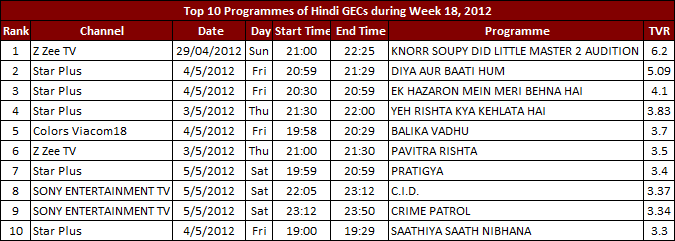
  • TAM data Top 10 programmes on HGEC – Wk 18’12


    Source: TAM Peoplemeter System
    TG: CS 4+ yrs
    Market: Hindi Speaking Market
    Period: Wk 18: Apr 29 to May 5, 2012


    About TAM Media Research

    TAM is a joint venture between Nielsen Company & Kantar Media Research. Besides measuring TV Viewership, TAM also monitors Advertising Expenditure of Television, Print & Radio through its division AdEx India. Since 2004, it extended its presence in the PR Measurement & Analysis space for Corporate/Marketing Clients by setting up a separate division Eikona PR Measurement.


    In 2007, the joint venture introduced RAM (Radio Audio Measurement) service to track Radio Listenership for the Indian Radio Broadcast Industry. In year 2009, TAM launched a division, called TAM Sports that specializes in monitoring Sports Sponsorship ROI.


    TAM Media Research’s objective is to fuel media insights that will drive the growth of the Indian Media Industry.