Blog

  • [MJR] Holier than thou Hindu takes on the Times


    Ranjona Banerji

    By Ranjona Banerji


    The Hindu has published a massive “expose” on paid news in The Times of India. According to painstaking research done by veteran journalist P Sainath, the Nagpur edition in 2008 carried a special feature about how farmers in Vidarbha had benefited from using Bt cotton seeds. This went against all other evidence that it was the use of Bt cotton which had led to falling yield, depleting the land, increasing debt burden and consequently the large number of suicides in the region.


    The TOI team spoke to farmers who said they were making much more money than they thought and were very happy. The villagers spoken to said no one had committed suicide. The trip was sponsored by the manufacturers of the Bt cotton seed – Mahyco Monsanto Biotech. The newspaper added this as a disclaimer, maintaining however that the journalists had done their own research.


    According to Sainath, in 2011, the same feature was dredged up and re-printed, this time as an advertising feature – paid for by Mahyco Monsanto Biotech – and published in all editions of The Times of India except the Nagpur edition.


    Yet, the same villagers, when they spoke to a Parliamentary Standing Committee in March this year, Sainath points out, said that 14 people had committed suicide since Bt cotton had been introduced and that their financial plight was pitiable. The enormous amounts of money being made – as claimed in the TOI report – were untenable and were also contradicted by figures provided by Union agriculture minister Sharad Pawar.

    So what do we have here? A cynical manipulation of events to help a giant corporation out of a PR disaster? Or exploitation of journalists to further the commercial interests of the newspaper? Or complete contempt for the reader and disregard for the newspaper’s credibility?


    I would say the worst sin is number 3. The first two lead to the third. The fact that Bt cotton has aggravated rather than alleviated farmers’ problems ought to be a fact universally acknowledged. It is also well-known that Monsanto has an extremely aggressive public relations department. Further, the government has also pushed farmers to opt for Bt cotton and thereby helped Mahyco Monsanto Biotech.


    However, it has to be pointed out that The Times of India is not the only practitioner of paid news. This menace is prevalent through the media, both print and television. The ways in which it is done can be subtle or brazen – here TOI seems to have opted for the latter. It is also not clear if this deal with Monsanto was limited to the Nagpur marketing department which then shared it with headquarters or whether the entire editorial team was aware of what was going on.


    Either way, though, both the initial report and the use of that report as an ad are highly questionable. Cynicism on the part of journalists will only make life worse for them more than anyone else.


    There is one more question here as well. Holding the media up for scrutiny is necessary and important. But The Hindu’s tendency to take this holier than thou line is bound to boomerang at some time. It now has to keep its house cleaner than everyone else’s.


    The link to Sainath’s column in The Hindu: http://www.thehindu.com/opinion/columns/sainath/article3401466.ece?homepage=true#.T6tjbKDv3XQ.email


  • Bindass to host ‘Generation Einstein’ tonight

    By A Correspondent [updated]


    All roads lead to the Mahalaxmi racecourse today (Monday, May 14) as Bindass will launch the Indian edition of the very successful book ‘Generation Einstein’.  Co-authored by UTV Bindass along with the well-known international author and speaker Jeroen Boschma, the book is being launched in India keeping in mind the specifics of the Indian market and traces the emergence of a global generation in India, their likes, dislikes, lifestyle and what sets them apart from the others.

    The Indian edition of Generation Einstein – authored by Samyak Chakraborty and Arjun Vednayagam – also goes on to explain the communication strategies that marketers could adopt in reaching out to the youth with the help of India-specific case-studies like Tata Docomo, Bindass, Virgin Mobile and many more.

    The book describes a new generation, ‘Generation Einstein’ that was born during the last decade of the previous century. It also stresses upon the significance of the youth as an important part of the market and how fast the new generation understands the world better than anyone else. The book attempts to decode this generation and help marketers reach out to them.


    Commenting on the association of Bindass on the launch of book, Kunal Mukherjee, Director-Marketing, UTV & Bindass Networks, said: “Bindass being a 360-degree youth brand continuously looks out for avenues to work with people who engage or reach out to the youth in various ways. Generation Einstein 3.0 provides an insightful look into the working of the youth’s minds, how they make choices, evaluate mediums and more importantly how to establish a connect with them as equals. One of the hardest things to do for any brand today is to get their communication across to the youth and Generation Einstein helps each of us do just that as we decode the youth step by step.”

    The book will also throw light on the new age communication strategies like “Increation’ which is a more effective method of communicating with a youth segment. The new methodology of research – Increation involves putting many ideas to test, then trying to use the reactions to narrow down the ideas. The researcher will look for overlaps on what connects to solutions…leading to that one big insight that results into that one big idea.

    Young people are ultimately suited to working with increation projects. They are extremely creative because of the world in which they live and their present stage of life.

    Entry to the event, which is being organised in association with MxMIndia, is by invitation only. It will be followed by cocktails and dinner.


  • Marketers make hay in Rural India


    By Ritu Midha


    There’s no denying the unprecedented push being issued by marketers in getting their brands to reach out to rural cities and towns. Most marketers, who earlier had shied away from reaching out to these markets, are now reviving their interest and want to be a part of the action in the so-called Rural India. Till recently, the interest was not translated into action due to various issues like lack of infrastructure, information and consumers loyalty to a few brands that braved adversities and made inroads into these difficult-to-reach markets. However, things are changing now and, to a large extent, the change can be attributed to information access and the penetration strategy adopted by the mobile networks, which were closely followed by handset marketers.


    Harish Bijoor
    Avinash Oza
    Mihir Mody
    Mayank Shah

    As per Harish Bijoor, CEO, Harish Bijoor Consults, the rural consumer is just getting the taste of experimenting and owning, and hence a larger opportunity lies there. He elucidates: “I would segment the hinterland into urban, rurban and rural. The hunger deepens as you go from urban to rurban to rural. The opportunity for marketers therefore deepens as one penetrates further down this strata.”


    There are a number of pull factors attracting marketers to these areas; one also shouldn’t ignore the emphasis being laid by the government in improving infrastructure and education levels across the country. Avinash Oza, Director Brand Communications, DDB Mudra Max reflects on this sentiment: “The government’s infrastructure vision of connecting rural with urban through construction of roads and rail network has led to migration, mobile working population, and better education – it has also provided an opportunity for marketers to reach out to rural areas, thereby increasing accessibility across categories. In addition to infrastructure, Doorsanchar Kranti (Telecom Revolution) has bridged the rural-urban divide via satellite cable, and DTH connections.” He, incidentally, believes that it is a crime to call them villagers – they are distant urbanites.


    Presenting his outlook, Mihir Mody, Founder & CEO, Adwallz, said: “There is awareness and good spending power. Gradually these markets are becoming urban in attitude and awareness, thanks to the medium of television. Marketers, too, are exploring a new world in rural – FMCG and telecom success stories are now attracting other product categories… the sheer numbers are formidable.”


    Marketers have taken note of this evolution, and there is an increased focus on rural markets across product categories. Mr Krishna Mohan, CEO, Sales, Emami Limited said: “The great rural-urban divide in household consumption patterns has reduced drastically. Bharat is indeed keeping pace with India when it comes to spending on most fast-moving consumer goods. Rural sales contribute more than 40 to 50 per cent of total sales in various categories for Emami. We have increased emphasis on engaging rural consumers. The market is huge with a lot of potential.”


    Mayank Shah, Group Product Manager, Parle Products too is of the opinion that rural markets are indeed opening up, however there might be a difference in purchase behaviour and consumption pattern. He states: “In case of rural buyers, it is smaller units. Instances and opportunities of buying are less and they buy if the right quality is delivered at the right price.”


    It is not only the FMCG marketer who is witnessing an increased awareness and demand, but also the durables and electronics sectors. Kamal Nandi, VP – Marketing & Sales, Godrej Appliances explains: “It is not only the towns in these areas which are seeking a metamorphosis, but demand in rural markets too has increased. Though it might still be the entry level products that are being sold there – the aspirations are high, and demand is increasing. For instance, we have seen remarkable growth in sale of single-door refrigerators in these markets.”


    The consumerism in rural areas is being led by youth who are better connected, informed and travelled than the generation before. As Mr Oza stated: “Youth here are fast adopters, acceptors and can be termed as change agents. To reach households, the route is to bring youth on your side. Marketers can use youth by following ‘learning with livelihood’ model when they plan to penetrate hinterlands.”


    Another trend that has shown marked improvement is penetration of media in rural areas. This has resulted in more number of consumers who are being exposed to brands and their promises. However, the success of a brand in rural areas, to a very large extent, lies in the retailer’s hands – and it is important for the marketers to win them over. Citing an example, Mr Oza said: “Each retail store has 3-4 shop boards. On my visit to Khandwa in Madhya Pradesh, I came across unique shop boards. One brand – Pariwar tea, even deployed shop boards with retailers’ photographs. This shows that Maslow’s hierarchy pyramid works the opposite in the hinterland.”


    Beyond being in the good books of retailers, marketers have also realised the importance of educating consumers in these markets. The objective, of course, is to increase awareness levels and thereby consumption. Krishna Mohan stated: “The way forward is to help consumers, especially in the rural areas, to make the switch from loose to branded products or aid new consumption habits, either with novel products or new formats. We have embarked on a project called Swadesh, where Emami through its field staff would cover rural markets directly through dedicated organisation structure for rural operation.” He added: “Communication is another vital factor in ruralIndia. We need to reach out the consumers through innovative ways and create brand recall.”


    Though a number of theories have been floating around on the scope that rural markets throw up for brands, what is certain is that this is where the action would come from – and obviously more moolah. This would be driven largely by consumers from these belts that are increasingly becoming savvy, have better disposable incomes and are ready to spend. However, at the same time, the consumer is discerning, price conscious and desires to take small steps. The need of the hour is to communicate to him in a right manner and offer him the right product in the right size – win him over by giving the right advice and see your brand grow. But it must be mentioned here that word-of-mouth or buzz marketing is still the key to a making higher purchase decisions. As one jilted consumer might lead to many being drawn away and that’s the last thing a brand might want to confront itself with.


    Imaging: Rafiq, Photograph: Fotocorp


  • Dutch retailer Spar to end ties with Max

    By A Correspondent


    Dutch retailer Spar International and Dubai-based Landmark Group’s Max Hypermarkets have decided to part ways in India by the end of this year after the two developed differences over expansion strategy.


    While Spar was keen on partnering multiple national and regional retailers to expand in the country, Max Hypermarkets wanted a strategic investor for the business, Dr Gordon Campbell, managing director of the 31-billion euro (approx Rs2 lakh crore) Spar International said. The companies will now pursue separate growth plans in the country, they said in a joint statement. The two have decided not to renew the licence after it expires in December.


    Max Hypermarkets operates 13 Spar Hypermarkets across Karnataka,

    Maharashtra, Andhra Pradesh, New Delhi and the national capital region under a licence agreement signed in 2007.


    Viney Singh, MD of Max Hypermarkets India, said the company will rebrand its hypermarkets (large-format food & grocery stores that also stock general merchandise, electronics and apparel) once it decides on its future course. “We believe that it is good to have, in the long term, strategic investor partners to run the hypermarket business in India,” he said.


    Spar, which has 12,000 stores across 35 countries, does not financially invest in any market, but signs license agreements with independent retailers in different markets to use the Spar brand name.


    It also provides technical know-how and expertise for the front-end and supply chain for its partners. In fact, it had first entered the Indian market with Mumbai-based  Radhakrishna Foodland in 2004.


    Spar is now looking for multiple partners in India. “Given our experience now, we believe we have the opportunity for other partners to develop it (stores) at a quicker speed. We would be interested in tying up with 4-5 partners for different regions,” said Mr Campbell, on a call from Amsterdam.


    He said Spar has established contact with a few partners across regions, but refused to clarify whether they were corporates or standalone chains. Mr Campbell said Spar is willing to open supermarkets in India. The size of its supermarkets are around 1,000-2,000 square metres, while hypermarkets are above 4,000 sqm.


    Spar aims to finalise new relationships quickly so that its brand does not have to wind down. Campbell said this would be possible if new partners have operational stores that can be converted into Spar.


    Analysts say there is limited risk to brand Spar if it is absent from the Indian market for a few months because its footprint is limited. “Food and grocery is bought within a limited radius. As long as the brand’s reappearance is handled well, there is no real damage expected,” said Devangshu Dutta, chief executive of retail and consumer goods consultancy Third Eyesight.


    He added that it would not be difficult for Max Hypermarket to find a foreign partner, given Landmark Group’s presence in India and international retailer interest in the market. Landmark Group operates department store Lifestyle International in India.


    “They could also come up with their own brand and partner a financial investor as they would have the operational expertise now,” said Mr Dutta.


    The $12-billion organized food and grocery retail market that is projected to grow at a compounded rate of 30 per cent over next five years, according to estimates by Technopak Advisors.


    Source: The Economic Times
    Copyright © 2012, Bennett, Coleman & Co. Ltd. All Rights Reserved


  • Ogilvy CEO Miles Young to be new chairman

    By Amit Bapna


    There is a change of guard at WPP’s star agency, Ogilvy. At a recent board meeting in Sao Paulo it was announced that Ogilvy CEO Miles Young would take on the role of chairman effective July 1. This comes in the wake of the long time Ogilvy & Mather Chairman Shelly Lazarus deciding to step down and move into the role of chairman emeritus.


    Ms Lazarus has had a very successful stint at Ogilvy & Mather, having spent 40 years in the agency – beginning her career in account-management roles on brands like American Express and Unilever, before becoming general manager of Ogilvy & Mather Direct in the US. She was named CEO in 1996, and became the chairman in 1997. Now she has passed the baton to Miles Young who had taken over the role of the CEO in January 2009.


    On being asked what would be his top priorities as he takes full charge at the WPP agency, Mr Young shared in an exclusive email reply to The Economic Times: “A key priority for me will be to push our digital leadership even further. I see an inflexion point where the pure play offer has failed to satisfy clients. Our scale and 360 degrees approach to digital offers much deeper solutions.”


    Specifically about India he said: “Growing digital in India will be a critical priority for me.” To further acknowledge the importance of India, he intends to hold “the first Board meeting of my Chairmanship in India early in the New Year.”


    Source: The Economic Times
    Copyright © 2012, Bennett, Coleman & Co. Ltd. All Rights Reserved

  • The Anchor: Raman Kalra on 5 reasons how tech is going to drive media and entertainment

    By Raman Kalra


    1. Always Connected

    The shift to connected devices disrupts established ecosystems and present opportunities to engage and monetize the content in very different manners. It is beyond than just being digital. Multitudes of technology platforms is fast becoming a reality providing seamless experience to the consumers.


    2. Target consumers based on their “digital personalities”

    Personalization of content is an ‘essential’ now to be able to garner the time and wallet share of the consumers, and thereby monetize the content. While most of the ecosystem players are yet to gear up for age based segmentation, it’s already becoming increasingly important to segment the consumers based on the individual behaviours. Social media adoption and influence is further making this element lot more critical. Media companies will have to invest lot more heavy for the Customer Relationship Management solutions.


    3. Substitution is real

    Fragmentation continues as consumers of all ages embrace these new experiences, substituting time spent with traditional media. With consumers of all ages embracing digital, the threat to traditional media is real and which brings with it the larger impact of the multi-billion dollar ad industry. As cannibalization percentage grows, more revenue will be at risk for broadcasting and print industries. Changing media consumption habits with time-shifting and place-shifting will further add to this challenge. Technology will bring a paradigm shift in the way audience measurements and readership surveys are carried out. This will eventually work towards a 360 degree view of the consumer behaviour.


    4. Cable Industry will see a big shift from B2B to B2C

    With ongoing digitization of cable industry, technology – both information technology and operational technology – will become critical to succeed in the changing B2C environment. Globally, cable & satellite companies have made their profits from VAS add-on offerings. It is vital for cable companies to start understanding this important aspect and invest in technology for organizational readiness from back end standpoint as well as in revenue generating technologies to lead the ARPU growth. Consumers are more than willing to pay more, if provided content of their interest and relevance.


    5. Its ‘Data’ flowing everywhere

    The media industry is increasingly driven by data, shaped in different forms including news, education, sports, entertainment, and so on, flowing in structured as well as unstructured form. Media companies would need technological solutions to be able to make the data useable to inspire customer actions such as: buy, subscribe, share, recommend, like, etc.


    Raman Kalra is Director & Partner, Communications Sector-Media & Entertainment, Industry Leader, IBM Global Business Services, India/South Asia

  • The new reality

    By Premjeet Sodhi


    The change in society is expressed in three key dimensions which are Attitude, Affluence and Ambience. Of course, there is certainly an interaction between each of these as they are not independent of each other. And, in the past few years each of these have significantly changed for the Hindi Hinterland.


    The Ambience, which is the infrastructure around, has made progress by leaps and bounds. One can always say that there is a lot to be done for amenities like roads, electricity, healthcare, communication, education, governance, commerce, but all these areas have seen improvement. Government initiatives as well as private enterprise have contributed to this change.


    Affluence is on the rise. The average monthly household income has improved (as measured by the IRS database). The access to durables has improved and in most categories not only does this market constitute a large share of sales but is also a high growth market for the future. Automobiles, Entertainment Electronics, Household & Kitchen Durables are all expanding into these markets. For FMCGs, these markets were always an important geography, though only for the essentials, but now the market is also growing for the premium segments. Services, which focused only on metros a decade ago, are all vying for the masses in the Hindi Hinterland today.


    The change in Attitude of the consumers is of utmost importance. Increased urbanization, higher exposure to urban lifestyles and high aspirations are fuelling consumer demand. The attitude towards social equality, gender issues, education, personal lifestyles, technology adoption, and so on are all tending to match up with consumers in the other geographies. For Telecom, the Hindi Hinterland is a gold mine. The growth rates in these markets are enormous and cell phones are changing the very basics of media reach.


    Illiteracy has decreased by 15 per cent and 18 per cent in the rural and urban areas respectively in the last 5 years. The readership of publications (mostly dailies) has grown manifold in the last decade and continues to be an area of growth in the future.


    Television ownership has grown at a CAGR of 10.3 per cent over the past 5 years and viewership is increasing exponentially. Hindi news channels, Hindi movies and GECs are fast growing; regional content on TV too has seen significant growth. The DTH growth story has started from these markets and now is making its presence felt in the larger cities. Despite, the growth in media reach over the past decade, it is still a challenge to do justice to these markets in the current media context.


    Hence, the key challenges are:


    • TG Isolation: To manage sufficient reach, most often the largest reach media needs to be utilized and that reaches across target groups. There is, therefore, a lot of spillover resulting in wastage of media monies.
    • Geographical Isolation: As soon as one uses the national Hindi media beyond the regional media the spillover into national markets is inevitable.
    • Message Localization: Most campaigns use the creative made for large urban markets which has a challenge to connect with the consumer in the Hindi Hinterland.
    • Cost per Reach: As local media becomes important for coverage in the market; the comparative cost of reach is a challenge.
      Overcoming any of the above challenges is not easy as most of these are issues are related to the structure of the markets and the media industry. However, the following best practices can help the custodians of communication for these markets:
    • Do not look at each media in isolation. Use a multi-media approach to target specific market and TG. This will help in controlling spillover.
    • Take advantage of localization and extension of campaigns in partnership with the media. Integrate the creative into local contact opportunities and even activation.
    • Make extensive use of local representatives to understand the media preferences.


    – The writer is COO, Lintas Media Group


  • Anil Thakraney: Aamir, hope this isn’t social tourism

    By Anil Thakraney


    I can assure you a whole lot of news channel anchors must be burning with jealousy.

    Evening after evening they raise various social issues, and nobody notices and no one cares. And of course, nothing changes. Along comes Aamir Khan, and with just one TV show, that too aired on an entertainment channel, and he’s already compelled some ministers to wake up and smell the coffee on the slaying of the girl child. What must also be making these worthies a bit embarrassed (at least I hope so!) is that Aamir scores far higher on parameters of good journalism. He’s anchoring the show the way it should be anchored on the news channels.


    Well, now that I have patted the superstar on the back, let’s see if he can/will make a real, long term impact. Okay, so the Rajasthan CM met him for tea and agreed to set up a fast track court (a nice photo-op), but is that the real solution? In my previous blogpost I had mentioned that Aamir must keep the follow-ups on. And not disappear, which he often does. Remember theNarmadaand the Lokpal campaigns where he dropped by, for what I call, ‘social tourism’? Well, hope he’s not playing a tourist with Satyamev Jayate.


    The concern is this: Come a new Sunday and the show will discuss a brand new social issue. Don’t know what it is going to be this weekend, maybe it’s domestic violence or child abuse or dowry deaths. The tears and all the drama will be back, and the new issue will become the flavour of the week in the media. Female foeticide will be all forgotten, and it will be back to routine life for everyone. Aamir MUST ensure his good work doesn’t go for waste. He must keep himself involved, even as his other projects go on. If a global star like George Clooney can sail the two boats of commerce and social activism effortlessly, so can Aamir. If the issues remain at the level of a Sunday TV show, I am afraid nothing will change on the ground. The janta’s ancient beliefs and customs are too deep-rooted to be wished away by a chat show discussion.


    Do it, Aamir. You have the star power, the fan following, the charisma, the intelligence and the clout to make a real difference. Don’t blow this opportunity away.


    * * *


    PS: Public awareness campaigns need not be boring. Here’s a foundation set up to spread awareness about HIV. And they have developed funky merchandise items to keep people informed and entertained at the same time. Good work.


    Link: http://www.thukralandtagra.com/foundation/

  • Differentiation & Innovation key to success, says Harshad Jain

    As Business Head – Radio and Entertainment of HT Media, a role he assumed last year, Harshad Jain has his role tailormade for excitement. The FM Radio market may be small when compared to television or print, but given the nature of competition is a challenging play. In conversation with MxMIndia’s Robin Thomas, Mr Jain spoke about Fever 104 FM’s radio play – Gandhi, the consistency of the FM station’s leadership position in Delhi, Phase III plans and much more. Prior to joining Fever 104 FM, Mr Jain worked with companies like Pepsico, Worldspace and Airtel to name a few.

     

    Fever 104 FM recently launched radio play – Gandhi… What is the kind of response you have been receiving?

    The radio play, Gandhi, has done extremely well. It is currently aired at three different day time slots, and we have extremely good sponsors – Maruti Suzuki, Union Bank of India and Tata chemicals. We have been inundated with thousands of SMSes and calls, along with over 3,000 plus responses on Facebook wherein people have appreciated our initiative. And I do believe this has been one of the finest innovations in the radio industry.


    Do radio plays still strike a chord with listeners?

    Absolutely, because it drives a lot of appointment listenership. Today, the issue with the radio industry is the fact that it is tough to create differentiation. A radio drama like Gandhi or Ramayan is a high end production which drives appointment listening and, it is very relevant for any target group.


    According to RAM, Fever 104 FM Delhi consistently claimed the No 1 spot… What, would you say, are the factors that led to this success?

    Today, we are the single largest radio station in Delhi, not only among the private FM radio stations, but we have managed to go ahead of AIR FM Gold – we are the undisputed number one FM radio station in Delhi. The key reason for our success in Delhi is because we are a station which is very much integrated in Delhi. We believe that we have got a differentiated product offering in Delhi, we do a very high level of innovation and we’ve got an extremely strong local connect which makes us very powerful competition.


    IRS, on the other hand, seems to have a different story to tell… What would you say are the takeaways from IRS Q4 numbers?

    IRS is a readership survey; it is not a survey for radio. Radio Audience Measurement (RAM) on the other hand is an exclusive survey only for Radio. Second, IRS is a quarterly survey whereas RAM is a weekly survey. Third, the detailing in terms of RAM is excruciating as it provides time-band listenership, number of listeners by show, cumulative listenership, time-spent listening, therefore RAM is a measurement system meant to track a certain kind of medium. IRS is principally a tool for print media, it is about readership survey and a readership survey cannot do justice to a listenership survey.


    What, according to you, worked in Delhi but did not work in Kolkata and Bengaluru? What is the learning from Delhi for the remaining markets?

    The learning from Delhi comes from the fact that we need to be high on innovation, we need to have a differentiated product, and a very strong local connect.


    How has the Fever 104 FM Digisound impacted listenership?
    We used to be a distant number five in Mumbai, now we are a dominant number three player in the city. This proves that the strategy has worked positively for the station.


    What are your FM Phase III plans? Do you plan to expand to newer markets? Any specific cities or towns you are eyeing?

    We will participate in FM Phase III, we are still strategizing and only after thought through consideration, will we do what is required. We do have our expansions plans as to which markets we need to expand and depending on the how the viability and economic model works, we will expand.


    How active is you online presence – your website, Facebook and Twitter? How do you engage listeners off air?

    We do a lot of activities online, a lot of our RJ promotions and other engagement activities are done online. Digital is, therefore, a key part of our strategic mix in terms of reaching out to a larger audience, and we use it very effectively.


    How has the year been so far for Fever? And what would you say are the challenges and concerns facing the radio industry today?
    It has been a good year for us so far. We have entered the year very well, and we are looking at very strong sustained growth. As far as the challenges are concerned, there are couple of challenges – lack of differentiation in content is one of them. Second, the size of the advertising category is relatively small which needs to grow dramatically in the next couple of years, and third, the licence fees needs to be reduced.


  • By Invitation: Sundeep Nagpal | Will Satyamev Jayate work for advertisers?

    By Sundeep Nagpal


    Much has been said already about this latest attempt at garnering mindshare (no, not that one …. please notice, the ‘m’ is not in caps !). And most of it is reasonably credible and justifiable. For instance, there’s little doubt that the show is a brave attempt by an entertainment channel to create some degree of social transformation, as much as being almost a challenge to its sponsors to leverage its equity for their brand.


    There’s also little doubt that both, the anchor of the show and its production values are as superlative as they could be.


    But the question is: Will it work?. What are the benchmarks of performance? Should they be just the ratings? And if not, are there any other – for example: any NGOs which can monitor changes in behaviour, attitude, etc. towards the social issues that the programme addresses.


    However, until such time that any social transformation becomes evident, here are some thoughts that still intrigue media professionals (especially after seeing the first episode). (Lesser mortals such as us can only look at this prism, in the light of the advertising / media business).


    – By any stretch of imagination, and despite being broadly classified under the genre of reality, SJ is far from being an entertainment show (no argument that even KBC was entertaining to some degree, despite basically, being a general knowledge quiz). So, will it work even half as well as KBC?

    – With the backdrop of socially-oriented programs like Aap Ki Kacheri, what can be expected from SJ? Can the host / treatment of this show make it a commercial viability for the channel?

    – In a season where the popularity of the country’s largest entertainment spectacle (the IPL) seems to be on the wane, what can be expected by an advertiser from a social talk show?

    – To what extent could the marketing muscle behind the show have bolstered the ratings of the first episode? (and of course, what, if anything would sustain its popularity?)

    – While there is no doubt that the host/ anchor, production values and the promotional strategy (including the suspense created), have been very favourable for the show, are the time slot, program duration and basic content, favourable enough to create a block buster?

    So, this article is not a shot at ‘philosophical gyaan’. In fact, it is an attempt to understand audience perception as well as an attempt to predict the popularity of the show (yes in terms what the opening ratings are likely to be).


    To address the former issue, we at Stratagem Media, undertook a dipstick study of a cross-section of more than a 100 people who had watched the show, in Mumbai only, (needless to say that dipsticks are only meant to be indicative of any patterns that may exist and not necessarily statistically accurate).


    Also, we did look at the ratings of a variety of other reality shows quite closely, just to be able to arrive at an educated judgement on what its opening TVR would be on Star Plus (for an All India, CS, 4 + audience).


    Here are some of our observations.

    –  To begin with about 25 % of people approached for the dipstick survey had not seen the show (but that’s not surprising, after all people do other stuff on Sunday mornings), and males formed a larger component of the non-viewing audience.

    – 18 % watched for less than 15 minutes, while 27% watched for more than an hour (albeit, not for a statistically valid sample).

    – A majority of male viewers did not even know the duration of the programme, (even after having watched it).

    – Two-thirds of viewers watched the original airing and almost everyone who saw it, did so on Star Plus (in Mumbai).

    – A majority of Males watched primarily because of the host/anchor, while about a third of them were curious about the content. Whereas a much larger proportion of women watched for the content.

    – More than two-thirds of viewers rated content and credibility of the show very highly.

    – In fact, the majority seemed to find nothing wrong with the time slot and expressed a desire to watch it again.


    And lastly, while the media fraternity waits with baited breath for this, and purely based on judgment, the opening original episode of Satyamev Jayate on Star Plus, ought to garner a rating of between 3.2 to 3.7 for an All India, C&S, 4 years-plus audience.


    However, as has been said before, for advertisers/ sponsors, this programme is not about ratings alone – it’s about an opportunity to build brand equity, which can be invaluable. In fact, it could be about diverting your CSR budget to Television !


    So, All the best, Aamir & All the best, Star!


    Sundeep Nagpal is director of Stratagem Media Pvt. Ltd, a Mumbai based media agency!


  • Of Haldi, Chandan & all that makes Santoor

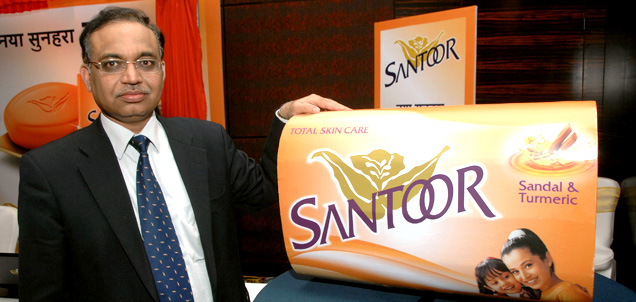
    Consistency in Communication: Anil Chugh, Senior VP, Wipro Consumer Care with a Santoor signage


    By Tuhina Anand


    Did you know that Santoor is the third largest soap brand in India? The brand, belonging to Wipro Consumer Care, has done well for itself by beating the international biggies and carving a niche for itself since it was launched in 1986. In the past 25 years, the run for the brand was not always so good, but a consistent and strategic communication has played a pivotal role in its success. Santoor is a Rs1,000 crore brand and has been growing at a CAGR of 23 per cent for the last five years.


    The communication has always focused on ‘younger looking skin’, but the portrayal has changed with the times to appeal women, who were earlier seen as homemakers to now those who excel in various professions – mirroring the changing aspirations of Indian women.


    Giving an insight into the Santoor story, Anil Chugh, Senior Vice President, Wipro Consumer Care, said: “Santoor is the third largest soap brand in India and the largest selling brand in the South + West India (value MS – 13.5 per cent). The ‘ageless skin’ campaigns and innovative marketing strategies have helped Santoor grow faster than the industry and gaining share over the years. One of the reasons for this is the consistency in communicating our core proposition of younger looking skin while keeping the message contemporary over the years. Also, our focus on providing the right value to the customer has contributed significantly to the brand’s success. The growth was also achieved on the back of a strong distribution network and communication in rural areas.”


    He added: “The strength of Santoor has been its promise which is consistent, powerful and eternally relevant to consumers. For over 25 years, the brand has delivered on the promise of ‘younger looking skin’ through superior product offerings which have used deep acting and trusted natural ingredients. Our campaigns have reinforced this message consistently. Over the years, Santoor has carefully chosen celebrities to endorse the brand and it has worked well for the brand.”


    While factors like distribution cannot be overlooked in the success of Santoor, the communication has been one of the key pillars. However, this was not the case always. MG Parameswaran, Executive Director & CEO, Draftfcb + Ulka elaborated: “When Ulka Advertising was assigned the brand in 1988, it was in a bit of a limbo, growth had stalled. The agency evolved the ‘younger looking skin’ and ‘mistaken identity’ as the key pillars for the brand. The advertising created history of sorts. The brand growth picked up momentum and Wipro has ensured that marketing money was well spent, through judicious correction in the messaging of the brand.”


    “In 1989, Santoor was basically selling in two states of Kerala and Karnataka. It was selling a fraction of what brands like Hamam, Rexona, Cinthol and Liril were selling. By focussing advertising on one promise and evolving it over time, Santoor has become one of the top three soap brands in the country.


    The advertising has evolved in many ways, but the core message of ‘natural ingredients for a young looking skin that will get you accolades’ has not changed. But the Santoor woman has evolved from being a pretty woman at a wedding to a confident woman who is doing aerobics, to a woman who plays cricket with her daughter, to a dress designer, to a TV anchor to a choreographer to a photographer. In a sense, the brand has reflected the aspirations of the new Indian woman,” added Mr Parameswaran.


    He is very clear that the success of its communication is purely because it tells a timeless story that always appeals. As he puts it succinctly, Santoor is about consistency in communication that adds a new layer with every new piece.


    In fact, as Santoor completes its 25 years, it has come out with a new campaign that is the Santoor anthem, giving it a contemporary look and feel yet telling the same story about a mother and daughter. The new advertising campaign features two ads – an anthem film that celebrates the achievement and pride of millions of Santoor women and a new theme film with new brand ambassadors – Saif Ali Khan and Mahesh Babu.


    Over the past few years, Santoor has grown from a single soap brand to talcs, deodorants, soap variants, liquid soap, facewash and so on. Mr Chugh said: “We will continue with our quest to keep the brand relevant and contemporary even in the future. The aim of new campaign is to take the Santoor brand to the ‘next level’. We are constantly looking at consumer needs and expanding/enhancing the brand to meet such needs. The brand has grown ahead of the competition in its core states and is now trying to break out of its traditional stronghold and make quick gains in other markets.”


    As a concluding note, Mr Parameswaran, who has been associated with the brand for almost two decades, said: “I am proud to have been associated with the brand for almost two decades. What is unique about the Santoor story is the great trust and regard this brand has spawned between the agency and client. It is has been a wonderfully rewarding experience and all of us in Draftfcb Ulka are proud of the association. It is not easy to take on large well-heeled multinational FMCG behemoths; we took them on and managed to find a place for Santoor under the Indian sun. The story is far from over. Santoor won against all odds and it will keep winning. I am sure of that.”


  • ‘Content not big celebs get in numbers’

    By Meghna Sharma


    Ashish Golwalkar

    Zee TV danced its way to the #2 slot amongst Hindi GECs as its Dance India Dance Little Masters (DID L’il Masters) leapfrogged to ratings of 6.2. Commenting on the reason why kiddie reality shows work, Ashish Golwalkar, Non Fiction Head, Zee TV, said: “The kids’ versionsof both Sa Re Ga Ma Pa and DID have done well. Kids bring out the universal emotion that connects with all; and with the holiday season on, the show makes for great television viewing for families. The talent that has auditioned for the show is superlative and watching them makes it aspirational for the kids and emotional for the parents.”


    The network which has various non-fictional shows to its credit believes in focusing on different genres. “We’re the pioneers of shows like Saanp Seedi, Sa Re Ga Ma Pa, Antakshari, Khana Khazana, and others and our non-fiction has always delivered. The feeling that only big celebrities garner high ratings is not true. It’s the content that connects with the audience and that’s what gets in the numbers,” added Mr Golwalkar.


    Akash Chawla

    The channel has done extensive marketing for the show. “Understanding the power of dance as an audio-visual treat, we wanted to promote DID L’il Masters through various audio visual means and hence, strategically focused on television and active online engagement. Through this, the extreme talent, skills, intrigue and the innocent attitude of the kids was highlighted which made the promos entertaining and endearing. The ‘Dance ke baap’ philosophy from the first season was further extended to ‘Yeh Badon Ke Bas Ki Baat Nahin’,” said Akash Chawla, ZEEL – Marketing Head, National Channels.


    Exclusive dance acts were showcased on the DID Youtube channel and also promoted across active social communities of DID 3. Glimpses of the show were integrated into DID 3 and other fiction shows on Zee TV creating high anticipation for the show. Talking about retaining the same ratings for the show in the coming episodes, Mr Golwalkar said: “Due to its nature, the audition episodes always rate higher, but we will try to maintain/sustain these ratings after the Top 16 are announced.”


    The channel also has plans to launch a few more new non-fictional and fictional shows for weekdays and weekend slots. Talk shows being one of the genres which the channel doesn’t mind exploring in the near future. “The television landscape has changed since the first season with more time bands, more shows and varied reality genres,” added Mr Golwalkar.