Blog

  • Mediaah! Broadcasters suffer with ad restrictions while print & web publishers have fun

    By Pradyuman Maheshwari


    So the TRAI has finally chosen to subject the television channels to its regulation over ad duration in the guise of quality of service. Assorted politicians and consumer groups who’ve been complaining about the ads on telly should be happy, but I would see the development as unfortunate.


    Yes, some of the practices adopted by our broadcasters are reprehensible. They deserve to be damned.  But should the government directly or via a regulator like TRAI be getting into the act? I don’t think it should.


    Market forces will force channels to ensure viewer experience isn’t impacted beyond a point. In fact in the chase for ratings, the entertainment-wallahs have already done that.


    My heart goes out to the news channels who are going to be impacted the maximum. Ads in the form of tickers etc amount to revenues of around Rs 100 crore across channels, I was told.


    The battle is going to move to the Courts/TDSAT, I am told. I hope the learned souls there see reason.


    What about other media?

    If broadcasters get carried away with commercials and if the government and/or TRAI sincerely believe that they are taking consumers for a ride, then what about newspapers, radio and the internet?


    Full page ads on Page 1, half-jackets, ads flowing through editorial… etc etc etc. All of this in print.  Radio has ads camouflaged as RJ mentions. On the web: innumerable innovations, site captures, interstitials, awful and annoying innovations done by some of the trade sites.  And then innumerable advertising mailers. I must add here MxMIndia too carries site captures and while we don’t send more 5-6 mailers or at most 10 a day, guess we’re getting there.


    Now, other than our readers cursing the publications in question, there’s no one stopping the print and web players from carrying intrusive adverising. Also, the ad-edit ratio can well exceed 70-30 on big occasions like Diwali or Akshya Tritiya.


    Wanted a top quality lobbyist for TV!

    Perhaps the television industry must hire a top draw bureaucrat to lobby its case to the powers that be. The fact is that the Indian government policies are skewed against the television media. Even on issues like service tax, while advertisers don’t have to pay any levy for an ad in print, they’ve got to cough up the entire 12.36% for TV, the web and I guess radio too.


    Even though television has some rather powerful players, it’s evident that the print folks command more respect. Or at least the government tries to not meddle in their affairs.


    It’s not that established print players don’t have a broadcast interest… we have BCCL, India Today, ABP, Malayala Manorma, Lokmat, Sakal, Mathrubhoomi and Eenadu amongst others, but it’s just that they are more revered for print than television.


    Now that INS president Ashish Bagga also heads up the TV Today Network as CEO of the India Today group and the MCCS channels are better integrated in the ABP group, perhaps the old warhorses must exert pressure.


    Buzz me if you have a story to tell. Confidentiality assured. There are various ways you can reach me:

    pradyumanm[at]mxmindia.com, BBM 23050B5D, Gtalk pradyumanm@gmail.com, Twitter @pmahesh and of course the mobile: 98338 76278.


    Disclaimer: Although he is CEO and Editor-in-Chief of this site, Pradyuman Maheshwari’s views in Mediaah! are not necessarily those of the rest of the team and MxMIndia.com.


  • More Mediaah!: Indian Express, Shekhar Gupta & Co send notice to Open, Vinod Mehta. Demand Rs 500 cr as damages

    By Pradyuman Maheshwari


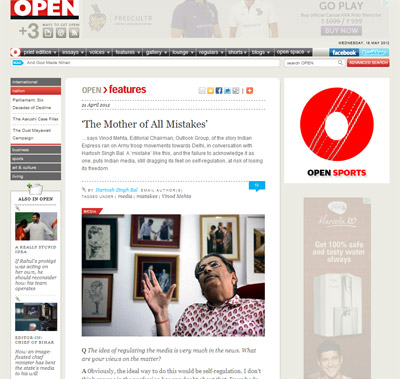
    The Indian Express group and four of its senior journalists (including editor-in-chief Shekhar Gupta) have sent a legal notice to Open magazine, its editor and other professionals. And above all to Vinod Mehta. The reason: in an interview to Open, Outlook’s Vinod Mehta rubbished the Express expose of a coup-like situation in the Capital.


    The Express is also upset with the publication of reactions that the interview elicited.


    I strongly recommend a read of the legal notice (currently posted in a blog that seems to have been created for the purpose — http://nobodyisusingthedword.wordpress.com/2012/05/15/indian-express- shekhar-gupta-threatens-to-sue-vinod-mehta-hartosh-singh-bal-open-magazine-c-repor/ .  Please don’t miss Pages 6 and 7, where the notice highlights a contradiction in Mehta’s statement on how he quit The Independent in the interview (as also made in a speech at the Press Club Bombay awards recently) and his book Lucknow Boy.


    The lawyer has asked for an apology, removal of the interview from the site and Rs 100 crore each for her clients. Note the money must be remitted even after the publication of the apology.


    Mediaah! view: I think the Express should’ve just let the interview be (link: http://www.openthemagazine.com/ article/nation/the-mother-of-all-mistakes). I don’t think the interview is damning the reputation of the Express or its editor-in-chief. And even if there is a belief that Vinod Mehta ought not to have said what he did and Open shouldn’t have published it especially since the coup story hasn’t been proven to be wrong, initiating a legal procedure is perhaps a bit much.


    Moreover, though it has established itself as an independent, gutsy publication, Open isn’t mass-circulated as, say, The Times of India. I must confess that even though I had been told about the interview, I read it only yesterday, after I heard of the notice. There is sure to be a fair bit of buzz in the social networks.


    I spoke to a senior member of the Open team who said the company lawyer was planning to respond to the notice and the magazine has no plans to pull the story off the Web.


    Final words: It’s imperative that while the media subjects everyone to criticism, it must be willing to take the heat whenever it’s subjected to it. Now, let’s hope Mediaah! doesn’t get a legal notice for writing all of this 🙂


    Buzz me if you have a story to tell. Confidentiality assured. There are various ways you can reach me:

    pradyumanm[at]mxmindia.com, BBM 23050B5D, Gtalk pradyumanm@gmail.com, Twitter @pmahesh and of course the mobile: 98338 76278.


    Disclaimer: Although he is CEO and Editor-in-Chief of this site, Pradyuman Maheshwari’s views in Mediaah! are not necessarily those of the rest of the team and MxMIndia.com.


  • HUL on a roll with Nitin Paranjpe at wheel

    By Kala Vijayraghavan & Sagar Malviya


    When Nitin Paranjpe took over at the helm of Hindustan Unilever Ltd (HUL) in April 2008 at 44, he became the youngest chief executive to head the Anglo-Dutch consumer products giant’s Indian operations. Now Mr Paranjpe has another one for the record books – he is the only CEO in the past two decades to be recommended by the board for a second stint.


    The man, who joined HUL way back in 1987 as a management trainee, has been reappointed managing director & CEO for another five years beginning April 2013. The longest serving head of HUL was Ashok Ganguly, who was chairman from 1980-1990.


    Of course, there is little guarantee that Mr Paranjpe would continue as CEO till 2018, what with previous CEOs – from Keki Dadiseth to MS Banga – going on to assume larger responsibilities at the parent company, during their stints.


    Paranjpe’s imminent second stint is just what the doctor – Unilever CEO Paul Polman – ordered. In 2010, Mr Polman, the first outsider to head the $40-billion consumer goods giant, mandated longer tenures for the top and middle management. Polman’s directive was to ensure greater organisational stability while tackling increasing competition and business volatility. The CEO’s view was that management stability would ensure quicker decision-making and accountability.


    That’s certainly been the case at HUL; and those benefits have translated in creation of shareholder value. When Mr Paranjpe took charge in 2008, the HUL stock was quoting around 230 levels. Today it is 87per cent higher at a little over 430; the benchmark Sensex has fallen 2.8per cent during the same period.


    Over the past two years, Mr Paranjpe added some 4,500 crore – quite literally the size of some mid-sized rivals – to its top line by increasing sales from Rs17,873 crore in fiscal 2010 to Rs22,394 in fiscal 2012 – a compounded annual growth of 12 per cent. “We want to set goals that are so audacious that, even if they are missed, the performance is still heroic,” Mr Paranjpe told ET.


    “There is an obsessive focus on the consumer that goes beyond just slogans and ensures execution. We are now gearing the organisation to future-proof the business through innovation, improving product quality, dramatically raising execution capability and ruthlessly focusing on costs,” he added. And then there’s the supply chain where the CEO says he “wants to be the best at both ends of the market, the top and bottom. There will be no compromises at any end.”


    The relentless consumer focus – the shareholder cannot be ahead of the consumer, avers Paranjpe – manifests itself in initiatives like Mission Bush Fire, an employee-led market execution and customer interaction exercise initiated in 2010 to get the home & personal care giant to connect with the market place. HUL CEO Nitin Paranjpe and every member of the company’s management committee participate in this project to get direct feedback on how HUL brands are faring.


    “Bush Fire has resulted in a 40 per cent spike in sales in stores wherever the initiative has been implemented, according to internal company estimates. And HUL managers say Paranjpe has led from the front. “There is nothing he expects us to do that he has not done himself. Nitin is out on the road making customer visits almost 15 days a month,” said a senior company official.


    Analysts are calling it a dream run. Abneesh Roy, associate director, institutional equities, research, Edelweiss Securities said: “HUL is in a growth phase with Paranjpe leading from the front with vigour and stability. His reappointment is a move by Unilever to reward his performance and execution capabilities as CEO.”


    HUL’s sales have been growing not just by value over the past several quarters, but also consistently recorded volume growth that is ahead of the market. Despite a spurt in input costs and aggressive spends in ramping up distribution, HUL has maintained its 2008 operating margin at 14.1 per cent during the last fiscal year.


    Company watchers say Mr Polman too deserves credit for HUL’s outperformance as it was the global CEO who injected a sense of aggression and put in place a performance culture across Unilever globally by linking rewards to results. For instance, it was Mr Polman’s decision to hike variable pay to as much as 50 per cent of total salary from 30 per cent as this would lead to hefty bonuses for those who deliver and penalise those who don’t. “We want to strengthen our performance culture and be intolerant of incompetence. Consumer centricity must be a non-negotiable in business and so we have put a lot of pressure internally so that we delight externally,” said Mr Paranjpe.


    Source: The Economic Times
    Copyright © 2012, Bennett, Coleman & Co. Ltd. All Rights Reserved


  • Broadcasters slam TRAI notification to limit ads

    By A Correspondent


    Broadcasters and advertisers have slammed Telecom Regulatory Authority of India (Trai) move to limit the duration of television advertisements to 12 minutes in an hour, and accused the regulator of exceeding its brief.


    A new notification issued by the regulator on Monday limited the amount of advertising on TV channels and disallowed any shortfall in a particular hour to be carried over. According to industry estimates, this could impact advertising revenues of broadcasters by 15-40 per cent.


    “Trai has no jurisdiction in the subject. Advertising is governed by the Cable and Satellite Act and the appropriate authority is the ministry of information and broadcasting,” said Uday Shankar, president of the Indian Broadcasting Foundation, and the chief executive officer of Star India. “The regulator is overstepping its brief,” he added.


    According to Mr Shankar, the low revenues from subscriptions give broadcasters no option but to rely on advertising inventory and revenues to survive.


    An Indian Broadcasting Foundation official said an earlier government guideline stipulated that Trai could issue an advisory with regard to advertising but not a notification.


    Sunil Lulla, managing director and chief executive officer of Times Television Network, which runs Times Now, ET Now and Movies Now channels, too criticised Trai’s decision. “This move is completely ridiculous. Self regulation is the best regulation,” he said.


    “This move will have an immediate impact because right now there is no other big source of revenue for broadcasters,” said Rohit Gupta, president of Multi Screen Media, the company which runs Sony Entertainment Television. The IBF will appeal against this new regulation, he added.


    Barun Das, chief executive officer of Zee News, questioned the timing of the regulation at a time when the entire broadcasting industry was going digital. “We have a limit mentioned in the Cable Act. If at all there is a need for regulating duration of advertising, it possibly could have waited some more time for the digitisation process to settle down.” he said.


    Mr Das said his channel had voluntarily cut its advertising inventory by 30per cent earlier this year. “We realise that too much advertising is a deterrent to viewership. We were not driven by regulations, rather we were driven by market forces,” he said.


    Mr Das said the viewers had choices not only of channels but also of media platforms. “I am not sure if advertising volume needs to be regulated. I would tend to believe that too much advertising would anyway drive away viewers,” he added.


    Sale of television rights have become an important source of income for sports bodies such as BCCI but the restriction on advertising will adversely impact the ability of broadcasters to recoup their investments, forcing them to scale down their bids.


    Source: The Economic Times
    Copyright © 2012, Bennett, Coleman & Co. Ltd. All Rights Reserved


  • Bates boss-to-be plans big


    Sanjay Thapar, Group President, North & East, and member India Board, Ogilvy India is all geared to take one of the most challenging jobs of Indian advertising in the current times – that of reviving Bates India. He is set to take the mantle as the CEO of Bates India. The agency has gone through a lot of upheaval in recent times and Mr Thapar’s job is definitely not a simple one but the man has proved his mettle in his past assignments. Will he be able to pull this one off? Mr Thapar in conversation with Tuhina Anand of MxMIndia, talks about this and more.


    What prompted you to take this role at Bates?

    During my career, I have done many different roles and I have donned multiple roles specific to communication too. Each one has come with different challenges and each challenge brings with it a unique set of opportunities that has given me the chance to learn and grow. I guess I love each one of them, especially if they are different, and this is one of them.


    Don’t you think that after the entire churn that the agency has gone through, you have a tough job to keep?

    As I said, each job or each role has its challenges and this one is no different. Of course, the job is challenging, but that’s what makes it so interesting.


    What will be the tasks on hand once you join the agency?

    Bates has had its share of glory in the past, and currently it is a robust agency with a good pedigree and foundation. My job is to build on its strength and make it shine again. I would love to see the agency double its business in the next 3 years.


    You are an old hand at Ogilvy, though it is within the network, how easy or difficult is the switch for you?

    It’s been 14 years with Ogilvy and that is a long time. Sure, it’s difficult – it’s like moving to a different part of the family. Thankfully, it’s the same family and that’s what made the decision somewhat easier. Being part of the same group, we do share similar values and are culturally alike. That surely helps.


    It is known that Bates didn’t perform in the last year, can you share any strategy that you would adopt to turn around the agency?

    It’s too early for me to comment on this. I take my position with Bates sometime early July and I can only comment once I get there. One thing is clear though, it’s the people who make the place and I am sure we still have many of them at Bates.


    How do you view this opportunity?

    Interesting and Challenging.


    At Ogilvy, what would you say has been your achievement and also share some of your learnings.

    I have played many a parts at Ogilvy. Some of the most significant ones would include the turnaround of Kolkata office, which is also as it was my first role at Ogilvy. Another would be achieving significantly higher levels of growth in Delhi, which brought the office to its current position, both in size and stature. I can also recall helping to set up Ogilvy’s Shopper marketing practice as another achievement and learning.


    Along the way, I have learnt many lessons, which include when to be aggressive, when to be humble, when to accept situations and when to fight them. The most significant of them is the art of collaboration. Our business has so many people, each with different skills/strengths, yet it is a must that they combine well and that is when magic happens.


  • Mahindra Retail launches ‘Mother’s World’

    By A Correspondent


    Taking another step in cementing their philosophy of striking innovations that enrich communities and enable people to rise, Mom & Me, the flagship brand of Mahindra Retail is introducing its first ever publishing initiative with the launch of a maternity magazine titled ‘Mother’s World’. This new consumer-centric initiative is an extension to their commitment to provide relevant information, assistance, tips and guidance to the world of early parenthood.


    After their very successful venture into retail with Mom & Me, Mahindra Retail will now focus on providing expecting and new mothers with world class services to care for their bodies and souls during the fragile and overwhelming beginning to motherhood.


    Commenting on the launch of Mother’s World magazine, K Venkatraman, CEO, Mahindra Retail said: “Today’s mothers are highly involved decision-makers and look deeply into every aspect of their babies’ well being. The launch of the magazine marks our commitment to consumer-centric initiatives, and we hope this magazine will be a perfect companion for parents.”


    The inaugural issue offers readers a host of stories, features, tips and advice. It also speaks to three celebrity moms – Sonali Kulkarni, Tara Sharma and Mandira Bedi and their experiences of motherhood.


    Mother’s World magazine serves as an extensive and comprehensive guide for young parents to deal with parenthood and its challenges. With this subscription based magazine for parents-to-be, Mahindra Retail aims to provide insightful information, carefully researched articles and quotes from real parents who share their experiences, besides tips on fashion trends in maternity wear.


    The magazine has been divided into relevant sections covering all aspects of parenthood: conception, infancy, toddler hood and relationships, with all the information verified by in-house experts.


    While Mother’s World magazine adopts a serious approach to parenting, it does have a light-hearted side to it as well with lots of tips, tweets and fun facts about pregnancy on almost every page. It also features a host of relevant products, all easily available to the reader at Mom & Me stores. What also sets the magazine apart is its take on lifestyle and fashion. From maternity fashion to toddler fashion – beautifully taken, theme-based shots give the magazine that classy edge. Occasional celebrity covers, photographs and interviews set Mother’s World distinctly apart from other parenting magazines inIndia.


    Mother’s World quarterly issue will be available on stands across the country from May 14, at a cost of Rs100.


    Mahindra Retail is an extension of the $14.4 billion Mahindra Group’s trading foray in the domesticIndiamarket. The Group believes that this is the favourable time to extend its distribution business into direct retailing, when the organized retail market is expanding inIndia.


  • Radio City renews sales alliance with Friends FM

    By A Correspondent


    Radio City, the FM radio brand promoted by Music Broadcast Private Limited (MBPL) has renewed its strategic sales alliance with the Kolkata based Friends FM, the FM radio arm of ABP (Ananda Bazar Patrika) for another one year term. The strategic sales alliance between the two stations has completed nearly three years.


    Of the 20 cities, Kolkata remains the only big market where Radio City is not present, thus the sales alliance allows Radio City to extend its sales reach to Kolkata as well. Besides Friends FM, Radio City is also in sales alliance withGwaliorbased FM radio station, Suno Lemon.


    Speaking to MxMIndia, Ashit Kukian, COO (Chief Operating Officer), Radio City said: “Strategic sales alliance has worked for us. We are already in our third year of strategic sales alliance with Friends FM and have, in fact, renewed it again. It helps a single station to sell their brand nationally because it is very difficult to sustain the cost of placing people nationally. As for Radio City , this alliance helps us reach out to a critical market – Kolkata where we are not present. Besides Friends FM, we also have a strategic alliance with Suno Lemon inGwalior, and once the third phase is rolled out, we will strategize how to reach out to rest of the markets.”


    Radio City had recently announced its decision to increase its ad rates by 15 to 20 per cent, which it believes will result in better ROI for its clients. Some of its telecom clients include Tata Docomo, Vodafone, Idea, and Airtel, while FMCG, Consumer Durables, Automobiles, Realty Estate and media are some other advertising categories that advertise on radio. The retail versus national advertising ratio in Radio City is currently around 35:65 per cent – 35 per cent from retail and 65 per cent from national advertisers.


    Currently, Radio City is present in 20 cities namely, Mumbai, Delhi, Bangalore, Chennai, Ahmedabad, Pune, Hyderabad, Lucknow, Jaipur, Vadodara, Surat, Sholapur, Nagpur, Sangli, Coimbatore, Vizag, Ahmednagar, Akola, Nanded and Jalgaon.


    In the last couple of years, Radio City is said to have established and rolled out a lot of 360 degree marquee campaigns. Following the season one success of its property, Gully Premier League (GPL), Radio City is back with the Season 2 of GPL. Season two of the GPL is said to have already registered more than 14,000 teams for the tournament. Mr Kukian also pointed out that BTL (Below the Line) activations which has been witnessing growth over the years, have contributed significantly to the overall revenues of Radio City : “Our BTL activations have also been growing from strength to strength, moreover our activations last year contributed significantly to our overall revenues. From a radio industry perspective, BTL activations could be around 12 to 15 per cent of the overall revenues, whereas the BTL activations of Radio City alone contribute around 10 to 12 per cent of its overall revenues.” Therefore we are very much in sync with the contribution of BTL activations in the overall revenues.


    Mr Kukian was also of the view that besides FTCs, a radio station, and Radio City in particular, has multiple sources of revenues, activations and on ground propositions are a couple of them. He was also of the view that in the long run, he expects to see further growth in the contribution of these other revenue sources in a radio station’s overall revenues. “Since the medium is high on reach and content, customised syndication of content can be another source of revenue for the industry. In addition to this, we can also look at digital content syndication and monitisation as an extended source of revenue for Radio City .”


    “As of today, 15 per cent of our revenue comes from other sources but, over a period of time I believe these revenue sources could contribute to around 22 to 25 per cent of the entire revenue,” he added.


    Mr Kukian said that 2012 has been the best year so far for the FM station since the last three or four years. He went on to add that Radio City has been consistent in its leadership position in both Bengaluru and Mumbai. In Delhi too, it witnessed an increase in listenership numbers: “According to IRS, Q4 2012 we are ranked first or second across most of the non-metro cities in which we are present in. So from a product perspective, it has been a great year. As far as the revenues are concerned, we have always been doing well, in fact this year we have almost doubled the growth over the market category. Even in terms of talent, we have witnessed consistency in the low attrition rates. And with phase III coming up, we are clear about expanding our network to many more markets and increase our foot print panIndia” he said.


  • Anil Thakraney: Balika Vadhu: 1000! Wow!

    By Anil Thakraney


    I don’t watch many TV soaps these days, and to claim that I am too busy for such mindless entertainment will be a fashionable excuse to give. The truth is that most serials haven’t caught my attention in recent years, simply because the plots are either uninteresting or rehashed. But one soap has made the cut for me, I still watch it whenever I am at home at 8pm. And that’s Balika Vadhu.


    And I was staggered to hear that the serial has just completed 1000 episodes. That’s a lot of airtime by any stretch of imagination. While it may no longer be No 1 on the ratings chart, it’s equally true that Balika continues to hold the nation’s living rooms enthralled. The loyalists have remained with it for years.


    The story of Balika is indeed the story of Colors itself. The show provided a massive launch platform for the channel, and the latter hasn’t looked back since then. I think the main reason the soap has held its own for so long is that when it first hit the small screen, viewers had begun to tire of all those over-the-top saas-bahu dramas set in a Juhu villa. The garish make-up, the hamming, the shrieks of the women in the huge household, dead characters suddenly springing to life, etc… the nation was ready for some real freshness.


    Balika quietly came and filled the vacuum. The setting was rural, the characters very real. Simple people who acted simply and were true-to-life. The child marriage story was, of course, the novelty. It worked, and the characters instantly became household names. But what’s most important is that the makers of the show did not lose steam along the way. Even as there’s been a time jump, the characters remain grounded in reality, and we connect with their problems and their life dilemmas. In one word I would say Balika’s success is embedded in its sincerity. Sincerity of its actors and its directors.


    I am not sure how much longer the serial will continue. 1000 episodes is already a huge run. But I am certain to be there till the last ball is bowled.


    * * *


    PS: To celebrate this year’s Cannes Film Fest, some art directors have re-created posters for iconic films. Wonderful. Gives me an idea: Why don’t contemporary art directors from our ad world re-create posters for legendary ads from the bygone era?

    Should be fun. Perhaps a competition can be held to make this happen. This will also

    help art directors in ad agencies make their presence felt.


    Link: http://www.booooooom.com/2012/05/08/little-white-lies-x-colette-movie-posters/

  • ASCI upholds complaints against 12 ads

    By A Correspondent


    During March and April 2012, the Consumer Complaints Council (CCC) of ASCI, upheld complaints against 12 advertisements, most of them part of the healthcare and/or personal hygiene sector. During the same time, the CCC did not uphold complaints made against 12 advertisements.


    Euro Fashion Inners received complaints against its print advertisement published across newspapers across the country.  As per the complaint, the advertisement shows “naked men holding cockerels against their pelvic region while asking ‘what’s your size’?” This advertisement was seen as obscene and seriously offensive to public decency. The CCC concluded that the advertisement was indecent, vulgar and repulsive, likely to cause grave or wide spread offence. The complaint against the advertisement was Upheld and the advertiser was asked to stop the campaign.


    Sareen Hair Clinic’s advertisement stated that “Hair re-growth – also treatment for hair falling, baldness, alopecia, and thinning of hair. Non surgical hair replacement – painless, totally natural, completely undetectable, look younger in just 120 days, surgical hair replacement – get your hair back naturally in just 1 day procedure.” The advertiser did not provide any proof or supporting clinical information, neither were any details provided on reports of tests/trails conducted from an independent recognized testing institution. In the absence of supporting clinical information from the advertiser, the CCC concluded that the advertisement is likely to mislead consumers. Hence, the complaint against this advertisement was Upheld.


    Fit and Fine Slimming Centre and Beauty Clinic was under the scanner for their advertisement which claimed that “Reduce upto 5 kg, Lose up to 15 inches with Ultra Lypolysis Program, Advanced treatment free”. The advertiser failed to provide  data or supporting technical information with details of reports of tests/ trails conducted by an independent recognized testing institution, in substantiation of these claims. In the absence of supporting clinical information, the CCC concluded that all claims mentioned in the advertisement were not substantiated and the complaint was Upheld.


    Fair Pharma was pulled up for their advertisement that states “Cancer – We open for you the door back to life”. The treatment given by Fair Pharma for curing Cancer is not provided and the claim implies assuring consumers of curing cancer, which is a false claim. The claim needs to be substantiated with data based on independent scientific research. Since the advertiser failed to respond to ASCI’s letter and in the absence of supporting clinical information, it was concluded that the advertisement could be misleading and could cause wide spread grievance. Hence the complaint was Upheld.


    The advertisement of Smart Careers (BBS/BBA), claimed “guaranteed College Admission”. This claim was not backed or substantiated with data or evidence. Also, there was no validation provided by an independent agency to confirm the claim. In the absence of any proof, it was concluded that the advertisement contravened Clause 3 of the aSCI Guidelines for Advertising of Educational Institutions and Programs and hence this complaint was Upheld.


    Similarly, the advertisement of Career Launcher (IIM Calls) was pulled up for their claim “24 YLP admits in ISB.” In the absence of any verification of claims from an independent body, the CCC concluded that the advertisement contravened chapter 1.1 of the code and the complaint was Upheld.


    Stoss Welle Healthcare was under the radar for their advertisement which states “Many suffer from erection related problems/ pre-mature ejaculation/ leakage of urine/ difficulty in urination. Are you one of them? Obtain desired results with the help of latest proven state-of-the-art non surgical Swiss Technology.” Advertiser must provide proof, supporting clinical information, with details of report of tests and trials conducted from independent recognized testing institutions. In the absence of supporting clinical information, the CCC concluded that the claims mentioned in the advertisement and cited in the complaint, were not substantiated. Hence, this complaint was Upheld.


    Shree Baidyanath Ayurved Bhavan P Ltd’s advertisement on Rheumartho Gold Capsules stated that “Enriched with most effective swarna bhasma and salal guggul; Offer lasting relief from backache, joint pain, muscular pain etc; Helps to treat the root cause of pain and Helps to regain the flexibility of joints”. Advertiser should provide proof, supporting clinical information, with details of test/trials reports conducted from an independent recognized testing body in order to substantiate these claims. However, in the absence of adequate clinical information, the CCC concluded that the claims mentioned in the advertisement and cited in the complaint were not substantiated and therefore this complaint was Upheld.


    In April, media house Dainik Jagran’s 2 advertisements were pulled up for being false and misleading. For their claim, “Haryana mein Dainik Jagran 2 guna Dainik Bhaskar se” Dainik Jagran has used the data of readership in the city of Faridabad and implied all state leadership. As a standard practice while comparing two publications, city data cannot and must not be referred to as state’s data. The CCC noted that the claim, ‘Haryana mein Dainik Jagran 2 guna Dainik Bhaskar se’ was not made on the basis Average Issue Readership (AIR), which was considered misleading.  On another occasion, their advertisement which stated that Dainik Jagran is “Haryana’s No.1 newspaper,” was also pulled up for misleading the readers by using visual aids to create the illusion of its leadership and gap between the newspaper brands. Complaints against both these print advertisements were Upheld for being false and misleading.


    Vodafone, which is usually known for their excellent taste in advertising, was under the radar in April, for their TVC which depicted school going kids getting attracted towards each other and fall in love. The CCC concluded that the sexualized subtext of young teens being attracted to one another was likely to cause grave and widespread offence. Hence, the complaint was Upheld.


    Pernod Ricard’s print advertisement on Absolut Kher, shows the visual depiction of a ‘bottle’ which is suggestive of a well known brand of liquor product – Absolut. The CCC concluded that the depiction of the bottle with the titles ‘Absolut’ was in violation of the ASCI Code as it propagated a product, the use of which is banned under the law. The complaint was Upheld.


    During the month of March, the CCC also received complaints against two advertisements of  Perfetti Van Melle, and one each against Gulf Oil India, HUL’s VIM Detergent Bar, and Cadbury India’s Perk Chocolate, Johnson’s Baby Top-To-Toe Wash, HUL’s Close Up toothpaste, Parle Mango Bite, Uninor, HUL’s Axe Shower Gel, and Tata Chemical Ltd’s Tata Swach Water Purifier. As these advertisements did not contravene ASCI’s codes or guidelines, the complaints were Not Upheld.


    Advertising Standards Council of India is a self regulatory voluntary organization of the advertising industry. The Role and Functioning of the ASCI & its Consumer Complaints Council (CCC) is dealing with complaints received from Consumers and Industry against advertisements which are considered as false, misleading, indecent, illegal, leading to unsafe practices, or unfair to competition, and consequently in contravention of the ASCI code for self-regulation in advertising.

     

  • The Anchor: Sevanti Ninan on 5 things she’d like to change about journalism today

    By Sevanti Ninan


    1. Its idea of what constitutes national

    Delhi and Mumbai.  At a pinch add Chennai and Kolkata, because Mamata and Jaya are there to provide copy.


    2. Its notion of public opinion

    What Twitter, Facebook and smses on TV are saying.  Get off the computer and hit the streets to find out what’s happening to those who are not on social networking sites? Na, that’s uncool. Besides being too much work.


    3. Its notion of the arts

    Movies, movies, Bollywood, Bollywood. Regional stars in the field of writing, art, music: confined to the regional press unless they know how to make the scene in Delhi or Mumbai.


    4. What makes news

    Political spats, crime, scams.  Social issues are for documentary film makers, unless Aamir Khan comes with the package.


    5. Its notion of what constitutes progress for both India and Bharat

    Sexy industries like telecom and IT. Education reporting means tracking the IITs. Health coverage means celebrity cancer. Primary health centres and anganwadis-what’s that and where would I find them?


    Sevanti Ninan is Editor, thehoot.org and Columnist, Mint


  • Fever’s Gaurav Sharma on New York Fest jury

    By A Correspondent


    New York festival, world’s best radio programming and promotions award, scheduled to be held in June will have Gaurav Sharma as one of the jurors this year, along with other Industry veterans from across the globe.


    Popularly known as ‘G’, Mr Sharma is the group programming head at Fever 104 FM and is the mastermind behind various breakthrough innovations at Fever 104 FM. The New York Festival platform is not new to Mr Sharma as he was here last year when Fever 104 FM was recognized and facilitated with 2 Gold grand trophies for  ‘Best sound’ & ‘Best Editing’ for its unique radio epic – Radio Ramayana.


    A penchant for music and a voice to croon makes Mr Sharma a true blue creative programming guy. He is an MBA and has extensive experience in leading creative & radio teams. Mr Sharma is always full of ideas and innovations and spontaneity is nature’s gift to him.


    Fever 104 FM, operated by HT Media Ltd, is available in Delhi, Mumbai, Bangalore and Kolkata with a vibrant, youthful, creative and interactive programming. HT Media Ltd’s association with Virgin brings global strengths and expertise in radio markets across the world including Bangkok, South Africa, Paris and Malaysia. With the best quality and most quantity of music on-air, constantly playing only the top contemporary hits Fever 104 FM is synonymous with less talk,  more music.


  • Marketers ride high on BIG regional music awards

    By A Correspondent


    The BIG Regional Music Awards, when announced recently, saw the industry and marketers alike sit up and notice. An offering from Reliance Broadcast Network’s radio division 92.7 BIG FM and intellectual property division BIG Live, the awards are tailored for the markets of Punjab, Central India, Bengal, Hyderabad, Maharashtra, Tamil Nadu and Karnataka. With the endeavour to recognize the excellence in regional music which will appeal to regional and local tastes, the company has seen some of the biggest brands from across the country associate with it.


    The BIG Regional Music Awards, now in its 2nd year, has the following brands come on board already and are further attracting marketers who see value in the offering:


    Award Sponsor
    BIG Punjabi Music Awards UKStudios: Title Sponsor
    Aircel: Powered by sponsor
    Tata Nano and Nirvana Greens: Associate sponsors
    BIGHindustanMusic Awards Tata Sumo Gold: Powered by sponsor
    Samsung Mobiles: Associate Sponsor
    BIG Bangla Music Awards Exide Batteries and Mashal Oil: Associate sponsor & vertical partner
    BIG Telugu Music Awards Bharathi Cements: Title sponsor
    Narayana: Powered by
    Nuzen: Associate sponsor


    With localization and regional markets being a growing focus for marketers today and with ROI being evaluated for the last buck spent, media platforms have to offer them what best meets their requirements with minimal spill-overs.


    92.7 BIG FM already boasts of a 45 city network, each with a distinct programming in the local language of the region – given that radio is a local medium and the ‘one shoe fits all’ formula doesn’t work. It is with this background that Reliance Broadcast went ahead and launched its regional awards, tailored for respective regions to meet focused and regional approaches of marketers.


    The BIG Regional Music Awards is the only regional awards platform which not only has a wide national reach but also empowers people to recognize regional musical excellence and is a true ‘people’s choice award. The awards will bring a wider reach and visibility to the brands associated thereby accelerating consumer approach.


    Commenting on this occasion, company spokesperson said: “We are happy to have partnered with each of these brands, each with a deep understanding of their target audiences and markets of focus. They have selected the awards basis their focus territories ensuring minimal spill-overs and local audience reach. Our multi-media approach only strengthens our offering and commitment to offer our partners optimal return on investment. We are confident to see more partners coming on board these uniquely designed awards.”


    Reliance Broadcast Network Limited is a multi-media entertainment conglomerate with play across radio, television, intellectual properties and out of home. It is part of the Reliance Group and specializes in creating and executing integrated media solutions for brands.