Blog

  • The Anchor: Satish Singh lists 10 reasons why outdoor scores over other media

    By Satish Singh


    1. Free Medium – No Cost of Consumption

    Unlike any other medium, where you require a subscription or purchase, OOH is free. You need to purchase a newspaper to see an ad in it. One must have satellite TV subscription to cable/DTH to see an advertisement. For OOH, there is no need to purchase anything. It is outside, on the streets and is free for everyone to see, read, understand and there is typically a call to action – like a Short code, Toll free, and so on.


    2. Zone Domination Approach

    A particular territory could be concentrated with the communication in a limited geographic area to create a domination effect. What we call a roadblock in Radio and TV can be achieved in greater magnitude with this kind of an approach. This leads to the word of mouth and viral scenario along with creation of buzz – which is more likely to give a media multiplier effect – eventually leading to a digital platform discussions on the social platforms.


    3. Reach + Frequency

    This is the typical Catch 22 one sees in media planning. OOH allows you to circumvent the inherent challenge of the choice between the two, by helping you be there and do that. It is the only medium that will give you the best of the aspects by meeting both at a miniscule portion of what the traditional media would drain the wallet at.


    4. Large scale empty canvas

    The scale is superb and gigantic. One has the opportunity to create an imaginative thought on the larger than life canvas.


    5. Dynamic Visual impact

    3D, Motion, Lights, day/night effect, the list is nearly inexhaustive. This is something that is very exclusive to OOH. No other media offers this aspect – be it print, television, social, digital, none. The fanfare around the medium is because of the ability to push your imaginative genius to the limits and beyond. Practically anything and everything can be accommodated in the dimensions of a media unit on OOH space.


    6. 24×7

    This medium is there for an exposure 24×7. It will be present for a minimum duration of 10 days (as per the local associations in cities acrossIndia) and cannot be missed if a person is late to watch a program or read the newspaper that day.


    7. No Avoidance – Virtually No OTS

    Because of the size and scale, it is virtually impossible to miss a display in a city and, therefore, we have virtually no OTS. It is as good as MUST SEE.


    8. Key Ingredient of LMC

    As the studies have proved, the Last Mile Connectivity has most bearing in the actual purchase of the product. This is the time when the POP/POS is preceded by the OOH to ensure the curiosity pull happens to the brand/product and the retail point takes it up from there to ensure a closure of purchase/sale.


    9. Region Specific Targeting

    The only medium that works better than that of the traditional media is OOH in this area. If you want minimal geographic spillover, this gives you a ZERO spillover. The kind of brands and products that have a certain geography have chosen this medium as the lead medium. Telecom is the finest example for this – every circle has a specific tariff, VAS offering, network and bouquet of services. The best way of communicating about the same is the OOH. Traditionally, the lead medium for the industry has been OOH.


    10. Day-part capturing

    Media Scheduling is a part of every planner’s life today. Application in OOH is next to impossible. But that thought has been vapourised with the newer and advanced ways of putting up media and removing the same. This enables us to capture the morning, noon and evening parts of the communication that is possible on the same medium without breaking much of a sweat.


    All in all, the Out-Of-Home media is a really flexible and robust area of communication and advertising wherein one can expect focussed geographies to be connected, without the risk factors of a traditional print and electronic or any other media which has an OTS. Outdoors is BIG, BOLD, BEAUTIFUL and UNMISSABLE.


    Satish Singh is President, Lakshya Media
     

  • Apology + Rs 500cr: Is Indian Express right in sending Open a legal notice?


    By Pradyuman Maheshwari and Shruti Pushkarna


    Shekhar Gupta

    It was the most read story on MxMIndia yesterday. As the news of the legal notice served by a lawyer representing Indian Express, Shekhar Gupta and three others filtered in, there were heated discussions in newsrooms on whether the Express and its legal eagles were right in serving a legal notice to Vinod Mehta, Open and its senior staffers.


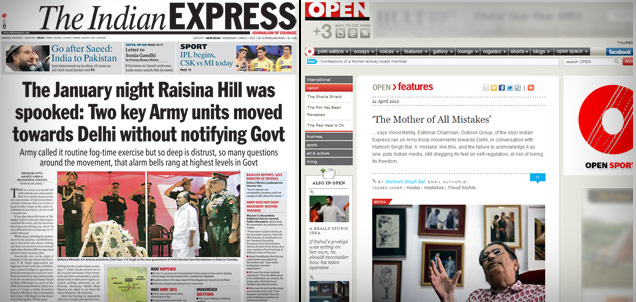
    First some background. On April 4, The Indian Express carried a story by editor-in-chief Shekhar Gupta with Ritu Sarin and Pranab Dhal Samanta on two key army units moving towards New Delhi without informing the government. Ajmer Singh contributed to the report.


    Vital Links
    The Indian Express report (April 4, epaper)
    The Open interview (April 21)
    The ‘notice’ (May 15, note: source unverified and unknown)

    There was outrage and denials issued by all and sundry in the government and armed forces. However, save the outbursts, it wasn’t proven that the Express story was incorrect.


    Meanwhile, ever since the report appeared, The Indian Express – while still respected as a no-nonsense, credible newspaper – was the butt of ridicule by commentators and on social networks. Those in print may have been a lot more gentle, but a few television discussions were indeed scathing.


    And then came this interview with Outlook’s editorial adviser (and former editor-in-chief) Vinod Mehta in newsmag Open on the issue. The headline of the interview said it all: The Mother of All Mistakes (issue dated April 21, 2012). In his inimitable style, Mr Mehta suggested that Mr Gupta was taken in by a story that was planted on the Express.


    While a magazine has a limited readership, since the article was freely available on the internet and it carried a very pointed allegation by one high profile editor on another, the interview viralled in the media fraternity a great deal.


    This legal notice by a lawyer representing The Indian Express and the four writers of the story – Shekhar Gupta, Ritu Sarin, Pranab Dhal Samanta and Ajmer Singh – came less than a month of the publication of the interview.


    One would’ve let the notice be, but its contents make for interesting reading. So while Mr Mehta may be suggesting in the interview (and he also said  amidst some cheer at the Press Club Bombay awards recently) that he quit the Independent owning moral responsibility of an incorrect story, the notice points out that in his memoirs (Lucknow Boy), he projects that he was compelled to do so. “Till now, I am unsure why I had to quit.”


    The notice asks for an apology and pulling the story off Open’s internet edition openthemagazine.com. At the time of filing this report, Open hasn’t done either and two senior staffers told MxMIndia that the magazine does not intend to do either.


    The notice also demands damages of Rs 100 crore each to the lawyer’s clients. That’s five of them – the Indian Express, Shekhar Gupta, Ritu Sarin, Pranab Dhal Samanta and Ajmer Singh. The Rs 500 crore damages have to be paid regardless of the apology.


    MxMIndia asked a few senior editors for their views on the issue. While many of them did not want to be drawn into the controversy, there were a few who told us that they didn’t know enough of the matter to be able to comment.


    Our questions were: Is the media too sensitive to criticism? Just as the Express, Shekhar Gupta & Co sent a legal notice to Open and Vinod Mehta, can governments, politicians, businesspersons and even film-makers who are critiqued by the media also send notices and ask for crores as damages?


    Here are reactions from four veteran commentators:

    Dileep Padgaonkar

    Dileep Padgaonkar, former editor-in-chief, The Times of India:

    Of course it is… the media is sensitive to criticism. The media thinks it is fit to criticise everyone but the minute everyone points a finger at the media, the media bristles. I think media should take criticism directed against it in its stride, this is part and parcel of democracy. And I don’t think one should be too prickly in these matters unless of course there is a clear case of personal attack, defamation… in that case legal course is available but otherwise one should ignore these things and go on.


    As it is, the censorship of cartoons was a dismal warning of the sensitivity of the political establishment. Now if media is going to go at another section of media, there is going to be a free-for-all and the big casualty out here would be good, decent, honest journalism.


    Sevanti Ninan

    Sevanti Ninan, editor, The Hoot, columnist and media-watcher:

    Criticism is not an accurate word for what Vinod Mehta called The Indian Express story. He essentially said it was a planted story and it was a huge mistake to carry it. Considering that the first byline on the story was that of the chief editor, that is quite statement to make. You are saying the chief editor and his colleague are susceptible to plants, thereby seriously questioning their credibility. So I guess the Express could hardly ignore it. IE did come in for a lot of criticism on the import of the story and the display given, including a critical editorial in the Hindu but nothing quite as damning as Mehta’s statements.


    This is the 3rd 100 crore notice involving the media over the past year, in any case. So it is becoming more common.


    Paranjoy Guha Thakurta

    Paranjoy Guha Thakurta, independent journalist and commentator:

    I think The Indian Express has over reacted. I think it’s gone a little over the top. They may disagree with what Vinod Mehta has said… my personal view is that it’s a point of view which obviously the Express doesn’t agree with but I don’t think that what Mr Mehta has said can be construed to be criminally defamatory. And the kind of damages sought are excessive. They are as excessive as the damages that Justice Sawant has sought from Times Now and what Times Now has sought from TheHoot. I mean these are ridiculous sums of money.


    I think we’ve become an extremely intolerant society. I think people talk about freedom of expression being a fundamental right but I don’t think people are really believing in Article 19(1)A of the Constitution of India. Like so many sections of Indian society, including our political leadership which is very upset about these political cartoons that have appeared in textbooks, I think even sections of the media are becoming extremely intolerant of criticism. If you are in a democracy, you have to give the right to everybody to disagree with you.


    Sucheta Dalal

    Sucheta Dalal, senior journalist and commentator, consulting editor, Moneylife:

    Well, not the media, but The Indian Express is too sensitive to critcism… It’s an interesting thing, it’s the first time it is happening and we should see where this goes, whether they follow through by actually filing a case. It’s the first time that somebody in the media is suing another person in the media, we need to look at how it goes… as I said everybody else is sensitive, everybody else does send defamation notices but I don’t know how many of those notices actually get converted into legal action. So we have to wait and watch.


    Otherwise the notice is also a way of making a point, it’s a way of putting pressure. It’s not just Vinod Mehta, if he looks at what was said about that story on the social media, then there are a lot more people that they would probably need to sue. So maybe he is making a case out of Vinod Mehta and Open magazine, we need to see whether they follow through. I would say that the test is not in the legal notice, the test is in seeing whether they are actually going to follow through, stand in court and argue it out.


  • Inext’s Ward Watch for civic issues

    By A Correspondent


    In an attempt to bring order to the ever chaotic city wards, Inext, from Jagran Prakashan, has launched a Ward Watch campaign, a three month long campaign which will focus on the civic infrastructure issues that plague the cities. It will highlight core areas which warrant serious attention like roads, sewage, power supply, water connections, garbage collection, which pose a big challenge for people to lead a healthy and risk free life.


    This drive covers over 500 wards across 10 cities includingKanpur,Allahabad,Ranchi,Gorakhpur,Agra,Varanasi,Meerut,Lucknow,PatnaandBareilly. Inext team will go from one ward to another, digging out problems that the residents face in their daily life due to lackadaisical attitude of authorities and the office bearers towards local area development. Inext, through this civic focused initiative, will pose direct questions to the policy makers by bringing the plight of the wards on a public forum. The corporators, councillors /parishads of the locality will be confronted and responses will be sought for the sorry state of affairs.


    Similarly, the residents are also invited to present their perspective on the health of their respective wards. Therefore, this not only provides masses a platform to voice their concerns through Inext, but also it will also open up a debate on the role of each of the stakeholders including the government, civic authorities and the people.


    Alok Sanwal, Editor, Inext explained the rationale behind this initiative: “Mini metros inIndiasuffer from a peculiar and perennial state of negligence as far as civic affairs are concerned. There are many pockets, where even very basic facilities like proper sanitation, power supply and garbage management are absent. Ward Watch will highlight the local problems by taking them up ward wise, for a deeper penetration. And Inext, being a youthful newspaper, through this initiative resonates with the realization of the need to change, a change that solves problems!”


    The idea behind Ward Watch is to sensitize people about their rights and to apprise the civic bodies about people’s expectations. In Inext’s efforts to reach out to the people, youth have shown tremendous enthusiasm and support to the cause.

  • Debrief: Cadbury Dairy Milk: Slice of sweetness

    By Anil Thakraney


    Cadbury Dairy Milk’s ‘sweet beginnings’ campaign introduces two more commercials.


    One involves a young girl who’s discovered she’s pregnant. And the other one features college ragging. I didn’t quite like the latter one (the chocolate is forced into the situation), so let’s just discuss the ‘pregnancy’ ad which I did like.


    The nervous girl finds out that she’s carrying. And is unsure of how to break this big news to her mate. So she rehearses the standard filmy lines in front of a mirror. But the man overhears her, and this leads to a sweet exchange between the two. And of course, Cadbury Dairy Milk happens as a natural extension.


    This ad works for me. Because the brand arrives seamlessly into the story, it isn’t forced. Also, the situation is very slice of life, many young people will identify with it.


    So this will strengthen empathy. But most importantly, the couple acts very naturally and convincingly (unlike the ‘ragging’ TVC), so full marks to the director.


    All in all, must say the ‘Shubh Aarambh’ campaign is progressing sweetly.


    Rating: (On a scale of 1 to 5): 3.5 Right situation. Good direction.


  • Planners happy with Satyamev’s 4.9 TVR

    By Meghna Sharma


    Star India’s much discussed show Satyamev Jayate which premiered across nine channels – Star Plus, Star Pravah, DD National, ETV, Star Utsav, Vijay, Star Jalsha, Star World & Asianet – on May 6 got a rating of an average 4 TVR for the CS4+ in the Hindi speaking markets and an average of 4.9 TVR for the All 4+, according to the TAM viewership data.


    The media planners are happy with the TVR of 4 and feel that it’s a good start for the show at the morning slot. “With Aamir Khan hosting the show and the whole secrecy about what the show is going to be, the show got its viewers. The slot worked too, as the repeat telecast has got a lower TVR than the morning slot. However, I was expected a rating of 5. In the metros the show has done extremely well but one cannot rule out DD’s reach too,” said Mona Jain, CEO, VivaKi Exchange.


    The show which marks the entry of Aamir Khan on the small screen does not fall into the typical ‘entertainment’ genre. The content is serious; however, it didn’t stop people from watching. The show reached 27 million people (All4+ category).


    “It’s a good TVR for a show at a Sunday morning time slot. But we’ll have to wait and watch if the show will be able to maintain it. However, without a doubt, one can agree with the fact that the time slot has worked for both the show as well as the channel,” said Jai Lala, Principal Partner – Exchange at MindShare.


    Agreeing with Mr Lala, Anil Sathiraju, Mudra Max Media, Head – South, explained that the 11am time slot on weekends is much better today: “The opening TVR for the show is 4, so it’s that context it might be around 3.2 or 3.4 in the coming weeks which will help the channel be on the top slot.”


    Sundeep Nagpal, director, Stratagem Media, predicted that the show might get a rating between 3.2 to 3.7 on Star Plus. According to TAM, it was able to get a rating of 3 on the channel: “It is unfortunate that the show got a rating of only 3. Social transformations cannot happen with a TVR of 3; it needs much more than that. It is a good property which advertisers should be happy to be associated with.”


    “For a show of such caliber and content, marketers should associate with it because it means quality viewership rather than the numbers,” said Mr Sathiraju.


  • Parle-G upgrades to Parle-G Gold

    By Tuhina Anand


    Parle-G, the biscuit that enjoys the unique position of being the largest selling biscuit in the world, has now launched Parle-G Gold. The variant adds the premium edge to the humble glucose biscuit, which is the USP of Parle-G and key to its success. This is Parle’s second attempt at bringing a variant to Parle-G. The product is targeted at keeping in mind the urban markets.


    Giving an insight as to why Parle decided to launch this product now, Mayank Shah, Group Product Manager, Parle Products, said: “In last couple of years, consumers have evolved across markets. The demand of premium category biscuits has gone up and as there was nothing in premium glucose category, we launched Parle-G Gold.”


    “The glucose segment has not seen any action or any significant launch in last few years, thus making it a good time to launch Parle G Gold. With the consumer preferences and needs changing with time, we would like to offer them an option of premium glucose biscuit with richer formulation. Parle G Gold offers exactly the same to them. With this new launch we are looking at increasing glucose category by 15 per cent over the next financial year,” he added.


    Replying to the question that their earlier attempt to bring in a variant in this segment did not meet with success and talking about how Parle changed their strategy this time to appeal to the consumers, Mr Shah said: “To be a successful product one has to, first, understand the consumers’ requirements. Parle-G Gold will give its consumers a richer and a better formulation along with a bigger biscuit and a better bite. I am sure the new product will do good in the market.”


    At this point of time Parle is concentrating on distribution and reaching out to relevant target group. There is no plan for any communication campaign on immediate basis. This product will be placed as premium glucose biscuit in their product portfolio.


    The packaging of this new product is done in a hazy BOPP material in a mix of red and gold connoting the premium quality of the biscuit. The colour, design and texture of the packet are clutter breaking, thus appealing to the consumers.


    Glucose is the one of the oldest category in the biscuit market, contributing close to 35 per cent in volume to the entire Indian market. Parle-G dominates the glucose segment with 80 per cent market share, catering to every spectrum of the society. The glucose category growth is 15 per cent, which is largely driven by Parle-G.


    While the first attempt to bring the premium category in glucose wasn’t met with success, probably the time is suitable now to make this entry as the consumers are more mature and look for greater variety. Also, the other players, especially Britannia with Tiger range, have come out with various variants and met with success.


    However, Mr Shah is clear that the move has nothing to do with competition. He said, “We have launched Parle-G Gold to fill the gap in premium glucose category, not because of the competition. Our focus is always to increase the reach and fill the gaps across categories. Keeping in consumer needs in mind we have launched Parle-G Gold.”


    Parle G is seen as the most loved brand of glucose biscuit category over the years and ruling the market for more than 7 decades. The overall look of the biscuit is wheatish brown with increased weight of 6.7 gms per biscuit. The new product is currently available in and around Mumbai. The company is planning to extend its presence acrossIndiain a phased manner.


    The product is currently available in pack size of 100 grams at Rs10 price point across kirana and modern trade outlets.


  • Media Pro fights piracy in Gujarat

    By A Correspondent


    Media Pro Enterprise India Pvt. Ltd have filed a FIR against the GTPL-affiliated operator for providing unauthorized analog signal to ‘The Fern’ hotel in Ahmedabad.

    A recent raid was successfully conducted on the 5-star Ecotel and it was found that the GTPL-affiliated operator was providing unauthorized signals of Media Pro Channels at the hotel.


    As per the terms and conditions of the analog agreement signed between the Multiple System Operators and Media Pro, the MSOs and their LCOs are not authorized to provide analog signals to commercial establishments unless the broadcaster i.e. in this case Media Pro provides them with the authorization.


    The Fern was sent two notices wherein they were informed that it was illegal to receive the signals from the LCO as he was not authorized to do so. They were also provided with the contact of the Sales Executive to get the required license for the same. Despite all of this, they did not stop displaying the signals.


    A senior official of Media Pro said: “The piracy of TV signals inGujarathas increased tremendously. By raising a flag against what GTPL is doing in Ahmedabad, we intent to make the state realize how big the issue of signal piracy in Gujarat actually is. We wish to stop this malpractice in the entire country starting with Gujarat. As a company we remain committed to doing our best to protect the interests of the viewers in particular.”


    An FIR has been registered against The Fern Hotel Manager and LCO Mr. Vinod Bhai along with the staff of GTPL. Signals to The Fern were shut down.


  • Loyalty factor is the key to consistency in season 5 IPL viewership

    By A Correspondent


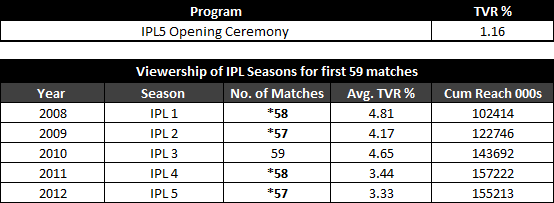
    Although the Indian Premier League season 5 (IPL5) delivered the lowest television ratings as compared to the previous seasons, the weekly data released by TAM sports has shown some consistency in its overall IPL 5 viewership.


    According to the latest numbers released by TAM Sports for the first 57 matches (CS 4+ All India), IPL 5 recorded a TVR of 3.33 per cent, which is slightly lower than the first 58 matches of season four which received a TVR of 3.44 per cent.


    The inaugural IPL season (IPL1) however continues to remain the most watched tournament till date with a TVR of 4.81 per cent for the first 58 matches whereas IPL3 which celebrated the home coming season witnessed the second highest viewership for the first 59 matches with a TVR of 4.65 per cent while IPL season two which was played in South Africa received a TVR of 4.17 per cent for the first 57 matches.


    What has shown improvement is the cumulative reach for these 57 matches in IPL 5 that stands at 155 million. This is nearly the same for IPL 4 where the reach was 157 million and far better than IPL 3, 2, and 1 where the reach measured was 143 million, 122 million and 102 million respectively.


    It may be recalled that for the first 48 matches, IPL 5 delivered a TVR of 3.40 per cent whereas for the first 36 matches IPL 5 delivered a TVR of 3.41 per cent, for the first 27 matches, it delivered a TVR of 3.53 per cent and the first 16 matches, a TVR of 3.65 per cent.


    Mr Ajay Rao, Vice President, Dentsu noted: “There has been consistency in the ratings, which is good and this consistency, I believe, is because of the loyal viewers who watch IPL matches, come what may and also those audience who continuously surf channels but, return to the game to check the scores. However, as we head towards the semi finals and the finals, we will see an increase in the ratings.”


    Source : TAM Sports, Period : First 59 matches of all IPL Seasons, TG : CS 4+ yrs, Market : All India, Channel : MAX


    * In IPL 1 one match (47th) was abandoned due to rain
    * In IPL 2 two matches (7th & 13th)were abandoned due to rain
    * In IPL 4 one match (20th) was abandoned due to rain
    * In IPL 5 two matches (32th & 34th) were abandoned due to rain


  • Meridian’s creative leadership changes

    By A Correspondent


    Meridian Communication, a group company of WPP, the world’s largest conglomerate of marketing communications services, has entrusted the creative mantle of its Mumbai office to Ogilvy’s Anuraag Khandelwal and Satish deSa. Both have been promoted to the rank of Executive Creative Directors and will assume this new responsibility with effect from June 1. Mr Khandelwal and Mr deSa boast a collective wealth of 26 years industry experience that will reinforce Meridian’s creative output. A major part of their career has been spent forging a fantastic partnership at Ogilvy, Mumbai. During their association here, they have created stellar campaigns for big brands like TATA Motors, IPL, Cadbury, Tata Sky, Aegon Religare Life Insurance, Unilever’s Beverages, Oberoi Realty and Hutch, to name just a few.


    Announcing the appointment, Piyush Pandey, Executive Chairman and Chief Creative Officer, Ogilvy Group, South Asia, said: “Meridian has found itself two young men who are very ambitious and full of exciting ideas. I have asked them to make Meridian a place that gives their friends at Ogilvy sleepless nights. I’m sure it will be healthy competition and result in some great advertising on both sides of the family.”


    “When we were asked to head Meridian, Mumbai, I thought – here is another opportunity to challenge ourselves. Because each time we’ve done that, we’ve been encouraged by the outcome. We’re sure this time won’t be any different. Can’t wait to get started,” said Mr Khandelwal


    “We believe that our appetite for constantly reinventing ourselves, for setting new standards is what will differentiate Meridian in the near future,” Mr deSa added.


    On this infusion of young blood, Samrat Bedi, Head of Office, Meridian, Mumbai said: “The passion Anuraag and Satish have for new-age work is remarkable. Their recent IPL ‘Carnival’ campaign attests to that. And that’s exactly the kind of fresh creative energy that Meridian needs today.”


  • Media Matrix: Valuing Audience – Part II

    By Paritosh Joshi


    Remember the 5 weepies that you were forced to watch because of your spouse? The maverick British automobile journalist? The irritatingly intrusive news editor? If you do, we met last week. And even if you don’t, I’m going to try and make this week’s 870 words stand on their own feet.


    We signed off last week wondering about whether audience quality, and not just quantity, could be measured objectively. And whether current systems of audience measurement pay enough attention to measuring audience quality. The questions were tainted by an assertion that “In the relentless focus on audience volume as the prime metric, we have lost sight of audience quality”.


    Why does audience quantity take precedence over any other measure, particularly in a market such asIndia?

    • Almost every product category has low penetration, or in more technical terms, low Category Development Index
    • Marketers’ primary priority is to reach the widest audience to build awareness about their product/category to stimulate demand
    • When width becomes paramount it is easy to see why quantity always wins over quality


    The arrival of satellite television inIndiain the early 1990s was the first intimation of accelerating media proliferation. An unregulated regulatory environment in its early years and limitless viewer demand for exciting, entertaining content fuelled a torrent of channels, and indeed genre innovation which continues unabated over two decades on. Coupled with rising incomes in a domestic consumption fuelled economy and steadily growing literacy, India also saw simultaneous growth in the print media and, with the advent of better telecommunications in the last decade, the ‘new’ or digital media. Making systematic and reasoned choices in this era of abundance was no longer the simple exercise that media planning used to be in the stone age of media scarcity that preceded it.


    Enter- the media agency of record.


    The challenge for advertisers was just this: how to reach the largest audience at the least cost. Inevitably, the agency’s singular task was to stitch up defined audiences across multiple vehicles at the lowest CPT (cost per thousand) or CPRP (cost per rating point). Conversely, advertising sales personnel at all media outlets were under pressure to offer packages that were compared relentlessly on cost almost to the exclusion of everything. The age of quantity had arrived.


    We will leave the hurly-burly of the media market for a moment and look at how audiences are actually measured and how these measurements are consolidated into reports.


    Television measurement involves peoplemeters; devices connected to domestic TV sets that keep track of who watched what, when. These peoplemeters, once installed in a home, track TV consumption around the clock, through the week, across months and years. These days, most have inbuilt communication apparatus that enables them to transmit their observation record to a central server without human intervention. The central facility now consolidates thousands of individual viewer readings into audience ratings, again with little human intervention. Ratings report second by second ebbs and flows in audience aggregates. Cross sections – by second, minute, hour of any other time interval become more important than how a particular individual, or household, or even demographic, spent a day interacting with TV.


    Other media, most prominently print, are measured by large scale media surveys like the Indian Readership Survey or IRS. Thousands of households are contacted across the country to map print, TV, radio, digital and other media consumption along with detailed information on usage of a wide range of consumables, durables and assets (such as personal transport). Here too, the system is geared to deliver cross sections of readership, listenership and so on, rather than examining how an individual, household or defined demographic consumes across media and product categories.


    In days of yore when data tabulation, summarization and analysis was done manually, examining and interpreting research information, whether for  TV or any other media, on a ‘longitudinal’ rather than ‘cross-sectional’ was practically impossible. While individual cases might be studied, purely for anecdotal value, there was no practical way of subjecting, large parts of, or the entire sample itself, to cross-sectional study.


    WithMoore’s Law having given us exponentially growing computing horsepower and data warehousing, this impediment no longer exists. Imagine an individual’s TV consumption across a week. From spiritual or yoga type programs in the early morning, through news and business during the day to action, drama, music, talk and comedy in the evening night, she has a wide range of content on her plate. And when you start looking at her ‘TV timeline’, and start comparing and contrasting it with the thousands of others, you will find others that are rather similar, somewhat similar or rather dissimilar to hers. Simple, least squares type, approaches can scan across timelines to find patterns of behaviour.


    In much the same way, the entire mix of product and media consumption of individuals or households, rather than cross sectional tallies, can also be run on respondent level data in studies like the IRS.


    Shifting attention from cross sections to longitudes or timelines – of moving from a cross-sectional view of audiences to actually understanding how they behave and what they consume across time and place is the difference between understanding audiences as quantitative aggregates or behavioural phenomena.

    Paritosh Joshi was until recently CEO, Star CJ. He has been a marketer, a mediaperson and been a key officebearer on industry bodies. He can reached via his Twitter handle @paritoshZero


  • [MJR] Un-miserable about Trai’s ad regulations

    Ranjona Banerji

    By Ranjona Banerji


    This is actually an “un-grouse” – I go with the current zeitgeist and fascination with the un-dead (vampires) and the unlikely (werewolves).


    Despite the criticism on MxMIndia.com yesterday over the TRAI regulations about ads on TV channels, needless to say, as a viewer I’m a bit un-miserable. I understand the need to make money and profits and all that but sometimes watching TV can be an unhappy experience.


    TRAI has asked for commercial breaks to be limited to 12 minutes for every hour that there should be at least 15 minutes between consecutive breaks for programmes and every 30 minutes for movies. In addition, there are to be no part-screen or drop-down ads for live sports events. What’s to complain? It’s not as if the TV channels themselves don’t know how damn annoying constant ad breaks can be – they themselves advertise “break-less” movies as a cachet, as if the producer suddenly released a new uncut version of the film.


    The worst transgressors are Indian general entertainment programmes. Producers shoot what seems to be about 10 minutes of programming for those popular soaps and serials and the rest of the time is spent on dramatic repetitions of the last two minutes that transpired before the 40-odd ad breaks. Obviously someone in TRAI (or their families) watches these serials.


    There can be no one – except for some very brain-dead advertisers – who actually thinks that part-screen drop-down ads which mask action during a live sports events endears one to the advertiser. TRAI has only stated the obvious here.


    News channels are no better in particular, NDTV and CNN-IBN. If you catch them on the half-hour or the hour, you can be treated to about 10 straight minutes of advertisement. I keep hearing about how news channels are financially precarious which only leads me to believe that they ought to charge more.


    Times Now is terribly smart about this. During prime time, which is when editor-in chief Arnab Goswami conducts his nightly inquisition, there are minimum commercial breaks. The channel knows that people are watching for the drama and are not interested for the moment in Katrina Kaif having sex with a mango. TRPs skyrocket during Goswami’s Newshour (sometimes two hours) and Times Now knows that that benefit can be spread across the other hours of the day.


    It must also pointed out that newspapers and magazines also operate under some restrictions about the editorial to ad ratio and this does not lead to general hand-wringing and despair.


    Plus, it is also true that some ad breaks are necessary. You can make a few quick calls, run to the loo and check that the dinner is not burning. In between you might also decide that the Appy Fizz is indeed incredibly annoying and a talking soft drink should indeed be un-alive.


  • Bollywoodlife leapfrogs into leadership league

    By A Correspondent


    Arvindra Singh Kanwal

    Entertainment, perhaps, remains one of the most sought-after domains inIndiafor those seeking to venture out with an online enterprise of their own. Proof of its popularity could be gauged by the presence of umpteen number of Bollywood portals that have surfaced in recent years, and continue to hold fort despite the tough business environment plaguing the outside world.


    Amongst the newer lot of entrepreneurs who have made a mark with their product offering is one-year-old entrant, bollywoodlife.com. The portal is part of India.com, founded by Zee Entertainment Enterprises Limited and Penske Media Corporation, USA with United Internet Germany. What is noticeable about bollywoodlife.com is that barely a few months since its launch, the portal went on to lead the category, overtaking some known leaders in the process.


    Throwing light on the genesis and journey of the portal so far, Arvindra Singh Kanwal, CEO, India.com, said: “Bollywoodlife.com was launched in May 2011 and follows the theme and design of its very successful parent site Hollywoodlife.com, owned and operated by our JV Partner Penske Media Corporation. Barely a few months since we launched, around November 2011, the website started being ranked as the No 1 Indian movie property in entertainment on comScore ahead of an old established player like Bollywoodhungama.com. It’s been at the top since.”


    Emphasising on the growth being registered since then, he said, “On comScore, we have been growing 3 per cent month-on-month, whereas other sites have been flat or negative. We are confident of accelerating this growth as we keep updating our offering.”


    Adding on the journey, Mr Kanwal said that most sites at the time they launched were very movie review-oriented. “We focused on content around Bollywood and Southern movie lifestyle. At a time when most portals tend to be biased towards Bollywood or Southern-based content, we pride on offering an offering that is well balanced.”


    The credit, according to Mr Kanwal, goes to Ramya Sarma, the editorial head of the portal who brought her own variety of conversational and photo-essay style essence to the product. “This approach has made it a leading destination to follow celebrity actors and entertainment news for style-minded men and women aged 18-35. Over time, we expect to see a spike in the women audience as the editorial style is tilted towards conversations they engage in,” he said.


    On what makes his portal unique from the others in the space, Mr Kanwal said that bollywoodlife.com’s uniqueness lies in providing content that is original, showing breaking news in a conversational fashion and having a multimedia editorial approach.


    “We also have transaction content sites in Auto, Education andMobilewhere we deliver news in English, Hindi, Marathi and Bengali. We rank No1 to 5 in every vertical category we represent. We expect our mobile offerings that are to be launched soon to take us closer to our vision of beingIndia’s premiere digital and mobile platform.”


    Divulging on the reach, Mr Kanwal said that worldwide it reaches around 15 million users per month (as per Google Analytics). “InIndia, we reach 12 million users of which bollywoodlife.com reaches to 2 million users worldwide and 1.6 million users inIndia.”


    On the growth strategy for india.com, Mr Kanwal said that, as a portal, India.com is barely 10 months old but is already ranked No 7 (March 2012, comScore) just behind in.com and AOL aggregate sites: “We have grown at a pace of 7 per cent month-on-month versus the market rate of 2 per cent. We are growing faster than all others. In fact in.com is in the negative zone and we should catch up soon going by our current pace.”


    On the scope for online players catering to the M&E industry, Mr Kanwal said that currently, the digital entertainment market is not built for local original licensed content. “There are a lot of sites that offer aggregated, undifferentiated and unlicensed content e.g. songs.pk, torrentz and others and this is the reason that advertisers have stayed away from advertising on them. But the time spent in this category is growing versus other media options. Also, internet penetration is expected to grow from 5 to 30 per cent by 2015. So quality content, multiple multimedia formats, time spent and high reach will make us and others who invest in this segment very valuable media assets.”


    According to Mr Kanwal, the plan going forward is to be seen as “a premier destination for users in every category that the company is present in.” This is what will make the company stand out and be counted as a “great” product, compared to the other good ones from the lot.