Blog

  • Industry gears up for India Radio Forum 2012

    By A Correspondent


    It is that time of the year, when radio players across the country meet to discuss issues pertaining to the industry, listen to ideas from advertisers and agencies, celebrate creativity in radio advertising and commemorate the medium itself. The seventh edition of India Radio Forum (IRF), organized by Partners in Media Asia (PIM), will be held on May 22 at JW Marriot Hotel in Mumbai.


    Amitabh Srivastava, Country Manager – South Asia, Radio Netherlands Worldwide who has been attending the IRF since the last four years and plans to do so this year, explained that radio is still at a nascent stage, thus such forums on radio are good for the industry as it discusses critical issues, it provides a good platform for all stakeholders, and in the long run, such forum on radio will benefit the industry. He further said that in the last four years that he has attended the annual event, he observed that IRF has ensured that every stakeholder participates in the event. He also said that smaller stations have been given their due weightage and their issues have also been discussed at various events.


    George Sebastian, COO, Club FM and GM Marketing, Mathrubhumi and Ravindran Nair, Director Programmes, Radio Mango would also be among the attendees at IRF 2012. When asked whether smaller stations have been isolated at the IRF this year, Mr Sebastian said that he has been attending the IRF since its inception and found that even the issues of smaller stations are addressed at the IRF. “IRF used to be a full day event, now it has been reduced to a little more than a half day. This is the only regret I have towards IRF. Such events most certainly benefit the industry, particularly the awards which recognizes good talents.”


    Mr Nair of Radio Mango said: “IRF helps maintain the vitality of radio stations, it gives one insights into how radio has developed in other parts of the world; it also provides ideas and new ways to monitise contents as well as gives us the client perspective about the medium. The only irony, however, is that the IRF has been reduced from a two day event to merely one day.”


    Unlike previous years, Mr Naval Toshniwal, CEO Tomato FM and Vice President, Pudhari Publications will not be attending the IRF this year. Ms Monica Nayyar Patnaik, Joint Managing Director at Eastern Media Ltd is also among the few industry veterans who would not be attending the IRF this year for personal reasons.


    Speaking to MxMIndia, Ms Patnaik was of the view that such forums do benefit the industry as it helps one learn from each other, helps find solutions to overcome issues and challenges, provides creative ideas and that awards also contribute in a bigger way in recognizing ones creative talents.


    Another industry player who did not wish to be mentioned was of the view that such events do help the industry positively, however, it all depends on implementing the lessons learnt from the various presentations made and panel discussions. “IRF is a good forum, but the industry must learn to implement what is discussed at such events, which has not happened so far. There has to be an action plan to implement all that is discussed at such events, only then will we see the industry grow even further.”


    Anurradha Prasad, President of Association of Radio Operators for India (AROI) and Chairperson cum Managing Director, B.A.G Network will also not be able to attend the IRF this year due to prior commitments. She, however, added that right now everything boils down to the passage of the Copyright Bill in the Lok Sabha. It has already been passed in the Upper House (Rajya Sabha), and once it is passed in the Lower House (Lok Sabha) too, and becomes law, it will significantly improve the growth of the Indian radio industry.


    The speakers list at IRF 2012 comprises of industry veterans not only from the radio industry, but also advertisers, and veterans from the creative and media agencies. IRF 2012 will kick-start with the CEO Roundtable, wherein industry biggies will discuss the current strength and weaknesses of the radio industry, and strategic options to improve the business and their vision for the industry in the coming three years. The panelists will include Apurva Purohit, CEO, Radio City; B Surendar, Sr. VP & National Sales Head, Red FM; Harrish Bhatia, CEO, My FM; Harshad Jain, Business Head, Fever FM; Joy Chakraborthy, CEO, Oye FM; Prashant Panday, CEO, Radio Mirchi and Rabe Iyer, Business Head, Big FM. This session will be moderated by Atul Phadnis, CEO, What’s-On-India.


    The second session at the forum – ‘It’s the Message, not the Medium: Growing your Advertising Revenues,’ will delve on important creative attributes that make radio commercials more effective and the unique qualities of radio as an advertising medium. Jason Brownlee, Founder, Dollywagon Media Sciences will be the speaker of this session.


    Another interesting session at this year’s IRF is ‘Radio and Social Media’, a panel discussion on the effect of social media on the listeners and the radio industry. This session will be moderated by Suman Srivastava, Founder & Innovation Artist, Marketing Unplugged. The panelists of this session include Premjeet Sodhi, COO, Lintas Media Group; Raj Nayak, CEO, Colors – Viacom18; Satbir Singh, Managing Partner and Chief Creative Officer, Euro RSCG; and Tushar Vyas, Managing Partner, GroupM South Asia.


    There will also be a session on ‘Maximising Radio’s Asset: How to Gain Share of Market Spend’. This session will be moderated by Apurva Purohit, CEO,RadioCity. The panel members are Ajit Varghese, Managing Director – South Asia, Maxus and Motivator; Arpita Menon, Head – Media Planning & Buying, STAR TV; and Shubha George, COO, MEC. This session aims to provide the client point of view and that of media planners and buyers on radio’s critical role in meeting market challenges and opportunity it presents in achieving a better ROI and sales goals.


    ‘The Radio Pitch Challenge’, the last session just before the 2012 ‘Excellence in Radio Awards’, will see planning teams from media agencies invited to pitch a compelling and effective presentation to the judges. Each team will talk about a product or service in five minutes or less. They will present 16 slides with only 15 seconds per slide, ending with a radio promo not more than a minute long. The winning team will be awarded two tickets worth over Rs1,00,000 to the 2012 Singapore Formula1 Grand Prix.

  • Apalya TV crosses 11 million viewers on IPL 2012

    By A Correspondent


    The IPL’s fifth season is proving to be good news for mobile TV operators. Apalya Technologies, leader in mobile video, has registered 11 million viewers till now for the IPL 2012. This rise in mobile viewership is close to the numbers garnered by YouTube, which is also registering the same number of viewers on its website.


    Speaking on the increasing viewers for mobile TV, Vamshi Krishna Reddy, Co-founder & CEO, Apalya Technologies said: “We started the tournament with an aim to catch at least 10 million subscribers before IPL 2012 ended and today after 65 matches, we are proud that Apalya Technologies has already crossed its target and registered 11 million viewers who are watching the matches Live on their mobiles. With another 10 odd matches to go, we are sure that we will be able to write many success stories this IPL.”


    He added: “Apalya Technologies is exceeding not only TV, but also online viewership numbers, as compared to mobile viewership with the average minutes of usage per customer being between 17 to 20 minutes per day. Out of these viewers that we have registered till now, at least 70 per cent is coming from the Nokia users. The fact that mobile TV viewership is increasing is a proof in itself that the trends are changing and we are adapting to newer ways of watching TV.”


    With emerging technologies and growing mobile video viewing habits, India records over 200 million video views a month on mobile devices and Apalya is all set to capitalize the opportunity to tap the interest of the youth, allowing them mobile video viewing for various popular events. During the World Cup season in April 2011, Apalya generated 17 TB of streaming and with close to 50 minutes of usage per user for the 6 matches India played. Currently, Apalya powers mobile TV for all the major telecom service providers in India and has also launched its services with leading operators in Sri Lanka & Indonesia.


  • Congress-led UPA loses sheen as BJP inches ahead: ABP News-Nielsen Survey

    By A Correspondent


    The ABP News-Nielsen survey conducted on the eve of the UPA-II third anniversary has revealed that after eight years in power, the Congress-led coalition’s pull seems to be diminishing.


    The survey, conducted across 28 cities across the country in April-May 2012, revealed that the BJP would garner 28 per cent of the votes if Lok Sabha elections are held now, while the Congress would manage only 20 per cent.


    In fact, the BJP has turned out to be the most favoured party. In an interesting revelation, only 69 per cent of those who voted for Congress during 2009 Lok Sabha elections are still intending to vote for it, if Lok Sabha elections are held now. 31 per cent are moving away from it and 12 per cent now intend to vote for the BJP. Whereas for BJP, 84 per cent will stick with the party and only 2 per cent are switching away from it to Congress.


    In 2009 elections, 28 per cent of these respondents voted for Congress, while 27 per cent voted for the BJP. But for the BJP, the dip of 8 per cent in the Congress vote share is not a complete gain. The BJP is gaining only a marginal 1 per cent. The remaining 7 per cent dip in Congress vote share among these respondents is gain for regional parties.


    In the 2009 Lok Sabha elections, Congress had won 207 seats while BJP had got 116 seats.


    While 32 per cent believed the government’s performance was good or very good, a sizable 35 per cent rated the performance as average.


    Significant 21 per cent respondents said it was poor while 11 per cent rated the performance as very poor. The performance of UPA government has been rated slightly below average with a mean score 2.95, which is lower than the mean score of 3.22 last year.


    However, Manmohan Singh’s ratings are good with 37 per cent respondents saying his performance was good or very good. Another 33 per cent ranked him average, while 28 per cent believed his performance was poor or very poor.


    Around 32 per cent of the respondents felt that performance of UPA government is better or much better than its last term. A dip of 8 per cent is observed in the perception of people from last year survey, where 40 per cent of the respondents felt that the performance of UPA government is better than previous term. 39 per cent rated UPA performance as “about the same” this year, similar score in comparison to last year.


    Only 36 per cent of the respondents felt that performance of the PM is better than its last term. A dip of 8 per cent is noted in the perception of people from the last year survey, where 44 per cent of respondents said that the PM performed better than his previous term.


    When it comes to best leader in the country, Narendra Modi 17 per cent said he is the best leader over Manmohan Singh at 16 per cent. Modi was preferred at number four during last year’s survey (12 per cent).Manmohan was ranked at number 1 last year (21 per cent).  Rahul Gandhi’s scores have dipped from 19 per cent to 13 per cent this year.  Sonia Gandhi’s scores are down from 14 per cent to 9 per cent.


  • Birla may use personal money for buy, Mail Today may now launch editions in Mumbai, other metros

    The Aditya Birla group investments may help India Today invest in launching editions of its newspaper Mail Today in Mumbai and other metros.


    By A Corresdpondent


    Kumar Mangalam Birla, chairman of Aditya Birla Group, has bought a 27.5% stake in Aroon Purie-controlled Living Media India, the publisher and owner of India Today magazine and Aaj Tak television channel. Mr Birla will use his personal money to invest in the New Delhi-based group, which straddles the entire media chain, from television to magazines to tabloids.


    A statement from the metals-to-retail group said Birla has agreed to join the Living Media group as a financial investor. It did not specify the price for the deal or the valuation.


    However, investment bankers close to the transaction said the deal has been finalised for Rs 600-700 crore, valuing the media group at Rs 2,400-2,800 crore. Mumbai-based investment bank Ambit Corp was the advisor to the deal.


    This is the second big investment by an industrialist in the media space. In January, affiliates of Reliance Industries agreed to buy a large stake in the companies of Raghav Bahl, the promoter of Network18 and owner of channels such as CNBC-TV18 and CNN-IBN. The investment was worth over Rs 1,500 crore.


    TV Today is listed on the stock exchanges, but it is not clear whether Birla’s personal investment companies will now have to make an open offer to buy 26% from public shareholders.


    The financial investment also marks the realisation of Kumar Mangalam Birla’s cherished dream of owning a media company. “The media sector is a sunrise sector from an investment point of view. I believe that Living Media India offers one of the best opportunities for growth and value creation,” Birla said in a release.


    Birla made an unsuccessful entry into the entertainment space by launching a movie and TV production company, Applause Entertainment, in 2003. The company, which produced the acclaimed movie Black , was closed down in 2009 after the downturn in the entertainment industry sparked off by the global recession.


    Living Media will use the cash from the deal to expand its presence in media. It may now look at launching its New Delhi-based tabloid, Mail Today, in other metros, including Mumbai, according to persons close to the company.


    Source:The Economic Times

    Copyright © 2012, Bennett, Coleman & Co. Ltd. All Rights Reserved

  • AV Birla group buys 27.5% in India Today group

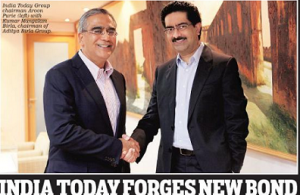
    A Mail Today news article with Aroon Purie with Kumar Mangalam Birla in the photograph

    By A Correspondent

    The Aditya Birla group has announced a financial investment of 27.5% in Living Media India (better known as the India Today group).

    The move has been confirmed by a way of a communique to the stock exchanges. Says Kumar Managalam Birla, chairman, Aditya Birla group, “The media sector is a sunrise sector from an investment point of view. I believe that Living Media India offers one of the best opportunities for growth and value creation.”

    Comments Mr Aroon Purie, chairman of the India Today group, “I am delighted to partner with the Aditya Birla group to aggressively address the current and futre potential of the Indian media business which is at a tipping point. The Aditya Birla group with its strong leadership global footprint, diversified business interests and its shared values of integrity, commitment and social responsibility make it a perfect fit with the India Today group.”

    The transaction is of course subject to the statutory approvals.

  • [MJR] TV journos prove Katju is right

    Ranjona Banerji

    By Ranjona Banerji


    Journalists have evidently signed a pact to prove Press Council of India chairman Markandey Katju right – 90 per cent of Indians are idiots. There seems to be no other reason for this enormous media reaction to the late night fracas between film star Shah Rukh Khan and a security guard at Wankhede stadium two nights ago.


    Of course, the shenanigans of film stars are exciting and when they behave badly it’s even more fun. But is there anything to justify front page headlines and TV debates for two days? What exactly is there to debate? Khan arrived last the stadium around the time Kolkata beat Mumbai, with a bunch of kids. The kids ran into the field. A security guard stopped them. Khan intervened. Words were exchanged and some apparently not very polite ones and then Khan left.


    For this, the world has come to an end. We are discussing politeness, propriety, banning, apologies, role models, respect for the uniform, high-handedness, diplomacy, official inefficiency, entitlement or the sense thereof, protection of children and the decibel level of whistles.


    If we went to war with China, I cannot imagine more being discussed on television. The journalists on TV cannot seem to distinguish between a security guard and a policeman. Rahul Kanwal almost burst a blood vessel when on Headlines Today veteran adman Prahlad Kakkar tore into the behaviour of security guards: “You have to respect the uniform”. I would really like to know how any of these TV guests react when faced with the officiousness of a security guard.


    Kakkad was a rare voice of sanity as was Rohan Gavaskar who said: “Banning Shah Rukh Khan from Wankhede is like banning Sachin Tendulkar from PVR”. Meaningless, in other words. Except for Arun Lal on Times Now, no one wanted to discuss whether officials of the Mumbai Cricket Association, who called for a ban on Khan entering Wankhede, were not over-reacting. Lal said it’s a question of contesting fiefdoms – with Khan as an IPL team owner against MCA officials with their hurt pride at being event managers rather than stakeholders.


    The levels of self-righteous on Times Now were staggering, with anchor Arnab Goswami, veteran columnist and author Shobhaa De and not-so-veteran columnist Simi Chandok leading the way. Goswami kept bringing up police action against Hollywood stars Nicholas Cage and Russell Crowe, again unable to distinguish between security guard and a policeman. (Hint: different uniform.)


    Former Mumbai police commissioner MN Singh tried to point out that criminal charges against Khan were not possible and this led to him being dragged over hot coals by Goswami. When the nation wants to know, let no man or woman try and douse the fire.


    Commentator Charu Sharma however poured cold water on Rahul Kanwal’s spectacular rage – mainly it seemed because uniforms were not being respected, apparently a prime concern in his life – by forecasting that an amicable resolution would be reached and the incident would soon be forgotten. The truth is that everyone knows that that is what will happen.


    As a matter of interest, after all the hot air expended over the fight which Saif Ali Khan had in a restaurant at the Taj a few months ago, can anyone remember the names of those self-righteously hurt complainants from South Africa? Hmmm.


    * * *


    On NDTV, I watched another somewhat circular debate over whether PA Sangma could become the next president of India. These speculative discussion with weak premises only illustrate our emptiness of thought. I greatly admire Divya Marathi editor Kumar Ketkar for his fortitude and level of tolerance as he sits through so many TV debates these days, trying to inject a little sanity into proceedings.


    It seems amazing to me that no TV people seem able to realise that all this political hoopla over the next president is just a diversionary tactic from all the political problems this country is facing.


    Goswami even wants a debate between Sangma and Vice-President Hamid Ansari, since he possibly believes that India has a presidential form of government. Contestant 1: I will plant 400 varieties of roses in the gardens. Contestant 2: I will conduct the tours of Rashtrapati Bhavan myself. Contestant 3: I will never build a large retirement home for myself. Contestant 4: I will never bore school children with my poems and ideas.


    Please, somebody, save us!


  • Indian Idol 6 to use drama & emotions for a connect with viewers

    By Meghna Sharma


    Music is something that almost every Indian can relate to. So, when in 2004, a reality show was launched which gave the people a chance to show-off their singing talent, the whole country lined up for auditions.


    Today that very same reality show, Indian Idol, is getting set to launch its sixth season. From June 1 on Sony Entertainment Television. The show had opened with average TVR of 6.9 in its first season whereas the last season got an average TVR of 2.0. According to Chandradeep Mitra, managing partner, Anvention, the main reason why reality shows lose their audience over years is stagnation: “After a while, one does get bored of watching the same genre of shows. It has happened to a lot of shows, be it KBC or IPL. Also, there are a lot of similar shows on other channels. So, there is a natural decay.” He further explained: “With more and more channels coming up and new genres being experimented, there is division of audience too.”


    Danish Khan

    Danish Khan, senior VP and Marketing Head, SET, is optimistic about the upcoming season and feels that every season has to have a unique hook to catch audience’s attention. “We are doing our best to come up with a delight for our audience. I agree that there are a lot of reality shows, so differentiation becomes important to stand out of the clutter.”


    This year, the show will focus on ‘Idols behind the Idol’: “We thought of going back this year and focus on how ‘nobody’ becomes a ‘somebody’. We’ll follow the journey of the Idol and the people who have played a role in guiding them to reach that position. So, there are a lot of drama and emotion this time, and we are hoping that it will touch the audience. And help us get good ratings,” Mr Khan said.


    However, Mr Mitra feels that for this genre to work well, the show must have quality talent and should be able to use social media well to promote it which will help to create awareness about the show.


    The channel will launch the show after the IPL. “It is a deliberate move and we have used the IPL to build the show through various promotions. We have used 360 degree marketing strategy to market the show,” said Mr Khan.


  • Vivek Bahl joins Viacom18 as Network Advisor Content, to work on proposed regional foray

    By A Correspondent


    In a move to expand its horizons, Viacom18 has appointed Vivek Bahl as Network Advisor Content. He will be working on the regional channels which the media conglomerate plans to get into. He will also play a strategic role in planning and development of new content.


    Mr Bahl will report to Raj Nayak, CEO – Colors and will have a parallel line of reporting to the Regional Head.


    Announcing his appointment, Raj Nayak, Chief Executive Officer, Colors said: “Vivek comes with great experience in developing content for different genres and his understanding of the television and entertainment industry is quite phenomenal. We believe he will play a significant role in not only in further developing and strengthening the current content on Viacom18’s offerings but also in the expansion of the network’s upcoming regional channels.”


    Mr Bahl has over 25 years of experience in the entertainment industry and a strategic cross-functional perspective. He has worked with leading television networks inIndiaincluding Star TV and Zee TV, where he helped in the development of multiple fiction and non-fiction properties including Antakshari, Banegi Apni Baat, Jassi Jaisi Koi Nahi, Bidaai, Yeh Rishta Kya Kehlaata Hai, Saath Nibhana Saathiya, Saat Phere, Betiyaan, Maayka and Pratigya.


    On his new assignment Vivek Bahl said: “Viacom18 is a network that, through its various channels, reaches to multiple audiences across the country. I am extremely excited about this opportunity to help take the content and the network to the next level. I am looking forward to working with the incredibly talented team at Viacom18 and help escalate the properties to reach out to a larger audience across the country.”


    Prior to joining Viacom18, Mr Bahl was Chief Content Officer forIndiaat Turner International and overlooked the content strategy and development for Turner’s entertainment brands inIndiawhich included Imagine TV, Cartoon Network, Pogo and Warner Brothers.


  • So will Digitization mean more Revenues?


    By Ashish Pherwani & Devendra Parulekar


    It is estimated that India has 127 million C&S television homes, out of which around 32 million are DTH, 7 million digital cable and the balance 88 million analogue cable homes.  The first phase of digitization of analog TV broadcast, which covers the four metro cities – Delhi, Mumbai, Kolkata and Chennai – is mandated to be completed by June 2012, while the entire country is to be digitized by December 31, 2014 when analogue signals will be finally switched off completely.


    It is expected that the industry will need to invest around Rs75 billion in the process, and Phase I alone will need around Rs11 billion. This is based on the assumption that the cost of digitization per subscriber will be Rs1,500, out of which around Rs600 will be borne by the customer.


    The following present some of the key aspects of digitization:


    How does digital cable compare with DTH, the current digital distribution leader?
    Digital cable has the capacity to carry 1,000 Standard Definition (SD) channels and surpasses DTH, which can only carry 250-300 SD channels at present due to limited transponder availability. In terms of technology, digital cable is capable of having a “return path”, which is not possible in the case of DTH. This limits the latter’s scope to provide value-added services and dual play. Digital cable is able to provide a larger number of regional channels, and given the growth of the Indian media sector – fueled largely by regional content – this could be a significant advantage for it.


    However, in terms of customer connect, management capabilities and readiness, DTH players have a definite advantage, since while they have had B2C from the beginning, most Indian MSOs still have B2B. DTH players already have in place customer-centric systems and processes, including multi-lingual call centres and field engineer forces.  They understand the implications of running a B2C business, having already implemented subscriber management systems, customer relationship management systems, and so on.  Moreover, DTH players have already invested heavily on building their brands, using ambassadors such as Saif Ali Khan, Aamir Khan, Shah Rukh Khan and Abhishek Bacchan, thereby making DTH an aspirationally more desirable product.


    Due to the factors mentioned above, it is expected that there will be a churn of subscribers from cable operators to DTH, particularly in Phase I. While certain MSOs peg this churn at 15 per cent in favour of DTH, DTH players are more optimistic and expect to gain up to 40 per cent of MSOs’ customers. This churn will, however, largely depend up the readiness of MSOs to meet digitization deadlines and also take advantage of the marketing and sales efforts of MSO and DTH players.


    Another factor that needs to be considered is Headend in the Sky (HITS).  HITS operators may find it advantageous to assimilate smaller LCOs by becoming their technology service providers and providing them with content as well as SMS, CRM and billing services.  However, this could pose issues for MSOs, who are counting on aligning themselves with such LCOs.


    Evolution of the distribution system

    The distribution system comprises four key segments:

    • DTH companies
    • Large national multi-service operators (MSOs) – 5-6 players
    • Small MSOs with a regional presence – around 25 players
    • Small LCOs (local cable operators) – around 40,000 players


    Currently, national MSOs have interests in several smaller MSOs and LCOs. This is either in the form of investments or JV agreements.


    Going forward, the distribution system is expected to evolve, based on the ability of small players to scale up their operations. Today, the main role of an MSO is to buy content from broadcasters, decrypt it and distribute it to LCOs for last-mile distribution to customers. All customer-facing operations are performed by LCOs, which include billing, collection, repairs and maintenance.


    Once digital addressable systems are set up, some of the smaller MSOs or more competent LCOs may decide to provide all services to customers themselves. In this event, they may break away from their parent MSOs, and assisted by funding and systems setups, be in a position to manage their customer bases on their own, and thereby gain a large share of the total subscription revenue generated.


    Therefore, we expect that broadcasters may not only be dealing with the big 5 MSOs, but the big 50 MSOs as well in a short time, which would be a definite advantage for them.

    The depth of relationships of MSOs with their JV partners and the LCO community will be critical for a successful national roll-out.  It will determine which and how many LCOs team up with each MSO, as well as the share of revenue an MSO can expect to receive from LCOs.


    The entry of pure-play global cable operators such as Liberty and Comcast could result in consolidation of the industry.  The proposed change in FDI limits for all cable distribution to 74 per cent, and the sheer size of the Indian TV market, is sure to interest such global players. PE players have shown a significant interest as well, but appear to have taken a watch-and-wait approach to determine how phase I of the digitization process plays out before deciding on whom and how much they will fund.


    How will ARPUs move?

    Given the past as a benchmark, one likely scenario is that the base pack of free to air (FTA) channels is priced at around Rs100 plus taxes.  Earlier indications from TRAI indicated a rate of around Rs83 plus taxes, but given that several channels are expected to opt for FTA in the digital arena, this will probably increase.  The cost of this base pack is, therefore, expected to increase at an inflationary rate of around 8per cent every year.


    High growth rates of 10-15per cent are likely to be seen in tier 1 and tier 2 packages, which will comprise most of the popular pay channels, e.g., the GEC and sports channels, and be priced between Rs150 and Rs250 plus taxes.  Premium packages, priced at Rs300-500, and including packages that have a large number of niche and HD channels, will probably grow at 15-20per cent per annum.


    Compared to the current ARPU of Rs140 per subscriber, we expect that within two years, the average family cost per TV set will increase to Rs250, inclusive of taxes.  The important factor to note is that households with two or more TV sets (according to estimates as high as 20per cent or more in the four metros) are likely to opt for addressable digital systems, and thereby, increase the size of the industry significantly.


    Application of a price cap, either at per channel level or a package level, could prove detrimental to the roll-out of digitization.  The equilibrium brought about by market forces would ensure optimal price points from a customer perspective.


    The tax impact could be significant as well.  The so far largely untaxed 88 million analog subscribers will now be subject to taxation, and this is likely to result in an increased cost of Rs25-45 per subscriber per month.  In all probability, this cost (around Rs4,000 crore a year) will be transferred to customers by the industry, and therefore, ability to increase ARPUs may be impacted in the short term.  Therefore, the efficiency of the value chain will be critical in determining the actual incidence of taxes levied on LCOs, MSOs and broadcasters.  The cost incurred to digitize networks also needs to be considered in terms of a one-time write-off or by spreading its impact over several years.


    How will ARPUs be shared?

    Honestly, we don’t know.  Today, many LCOs retain up to 85per cent of the revenues they collect from their end customers due to under-declarations made by subscribers, and the balance is split between MSOs and broadcasters in a ratio of 1:2.


    Different MSOs are proposing different splits.  Some envisage an equal split between the broadcaster, MSO and LCOs.  Some expect LCOs to retain 50 per cent of the collection, even two or three years down the line (given that it would be difficult for them to give up their revenue share).  According to a recent news article, TRAI is considering a regulation whereby LCOs will retain 70 per cent of the collections.  Some sources indicated that MSOs may guarantee revenues for certain LCOs at their current take-home levels for a year or two.


    Eventually, once addressability sets in, the share of revenues is expected to be driven by services provided to the customer.  Broadcasters will get a share for the content they provide; MSOs for their buying efficiency and the technology support they provide;  LCOs a share that is proportionate to the last- mile and customer-facing activities they provide.  If we compare this to the telecom sector, 60-70 per cent of the revenues are retained by telcom, as compared to 90 per cent by MSOs and LCOs.  This percentage needs to come down to global levels, where less than 50 per cent is the share of the distributors.  But this will take time.


    How carriage fees are likely to move

    Every business has a cost of distribution, and media is no different.  The cost of carriage will remain, one way or the other, whether as a per subscriber technology, a provisioning cost, a fee to place a channel in a package or as one to position a channel within a genre.


    There is likely to be some reduction in carriage fees, since digitization will result in eradication of the artificial scarcity caused by the analogue infrastructure.  However, in the long term, carriage fees are expected to continue in one form or the other .


    In all probability, strong channels (and those that are included in much-demanded broadcaster bouquets) will end up paying a reduced carriage fee, and weaker ones will pay a higher amount.


    The role of TAM

    TAM is expected to continue being the leading provider of viewership measurement services inIndia, since no method or technology is currently planned in any large-scale STB implementation program or any other system to find out which person in a household is watching which part of which program.  It may be possible to determine how many subscribers have subscribed to a channel by aggregating data from leading MSOs, but that is not a measure of actual viewership.


    Alternative business models

    Broadcasters and distributors can now think about implementing channels by using innovative methods to share risks and rewards.  Some such methods could be:

    • Broadcasters selling channels to distributors to exploit these in the form of ad sales and subscription revenues
    • Re-packaging existing channels for local audiences of MSOs and larger LCOs
    • Creating channels based on dubbed content from popular channels, to be rolled out as regional language channels across larger MSOs
    • Broadcasters, etc., distributing specially packaged film or music channels on a revenue-sharing basis


    The recent recommendation made by TRAI to limit the total advertising time on pay channels to 6 minutes per hour and FTA channels to 12 minutes per hour could also have a significant impact on the number of channels that continue to “go pay,” should such recommendations become the law.  Such a rule would boost transparency in TV distribution, and given that advertisers would not be willing to pay twice for the same audience reach, would also push up per-channel prices significantly.


    Moreover, in addition to regular revenue streams, new ones would emerge for MSOs.  For example, Hathway has demonstrated that it can generate 10-15 per cent of its revenues through broadband, and this could become a service other operators can also begin providing. Video on demand, gaming and niche content could also be provided at local levels.


    In summary, although the timeline for digitization is aggressive, the ordinance is a concrete step toward enabling systematic growth in the industry and more equitable distribution of revenue across the distribution value chain. All stakeholders are expected to benefit from the digitization process – transparency generally ensures this. It is, therefore, in the best interest of the industry that all stakeholders ensure that this initiative is implemented in as speedy a manner as possible, and make sure that no political, regulatory or any other road-blocks interfere in the process.


    Ashish Pherwani is Associate Director, Ernst & Young & Devendra Parulekar is Partner, Ernst & Young


  • Internet as a media has arrived: Hitesh Oberoi

    Hitesh Oberoi is  Chairman- IAMAI and CEO and Managing Director, Info Edge. In conversation with MxMIndia’s Robin Thomas on the sidelines of the IAMAI’s marketing conclave recently, Mr Oberoi spoke about the changing dynamics of internet and mobile in India, the trends to watch out for and much more.
     

    For long we have been referring to internet as a new medium. Would you still regard the internet as a ‘new’ medium?

    I don’t think internet is a new media any more, but a media which has arrived. There are already more than 120 million online users and this number will grow to 400 million in the next three to five years. Therefore, I don’t think internet is a new medium any more nor a medium that can be ignored.


    Has there been a shift in perception over the years among advertisers about the internet and mobile as media vehicles?

    Advertisers are definitely taking the internet a lot more seriously today simply because of the growing number of online and mobile users. With the kind of targeting options and the kind of measurement options, the internet offers have brought more and more advertisers on board. In addition to this, the internet is not only one of the cheapest medium to advertise but, also provides better ROIs to advertisers. So certainly these are some of the factors leading more advertisers to the internet.


    What about a credible measurement system? Why do we lack still one today?

    There are some challenges, there are different methods used by different measurement providers but, I think they realize that internet is getting big in India and are, perhaps, working towards a better measurement system. So very soon we should have a credible measurement system in India.


    What according to you are the opportunities and possible threats or challenges that 3G and 4G services could have for mobile advertising in India?

    As the internet grows faster, people will spend more and more time on the internet. Penetration and the speed of access are the two things needed for bringing in more people to mobile internet. What 3G and 4G will do is, improve the speed of access and when the speed of access increases, a user will be able to download content faster. So, a combination of faster internet on mobile, quick downloads, and good quality content and so on will lead mobile internet to a different level altogether.


    And the lessons that India can learn from their international counterparts on internet and mobile advertising?

    One thing we should be investing in is the internet economy. The truth is that internet is a great medium for consumers, and it is a great medium for small and medium enterprises to build their business. Internet is a great leveler of the two India’s (urban and rural). Just as the telecom revolution which has led to people being empowered, the same could happen on the internet. So, I think the lesson we can learn from the United States and China is that we need to invest more and more in broadband and we need to make it cheap for people, so that many more can get onto the internet.


    Any specific trends to watch out for in the digital media space?

    There will be many more people on the internet five years from now, Indians will spend more time on the internet and probably they will spend most of their time online, therefore, marketers cannot afford to not be online. In fact, a lot more access to internet will take place through mobile phones. So while in this phase, more people are accessing internet through their PC or desktop, the next phase of internet growth will come from mobile. Therefore, marketers need to adapt to these changes accordingly. These changes may take a while but, undoubtedly digital is the way forward.


  • Sania Bhabhi is back on Red FM

    By A Correspondent


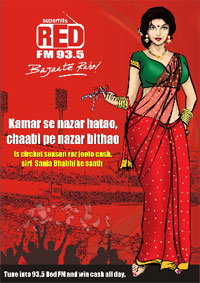
    Known for its innovations, 93.5 Red FM has got ‘Sania Bhabhi’, a sensuous housewife who considers all cricketers her ‘dewars’, back this cricket season. Last year, the character was introduced by Red FM Delhi to deliver cricketing content in an interesting and entertaining manner. Sania Bhabhi used to have topical conversations with her dewars, in a way that makes the listeners let loose their imagine.


    This year she has come back with her wallet full of cash, nicked from her dewars, up for winning through interesting contests. The concept of the show is that Sania Bhabhi knows that all her dewars have earned big bucks, and now she will share that loot with the listeners. For one specified hour in each show on Red FM, she will declare the amounts she’s taken from cricketers. Listeners are encouraged to stay tuned through the hour to know how much money she has given away. The listener who will declare the correct total amount will walk away with that cash prize at the end of the hour.


    The activity has already started from April 4 and will stay on air through-out the IPL cricket season till end of May.  Nearly Rs10,000 will be given out as prizes every day.


    The campaign is primarily aimed at getting listeners to listen to the station longer, through which they can win big. As such, the off-air media will focus to touch-points, to generate incremental listenership:

    • Posters in pan shops, other relevant outlets in high visibility areas for the primary demographic
    • Slides, ambient media at PVR
    • Facebook activation, with creative and audio downloads from theDelhipage


  • Anil Thakraney: The BCCI has to be controlled

    By Anil Thakraney


    Constant readers of this blog might remember my post on IPL 5 when the tamasha had just gone underway. And in that post, I had spelt out various reasons why the tournament doesn’t interest me in the least. Now, I know it isn’t very nice to boast ‘I told you so’. And yet, on this occasion, I feel no hesitation in reporting that I had mentioned at the time that I would be mighty surprised if there was no match fixing going on in this cricket ‘fest’. I also recall saying that for the tabloid media, IPL is a goldmine for sensational stories.


    Don’t know if the India TV guys read my post or not, but their sting operation has confirmed my fears. Good story. The only little grouse I have with the channel is that maybe they went out with the story a bit too soon. Perhaps if they had been more patient and had cared to dig a little harder, they may have nailed some big fish too.


    To be fair, it isn’t entirely BCCI’s fault if some youngsters decide to sell their souls for some extra moolah. Surely the board cannot keep an eye on the activities of every single player. So perhaps we can’t slam only them for this scandal. The real question is this: What will the BCCI do NOW? Their future conduct will determine if they are serious about protecting the credibility of these games. They have to not just impose a life ban on the offenders (if proved guilty), the richie rich cricket board has to draw out powerful anti-corruption mechanisms to make sure the games are run cleanly.


    And this is where the problem lies. How can an organization that’s not answerable to anyone, that has been following dodgy practices as standard operating process all these years, be trusted to run clean and transparent games? Which is why I really think the government, through the sports ministry, must clamp down on their activities. To begin with, they must bring the BCCI under the RTI regime. Of course, this is going to be tough because a whole lot of netas are involved with cricket in India, but it simply has to happen. As long as the BCCI is run like a private party, a personal fiefdom of a chosen few, rats will keep crawling under their glitzy carpet.


    If the latest shameful expose doesn’t trigger massive changes in the functioning of the BCCI, nothing will. And yes, thank god I chose to stay away from the IPL. Imagine wasting so many man hours each day watching this nautanki, only to discover later that some players have been busy cutting private deals with freelance agents. Bollocks, mate!


    * * *


    PS: An interesting billboard created by JWT, London. The National Centre for Domestic Violence, through this interactive billboard, asks people to use their cell phones to drag an abusive man away from his partner. Folks can visit a website featured on the billboard, and click on that to remove the man. Good way to directly involve people on the issue of domestic violence. Wonder when India’s hoardings will get a little imaginative!