Blog

  • Anil Thakraney: Hysterical news channels

    By Anil Thakraney


    On Wednesday noon I got a serious jolt. Was in the middle of some work, and during the quick lunch break I switched on the TV to check if there was any khabar on the heavy downpour in Mumbai. What I saw instead made the food plate drop out of my hands. All the news channels were going ballistic over the discovery of a ‘suspicious looking’ object inside a Lokhandwala Complex (Mumbai) mall. Even as the police was busy sussing that mysterious object, it was being freely referred to as a ‘suspected bomb threat’. In fact, close-up shots of the damn thing were being flashed.


    Totally panicked, I frantically got onto the phone to alert family members who live in the vicinity (and am sure many people did ditto), and then rushed back to the television set. Suddenly, instead of the bomb threat, all the news channels were hectically ‘breaking news’ on the Indian cricket team’s selection for the up-coming Sri Lanka ODI series! And I was like: Arre, bomb ka kya hua, behenji?


    I had to strain my eyes to read the fast moving ticker. Which, very quietly, indicated that it was only a false alarm. Meanwhile, of course, many weak hearted sods (like me) had to endure a great deal of stress. Now this is worrying. It’s clear that not many lessons have been learnt from the past, and that the news channels are busy making the same goof ups. It’s back to alarm-raising and hysteria. (Also, I later discovered this led to intense rumour mongering all over the city.)


    Guys and gals, it’s simple, really. No ‘God Particle’ science, see? Maybe we should hold the news till some sort of an official statement is made by the cops? Maybe the media needs to let the investigators do the initial work in peace, that of determining what the ‘suspicious looking’ object is? So that people don’t needlessly panic. And most importantly, the same old disturbing question: What public service is being served by such ultra hurried, speculative reporting? Correct, the answer is none.


    Frankly, I really don’t know if and when we’ll get our act together on terror coverage. I guess our news channels simply cannot resist going live at the very first hint of terror. In which case, there’s no hope at all. Keep your pace maker on stand-by.


    * * *


    PS: Hahaha. Really enjoyed this series of comic strips on the advertising life. Hit this link only if you belong to the crazy world of advertising, because only then you’ll be able connect with these situations. Yep, we ad buggers have lived each one of these moments! Awesome stuff.


    Link: http://theawesomeworld.tumblr.com/archive


  • Biggest driver of change for women has been education: Ambika Srivastava

    With nearly three decades of experience in senior positions at agencies of repute like JWT, Lintas, McCann Erikson and the Publicis Groupe, Ambika Srivastava, Chairperson, VivaKi Exchange India, has been instrumental in bringing media planning and buying out of shadows and propelling its growth.


    In this conversation with Shruti Pushkarna of MxMIndia, she focuses on understanding women’s preferences and priorities, marketers’ need to understand them well, and their increased role in making purchase decisions.


    [youtube width=”400″ height=”225″]http://www.youtube.com/watch?v=DUxJ7mzohF8[/youtube]

    Q. It is often stated that women have a very different set of priorities, preferences, and attitudes vis-a-vis men? What is your take on this?

    Yes, women are different. However, some priorities are the same. If you take the example of looking after the children, it’s as big a priority for a mother as it is for a father. I believe there are some universal issues that are as important to men as they are to women. But, yes, the way a woman will deal with something would be very different from the way a man would deal with it.


    There are inherent differences – even at the workplace you will notice that women tend to approach things a little more intuitively than men, who are far more rational. Women tend to be more emotional, they have the benefit of intuition or emotion, whereas men look at life very rationally.


    Q. Do the marketers need a specific skill set to reach women effectively? How would you define this skill set?

    I think the key issue is understanding your consumer, and using that understanding to create powerful way of connecting with your consumer. Marketers do need to understand women – what motivates them, what are their aspirations, what is it that inspires them… So, you need to develop knowledge that is perhaps a little women-centric.


    Q. What in your view are socio-economic forces behind the growth of women as purchase decision makers?

    I think the biggest driver of change as far as women are concerned has been education. And this is not just in India, it’s across the globe. Education has driven them to seek better opportunities, many more women are working today. They are financially independent, and that independence has given them a sense of power and a sense of responsibility. It has allowed them to actually live their dreams.


    Q. What are the key sectors that have gained with increase in purchasing power of women?

    Many sectors have gained. To name a few, I would start with education, because today every mother wants to educate her child – not just in middle income homes but even in the socio economic strata at the bottom of the pyramid. They want their daughters to study and to be able to stand on their feet. So, education is a sector that has benefitted immensely. Women today are more conscious about how they appear at the workplace, so personal care has become a big thing. Apparel, garments etc. too have grown as a big sector. Then you have luxury and leisure sectors – women want to spend on themselves.


    Having said that, it is not just categories that pamper women or address their specific needs.  The fact is that many more women can afford to buy a car or house for themselves, and so Auto and Real estate too have benefitted. And of course, the fast growing category off mobile telephones too have gained.


     Q. Does it make sense to define a set of women as ‘Primetime’ women – and use Primetime TV as the medium to reach them?

    There are two ways of defining primetime, it’s when the largest number of women can be reached. The other criteria is trying to see when is it a good time to reach women when they are not distracted by anything else. We have to remember that women are multi-taskers. Is primetime the ‘me time’ or is primetime simply the largest number of women? If I were to look at the largest number of women, that would be when you have both sets of audience available, working women and the homemakers, and this would typically be in the evening. But if we were to look at the ‘me time’, then perhaps the audiences that you can reach out to through afternoon television or through magazines, would be what I would call ‘prime time’. That’s the best way of connecting and engaging with women consumers.


    Q. You are one of the biggest success stories in media business, what would you attribute your success to?

    I think hard work.  More importantly, I have been very fortunate and blessed because I’ve had a great team. I have worked with some wonderful people who helped me do the right things. Also, I would like to attribute my success to my family that has helped me, and supported my efforts.


    Q. Has being a woman ever been a hindrance?

    Never! I think it is not about being a woman, it is about being a professional. And I feel very strongly about the fact that women tend to get evaluated amongst a set of women professionals. If you are a good professional, regardless of whether you are a man or a woman, you should be actually in that league. So it’s not Top 10 ‘women’ in advertising, it’s Top 10 ‘people’ in advertising. And personally I have really never had a problem.


    Q. What would be your message to new entrants in the media fraternity?

    I think this business is really exciting and very dynamic. Having said that, it’s extremely demanding.  I  believe that people who are getting into the profession need to be prepared, it is a tough profession. You have to be very focused. It’s not just demanding physically, it also demands a lot emotionally and intellectually. Once the new entrants are ready for that, they will be able to strike a good work life balance which can help them really do well.


    Q. The last question, how would you define a Diva?

    My definition of a Diva is somebody I admire, and someone who would inspire me. It doesn’t necessarily have to be a celebrity. I have come across girls who are full of grit and great spirit, who have achieved a lot very young in their life, fought against the odds. And I think from that spirit, there is a huge inspiration. Again in my own office, I find women who are amazing at ideation… at meeting really tough deadlines. So for me, it doesn’t have to be somebody sitting on a pedestal, you look around and you should be able to find that inspiration. That’s really my definition of a Diva.



  • Ormax Media to forecast TV viewership using True Value

    By A Correspondent


    Ormax Media announced the launch of the new version of its television content testing tool – True Value. Since its launch in 2009, True Value has been the television industry’s certified tool for content pre-testing. The tool has been used to test 146 programs across 19 channels.


    The new, enhanced version of True Value now allows broadcasters to forecast the viewership of new launches. The tool is available in three versions – for GEC fiction (Hindi & Regional), for all types of non-fiction (GECs & niche channels) and for kids channel animation content.


    True Value has two statistical tests built into its design – Go Or No Go (GONG) Test and Success Test. The GONG Test can be used to decide whether a program should be put on-air at all, while the Success Test can be used to predict if the program will fit the definition of ‘success’, as defined in the context of the genre and the channel.


    Shailesh Kapoor, CEO – Ormax Media said: “The previous version of True Value was more directional in nature, while the revamped version is more action-oriented. Its ability to forecast the steady-state viewership of a program makes it extremely useful for taking business decisions in the area of content selection. The television industry has been very supportive of the product, and the new version has been designed to meet their needs even better.”


  • IAMAI- IMRB report: MVAS grows at 28 per cent; surge in modern MVAS in India

    By A Correspondent


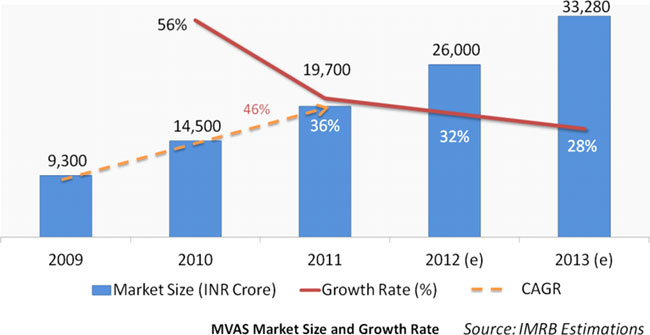
    The Indian mobile value-added services (MVAS) market is expected to become a Rs26,000 crore market by the end of 2012, growing at the rate of 32 per cent. MVAS is estimated to further grow to a whopping Rs33,280 crore market by 2013, a growth of 28 per cent. While the conventional MVAS services are still dominant, emerging MVAS services are also rapidly gaining popularity with mobile users. These are some of the findings from the latest IAMAI – IMRB report on Mobile VAS in India.


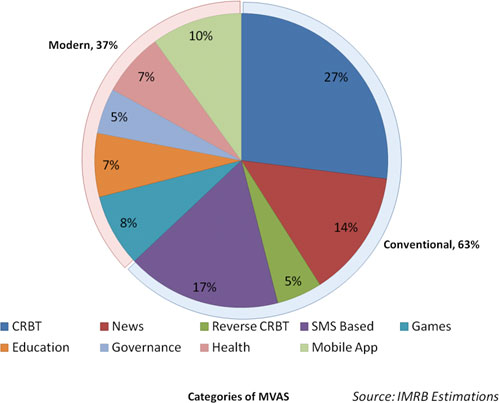
    According to the IAMAI-IMRB report, MVAS can be divided into two categories – conventional MVAS which has a market share of 63 per cent and the emerging or modern MVAS which contributes a market share of 37 per cent. While the conventional MVAS services consist mainly of CRBT and SMS-based applications, the emerging or modern MVAS mainly consist of mobile apps and games.


    Speaking to MxMIndia on the factors that would drive the MVAS revenues in the long run, Rajiv Hiranandani, Co-founder and Executive Director, Altruist- Mobile2win said: “I am a firm believer that the true growth of mobile VAS is going to come from the rural India. You will see more of services that will help the rural or the small town Indian utilizing the services. In that respect, I believe Interactive voice response (IVR) based services and SMS-based services are going to be big drivers of Mobile VAS. These services could range from basic things like finding the price of vegetables or some information over SMS or finding friends over IVR or IVR-based social networking. These are services that will catch on and will drive revenues in India over the years to come. So for VAS revenues to explode in the country, you need to appeal to the lowest common denominator which primarily resides in the rural India.”


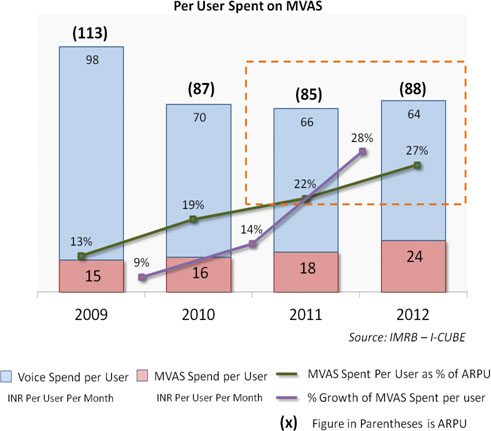
    In the last three years, the average MVAS spent per month has risen by Rs9 to stand at Rs24 per month in 2012. The percentage share of per user spend on MVAS in Average revenue per user (ARPU) has been increasing gradually. Even though the ARPU has declined over the years, per user spend on MVAS has gone up by 28 per cent in the last one year. It is now 27 per cent of the ARPU pie. The dependency on voice services is reducing and to increase the ARPU, the emphasis must be put on data services such as MVAS.


  • Vertebrand: bringing intellect to brand building

    By Tuhina Anand


    Vertebrand, a brand value management consultancy, has just upped the ante in the intellect and process-based approach to brand building as it announced its JV partnership with Equancy, an International brand, marketing and web analytics/CRM consultancy.


     

    Giving an understanding on how the latest development will help Vertebrand’s offering, Raghu Viswanath, Founder and Managing Director, Vertebrand, said: “From pure knowledge front, the partnership will help us, apart from CRM, Digital Marketing and Web Analytics. The online marketing being the next big wave to hit the country, the partnership will help us in looking at web in a much more powerful way to reach the customers.”


    He added: “The entire online marketing is a science in itself and what we see happening on this front is just tip of the iceberg. The partnership enables us to be well equipped to meet digital needs of brands and offer 360 degree digital media offering. We can learn a lot from them and also will help us with existing deals and create completely new opportunity ourselves.”


    They understand that online is not about banners or creating a website but is to marry a person’s online behaviour with offline and deliver solutions accordingly. This would mean analyzing data and that’s where Equancy will play a major role.


    The partnership would enable Vertebrand to handle marketing and branding projects for Equancy’s global clientele across India initially, extendable to Middle East and Asia Pacific over time, as Equancy’s exclusive licensee for Asian markets.


    Right now the JV is a strategic alliance, but in the long run it is understood that Equancy can take majority stake or completely acquire Vertebrand.


    Mr Viswanath is bullish on the India story and is of the opinion that despite the falling GDP, India is still better bet than many western countries. For a player looking for growth there is no option but to look at India and Asia and APAC thereafter. With this JV, Vertebrand will become partner of choice for many brands who look at partnering with Equancy this paving way for manifold growth for both the players.


    One has to understand that the offering of Vertebrand is unique as it’s a niche consultancy and will get further enhanced with the JV. Post the development, the agency also started hiring senior resources with global exposure to help them in further building the agency’s equity.


    Currently, they have offices in Delhi, Mumbai, Kolkata and Chennai. Mr Viswanath quips: “Our role is like that of a movie director where we don’t have any portfolio of work to show to our clients as we are not an advertising agency but like the movie director we shape the brands in the right direction.”


    “InIndia, paying money for intellect and strategy is not a habit and we are aware of this but we have seen attitude changing as marketers become more conscious of the monies being spent on brand building. Our offering should not be confused with advertising or designing. It could be best described that we come somewhere when between an advertising agency and brand management,” he added.


    Vertebrand is recognized as an accredited Brand Valuation specialist. The company works in diverse range of Industries from Retail, FMCG, Pharma, Automobiles, Engineering and Technology.


  • Taste of India backs Hope of India


    By Meghna Sharma


    Think of Olympics, and the one word that comes to mind is ‘glory’. With only a few weeks left for the mega event to begin, all eyes (and hearts) will be on the Indian contingent, which is the biggest by far that is being sent to the Games. While that increases India’s chances of bagging more medals, what it has also done is turn the attention of brands towards the aspirants with the obvious intention of improving awareness and possibly, even sales of products.


    One brand that is taking the lead in associating with the mega event is Amul. The Anand-based Gujarat Cooperative Milk Marketing Federation’s (GCMMF) Amul has signed a memorandum of understanding with the Indian Olympic Association (IOA) for sponsorship of the Indian contingent.


    With this, Amul has become the official sponsor of the Indian team. For Amul, this association would work in two ways: first, allowing it to push its multiple products that have been positioned for the purpose of building stamina and strength and, second, enabling it to encourage aspirants to go out and deliver their best performance at the event.


    RS Sodhi

    Speaking on the association, RS Sodhi, managing director, Amul, “Amul is committed to strengthening the Olympic movement in India and encourage young generation from all corners of the country to take up sports in a big way.”


    With milk being Amul’s core ingredient, the brand believes that milk is nature’s original energy drink and plays a pivotal role in building the physical and mental strength of the athletes.


    “India is the largest producer of milk in the world and Amul is not only India’s, but Asia’s, largest milk brand. This association, and activities around it, will help in engaging the youth so that they can enjoy a healthy life,” he added.


    In fact, this is not the first time that the milk major has stepped up to push for the cause of promoting sports. In 2011, Amul sponsored the Nether lands cricket team in the ICC Cricket World Cup and Switzerland-headquartered Sauber F1 team at the inaugural Indian Grand Prix. “We use the opportunities available on local and global scale to associate,” explained Mr Sodhi, on the brand’s recent decisions to associate itself with sporting events. “It is a good and positive association to connect with the youth.”


    Helping the brand in its mission is media agency Lodestar UM, which is the media agency on record for the company and has helped the brand associate with sporting events at a global level in the recent past.


    [youtube width=”400″ height=”225″]http://www.youtube.com/watch?v=0Qafz4YDG1A[/youtube]

    According to Lodestar UM, such associations will help the brand as India is a young nation with over 60 per cent of the population being below the age of 35 years and sports is a high interest area for them. “Amul has always been involved in raising the bar. The Olympics association has helped place Amul on the global map of international sporting events. We saw a great fit…Amul’s dairy products stand for high energy and complete nourishment and Olympics stand for values like strength, determination, vigour and winning which every person aspires to, and wishes to imbibe and practice in his daily life. We also saw this as an excellent platform for Amul Milk to assert the positioning of ‘World’s original energy drink’,” said Dhruv Jha, business head, Lodestar UM Content & Experiences.


    Although the brand has come up with a special campaign on the event for the medium of television, it doesn’t plan to come up with any more. “We are continuing our advertising, but no special Olympics focus has been planned during the Games,” said Mr Jha.


    Another motivator, that has always done its bit in raising the awareness levels of Amul with its consumers, will be at it around Olympics too. The eye-catching hoardings that figure the polka-dotted Amul Girl will continue disseminating messages as they always do.


    Rahul da Cunha

    According to Rahul daCunha, MD and creative head of daCunha Comminucations which created the Amul Girl, one should keep a catch-out for interesting and tongue-in-cheek hoardings during the period. “We have already started the build-up and there is a scope for many more as the Games have so many aspects and characters to it.”


    Mr DaCunha is proud to be associated with the brand and now its association with the world-class games. He added: “What can be more Indian than to support the Indian contingent in the Olympics. It’s a very ‘cool’ and prestigious moment for the brand. In the last year and a half, the brand has been getting allied with activities and events which will help it globally too.”


    And the attempt doesn’t end with Olympics. Amul plans to keep associating itself with such major events in the future too. “We will like to associate with any good event/series. Our focus is on the domestic market. But yes, Olympics will help in better brand recognition around the world,” said Mr Sodhi.


    Mahesh Ranka

    Mahesh Ranka, founder & CEO, Indus Sports and Sponsorship, feels that since it’s a home-grown brand, such association will help it create a buzz. “During and after the Olympics, when people will read or see about the games, hopefully, Amul as the brand will be on people’s minds. It’s a very good move by the brand and hopefully other corporates will also learn from it.”


    Not just the brand recognition, Amul hopes that the Indian contingent will get the country recognized in the world with a good medal tally as well. “Olympic Games have come to be regarded as the world’s foremost sports competition where more than 200 nations participate. Participation in Olympics is the aspiration of every athlete and with the kind of investments made by our country in this arena to select, nurture and train the best athletes, we are confident that Indian contingent will deliver the best ever performance in the London games and make our country proud.”


    So, let’s hope the players take India to new heights at the games while the brand would manage to do its bit and bask in the success as well.


  • Mindshare wins pitch for Legoland Malaysia

    By A Correspondent


    Legoland Malaysia has appointed Mindshare following a media planning and buying pitch involving four agencies. The first Legoland theme park in Asia is set to officially open in Johor’s Iskandar development region on September 15. The park will be operated by Merlin Entertainments Group, the world’s 2nd largest visitor attraction operator.

     

    The business will be run out of Singapore, and the S$296 million theme park will feature 7 themed areas over 76 acres with more than 40 family friendly interactive rides, shows and attractions.


    “Mindshare won the pitch by being able to bring to the table not just a comprehensive plan, but an understanding of our brand uniqueness. In today’s landscape it’s vital for agencies to stay on top of trends that help brands be effective and cost efficient,” said Thilakavathy Munusamy, Director of Sales & Marketing, Legoland Malaysia.


    Mr Munusamy added: “Our selection process was grueling and Mindshare demonstrated the best ability to serve a brand like Legoland.”


    Renee Tan will be the regional director for the business, and she and her Singapore-based team will work with Mindshare Malaysia. “We are very excited about handling this launch and adding the brand Legoland to our portfolio,” Mr Tan said.


    Speaking about the appointment, Mindshare Singapore, Managing Director Leela Nair said: “We are honoured and thrilled to be working with Legoland Malaysia. They are a unique business, and Lego itself celebrates original thinking. This is the perfect partnership for us, and we look forward to delivering break-through results for Legoland.”


  • Yang Saints and Warriors to sing creative tunes for Red FM

    By Shubhangi Mehta


    Yang Saints and Warriors will be henceforth handling the creative mandates for Red FM. The win comes after a multi agency pitch that Red FM had called for a couple of months back.


    Though no confirmation from Red FM could be obtained at the time of filing the report, sources close to the development have confirmed the news to MxMIndia.


    The agencies participating in the pitch include names like Lowe Lintas, DDB Mudra, Scarecrow Communications, Law &Kenneth and others.


    The incumbent agency on the account is Ogilvy & Mather, who have been handling their creative mandates for the past five years. Even the marketing spends could not be ascertained at the time of filing the report.


    Red FM is a property of Sun TV Network, India’s largest television network which has 20 TV channels, 45 FM radio stations, two daily newspapers and four magazines in several Indian languages.


  • Debrief: Honda: No need for desi flavour

    By Anil Thakraney


    On Tuesday we examined what Hero is up to. Today let’s see what’s happening with their estranged partner, Honda Motorcycles and Scooters India (HMSI). I suppose the key task Honda set for itself is to establish a bond with the desi youth, now that the ‘Hero’ moniker is gone. And they have rushed to macho hero Akshay Kumar for help.


    The idea in the TVC is that every Indian is in a great hurry to make his/her dream come true. And that the Honda bike imparts acceleration to those dreams. The voice-over is provided by macho ‘dood’ Akshay Kumar (decked up in a horrendous hood), who claims to know all about chasing dreams because he’s been there, done that. Or some such words. And the ad is peppered with Indian symbols and attitude to further embellish the local flavour.


    An entirely boring commercial. It features nothing that we haven’t seen before. In fact, the ad re-hashes all the usual Indian advertising cliches. Worse, Akshayji’s non-stop drone gets on the nerves, and what saves your life is the biggest tech boon known to humanity: the blessed remote control.


    [youtube width=”400″ height=”225″]http://www.youtube.com/watch?v=Rz6Zxh7rbH4[/youtube]

    Apart from the TVC being a complete flop show, here’s a thought for Honda: Now that you are on your own, and now that your only USP is the Jap connection (and it IS a positive connection), why do you want to desperately bring out the Indian touch? Wouldn’t it be better to go full-on on your Japanese lineage and expertise? As a bike purchaser, I would actually find that a lot more appealing.


    Bring out the kimono, guys. And chuck the dreadful hood.


    Rating: (On a scale of 1 to 5): 1. Boring and misdirected.


  • The Anchor: Asif Syed on 5 Things that are getting hotter in New Delhi

    By Asif Syed


    1. Manmohan Singh – Will the sardar become asardar?

    For a while now, many observers of the Delhi durbar have felt that the real Prime Minister wasn’t Manmohan Singh, (no, not Sonia Gandhi, she’s the super PM) but Pranab Mukherjee. Whether it was with government work, party work, troubleshooting for the UPA sarkar or heading 13 Groups of Ministers that deliberate on government policy, Pranab was the man. The joke is that the PM (Manmohan) spoke so little is because the real PM (Pranab) didn’t let him.


    Now with Pranab on his way to becoming President of our republic, many ministers in the Union Cabinet have found some additional breathing space, but none so much as Manmohan Singh. So much so that the very day he took over the Finance Ministry, the sardar ordered the government to go looking its lost “animal spirits!”


    So will the sardar become asardar or will the real number 2 – P Chidambaram, who was second only to Pranab in the GoM count with 12 in his kitty – muscle in and fill in the vacuum.


    2. The Summer of 2012

    The venerable Times of India has reported that Delhi has had the hottest summer in the past 33 years with the average temperature frizzing the mercury to an average of 41.25 degrees. Interestingly, and what is probably a sign of the times, the data for this investigative story was sourced not from the Metrological Department of India but from the website of the National Climatic Data Centre (NCDC) in the United States.


    Unlike Bombay and (ahem) some other parts of the developed world that have uninterrupted power supply, Delhi seems to have introduced the new concept of uninterrupted power cuts. Add to this the severe water shortage – basically no water at all from the MCD – and one gets situation where residents who are out on the streets to protest the lack of bijli get into a scuffle with each other over tankers delivering water.


    Of course, Lutyens Delhi, home to national level politicians, bureaucrats and businessmen has no bijli or paani problems. The air conditioners in the MPs homes are humming and sprinklers keep their lawns achingly green.


    There is fervent hope that the monsoon rains will bring some respite but they too seem to be avoiding Delhi and are stalled somewhere over central India. Maybe the ToI can talk to the NCDC about what to do…


    3. The most modern thing in Delhi

    Not all is bad in Delhi and the Delhi Metro Rail Corporation is the best thing going on the ground, below the ground and above the ground. It has changed the face of Delhi for the better like nothing else and with every phase of expansion it is bringing the spread out city of Delhi and the other parts of the National Capital Region closer to each other. It is the one thing that works in the city of a thousand hindrances and works very well.


    With two phases completed and almost 200 km of track laid and services running, the DMRC has commenced Phase III which it aims to complete by 2015 and Phase IV by 2021. By then the Metro will have more than 400 km of track and will reach every corner of the megapolis. It is already one of the most advanced metros in the world and soon will also be one of the largest. (check out this map – http://en.wikipedia.org/wiki/File:Masterplan_of_Delhi_Metro.png)


    Like Vicky the eponymous sperm philanthropist of the move Vicky Donor says to his nani, “Dill mein sirf do cheezein modern hain, ek hai metro aur ek tu.” I can’t vouch for the old lady, but he is bang on with the metro.


    4. News Capital

    For a city where the large majority of the people have at best only a passing acquaintance with the English language (or as they say in Delhi – bus sirf hi/hello hai), it is home to more English language newspapers, magazines and television news channels than any city in India.


    At last count there are more than 15 mainstream general and business daily newspapers being published from the city in English. The Millennium Post was the latest of the blocks and a couple more are reportedly in the pipeline. At this rate we run the risk of soon having more English newspapers than readers who read English.


    Throw in Hindi and other language publications and Delhi is probably host to the largest print news industry, with more print journalists than any city in the world. And in no other city can one find such a large number of journalists that speak, report and write in such a range of Indian languages.


    Sucking in all the content produced everyday and spitting it out in a physical form is a robust contract printing industry that is centred largely in neighbouring Noida. The printing industry there probably has the distinction of having not just the largest number of printing presses of all shapes and sizes of any city but of also printing newspapers not just in English in Hindi but also a number of other languages. For example, Vibha Printers (in NOIDA obviously) print newspapers in six languages.


    Never mind the lack of revenue, let alone profits, the news business inIndiais growing faster than ever before.


    5. Rahul Gandhi – naram but still garam

    As ever, Rahul Gandhi remains the hottest politician in India and with talks of an impending Cabinet reshuffle he is hotter property than ever.


    There is now talk about him finally finding a seat in the Cabinet as the Deputy Prime Minister, no less. The logic goes that this will be a suitable post for him to make his entry into the government as it won’t be decried as nepotism at its most obvious and it will still be a prominent enough to position him as the next leader of the party and the government. Party pundits feel the results of the next general election in 2014 will be determined by the ‘Youth Vote’ and who is better to capitalise on this demographic dividend than the youthful Rahul Gandhi.


    His middle-of-the-road pragmatism and firm resolve to stay away from the politics of caste and religion give him a universal appeal. And that, the thinking goes, will lead to a windfall of young urban and rural votes for the Congress and its allies.


    Though it would be wise to recall the ‘Rahul Effect’ in recent elections. Beginning with Bihar and followed by Pondicherry and most recently Uttar Pradesh, the last three assembly elections where he has played a significant role, it has become clear that Rahul’s presence alone does not bring in electoral results for the Congress party.


    However, the party, and specially dye-in-the-wool Congressmen, can’t stop gushing about him like schoolgirls with a crush on Ranbir Kapoor.


    Asif Syed is Editor and Publisher of Current and www.CurrentNews.in. He toggles between New Delhi, Mumbai and Buenos Aires


  • Rajendra Gupta joins Mogae

    By A Correspondent


    Rajendra Gupta has joined Mogae Media as Chief Value Officer from Reliance Communications. Mr Gupta will be based at Mogae’s Gurgaon headquarters.

     

    Mr Gupta started his career at Dunlop where he worked across different geographies. He then spent a few years at Wipro in their Lighting Division. In 1994, he moved to Rediffusion DY&R as national head of Business Development. His first big win at Team Rediff was a small company that had won a license to launch cellular services in Delhi- Bharti. Brand Airtel was soon born


    “Those were the best days of my professional life. I got to work closely with the Mittal brothers and enjoyed every moment of launching a brand that one day would become a world beater”, he said.


    Mr Gupta moved to Reliance Communications and spent the last 10 years there in a broad variety of functions. “Moving to Mogae is like home-coming. I have worked with Sandeep Goyal for many years and his new venture really excited me. So here I am,” said Mr Gupta.


    “Guptaji (as he is popularly called) is a veteran of both mobile and of advertising. It is a rare combination. And that is what makes him a really valuable asset on any team,” said Tanya Goyal, Director of Mogae Media. “We look forward to Guptaji carving out a new business out of creating customer value and delight through options on hi-value brands”.


    Mogae Media is the exclusive partner of Airtel, for monetization of all its mAdvertising assets, including mCouponing and mCommerce.


    Mogae Media was launched by Sandeep Goyal, former JV partner of Dentsu India in October 2011.


  • Oh God! Why Higgs-boson and not Bose-Higgson?

    Ranjona Banerji

    By Ranjona Banerji


    The main question in the discovery of a Higgs-boson particle at the CERN in Geneva is simple: How many Indians were involved? This is the conundrum that has enthralled and mystified many as the search began for this sub-atomic particle that explains how matter got mass.


    It has been well known for years that no discovery by the human race is of any significance unless Indians are somehow involved. In the case of Higgs-boson, this Indian connection is even more significant: it is also called “the god particle” and the world knows that India has first dibs on anything connected with god. Or even better, gods.


    The Higgs-boson god we will soon be told is described in detail in the ancient Indian scriptures. But there are other Indians involved too. Some worked at CERN or were seconded there. Then there’s that “boson” part of the Higgs name. That’s Satyendra Bose who worked with Albert Einstein and postulated the existence of sub-atomic particles in the 1920s.


    An international inquiry will now be held to find out why the particle is not called “Deva” particle and equally important, why it is not called Bose-higgson. Peter Higgs after all wrote his academic paper in 1964. I don’t know much mathematics but even I can guess that the 1920s is many years before 1964.


    The Indian media must now investigate this international conspiracy to demean India: this is almost as important as why McDonalds used beef fat to fry its French fries, even if the fast-food chain started in a country where cows are not holy and often used as food. Indians make up one-sixth of the world’s population most of which are Hindus and that has to count for something (80 per cent of 1.2 billion).


    Some in the media last night were very worried that the world famous scientific research institute which has been at the forefront of global work in quantum physics, the Indian Institute of Technology, was not involved in the Light Hadron Collider at CERN, Geneva, Switzerland. Subramaniam Swamy can file a PIL on this and at the same time, find out how much money from Swiss banks was used in this experiment.


    I might venture to point out to the media that there is a significant difference between science and technology, but I fear for my life. It explains why Steve Jobs was credited with inventing the computer after he died and Alan Turing’s birth anniversary only noticed by Google.


    Of course, few really understand this sub-atomic mass matter stuff, so we need to find a suitable person sorry I mean Indian to explain it all. How about Raj Koothrapalli from the Big Bang Theory? He’s the only famous Indian astrophysicist I can think of.


    Incidentally, in one of the early runs of the Light Hadron Collider, the experiment failed because of some faulty wiring. Anyone think an Indian was involved?