Blog

  • Paritosh Joshi: Everything I had to know, I heard it on my radio

    By Paritosh Joshi


    Three times this last week, radio has crept into my conversations, with three quite different people. Let me cite just one. We were talking about our preferences between playing music from our CD collection and dialing up a radio station. My guest was enthusiastic in his approbation for the radio, for a very simple reason too. “When you play music from your collection, you always know what’s coming up next,” he said, adding: “and what makes radio fun is it’s an endlessly unfolding sequence of surprises.”


    To which I would add that there is something rather relaxing about leaving the hard work of choosing what plays next to someone else, indeed someone else who is specialized in the art and craft of assembling and running through playlists.


    Got me thinking about radio, so it was the obvious next step to check out what the industry association offered up. Wasn’t hard to locate the website of the Association of Radio Operators for India (AROI). Promptly went there to discover – well, not a lot. Had to get something on the industry and thankfully, the good people at KPMG and FICCI had the latest “Indian Media & Entertainment Industry Report” available for download, which I swiftly proceeded to do. Here’s what I found.


    The Radio industry in 2012 is worth a mere Rs13 billion, ~ US $ 240 million and represents a mere 1.6 per cent of the overall industry of Rs 823 billion, ~ US $ 15 billion.


    In five years, it is projected to grow to Rs 29 billion, still just ~ US 540 million but representing a slightly more respectable 2 per cent of the overall pie. Evidently, this will require it to grow faster than the overall pace, which it is projected to do, clipping along at a 21 per cent CAGR even as the overall number doesn’t quite get to a 15 per cent CAGR.


    Dig deeper and you will find that a lot of the enthusiasm stems from FM Radio Phase III which will introduce private FM to as many as 227 new towns. So that is all it takes to make radio exciting, is it?


    Let’s take a look elsewhere and find out what radio is really about. A good place to start is any of these: Last.fm, “tunein.com” Radio or “shoutcast.com” Radio Directory. All of them are aggregators, like the portals of yore in some ways, which offer you an endless variety of radio stations from across the planet. An important aspect of what is on offer is the range of ‘genres’ by which the stations are classified. Here’s a list of the genres under the broad category, ‘Music’ on TuneIn:


    Adult Contemporary Country Hip Hop Rock Top 40-Pop
    Blues Decades Jazz Soul World
    Classical Easy Listening Oldies Spanish
    College Electronic-Dance Religious Specialty


    Just in case you might think this was a bewildering choice, I have news for you. ‘Sports’ offers a choice of 21 genres, including, trust me, ‘Fantasy League’.


    The point I’m making is quite simple really. Radio is all about precise choices and tightly defined audiences. Stations have an unapologetic and uncompromising commitment to their audiences and are only able to attract them because they stick to playlists that reflect the choices of their highly differentiated audience.


    What does the picture look like inIndia? Our earliest templates from what radio stations must sound like came from Akashvani, the one channel that catered to our teeming millions long before the brash youngsters arrived on the scene with FM Phase I.


    Akashvani was the ‘one size fits all’ / ‘any colour so long as it is black” radio station. From programming in two, even three, languages to carrying everything from mythologicals through adventure serials (anyone remember Inspector Eagle here?), to the News and various topical features, radio did everything – catered, as it were, to the lowest common denominator.


    Look at where we are now. Barring one station that chooses to play a purely Western playlist, all our major metros run a whole bunch of stations whose content is largely interchangeable, mainly because their music and even anchoring style – chatty, hip youngsters doing their clever, irreverent thing, are right out of a cookie cutter.


    Now before I get flamed out by radio folks pointing to the compulsions of recouping sizable licence costs, I must beg forgiveness and hide behind the defence of ignorance. What I do know, however, is this cannot possibly be the best way for radio to go forward.


    Radio must target tightly and then programme obsessively to that chosen audience. “Let me be just like everyone else” is not good marketing in any category, least of all radio. Keep in mind that radio will shift away from airwave frequencies to the Internet. That’s when the same-same (known, I believe, as Adult Contemporary) content will die anyway.


    I began by invoking Queen’s Radio Gaga and can’t help but quoting again from the same, wonderful song at the end.


    “You’ve yet to have your finest hour Radio – radio”


    Paritosh Joshi was until recently CEO, Star CJ. He has been a marketer, a mediaperson and a key officebearer on industry bodies. He is Strategic Advisor, Ormax Media. He can reached via his Twitter handle @paritoshZero
  • Now an agency to crowdsource design & communication ideas

    By Preethi Chamikutty


    The season for new businesses in advertising just doesn’t seem to end. However unlike other agencies that are brick-and-mortar in format, IdeaDemocracy is an online design and communication crowd sourcing platform. Setup by Rohit Misra, ex-president of Rediffusion Y&R and his partner Chetan Mangat, the agency is novel in its format. Before it goes out and talks to clients about themselves, IdeaDemocracy used crowd-sourcing to even design its logo and next in line is the agency’s website homepage.


    Talking about the concept, Mr Misra said: “It has been noticed that many a times when the company briefs an agency, people often don’t come back with what the brief was about. There are people with creativity and imagination every where and not necessarily in our offices, so we thought to do something to harness this pool of people and reward them. That is where the idea of crowd creativity came about.”


    So from doing collaborative thinking, to using a tool called the IdeaStarter – a mood board for discussions and bouncing off ideas, IdeaDemocracy is a big playing ground for every creative individual.


    As a concept IdeaDemocracy looks exciting but can client deadlines be met working with such a model. Misra says every work can be customized as per client requirement and delivered within the time agreed. “When we get a requirement from client, we put it up on our community and then we brainstorm to get the appropriate solution. So we can run a contest online and look for people with certain kind of skill set to do the job. Then we shortlist people who best fit the bill basis their portfolio and give it to the client. If the client is willing to pay the money asked by the person, he gets the job,” explains Mr Misra.


    IdeaDemocracy works on connecting the audience to the client. There are also tools on site which can be used by freelancers, besides traditional tools and moods boards to execute what they have in mind. The site also has strong end user agreements, which according to Mr Misra, can ensure everybody gets the proper worth for their efforts.


    The site already has a user base of 5,000 creative people. The initial crowd sourcing activity to create the agency’s logo received 40 logo design entries and the current logo being used by the agency is that of the contest winner. Mr Misra said that IdeaDemocracy would first like to talk to SME’s who may not have the large budgets of an MNC, but still want good people for the job. A self-funded venture, Mr Misra says he would not measure the agency’s success in revenue terms but more on the number of transactions happening on the site. His optimism also comes for a similar creative group in Indonesia which already has 65,000 people onboard doing proper work.


    Source: The Economic Times

    Copyright © 2012, Bennett, Coleman & Co. Ltd. All Rights Reserved


  • Vuclip wows women with video…on the go


    Text and Video by Shruti Pushkarna


    Mobile video portal Vuclip unveiled India’s first mobile video portal for women in New Delhi on July 11. The video portal for women, Mira!, is designed to appeal to the independent women of our times. Mira! draws content from around 30 content providers in India, as well as globally, to offer videos across a host of categories that interest women. The mobile portal will feature content relating to health, beauty, fashion, lifestyle, parenting, cookery, entertainment, astrology and much more.


    Launching the portal at the Press Club of India in New Delhi, Chief Guest Prof Kiran Walia, Delhi NCT’s women development minister, said: “Mobile phones are emerging as an economical tool for accelerating mass-scale development of women. Studies show that the mobile phone has helped women feel safer, more independent and connected, and has opened new professional avenues and income sources for women. As India’s first mobile video channel for women, I hope that this initiative will help boost mobile adoption among women, and will encourage the creation of more women-oriented mobile content.”


    Prof Kiran Walia, Delhi NCT’s women development minister, with a part of the the VuClip leadership team

    Vuclip also unveiled the findings of its global survey in which almost 40,000 women users participated from 176 countries, including nearly 13,000 women from India. The survey found that besides voice and text, 60 per cent of Indian women respondents use their handsets as a primary source of entertainment. As many as 80 per cent of the respondents reported steady increase in time spent on mobile-viewing. Besides movies and music, Indian women also loved watching TV soaps, funny videos, sports, news and celeb gossip on their mobile. Women between 18 to 35 years comprised 65 per cent of the Indian respondents, while 24 per cent were under 18 years and another 11 per cent were over 36 years.


    Commenting on the survey findings, Meera Chopra, Vice President-Advertising, Vuclip India, said: “Even as the adoption of mobile among women grows in India, it is encouraging to note that mobile is already becoming a woman’s preferred source for content. While 37 per cent women from India reported that they spend more than one hour daily on TV, print or radio media, a close 32 to per cent women reported that they spend over an hour to access mobile content every day.”


    Vuclip’s Global Vice President-Marketing, Judith Coley, said: “In contrast to the developed countries, internet in the developing world is arriving on phones before traditional computers. About 59 per cent of internet users in India get online via mobile phones. We hope that Mira! will help spark a revolution in the way women’s mobile content is perceived – by content providers, brands, and women themselves. Cisco predicts that mobile video will increase 25-fold to account for over 70 per cent of total mobile data traffic between 2011 and 2016.”


    [youtube width=”400″ height=”225″]http://www.youtube.com/watch?v=biLDcqZ-TkY[/youtube]

    Speaking about the choice of the name for the portal, Ms Coley said, “Mira!’ in Latin is the root word for ‘wonderful’, while in Spanish, ‘Mira!’ means ‘look’. Mira! is also the name of a bright star. The Mira! Woman is busy, engaged, radiant and full of life. She wants to make the most of every moment, and when she takes a break, she turns to her mobile phone for entertainment, news and tips.”


    MxMIndia also spoke to Salman Hussain, Vice President- BD & MD (India & Middle East), Vuclip. In his conversation with MxMIndia, Mr Hussain talks about the genesis of Mira!, Vuclip’s content partnerships, the road ahead and more.


    Excerpts from the interview:


    How did Vuclip decide to come up with a women mobile channel? And why ‘Mira!’?

    Vuclip launched in India in 2008 and it’s a mobile video portal. We were trying to get people to watch the videos they wanted on their mobile phones and it’s primarily search-driven. What we saw happening over the past couple of years that we’ve been around was that there were a lot of topics that were being looked at which were women-oriented and that was the genesis for us to create a verticalized portal with women-oriented content on it. The precursor to that was a global survey we conducted, where about 40,000 women responded, out of which 13,000 were in India. We asked these women that if we set up something with the kind of content they are looking at, would that be of interest for you. So that was the genesis for it. And Mira, the name was an amalgamation of the different things it means in various languages.


    Have you partnered with a content provider for all the content on the mobile video portal?

    Absolutely. Vuclip in India works with almost 80 content partners. We work with the large movie production houses, someone like a UTV. Then we work with television channels like a NDTV. We also work with a lot of regional players, like MAA TV down in AP, we also work with quite a few local news channels as well.


    So what about the content on Mira…

    Mira sort of becomes a subset of what’s happening on Vuclip. If you look at the Mira portal, you will see there are various kinds of content available, like the traditional entertainment genre, there’s also news so somebody like an AP (Associated Press) becomes a partner for that.


    If you could also share some mobile viewing trends in India indicated in the survey conducted by Vuclip.

    Vuclip is doing more than 4 million video views a day in India. We have an audience of more than 10 million unique users that are coming on to Vuclip each month. To talk about the kind of categories that people are viewing, they range from the typical movie related content, astrology, cricket and so on. But that’s not the only thing people watch. For example, you’ll be surprised that one of the big things that people look at is animation and nursery rhymes.


    Are you looking to launch any other channels apart from this women’s channel?

    Yes, there is a huge roadmap we have in terms of content that’s coming up. It will cover all genres. So there’s sports, music, devotional, cricket, health. It’s always going to be an ongoing process.


    Is this going to be an Instagram for video?

    Not really, because Instagram looks more at user generated content. In this case, we are more search-oriented, where we are saying that there is some curated content that’s available. But I think we’ll sort of move towards that phase eventually because while it’s easier to do that for images, it’s a lot tougher to do the same for video. Right now there is a huge demand for watching video content. I think as the space evolves, since video is still very nascent in Indian market, we will see folks starting to generate more video content. And that’s when we will see a video for Instagram sort of thing happen.


    Is Vuclip only for airing proprietary content? Or is it also into social video sharing?

    You know social is a very large aspect of why Vuclip grew in the first place. So if I watched a video which I liked, the biggest advantage that Vuclip brought to the table was that I could just forward that very quickly via Facebook, or tweet it or sms it to my friend. So that virality is what helped us grow in India. An interesting stat I want to share, when Vuclip started, 65 per cent of views came from search. But in the last four years, more than 65 per cent views come from people sharing. And that’s been the trigger for our growth.


    What are the infrastructural obstacles that something like Vuclip faced in being able to deliver bandwith-heavy content quickly? And what are the ways in which you worked around them?

    That is our USP, that’s really what we brought to the table in the Indian context. We have our own proprietary technology, whereby we can take a video and in real time make it match the handset which is requesting for it. Today we support more than 5,000 different kinds of devices and that has been our biggest strength in India. We have grown with the growth of mobile internet in India. With the advent of 3G and 4G, I think it’s only going to help us grow in a much faster manner.


    Will Vuclip be open to partnering with niche content producers to create subject or domain-specific content channels like this women’s channel?

    Absolutely. We are seeing content providers in three categories right now. Someone like a UTV is a much more tech-savvy partner who knows internet and mobile, and already has curated content. So it’s easier for us to work with them. But if you look at more regional content players, that’s been our focus for the last one year. And as we talk to them, they have great aspiration in terms of going mobile but they don’t know how to. So we are working with them, educating them and trying to get them to edit and tag their clips. From our perspective, we are a great distribution partner for them.


    Do you have to partner with each carrier?

    Not for Vuclip itself because if you are able to go on to a rediff or a yahoo on your phone, you will be able to go to Vuclip, it’s an off-deck site. And it’s free to the consumers, so there’s no billing integration required. But we are aligned with all the major carriers in India and that’s because we believe that the more we get to know about the consumer, the better product we can offer. Similarly, it’s a two-way path for the carriers as well; we provide a lot of insight in terms of what the consumers are watching. We are also able to tailor the experience for individual carrier depending on the kind of networks they have and depending on the kind of regions their audience is in.


    And how is it in terms of revenues?

    We are looking at two revenue models. We are looking at advertising increasingly becoming a larger play for us. I think it’s still in the nascent stage. What we have also been able to establish in parallel is like a ‘freemium’ model, where we take a subset of the audience that comes to us and up sell them on some premium video content for which they explicitly pay, and we proactively push out that content to them on a daily basis.

     

  • Free Press Journal celebrates 84th anniv

    By A Correspondent


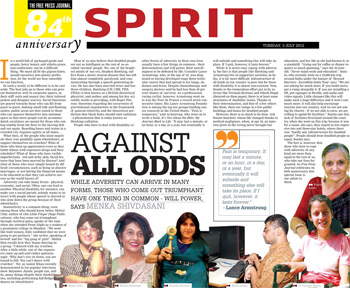
    The Free Press Journal, one of the oldest dailies published from Mumbai, recently celebrated its 84th anniversary by publishing a special eight page pull-out called Spirit.


    To celebrate this intangible, yet very relevant, human trait called ‘spirit’, The Free Press Journal decided to profile Mumbaikars – men and women of courage – who did not give up. The issue was an attempt by The Free Press Journal to inspire Mumbaikars and present them with living examples of persons who surmounted obstacles by summoning the indomitable spirit.


    Each page of the supplement had profiles of persons who summoned their inner strength, to deal with life challenges. The pull out had people like Raageshwari Loomba spoke on how Bells Palsy did not stop her from fighting back and opening up a new world; activist and lawyer Flavia Agnes spoke about the struggle of fighting domestic violence and how she battled years of abusive marriage.


    The anniversary issue was received very well across the market thanks to the theme and the array of articles.


  • Sanjay Sharma joins Bhaskar for sales

    By A Correspondent


    Sanjay Kumar Sharma has joined Dainik Bhaskar group as Regional Head (West). He will be responsible for sales revenue across all products in Dainik Bhaskar Group’s portfolio.
     

    Mr Sharma has a rich experience of 22 years in Sales, Marketing, Customer Service and Business Development. He has an extensive experience in spearheading businesses across Telecom and Consumer Durable companies.


    Mr Sharma is an MBA (Marketing) from Pune University and have worked in companies like Unitech Wireless (Uninor), Bharti Airtel, Reliance Communications Ltd., ZIP Telecom, Samsung India Ltd. and Philips India Ltd. His last assignment before joining Dainik Bhaskar group was with Unitech Wireless.


    At a personal level, Mr Sharma likes to read, is an ardent fan of cricket and likes to travel and explore new locations.


    On his appointment Mr Sharma said: “Media is a new challenge for me and I am happy to be part of Dainik Bhaskar, the leaders in Print Media business.”


  • Viewers can name upcoming A&M show on Awaaz

    By A Correspondent


    Hindi business channel, CNBC Awaaz, plans to launch first-ever show on advertising and marketing. This is the first time a channel will be looking at the world of marketing and advertisement from the consumer’s perspective. The channel will attempt to engage and connect consumers with experts from advertising, marketing and media planning sector through the show.


    Aimed at decoding the world of advertising for the consumers, each episode will consist of various segments. The first segment will focus on the campaign of the week and the various teams behind its success – creative, marketing and media planning.


    The second session will be a ‘Marketing Classroom’, where some of the best case studies will be analysed to guide SMEs in building their brand. This would be followed by the news of the week with the latest reports from the M&A world and issues related to the ASCI and consumer courts.


    Keeping in mind the focal point of the show and its primary stakeholders, the channel has launched a unique contest Kya Hoga Iss Show Ka Naam. From July 9, consumers as well as experts from the A&M sector can suggest a suitable name for this upcoming show.


  • Cheil appoints Nima DT Namchu as ECD

    By A Correspondent


    Cheil Worldwide SW Asia has announced the appointment of Nima DT Namchu as Executive Creative Director. Mr Namchu will join soon, from Contract Advertising where he was senior VP and Executive Creative Director.


    Confirming the appointment, Alok Agrawal, COO, Cheil WW,SW Asiasaid: “Cheil SW Asia has been growing at a rapid pace, gaining traction both on account of new business and current client portfolio. We have been steadily improving our creative product and the proof was the recent win at Cannes. Nima is a highly accomplished creative person and I am happy to have him on board. His joining completes the creative trilogy at CheilIndia, and along with Varun and Ravi, we will be a creative force to reckon with.”


    Mr Namchu comes with over 19 years of experience in advertising. Over the years Namchu has worked with a wide range brands including Sony, Indian Oil, LG, Maruti, Mastercard, Nescafe, Perfetti Van Melle, Virgin Atlantic, Reebok, General Motors (OPTRA), XBOX, Hewlett Packard, Aviva Life Insurance, Jim Beam. More recently, he has been involved with Domino’s Pizza, Google, NIIT, SpiceJet Whirlpool, DelMonte Foods, Jaypee , Dabur and British Council among others.


  • BIG FM hosts Twenty20 World Cup trophy display

    By A Correspondent


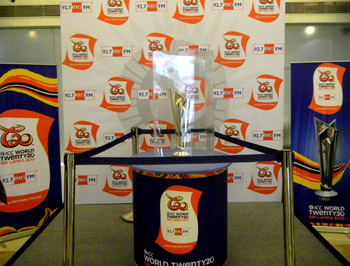
    Reliance Broadcast Network Ltd’s radio vertical 92.7 BIG FM announced its set up as the official FM Radio Partner for the fourth edition of the ICC World Twenty 20, Sri Lanka 2012 in Delhi. The announcement was made as they hosted an exclusive display of the prestigious trophy at an exclusive closed door preview at Maples Emerald, New Delhi.


    The elegant, glittering, 7.5 kg trophy was unveiled for key partners from advertising agencies and top clients across FMCG, retail, banking, pharma, manufacturing and other sectors.


    As the official FM Radio Partner for the ICC World Twenty 20, 92.7 BIG FM will get to display the trophy in Mumbai as well, which is scheduled to happen next week. It will also mean exclusive access for the station to players from India and abroad during the course of the tournament.


    Exclusive interviews and bytes from players and other match officials will be aired first only on 92.7 BIG FM. In order to promote the tournament on-ground, 92.7 BIG FM will conduct a number of T20 matches for listeners across cities, who will fight for the BIG T20 CUP, the winning team here will also get the rare opportunity to witness a match involving India in Sri Lanka.


    According to the latest RAM ratings, 92.7 BIG FM with a listenership of 1076 (age group 24yrs -34 yrs) in the 7am-11am time slot is the No. 1 FM radio station in New Delhi.


  • Carat Bengaluru bags Koov’s Media AOR

    By A Correspondent


    Koovs.com, one of India’s fastest growing fashion e-store, announced that they had chosen to partner with Carat Media Services after screening a number of media agencies.


    Speaking on the appointment, Mr. Rajesh Kamra, Director – Koovs.com, said: “We were delighted to see the response we received from Carat on the brief and their huge passion for our business. Their tools and technologies as well as their approach to media completely took us by surprise as they were truly business focused. We are pleased to have them as a partner and are sure that they would contribute significantly to our business growth.”


    Joydeep Raha, Senior Vice President -South, Carat Media, shared: “Our thorough understanding of the online consumers with respect to their attitudes and aspirational needs was critical in recommending customised media solutions for  Koovs as an online lifestyle portal bringing in the best solutions in luxury & lifestyle. We look forward to partnering Koovs in their endeavours and will leave no stone unturned to deliver cutting edge Integrated solutions for the brand.”


    Commenting on the engagement, Kartik Iyer, Managing Director Carat India, expressed his joy and said: “I am delighted to partner with Koovs.com, which is India’s fastest growing ecommerce site and thank Mr. Rajesh Kamra for reposing faith and confidence in our cutting edge media solutions, backed by relevant consumer insights.”


    Carat, which launched its Bangalore operation 3 months ago, has been receiving wide acceptance amongst marketers and media professionals with Koovs.com as their second win after the Digital and OOH duties of Wipro Technologies.


    Carat is part of the Aegis Media Group. Other companies in the group include Vizeum, Posterscope the global OOH sector leader, Brandscope,  Hyperspace (Retail), Carat Fresh Integrated (Activation), PSI (Airports), Doosra (Creative), Isobar and iProspect.


  • Prabhat Khabar launches Panchayatnama in Bihar

    By A Correspondent


    Prabhat Khabar successfully launched fortnightly tabloid Panchayatnama, targeted towards the rural areas of Jharkhand and its Panchayat related issues, in Jharkhand. Now taking it a step further, Prabhat Khabar has now launched Panchayatnama in Bihar on July 11. This launch took place with an inaugural function in Patna, presided by Mr. Nitish Kumar, chief minister of Bihar.

     

    Panchayatnama will have 40 pages tabloid and will come with a price tag of Rs10. It will be circulated in all 38 districts (8842 panchayat) of Bihar with approximately 25,000 copies on day one.


    Panchayatnama is a way to allow the growing media industry to connect with the vast rural population ofBiharand let the rural population get an opportunity to voice their problems and developmental aspirations.


  • Debrief: BombayTimes = Lokhandwala Times?

    By Anil Thakraney


    I like the Bombay Times commercial. Mainly because it’s entertaining and the musical score is nicely languid and quite catchy. The ad also has an idea: People in Bombay like to dress well and like to get noticed for their glam quotient. The TVC features aam aadmis and aurats wearing bling and lagaoing style: a government daftar babu, a fisherwoman, a rick driver, etc. So unlike the colourful supplement, the ad isn’t air-headed and that’s great.


    However, there are a couple of problems I have with this treatment. The ad doesn’t really gel with the product. The commercial features people who would NEVER be seen in the pages of Bombay Times. And this creates dissonance in the head. Because every morning, all I spot in the supplement are pics of the hundred usual suspects. And I must add here that I would actually like to see pics of the shining aam junta in Bombay Times. Would make it a little interesting.


    [youtube width=”400″ height=”225″]http://www.youtube.com/watch?v=tUjhPjGw8DI[/youtube]

    Secondly, I am not sure all Bombayites like to glam up on the streets. Most are forever stuck in the worst sort of traffic jams, or packed inside the ultra-crowded public transport. And surviving the city is all that goes on in the mind. Therefore, it doesn’t really capture the ethos of Bombay. This ad would have worked wonderfully for Andheri’s Lokhandwala Complex, the one street that’s swarming with glam wannabes.


    Still, the TVC does deserve good marks. Because it doesn’t bore you even on repeat exposures. And because it’s (thankfully) not even trying to project BombayTimes as an intelligent read.


    Rating: (On a scale of 1 to 5): 3.5. Strategically off the mark but very entertaining.


  • The Anchor: Faisal Farooqui on 5 changes he would like to see in digital media

    By Faisal Farooqui


    1. Government adopting Digital:

    There is a lot that the government can do by adopting the digital media. We look forward to significant changes in the government where the entire delivery of the government public interface services should be digital. I would like the government to understand that digital media is not just about having a website but it is really about reaching out to your citizens on a larger scale.


    2. More schools adopting Digital:

    All schools inIndiastarting with government schools must adopt digital as part of their curriculum and treat it as a separate medium. All the schools in this country should realize that digital is not a separate medium, but a medium which can be integrated with their teaching and curriculum, and they should make this change.


    3. Cutting down on the middle men:

    I would like advertisers and publishers to reach out directly to each other. There are a lot of middle men involved in the whole process of buying and selling of ads in the digital space. If the digital industry, both on the advertiser and publisher front, has to make progress then we need a lot of direct interaction between buyer and sellers. This will help ad buyers reach out to inventory sellers directly. Therefore, we need to cut down on some of the layers in between.


    4. Cell phone operators adopting digital:

    Cell phone operators inIndiahave not adopted digital completely. They have to realize that digital doesn’t just mean subscribing to SMS jokes. Most of their websites are not optimized. Hence, a great push can be given if the mobile operators can go digital. Cell phone companies must therefore make a lot of their services digital. So if they can change their digital strategies and adopt digital in a bigger way, I think that will be a big boost.


    5. Digital industry must think beyond the websites:

    Digital industry has to think that digital is beyond the website. You have to build social integration and a lot of these digital companies inIndiahave not embraced social media. Hence digital I believe has to become social.


    Faisal Farooqui is the Founder – CEO, Mouthshut.com