Blog

  • Mindshare continues to be India’s #1 media agency, Madison is at #2: RECMA billings report

    By A Correspndent


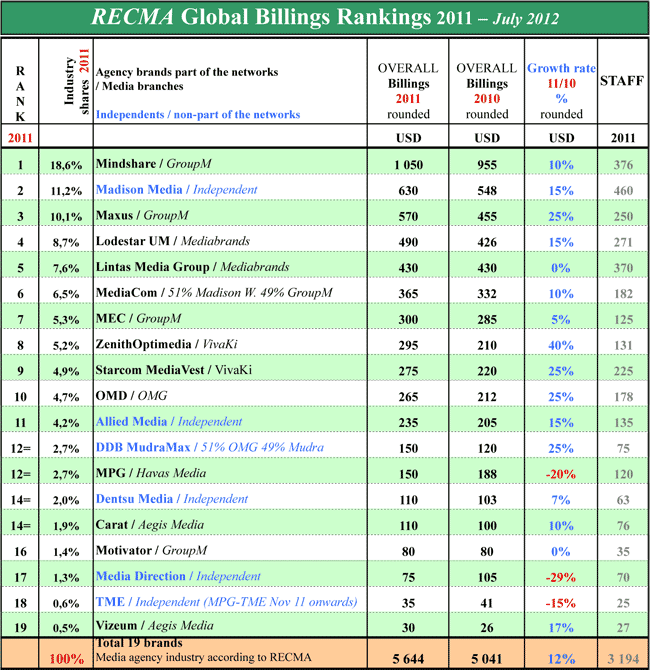
    The much-regarded billings report for India has been released by RECMA. The Indian media agency business grew 12 percent in 2011 with a total billings of US$ 5644 million.


    Group M’s Mindshare media agency tops RECMA’s India billings report for 2011 with US$ 1055million, growing 10 percent over its 2010 billings. Madison Media is second 630mn, growing 15 percent. Maxus, Loderstar UM and Lintas Media Group are rank third, fourth and fifth respectively.


    ZenithOptimedia saw the highest growth with 40 percent over the previous year, as per the RECMA report. At least three agencies saw a degrowth. Media Direction went down 29 percent, MPG down 20 percent and TME dropped 15 percent.


    The combined billings of Dentsu and Aegis agencies Carat and Vizeum would put the new entity at #11 with US$ 250 million.


    Last week, MxMIndia had reported RECMA’s global billings data and rankings (see Link: http://www.mxmindia.com/2012/07/starcom-tops-recmas-global-billings-rankings-omd-is-2/).


  • Percept Live takes flight with Rs 200cr investment

    By A Correspondent


    There’s no denying the endless opportunities that live events manage to throw up. Ask the owners of Percept who’ve organised some memorable – and of course profitable – events in the recent past. With the number of properties seeing an upward spike, the media and communications powerhouse has decided to house all its event properties under a newly instituted division, Percept Live.


    Percept Live businesses will include all the IPs created and owned by the Percept Group, including IPs in the live entertainment, sports, celebrity management, digital and media space. Some of the renowned IPs currently owned by Percept Limited includes Sunburn, Fight Nights, Bollywood Live, Lost Music Festival, Fan Football Championship, Champions of the World and Windsong Music Festival.


    The group would be pumping in close to Rs200 crore to execute its plans over the next three years. While Rs100 crore will be raised through equity, Rs50 crore will be raised through debt and the remaining Rs50 crore will be through internal accruals. Of this amount, Rs50 crore has already been raised and will be used in creating innovative IPs with global appeal as well as scaling up existing IPs.


    To take their plans in the space forward, the group has bought back former head Manuj Agarwal who has been appointed CEO of Percept Live and will be responsible for providing strategic direction to Percept’s IP business.


    Prior to coming back to Percept, Mr Agarwal was CEO-Television at Balaji Telefilms Ltd.  Mr Agarwal said: “I am delighted to take on this new and challenging role. This new initiative is designed to consolidate our efforts in the area of IP creation and management, and will ensure that we take ownership of our ideas and convert them into assets that would benefit our clients and Percept in the long run.”


    Elaborating on the prominence being laid on the new venture, Shailendra Singh, Joint Managing Director, Percept Limited said that for long Indian companies have been dependent on ideas from outside and failed to produce something spectacular from their own home ground. But all that is changing now and Indian ideas are now finding acceptance with the outside world. It was therefore essential to come up with ideas that are ‘glocal’ in nature.


    “We have been in the ‘Ideas’ business for the past 28 years and have been instrumental in creating many legendary Intellectual Properties in the past for our clients. The launch of a dedicated IP vertical is but a further extension to our existing knowledge and expertise in the Entertainment, Media and Communications domain and is in keeping with the growth plans of Percept in the coming years. Our vision is to convert path breaking innovative ideas into assets in order to create long term value for brand Percept as well as our clients and investors,” said Mr Singh.


    Of the several properties, Sunburn has been Asia’s biggest and most desired electronic dance music festival. It has completed five years and in its 6th year the brand is going truly global with Sunburn already finalized for SL, Singapore, Jakarta and Dubai, besides a big domestic calendar. Other events include Fight Nights – India’s first ever indoor boxing bouts between leading Indian and International boxers; Bollywood Live – the first ever multi-city Bollywood Dance Music Festival; Champions of the World – bringing together under one roof celebrated super-icons in the arena of Sports, Cinema, Business, Entertainment & Entrepreneurship; and Lost – a music festival extravaganza featuring International and domestic talent across various live music genres such as Pop, Rock, Dubstep, House, Reggae, Metal and R&B. Lost will be India’s largest Live Music Festival.


  • ‘If you’re not ready for digital, your company is’: Media Rhythm 4


    By A Correspondent


    Stratagem Media Pvt. Ltd, an independent media services company, held its fourth training program called ‘ReveNEW Concepts – The Media Rhythm series and Ideas’ on July 21 in Mumbai. The workshop saw participants from The Times of India, The Hindu, Malayala Manorama, Eenadu, Amar Ujala, MY FM and other media companies.


    Among the speakers were Mr Sundeep Nagpal, Founder Director at Stratagem Media Pvt. Ltd; Mr Suresh Balakrishna, CEO, Brand Programming Network; Mr Bharat Kapadia, Chairman, Whatuwant Solutions and Mr Madan Sanglikar, a digital media expert and CEO, AD2C.


    About bending backwards with ease:

    Mr Nagpal, the first speaker of the day, delved on ‘Bending back with ease’ wherein he asked the participants to first know what they are selling. He said that instead of selling many things at one time, there has to be some clarity and certainty of what is being sold and only then the expectations of the clients can be met. Mr Nagpal also spoke about the importance of reminding the consumers about the brand even after awareness is created: “A consumer needs to see the ad frequently. Time and again we have been able to convince clients that in a crowded market, playing one advertisement is not enough. Therefore a reminder is very important.”


    He also said that even though there is awareness, reminder and high impact, the brand may not sell as the problem could be because the competition is making more noise. “At times when everything is good, there is no recall because competition is making more noise. Response measurement is very tricky and must be done in a scientific way. Low response could be because of the lack of good features, price and distribution issues,” he said.


    Mr Nagpal also pointed out that it is very important to know the client’s business or product: “If you are managing client expectations, you must also know the client’s needs. When you do consultative selling, you can reduce the discount selling.”


    He also spoke about the two ways a brand can grow. First, get new consumers and second get the same old consumers to consume the brand more frequently. Some other ‘home truths’ Mr Nagpal shared were: remove discount, adopt differential and value based pricing.


    He said it is important to know the competition as is important to calculate, permute and innovate and that you can always refuse a business instead of selling lower than what you deserve.


    Customising media usage for brand communication:

    Mr Suresh Balakrishna kick-started his session by playing a one minute trailer of the film ‘Rocket Singh, Salesman of the Year’ as an example of how one should and can sell his brand to the consumer. He spoke about going beyond media objectives and looking at communication objectives, quickly pointing out that the media objective is only a channel; the client however wants a communication objective. “You need to create a connect between communication objective and media solution. It is important to understand the communication objective of the client, his needs and aspirations as well. You must, therefore, involve your clients and listen more to what your client wants.”


    Mr Balakrishan presented three case studies – Union Bank of India, Vodafone, and Cadbury Dairy Milk Shubh Arambh. He split the participants in different groups and asked them to do various exercises on the case studies presented. He gave the participants various challenges and asked them to come up with solutions to those challenges: how they would have connected with the consumers; how they would have amplified a particular campaign in the media or solved a certain problem in a different way.


    On Motivation and Innovision:

    Mr Bharat Kapadia spoke about the importance of motivation in an individual and the need for ‘innovision’- a combination of innovation and vision. “Everyone cannot have wrong card, what is important is how you play your cards. Unless ‘You’ believe that nothing is impossible, nobody will be able to help you out. Whenever you are given a tough task, don’t see it as impossible, but instead attempt it to raise the bar for yourself.”


    On the need for innovation, Mr Kapadia stated that even innovation needs to have a vision. He said that one needs to innovate, to not only stay ahead of the competition, but also to create a new experience or even to solve a problem which at first looked quite challenging.


    Mr Kapadia shared four crucial points for innovation: Uniqueness, Impact, Achieving the goal and Sustainability. He was quick to state that ideas and creations are nobody’s monopoly as each one is capable of generating ideas. Therefore, one needs to start thinking without any baggage.


    He also stressed that an idea needs nurturing, which could be achieved with the help of family, friends and colleagues. He asked the participants to mentor the ideas of their juniors, so that they would come up with better ideas. But he was also quick to stress that the real test lies in the execution of the idea. One must always think of the end objective of their idea, and the hurdles they might have to cross.


    Mr Kapadia also warned the participants about the dangers of an idea: “Be careful that your idea is not gimmicky and irrelevant, the idea must fit into the objective of the brand. A good idea becomes a great idea if it is implemented well.”


    He also told the participants not to be afraid of mistakes and failures, but to learn from them. Mr Kapadia shared his experience about how he managed to successfully execute the Bru Coffee aroma campaign on The Hindu and the challenges he have to overcome to execute the campaign successfully.


    Mr Kapadia also gave participants some practical or exercise work during his session. He asked them to come up with an innovation for any media vehicle for any brand, whether existing one or a fictitious one. He asked them to exploit the strength of that medium. The teams were split into five groups.


    While concluding his session, Mr Kapadia reiterated that an idea is no one’s monopoly. It must however be relevant, feasible and beneficial to the client. He concluded: “There is no dearth of money in the market because it is all about a good idea. If you come up with a good idea, then the client will also shell out the money required for that idea. A good idea can even bring new advertisers.”


    Teleporting to 2015:

    Mr Madan Sanglikar shared nine concepts on digital, emphasising the growth of digital and the implication of that growth to other medium and the brands. He spoke about the future of print, television, gaming, mobile, social media, e-commerce, data visualization and eco-system transition, pointing out the need to think digital, that innovations are also happening on digital, and the fact that digital media is the fastest growing medium in the country.


    He said that the growth of digital will see more advertising categories increasing their spends on digital. He also said that digital will reduce the urban- rural gap. On the future of print media: “Print will be the biggest beneficial from the digital growth among the media categories. Dailies and magazines will get a new lease of life and static and AV (Audio Visual) formats of content and ads will co-exist.”


    On the future of television, Mr Sanglikar said that television experience will get better, a lot of which will be gesture controlled. Online video format will merge with television; it will create an explosion of online and on-demand videos.


    Talking about the gaming market, he stated that it is expected to grow to Rs3,100 crore by 2015 and there is a shift of gaming from bedroom to living room, wherein it becomes a family entertainment medium.


    Mr Sanglikar gave the example of a bakery in London who used Twitter to attract customers to his bakery as an example of how social media can be used for enhancing the business. He said that very soon there will be no emails as corporate social network will see huge growth.


    On the e-commerce front, Mr Sanglikar stated: “E-commerce market is also growing tremendously. Online shopping is getting more interactive with more pay options available and newer shopping categories soon catching up.”


    Mr Sanglikar also explained the difference between paid media, owned media and earned media and how today we are witnessing owned media and earned media share growing. He concluded: “Digital is like another medium and not imbibing the medium will not work. If you are not thinking about digital, your companies are certainly thinking about it.”


    What the participants say:

    At the sidelines of Media Rhythm 4, MxMIndia spoke to some of the participants for their views on the daylong event. According to Mr Subin Thomas from MY FM: “It was very interesting and fun too. Mr Suresh Balakrishna’s session was especially very good. There has been lot of learning, especially about innovation and communication objective.


    Ms Zeenat from Eenadu said: “The workshop was definitely helpful for us as it helps us with new ideas. After being in the industry for a long time, you tend to get a rigid mindset but, when we attend such forums where so many different issues are discussed, it refreshes our thoughts and allows us to think differently. The session on digital will probably help us in our work in digital.”


    A Times of India participant said: “It was a good way of looking at certain things and even on media selling. All in all it was a good and interactive sessions. There have been some good learning and takeaways too. I would also be taking some of the takeaways from these sessions to my clients.”


    Mr Soham Khimani from Malayala Manorama said: “The sessions were really wonderful and the speakers too were good. There was lot of creativity in the session which is very important in media sales today.”
     

  • Anil Thakraney: Cap on TV ads harsh. but necessary

    By Anil Thakraney


    TRAI’s proposal to control television advertising does sound anti-free market at first glance. They have proposed 12-minutes per hour cap on ads. And also a ban on drop-downs and half-screen ads. Surely this is unacceptable. In an open market economy, marketers must be allowed to run their own commercial agendas, as long as no law is being broken. Just as all other media formats and most other businesses are allowed to. And I do see matters reaching the boiling point as the D-Day gets closer. Fair enough.


    Having said that, there is no doubt that TRAI’s new guidelines will vastly enrich the TV viewing experience. There are often too many ad breaks, and the Hindi news channels are particularly guilty of this. Many of us get scared of watching these channels more because of the breaks rather than the bhoot prets they regularly feature.


    And on some entertainment channels, the ad breaks are so long, leave alone No 1, you can actually manage No 2 inside one break! I know this example is crass, but you have to admit it’s quite relevant in this context. 🙂

     

    And of course, some of the sports channels have made a mockery of the TV screen. The way they splash live action with ads and commercial graphics, it’s like a naughty child has been let loose on canvas with a bucketful of paint. Half the fun of watching live action cricket has gone because of these sad gimmicks.


    TRAI’s proposal attempts to correct these things, and that’s a good thing. Also, because the ad rates will zoom up in the new regime, advertisers will be pickier about the programmes they choose, and will make sure they are focused. This will provide them with better return on investment. Today, on a very serious programme like Satyamev Jayate, one is bombarded with rubbish chaddi/baniyan ads. This makes no sense, neither as a marketer nor as a viewer.


    In addition, advertisers and their ad agencies will be compelled to get innovative on television. People will have to think beyond the classic 30 seconder, and as a creative person, I find that idea pretty challenging.


    Bottom-line: Yup, TRAI’s proposal is autocratic and draconian. They have no right to decide how private operators choose to make their money. I accept that point. But if their new guideline does get implemented, the television medium will regain some of its lost sheen. That, too, is a fact.


    * * *


    PS: Ah! Just another fun filled day in the ad world. It was like this a hundred years ago, and it’s still the same. And outsiders wonder why ad guys are often found inside watering holes. This is the key reason!


  • Global luxe brands woo first-timers with sales

    By Vijaya Rathore


    International luxury brands such as Chanel, Christian Dior and Burberry have started discount sales at their outlets in Delhi, Mumbai and other cities to woo first-time buyers as well as to clear inventory.


    “Sale is a good way to bring down the entry point for the first-time buyers,” said Roasie Ahluwalia, general manager (marketing), at Genesis Luxury that operates brands such as Giorgio Armani, Paul Smith, Bottega Veneta, Canali, Burberry and Jimmy Choo in India.


    She said this strategy is particularly effective in a nascent luxury market like India. “Many of those who buy these luxury products at a 40 per cent lower price end up becoming regulars,” she said.


    A CII-AT Kearney study recently observed: “End of season sales have played a good role in getting more and more Indians to get their first experience of luxury.”


    Even Chanel and Christian Dior, among the best-known luxury brands in the world, have put lower price tags on select products. Chanel offers 30 per cent sale on its ready-to-wear section twice a year while Dior offers discounts on items such as clutches and shoes.


    Marielou Phillips, spokesperson for Chanel in India, however, said the luxury brand uses the sales to reward its loyal customers rather than attract first time buyers. “Neither do we put up big signage at stores nor we give advertisements in newspapers. We simply put aside a few products and inform our regular buyers about the discounts,” she said.


    Industry experts say tempering sale of high-end goods in a slowing economy and limited circulation of products due to small number of stores in the country are forcing luxury brands to put the big labels on sale.


    “Brands go on sale in India because they have to get rid of last season’s products. In case of luxury brands, the seasonality factor is much higher. Most of their products are seasonal in nature,” said Dipak Agarwal, chief executive officer at DLF Brands, which co-operates Salvatore Ferragamo stores.


    Most international luxury brands do not operate more than five stores in India, making it necessary for them to flush out the old inventory. “A brand’s ability to leverage inventory across stores goes down when it has a limited number of stores in a country,” said Mr Agarwal.


    Dinaz Madhukar, president at DLF Emporio, a luxury shopping mall in South Delhi, says the number of shoppers increase 30 per cent during any sale. “Even brands that do not go on sale benefit from the increased footfall,” she added.


    An average two lakh people visit the DLF Emporio each month. The mall also does a lot of events like corporate tie-ups to invite potential customers for sale previews.


    However, there are a few brands like Hermes, Louis Vuitton, Cartier and Tom Ford that do not offer discounts. “We do not go on sale,” said a representative at a Louis Vuitton store.


    Experts say most of these brands follow their global policy of not bringing prices down.


    An executive associated with Tom Ford brand in India said: “Many brands also want to convey a message that each of their products is worth what a consumer is paying for. They do not want a customer who has paid more for the item to feel cheated when he finds that someone else has paid 30 per cent less.”


    Fair enough, but such brands might be losing out on a certain class of luxury customers in India who buy luxury only on sales.


    Abhay Gupta, founder promoter and CEO of Luxury Connect, which offers executive educational programmes on luxury business, said there are two kinds of luxury shoppers in the country. “There are people who are brand loyal and spend irrespective of the price tags and there are those who wait for six months for the sales to begin,” he said.


    Source: The Economic Times

    Copyright © 2012, Bennett, Coleman & Co. Ltd. All Rights Reserved


  • Opera’s m-advertising report reveals monetization trends

    By A Correspondent


    Opera Software launched its first State ofMobile Advertisingreport, which highlights key data and trends in mobile advertising worldwide. The report shares finds from the perspective of the world’s leading mobile ad platform, using data mined from the global network of 35 billion+ ad impressions and driving over $240 million in revenue to mobile publishers in 2011.


    The findings of the report were unveiled by Mahi de Silva, EVP of Consumer Mobile for Opera at his opening keynote atMobile+ Web DevCon inSan Francisco, with a presentation on “The State of Mobile Advertising.”


    Some of the key findings that Mr de Silva presented are:

    • iOS rules the roost. The average eCPM (effective cost per thousand impressions) on iPhone is $2.85, followed by Android at $2.10; Windows phone is last at $0.20 eCPM.
    • Rich media ads, especially those that leverage the capabilities of more sophisticated mobile devices, drive CTR (click-through rates) and better customer engagement.
    • Business & Finance is the top revenue category. It generates more revenue per impression than any other category.
    • Using just one ad network won’t cut it. Performance varies significantly over very short periods of time, so publishers and advertisers that don’t use a strategic mix of networks won’t maximize their profit and reach.


    In addition to the special focus on monetization patterns and trends, the report also includes key insights for advertisers, such as:

    • How device adoption among demographic groups impacts media buying strategy
    • Why mobile landing pages could soon be obsolete
    • 5 traits to look for when choosing a mobile ad network


  • Of ‘Pimple’ and ‘The Phenomenon’

    By Ranjona Banerji

    It was something of a shocker when Rajesh Khanna’s marriage to the young Dimple Kapadia made it to the front page of the venerable Times of India. I can still remember the shock with which my father read out the news to us. Newspapers in 1973 were serious and sober and did not have much to do with filmi matters. It was perhaps a measure of the enormous popularity of the film star that his marriage was worthy of mention in a space strictly reserved for politics and matters of great import. It was only decades later that The Times of India became what it is today. In those days, film stuff was reserved for film magazines and those were read assiduously by all faithfuls. My mother banned me from reading Stardust for some years to protect my young and innocent mind but that doesn’t mean that I didn’t sneak a peek whenever I could.

    Film stars in the 1970s were different and so were film magazines. It was not all PR driven and film journalists were usually bitchy rather than slobbering the way they are now. Filmfare of course was goodie-goodie and nicer than Star & Style and Stardust was irreverent and chock-full of stuff. The subjects of discourse would shock today’s pap-fed journalists as starlets discussed the colour of their nipples and their Playboy days. Katy Mirza burst her way into our lives long before Sherlyn Chopra was a gleam in her daddy’s eye. The fact that Mirza’s assets took her career nowhere was a subject of much sniggering. Cine Blitz came later.

    Rajesh Khanna was also the subject of much mockery. After he married Dimple, the family was often called Pimple (he), Dimple and Simple (her sister, who tried to imitate but failed). He was also dubbed “The Phenomenon”. Devyani Choubal promoted him heavily. And unlike Amitabh Bachchan, Khanna did not declare war on the film press.

    This is in spite of a colourful lifestyle lived openly. First with Anju Mahendroo for years, then marrying this young girl about whom there was already much speculation, the dumping Dimple for Tina Munim… It was as if Rajesh Khanna did not have to succumb to the hypocrisy which Indian society still demands. He was the eternal romantic and needed nothing else. And the press went along with that.

    It is perhaps fitting then that in his death Khanna has sent the media into one of the biggest nostalgia sprees I have ever seen. For anyone born before about 1970 at a vague guess – and there are many in the media of that vintage – Khanna was an inescapable part of the environment, crinkling his eyes and smiling down at you.

    And he’s taken us back to that journey with his death.

  • Welcome to Divas Upclose

    The Indian media has been particularly lucky to have no gender barriers. Media and creative agencies, television channels, newspapers and magazines and even the newer crop of digital agencies are run by women and men in equal measure.

     

    In fact in most cases there is no discrimination. It is perhaps unfair to the captains of these agencies to be categorized by gender, because that they are men or women has not in any way played a role in their ascent or day-to-day work. However, a lot still needs to be done across the country.


    Hence, when we started work on this microsite, we were concerned that we are playing to the stereotype. We aren’t. In Diva Upclose, sponsore by BIG CBS LOVE, we speak to the power women in the industry and profile emerging talent in an attempt to inspire more women to get to the profession.


    Although media buying and planning have existed ever since advertising began formally, it’s only in the last two decades that we have seen this sector blossom. A lot of credit for this would go to Roda Mehta, who is respected and admired in the industry even today.


    And then, of course, we have Lynn De Souza and Ambika Srivastava, women at the helm in two of the most powerful media agencies in the country – Lintas Media Group and Vivaki Exchange respectively. Both fine examples of powerwomen and media professionals par excellence.


    The club of power mediawomen has many more members or ‘Divas’ – firm in their belief, rock solid in their standing, having admirable acumen for their work and managing their work, teams, and of course their clients with aplomb. These are (in alphabetical order of their first names) Anamika Mehta (COO, Lodestar UM), Anupriya Acharya (Leader, Client Leadership, South Asia at Mindshare Fulcrum), Basabdutta Chowdhury (CEO, Platinum Media), Divya Gupta (CEO, Dentsu Media), Jasmin Sohrabji (Managing Director, OMD), Mona Jain (CEO, Vivaki Exchange), Nandini Dias (COO, Lodestar UM) and Shubha George (CEO, South Asia, MEC). And then, of course, there is Lara Balsara (Director, Madison Communications).


    However, our list of power mediawomen does not end here. There are many more showing their might, or already on the expressway to the top. On the fast lane, but steadily so. Presenting to you these Emerging Stars (in Box below, segregated based on number of years they have put in the industry). In case you find any names missing or wrongly listed – please mail the Series Editor Ritu Midha at ritum@mxmindia.com. Meanwhile, enjoy DIVAS UPCLOSE.


     DIVAS – EMERGING STARS


  • Nithya Ravi: Group Manager, DDB Mudra

    (Experience: 4 years)

    Born a Tamil Brahmin, Nithya grew up largely in New Delhi, though she moved around a fair bit in her early years owing chiefly to her dad’s job at a bank. The multiple cultures she was exposed to fostered her curiosity in understanding people and cultures. While still in school, she discovered an interest in media and went on to do her BA (Hons) Journalism from Lady Shri Ram College for Women in Delhi. While at college, she was exposed to the various facets of the media industry and not just journalism. “In those three years, I was able to explore both the content creation and business sides of the media and entertainment industry in India and decided to do my MBA in Communications management from MICA. After graduating from MICA in 2008, I moved to Mumbai and joined Mudra Communications, and am now part of the DDB Mudramax media team,” avers Nithya Ravi.


    While doing her MBA in communications management at MICA, Nithya was drawn more towards media than advertising. The whole process of planning based on knowledge and data was what excited her. In fact, analytics and strategy continue to be her key area of interest and the part of work that she enjoys the most. Working on a couple of industry projects in her second year and her internship at JWT only strengthened her decision. Having joined DDB Mudramax straight out of MICA, the last four years have been interesting and a wonderful learning experience for Nithya.


    “Having worked in the industry for four years, I find that my early familiarity with different parts of the country continues to play a key role as we strive to find more creative and localised media solutions for clients and also continues to define my personality and my interests and hobbies,” she says.


  • Akanksha Jain: Partner, Business Planning at Mindshare

    With over 10 years of professional experience, Akanksha’s mantra is “to be true to everything I do and to myself – by ensuring that I have given nothing short of my 100%.”

     

    “What drives me is the selfish desire to make a mark; essentially leave everything better than I found it,” she says.


    As for choosing her career, Akanksha said, “I wanted to be in the ‘Communications’ industry long before I even understood what it entailed and that’s what led me to MICA. While I did dabble with Account Management for about a year at the start of my career, I felt that the well-honed left part of my brain wasn’t getting enough exercise! I was attracted to media and joined what was then a 3-member team (Pepsi @ Mindshare) to try my hand at it. That I am still here is thanks to the constant excitement and challenges that have engaged both parts of my brainJ.”


  • Sonali Malviya: Client Leader, Mindshare

    With a professional career spanning 15 years, Sonali began her journey with Grey 15 years ago as a Media Planner. From there, she moved on to HTA before she got married and had to leave the country for the next 12 years.

     

    She worked in Dubai and Australia with ZO, OMD and even did a three year stint in consumer research. Having had enough of the outside world, Sonali came back to Mindshare and closer to her home. Since then, she has been working as Client Leader with Mindshare Gurgaon.


    Sharing an anecdote from the past, Sonali says: “I remember when I was doing my PG, and showed inclination towards Client Servicing, one of my mentors wryly commented: “here goes another one, she’d rather chase artworks and function as an exalted courier and not use her brains towards making a difference”. It almost felt wrong not to do something about such a strong statement… Well, here I am today and you don’t see me complaining…so I guess something I must have done something right many years ago…

  • Ranjona Banerji: How TV and print covered Rajesh Khanna

    By Ranjona Banerji


    The death of superstar actor Rajesh Khanna was felt very deeply by the Indian media. Although Khanna had been largely forgotten in the PR driven-celebrity obsessed circus that we now live in – except for his foray into an ad which many found offensive – his death brought out a tidal wave of nostalgia. Everyone tried to look back on their Rajesh Khanna moments and several actually found them.


    On Wednesday, TV followed its normal procedures, which in the current climate is outrage at various discriminatory procedures heaped on hapless citizens by ourselves or others. But once news of Khanna’s death came in, everything else came to a standstill.


    Is there scope for criticism here? There can be no doubt that Khanna was an enormous star and in his heyday, he was so high as to be untouchable. He was also a bit unfathomable, which made him all the more appealing. Many TV anchors – notably Nidhi Razdan of NDTV and Rajdeep Sardesai of CNN-IBN – found it hard to believe that Khanna did not “reinvent” himself in his later years. Their bewilderment is understandable. In a world where everyone endlessly (apparently) craves for fame, this man retreated once the world moved on. Of course, in Rajesh Khanna’s case this is not really true. He did try a few times to come back but it just didn’t work. Then, he retreated. But facts are often difficult to muster when you don’t have personal knowledge and everyone around you is 11 years old.


    Arnab Goswami jumped into the Times Now studio much before the appointed time but he was clearly clueless about Rajesh Khanna’s days in the sun. Most news channels therefore pulled out the guests they could – Shobhaa De, since the rise of Stardust coincided with the rise of Khanna, Shabana Azmi who acted with him later, Mahesh Bhatt who made his name a little later and Javed Akhtar, who wrote some of his films with Salim Khan (who is almost never acknowledged by the media although he is very much around). Sharmila Tagore was interviewed – she was the star with whom he had his biggest hit Aradhana.


    The biggest confusion was between Khanna the actor and the songs in his films. Few TV journalists seemed familiar with playback singing and the fact that Khanna did not sing anything and the songs in the movies had nothing to do with him. Endearing journalistic naivete or the need for a few more celebrity news anchors from Mumbai?


    However, at the end of Wednesday, one might conjecture that there was no need for TV panel discussions on why Rajesh Khanna was so popular. It’s not the sort of subject that needs to be debated the day a man dies. It’s not even a subject for debate really.


    **


    The newspapers the next day obviously did a more comprehensive job, especially the Times of India since it has better archival resources and institutional memory. It is at times like this that the youth tilt in the media at the moment becomes a liability. Wikipedia cannot give you everything you need to know. Also lack of journalistic imagination is a hindrance – although it seems to be very common – and this was evident in both Hindustan Times and DNA.


    Mumbai Mirror carried an informed and incisive piece by De, best qualified to do so. Mid-Day’s front page headline told us that Jatin Khanna is dead while Rajesh Khanna lives on, a play on the transience of life but the permanence of memory. Indian Express treated it like one more news story.


    **


    Since Khanna’s funeral procession saw unexpected crowds, his death practically overshadowed Rahul Gandhi’s ascension to who-knows-what in the Congress party on Friday morning.


    **


    Outlook’s latest cover is on Barack Obama, headlined “The Underachiever”, mimicking the recent Time magazine cover on Manmohan Singh. It may seem funny at first glance – I thought it was a joke, actually – but it is surely a tad childish. Why should an Indian newsmagazine take up cudgels for the prime minister? Time has a right to its opinion and is not Obama’s mouthpiece. Why should Outlook want to look like the PM’s mouthpiece?