Blog

  • Anil Thakraney: Murder in the factory

    By Anil Thakraney


    What happened at Maruti’s Manesar plant is extremely sad. You don’t go to work and expect to get burnt alive by your own colleagues. And this is no longer a business story, it has moved to Page 1 as a sensational crime story.


    Naturally, we now have to wait for the police investigation to get done, so that we know exactly what transpired that fateful day. Apart from nabbing the criminal workers (which isn’t going to be easy given the political pressure), another truth needs to be uncovered: There are rumours that the slain HR manager provoked a group of workers by hurling casteist or communal abuse. This doesn’t lessen the crime, but it still needs to be investigated.


    As of now, I know just one thing: HR managers who deal with factory workers need high level of skill and training. It is a very difficult job because there is always a huge degree of mistrust between white and blue collar workers. Everything is vastly different: Sensibilities, motivations, attitudes, culture, language, you name it. I sometimes wonder if CEOs put in special efforts to appoint the correct HR personnel for their factories. And ensure they are heavy trained for the job. It’s just not the same as air-conditioned corporate offices, where even if the HR staffers did nothing (and many do precious little!), life simply goes on.


    How do I know all this, since I have never worked in HR? It’s simple. My dad, before he retired, was the chief of personnel and human resources at Shaw Wallace. And the factory HR was his key result area. I am aware of the high level of tact and diplomacy he used to need at his disposal to keep the workers and the management at peace. It was a very stressful job, and despite his best efforts, he would, at times, receive violent threats from a section of workers.


    I got a chance to watch him in action when he took me for a factory visit to the company’s Uran (Maharashtra) brewery. This was when I was in school, and the visit introduced me to beer very early in life, but that’s another story. 😉


    * * *


    [youtube width=”400″ height=”225″]http://www.youtube.com/watch?v=pTjHCCU2E4c[/youtube]

    PS: ‘The web is what you make of it’. Google Chrome has been doing some nice adverts in this campaign. This particular one, where a man is trying to woo his lost love back, is quite charming. The strength of this work lies in what is known in advertising parlance as ‘vivid demonstration of the product’. Whereby you experience exactly how the product works. But they do it in a very entertaining way, which is why the ads shine. Something to learn here for all those guys who make those ultra boring mechanical car commercials.


  • The Anchor: 6 ways to create pathbreaking & sustainable communication for a brand

    By N Chandramouli


    Everyone loves to win, though only a few have what it takes to prepare for the win. Sustainable Communication is that organizational winning strategy.


    1. Future relevant communication

    In my several thousand interactions with CEOs and top management, one significant conclusion with regard to communication has dawned – successful organizations always have top-driven communication.


    Though everyone understands the importance of communication, most top management are unwilling to get involved enough to deep-impact it. Most only want to see results without wanting to participate in its creation.


    Communication is treated as an essential, but ‘extraneous’ service to the organization. Therefore, while the result is important, how it is achieved, is not. The communication function most often reports into marketing, and due to this, the entire organization’s communication remains partial to marketing communication.


    Sustainable Communication is that which impacts the future of the organization, and without the direct involvement and guidance of the top management, the organization’s future cannot be impacted. Organizations where the top management does not give communication the maximum attention remain myopic without much control over their own destiny. It also silently encourages the ‘dynamite fishermen’ to play havoc, severely damaging the communication environment of the organization.


    For an organization that wants to remain relevant in the future, the person piloting it has to be fully committed to Sustainable Communication giving it requisite time, energy and direction.


    2. Communication Philosophy

    All systems run on some principle and only when articulated explicitly do they become ‘believable’- a prerequisite for adherence. Its expression is the first step for Sustainable Communication to take root, and this creates adherence at the deepest level in the organization.


    The Communication Philosophy of an organization is an analysis of the organization’s reason for existence, its values, nature and its reality. It asks three fundamental questions, the answers to which define a Brand’s topography for Sustainable Communication.


    Q. Why do we communicate?

    Neophytes usually get drawn to answering this in terms of the business goals of the company, but this question must not be taken too literally. It is necessary for the answers to be unshackled from the business goals, and therein lies its difficulty. The Communication Philosophy seeks out the intrinsic nature of the organization’s communication, and this answer helps understand the organization’s true objectives in relation to its ecosystem.

    Q. How will we communicate?

    The answer to this question gives guidelines for communication to the organization. It also elaborates the tone and tenor of communication, and most importantly, the Brand’s not-to-do list.  This usually sets the foundation for all to adhere to.

    Q. What do we want to communicate about us?

    The answer to this reveals the ideally desired perception. Since the seed of communication lies in its action, it is necessary that this ideal seeps into every action the organization takes. While articulating its response, one must consider the different states of the entity; current, future and the approach to overcome this aspirational gap. The danger with ideal perceptions is that they tend to fly, and therefore, its articulation should be grounded in reality.


    3. Discovering Communication pathways

    Every organization has natural communication trails within them. They use these pathways predisposed to communication because of interdependencies within the sub-group. Use of these interdependencies provides natural energies for supporting the Sustainable Communication structure. Often hidden beneath the surface, unexposed to the organization, these trails need to be discovered with focus. Once found and worked on (no different from real pathways), these pathways will automatically draw more communication traffic through them.


    To discover these trails, a deeper understanding of each sub-group’s aspirations, interests, preferences and culture is necessary. These communication trails are also useful in two-way communication and have the scope to become robust feedback systems.


    4. Integrated approach

    An integrated approach looks at the organization’s communication philosophy from various dimensions. Some are listed below, but this is a dynamic list and must be added to by the communicator – the more that get included in this list, the more sustainable an organization’s communication will be. The communication should be integrated from the dimensions of:


    1. Culture – The organization’s communication must be integrated with the culture of its people and of the society that it exists in.

    2. Vision – All communication of the organization must emanate from a common, expressed vision.

    3. Time – The organization’s communication must be relevant to the past and the future of the entity while remaining aligned to its present.

    4. Environment – The communication must be in harmony with the environment the brand engages with, eliminating any damage to it.

    5. Audiences – It must be integrated with the needs of all the primary audiences of the organization; clients, employees, shareholders among others.

    6. Audience Degrees – It must be integrated with the primary, secondary and tertiary audiences and must be relevant to all three.

    7. Knowledge – Sustainable Communication must have an integrated approach to creation, storing and dissemination of knowledge.

    8. Lifecycle – It must have a regenerative approach such that the birth to demise message lifecycle is considered.

    9. Function Collective – Each function of a business must reinforce the collective, and the collective must reinforce each function’s communication.


    5. Multi-polarity

    Multi-polarity tends to maximize communication efficiencies and as it looks at several polarities achieved through each message. For an organization to have Sustainable Communication, while the main focus could be one or a few, the multi-polarity maximizes value by deriving more from the same message. The more polarities that get included in the message, the more sustainable it is. These polarities are:

    1. Multi objective – Each communication must impact multiple objectives in positive ways.

    2. Multi sensory – Such that it integrates experiences of as many senses as possible – cognitive, tactile, auditory, visual.

    3. Multi-audience - The same communication should reach several audiences.

    4. Multi noded – There must be several crossover nodes of several communication pathways to facilitate interaction at the nodes.

    5. Multi functional – It should take into consideration the needs of all the functions (like finance, human resources, marketing and others) around the communication.

    6. Issue Chain

    An Issue Chain is the identification of the natural issues of any system that gives it the propensity to communicate. These depend on its contributors – sector, audiences, technology and others that are issues that drive communication energy. To better this Sustainable Communication method, it is necessary to identify the various issues in the sub-systems and then build communications around these. Such communication sustains itself through the energy that others put into it as it is of their interest.


    N Chandramouliis Author of upcoming book Decoding Communication and CEO Comniscient Group

     

  • Mid-year Blues: Group M media spends forecast down from 12 to 6.6%


    By Johnson Napier


    The writing was on the wall and the signs apparent but perhaps one was hoping for the impossible to happen. After all, it’s optimism that drives any business activity. But if the revised growth numbers released by GroupM globally are anything to go by, we may all need to pray for some divine intervention this festive season.


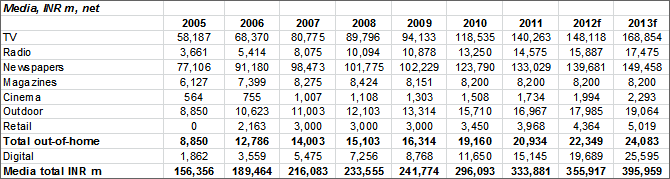
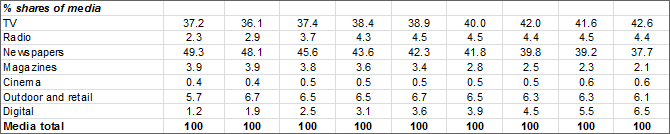
    Titled ‘This Year, Next Year – India Media Forecasts: Midyear update ‘, the study released by GroupM has brought to the fore growth figures that several sectors will throw up in 2012 (see Tables titled  The Detailed Mid-Year Numbers at the end of this story) and not what was predicted of them at the start of the year (winter edition).


    To begin with, the overall growth figure that media will throw up in 2012 has been revised to Rs 355,917 million from the earlier Rs 373,975 million. With this change, the new growth number has been set at 6.6 per cent for CY2012 compared to 12 per cent that was set earlier. While the change is disturbing in nature, what has emerged a bigger shock is the sharp drop in revenue numbers estimated for the domain of television. From the original Rs 160,839mn that was forecast at the start of the year (winter forecast), the revised estimate now reads Rs 148,118mn (mid-year forecast) – an adjustment of nearly Rs 12,721mn or an 8 per cent decline (refer table). In fact, television is the only medium to have seen such a steep readjustment when compared to the other domains under media.


    Media (INR mn net) 2012 forecast (winter) 2012 forecast (mid-year) Difference (%)
    TV

    160,839

    148,118

    -8%

    Radio

    16,178

    15,887

    -1.79%

    Newspapers

    144,260

    139,681

    -3.17%

    Magazines

    8,241

    8,200

    -0.497%

    Cinema

    1,994

    1,994

    no change

    Outdoor

    18,409

    17,985

    -2.3%

    Retail

    4,364

    4,364

    no change

    Digital

    19,689

    19,689

    no change

    Media total

    373,975

    355,917

              -4.82%
    YoY % change  2012 forecast (winter)  2012 forecast (mid-year) Winter to mid-year YoY change%
    TV

    15

    5.6

    -62.66%

    Radio

    11

    9

    -18.18%

    Newspapers

    8

    5

    -37.5%

    Magazines

    0

    0

    0

    Cinema

    15

    15

    0

    Outdoor

    9

    6

    -33.33%

    Retail

    10

    10

    0

    Digital

    30

    30

    0

    Media total change

    12

    6.6

    -45%


    Vikram Sakhuja

    When asked on the reasons for the sharp decline that was observed for the domain of television and the impact of the drop on the industry, Vikram Sakhuja, CEO South Asia at GroupM said: “The decline from 12 to 6.6 per cent is primarily on account of the medium of television. We had expected the medium to grow by 4 per cent in the first half of 2012 while for the second half we had expected a growth of 27 per cent. So the two combined would have contributed an average growth of 12 per cent. We were expecting a low first half as there was no big sporting property like the ICC World Cup last year, and simultaneously expecting a good second half on account of T20 World Cup, The Olympics etc. But that has not been the case so far. Also, it will be inappropriate to say that there will not be good growth; there will be good growth in the second half but it will be lower than what we had anticipated. We are looking at a number of around 18-20 per cent for second half of 2012.”


    On his assessment for the industry for the second half of 2012, Sakhuja said: “We are looking at a revival sometime soon as the political situation in the country is expected to become better and the economy is expected to come up with measures to stem the downward slide.”


    Minor changes in print, radio & outdoor; others unchanged

    Meanwhile, newspapers see a revision of -3.7 per cent with the new figure standing at Rs 139,681 mn as against 144,260mn predicted earlier. Outdoor is next witnessing a change of -2.3 per cent to Rs 17,985mn as against Rs 18,409mn that was predicted in the earlier edition. Radio follows with a -1.79 per cent decline to display Rs 15,887mn as against Rs 16,178mn that was predicted earlier. On the other hand, Magazines sector has been revised by -0.497 per cent to Rs 8,200mn as against Rs 8,241mn predicted earlier. Cinema at Rs 1994mn, Retail at Rs 4,364mn and Digital at Rs 19,689mn remain unchanged from the previous released numbers.


    Explaining the rationale for the change, the study states: “While we expected first quarter of this year to be weak, we expected the economy and hence ad investment to strengthen after this. Ad investment actually remained weak throughout the first half thanks to macro-economic issues such as continued inflation, a weak Rupee and lack of movement in government policies. Elections are another source of additional advertising. However, since political spending limits per candidate have been applied more strictly, the spends were lower than might have been expected.”


    On the performances of other sectors, Sakhuja said: “We hadn’t expected a good growth for newspapers and magazines and that continues to report a single digit growth. The same is with radio and out-of-home that will report numbers as envisaged. But we had also expected digital to throw up a robust growth of 30 per cent and that continues to perform as expected. So that’s the situation on the other sectors according to our study.”


    When sliced further, the study depicts television as the medium most affected. The medium will witness a 5.6 per cent year-on-year change as against the 15 y-o-y that was predicted earlier. That puts it at the bottom three of the growth pyramid just next to magazines and newspapers. For the medium of television, the study states: “2011 had the cricket World Cup which attracted an incremental Rs 8,500mn. This was obviously expected to drop out in 2012, but April-May IPL cricket did not perform as strongly as previously to compensate. In addition, the Telecom category cut down spends substantially in the first half of the year. Financial services have been adversely affected by poorer economic conditions here as elsewhere in the world. Even consumer durables spent less in the first half of 2012 than the prior year period. Occupancy of premium inventory has decreased with advertisers choosing to stay with safer tried-and-tested formats.”


    As for print, newspapers have been set to register a 5 per cent growth as against 8 per cent predicted in the previous edition. According to the study, “Regional publications have expanded into new markets and have actively developed local advertisers largely in the retail categories. They have therefore added some ad volume even though the larger national advertiser categories have reduced investment.”


    Where the domain of Outdoor is concerned, the new growth number has been pegged at 6 percent from the earlier 9 percent. “Reduced consumer demand and the current global turmoil have caused 2012 budget reductions in categories including telecom; automotive; banking, financial services and insurance (BFSI); real estate; and FMCG vis-a-vis 2011. The trend began in 2011 and continued into the first quarter of 2012, which is considered to be seasonally very important for BFSI. In the first half of 2012, there has however been increased investment from the entertainment and media category,” notes the study. Adding further, the study notes: “The reduction is affecting the metro markets but not the non-metros and smaller towns, where demand from local advertisers in a few categories like jewellery, apparel, education, real estate and construction has offset  the withdrawal of national activity. Smaller towns are actually seeing ad demand rise as much as 25 per cent.”


    Radio has been revised to 9 per cent from the earlier 11 per cent. States the study: “Radio’s first-half slowdown is another result in part of the poorer economic situation. The next round of FM auctions has been pushed to 2013, so delaying this uplift to next year. Individual markets have seen very varied demand according to local retail conditions.”


    The study predicts Digital to remain unchanged since the last forecast. Given that it typically has smaller outlays and is very response-based, it has not been affected like other media, it states. Similarly, Retail Media & Cinema are also performing as expected. “Even though telecom advertising fell in the first half, categories like FMCG and durables have risen in these media. As previously envisaged, destinations in smaller markets have experienced raised demand of about 10 per cent. Leisure destinations have also expanded their presence in these smaller markets that has helped drive spends,” notes the study.


    Blast from the past?

    While 2012 is being compared to the slowdown of 2008-09, it has to be admitted that the current period does get to see few glimpses from the past. Answering the query, Sakhuja reasoned: “Similarities could be somewhat drawn to the growth story of 2008-09 because the core economic sentiment at that time was based almost entirely on the global downturn whereas for 2012, if I have to put a weightage to it, the negative sentiment is driven a little bit more by the inaction from the government’s end rather than the global downturn. So we have our own internal issues to sort out and not so much of an outside effect that is holding us from staging a good growth for the industry.”


    Highlighting the trend spotted worldwide, especially the BRIC countries, the study notes: “The Brics and ‘Next 10’ (that’s the Next 11 minus Iran) are still expected to contribute 51% of global ad growth in 2012, down from 53% in the winter forecast. We have revised China growth down from 17% to 13% for 2012. We attribute this to general headwinds in the economy, with loss of consumer confidence having only a slight effect. This represents a $2bn reduction in expected ad investment, taking 0.4 of a point from global growth. Falling global and local sentiment has hit India and Brazil forecasts much harder, relatively speaking. These two ad economies are together only a third the size of China’s, but they shed $1.5 bn from their expected 2012 increment. The Russia forecast for 2012 is raised from 10 to 12%.”


    Note: All numbers are net advertising revenues not inclusive of agency commissions. Hence they reflect what media owners have earned and not what advertisers have spent


    MxMIndia quizzed a few honchos from different sectors to gather their opinion on what the change would mean for the industry. And the reaction was on expected lines…


    Tarun Katial, CEO, Reliance Broadcast Network

    “There is a slowdown, but it is better than the last one we saw! The signs in fact, have been there from the last quarter of 2011 so most of the industry has been cautious in spends and projections. Having said that, there is optimism looking forward, because typically the second half of year sees spending leapfrog.”

    Prashant Panday, CEO – Radio Mirchi

    “I think the adjustment downward is correct. The Indian economy is in quite a bit of a slowdown, the interest rates are high, inflation is high and investments are coming down. Commodity prices drove client profitability downwards. Not surprising then that clients have been cautious on advertising spending. The advertising markets are shaky at the moment and any upturn is expected only during the Diwali season starting October this year. It can also start early if the government initiates positive decision making. Allowing FDI in multi-brand retail, increasing FDI limits in Banking and Insurance, successfully auctioning 2G telecom licenses and quickly rolling out Phase-3 of FM will all help in bringing cheer to the advertising businesses. The first quarter has been a tough quarter for most media companies. The few results announced so far are evidence of that. But don’t forget that this is a traditionally weaker half. So media companies should be expected to fare poorly…..like I said the recovery can happen from October this year…”

    Suresh Srinivasan, Vice President (Advt), The Hindu group

    “The first quarter of the year has been good for us however in the last month the numbers have not been so encouraging. Things are not looking too good and the numbers are less than our expectation. However, I would not term a short period of lull as defining the year as there are opportunities ahead. With festive season one definitely hopes that things would turn for the better. I think India remains largely unaffected by the global slowdown and we still see new launches happening in the market and people still spending on shopping. We have seen particularly less spending from BFSI sector, education and retail who traditionally have been big investors.”

    Shailesh Amonkar, CMO – Sakal group

    “We are more or less following the trend that’s been witnessed by the industry, which has been recording slow growth in the past few months. Going by our experiences, we feel Retail & Corporate are categories that have bought us some good growth but categories like Education which used to get us good numbers earlier has seen a decline. Even categories like Real Estate and Finance have been sluggish this year. We are looking at other alternatives like innovations, supplements etc and are partnering with clients across the verticals like digital, newspapers, activations etc to ensure that we generate whatever revenues through such ventures. We hope to see a revival by end of August and start of September – around the festival season. Things should be looking up during the next three-four months for the industry as it happens every year. But then again, this too will be dependent on factors such as good monsoons, inflation, fuel prices etc that will decide whether investments will come in or whether clients will be cautious in their ad spends.”

    Atul Hegde, CEO – Ignitee

    “I definitely foresee Digital throwing up a 25-30 per cent growth this year compared to the last year. I do not anticipate any situation that will lead us to downgrade the growth of this medium. In fact if one were to analyse the earlier slowdown period, a lot of expensive money from the mediums of television and print came to digital; this will be a trend that one will get to witness whenever there is a recession. Clients will want to invest in a medium that is more accountable, has very little wastage, where they do not need large investments…Also, what will happen is clients are going to be very selective about the markets that they advertise in; it’s not going to be blanket advertising everywhere. Digital will help them pinpoint that.Within digital, you will see social media driving the growth more than anyone else. Search will be the biggest focus area for clients as they are more targeted and one-to-one. Even channels like Youtube etc will add to the growth of this medium. So the medium will put up growth as expected. After all, the medium has gathered momentum after 7-8 years and large brands have seen the value that the medium brings to their brands. So it is going to be a good ride ahead for the digital medium.”

    With inputs from Tuhina Anand and Meghna Sharma


     The Detailed Mid-Year Numbers


  • Ranjona Banerji: TV news viewing can be injurious to the lower jaw

    By Ranjona Banerji


    Since president-elect Pranab Mukherjee spoke to almost everyone on Tuesday, it was hard to see why news channels rushed to qualify their interviews as “first” or “better” or whatever. Exclusive, in TV parlance, is apparently when you do the same thing as everyone else, except five minutes before.


    Anyway, Mukherjee did not say very much about anything he was going to do as President although he talked about his childhood and his early political career. The silliest question I reckon came from Sagorika Ghose of CNN-IBN who asked whether Mukherjee’s ascension to Rashtrapati Bhavan was a “return of Bengal to the mainstream”. At this point my jaw dropped so low that it fell off and I was so busy retrieving it that I couldn’t pay attention to the rest of the interview.


    The best I could get from Arnab Goswami’s interview with Mukherjee on Times Now was that first Mukherjee walked round his garden 40 times, then 33 times and now 30 times and he did not know how many times he was going to walk around the Mughal Gardens. He said he heard the gardens were very large. Anyway, as President he will have ample time to work out stuff like that. Or if he asks someone they might tell him how big the Mughal Gardens are.


    * * *


    Sunday was all about the presidential election as well as everyone gave us live coverage. Of course, after some time they ran out of things to say because there was very little to say about a presidential election in India, at least not enough that can last a whole day even given TV’s marvellous propensity for waffling on about nothing. The highlight of the day was losing candidate PA Sangma’s losing speech. He started by congratulating Mukherjee and then went into a whine about how the Congress had used bribery, extortion and threats to ensure Mukherjee’s victory and how the North East and betrayed not just him but all tribals and themselves as well. (They didn’t vote for him.) Sangma’s entire campaign was based on pettiness, so nothing surprising here. What was surprising was Navika Kumar of Times Now stating emphatically that this was the best, most gracious and most sportsmanlike speech she has ever heard from a loser. Her guests Krishna Prasad of Outlook and commentator NN Satchidanand tried to point out otherwise, but she would have none of it. Jaw-retrieval is a common affliction for those who watch too much TV news, as I should know by now.


    * * *


    Rupert Murdoch has stepped down from several boards which control News Corp’s titles in the US, UK and India. The pressure to do so apparently came from investors, after the phone-hacking scandal led to the closing of The News of the World and all the arrests of News Corp staff, current and former. Murdoch’s rise saw a lot of bile but in his fall are some abject lessons for media bosses and for those journalists who decide that principles are nothing when faced with corporate pressure to perform in a particular manner or to do anything to get results. The Nuremberg trials ought to be required reading for young aspiring journalists: the fact that you got an order is not defence enough.


    * * *


    I was appalled yesterday and continue to be appalled today about Monday’s front page anchor in The Times of India about a group of Indian athletes that went to the 1936 Berlin Games under a saffron flag singing Vande Mataram and impressed Adolf Hitler enough to give the group a medal. The story behaved as if getting a medal from the 20th century’s most frightening dictator was a great honour. There was not a squeak in the story about Nazism and what the organiser of the group thought of that. The glorification of Nazism in India is restricted to those influenced by the religious nationalism that comes of out of Nagpur. The story, therefore, should have mentioned or questioned the RSS connections of the group. Saffron flags and Vande Mataram were clear giveaways but why not come out openly and say so? And for a journalist – and a newspaper – to ignore the Nazi angle to such a story is criminal.


    * * *


    Vikram Doctor’s article in The Economic Times on food and the Olympics was extremely readable and well-researched. Try it: http://blogs.economictimes.indiatimes.com/onmyplate/entry/thanks-to-french-humour-here-s-best-of-british-food


  • Debrief: HCL: Fresh and entertaining

    By Anil Thakraney


    HCL is back with its Mr HCL and Mr Banker campaign. The positioning is the same as before: ‘Technology that touches lives’. But innovation is at the heart of the new commercial.


    This time the two dudes are marooned on a remote island. The banker plays the bumbling idiot, and Mr HCL is, of course, the smart one. The latter uses the banker’s dead cell phone to light a fire on the beach. The smoke is detected by a rescue helicopter, and the two are saved. But not before the banker has made a fool of himself for some quick laughs.


    This commercial works for me. Mainly because Mr HCL isn’t shown using technology to provide a solution, he uses ingenuity. Imagine if he had used techno magic to perform the rescue act, the TVC would have become literal and therefore boring. At the same time, this approach projects HCL as an innovative company that’s ready to think out of the box. Ergo, message delivered.


    [youtube width=”400″ height=”225″]http://www.youtube.com/watch?v=1gAASVe09VM[/youtube]

    I didn’t much care for the ‘ass on fire’ slapstick stuff, it is much too forced, but our cold techie friends will find this funny, so that’s fine. But why make fun of investment bankers? Are they such morons? This is the only part I don’t quite get.


    All in all, an entertaining ad that delivers the message. Also, the Discovery Channel type of a setting, of being rescued from wilderness, adds to the freshness of the communication.


    Rating: (On a scale of 1 to 5): 3. Focused message. Cool delivery.


  • Clean & Clear’s morning energy campaign

    [youtube width=”400″ height=”225″]http://www.youtube.com/watch?v=u_7cyKss7Ts[/youtube]

    By A Correspondent


    Clean & Clear didn’t want their brand to be associated only with problems. They wanted girls to celebrate their skin and have fun with their beauty regime. This sparked the need to launch Clean & Clear’s new fruity range – Clean & Clear Morning Energy Face wash.


    Internationally, the Clean & Clear Morning Energy range is advertised as the perfect solution for girls who’ve had a late night and need to perk up in the morning. However, inIndia’late nights’ have negative connotations of parties and irresponsibility. They kept Indian sensibilities in mind while creating communication for this new range.


    Research with teen girls confirmed what they had feared. They immediately rejected the notions of late nights claiming that it didn’t hold true for them. However, when spoken to about their daily routine, they found that most teens spoken to went to sleep after midnight on weekdays. In fact, they stayed up much later when they had exams or project submissions due.


    They have created a series of fun TVCs that showed a girl employing unusual techniques to wake her best friend up. They’ve used these spots to communicate that in addition to your best friend, you also need an alarm clock for your skin.


    The TVCs were followed by a crowd-sourcing contest on social media where contestants were asked to shoot their own crazy ways of waking their best friends up. Radio, outdoor and print was used to reinforce the message that there’s now an alarm clock for your skin.


    Credits:-

    Chairman & CCO: Sonal Dabral

    President: Rajiv Sabnis

    Executive Creative Director: Louella Rebello

    Group Creative Director: Hanoz Mogrelia

    Art: Rithwick Raghunath

    Copy: Kashyap Joshi

    Account Management: Sharmila Malekar, Sumeeta Bhangalia & Aastha Chopra

    Account Planning: Aditya Kanthy, Mitali Srivastava, Saloni Handa


  • Mahuaa channel directors held for forgery

    By A Correspondent


    Two directors of popular Bhojpuri TV network Mahuaa were arrested for forgery to secure loans of nearly Rs.100 crore, a CBI official said Monday. A Delhi court sent them to judicial custody till August 4.


    Central Bureau of Investigation (CBI) Special Judge Swarana Kanta Sharma sent Mahuaa channel directors P.K. Tewari and Anand Tewari to jail after they were presented before her on the expiry of the period of their custodial interrogation.


    The duo were arrested by the probe agency on July 18 for their alleged involvement in presenting fake invoices and chartered accountant certificates to secure Rs 34 crore loan each from three banks. The two allegedly cheated three banks – Bank of Baroda, Punjab National Bank and Union Bank of India. The banks lodged a complaint against the accused in January.


    According to the CBI, the directors procured loans from the three banks for the expansion of their channel.


    Source: Indo-Asian News Service


  • London’s Imagination creative shop enters India

    By Preethi Chamikutty


    Imagination, a London based creative agency became the latest entrant in the Indian advertising landscape. With offices in Mumbai and Bengaluru, Imagination is currently in the process of building its team in India. The India operations will be headed by Uday Vijayan, who has worked in the past with agencies like JWT, Bozell and GPJ.


    Imagination’s creative team will be headed by Alistair Petrie, regional creative director who is based out of the agency’s Hong Kong office. Imagination started off as an experiential agency but now handles different creative needs that a client may have. At the Auto Expo 2012 held in New Delhi earlier this year, Imagination helped auto brands like Land Rover, Ford and Tata Motors showcase themselves in a distinctive manner.


    “This maybe our official entry into India, but we have been working with Indian clients over the last 15-20 years,” explained Mark Barrett, CEO, Asia Pacific, Imagination.


    Oberoi hotels, 360 restaurants, Hyatt New Delhi and Ritz Carlton Bengaluru are among the brands that Imagination has worked with. Imagination has also redesigned the Aston Martin showrooms for the car brand in India.


    Imagination has 16 offices spread across Qatar, Moscow, Seattle, Sao Paulo and has 9 offices in the APAC region alone. China was its last entry before India, and Barrett hopes to replicate the success of Chinese market in India as well.


    “Our past experience with Indian brands is helping us grow. Everybody thinks an international agency will be expensive, but we think globally and work locally,” said Mr Barrett. He also said Imagination will draw upon its resources across the globe to do the best work for its clients, irrespective of where the client is physically located.


    Imagination, said Mr Barrett, works with over 311 brands globally including Disney, Siemens, Aston Martin and The Body Shop among others. Talking about the Indian opportunity, he said there are a lot of luxury brands in India which he says is an area of opportunity for them.


    Source: The Economic Times

    Copyright © 2012, Bennett, Coleman & Co. Ltd. All Rights Reserved


  • … but rejoice! Dabur increases its adspends

    By Jwalit Vyas


    Dabur India delivered a good performance in June 2012 quarter. The major surprise of the June quarter numbers was the year-on-year 51 per cent jump in its advertising and publicity expenses.


    Dabur had kept its advertising cost in control over the past several months in order to maintain its profitability. However, the strategy seems to have changed as the company again has started pumping money in marketing its products.


    Its advertisement to sales ratio increased by 310 bps year-on-year to 15.7 per cent in March 2012 quarter. Its sales grew by 20 per cent y-o-y to Rs1,462 crore, which its net profit grew by 17 per cent to Rs 150 crore. Operating margins remained flat at 16 per cent which is positive for the company considering the additional advertisement expense.


    The second most diversified Indian FMCG company showed a healthy growth across segments. Its food business which contributes to around 15 per cent of the company’s net sales grew by 31 per cent, while its consumer care business which is 80 per cent of its total sales grew at 15 per cent. Its retail business (Kaya Skin Clinic) continues to be loss making but the size of this business is negligible when compared to its overall business.


    Dabur’s stock closed 0.1 per cent up at Rs 118 while the Sensex was down by 1.7 per cent. The company’s stock is trading at a price to earning multiple of 31.


    Source: The Economic Times

    Copyright © 2012, Bennett, Coleman & Co. Ltd. All Rights Reserved


  • The Anchor: Ajay Chandwani on 5 reasons why youngsters/MBAs should join advertising

    By Ajay Chandwani


    1. Brand Management

    For those who have studied MBA, marketing management is just one part of the spectrum, but one should realize that in advertising you also get to do brand management. This is a dynamic field to be a part with immense opportunity.


    2. Variety

    In advertising, you are not restricted to one industry, but you get to work on various categories. So if one time it is about selling a washing powder, next time it could be about selling biscuits and then about selling cars. One has to think different thus not getting stuck in stereotypes.


    3. You do it for a living

    Advertising promotes lateral thinking. It’s not that you can’t do out-of-box thinking in marketing, but in advertising that’s how you are making a living. You get to interact with creative minds and you need to be an ideas person to survive and succeed.


    4. Never a predictable moment

    You could get to work on a new product, marketing plans keep changing, new brands gets launched, so in short, there is no boredom. There is so much going around in advertising business that it promises to be one roller-coaster ride.


    5. Today advertising is at the helm of a marketing function

    The former has taken a 360 degree avatar which included advertising, PR, digital, BTL and the works. There is a desirable exposure to brands. Hence it provides a wider canvas to work on and promises to be an integral part of marketing.


    Ajay Chandwani is Director at Percept Ltd


  • Zarina Mehta quits Disney to ‘SHARE’

    Zarina Mehta

    By A Correspondent


    Zarina Mehta, the Chief Creative Officer of UTV Group of Channels at Walt Disney India, who led the creation and launch of popular TV brands such as UTV Bindass, UTV Stars and UTV Action has decided to move on from Disney-UTV after a 27-year-long stint.


    She sent a mail to her company’s employees informing them about the decision. She wrote: “After 27 years, I have decided that I need to move on from my beloved UTV.  It has given me such joy and fulfillment to create a vibrant, passionate, cutting edge company that believes passionately in creativity at its core. I have loved especially all the wonderful people I have worked with and the TV shows and brands I have helped create.”


    She will be moving on as a full-time Managing Trustee of the foundation SHARE (Society to Heal, Aid, Restore and Educate). The foundation is ten years old. “Our aim is to transform the lives of one million people in rural Maharashtra over the next seven (or so) years,” read the mail about what plans she has for the foundation.


    The decision wasn’t an easy for her, but the reason behind her move is her love for challenges: “Well its 27 years of doing the same thing. And much as I have loved it passionately I have felt the need to think about different challenges, to apply my mind and energy and passion to other problems.”


  • Vivek Bahl hops to Sony as Chief Creative Director

    By A Correspondent


    In 18 months, this is his fifth place of work… surely, the man’s on the move. Yes, Vivek Bahl is set to join Sony Entertainment Television (SET) as Chief Creative Director after short stints at Mahuaa, Turner and Network 18.


    One of the seniormost programming executives in the business, Mr Bahl, joined Zee TV a few months before it was launched way back in 1992. His last port of call has been the Viacom18 Network which he had joined in May this year as network advisor (content).


    In the new role, Mr Bahl will be responsible for the overall programming of the flagship channel. Speaking on his appointment, he said, via a communique: “I’m delighted to join SET and hope to provide valuable programming inputs in all genres of shows. This is an exciting and challenging role and I’m honoured that trust has been reposed in my abilities.”


    Mr Bahl will report to Sneha Rajani, Senior Executive Vice President & Business Head – Channel SET.  While announcing the appointment, NP Singh, COO, MSM, said: “Vivek’s entertainment experience and a cross-functional strategic perspective will enhance the growth of SET. On behalf of Sony Entertainment Network, we look forward to a long and fruitful working association with him.”


    Prior to joining Viacom18, Mr Bahl was with Turner International where he was the Chief Content Officer. And before that he was with the Mahuaa Network where he moved from Star India.