Blog

  • Dish TV launches India’s first SD Recorder with unlimited capacity

    Salil Kapoor

    By A Correspondent


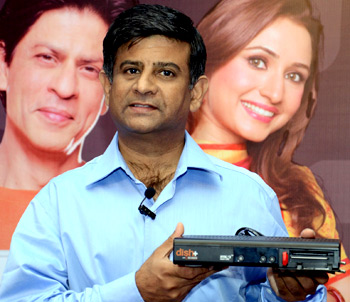
    Dish TV has launched “Dish+”,India’s first standard definition box with unlimited recording facility. Dish+ is positioned at a consumer-friendly and competitive price of Rs1,690 (against all other SD boxes at Rs 1590) with a free 4 GB pen drive as promotional offer. Post VCR, there is no recording device available with consumers and there is a huge vacuum to fulfil the consumer need. Dish+ fulfils the ‘need gap’ of recording facility for the consumers.


    Speaking on the launch, RC Venkateish, Chief Executive Officer, Dish TV India, said: “Being pioneers and market leaders, we have constantly reinvented and redefined the market with thought leadership to be ahead of the pack. Dish+ is being launched in 42 cities of Phase I and Phase II of digitization and will clearly demonstrate Dish+ as a better alternative for all viewers who will shift from analog to digital.”


    Salil Kapoor, Chief Operating Officer, Dish TV India, emphasized: “Dish+ is a comeback of recorders in the living room and is a clear differentiator vis-à-vis other alternatives including digital cable. Its highly competitive launch price will position it as a preferred option amongst all DTH buyers”.


    The unique feature of Dish + is its compatibility with any USB device enabling consumers to simply plug and play an existing USB stick/ HDD, and build an entire genre based library of their favorite program. Dish+ offers unmatched advantage of recording on SD. Dish+ is user-friendly with features like “plug-n-play” through an external USB device. This enables all benefits of a traditional DVR like recording and playing back programs, Pausing or Rewinding live TV, different play-back positions, event based recording (EBR), time based recording (TBR) and so on.


  • Digitas India appoints Nirmal Dayani as its COO

    Nirmal Dayani

    By A Correspondent


    Digitas, the digital marketing agency, has appointed Nirmal Dayani as its Chief Operating Officer inIndia. Mr Dayani will be directly reporting to Kanika Mathur, President, DigitasIndia.


    Mr Dayani has vast experience in the field of advertising and marketing with a significant exposure to digital media. Having spent over 21 years in this field, he has worked at Mc Cann Erickson, JWT and ESPN Star Sports.


    He has worked with leading brands such as Pepsi, Horlicks and Harpic and in his last stint as Head of Marketing at ESPN STAR Sports, he contributed to the successful launch of new channels – STAR Cricket, ESPN HD and STAR Cricket HD and led the company’s diversification into new properties such as espnstar.com and espnmobile. His experience with Digital started with the launch of the famous “Super Selector” cricket game and several other properties for espnstar.com.


    Speaking on his appointment, Mr Dayani said: “This is an amazing opportunity and I am incredibly excited to be a part of the Digitas India team. In this new digital era, we have a great opportunity to integrate our offerings and adding value to our customers/clients portfolios. I am looking forward to working closely with our clients and together developing their digital roadmaps and taking them to the next level in their growth curve.”


    Kanika Mathur, President, DigitasIndiasaid: “We are looking forward to Nirmal leading DigitasIndia. We believe that with his experience and skills, he will play a key role in nurturing client relationships and driving growth.”


  • Anil Thakraney: Ad agencies can help with hate crime control

    By Anil Thakraney


    I still recall the first thing many Americans did immediately after 9/11. This was to frantically search for their world maps, and try to locate Afghanistan. This, of course, became a subject of many jokes at the time, but after we stopped sniggering, we realized that the average Yankee is totally cut off from the rest of the world. That, he/she has never stepped out of his/her comfort zone and hasn’t even bothered to find out what goes on beyond their shores. That it was of no consequence to them. And this isn’t something to laugh at, it can be dangerous.


    The recent attack on a Gurudwara in Wisconsinis yet another reminder that the average American remains blissfully ignorant of international geography, history, culture and religion. The attack was obviously targeted at another religious minority group, and our Sardarji friends paid heavily for someone’s lack of general knowledge. So then what’s the way out of this mess? There is only one way: this problem can be fixed by advertising agencies. Because it pertains to communications.


    I think ad agencies inIndiashould work with their American parents and devise a powerful communication package, to be run across the media, with the objective of imparting Americans with basic knowledge on various religions and cultures. The Obama government needs to include this education as a part of school and college syllabi, but that can only work as a long term solution. Ad agencies can create campaigns to provide immediate solutions.


    So go for it, people. Not only will such a public service campaign win you many awards, you can end up saving many innocent lives. What can be sweeter than that?


    An important disclaimer: Having said the above, let me hasten to add that attacks on ANY community members is highly deplorable, and one hopes that the world evolves to a stage where these things don’t happen at all. But in the meantime, at least the ill-informed Americans must be educated on how to differentiate between communities. That itself will be an important beginning.


    * * *


    PS: If you are a constant tweeter, and have no control over your thoughts, hit this link. It’s about the journalist whose Twitter account was suspended. I like this. It’s time the social media portals stepped in to oversee things. Excessive illegal and abusive stuff seems to be freely floating around in the virtual world.


    Link: http://mashable.com/2012/08/01/kicked-off-twitter/?
    WT.mc_id=en_all_stories&utm_campaign=All%2BStories&utm_medium=email&utm_source=newsletter


  • The Anchor: Sumanto Chattopadhyay on 5 ways how creativity can change the image of a brand

    By Sumanto Chattopadhyay


    A brand is nothing without creativity. It is, in fact, a sum total of the creative elements that go into designing the product, its packaging and its communication. There are ways and ways of giving these elements a new spin – a new lease of life.


    Here are five examples of how a brand can hit the refresh button:


    1. Creativity can gloss over history: Volkswagen was launched by Hitler. But creative communication made the brand that rides the Beetle Bug one of the most lovable automobile icons of our times.


    2. Creative rebranding can make an old brand new and improved: When UTI Bank became Axis Bank – adopting a contemporary look and logo along with the changed name – it shed some of the negatives – ‘public sector’, ‘technologically outmoded’ – associated with the UTI label and made itself relevant to modern consumers.


    3. Not just products, but people too can change the image of their brand: In order to join Bollywood’s A List, Brand Karishma Kapoor underwent a total makeover. It took considerable creativity – that of hair stylists, beauticians, costume designers, film directors, publicists – to change her persona and transform her into one of tinsel town’s more premium brands.


    4. Creativity can make a brand attractive by putting it in a different slot in people’s minds: Cadbury’s told consumers to think about it in the same way as they do about Indian sweets – something you eat to make an auspicious beginning. Imaginative skill went into making people see an inherently Western product as something that satisfies a very traditional Indian need. And voilà  – Cadbury’s was reborn in a new avatar.


    5. Brand China wanted to replace the existing view of a grey, regressive totalitarian state with the image of a vibrant, young and capable nation. And so, at the 2008 China Olympics, it put on the greatest spectacle on Earth, taking branded event management to a new high.


    Sumanto Chattopadhyay is Ecd, South Asia, Ogilvy


  • Ranjona Banerji: Outrage Unlimited on news telly

    Ranjona Banerji

    By Ranjona Banerji


    Expectedly, Indian new channels were very moved by the attack on a gurudwara and the deaths of at least six Sikhs in the American state of Wisconsin on Sunday. However, their pain is not tempered by any sense of journalism so they tend to jump straight into a series of discussions based on unworkable premises. Regardless of how patriotic TV news people in India are and how they care about the plight of Indians abroad, the Indian government cannot send the army to protect Sikhs in America or indeed people of Indian origin anywhere else in the world. Nor can Indian investigating agencies jump in. Also, to have a bunch of understandably upset but substantially uninformed people competing for air time is unproductive. Not surprisingly, senior journalist Chidanand Rajghatta looked visibly disgusted on Times Now.


    It is also not possible for Indian TV outrage to change the USA’s gun laws. Such a discussion, earnest and less hyper though it may have been on NDTV, is also an exercise in self-indulgence.


    Arnab Goswami of Times Now was very upset that Sikhs are targeted in the US. I cannot remember any similar pain or any dramatic debates when it appeared as if people from Andhra Pradesh were being targeted. South India too far away from the purview of TV news?


    But what is new in what I’ve just said? It happens every time and each time, it looks more and more like a farce to whip up public sentiment and push up rating points with some badly directed drama.


    **


    Indian newspapers chose not to lead with this story although most put it on the front page. They also presented readers with the facts, sans comment. What comment can there be so soon after such a terrible crime, as the investigation is unfolding and facts are still being revealed?


    **


    It’s still Olympics time. The marvellous exploits of Usain Bolt captured imaginations worldwide and even in self-obsessed India. Indian wonderwoman boxer Mary Kom’s medal prospects also excited a nation so short on Olympic medals.


    But let’s consider the curious case of shooter Vijay Kumar who won a silver medal in London 2012. In the run-up to the elections, shooters were definitely in focus and newspaper after newspaper told us that Abhinav Bindra – gold medallist in Beijing – Gagan Narang and Ronjan Sodhi were our best medal prospects. We also saw some of them in TV promos telling us that they were “Olumpians” and Indians. But Vijay Kumar got nary a mention.


    Early on, Narang got a bronze so perhaps the hype was justified in his case. Bindra did have a gold, so who would guess that he wouldn’t even make the grade in London. Sodhi got nowhere very fast.


    So, as it turns out, India’s best medal in shooting came from Kumar, a subedar in the Indian army. Kumar’s credentials are excellent – he has three golds from the Commonwealth Games and medals from the Asian Games and other international tournaments. Why didn’t he get any media attention before the Olympics?


    Conversations with sports journalists have revealed a sad story of laziness and reliance on PR. The other shooters were more media savvy and journalists were just not bothered to find out about people like Kumar. This would be mildly acceptable if Kumar came out of nowhere to win. But that is not the case.


    Kumar himself was a little shocked that the media was presenting him as an outsider. He told CNN-IBN that they may not have seem him as a medal contender but he always knew he was! Indian sports journalists are often the best of our breed but lately…


    As it stands, Kumar’s the only silver medal winner for India so far at these Games…


    Ranjona Banerji, senior journalist and commentator, is Contributing Editor, MxMIndia. The views here are her own.


  • Luxury brands, including Louis Vuitton, Armani and Burberry, eye ‘conservative’ markets like Surat, Chennai

    By Vijaya Rathore & Nandini Raghavendra


    Traditionally conservative markets like Surat, Chennai and Kolkata are warming up to luxury, opening a wealth of opportunity for brands such as Louis Vuitton, Armani and Burberry beyond Delhi and Mumbai.


    In the next six months, people in Surat – home to some of India’s richest entrepreneurs in the diamond and textiles trade – will see the entry of half a dozen international labels that include Armani, Burberry, Tumi and Crabtree & Evelyn.


    Some 1,500 km away down south, on the eastern cost, curious shoppers in Chennai are checking out the first Louis Vuitton store that opened a fortnight ago. “Chennai is a great market, full of possibilities and perspectives,” said Geoffroy van Raemdonck, Louis Vuitton’s south Europe president, from Milan.


    Two new luxury hotels in Chennai are offering space to luxury brands keen to go deeper into the country even as Louis Vuitton has identified its next stop – Kolkata, where businessman Sanjiv Goenka is readying a 7-lakh sq ft mall that has already leased out about 50,000 square feet of space to luxury brands such as Bottega Veneta, Bally, Burberry, Rolex, Porsche Design and Jimmy Choo.


    Surat, Chennai and Kolkata have traditionally been conservative markets, with only a few rich buyers spending on the luxury labels. But now these cities are among the emerging hot destinations for luxury as premium global brands seek to reach out to pockets of affluence beyond the big metros.


    “There is a nascent market waiting to explode. We think the time has come,” said Sanjay Kapoor, managing director of Genesis Luxury, which markets brands such as Armani, Burberry and Canali in India.


    Genesis has taken up space for half a dozen stores at a luxury mall in Surat being built by Virtuous Retail, a retail real estate asset platform sponsored by the Xander Group Inc. It is also looking for space in Chandigarh, Ludhiana and Jaipur because several people from these towns frequent its stores in Delhi and Mumbai.


    Clearly, the rich in small towns have more money and desire than ever to spend on high life, and they seem indifferent to the slowdown in economic growth and overall consumer spending.


    Three years ago, NCAER’s Rajesh Shukla and Future Capital’s Roopa Purushothaman had said a report titled Next Urban Frontier, that boomtowns like Surat, Jaipur, Lucknow, Nagpur, Bhopal, Coimbatore and Kanpur have seen the most striking shift in income distribution.


    “That trend is established now,” said Mr Shukla. “The number of high-income households in boomtowns is growing at around 20 per cent a year, against 13.7 per cent in the mega cities…(and) boomtown households on average spend 12.7 per cent more than mega cities on clothing.”


    Anupam Yog, marketing director of Virtuous Retail, said Surat is one of the top ten markets on the company’s radar and has massive consumption potential. He says 73 per cent of the five million population in Surat is below 35 years of age, and 32 per cent of the households there have an annual income of more than 3 lakh.


    Virtuous Retail has also tied up with Indian fashion designer Rohit Bal to open shops within ‘VR Surat’ mall.


    Chennai, meanwhile, is fast becoming a popular luxury destination. “Chennai is becoming big in terms of consumers’ spending on luxury and lifestyle,” said Rajmohan Krishnan, executive vice president (wealth management) for north and south, Kotak Mahindra Bank. “People have new money and also the new generation of business entrepreneurs, who want to splurge, has come up.”


    Mr Krishnan says increasing connect between north and south of India too is impacting spending habits of people in the south.


    A new luxury hotel in the city, The Leela Palace, has earmarked around 8,000 square feet of retail space for luxury brands. “We are looking at luxury retail brands, with a focus on jewellery and watches,” said Amruda Nair, head of asset management, The Leela Palaces, Hotels and Resorts.


    ITC Grand Chola too is offering space to luxury retailers in Chennai as the city does not yet have a super luxury mall.


    In Kolkata, Sanjiv Goenka’s mall that will be operational early next year. “The mall will not only get shoppers from within the city but from the entire eastern region. We also expect an influx from Bangladesh,” said Pankaj Renjhen, managing director, retail services, at property consultant Jones Lang LaSalle, which is marketing the property. Gucci, too, is exploring having presence in Kolkata.


    Then there are other places.


    Louis Vuitton’s chief representative in Asia, Tikka Shatrujit Singh, said that besides Kolkata, the French fashion giant is considering places like Hyderabad, Noida and Gurgaon to open shops. High-end crystal products maker Swarovski opened boutiques in Ahmedabad and Pune last year. “This year we are opening in Ludhiana and Chandigarh and also looking at Kochi and Jaipur,” said Sukanya Dutta Roy, managing director (consumer goods business) at Swarovski India.


    Luxury hotels too are reporting higher business from domestic travellers.


    Source: The Economic Times

    Copyright © 2012, Bennett, Coleman & Co. Ltd. All Rights Reserved


  • The Crucial Social Media Question: Have fans? Now what?

    By Tuhina Anand


    Every marketer worth his salt wants his brand to have a presence on social media. However, the truth is that the marketers are still trying to figure how to navigate this medium.


    Having heard that it’s a ‘cost effective medium, can be tracked and is ‘the’ medium’ where the customers hang out, the marketer obviously wants to be there too. But the social media still has a long way to go before it is seen as the ‘vehicle of choice’ and not just as an afterthought.


    Yes, one agrees that marketers are warming up to the medium but they are still testing waters barring a handful who have taken the medium wholeheartedly.


    Once a marketer decides to go on social media, the next move is to create a presence on Facebook and maybe on Twitter. We have often heard the marketers talking about the large number of fans they have acquired on FB, so what do these number of fans mean to them and how are the marketers leveraging these fans to engage effectively with consumers?


    Chhaya Balachandran Aiyer, Founder and Managing Director, BC Webwise agrees that there is peer pressure to acquire more fans and clients often bow to that demand: “The number of fans and likes is a visible number, hence one can’t write it off completely even though many of the numbers could be dormant fans. These numbers are an opportunity to engage those fans in a meaningful way to create brand loyalty and brand recall.”


    She added: “Two years back, the common demand of a client was to be on Facebook, but we have seen a shift now where they have realized that it’s not the ultimate answer but social media too needs a 360 degree approach.” So it’s clear that there are different kinds of marketers and the early adopters are clearly asking the right kind of questions.


    Some of the brands that have effectively used the communities on FB are Fastrack, Café Coffee Day, Sunsilk while more are getting on the engagement bandwagon. Explaining the significance of the numbers, Rajiv Dingra, CEO, WATConsult, said: “While all readers of an ad do not become buyers of the product, similarly with FB, the marketers become a publisher of its page to reach out to the consumers. The aim is not always conversion to transaction for all people on its FB page, but with a large fan base the number of potential buyers definitely increases.”


    Mr Dingra is clear that there is no replacement for good content. He added that the numbers might reflect various objectives of a brand at different points, but if the content is good, the engagement with brands will become only much more involved and meaningful.


    Vineet Gupta

    Vineet Gupta of 22feet has been relentlessly engaging with brands to enable them to use their social media tools effectively. He explained: “We have brought out exclusive sale for Fastrack fans on FB and the brand has been doing a lot of stuff exclusive to the community. Scale has its own benefit and one can’t deny that. With people becoming familiar with social media, there are lots of activities happening which take people beyond the likes and the fans.”


    The agency has recently done activation for Lee titled ‘Shadows of City’, where people were encouraged to present their photographs of the city and the shadows they create which would then be put up in the stores.


    CCD is another brand that has been using FB to listen to its customers and also engage them via the medium. Ramakrishnan K, President- Marketing at CCD elaborated: “At CCD, we not only have numbers, but also a high level of engagement. Our fan base is 2.6 million and our monthly engagement level is 60 per cent, i.e. 60 per cent of our fans interact in some form with our page every month.”


    He added: “At CCD, we use social media base for regular tailor-made communication on happenings in CCD. We have a direct consumer feedback on cafes across the country which gives us instant information that keeps us on our toes. Most importantly, we use the fan base for co-creating many of our offerings – be it new menu, suggestions for improvement, live tasting of new introductions, choice of music among others. We engage fans to co-create their brand. As a result, we drive a very high level of consumer engagement, which in turn helps us drive sales.”


    One concern is that many fans on FB might be dormant, so then do the numbers really mean anything? Sanjay Mehta, Joint CEO at Social Wavelength explained: “I think that the key is to deliver message to interested people. If people receive the message but not respond, that is not a concern, but if they do not get the message in the first place, then it’s a bigger challenge. I think one should not be dismissive of the dormant numbers, but focus more on getting the right kind of messages that will get them to engage.”


  • If we are divided as an industry, we will sink: Prasoon Joshi


    Forty-one-year-old Prasoon Joshi’s has been a remarkable story. A young lad from the mountainous region of Tehri Garhwal (Uttaranchal), who once struggled to get a book of poems published, is not only heading a top ad agency today, he is much sought after in Bollywood for his superlative song writing skill.


    The Chairman and Creative Chief of McCann opens up on his multi-faceted existence, the challenges the ad world faces today, his approach to creativity and the things about the industry that disappoint him. Joshi also admits that ‘Bose DK’ made him frown. Despite his close friendship with Aamir Khan.


    By Anil Thakraney


    Excited about Milkha Singh?

    Yes, I have written the story, screenplay, songs and dialogue. It’s been two years since I started working on this project.


    Must have been a time-consuming project.

    Only in phases. One had to spend time with Milkha Singh, since this is a biopic. You have to know the person and his life very well. But there was enough time, and I only do projects which give me that kind of time. Because my first job is to run the ad agency.


    Don’t your big daddies at McCann get hassled with your moonlighting?

    No. In fact, I would say any intelligent boss would understand how it helps them in return. I do these things in my free time. Now, if this takes a toll on your free time, then that’s a choice you have to make. Today is a Sunday and I am sitting with you. After meeting you, I am meeting a musician who wants to collaborate. My wife understands this, my family understands this. This keeps me happy, and when you are a happy, satisfied person, everyone likes you. Your organization likes you, your wife likes you. I whistle at home and at work. People from my organization will tell you, no matter how difficult the problem is, I have a very positive attitude about life. And positivity happens when you are not frustrated. My organizational leadership has understood that this man has many needs. He is a musician, he is a poet.


    Which means you say no to many film producers.

    Yes. 90 per cent of them.


    You are the global creative director?

    Till now, I am the chairman of the global creative council. Soon this mantle will shift from me to our creative director of New York and London office.


    How exactly does the creative council work?

    You are like the global creative director for that period. You go through the work, advise people, send them feedback. There is a chosen set of seven or eight of us who meet quarterly and review the work. This was the idea of our new CEO, Nick Brien. It was his vision to start a council where the best minds of the company can collaborate.


    Don’t you want to play a global role now?

    I have been doing it. Working out of India, I am the global creative director. I am the Asia Pacific creative director as well. I heard this couplet when I was in college: ‘Phool wahi sar chadha jo chaman se nikal gaya, izzat usi ko mili jo watan se nikal gaya.’ And I thought this was wrong. Why do Indians respect only those people who leave the country? I decided I will be here, and I will do global work. In fact, I have been instrumental in getting the Commonwealth hub to Mumbai. This is an unprecedented collaboration between two rival groups, IPG and Omnicom. There will be four Commonwealth hubs around the world. Detroit, Milan, Sao Paolo and Mumbai. This means the global work for General Motors’ brands will be generated out of Mumbai. And I will head that.


    Why was the need felt for Commonwealth?

    What happened is that in the US, General Motors was being handled by Goodby Silverstein & Partners. And some other agencies around the world, including McCann, were handling this account. A collaboration of minds happened between Jeff Goodby, myself and a few others. And it’s interesting because Goodby is owned by Omnicom and McCann by IPG. The client felt that these minds are rare to get together, so why not start another set-up, which will be dedicated to GM around the world. So my ambition is to get India onto the global map, and not just Indians.


    What about growth plans for McCann in India?

    McCann has grown in leaps and bounds in the last three years. Last year we grew by 50 per cent, this year’s projected growth figure is 45 per cent. We are No 2 in Delhi. It’s amongst the top four agencies in India. And let’s not forget that McCann doesn’t have a history, unlike JWT, Ogilvy or Lintas. We are the youngest multinational agency in this country. We are fifteen years old, unlike the hundred year legacy of the others. Also, we are expanding beyond advertising. Into things like branded content and events. For example, we have launched ‘Chevrolet Jam’. What happens is that a veteran artist comes and introduces a young musical band, and then they jam together. And this not restricted to the club culture, it extends to the rural culture. There will be a series of such musical events, and this will finally lead to making of albums.


    You come from the Northern heartland, and this has played an important part in your success. Do you prefer to hire people from the North?

    We do hire people from the heartland a lot. We have a great combination of IIM grads and people who come from extremely different background, from smaller towns. This is because we have a large base of local clients. Dabur, Marico, TVS, Videocon, Britannia, etc.

     

    “We need IPR (Intellectual Property Rights). Our ideas need to be valued much more”

    Do you feel pressure has increased in the ad world? You said this to me when we met last.

    There is pressure of growth and it percolates down from the top. If the pressure is on the CEO, he expects more from his marketing head. Who then expects more from his team. And advertising being a very important part of the marketing mix, the pressure percolates down to the ad agency. There are aggressive growth targets. Also, people come and go very fast. The new guy comes in with new aggression, and he starts evaluating everything, even the ad agency. Which is why we need IPR (Intellectual Property Rights). In the older days, clients and agencies had a long term relationship. Today it’s different, you might be there for just one year, and the client continues to use what you created for him, and you hardly got returns for that. Our ideas need to be valued much more.


    “I think there is too much animosity in the ad world. This is the reason I desist from going for certain ad functions”

    Prasoon, here’s the problem: You ad guys talk a lot about these things but no one takes the lead in trying to change things. Shouldn’t you people get together and find solutions?

    That’s a good observation. I think there is too much animosity amongst each other. This is the reason I desist from going for certain ad functions. I think it’s high time we understand that together we will succeed. And if we are divided as an industry, we will sink. And I take part of the blame for this. As the youngest of the big agency leaders, I expected the older people to take the lead.


    Another observation is that you old world chaps have a TV fixation. And no one’s even trying to understand the digital space.

    I am a geek, I was the first to launch a virtual office in Asia. But let me speak for everyone. Age has nothing to do with it, and it’s not a TV fixation. Also, I must tell you Indians are very adaptable people, history will tell you we are the least resistant race. We have been invaded, we have dealt with many cultures, and we have emerged victorious. So there’s no resistance to digital. The needs are very complex. There are certain products which do not have any need for digital. In some categories, it’s really needed. The market needs out here are very different from those in the West. If we are doing a lot of television, it’s because of the market. You know, my driver bought his first TV set only last year! But I must tell you, at McCann, we have moved away from the copy/art model. Now it’s copy/art/digital. So there are three people working together.


    “The younger talent is in too much of a hurry. Today the patience is not there, they don’t dive deep into problems”

    The biggest challenge facing the ad world today.

    Client relationships are becoming very short term. There used to be a time when you understood the brand, there used to be consistency of people. Too many changes are happening at the client’s side. As a result, new expectations keep coming up. So we are re-inventing the wheel far too often. Also, on the advertising side, the younger talent is in too much of a hurry. And I keep telling them to nurture a brand for some years, to understand it. Else you’ll have one-offs in your portfolio but not great campaigns. Today the patience is not there, they don’t dive deep into problems.


    We didn’t do well at Cannes this year. What happened?

    Well, our agency did win a Gold. We have to understand that a number of new media have emerged, such as interactive, digital, etc. We don’t have that much of work in these categories to begin with, so our number of entries in these categories is very less. What worries me however is that we should be doing much better work on television. We need to introspect on what went wrong.


    Never thought of moving full-time into Bollywood? Surely they pay you very big bucks now.

    I have a lot of respect for Bollywood, and they have given me a lot of respect. The masses have accepted my work and I have won awards. But I don’t want to do too much of work in Bollywood, not every film excites me. Tell me which film you have seen, for which you wished Prasoon had written the lyrics? You’ll probably come up with one or two names. Also, I love advertising, I like the adrenalin, it keeps me on my toes. I come to know about the global perspective, the changes, it’s a business which keeps you alive and kicking.


    Given your sensibility, a song like ‘Bose DK’ must have appalled you. Did you speak to your friend Aamir Khan about this?

    I honestly expressed my point of view to him. I told him I would never do this. Because there is something called sanctity of a language. I feel it’s easy to abuse it and difficult to maintain it. I am of the view that you have to entertain people, but tehzeeb ke daerey mein rahe ke. But Aamir’s an individual, he believed there’s nothing wrong with it, and that he was having fun.


    An honest review of Satyamev Jayate.

    I believe in people who do something, I am against arm-chair criticism. Aamir went ahead and did something he believed in. And hats off to him.


    You really think the programme will make a difference on the ground?

    Will things change overnight? No. A taxi driver in Delhi asked me to thank Aamir on his behalf. He said, on the issue of child sex abuse, he (Aamir) told his children things which he was not able to do himself. So at the grassroots’ level, it does make an impact on the psyche of people. How far will this get manifested, is very difficult to measure.


    What is the ad sensibility you bring to Bollywood?

    Simplicity and single-mindedness. Every song of mine communicates something, and it’s crafted in a way that the message doesn’t get garbled.


    One Indian creative director you admire.

    Piyush Pandey. He leads by example, he is such a hard working man. He sweats it out. And that’s exactly what I am today.


    Why did you leave him in that case?

    After a point, you have to find your own world. My upbringing was of a certain kind. Piyush had the language of the street in him. I wanted to bring in literature and music. I wanted to bring in my surrealism, my minimalism. Which is why I chose McCann, they offered me an open platform, a canvas to paint on.


    One thing that disappoints you about the Indian ad world.

    There’s unhealthy competition. The talk is less constructive and more destructive. One-up-manship is the name of the game. We forget that this is only advertising, and we aren’t at war. When I asked a few of my clients to come to Goa Fest, they said, “You people are too much into mud-slinging and we don’t want to be a part of that.”

     

  • Debrief: Airtel Internet: Lacks the magic of ‘Har Ek Friend’

    By Anil Thakraney


    I was looking forward to see what Airtel does to extend their superb ‘Har ek friend zaroori hota hai’campaign. It was a maha cool idea, and enough has already been said about it. So let’s cut to the new ad for Airtel Internet.


    The TVC carries a brand new friendship message: ‘Jo mera hai woh tera hai’. It features youngsters riding around Mumbai on an open-top bus, singing, bonding, enjoying and sharing. The ad also, in a sing-song manner, talks about the constant sharing of pics and updates that happens in the social media. Sharing is at the root of today’s friendships, and that’s the insight the idea rides on.


    [youtube width=”400″ height=”225″]http://www.youtube.com/watch?v=nIuGHTAwi1g[/youtube]

    In principle, this is a good concept. The consumer insight is correct; kids, who are perpetually sharing stuff in the virtual world, would connect with this. However, the execution fails to replicate the magic of ‘Har Ek Friend’. This time the creative is a bit too literal, and ‘Jo mera hai woh tera hai’doesn’t pack in the natural charm of the earlier ad. And the song isn’t catchy. I think the creative team faltered at the last mile on this one, they needed to go a few steps further to weave in magic around sharing.


    Anyways, as they say, the proof of the pudding is in the eating. So let’s see if youngsters get hooked to the new song, and are found sharing it excitedly on the net. Personally, I doubt that’s gonna happen.


    Rating: (On a scale of 1 to 5): 2.5. Good insight. But the communication disappoints.


  • Dainik Bhaskar Haryana gives ‘Pehle Se Bhi Zada’

    By A Correspondent


    Dainik Bhaskar Haryana celebrated its 12th Anniversary by making the news more reader-centric – reflecting the preferences of the new age readers.  The refreshing changes are encapsulated by ‘Pehle Se Bhi Zada’ which makes for enhanced reader delight.


    Based entirely on the pattern of news consumption by its base of 12.68 lakh readers in Haryana, Dainik Bhaskar has realigned its 12 page main issue to provide insightful focus on government and political issues. It has also added a weekly page talking about latest developments in agriculture practices along with opinion and interviews of experts for the agrarian state. The paper has gone even more hyper local in its approach providing depth of information and opportunities within the state with local news finding prominence in the special supplements on Hissar, Rohtak, Ambala and Sonipat.


    Along with the focussed localisation, investigative journalism finds its place with an aim to help empower the readers with information that is relevant. Speaking about ‘Pehle Se Bhi Jyada’, Ashu Pharkey, COO (CPH) Dainik Bhaskar Group said: “Over the last decade, the confidence of our readers is high as we remain relevant,  innovative and have continuously evolved with the changing reader ecosystem.”


    Commenting on the ‘refreshing’ strategy, Sanjeev Kotnala, VP Dainik Bhaskar Group said: “At Dainik Bhaskar Group, we always look at some way to contribute toward socio-economic development of our markets. There is a constant formalised research and informal feedback mechanism that allow us to track the changing needs of our readers and hence evolving with them.”


  • Harshad Hardikar returns to OgilvyOne

    Harshad Hardikar

    By A Correspondent


    Harshad Hardikar has returned to Ogilvy after working for one year at rediff.com. At rediff.com, he was responsible for Rediffshopping. Prior to that Mr Hardikar was with OgilvyOne for 4 years as its Mumbai Head.


    A postgraduate from MET IMS, Mumbai, Harshad has over fifteen years experience in CRM/Loyalty, working with Select Direct, iContract, ICICI Bank and OgilvyOne. He launched India’s first coalition loyalty programme called iMint (now Payback).

    Harshad Hardikar, Senior Vice President, Ecommerce & CRM Practice, OgilvyOne India said: “I am glad to be back at OgilvyOne. We are witnessing unprecedented growth for e-commerce and ECRM in India. Our clients are actively looking for solutions to sell online as a cost efficient revenue stream.  My mandate at OgilvyOne is to lead this practice nationally and manage our clients Ecommerce/CRM needs end to end.”


    Kunal Jeswani, President, OgilvyOne India said: “The best service we can do for our clients is to bring in talent that can make a difference to their business. Harshad represents just that, the best available talent in CRM and e-commerce. Someone who understands the intricacies of digital relationship marketing and can use it to demonstrate a real impact on our clients businesses.”


  • I Venkat on 10 things to look forward to at the INMA conference

    By I Venkat


    1. The entire conference is built around the theme- current complexity and advantages. The treatment of this subject is the first for INMA hence makes it worth attending.


    2. Keynote address by Nandan Nilekani where he will talk about sustaining in the volatile market.


    3. Earl Wilkinson of INMA will focus on the key subject of new growth plan and how to get there.


    4. Discussion on the future of news


    5. Youngsters will be involved who will make a case for how they want their newspapers to be


    6. The concern area of ad-growth challenge will be another discussion that is worth attending


    7. Battle of the bulge will discuss the issue of cost depreciation and utopian expectation. The point being can you really reduce the cost?


    8. The burning issue of increase in circulation but decline is readership will also be discussed at length


    9. The ever-pressing matter of talent shortage and what one should do about it is another topic that will be brought to the fore.


    10. All the topics this year are very provocative that will encourage debate and discussion.


    I Venkat is the Director at Eenadu and Chairman of ASCI. He is also on the Board of INMA South Asia