Blog

  • @INMA: Thriving in a digital world

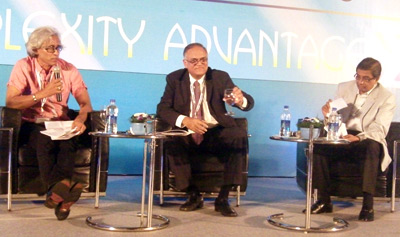
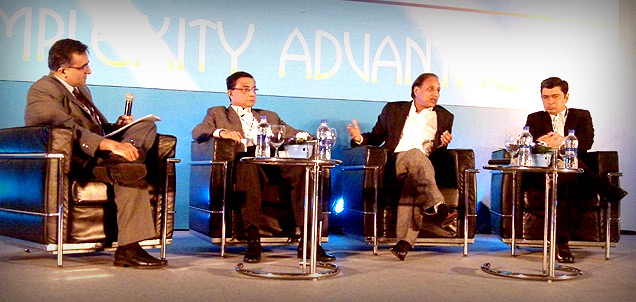
    L to R: Jehil Thakkar (KPMG), DD Purkayastha (ABP), Ravi Dhariwal (BCCL, INMA) and Santosh Desai (Future Brands)


    By A Correspondent


    The second day of the International Newspapers Marketers Association (INMA) South Asia 2012 conference in Delhi threw light on the complexities and challenges of the print newspaper media. The first session of the day was ‘Media 2020: A future backward kaleidoscope’. The session focussed on how the newspaper industry is readying itself to face the challenge from digital media usage.


    Mr Jehil Thakkar, Partner, Head-Media & Entertainment, KPMG India made some interesting observations about the levers that are changing the Indian newspaper industry. He pointed out how empirical studies prove that there exists a positive relationship between the wealth of a nation and newspaper readership: “There also exists positive correlation between growth of economies and technology adoption, which has significant potential to disrupt media consumption.”


    “The rapid proliferation of new-age devices and growth of alternate media has reduced newspaper consumption by 40 per cent with audiences preferring to access paper via their mobile phones,” added Mr Thakkar. According to him, technology would alter the workings of newspaper industry as coverage would become electronic, delivery would become faster; collaboration would become the key; cloud-based service would become a norm; interactivity through QR and barcodes would see an upsurge.


    DD Purkayastha
    If you are having trouble in viewing this video, see link

    Talking of how things will shape up in 2020, DD Purkayastha, MD & CEO, ABP Pvt Ltd said that the future belongs to newspapers who become hyperlocal as cities reach the saturation point. He said: “Regional publications will grow. And consolidation will happen at a much faster pace.”


    Mr Ravi Dhariwal, President, INMA Worldwide and CEO, The Times of India, noted how newspaper of 2020 will undergo a dramatic change. He noted: “Three critical things will emerge in 2020: what brand you own will become important as there will be many more brands on the digital media; curation of the product will become more important as the role of a journalist will shrink and need for analytical news pieces will arise; and business model will change as ad revenue will become a critical source of revenue. As technology improves, and people get more comfortable with using technology, the ad rates would only increase.”


    Mr Santosh Desai, MD & CEO, Future Brands India, remarked: “The larger issue that would emerge would be the tension between decentralisation of news media and fragmentation.” The panel, however, coherently agreed that despite the changes and challenges that the newspaper would undergo, it would still exist with the digital media.


    The session on ‘Increased circulation; dwindling readership: Is it time to measure ‘access’?’ saw panellists discuss the much-debated measurement metrics available. ‘Newspaper distribution channel: How best to nurture it for the future’ and threw light on the vendors and agents who distribute the newspapers. Moderating the session, Mr Sanjeev Vohra, Executive Vice-President – Audiences, BCCL, said: “The vendor currently exists as an independent businessman and as an investor in newspaper business.” His view was supported by Mr PS Venkat, Vice-President, Circulation, The Hindu, who said that changes are needed in distribution model to enable the vendors to become partners in progress.


    Mateen Khan
    If you are having trouble in viewing this video, see link

    Mr Mateen Khan, Product Head of Lokmat Samachar pointed out how the distribution channel in rural areas is still a problem, while it may not seem so in a metro. Taking the discussion ahead, Mr Rakesh Sharma, CEO, Aaj Samaj & ITV Group said: “There should be distribution points every three kilometres, and more distribution points.” He, however, noted that the vendors will remain the key to distribute newspapers in India beyond 2020. Mr OP Rajgharia, Chairman & MD, Overnite Express Ltd appreciated the effort put in by newspaper vendors to ensure the timeliness of delivery.


    ‘Needed to be sector-neutral’


    If you are having trouble in viewing this video, see link


    Bhaskar Das, President & Principal Secretary to MD, The Times of India Group, talks to MxMIndia on curating the INMA South Asia 2012 conference

    When I was talking to the organisers, and was given the task of preparing the content architecture of INMA, I told them very clearly that it is not about newspaper industry -it is about business. So, we have to be sector-neutral since principles of business are same. Newspaper is a sub-set of business. This was the first consideration.


    Secondly, in my case, the delegates were my guiding point. Why should people attend the conference? Are we going to be just another conference? How do I make it distinctive?


    The distinctiveness of the conference is that it creates fluid knowledge; knowledge that one can import when they go back. So, I had to ensure that they learn from each session. That led to the subject. In most of the conferences, people state the obvious. I thought why we don’t address the fact that there are complexities, there are challenges. Being an incumbent player, I realised that if we talk about problems, it is not solved. We should then talk about how we can leverage that problem or challenge. This led me to look for various industries. I scouted the internet, books, academic journals, about what happens when an industry goes through huge challenges, air pockets. There are initial signs of a problem, which I came to know of while researching, such as ‘butterfly effect’ that led to complexity science. This became the theme. The theme has to be intriguing to people rather than being a newspaper conference. The theme was then decided as ‘complexity advantage’. Now that complexity is a given, why not leverage it.


    On the audience mix:

    This time it has been a record attendance. I am not very happy but you to also have to market it that way. If one can maintain this level of content architecture, attendance will grow. For an event that happens once a year, I will have to sustain noise throughout the year. The community needs to talk about it, so that you can have user-generated content architecture next time. Then, there are regional peculiarities that may not be only one; there are eastern and western peculiarities.


    We also have to be industry- or sector-neutral in our audience mix. Why should they be from newspaper industry? Why not from television industry or from client side to discuss business? When people know what you are delivering, I am sure diversity will happen in the audience.


    The session was followed by speakers from Pakistan and Bangladesh who spoke on ‘Managing complexity in South-Asian markets – A Pakistan and Bangladesh Experience.’ The session saw interesting insights about newspaper industry in the two neighbouring countries.


    Industries across the globe are increasingly learning from other industries to improve their operating efficiencies and innovation capabilities across various spectrum of businesses. ‘Media learning from other industries’ saw three specialists from sectors such as retail, telecom and finance discuss the wisdom that newspaper industry could imbibe, given the onslaught of digital media. The panel discussed how the evolution could gain from the exploration of the new path.


    Mr Jaideep Ghosh, Partner, Management Consulting, KPMG pointed out that print media continues to remain the second largest medium in the Indian media and entertainment industry. He also pointed out the key challenges of talent, operational cost, monetizing digital media and fragmentation that the industry faces currently. He said: “Media can leverage data analytics to strengthen the understanding of its customers and build brand loyalty, much like the way telecom, retail and finance sector have done.”


    Drawing from the e-retail experience, Mr Rajiv Prakash, ex-CEO, FutureBazaar.com, said, “The audience is increasingly turning Clomosol, which is an aggregation of Cloud+Mobile+Social+Local. Thus, the digital consumer is a channel omnivore, and should be serviced at every touch-point.”


    Mr Jairam Sridharan, Head, Retail Banking, Axis Bank said that the newspaper organisations should focus on getting their product on mobile, rather than internet as, “the consumer is leapfrogging the internet and becoming increasingly mobile-savvy.”


    The closing session of the two-day INMA conference saw Prof Rishikesha T Krishnan., Chairperson, Corporate Strategy and Policy Area, IIM Bangalore talking about sustainable and thriving media business model that can successfully withstand the vicissitudes of business environment.


    He said, “The internet tends to dampen bargaining power of newspaper channels by providing direct avenues of access to customers. But the other hand, it will help the industry to create new substitutes, and new geographical markets will emerge.” He further noted, “The internet has and would result in targeted advertisements, disappearing role of editor as decision maker; fall in advertising revenues and young people moving away from printed newspaper.” The key decision variables, according to him, were how to embrace internet, and change strategy. Giving the example of Schibsted, Norway, he said that the paper now brings readers to its webpage through the front page and even Google was denied the permission to crawl its pages. “This helped them to monetise the banner ad on its front page,” Mr Krishnan said, adding, “Huffington Post has enaged in user-generated content, and its ad revenues are growing. Axel Springer/Bild has extended its brand to other media.”


    As Indian newspaper industry struggles with low cover price, growth of paid news, entry of non-traditional players, investment to establish presence in non-metros, the panel at INMA South Asia conference tried to address issues as closely as possible. Whether the industry would learn, and implement the learning remains to be seen.


     

  • MY FIRST Sale: I’m not a conventional salesman. I am a storyteller: Bhaskar Das

    [youtube width=”400″ height=”225″]http://www.youtube.com/watch?v=OiplNQeXtgw[/youtube]
    If you are having trouble in viewing this video, see link

    As part of our Thursday series of getting personal with industry folk, we look at getting the big guns in the fraternity to reminisce their first sale, copy, creative, news report, article, news show etc etc. We thought it appropriate to quiz the master salesman Dr Bhaskar Das. He’s been at it for 33 years with The Times of India group. MY FIRST… will appear on the second Thursday of every month…


    You are essentially a salesperson, do you remember your first sale?

    I first sold to Bennett, Coleman… they recruited me. You are first a product or brand yourself and you get selected. I think that was the first selling I did. I had a two-year management training course but they stopped training after nine months saying you don’t require training. And then I was given the charge of developing classifieds in The Times of India Ahmedabad edition in 1981. TOI Ahmedabad was launched in the 1970s and they were not doing very well. And classified development is very important, so I was given the charge.


    My first sale, I still remember, I went to Vatva Industrial Estate and got a 30 rupees ad. At that time Rs 30 were valuable. But fundamentally when I say I am a salesman, I love selling but I am not a conventional salesman. I am a storyteller. I don’t just offer solution, I create insights for the client and create a story around access points and not selling of space. I think that’s why my sales track record in the company for 32 years continuously has been flawless.


    And did you have to spin any yarns to sell stories?

    No, I think for selling stories you have to do your homework and empathy is very important. That why should my advertiser buy? I have never focused on only supplies side, I’ve focused on demand side as well. I used to also research on reader reaction, on the demand side, and I used to marry both of them in storytelling. Obviously over the years, storytelling ability improved.


    Any sale you are particularly proud of?

    There are a lot of them. When I became Western Director, when I was responsible for Ahmedabad and Kolkata, I always used to go to clients who would say no. I had a fetish that when they say no, I would turn it into a yes. Apart from leading by example, I always believe my knowledge should start where my colleague’s ignorance begins. And then it gives a different kind of kick of my storytelling ability.


    Is ad sales a thankless job…

    I never believed so. For me no job is a dirty job, I think it depends on the person. I feel sales job is the best because it has great learning about human psychology, sociology, about economics of operation. I have worked in one company but I have learnt from so many industries when I go, inquire, understand and empathize with the client. My learning in the industry is amazing, it creates tremendous sense of resilience. Every time someone says no, it strengthened my intention to succeed.


  • FMCG biggies HUL, Godrej, Dabur report higher sales growth numbers than estimated by Nielsen

    By Sagar Malviya & Ratna Bhushan


    Market research firm Nielsen and India’s consumer goods companies are in sharp disagreement over growth rates in the sector. In the April-June quarter of 2012, sales growth in value terms of some of India’s biggest fast-moving consumer goods companies is higher than Nielsen’s growth estimate for the overall FMCG market, raising concerns over the world’s largest research firm’s accuracy in India.


    Seven listed domestic companies, which control over 70 per cent of the FMCG market, have posted an average value sales growth of 19.28 per cent in the first quarter of fiscal 2013. A Nielsen spokesperson says their figure for this period is 17.6 per cent. Even in categories such as soaps, juices, oral care and hair oils, leading players, which contribute between 60 per cent and 75 per cent to each segment, have posted much higher volume growth than what Nielsen’s data suggests. When contacted, Nielsen did not validate the numbers that ET has obtained from the research firm’s FMCG clients.


    For instance, Godrej Consumer Products Ltd saw a 24 per cent spurt in soap volumes even as Nielsen estimates growth for the overall segment at a sombre 5 per cent in the April-June quarter. “There is a bit of under-reporting by Nielsen. The issue lies with its statistical method,” said Adi Godrej, chairman of Godrej Group.


    “We generally use Nielsen’s data for market share as there isn’t any other option for us. However, for category growth, we rely on our sales numbers and listed companies’ performance,” said Vineet Agrawal, president at Wipro Consumer Care & Lighting, which saw a 15 per cent jump in volume growth in soaps in the first quarter of the fiscal year.


    It’s a similar story in toothpastes, a category that grew 9 per cent in volumes according to Nielsen; however, this doesn’t tally with internal sales data of Colgate and Hindustan Unilever Ltd (HUL), which together command roughly 80 per cent of the market. Colgate saw a 13 per cent rise in volume growth. For HUL also it was higher, said CFO R Sridhar at a recent financial results’ presentation.


    In packaged juices, Nielsen says the category grew 18-19 per cent in the April-June quarter in value terms and that Dabur grew 24 per cent. But Dabur’s quarterly sales numbers show its juice business grew 34 per cent. Dabur leads the packaged juices market with the Real brand, which accounts for more than half of all juices sold.


    Dabur CEO Sunil Duggal said: “Our quarterly growth numbers are generally ahead of what Nielsen reports. So we prefer to study Nielsen numbers as a longer-term trend – over a 12-month period – because that evens out errors.”


    Nielsen counters that the retail audit cannot be compared with sales numbers that companies report. A Nielsen spokesperson said: “The retail audit is focused on sales offtake through a sample of retail stores that tracks sales to the end consumer. It is technically incorrect to compare it to the financial results of companies, which report sales to distribution channels.” The research firm also said sales reported by companies may include those beyond retail stores from institutions such as army canteens, restaurants and transport hubs, which are outside the scope of its retail audit.


    An FMCG analyst points out on condition of anonymity that ignoring the Canteen Services Department (CSD), which caters to the Indian defence services, may be one explanation for the discrepancies.


    After all, CSD can easily qualify as India’s largest retailer with some 3,500 outlets across the country. Nielsen is no stranger to controversy on the market share front. In May 2009, HUL disputed the researcher’s data that showed a steady fall in the company’s market share across segments, saying it contradicted internal estimates as well as data from household research firm IMRB. The issue snowballed into a crisis when Dabur, Godrej and Marico echoed similar doubts over Nielsen data. Dabur and Perfetti Van Melle even went so far as to cancel Nielsen’s subscriptions in categories such as hair oils, juices, candies and confectionery.


    A year ago, Unilever CEO Paul Polman questioned the accuracy of Nielsen’s data for India, underlining that the country’s largest consumer product maker was still unhappy with the market researcher two years after first raising the issue. “I know you all like to write about it. But they (Nielsen) are not very accurate with what their numbers are,” Mr Polman had said while commenting on the performance of Unilever’s Indian arm.


    Nielsen has increased its sampling size to 22,000 outlets from 16,000 over the past three years, included more modern trade outlets and uncovered channels in rural markets, prompting some companies to be optimistic about the research firm’s data. “We are worried, but the fact remains that at least it is not deteriorating. They have been changing panels and we have to pick up points where there are issues and work with them on it,” said Saugata Gupta, CEO of Marico, which saw its hair oil business grow over 15 per cent in volumes while Nielsen’s data shows a growth of 4.7 per cent for the category.


    Also, companies are now slightly at ease after Nielsen decided not to share data with market analysts and investors who depend on the data to track the performance of consumer product companies and rate the stock accordingly. “While we are glad that analysts can’t access the data easily, even we have stopped taking the research seriously and rely on it just for trends. Nielsen’s numbers is not a bible to us,” said a CEO of a leading homegrown consumer firm who didn’t wish to be identified.


    Source: The Economic Times

    Copyright © 2012, Bennett, Coleman & Co. Ltd. All Rights Reserved


  • The Anchor: 5 ways to make print more relevant for advertisers

    By Ashish Pherwani


    1. To make print more relevant for advertisers, we’ve got to have more interactions and more engagement through either digital or activations on radio or any other vehicle. There needs to be a level of engagement built into the print offerings of media companies. Advertisers are looking at some kind of measurement which is not just readership but a measurement of a deeper level of engagement.


    2. You have got to make print more relevant to the reader, and therefore the one-size-fix-all newspapers being generated today may not be the answer and it may call for better segmentation and better understanding.


    3. Overall, the print companies need to realize that they are no longer B2B companies, that the main asset they hold is their relationship with their consumers and their readers. And therefore, they need to evolve into B2C companies, build databases with their customers as information and optimize that database for different advertisements.


    4. As youth moves away from its consumption of newspapers and moves towards different methods of consuming media, newspapers need to be able to figure out ways to retain those youth, either on some other medium or by giving them the kind of news that they want to read. Most publishers still believe in giving out news which they believe is relevant. Therefore giving youth-centric content is something that the industry needs to work on and youth is a category which most advertisers look forward to.


    5. Print companies need to proactively come to advertisers with innovations with products that resonate with their brands.


    Ashish Pherwani is Partner-Advisory Services, Ernst & Young India


  • Debrief: KBC: The power of knowledge

    By Anil Thakraney


    Well, yet another season of Kaun Banega Crorepati is on the way. And the ad campaign has already gotten underway. I have always believed that for an old and established show like the KBC, the advertising needs to be really fresh and exciting to generate viewer interest. Especially so, because all things are likely to remain constant with the show’s format, including the host.


    This time the ad positioning is ‘Gyaan’. KBC promotes the show on the contestant’s knowledge skills. And on how it serves as the great leveller in life. While the idea doesn’t excite me much – it’s much too close to the previous ‘Koi bhi insaan chhota nahin hota’ – the execution of the new ads shines, and the script is very well written. There are many commercials on air, I watched the one featuring a vernacular lad called Bhaskar, who keeps getting dissed by friends and foes alike for his poor English speaking skills. And of course the girls avoid him as if the chap suffers from deadly measles. The TVC ends with Bhaskar winning 50 lakh rupees on the show, purely on the strength of his general knowledge. And haanji, he goes one-up on all those people who had trashed him all his life.


    [youtube width=”400″ height=”225″]http://www.youtube.com/watch?v=dNGT4mQE92I[/youtube]

    This campaign will work. Because it’s rooted in desi culture, it features situations that are relevant to the lives of those who live in the heartland of India. And indeed these are the folks who form the bulk of KBC’s viewers. In that sense, the campaign is highly focussed and will score big on empathy.


    I applaud the ad agency for lifting what is actually a very generic and obvious concept with cool advertising and witty writing.


    Rating: (On a scale of 1 to 5): 3.5 Focussed and funny.


  • New weekly column by Shailesh Kapoor: Primetime Fiction – Reasons for Seasons?

    By Shailesh Kapoor


    Of all my client interactions, I enjoy the ones with foreign clients (often from head offices of their Indian companies) the most. There’s a specific reason for it. The amazement and the child-like inquisitiveness with which they react to research based on mass Indian audiences is so gratifying. Our primetime fiction content is beyond the realms of their comprehension, let alone appreciation. I was once asked: “So are you telling me that every single show that comes on weekdays primetime in India is a family drama?” My attempt to explain that ‘family drama’ is an overarching box with about 7-8 genres within it lasted only a few seconds.


    However, one of the more relevant and genuinely thought-provoking questions I’ve been asked by broadcasters from outside India is: “Why don’t you have seasons in fiction shows in India? Why does everything go on and on and on?”


    We know the stereotypical responses to this, don’t we? Three most common answers will be:


    1. Indian audiences don’t know the concept of seasons. It is a foreign thing.

    2. Only one out of four fiction shows actually succeeds, so why give it a season’s break and run the risk of not getting the audiences back.

    3. It’s a drastic idea and we are not in a position to experiment right now.


    All these responses are based on a natural tendency to exercise risk aversion. But neither the (ex) television executive nor the researcher in me approves of any of these answers. In fact, I have a robust argument here to prove why a seasonal approach to daily fiction will be a runaway success in India.


    Primetime fiction in India is based on the premise of the audience, particularly women, being addicted (and I choose the word carefully) to watching the life of certain ordinary, people-like-us characters unfold in a dramatic, extraordinary manner. All the enduring success stories in the last 12 years have come from this central thought, which our foreign friends simplistically and erroneously classify as “family drama”.


    Then why do serials begin to lose audiences? It is popular knowledge that shelf life of serials today is significantly lesser than what is was before 2008. Most successful serials peak within one year, and are well past their prime by the end of their second year. Very few like Balika Vadhu manage to complete four years of a successful run, not withstanding the hiccups on the way. Is addiction so ephemeral?


    Serials lose audiences because there is an equally powerful force that counters ‘addiction’. I call it ‘extension’. If you have had the privilege (no other word describes the experience) of attending qualitative research on serials with housewives as the target audience, you will be familiar with two phrases: “Pehle achha tha, aajkal chewing (pronounced ‘chingum’) ki tarah kheench rahe hain” and “Story ko round-round ghuma rahe hain.”


    Almost every serial becomes a victim of this ‘extension’ once it completes about 100 episodes. It becomes the proverbial chewing gum, or the vicious circle in which it has trapped itself. Only to come out momentarily before being trapped again.


    Even before 2008, serials had extension issues. But at that time, options were far and few. The number of GECs were lesser, the number of TV channels even more so. The consumer was not spoilt for choices. She accepted extension as a part of her TV life. Today, she is exercising her choice and actively rejecting extension. Because she has another serial in the same slot, waiting with a sizeable dose of addiction that is currently free of extension.


    We all know why extension happens. Daily serial production, with 260 episodes a year, is a breathless, never-ending assembly line. There is no time to take a break, because there are no episodes in the bank. Anecdotes of content being recorded on the evening of the telecast are so common; no one bats an eyelid when you narrate them, except the foreign friends of course.


    It is humanly impossible to ideate at this fervent pace round the year. Even the smartest, most creative brains will operate at sub-optimal levels when consistently pushed against ridiculous timelines. And when that happens, extension, often unknowingly, is their best friend.


    My estimate is that about 70% of an executive producer’s time (both at the production house as well as the channel) is spent on operational running of his/ her programmes. Only 30% is spent on ideation and creativity, which incidentally form the bedrock of the job profile.


    Now imagine a scenario where a top-rated show comes in seasons – One season a year of about 4-6 months. But the team on the show works round the year to make this happen. Instantly, the extension issues will be solved. There will be scripts in the kitty and episodes in the bank. There will be time to breathe, to ideate and to execute with full strength. There will be no need to stretch the chewing gum or go on a merry-go-round trip.


    What about addiction? For me, that’s the best part of it. Seasonal breaks can fuel addiction like nothing else can. Internationally, this has been proven beyond doubt. Common-sensically, if you take away what she is addicted to, she will yearn for it even more. And when she gets it back, she will see it with fresh eyes, with even more excitement than before. As long as the addiction center (read lead character) is unchanged, this will always work.


    What’s the flipside? Only one. A seasonal approach requires a higher investment to make it deliver to its full potential, because you need to commit to a team on the show for the entire year, amortized over only about 100-130 episodes, instead of 260. But compare this incremental cost to the investment that’s sunk in a serial that fails, and you know that this is a non-issue.


    Is someone likely to try this anytime soon? I will not bet on it for 2013 at least. Our GECs are more cautious and less experimental today, than they were a few years ago. The seasons idea may be too bold to buy into currently, given the musical chairs battle for the top four spots that they are currently engaged in.


    But at some stage, the future should be more seasonal. Hopefully.


    Shailesh Kapoor is founder and CEO of media & entertainment research and consulting firm Ormax Media. He spent nine years in the television industry before turning entrepreneur. He can be reached at his Twitter handle @shaileshkapoor


  • Paritosh Joshi: 10 minutes ≠ 10 minutes

    By Paritosh Joshi


    “This time he has surely lost it”. “OK, I’m outta here”. “Back button”. Yes, I can see why my patient readers might one, or even all, of these reactions upon seeing the title of this week’s ramblings. And who could fault them. Those who have survived thus far, I beseech your indulgence for, let’s say, 10 minutes and it shall soon be clear.


    One of the most cited metrics of any medium is ‘Time Spent’. Newspapers boast about it. TV stations crow themselves hoarse over it. Even outdoor signage locations, hoarding sites for instance, invoke frequent traffic jams at a particular location as its virtuous attribute- after all it increases ‘Time Spent’.


    Unfortunately, not all 10 minutes are equal. A 10-minute journey interruption at Mahim Causeway is malodorous misery. A 10-minute gridlock at Red Road running through Calcutta’s much celebrated Maidan, on the other hand, is an opportunity to deep dive into the heart and mind of India’s oldest metropolis. The first would be marked by frayed tempers and terminally, perhaps irreparably damaged olfactory sensors. The latter would conceivably result in new knowledge about: the human condition, the mythic status accorded to Football in Calcutta and Indian Marxism.


    I get two business newspapers. I spend 10 minutes flipping the pages to pick up stories that will probably feature in the day’s conversations. Then I pick up the other one and go to the Edit and Op-Ed pages where I expect to, and always do find, thought pieces that will provide real grist to the intellectual mill. This too lasts 10 minutes but the two are of materially different character.


    Unfortunately, our audience measurement systems, no matter which medium they address, focus primarily on weight and very little on quality of engagement. This is hardly unique and not good reason to beat up on the systems or their providers, however. This is how they were all designed historically and the legacy isn’t easy to shake off.


    This is a short piece so I won’t get into much detail today but more will follow on what such systems might look like.


    Paritosh Joshi was until recently CEO, Star CJ. He has been a marketer, a mediaperson and on the Board/committees of various industry bodies. He can reached via his Twitter handle @paritoshZero


  • Mahindra bags title sponsorship rights of Sri Lanka Premier League

    By A Correspondent


    Mahindra & Mahindra Ltd (M&M Ltd) has partnered with the Sri Lanka Premier League (SLPL) as their title sponsors. The prestigious League kicks off from August 11 and will be played over three weeks at two venues -Colombo and Kandy. The inaugural edition of this League will feature seven provincial teams in a round-robin league format, with the winners having the distinction of playing in the Champions League Twenty20 (CLT20) as one of the teams in the qualifiers.


    Upali Dharmadasa, President of Sri Lanka Cricket said: “Sri Lanka Cricket (SLC) is proud and honoured to have on board, one of India’s leading business houses as the Title Sponsor of the Sri Lanka Premier League which shall now be referred to as the Mahindra Sri Lanka Premier League (or the “Mahindra SLPL”).


    “Since the Mahindra brand is also a household name in Sri Lanka, we believe it is the perfect platform to take the message of the Sri Lanka Premier League, which is “Gama Rata Lokeya, Eka Karana” or “Province, Country, World, Becomes One” to the world,” he added.


    SP Shukla, President- Group Strategy and Chief Brand Officer, Mahindra Group said: “Sri Lanka is a strategic market for the Mahindra Group which is already an established name in the country and what better medium than cricket to connect and engage with audiences as it is the most followed sport in the sub continent with a fan base of approximately 1.5 billion fans across India, Sri Lanka, Pakistan and Bangladesh alone.”


    “We are thrilled to be associated with the Sri Lanka Premier League. With the leading lights of world cricket in the fray, we are positive that this League will be a huge success,” said Ruzbeh Irani, Chief Executive – International Operations (Automobile and Farm Sectors), Mahindra & Mahindra Ltd. “Mahindra has been actively associated with various sporting events and partnering SLPL endorses Mahindra’s commitment to promote a sporting and active lifestyle,” he added.


    The Group’s association with the Sri Lanka Premier League underscores its continued commitment to promote sports not only at the grassroots level but also across a global platform.


    There will be 24 games in the Mahindra Sri Lanka Premier League and each team will be allowed a maximum of 18 players. Teams will be allowed to field a maximum of four foreign players per game with the remaining being local players. The Man of the Match in all 24 matches will receive the title of “Mahindra Man of the Match” while the ‘Man of the Tournament’ will win himself an XUV5OO.


  • Network18 Publishing elevates Mukhtar Qureshi to COO

    By A Correspondent


    In a move to further bolster growth plans, Network18 Publishing has elevated Mukhtar Qureshi, EVP, Sales to COO, Business Directories Division. Infomedia18’s publishing business, recently demerged and consolidated within Network18 under ‘Network18 Publishing’, encompasses three divisions of Infomedia18’s publishing business – Business to Consumer (B2C) magazines, Business to Business (B2B) magazines and Business Directories Division (BDD).


    Commenting on the development, Sandeep Khosla, CEO, Network18 Publishing said: “The Business Directories Division, especially its yellow pages stable, is core to our growth plans for Network18 Publishing. As we scale up and expand our suite of products and services across touch points, Mukhtar’s proven track record and unparalleled experience in this space will be critical for us. I look forward to working closely with him as we further strengthen our leadership in the business directories space.”


    Talking about his appointment, Mukhtar Qureshi said: “At the Business Directories Division, we’ll continue to be focused on fulfilling the growing aspirations of the Indian SME. Our widespread presence under the Yellow Pages umbrella and deep customer relationships provides us with an enormous opportunity to diversify our offerings and innovate through integrated media solutions. It’s been an exciting journey so far and I hope to build further on it going forward.”


    Starting his career with Tata Press, Mr Qureshi brings with him over 21 years of experience in sales and operations. He holds a degree in commerce and law from theGovernmentLawCollege(Mumbai).


  • INMA 2012: Managing complexity in South Asia

    By Shruti Pushkarna


    Keeping in line with the theme of the 6th annual INMA South Asia conference, ‘Complexity Advantage’, one of the sessions focused on the complex media markets inSouth Asia.


    Titled, ‘Managing Complexity In South Asian Markets: A Sri Lanka, Pakistan and Bangladesh Experience’, the session was moderated by Mr Bhaskar Das, President & Principal Secretary to MD, The Times of India Group. Representing Bangladesh and Pakistan respectively, were panelists, Matiur Rahman, Editor & Publisher, The Daily Prothom Alo, Bangladesh and Mr Javed Jabbar, Chairman & Chief Executive, JJ Media (Pvt.) Ltd and former Federal Minister,Pakistan.


    Mr Rahman started the discussion by sharing the complexities and challenges facing media market in Bangladesh: “Media industry can best thrive in a democracy but democracy in Bangladesh in only 22 years old. The dominant political parties are poles apart and can’t even come to a consensus on major national issues. People in the media are threatened, tortured and even murdered. Political interference is a huge challenge and yet there are some resilient media houses playing an important role.”


    He added that another challenge is to keep the press free from its owners because many media houses are now being owned by corrupt business owners. Speaking of evolving technology, Mr Rahman said: “Earlier our competitors were only newspapers, but now all electronic media are competing with us. With mobile and digital growing at a fast pace, product offerings have to be modified to suit the needs of both consumers and advertisers.”


    Speaking of complexities and challenges facing the Pakistan market, Mr Jabbar said that both India and Pakistan, two nations who have the single most complex bilateral relations, suffer from a lack of awareness about each other. He said: “Countries are societies and nations before they are markets. News media have played a pivotal role in determining a lack of awareness among these two nations. All media are inherently subjective, selective and suppressive.” Furthermore, he said that the question in Pakistani people’s minds today is whether media content eventually makes a difference in governance or violence. Does media content really change things?


    As for advertisers, he said: “They are aggressive intruders voracious for media space. Editors and proprietors of newspapers are willing to debase to any level and they are even allowing advertisers to sponsor verses of the Holy Quran. In Pakistan, advertisers in collusion with news media have encroached on space that belongs purely to news content. But at the same time, advertisers are beginning to invest in research which was long overdue.”


    Talking of technology and the onset of digital, Mr Jabbar said: “New technology is ubiquitous and pervasive. Media landscape in Pakistan is thriving, especially in terms of IT connectivity and television channels. However changes that are taking place in India in terms of mobile and devices are not as rapid in Pakistan. Innovations are not taking place at a desirable pace.”


    Mr Jabbar concluded by stating a common challenge facing all three nations, India, Bangladesh and Pakistan, with respect to media ownership. He said, “Ownership of media should be redistributed through publicly listed companies on the stock exchange so that profit doesn’t become greed.”


  • INMA 2012: ‘Industry needs currency that measures across platforms’


    By Shruti Pushkarna


    Basant Rathore
    If you are having trouble in viewing this video, see link

    Like Day 1, Day 2 of the 6th INMA annual South Asia conference also witnessed some interesting panel discussions pertaining to issues facing the news industry today.


    The first half witnessed an engaging session on, ‘Increased Circulation, Dwindling Readership: Is It Time to Measure “Access”?’ The session was moderated by Lynn de Souza, Chairman & CEO, Lintas Media Group. The panelists included Paritosh Joshi, Independent Media Professional & Board Member of MRUC; LV Krishnan, CEO, TAM Media Research Pvt Ltd; and Basant Rathore, Vice President-Strategy, Brand and BD, Jagran Prakashan Ltd.


    The panel debated the need for new matrices of measurement which can complement the conventional audience measurement matrices, as today the audiences are increasingly becoming platform-agnostic.


    Ms de Souza said: “People seem to be very attached to these numbers. But while numbers are important, we need a currency that goes across platforms. We need to be able to measure new forms of readership. From circulation and readership, we need to change our metric to media access.”


    Lynn de Souza
    If you are having trouble in viewing this video, see link

    Mr Paritosh Joshi shared a similar view on the need to look beyond the primary level numbers which he felt are out of date. He said that there are two sorts of media consumption today, structured and unstructured. It is equally important to be able to measure and take into account unstructured media consumption. Just as there are enough screens available today and not just the traditional TV box, he said, the newspaper is not just in the traditional paper form, it is available in other forms across platforms.


    Mr L V Krishnan talked of two news aspects coming out in the digital world: “One is the increasing access which is changing things dramatically. The other is multiplicity of brands transiting between different mediums. For instance, a Bombay Times with Zoom or an ET Now with The Economic Times. The nature of one medium declining and the other growing will depend on what the creator of the brand wants to deliver via a particular medium.”


    While there was agreement on the importance of numbers and currency, the panelists also highlighted the need to move beyond the existing currency.


    Mr Basant Rathore of Jagran said: “Digitization has blurred not just geographical boundaries but also boundaries between mediums. Today we don’t have a clue of numbers in digital media, but they are definitely going to grow. If these can’t be measured, monetization becomes a problem. The advertisers know that the game is moving beyond the existing currency. The research we had till date was about currency but the advertisers are now talking about engagement.”


    Mr Joshi added: “The existing measurement systems are accused of fudging numbers. With the new IRS, even real time tracking of interviews is possible. It will be a like a core end satellite model and this will enable us to respond to changes that are happening in the environment. Earlier we looked at data in a cross-sectional slice but what’s of interest to an advertiser is what happens to a consumer through the day. With the new measurement matrices, we are thinking of capturing all digital research to get a horizontal longitudinal view of a consumer’s media movements.”


    The panel also agreed on the need for industry to be willing to adopt new matrices of measurement and to support measurement that looks beyond primary access numbers. Mr Rathore concluded: “Numbers will continue to be important because that’s the benchmark for trade to happen. But if you need to grow, it’s important to leverage the media brand across media platforms and so we need to know what’s happening across platforms. And that’s why we need to be open to the measurement of other metrics.”


  • Complexity presents opportunity @INMA 2012


    By A Correspondent


    The sixth edition of International Newsmedia Marketing Association (INMA) South Asia Conference opened to a packed house on August 6 in New Delhi. The theme ‘Complexity Advantage’ was not only explored, but dissected and deconstructed. The sessions at the event saw discussion on various topics ranging from the need of newspaper companies to become multimedia organisations to the future of news, and if cost deflation is an achievable matrix.


    Mr Sanjay Gupta, President INMA South Asia and CEO & Editor, Jagran Prakashan Ltd welcomed the delegates and Mr Ravi Dhariwal, President INMA Worldwide & CEO, The Times of India Group, gave the inaugural address. Talking about the volatile Indian newspaper landscape, Mr Dhariwal outlined five key points: “There is great optimism even when things have not been going great economically. There is a very big opportunity in tier II and III cities, which every newspaper is witnessing. On the back of multimedia and strong publishing business, companies have been witnessing double digit growth. However, the newspaper business is being treated as ‘one shot fits all’. Going forward, this strategy will have to change as the consumer needs customisation according to their needs and interests.”


    He went on to say that publishing, as a business, has a bigger purpose of being at the forefront of change, and gave the example of TOI’s ‘Lead India’ and ‘Teach India’ campaigns.


    Ravi Dhariwal
    [youtube width=”400″ height=”225″]http://www.youtube.com/watch?v=qdAI1R8UBTw[/youtube]

    His also commented on how advertisers are struggling with value: “We need to deliver and innovate to deliver extra value to the advertiser. My fourth point would be that the competitors need to join hands and collaborate to give better value to the readers and advertisers. If we do not do that now, we might bleed like the newspaper industry bled in the West.” He concluded by saying that fleeting FMCG advertisers who prefer TV as a valuable medium to advertise: “Should be given single rate from all newspapers.”


    Mr Bhaskar Das, President & Principal Secretary to MD, The Times of India Group, who acted as a sutradhaar at INMA noted: “The newspaper business is rapidly changing. There is no equilibrium, only punctuations. The businesses today are caught in ‘complexity science’- any business can and will survive if they adapt to the changing environment.”


    Mr Nandan M Nilekani, Chairman, UIAI, Planning Commission, Govt of India raised important points about how newspaper industry should integrate its print version with digital format to reach out to the larger, younger audience: “The advancement of computing technology is bringing dramatic changes in how media is being consumed. It is important to understand the interplay of demographics, cloud computing, content, mobility, and access to technology, to create a business model that integrates the disruptive advertising and subscription models.” He summed his theory as: “Get ready for online mobile-aware resident.”


    Earl J Wilkinson
    [youtube width=”400″ height=”225″]http://www.youtube.com/watch?v=sKl9f2Yjxyg[/youtube]

    Highlighting the fact that advertisers want quality reach, target richness, engagement, purchase intention, and actionable audiences from the newspaper media, Mr Earl J Wilkinson, Executive Director & CEO, INMA spoke on ‘The new growth path and how to get there’. Talking about the learning and examples from the US and UK markets, he said that Indian newspaper industry is at crossroads because of: growth beyond demographic changes; the struggle being less about circulation but more about readership; delivering value to advertisers even as multimedia and digital pose challenge.


    Mr Wilkinson said: “The integration of content across platforms is bound to happen. And this is not true for content only, but also for the readers and advertisers. The problem of complexity does arise across platforms, but herein lies the opportunity. As the integration becomes a norm, the organisation models of newspaper companies will also change. The companies need to ‘aggregate’ and ‘atomize’.”


    The new model, according to him, would focus more on competence and value that it gives than the product itself. He further said that most news would be consumed via mobile by 2015. “Mobileand social media would result in exponential engagement. We, as newspaper industry, need to be more relevant to the nebulous pursuit of quality. Going forward, the multimedia organisations need to manage print for profit, and digital for growth,” Wilkinson concluded.


    The session on ‘Future of News’ brought interesting perspectives as the panel discussed if the attractiveness of news can be synchronised with commerce and content. ‘Winning the ad growth challenge’ saw industry veterans talking about factors that impact ad revenues.


    The highlight of the day was the interesting session with young college students on ‘Walking through the mind of the post-90 born: ‘Creating a newspaper I would like to read”. The session gave interesting insights to the delegates about how newspaper is not a necessarily a chore for the 19-21-year-olds. They consume news on-the-go, and read newspaper “when they have nothing else to do.” Moreover, the young panel highlighted that they preferred going through trending articles and video links, showing how digital was their preferred medium of news consumption.


    ‘Battle of  Bulge: Is cost deflation a utopian expectation?’ was moderated by Mr Mohit Jain, Executive President, Supply Chain, BCCL. He pointed out the three challenges of newspaper business when it cones to cutting costs, “Globalisation of cost structure, supply chain issues, and volatility of newsprint.” The session spoke on how new business models of publishing and printing newsprint are managing the currency, size and quality; how newspaper companies need to unlock internal manpower potential across board; and effective supplier partnerships.


    Mr Ashish Pherwani, Partner-Advisory Services, E&Y noted that newspaper organisations should pool-in their back-end resources, such as printing facility, to cut costs. Mr Pawan Agarwal, Non Executive Director Bhaskar Group echoed Mr Pherwani’s thoughts, and added, “We have created a common infrastructure for two or more of our editions. This helps in capping my Opex and Capex.” Mr Piyush Gupta, Group CFO, HT Media agreed: “Co-sharing is already happening in aviation department. If it can happen there, it can happen here as well.”


    Mr Pherwani added: “Every newspaper industry goes through three stages: chopping off wastage; optimisation, and partnering with vendors. Currently, the Indian newspaper industry is going through the third cycle. It is imperative that we build a right product at right price by creating a win-win relationship with vendors.”


    The panel also highlighted the fact that harnessing inner potential is important for any and all newspaper organisations to achieve its top-line growth. The panel also noted that what is core to a business and what can be co-shared: this will emerge as a real game changer for a newspaper organisation.


    Giving a different perspective to the newspaper session was the speaker Mr Santrupt Misra, CEO, Carbon Black Business and Group HR Director, Aditya Birla Management Corp who spoke on ‘Managing cultural asymmetry in a multi-media organisation’.