By Our Staff
The times are changing, so is audience targeting: Millennials form a large part of the population and often are considered as one target group. But the truth is that there is heterogeneity within this target group. Zirca Digital Solutions has produced a whitepaper titled ‘Mind The Age Gap’ to map a revolution in audience targeting. Says Neena Dasgupta, CEO and Director, Zirca: “The report captures the essence of the Millennials and GenZ and tells us that their personalities are different and unique. As a keen marketer, salesperson, planner etc, we need and look for these insights each day, trying to understand this segment.”
It’s hard to acquire consumers in today’s brand-saturated market. Advertisers try to gauge a consumer’s attention by means of various traditional and new-age marketing techniques, attempting to lure them to sample products or use services. It’s even harder for advertisers trying to market their products or services to many different age groups.
Generational marketing is a popular method used, an approach that assumes that the timespan in which people are born influences their values, attitudes, and experiences. Generation segments were created to enable marketeers to target their campaigns specific to generation’s needs,
Amongst these 5 cohorts (Baby Boomers, Generation X, Xennials, Millennials and Gen Z), , Millennials and Gen Z form close to 1.6 billion of the world’s digital population. Millennials in particular form the bulk of the working population and are the backbone of any country’s economy. Naturally, they’re a significant part of the target audience for almost every industry.
An American Concept: The term millennial was first introduced by Americans Neil Howe and William Strauss in their 1991 book Generations. At the time, the oldest millennials were completing high school in the early 2000s which was the beginning of the new millennium, hence the nomenclature. Economic recovery after a depression in the 90s, the birth of internet and digital, the 9/11 terrorist attack were all part of a millennial’s upbringing in USA.
Two decades later, the world continues to use the same westernized term even though the environment faced by people born between 1981-1996 was entirely different.
The Indian contemporaries to American millennials had an upbringing which was very different. Rama Bijapurkar, an icon in marketing strategy, called them India’s first non-socialist generation where consumption was encouraged, not curbed. She used the term ‘liberalization children’ since the environment they grew in saw India evolve from a closed to a liberal one. Yet, ‘millennial’ is very much a buzzword still (wrongly) used in the Indian marketing circuit.
Even if we were to lump together 80s and 90s born under a single category as millennials, there’s another key factor to consider. As of 2021, the youngest millennial is 25 years and the oldest is 40. This is a very wide gap between two extremes, and the context is important.
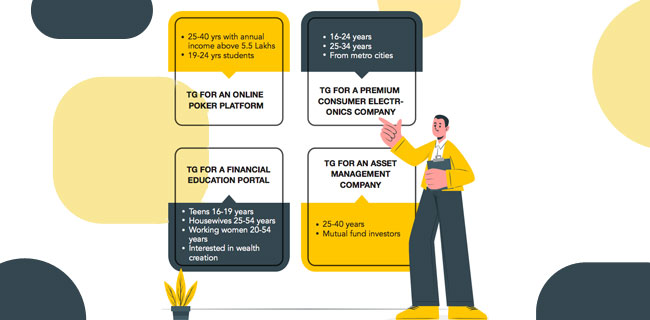
Yet, when it comes to communication marketers often adopt a one-size-fits-all strategy for millennials. Potential audiences are simply defined by a number rather than humanizing them.
According to a report by Trendwatching.com, “People – of all ages and in all markets – are constructing their own identities more freely than ever. As a result, consumption patterns are no longer defined by ‘traditional’ demographic segments such as age, gender, location, income, family status and more”. Thus millennials, however culturally similar their upbringings, are ‘heterogenous’.
The report can be downloaded from: https://zirca.in/mind-the-age-gap-how-consumer-archetypes-evolve-with-time/