Category: XTREME FOCUS

  • #Frames2013: The key is to know your markets and its demands: Anne Sweeney

    By Kshama Rao


    At the first keynote of the 14th FICCI-Frames convention, Anne Sweeney, co-chair Disney Media Networks and President, Disney-ABC Television group spoke about creativity and the importance of localization in creativity. She talked about how local markets and local culture play an important role for any programme or format to work in different countries.


    To source out local talent so that the character-actor fit is perfect for the said market is another important aspect of making a good show, she said, recounting how the creative team had short-listed two girls to play the role of Hanna Montana. While one was an experienced sit-com actress, the other was this shy, inexperienced girl who went on to be known to the world as Miley Cyrus aka Hanna Montana. “The key is to know what your market is and its demands. When we make or adapt shows to the Indian market, we have to know what’s important to an Indian audience and how different is it than any other viewership we might have catered to. The core values are universal is what we have found out time and again aligned perfectly with the Disney themes,” Ms Sweeney said.


    She then went on to cite two popular shows in the Indian kiddie show market – Best of Nikki and The Suite Life of Karan and Kabir, the latter being a desi take on The Suite Life of Jack and Cody. “The reason these two shows have best worked for us and the Indian market is because they celebrate culturally relevant things say a festival like Diwali or Holi. The theme is kid-centric and family-inclusive.”


    She said advancement in technology has only made story-telling much more compelling and magical. “It has helped us to push story-telling in the right direction just like it did several years ago when Disney made Snow White!”


    She said the key is to empower the audience and “give the consumers content which is what they want, when they want and how they want.”

    In a q&a session that followed with Man Jit Singh, CEO, Multi-Screen Media and Chairman, FICCI Broadcast Forum, Ms Sweeney also reiterated that as much as they love to adapt foreign content to Indian screens “the key is also to balance it with original content. It’s not just about recreating these shows for a different market but make it original too. Like some of the properties were created in Europe but adapted later to the US market. We are also looking at Indian content we could adapt to foreign markets.”


    Lastly, she said that while there is always the business challenge, difficulties in understanding the market, sourcing local talent and understanding the needs of the audience, it’s shows that are family-inclusive that work the best. “When we worked closely with children in focus groups to know what they were watching and when we asked them who their favourite heroes were, they never mentioned a superhero, it was always either the father, mother, brother or sister in their family. So family-inclusive shows are key for children’s programming!”


  • #Frames2013: Business of sports demystified

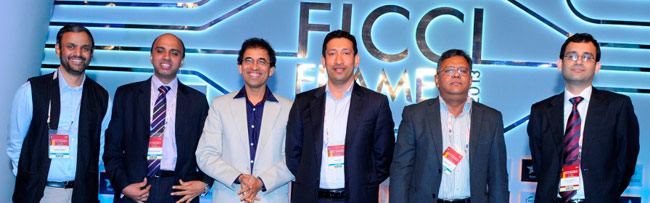
    L-R – Sundar Raman, CEO, IPL, Prasana Krishnan, COO, Neo Sports, Harsha Bhogle, Sports Commentator, Venu Nair,Head-South Asia,World Sports Group, Kushal Das, Secretary General, All India Football Federation, Nitin Kukreja, President, Star India Pvt. Ltd.


    By A Correspondent


    The third day of FICCI-Frames 2013 saw some of the key stalwarts of the business of sports and sports broadcasting industry come together to address and touch upon issues surrounding the sector. The session examined the hurdles plaguing the business of sports, which has evolved and yet lacks the direction to plunge ahead.


    With a regime beset with escalating costs, restricted prices and little IP protection; offering compelling content to Indian viewers remains a challenge, what are those enabling policies that will take sports business and broadcasting to its next level. The panel consisted of Sundar Raman, CEO, IPL; Kushal Das, Secretary General, All India Football Federation; Prasana Krishnan, COO, Neo Sports; Venu Nair, Head-South Asia, World Sports Group and Nitin Kukreja, President, Star India Pvt. Ltd.  The session was moderated by one of the most famed names in the commentating world, Harsha Bhogle.


    The initial part of the session stressed on some of the most common issues faced by broadcasters in the industry, ie the battle of Cost Vs. Revenue, if revenue is keeping pace with costs of the sports properties and whether they are viable. The session also touched on how broadcasters fair between airing cricket which has already established itself as a national sport and non-cricket sports which are still developing in India. Ultimately boiling down to the discussion whether costs on cricket properties are going on an upward spiral and if revenues are keeping pace with it.


    Sharing his views, Nitin Kukreja, President, Star India Pvt. Ltd said that his network has committed over Rs.38.50 billion over the last 6 years to acquire the rights to Indian cricket. He said “I think the challenges on the revenue part are manifold and are present in almost every field. The advertiser is always looking for continuous stream of content that he can count on for viewership. It’s the nature of the game, the format, the schedules which are different for sports hence influencing habit formation and therefore to get a consistent stream of advertising is a challenge. On the distribution front, the regulatory environment for sports is such that the catch up doesn’t happen and each step is a struggle. Also if you look at price caps every genre of content is treated similarly whether entertainment or sport or news. Any sport is bucketed together irrespective of viewership, so once again distribution has become a challenge and even monetizing a new form of content is a struggle because technology has emerged at a faster pace than regulation. The revenue stream is difficult to unlock in the value space.”


    Commenting on whether revenues and costs were pointing in different directions Prasana Krishnan, COO, Neo Sports added “The reality is that the revenue stream is still a little slow to catch up to today. The revenue streams are still not ramping up to costs. The DTH explosion has been slow and has not taken place at the rate we were expecting to. So you can say that the basic challenge is the cost structure, as it is slight above what is justifiable in the market at this point of time.


    The next phase of the session stressed that when rights are being purchased, broadcasters are fully aware of the environment and are therefore making rational choices. Venu Nair, Head-South Asia, World Sports Group said, ” Most people who bid on the rights, bid on basis on data which they think will come up to performance, the question when you go out and bid, can it be recouped?  The point is that unless you don’t bid on a cost that is unreasonable, you will not chase on its revenues. I believe this industry, like real estate, there is a price to every value point, if you can decide on a value point and stick to that, then you have a chance to make money.”


    Taking a look on the positive side and supporting the claim that there is no crisis in the industry Sundar Raman, CEO, IPL said “I personally don’t think there is a crisis as stated out for cricket or for any other sport.  There is a lack of opportunity in the industry and issues which need to be addressed and FICCI provides such a platform to address such issues. Today the amount of money that you notice in the markets such as UK, USA, South Africa or even Australia that a broadcaster gets paid is from subscription revenue. One of the major point broadcasters should look at is understanding the market size they exist in, once you are on track with that and recognise it you can understand the potential of revenue.”


    India now is getting influenced with the western world and is opening up to sports outside the world of cricket. The challenge is to develop these sports in the Indian environment where cricket is so strongly rooted. On that, Kushal Das, Secretary General, All India Football Federation said “The problem with football in India is football itself, you have every professional football league broadcasted across channels, if you compare the Indian league with other world class league you will see that it is not compelling. So if you look at it there are a host of problems as to why football is not being able to develop into a promising product. The challenge is to develop football as a compelling product through talent development and infrastructural improvements.”


    To summarize the discussion, Harsha Bhogle stated that the industry as is still at a crucial stage where sports broadcasters are trying to balance and justify their rationale of purchasing sports rights in the country, brace for developments into non-cricket sports and look forward to the digitization boom.


  • 3-day informational event fulfils tryst with destiny, almost!

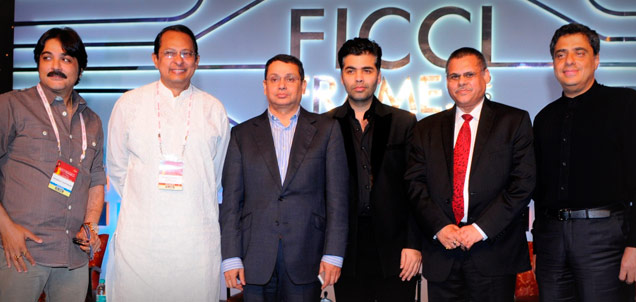
    Actor and Convenor, FICCI MEBC East Prosenjit Chatterjee, Bangladesh Information Minister Hasanul Haq Inu, FICCI M&E chair Uday Shankar and co-chair Karan Johar, I&B secretary Uday Varma and Ronnie Screwvala, MD, Disney UTV


    By Johnson Napier


    If there was ever a platform that was going to foretell the future that lay ahead for the M&E industry in a manner that was befitting, it had to be at the FICCI-Frames 2013. After an invigorating, insightful, challenging and forward-looking three days of deliberations, the biggest informational event for the M&E industry in India came to an elaborate end yesterday.


    While the day began with a series of interesting sessions that centred around topics like the economics of running a sports business, long versus short form of content consumption, skills in the M&E sector, unleashing the power of data, single window clearance for films, reinventing regional media and electronic news media among others, an equally power-packed panel of speakers made sure that the delegates had a lot to take away as learnings from the sessions.


    Perhaps the mood that was prevalent over the entire three-day event at the venue was summed up at the valedictory session on day 3 at FICCI-Frames. The session once again saw a line-up of dignitaries who had words of wisdom and promises to make to the gathering.


    Union I&B Minister Manish Tewari was not present at the event but shared a recorded message with the audience. Affirmed the minister, “The I&B ministry exercises various limits – we are licensors, we are players and stakeholders and are also regulators… so it’s a mixed bag of duty for us. But it’s incumbent upon the government to try and play the role of a facilitator and enabler in order to ensure the growth of this sector takes place at a more rapid pace than what it has witnessed over the past few years.”


    Highlighting his observations over the entire digitization exercise and the demand to do away with the hike in duty on STBs the minister said, “In the first phase we went through a digitization process in the four metros and what was observed was that the STBs are important from also a regional point of view – South East Asia. In order to give a fillip to the Indian manufacturers the Union Finance Minister therefore decided to hike the duty from 5 to 10 percent. So while a rollback is not possible we should see it in the perspective that we as a country also have a duty towards seeing that the other sectors are also benefited and a robust mechanism be established. To achieve success in the second phase across 38 cities all the players, stakeholders and MSOs and LCOs have to come together and make it a reality.”


    Adding further Mr Tewari said, “The other issue that had been highlighted was the issue of pricing of talent and that is something I feel has to be handled between the private-public players jointly. While the government has its own institute for providing training and other skill-sets it will take the combined efforts from the private sector to make that dream a reality.”


    Sounding a word of caution to the industry, Mr Tewari said that where the issue of freedom of speech and expression was concerned, it is something that is guaranteed by the Constitution but it also carries certain restrictions. “The challenge is to see how we can find the golden mean between liberty and the reasonable caveats that have been imposed by the Constitution. If you ask me the freedom of speech and expression does include the right to offend but we also need to ask ourselves the question – what about the remedy? As we unfold the debate further, it is worth that the industry also introspect that there is a distinction between a debate that is honest, candid and something which can be corrosive to the national spirit.”


    Next it was the turn of Ronnie Screwvala, MD, Disney UTV to put forward his predictions as he presented the keynote address. “Some of the good things that have happened in the recent past is the onset of digitisation that has had a huge impact on us. But I think we should hold on to popping the champagne as it will be another 2-3 years before the monetisation from this exercise comes about. So while we have made the investments, the consumer doesn’t necessarily reflect them. But it’s good news that after 20 years of waiting the move has finally come to fruition,” said Mr Screwvala.


    Adding further he said, “Where new media is concerned there is a lot to celebrate about, but unfortunately we have not been able to monetize it. The fact that we are going to be a 150-200 million smartphones market in less than two years, and the fact that large digital and mobile players look at this market as the second or third in the world is phenomenal. There is a need to take this growth further.”


    According to Mr Screwvala the future will belong to dominance from a single screen. “We all talk about the second-television household but that will become irrelevant as it is going to be our personal screen. We will be surprised to see how consumers from all corners of India wake up to using mobile as their primary source for entertainment. The issue is going to be of bandwidth and pricing,” asserted Mr Screwvala.


    Taking over from Mr Screwvala, Uday Verma, Secretary, I&B Ministry began by thanking the industry and the stakeholders for the response that was elicited for the digitization exercise. He said, “The digitization exercise has come about to be because of the alignment of the industry and the stakeholders. It was a difficult task but we are satisfied with what we have managed to achieve. It is something that has happened in a record time and has happened in a smooth manner. Also, it is something that has happened with no intervention from the government where cost is concerned; it has all been borne by the industry.”


    “Where Phase 2 is concerned the progress has been satisfactory with more than 60 per cent conversion having already taken place. There are 21 cities that have reported more than 50 percent digitization and about 10 cities have reported more than 75 percent digitization. There are just four cities that have been posing problems with a conversion rate hovering around 30 percent,” added Mr Verma.


    On the issue of measurement, My Verma said that the option of the industry making its own rating system is already there and the IBF is working hard towards making it a reality. “If there is a consensus that the government should intervene in this matter in terms of guidelines we can do so for the benefit of the industry.”


    Mr Uday Shankar, chairman of FICCI Frames summed up the proceedings by announcing the rollout of a Centre for Regulatory Excellence in collaboration with the industry. “This won’t be limited just to M&E but the entire corporate sector. It will also act as a facilitator in aligning corporate India’s objective with that of the goals of the government and policy establishments. We hope we receive active participation from all quarters.”


  • #Frames2013: Text of speech by I&B secretary Uday Varma

    I am indeed very happy and delighted to be here like previous years.


    FICCI FRAMES actually is one event in my opinion which perhaps is looked forward to by everybody in the media and entertainment industry. By Government also, because I think this is one platform, one forum where you get the best people from the industry and I think the level and quality of deliberation is of extremely high quality. And that provides us not only the inputs of the industry but also to a very large extent to the Government as well.


    There’s a very interesting and famous book in Sanskrit, known as Panchtantra. It’s like Aesop’s Fables but much more comprehensive and perhaps much richer. This was created by a fellow known as Vishnu Sharma. And when he started writing this book, he started with one couplet and I would like to quote it here. It says (quoting in the Sanskrit). Most of you perhaps don’t know Sanskrit, and therefore whichever way I translate it you will have to accept it but I am very faithful. What he did was he invoked good people. In an enterprise which is going to be an extremely important enterprise and they were going to be very important in delivery. Perhaps you know that this fellow was given the task of educating four delinquent children of a king and you know how difficult it is to deal with delinquent people, unruly people and undisciplined people. So this was the task given to him. And this is what perhaps FICCI is also doing, FICCI FRAMES. And I took it in the most positive sense and I made a bold statement. This offers through a collection of narratives and through a stream of thoughts. One is to be able to find a way forward, in practical terms. Also, there is a general sense of direction taken.


    But I think what is more important that we come out of these next … of deliberations is very substantial things and that is what is extremely critical. Meanwhile, we had all talked about digitization and we are all glad that it is happening. And it is happening because as Mr. Uday Shankar said, there was alignment, alignment within the industry first of all and also between the government and other stakeholders. And I think the argument of alignment is can be very challenging and I may refer back to it in my address. And that is perhaps one of the most important ingredient for any post – development from this sector that will be taken care. It was difficult task but we did it and we can feel very satisfied about it maybe a little bit proud also, a certain amount of pride we can take because this is something which has happened in record time and no country in the world has been able to do so and that too in the most smooth fashion. It happened quietly but it has happened very smoothly.


    We must remember that this has happened without a single paisa intervention from the Government. There was no subsidy. Whole cost of operation was pulled off by the industry. And I think this is remarkable. This has not happened anywhere else. With regards to Phase II, I can report to you that the progress is quite satisfactory. More than 60% digitization has already taken place. There are 21cities which are working with more than 50% digitization, 10 cities more than 75% digitization. And it is only in 4 cities, 4 problem cities where at this point of time digitization is roughly around 30%.


    I’m quite sure that with the help of all the stakeholders, the second phase of digitization should also be accomplished by 31st March. And if that is done, and I see no reason why it should not be done, the process of digitization of cable service in India would become virtually irreversible. And I think irrespective of mandate, irrespective of the deadlines, subsequent to 31st March, the process has to reach its logical conclusion and complete digitisation of cable service. So, we have been pursuing it, and I think all the stakeholders have been very helpful and very proactive and if there are any problems we need to see, we immediately look at them and we collectively tackle them and find solutions as far as those problems are concerned.


    While in the process of digitization, the seeding process of the Set-Top box has happened very successfully, I think the more important dimensions of digitization and after – effect of digitization is yet to be realized fully. Unless there is complete addressability, the digitization process is incomplete. And I think we have very seriously worked towards it and a number of steps are being taken by the government. Also we recognize the process and it takes a slight time, a while to do that. But I think all the stakeholders will have to work towards it. The certain responsibilities which are cast upon all stakeholders must be carried out because unless we are able to have complete transparency in the system, have full transparency in subscriber data, that would actually address the aberrations of the business models.


    And as Mr. Ronnie Screwvala was pointing out – in the next one or two years most of most of the aberrations should be addressed and we should have a far more healthy and more dynamic system based on real data and not on assumptions of approximate figures.


    So the challenges as far as this discussion is concerned – I’ll quickly put them: Number 1 – We have to make sure that set-top box is of good Quality and certifications are made by MSOs, We have to provide roughly 16million set top boxes; 10 million have already be seeded, 6 million have to be seeded; if we take into account what is in stock and what is in pipeline. We have 6 million lying and I don’t think we’ll have a problem. But I think the bigger problem is between the broadcasters and MSOs I think that needs to be addressed. And since all the people associated to that process are here, I’ll request them to address this problem.


    Also what is important is that the consumer understands what digitization is and what price he has to pay for the set-top box and the services – that is extremely crucial. The effective public awareness campaign is a must. And we already in one, it is already in place and we hope it gains momentum in the coming days. And it really becomes a very effective instrument of public awareness. And lastly the role of state governments is crucial because there are 15 state governments involved. And we know that it is seldom that Union and the State Governments seek to agree on any issue – that is what the situation is today. This becomes very crucial and a Role TRAI has to play the regulation of the right kind is put in place. I will not go into the detailsof TAM data,but I think it requires much better application of mind on the TV rating system.


    A lot of discussion took place to my understanding, and in proper rating system of TV programs I would like to say that the option of the industry creating its own rating system is already there.And if there is a general consensus that the governments intervene in this matter, we maybe come out with guidelines that any rating agency should be following in terms of sample sizes, spread, several other dimensions and parameters I think that it is possible. But that is that there is general consensus that is coming in into these matters, there are lots of people coming to us and telling us that we must do something about it there are issue waiting in the parliament, industry stakeholders come and say that governments should be doing more than what they are doing now and at the same time there are perceptions in the industry who feel that the government should be staying away from this thing because it is kind of a supply of a service and a demand for that service and therefore it is between the supplier and the person who is the purveyor of that service. But I’m mentioning this deliberately so that if it is indeed perceived as serious threat to the growth of TV industry and to what our minister has referred to as somewhat corrosive discourse on the TV screens, I think something has to be done about it and some decisions taken in the short term. I’m quite aware the disappointment that the film industry has articulated after the Budget speech of the Finance Minister. It is true that in terms of the tax capital the film industry actually feels, rightly so, that they haven’t got a fair deal.


    My ministry is with the film ministry. But the issue is how we go beyond the issues discussed. I have two suggestions to offer, one is to – and I have said also – the film industry and the gaming industry is to be seen as serious economic segment of the country. It is not nearly the glimmer and the glitch as Mr. Uday said in his speech. But a serious provider of employment and contributor too. And that is correct. Secondly the regime of general goods and taxes was to come into existence. It was to come into existence a year ago, it will take some time, it is unfinished, but I do believe it is the kind of industry and ministry to work together to make sure that is the kind of a not so fair deal that we have got so far from the film industry those issues are addressed right away so that when we have a new GST regime at least some of these issues are addressed.


    What I am offering is that we are willing the world to the film industry to deliberate on and how we can build up a very strong case for a fair case for the industry to the new GST regime comes in place. As far as the 100 years of cinema is concerned its initiative by the state has been talked about we now give away the national film awards every year on the 3rd of May to commemorate 100 years of cinema and  also to pay a tribute to Dada Saheb Phalke. The national museum on cinema, one part of it– is almost about to be ready and we and will be ready in next few months. We have launched the national film heritage mission, the formal launching will also take place, which actually will make sure that the film heritage is well preserved and are restored and the conservation of film heritage takes place.


    We want to make sure that nothing is lost…and we will facilitate the shooting in India by creating a board which will be used for film promotion and facilitation board so that people get that one window to go ahead and apply for permission by the producer, this is not only for the producer from outside the country butaldso domestic ones. On the FM radio we have done a meeting with the minister where we have some glitches because of TRAI recommendations which said that we could perhaps have more FM channels by reducing the spectrum requirement or inter spacing from 8ookilo hertz to 400kilohertz. But that had actually created a bit of a problem but that has been resolved. ECom has decided to go ahead with auctioning off 839 new FM channels to 295 cities, so it is my hope and am quite sure it should happen that in the next year we should be able to have close to 839 additional radio channels across the country. I think we can imagine to kind of impact it will have on the media industry once its close to 839 channels are launched and i think this will completely transform the industry in the country. I would now like to conclude that while  listening to other speakers and following FICCI Frames i heard things like talking about a 1000cr blockbuster, or having films like Life of Pi or Slumdog Millionaire being produced in India, and I think the KPMG report is talking about an encouraging kind of growth for the sector for next year and the years on for the next five years, I think this is perhaps the right opportunity to talk about this and my thought  is to make India the digital hub of entertainment not only interms of hardware in terms of teleports  but also interms of Digital production.  I think the task is difficult but I have no doubt in my mind that is neither impossible nor improbable the only thing is that we have to align our efforts align our thinking , and if the industry is able to do that we should be able to do this lots of people say that’s a risky proposition, and there are greats risks involved in the proposition, like in the film industry is considered to be a very risky, but I think risks must be takenand you must let me conclude with a poem that I find very stimulating but also very relevant and is titled only a one a person who risks is free……


    I’m very fond of this , please allow me to read out this as only a person who risks is free to laugh is to risk appearing a fool, to weep is to risk appearing sentimental, to reach another is to risk involvement, to explore your ideas out before a crowd is a risk to their loss, as a lot of people don’t talk about their ideas because they think that someone will steal them , to love is to risk not being loved, to live is to risk dying, to believe is to risk despair to try is to risk failure but risks must be taken because the greatest hazard in life is to risk nothing, the people who risk nothing do nothing, have nothing , are nothing the people who risk nothing do nothing,  have nothing , are nothing, they may be award3ed by suffering and sorrow but they cannot…, run, feel, change grow, love , live, change by the attitudes they are slaves they have forfeited their freedom only a person who risks is free.


    Thank you very much!


  • #Frames2013: Text of speech by I&B Minister Manish Tewari

    Good morning ladies and gentlemen, please accept my apologies. As a result of the Parliament being in session, I have not been able to make it in Mumbai amongst you all for this very important conference which the Federation of Indian Chamber of Commerce and Industry has organised. I have had the privilege of being briefed extensively about the discussions that have taken place and I am sure that this conference will come out with an appropriate take away which both the industries and government would be in a position to implement in order to ensure that we are able to make the sector far more robust and vibrant than it already is.


    As in happens in governments, the information and broadcasting ministry has its various limits, we are licensors, we are also stakeholders in the media industry, and we are also regulators of some sort. Therefore it is a mixed bag which you have to really banister as the person who is in charge of the information and broadcast limit of the government. However, I would not like to focus upon the initiatives the government has taken over all these years specifically with regard to making the entire broadcasting sector far more transparent and far more attractive in terms of an economic proposition. But I will try to choose and address the four or five issues which my friend who is the chairperson of the FICCI entertainment committee Mr. Uday Shankar has apparently raised in the inaugural speech, a copy of which he was kind enough to send to me.


    I cannot agree with the sentiment that media and entertainment industry is not only a huge economic multiplayer but it also has the potential of absorbing the creative intellect of our younger people as India goes into its next two decades of its economic trajectory. It is therefore incumbent upon the government that we put in place the appropriate mechanism which try and play the role of a facilitator and an enabler that in order for this sector is even at a far more rapid pace than what it has witnessed in the last couple of years.


    Uday in his speech has specifically referred to two issues, one was with regard to increased customs duty on set-top boxes and I believe the other issue was withholding of content rights and taxation bought on it, if I got it correct. So as far as the first part is concerned, digitization has been a unique experiment which my honourable predecessor took upon as a legal remit in order to see that cable and television which is analogue across 51 present of television homes in this country is digitised. In the first phase we went through a digitisation process in Mumbai, Delhi, Kolkata and in Chennai. By and large this digitisation process has been successful but what is also come out as a result of this is that most of the set-top boxes are imported from our neighbouring countries especially South East Asia. So it is important that when such a huge exercise is undertaken which involves a revenue of about four to five billion dollars essentially paid by the Indian and multi system operators there must be some tangible benefits which must accrue to the Indian manufacturer so therefore to give the Indian manufacturer and to see that a part of this huge economic cake in the broadcasting sector does translate into tangibles in terms of providing appropriate incentives to the Indian manufacturing sector. The finance minister in his wisdom decided that the duty on set-top boxes needs to be increased slightly, so therefore I don’t think it has to be seen as an attempt to stall digitisation or set the process of digitisation backwards. It needs to be seen in its proper prospective that we as a country also do have a responsibility and a certain amount of vibrancy in our manufacturing sector as we implement this.


    Some of the sectors are made far more transparent and robust as we go into the second phase of our digitisation across 38 cities. I think it is very important for the industry also to realise that there may be a legal contract which backs this entire process and also a social context which calls upon all stake holders to this process whether they are broadcasters or multisystem operators or the local cable operators  to internally sort out the issues they have because eventually this process needs to be a win-win situation from everyone, broadcaster to the consumer and if any section within this larger family feels shortchanged then obviously there is a cause of concern and that is where the industry needs to walk the extra mile in order to ensure as we unfold the process. In the third and fourth phase this is a process which enjoys the backing of all the stake holders irrespective of wherever in the value chain they fit in.


    Similarly, the film industry has been one of India’s greaterstrengths be it Bollywood or regional films like Tamil,Telugu, Bengali … for the lack of time I wouldn’t go into all the languages which have added to the diversity of India’s soft power initiative as it has unfolded over the last 100 years and the beauty is that the Indian film industry has grown not because of the government, it has grown despite of the government, that is why we have been working to ensure that there is a single window clearance especially for people who want to come in from abroad and use Indian locales for shooting that clearance time between state and central government can be cut down and also issues which have come up regarding the certification process, though the entry of section 60 gives this power entirely to the union government to certify films fit or unfit for public viewing.


    The state governments have been organising a certain law and order remit for all powers which flow out of entry of section 33 of the state list. Therefore to reconcile and harmonise this, we have set a committee with former Chief Justice Mukul Mudgul to see that the integrity and robustness of the Central Board of Film Certification process is protected and film producers don’t have to go hand in hand from secretariat to secretariat even after they have been certified by the central film certification. I do hope this committee would be able to send its report as early as possible so that we can translate it into appropriate legal frame work and if it needs to be taken to the parliament, we shall take it in the next session.


    Another issue which Mr Shankar had flagged off in his speech was the crisis of talent, within the industry, and I think that is something that needs to be looked after in terms of public- private partnership. Of course the government has its film institutes, institutes in the information sector and also in the training and certification of journalists. But a far greater initiative in this regard will be especially when we go into technical prospects of broadcasting and film-making. We really need to come out of the private sector and if there are any suggestions on how this could be a viable economical model we are prepared as a government to look at it.


    Since this is a recorded speech and not the same how you talk to a live audience, so you are constricted by looking into a camera constantly. Therefore I would like to round it off by saying that the last issue that Mr Uday Shankar addressed during his speech is that of freedom of speech and expression and he had some strong words to say about it. I would just like to say that freedom of speech and expression is something that is guaranteed by the constitution, guaranteed by article 19 of the constitution, but the same constitution which guarantees the freedom of expression and speech also imposes certain reasonable restrictions on it and I think the challenge here is to see as to how we can find the golden weave between this liberty and the reasonable restrictions imposed on it by the constitution makers. But if you personally ask me the freedom of speech and expression does include the right to offend but then as someone is a practising lawyer, I ask myself this question what about my remedy if I have a legitimate grievance with the offence which has been caused to me as a result of certain amount of irresponsible attitude being interpreted as the freedom of speech then do I have appropriate remedy which can restore to me my dignity which are equally guaranteed by the constitution of India. Therefore the more we unfold this debate further, I think it is worth the while for the industry to introspect that there is a distinction between a debate which is honest and something which can be frozen to the national spirit.


    As India goes into the next two decades of its economic trajectory, this is the space for consolidation and in this space while we require robust oversight we need to safeguard at least the corrosive nature of discourse which also has the ability to derail India’s quest to be a part of the 21st century as everyone says is the Asian century.


    So therefore with these words, I would like to close my remarks and once again apologise to all of you that I was not present there personally. But as we speak I have requested the secretary of information and broadcasting if he can travel to Mumbai this afternoon to Mumbai to be present with all of you in the evening in order to amplify the remarks which I have made if he feels to or at least a road map initiative which the government has taken to be an enabler in the information and broadcasting sector which is something that I choose not to address in my remarks. But once again I would like to congratulate FICCI for giving me this opportunity to speak, remarks of which should not be misinterpreted as a policy statement under the government, but rather as a food for thought as you go into the penultimate and final rounds of the conference.


    Thank you very much.


  • #Frames2013: ‘Dependency on data unavoidable’

    By A Correspondent


    The ongoing 14th chapter of Asia’s foremost conclave on Media & Entertainment, FICCI-Frames 2013, Day III, hosted a session on ‘Unleashing the Power of Data’. The panelists consisted of some of the big names in the business of numbers. These include Ashish Khanna, Managing Partner, Communications and High Tech, Accenture; Lousie Chater, Audience Research Consultant & former head of research, Walt Disney Studios; Atul Phadnis, Founder CEO, WhatsonIndia; Anandshiv Paramatma, EVP, Consumer Rights, Star India; Nick Burfitt, Head, Global Business, Kantar Media,UK; Rajesh Rai, Partner & India Smarter Commerce Leader, IBM GBS and L V Krishnan, CEO, TAM who was the moderator for the session.


    “Data is king and it will drive the revenues of the entertainment industry,” said Ashish Khanna, Managing Partner, Communications and High Tech, Accenture. Ashish went on to add that data has become very dynamic and the challenge before the industry is to get this data together. “Today, data should be an enabler to provide real time content for a great consumer experience,” he said.


    L V Krishnan, CEO, TAM added that we are living in a digital world, surrounded by data be it phone, television, radio, movie, internet. In real life we live with data and are surrounded by this data matrix. He added that data has become an integral part of our livelihood.


    The discussion further moved around the increasing importance of data collation and market research in the media and entertainment space. “Data has become very critical in film making and marketing to make the movie a box office blockbuster,” said Lousie Chater, Audience Research Consultant & former head of research, Walt Disney Studios. “Today, movies are scripted and produced based on the researched data available; which makes the film projects viable and profitable,” she added.


    The panel also discussed the perspective of data in today’s scenario where there is an explosion of technology. Atul Phadnis, Founder CEO, WhatsonIndia said, “Today content is very critical and available across platforms be it television, movies, social media, mobile content and other available mediums.” He added that with the increasing number of channels in India, almost touching 700, audiences are becoming more cautious of watching the relevant content. “With the increasing number of channels, the need for enhancing the diversity of content is becoming more and more important,” he said.


    The session further went on to showcase the importance of data, fascinating ways in which both online and offline research and data can be harnessed to understand audience preferences and behavior so that the country can witness a real media revolution.


  • #Frames2013: Combination of data, bandwidth and content will be more valuable than oil: Ronnie Screwvala

    By A Correspondent


    Assigned the task of providing a roadmap for the M&E industry to take itself into the next phase of growth, Ronnie Screwvala, MD, Disney UTV did a splendid job at that at the valedictory session on day 3 of FICCI Frames 2013.


    Mr Screwvala began by presenting his observations about the trends that were witnessed across various domains and what was needed to take the growth to the next level. He said, “If we start with the assumption that we are growing at 12 per cent, then compared to the top 4-5 industries we are still growing lower than most sunshine industries. So if we want to be in the peg of those sunrise industries we cannot afford to grow at just 10 per cent. My sense is that there is a certain gap that we are missing between the phenomenal talent that we have in the industry when it comes to creating content and also the talent that we have to make commerce out of it. Somewhere down the line there is a sliver in which a lot of it goes away. Each of us needs to introspect as individuals and also players to bring about a genuine change.”


    Elaborating on the big thing that has happened in the recent past, Mr Screwvala said, “A good thing that has happened in the recent past is the onset of digitisation that has had a huge impact on us. But I think we should hold on to popping the champagne as it will be another 2-3 years before the monetisation from this exercise comes about. So while we have made the investments the consumer doesn’t necessarily reflect them. But it’s good news that after 20 years of waiting the move has finally come to fruition.”


    Where the issue of measurement is concerned, Mr Screwvala said that it is upon the industry to come together and solve the problem. “It is catastrophic to note that 70 per cent of television households are still not in the ratings scanner. I cannot understand how anyone can run a business if we still cannot scan such a huge population size. But, we have moved from 10 per cent to 30 per cent and that can be seen as the cup half-full.”


    Where new media is concerned, Mr Screwvala added that there is a lot to celebrate about, but unfortunately we have not been able to monetise the medium. “The fact that we are going to be a 150-200 million smartphones market in less than 2 years, and the fact that large digital and mobile players look at this market as the second or third in the world is phenomenal. There is a need to take this growth further.”


    Presenting his outlook on the other mediums, Mr Screwvala said that this is the only country where print as a medium is growing. “It speaks about the dynamism as far as the print market goes.”


    “Also, we have been one of the largest DTH markets in the world but if you look at the foundation stone that has been laid for the sector and of you see the 4-5 year view, I feel we are heading in the right direction. But it is again a matter of seeing the glass half-full. There is obviously a lot to be done to derive more out of this medium,” said Mr Screwvala of the medium of DTH.


    Moving on to a more important topic of regulation, Mr Screwvala was candid as he said, “The fact is that our country enjoys minimum regulation where the M&E industry is concerned and if we benchmark that against the outside world there is actually very little regulation that we go through. When it comes to censorship I believe it is not necessarily a regulatory challenge; it has actually become a democratic challenge, an environmental challenge and a political challenge. Most of the resistance to self-censorship comes from organisations that are not part of the regulatory framework. We have to look at how we can support the regulatory mechanisms.”


    According to Mr Screwvala, “another big that has happened is that we have seen a massive audience democratization; it has flattened out. No longer can one sit out there and believe that a single advertising or media agency and a single marketing message os going to get anyone to consume anything else. Social media and word-of-mouth has made everything that is being created into a level-playing field. So while we are living in a competitive world we cannot undermine that thought process.”


    “Also, the regional market has grown phenomenally and will continue to post that kind of growth in the next 5 years or so,” noted Mr Screwvala of the domain.


    Moving on to the needle-movers, as Mr Screwvala put it, “the first thing is that we lack unanimity in this industry. Everyone has to look at what is going to be our contribution over the next 5 years to grow this industry further. We do work in competitive environments but we cannot be at loggerheads over 3-4 issues that emerge every year; we have to be a force to reckon with.”


    Adding further he said that “the other thing is that there is going to be a lot of innovation and disruptiveness. There are very few innovations that have taken place in the recent past. We have to see how Apple-innovative or Amazon-innovative are we with our ideas and have to plan accordingly to take the industry forward in the future.”


    He cautioned the audience saying that it is going to be very imperative for them to know the consumer. “It is something we take very lightly but it is a very difficult thought process. We have to make it a point to study our audience and see what they are going to require 4-5 years down the line.”


    Summing up his address, Mr Screwvala said, “We all talk about the second television household but that will become irrelevant as it is going to be our personal screen. We will be surprised to see how consumers from all corners of India wake up to using mobile as their primary source for entertainment. The issue is going to be of bandwidth and pricing. As an industry we have to look at engaging a billion users, this medium is going to be the one that will help us achieve that target. The next ten years is going to be a combination of data, bandwidth and content, which will be more valuable than oil.”


  • Gautam Kiyawat, Arminio Ribeiro, Gour Gupta, Paresh Chaudhary, Ruby Bana & Raj Nair on Madison@25

    A person is known by the company she/her keeps, and the same holds true of the company – it is known by its people – and how happy they are working for it. Madison, to its credit, has a number of old-timers who swear by it.  RITU MIDHA of MxM India spoke to a handful of the newer team members – on how Madison fitted into their system, and how they fitted into Madison’s. Three simple questions with, well, not-so-simple answers.


    Gautam Kiyawat, Group CEO, Madison Media

    Gautam Kiyawat became a part of Madison World in May 2012, when he took charge of Madison Media as Group CEO.


     A graduate from IIM Bangalore, Kiyawat has over 17 year of marketing, media and communications experience in organisations like P&G, Star TV, Phillips and Blackberry spanning across India, South East Asia and the US. He is happy working in “bold yet practical, client-focused approach in a non-political environment” at Madison.


    How difficult or easy it was for you to adapt to the Madison way of working?

    Quite easy. Madison, which I knew as a client, has remained true to its principles over 25 years.


    What are the key learnings in your Madison stint so far?

    Any agency role is a humbling experience coming from the client side. The degrees of freedom are fewer when you are helping drive multiple client agendas in addition to your own business. The great part of working at Madison is, the bold yet practical, client-focused approach in a non-political environment. There are certain founding principles and values that serve as a guiding light. Not too many organizations live by these values on a day to day basis.


    In a nutshell, how would you define your Madison experience so far?
    Our best is yet to come…


    Arminio Ribeiro, CEO, Madison OOH Media Group

    Arminio Ribeiro joined Madison’s Outdoor unit in April 2007. He is now Chief Executive Officer of Moms & Platinum Outdoor. His multifaceted personality needs no introduction. Ribeiro states that Madison objective is to achieve client delight – and he is happy to be working towards that along with others at Madison.


    How difficult or easy it was for you to adapt to the Madison way of working?

    It has not been difficult to adapt to Madison’s way of working! The fact that I decided to work with Madison rather than any other agency is because of its professional reputation, client profile, size and culture that was similar to what I had grown up with over the years – namely at JWT. At Madison World, there is a single minded objective – “achieve client delight” and this is across SBU’s and employees. Growth and profitability are by products of our delivery to our clients. Amongst the leadership team members there is collaboration and a spirit of comradeship, and I have had the advantage of working closely with Sam and Lara who have believed, supported and encouraged me in launching all our OOH business initiatives.


    What are the key learnings in your Madison stint so far?

    The answer is quite simple. I have imbibed Sam’s business acumen… priorities are client, then employees and then the management/me. Sam has been extremely successful by following this business principle. As I mentioned earlier, one needs to “achieve client delight” as Growth and Profitability are by-products. What’s more, one needs to be a better human being. And respect our clients and one another.


    In a nutshell, how would you define your Madison experience till date?

    It has been 6 years since I joined Madison and as CEO, Madison OOH Media Group. I am delighted to state that we have achieved the status of “preferred client choice” when it comes to out-of-home communications solutions across the growing consumer congregation points. As Madison OOH Media Group, we are proud to have some of the best, most experienced and developed minds in this market space, and as a team we have provided our clients with a comprehensive and integrated range of quality OOH communication services – both strategically and tactically. Being consumer-focused, our purpose through experiential, retail and design creations is to deliver experiences that enhance people’s lives at every point of engagement. This has helped deliver a market advantage to potential clients’ OOH needs which has resulted in dramatic growth and recognition for us.


    Gour Gupta, CEO, Platinum Communications:

    Gour Gupta joined Platinum Outdoor, a specialist OOH unit of Madison World, as Chief Operating Officer towards 2007 end. Before joining Madison World, he has spent time with Modern Suitings, Pantaloon Fashions, Selvel-Vantage Group and Portland India. Gupta believes in Madison’s values and style of functioning.


    How difficult or easy it was for you to adapt to the Madison way of working?

    The Madison way of working is built on trust, transparency and integrity. It is not much different from my previous work experience, and hence, it was quite easy for me to imbibe the existing work culture and smoothly ease myself into the orgainsation without any hassles


    What are the key learnings in your Madison stint so far?

    The key learnings so far have been understanding and managing the complexities associated with working for a large group like Madison with individuals from varied work backgrounds and experiences


    In a nutshell, how would you define your Madison experience?

    Enriching, Invigorating and quite Exciting!


    Paresh Chaudhary, CEO, Madison PR

    Paresh Chaudhary took charge of Madison PR from Veena Gidwani in June 2012. He has over 24 years of Brand Communication & Reputation Management experience across industries. Among the organisations he has worked for are Reliance Industries, Hindustan Unilever, Smith Kline Beecham , Ranbaxy and Wockhardt. He is an MBA (Marketing) with a Public affairs Diploma from Hong Kong University.

    Chaudhary defines his journey with Madison as “wonderful” and is elated that the organisation’s value system echoes his own.


    How difficult or easy it was for you to adapt to the Madison way of working?

    As part of its organizational DNA, Madison gives you the freedom and space to operate in. Sam’s value systems of integrity and fair play has seeped into the system, which echoes my own value systems. This made my transition easy. I am impressed by the engagement levels of our communication professionals, not just at Madison PR, but across Madison World. The empowerment to think out-of-box enhances self-drive and higher levels of customer delightment.


    What are the key learnings in your Madison stint so far?

    One key learning, I have had so far is that our clients really value our strategic intervention, and view us as important business partners. I intend to integrate my own areas of expertise in corporate communication into the enterprising Madison culture and use it to the benefit of our clients, so as keep raising the bar at all times.


    In a nutshell, how would you define your Madison experience so far?

    It’s been a wonderful journey so far, with large blue chip clients that we have on board. The fact that most of our clients have been with us for many years, reflects the confidence we have in our well-oiled teams. I plan to spring-board from here to ensure robust and consistent growth, both in terms of client’s delightment, and attracting and retaining talent.


    Ruby Bana, Chief Strategy & Insights Officer

    Ruby Bana joined Madison in January 2010. Prior to this she was working as Chief Intelligence Officer for APAC region at Havas.


    How has your experience been so far?
    I joined Madison at a very exciting phase. I have been a part of accelerated change and have enjoyed the pace as well as the experience. It is amazing how an organization this size can evolve, adapt and respond so enthusiastically.


    What are your key learnings from Madison?
    My key learning from Madison is that vision needs to be jointly shared by all stakeholders for it to be successful. Once a new direction is set fearless whole hearted commitment behind it with action and results to evaluate (both good and bad) is a better way than tentative steps and with halfhearted action.


    I have learnt to challenge myself continuously with both humility and confidence at the same time. Most of all, from Sam I have learnt that values endure and make for good long-term business sense even though in the short term it may seem irrelevant or even a baggage sometimes.


    Raj Nair, CCO, BMB India

    Raj Nair joined BMB India, a 50:50 JV between Trevor Beattie’s BMB and Madison World in June 2012. In his more than 20 year experience in advertising he has worked with JWT, Enterprise and Contract Advertising among others. Nair defines Madison spirit as indefatigability …. the very personification of passion.


    Says he:

    What really is the Madison way of working? Is it a never say never, relentless spirit? Is it a desire to create outstanding, lasting value for a client? Is it innovation in the truest sense of the word? Having joined BMB Madison just nine months back but having had the good fortune to interact with Sam closely on more than a number of occasions, I would safely say it’s all of the above and then some. It’s indefatigability. It’s the very personification of passion. It’s a sharp sense of what works and what doesn’t. It’s an eye on ROI.


    Nine months, quite obviously, aren’t even a blip on the larger picture woven over 25 years. And there will be many other Madisonites who have far more enriched experiences to narrate. But this I will say. On behalf of the entire media, advertising and marketing world and having taken the liberty of using a line from Casablanca, ‘Play it again, Sam.’


  • Madison is much more important than money: Sam Balsara


    It was in the mid-nineties that India started showing up on the global business radar, and multinationals started looking at India with renewed interest. Advertising was no exception. It was the time when many Indian agencies were taken over by, or merged with, global agencies. It was, they said, just a matter of time before Madison would be part of a larger media force. Rumours have not died since… but Madison World is not only alive with a radiant glow, but also growing – and how!


    Now 25, it has shed its puppy fat, is young and energetic, and the spring in its step is complemented by maturity of thought.


    Launched in 1988 as a full-service agency, it turned into a force to reckon with as India’s first full-fledged specialised media agency. Madison World now comprises 22 specialised units – media, though, continues to be the mainstay.


    For those who’ve had the privilege of visiting the agency’s Fort office in South Mumbai and have now walked the corridors of its Andheri headquarters in North West Mumbai, the Madison journey is very palpable. What has not changed though is the energy and charisma of its Chairman and MD Sam Balsara, and the rules he set out for himself and his agency.


    A labour of love and passion, Madison World turns 25 today. Clearly, a well-deserved and well-earned silver jubilee.


    In this freewheeling interview, PRADYUMAN MAHESHWARI and RITU MIDHA of MxMIndia make an attempt to capture the spirit of Madison World, its journey so far, future plans and what really makes Sam Balsara tick.


    One still remembers the time you announced the setting up of Madison in 1988. What really got you to take the plunge at that time?

    Well, I had already spent four years at Mudra and was kind of No 2 there. Mr A G Krishnamurthy was the CEO based out of Ahmedabad. While I was working there, the sense I got was that Mudra wanted to be – a la Reliance style – India’s largest advertising agency. I, however, felt that I was probably not the man – either capable or desirous – of the intense growth required to make Mudra the largest agency in the country.


    My heart and mind told me that a good agency is a small agency with a few large clients. That was my interpretation of an ideal agency – both from the clients’ as well as my perspective. I distinctly remember – it was Tanya and Lara’s Navjote, and I had taken a few days off. Being away from work gave me time to introspect and think. Those seven days in me triggered the thought that I should start something on my own.


    Did you speak with some of your clients before you really set up Madison?

    Yes, of course. After I had made up my mind, one fine day I asked Mr Godrej for an appointment. I went and met both Mr and Mrs Godrej one evening in their Juhu beach house. I told them about my plans, and asked them if they could give me one of their accounts to handle. They were very kind, and gracious and gave me the Cinthol account.


    …and Cinthol at that point was really flying high with its flamboyant advertising which got you into the limelight pretty fast.

    Yes, correct. I would say I got into the bigger limelight, thanks to Cinthol’s largest competitor, Lever. I don’t know whether I should get into it or not …. Lever played the oldest trick in the world – in order to stymie Cinthol Lime, they copied our commercial and inserted some shots from it into their commercial. They then went ahead and put their Liril commercial on air a few days before our Cinthol Lime was scheduled to go on air – obviously to prevent us from going on air. The incident created a lot of controversy at that point because we refused to be cowed down; we went to the press and made big noise about it. Levers and Lintas had sort of connived to spring this upon us.


    On a lighter note, over the next two to three years post this event, many clients were keen that I should create a similar controversy for them. It was because some marketing pundits thought that Cinthol Lime had gained a lot because of this controversy.


    Moving on, Madison has grown considerably and now it is a multi-brand agency. You started off as a full-service agency – and though you still have components of a full service agency…

    Soon after we got the P&G media account, I got sold on the virtues of specialisation, both from the agency as well as client perspective. To my mind, specialisation is great because it builds a body of knowledge, creates a cadre of people, and brings in efficiency and expertise, so you are able to offer service at a lower cost. The client not only gets the benefit of service at a lower cost, but also specialist expert advice. And so, as they say, if it ain’t broke, why fix it?!


    I then tried to replicate the specialist approach in other disciplines of marketing and advertising – for instance we spun off a PR agency with its own independent head, a few years later we did the same thing with outdoor – though it is a part of the media function, we have a separate outdoors agency called MOMS that runs completely independent of Madison Media.


    Madison World has grown a little larger than what my original vision was, we have tried to stick to my original principle that a good agency is a small agency with a few large clients. Madison World is today an amalgam of 22 units each headed by a unit head – who is designated CEO, GM or COO – who runs his/her agency, and has an independent set of clients almost like an independent agency. None of these units handles more than eight or ten clients. With all these units put together we do not have more than 220 clients. In Madison Media with all its units we handle about 45 clients


    So would you say Madison is David or Goliath?

    Madison is David, and it continues to be David.


    Isn’t 220 clients very large for it to be David?

    We have only 45 clients in media… 220 is the overall number.


    45 very large clients…

    Yes. But that is as per my original plan.


    Do you still believe that thinking small, as you say, is the recipe of Madison’s success?

    Yes, it is. I have also always believed that it is an advantage to know and recognise that you are at a disadvantage – because then you fight harder, think harder. And it is a disadvantage to know that you are at an advantage because then you become complacent.


    Have you ever become complacent in your own judgement?

    I don’t think so. Maybe sometimes my people get complacent – they might mistakenly feel that they are working for a large agency, but I never feel that.


    In these 25 years, what in your view, are a couple of high points that changed the course of your agency?

    The launch of Cinthol Lime and the controversy that erupted was clearly a high point. The second was when Godrej tied up with P&G – both of them encouraged me to tie up with DMB&B. It enabled us to continue working on Cinthol, and in addition work on P&G brands like Whisper and Vicks. I think breaking of the relationship with DMB&B also, in hindsight, was a high point. At that time, though, it appeared to be a big blow as I lost 70% of my business – we first lost the Cinthol account, and then because of break in relationship, we also lost the Vicks, Whisper and Philips accounts.


    In keeping with my principle that it is an advantage to know that you are at a disadvantage, we worked harder, we fought harder, we kind of developed this specialisation approach. In all this, of course, our creative did suffer.


    Any other milestones…?

    Media has been a reasonably good run. I think a more recent high point would be when P&G went on pitch and WPP approached me for a tie-up. This ultimately resulted in our ownership of Mediacom in India.


    Would you say it was the biggest high point?

    I would say it was one of the biggest high points, but you cannot take away from others.


    On one level you are competing with WPP, and on another you are partnering them – how does this work for you?

    I think one of the things I have learnt the hard way in life is that in the world of business there are no permanent enemies and friends. In today’s complex world, you have to be willing to work under various kinds of situations – you cooperate with some, you collaborate with others.


    While I would say that at one level it was a bit scary to collaborate with a competitor, it is a good, relevant experience and successful too – as we have demonstrated, Mediacom is a good successful agency.


    How do you make sure that all 22 units of Madison work towards the same goal, and that there is the same spirit of excellence?

    It is definitely not easy. Now I am being helped by Lara at the managerial level, so it helps us keep better tabs and controls. Our value system, according to me, also happens to be a sound business practice. The fact that you are transparent, simple and honest might be an old-fashioned way, but it makes good business sense. I presume that clients like to deal with transparent and honest agencies. Having said that, a principle is not a principle unless it hurts, and some of our principles have hurt us in a business or profit sense. Though, in the long term, these are also principles that help in retaining and growing business.


    One of the advantages or disadvantages of Madison is Sam Balsara. How have you managed to ensure that even as the organisation does not get too impacted by your persona, it reaps the benefits of it at the same time?

    Yes, you are right – it is both an advantage and a disadvantage. Disadvantage because I cannot be here, there and everywhere – many times I attend meetings which I easily need not have attended. It does put some extra pressure on our time.


    Probably one of the reasons some of my colleagues pull my leg for emailing them  at 2am is because they don’t know that I suffer from insomnia. I do not really know if it is hard work that led to insomnia, or is it insomnia that makes me work at 2 in the morning (laughs).


    What is the key differentiator that distinguishes Madison from the rest of the pack? Has it changed across the years?

    Differentiators obviously have been different. Today we are a little better structured, we have a better infrastructure, better resources, better ability to have a better well-oiled machinery that can service our clients’ needs and brands much better. We are getting increasingly focused now on not delivering the result anyhow or somehow, but delivering it through process and structure. We are able to deliver result by design – rather than by accident. Since last two to three years, we have been spending considerable time and energy on that.


    The media space is now changing at a fast pace – digital is growing. What is your strategy to adapt and cope with the changing media space?

    Since the last two years, we have been spending considerable time, money and resources on digital. The reason is that our clients have also begun to like the interactive and engaging power of digital. We believe that for an organisation our size, it is important to use our resources at the right time – it does not pay to invest in something 10 years ahead of its time. Investing ahead of time is a good idea if you invest six months to a year ahead, not 10 years ahead. The digital age is showing signs of explosion in India, and that is the reason for increased focus on digital in the last two years.


    Have you made any structural changes in the organisation in this direction?

    We want each of our planners to be digital savvy. However, considering that digital is a new area of functional expertise, we have islands of digital excellence and some people who evangelise digital among our large army of media planners.


    As the big strive to get bigger in the media space through mergers and acquisitons, do you see the scene getting more complex for Madison?

    The situation for Madison has never been easy. Neither was it in the ’80s and ’90s, nor is it now. As long as you operate independently, and as long as you operate in the business environment whether it is in India or America, there will always be severe competition in our kind of businesses. We will have to learn to cope with it.


    I know it is difficult to be a soothsayer, but in terms of future, where do you see Madison grow in the next 5 years?

    Let me try to sidestep your question a little by saying I am less of a visionary and more of an action man. I do strongly believe that if my today is safe, sound and successful, I will be alright tomorrow. Given that, we are doing reasonably well. Though it is difficult for me to say something specific, I would like Madison to be bigger, better and stronger than it is today.


    There are rumours time and again about you tying up with another international player or selling out…

    I can say with reasonable confidence that we have never ever thought of selling out. However, we are not closed to the possibility of having a joint venture partner in Madison with a view to making it stronger, better and more capable.


    Is there a specific timeframe you are looking at?

    Things like this cannot have a timeframe – how can I tell you when my daughter is going to get married? One thing I can tell you – though it might sound ridiculous – I did not start Madison to make a lot of money, neither will I sell Madison to make a lot of money. Madison is much more important than money.


    Are there areas in the last 25 years where you think that, given a chance, you would have done things differently?

    Of course there are. In hindsight, I think it was stupid of me to decry creative awards in the early years – when Madison was strong in that area. I always thought that awards came in the marketplace, and not from some forum or stage, though I myself presided over so many award juries. It was clearly a mistake. In the absence of anything else, clients look at the award telly to check the creativity quotient of an agency, and my overall approach and thinking in the ’90s that awards were not important was clearly a mistake.


    In terms of your agency, is there anything that you think you could have done differently?

    Yes, in our early years we should have focused on resourcing our creative department much better and stronger and deeper then we actually did.


    Though you do have 22 constituents, Madison World is essentially seen as a media agency…

    Yes. But in a way we have outdoor units, we have mobile, we have retail, we have sports management, PR. That is one of our ambitions, to make them as big in their respective fields.


    And Sam Balsara is best known for Madison Media…

    I don’t think any man can decide the label he would be given, especially by media people like you – 15 years ago The Economic Times decided to call me a media wizard, and I think the label has stuck. However, having said that, let me tell you, our OOH and PR units are doing extremely well and they are improving not just their financials but also stature and reputation. Mates, our celebrity management unit, is also doing well.


    So do you get involved with meeting celebs with Mates?

    No I am not. However let me tell you that initially I was the PR expert, the client servicing expert, the celebrity management expert, the media expert…I was everything.


    And ultimately all the hard work paid off…

    One of the things I said to myself when I started Madison was that any agency I create must be worthy of Sam Balsara working in it. It had to have a certain reputation and stature. Having spent nearly eight years in two good client organisations, and another eight in client agencies, I did not want to spend another 16 working in a company that did not deserve me as an employee.


    And your people helped you in attaining that. Who would be the key people without whom Madison would not be where it is today?

    I think they are predictable – first there was D Sriram, then Srini, Veena Gidwani, then Punitha more recently, Prabha is still there. Now Lara, Gautam… having said that, they are not the only ones. We have many young people burning midnight oil, and making a difference.


    Has Gautam’s arrival changed things at Madison?

    Gautam has worked in larger organisations – and hence, he is a little more focused on processes and structure than just the outcome. It is good for an organisation our size at this stage in our life.


    You work with a number of global networks – is there anyone you would want to emulate in terms of their practices and processes?

    Their challenges are a little different, and cannot be compared to ours. Theirs are organisations of 100,000 or 150,000 people with billions of dollars of income. Many of them are publicly listed – the challenge for them is managing their stock price and profitability etc. Fortunately our concerns are none of all these. Our key challenges are: Is the client happy with our services? Are we helping our brands score in the market place, are we building our brands?


    What is your biggest learning as the head of Madison?

    I would say you need to decide on what should be the objectives of your organisation, and where you want to lead it, and remain focused on that. These objectives cannot be stated only in terms of market share and profits.


    You have a number of long-standing client relationships, as well as returning clients…

    If I may say so, in lighter vein, a Madison client is an over-serviced client. We love them, we pamper them, we spoil them and they get used to us – and find it difficult to leave us.


    Is Madison ready for the next round of leaders?

    In today’s media and advertising world, changes are happening or changes in people are happening all the time – we have seen that we are able to survive these changes and actually make something out of them. I think every change is an opportunity to climb greater heights.


    Lastly, If you had to look back and give yourself a self-score on a scale of 1 to 10, what would it be?

    I would say 5.5.


    You are being tough on yourself.

    Not exactly. I am quite fair. Contrary to what a lot of people think, I am not as focused on growth and business and profits as many people give me credit for. I am a little more focused on doing a job well, getting a job done and making our brands succeed in the marketplace. I dare say there is a compromise in there, and I would rather compromise on this side than that. Almost for the first five years of Madison’s life, not only did we not pitch for a new client, if somebody called me and said we want to talk to you – I would tell them that we were pretty tied up and could not come. It is actually reflected in the fact that for the first four-five years, we only had our two founding clients – Godrej and Nelco. This, however, does not mean that we did not really grow – we got substantial additional business from Godrej, which kept us growing. Though management pundits today call it stupidity to put all your eggs in one basket, to my mind I did not want to spread myself too thin as I felt that it was a bigger risk than actually putting all my eggs in one or two baskets.


    So 5.5 it is?

    Unfortunately in today’s world the only yardstick for success has become marketshare growth and bottomline – my performance is not that good on these scores.

     

  • Former P&G marketing head Vivek Bali on Madison@25

    Madison was already being acknowledged for its ‘media capabilities’, when it participated in and won a pitch for Procter & Gamble Media AoR in 1995. This was the beginning of business of Media AOR in India.


    Vivek Bali, then, was at the helm of marketing affairs at Procter & Gamble India.


    MR Bali, currently Director, ANV Consulting Pte Ltd, Singapore, still has a vivid memory of the first media AoR pitch in India, his experience of working with Madison Media and of course the media magician Sam Balsara – and also the making of the first afternoon soap on Doordarshan, ‘Shanti.’


    In this short but vibrant trip down memory lane, Bali reminisces about this and more.


    As the head of Marketing Services at P&G, I worked very closely with Sam for many years, after we appointed Madison as our Media buying AOR in 1995. Out of the four agencies that pitched for the business, Madison stood out due to Sam’s hands-on approach and ability to get things done despite all odds. We were looking for an agency that could shape the media environment, rather than optimize within the monopolistic constraints of Doordarshan (DD). Madison’s spectacular growth over the years proves that it has continued to evolve and master the intricacies of India’s disruptive media scenario.


    Sam has many outstanding qualities that have made him extremely successful. For me, the two that stand out are “the ability to build a connection with people at all levels” and “overcoming obstacles”. We used to go to DD in Delhi very often to convince the Director General to open an afternoon slot. Sam knew virtually everyone over there, right from the security guards to the office peons to the DG. It is unimaginable now, but we were told DD was not interested in making money through advertisements. After many presentations and meetings we finally convinced them to start on an experimental basis with “Shanti” (jointly produced by UTV, Madison and P&G). The programme was very successful and established the afternoon slot. This is just one example of how Sam was instrumental in changing the media scenario that benefitted P&G and other companies.


    P&G’s media department used to set a “savings target” for Madison’s media team. The target was reviewed every quarter. Sam made it a point to attend the reviews despite many other commitments and his active involvement ensured that the target was beaten every year.


    As Madison celebrates its highly successful 25 years, I wish all of them the very best for the next 25 years.


    Vivek Bali is a practitioner turned consultant with over 21 years of FMCG industry experience. An MBA from the Indian Institute of Management, Ahmedabad, he worked with Procter and Gamble in India and Thailand. In India he headed the Hair Care Category group and in Thailand was the Customer Team leader for Big C/Casino.


  • Happy clients on Madison@25

    An agency, be it media or creative, thrives only if its clients are happy clients. While Madison’s success story by default becomes the story of its happy clients, we did speak to a few of them, and here is a glimpse of what they have to say…


    Saugata Gupta – CEO – Consumer Products Business, Marico:

    Madison under Sam has created one of the finest media entities in the country. We have a very strong and close partnership with Madison. Madison is a role model for what a media agency and a true partner should be like. We wish Madison and Sam many more years of heady growth.


    Karan Kumar, Head – Marketing Manager, ITC Ltd., Education and Stationery Business:

    “The experience has centred around involved engagement – a combination of valuable strategic partnership and attentive servicing. Appreciate Paresh’s involvement and his putting together a team on a business which is mix of experience and dynamism.”


    Rohan Mirchandani, CEO and MD, Hokey Pokey Ice-Creams:

    “Even though it has been only been a few months since I have worked with Madison PR, the results have been fantastic. A young, enthusiastic and talented team of professionals who have made me feel so comfortable with their high-value work. The most amazing thing about them is their belief in our product and concept. Before starting, their team actually tried our product, did a lot of research and then personalized the strategies accordingly. They are helping us not just in building a brand but to build a strong foundation for the future. Overall working with Madison PR has been an exceptional experience and I look forward to working with them for more years to come. All the best!”


  • Old-timers Prabha Prabhu, Veena Gidwani, Neelkamal Sharma, Basabdutta Chowdhury, Dipankar Sanyal & Nagaraj Krishnamurthy on Madison@25

    Prabha Prabhu, CEO, BMB Madison

    Madison feels like my own agency. You are given complete freedom to run the business your way within some broad parameters discussed at regular Management meets where strategies are discussed and finalized. The focus also is more on work than financials.


    Another very important aspect is that there is no office politics despite the fact that it is now 25 years old. Whilst it is extremely professional in the way it operates, there is tremendous bonding between the employees. Madison is not too strict about work timings, yet employees themselves make sure that they finish the work on time. Also it’s not work, work, work all the time. There is enough room for FUN too.


    No wonder, then that even if people quit Madison, many of them return.


    Having been part of the entire Madison journey, I have many fond memories. The first one that comes to mind, of course is, the way we started Madison itself. We started off with Godrej Cinthol and Tata’s Nelco TVs. We had to start work on both the accounts immediately and since our office was still undergoing renovation even most of the routine meetings were held at Yacht Club, to make sure work did not suffer.


    There was great excitement on Cinthol from Day 1. The first new launch was of the variant Cinthol Lime. We had the film shot and ready but the launch was delayed for several reasons. And one Sunday evening, just 2 days before launch of the film we saw the old Liril film interspersed with shots of our Cinthol Lime film. The first thing that we did was to incorporate the message COMING SOON in our film and aired it immediately. Then Sam and me rushed to Delhi, met up the DD officials and noticed that the Liril film script was approved just two days before release. DD stopped airing HLL’s Liril ad. Sam also spoke to journalists about this and the news was all over. Cinthol Lime galloped in Market share and overtook Liril.


    Another very interesting milestone was when P&G and Godrej came together to form PGG and that’s when we started working with P&G on Cinthol. The then CEO of P&G David Thomas was happy with us and wanted us to handle P&G brands. And as you know for that we had to be one of their Network Agencies. And David mooted the conversation between us and one of their roster agencies DMB&B. We started work on the two flagship accounts of P&G, Whisper and Vicks. And soon we made Whisper the market leader.


    P&G asked all their creative agencies to pitch for their AOR business. All of us, Grey, Leo Burnet, Mudra, Saatchi & Saatchi and Madison pitched for the account. We were the smallest and newest agency of P&G and yet we won the Media AOR account and thus became the first media AOR in the country.


    Shanti, was the first long running afternoon serial on DD and getting the slot from DD, getting producers to bid for it was part of the exciting journey of Indian Television.


    The stories of course are never ending.


    Veena Gidwani, Former CEO, Madison PR

    My friendship with Sam goes back many years before I became a part of Madison. My twelve and a half year journey at Madison PR was exciting, challenging, fun -filled and satisfying. Working closely with Sam on building Madison PR from scratch into an agency recognized for its Brand PR having a strong, motivated and committed team and a blue chip client roster was hugely enriching .


    As an organisation, Madison is professional, transparent , progressive and ethical, always putting client delight as the focus and every Madisonite feels a deep sense of pride being a part of the team. As a boss, Sam was easy to work with, trusting, appreciative and non interfering … always receptive to new ideas…. spotting opportunities and willing to invest for the future. He was sharp and incisive, able to get to the crux of any issue in no time.


    Sam has another rare quality of making team members of all ages and at all levels feel absolutely at ease. He has a special soft corner for the young PR team and had on several occasions expressed that when it came to energy and ideas to let one’s hair down, the PR team beat all other teams at Madison hands down. At our annual off sites, he contributed greatly during the business sessions in the day in helping us crunch ideas and numbers and in the evenings bonding with the team by sometimes walking the ramp in style for a beach fashion show or uninihibitedly answering personal questions on “Vodka with Veena” or helping to build a raft out of worn out tyre tubes, bamboo and rope and then participating in a river rafting race!


    I have always admired Sam’s zest for work and his boundless energy (he can be engaged in a serious discussion even at midnight after a long, hard day and still come up with fresh, exciting ideas!) and have never ceased to be surprised by his constant desire to learn new things from people in varied spheres.


    On this momentous and special occasion my heartiest congratulations to Sam, Lara and the entire Madison team and best wishes for more milestones and Bigger Celebrations!


    Neelkamal Sharma, COO Buying, Madison Media Group

    Madison has grown along with its clients’ businesses, and is competitive enough to handle all existing small & large national and multi-national blue-chip clients. It is able to develop tools locally to help meet clients’ advertising & marketing related challenges. It is honest and transparent enough to retain its clients and talent over years who believe in similar values in today’s cutthroat competitive environment.


    While HR takes care of many fun-filled events across the year, the real fun lies with people here who are a bunch of enthusiastic youngsters, and passionate enough to work hard to provide best media solutions for their clients. In all this, we work closely with our Media partners, and are able to work on win-win partnerships, delighting both media partners and clients.


    Working in Madison, I have learnt that client interest comes first, ahead of Madison’s interest and my own personal interest. It is wonderful that Madison has grown over the years, and yet retained its work culture and values.


    Sam is really a wonderful person to work with, one gets to learn a lot from. I can’t think of another organization that can offer me a combination of such leadership and values.
    When I look back, there are many fond memories and moments of pride during my last 15 years at Madison and some of those are “imitating Sam in his peculiar style” which you will find many Madisonites doing in the corridor or at many Madison get-togethers. Madison bagging so many awards and accolades, of course, is the pride of every Madisonite.


    Basabdutta Chowdhury CEO, Platinum Media

    I joined Madison when it was 21 years old. I have grown as Madison has grown. It has given me freedom and opportunities to fulfil my career ambitions. I am where I am today thanks to Madison. I could not have been more privileged than to work with Sam.


    The hierarchy in Madison, though it exists, is pretty flat – learning and growth opportunities are unlimited. It provides a great platform for young professionals who have the inclination.


    Madison’s vision, values, integrity have taught and inspired me to be the kind of professional I am today.


    My fondest memories in Madison revolve around Sam’s ability to defuse a difficult negotiation process with simple, real-life situations in a light-hearted manner. Every time I look back, these incidents bring a smile on my face. And I am sure many more such memories are still in store for me.


    Dipankar Sanyal, COO, Madison MoMs

    Madison is unique. It is thoroughly professional and at the same time there is a great bonding. Here one gets the freedom to speak his or her mind, express onself freely. This helps in solving issues/ problems far more easily. Even the junior members feel comfortable to bring up their ideas and thoughts without any hesitation. Our business is all about ideas and people, and when there is an atmosphere which allows free flow of thoughts and ideas among its people you are able to add immense value to your clients because you are always creating and adding on to a great product.


    It has been eight years that I have been with Madison in the current stint. Two major aspects that have always held me back are: people and the management. I have a bunch of brilliant people who have time and again proven that they are the best. On the management front I have always been allowed to express myself freely, act like an entrepreneur within the management guidelines. Personally that has helped me develop as a professional and an individual. Most importantly, I would not have got Sam Balsara anywhere else. It is an honor and privilege to be part of his team.


    An interesting incident comes to mind, that shows how seamless the organization is, when I first joined Madison in 1998, I was a junior client servicing executive. I remember Coca Cola had given us mandate to handle their OOH activities. We had to make an important presentation to them. The day before the presentation, Sam sat with me from evening to night correcting and guiding me through the presentation. I can never forget that evening as that was a huge lesson for me on many accounts in my life.


    Nagaraj Krishnamurthy, Senior Vice President, Madison Business Analytics

    As freshers from college, three of us (Santosh, Deepak and Myself) developed Adwise, the much acclaimed system of Madison way back in 1998. The system was so good that it was peerless for that time and remains so even today. As youngsters, three of us worked as if we were on a mission from God. In hindsight, very surprised that three freshers from college could accomplish so much in such a short period with so little resources. Easily, Adwise development is one of the most productive phase of my life.


    I and many like me, are a part of Madison even after years is in itself a proof that Madison is special in more ways than one. Entrepreneur culture at Madison and of course Charisma of Sam Balsara makes one stay in Madison for really long durations.


    This quote of Sam captures it all: ‘We believe that our client’s problems are our problems and we do go the extra mile. I hope to sort of try and partner the client genuinely without looking at Madison’s stream of resources or profitability. Do whatever to make the client succeed.”


    Sam does believe in every word of that statement and has ensured it is in the DNA of Madison.


    Interviewed by Ritu Midha