Category: XTREME FOCUS

  • AdAsia: Why market to women consumers?

    By Akash Raha

    Does being a man or a woman define shopping habits? Moreover, are Asian women different from women across the globe and hence, are their buying habits different? The session ‘Marketing to Women Consumers in Asia’, discussing these and other points, examined typical traits of the Asian woman consumer. The speakers at this session were Abheek Singhi, BCG India and Yeonhee Kim, BCG Korea.

    The speakers talked about the significant political and financial changes that are happening around the globe, and women are not alienated from these changes. As a matter of fact, significant changes are happening in the behavioural aspects of women in general and women consumers per se. Research by BCG on women consumers, the speakers noted, has highlighted the necessity of marketing to women consumers. Apart from the revolution that we see around the globe, they said, a revolution is happening with women too. With the change of time, the aspirations and wants of women have changed too. According to the study, women are showing their dissatisfaction and are not happy with what they are getting.

    Women around the globe work, and share their household responsibilities with their spouses, but the case is a little different in Asia where they are entrusted with the bulk of the household chores. The chief challenge for women is Asia today therefore is the challenge of time. There is too much demand on time and too much to do. All this compounded by responsibility for the vast majority of household chores. The cultural DNA of Asian women is such that they perform a bulk of the household work far more than in western countries. On a graph, the speakers showed how the happiness and stress level follow a ‘V’ curve for women in Asia where the troughs are quite low.

    Yet, women remain a very important segment in terms of spends per year, albeit ignored by marketers. Women control US$12 trillion of annual discretionary spends which is two-thirds of the total pie. And if women are seriously dissatisfied with what is on offer, it is essential to innovate for them. But relevant significant products are more important to women consumers than mere innovation. Hence the mix should be of innovation and significance (value for money spend). Women consumers are more conscious of the price that they are paying and the value they get for it. Considering the amount of money that exchange hands from this segment, it is but ironical, pointed out the speakers, that marketers aren’t focusing on them enough.

    That said, it would be a fallacy to generalize, and moreover generalize about all Asian women. There is no one Asian woman but multitudes of them. And marketers will have to cater to them separately. A one-size-fits-all strategy will not work. But there are some of the features in Asian women that remain same upon which marketers can look into. The challenge of time is their main constraint. Yet, Asian women are optimistic about their future, community, life, family and country. In Asian countries, women are comparatively more dependent on their spouses (in terms of money) as compared to global figures. Even in Asia, there are so many countries with so many different ethnicities, motivation, per capita income, GDP etc. The one point remains, that women in general have a high quotient of influencing buy. Hence it is important that they are kept in mind while planning a marketing strategy. Moreover, the psyche of woman in each of the Asian countries have to be researched upon to truly understand how, what and when they buy and then these research data can then be leveraged upon.

  • AdAsia wrap-up by Ajay Kakar: Memories from a distant past

    By Ajay Kakar

    Having just attended the AdAsia 2011 in New Delhi, I was reminded of the multi-starrer movies that prevailed through the 1980s. Many top-notch actors and actresses, all together. Many, for the price of one. Wow! These movies caught the fancy of the generation and the very presence of the mega stars assured the movie a great opening.

    AdAsia 2011 has been no different. Post a gap of eight years, the prestigious forum was back in India, with a line up of mega-stars from the world of advertising, media and marketing; Ram Charan, Michael Roth, Harish Manwani, Piyush Pandey, Prasoon Joshi, Sanjay Kapoor, Joseph Tripodi, Bob O’ Leary, Simon Bond, Chris Thomas… Indra Nooyi. The list just went on and on. And for good measure there was song and glamour too… our very own SRK doing a dance number, with Diana Hayden adding to the glamour quotient. With a batting order like this how can one go wrong! So not surprisingly, there were over 1200 registered participants from all across the region.

    But once the initial euphoria of multi starrers settled, the audience became discriminating and demanding. A winning cast was appreciated. Great production values and style was expected. But the demand to have a strong story line became the differentiator between a winning multi starrer and a loser.

    While AdAsia 2011 could be a learning for the Goafest on its speaker line up, it could arguably give a run to Cannes for it’s star speaker quotient. It could also boast of a classy and world-class execution. Be it the event, the infrastructure, the meals or the entertainment.

    But what about the content?

    One heard many in the audience lament ke naya kya suna aur naya kya seekha? Who were the speakers actually targeting? The theme had a slant towards the future – “Uncertainty: the new certainty”. But the audience comprised most of the stalwarts of the industry. Very few of the new generation torch-bearers. And as always, we had some good, some bad and some not-so-good presentations. Some highs like the Contagious and Coke presentations. And some disappointments – a no show by David Droga – due to visa problems.

    The halls were full, with people standing in the aisles. But within the crowd I would have loved to see more clients. And more than just the very few creative people who made it. Surprisingly, not many of the Delhiwallahs from the fraternity made it.

    Now for the rating of this multi-starrer. Net-net, I would give this extravaganza a 5 on 5, as far as the ‘cast’ and style is concerned. And on content, a 3 out of 5. Kudos to the organizing team (the event was supported by all the key industry bodies) for doing India and the industry proud.

    And to end with a confession – the demands of being on the client side….I sneaked out at the end of Day 2 – needed to be back at the workstation in Bombay.


    Ajay Kakar is Chief Marketing Officer – Financial Services, Aditya Birla Group

  • AdAsia: Exec Summary – what a day!

    By Tuhina Anand and Akash Raha


    One of the most engaging sessions of AdAsia 2011 was the start of Day 3 of the congress, with Swami Sukhabodhananda, Founder and Chairman, Prasanna Trust. He spoke on ‘Global ethos: Managing Unpredictability across circumstances of Life and Business. The session turned out to among one of the most engaging one with Swamiji captivating the audience with his wit and mantras on managing life and business. There was a fair dose of spiritualism, but it came with practical solutions that can help an individual perform better, both in personal and professional life. The key message was to look for the solution in the problem itself, as very often one ignores this aspect and gets engrossed and bothered by the problem while overlooking the solution which is right there.

    The much-awaited session on Creative Participation with David Droga and R Balki was cancelled. The next session was on Conscious Capitalism moderated by Santosh Desai, MD and CEO, Future Brands Ltd. Duncan Goose, Founder and MD, Global Ethics Ltd and Anna Bernasek, Journalist and Speaker, addressed the audience. While the theme of the discussion might seem an oxymoron, the session looked into the idea where many capitalists have successfully straddled this and pursued business objectives with a conscience and helped in global sustainability.

    Asian women are different from women across the globe and so are their buying habits. The session ‘Marketing to Women Consumers in Asia’ emphasized the importance of marketing to women, which is often ignored. Women remain a very important segment in terms of spends per year, albeit ignored by marketers. Women control US$12 trillion of annual discretionary spends which is two-thirds of the total pie. And if women are seriously dissatisfied with what is on offer, it is essential to innovate for them. But relevant significant products are more important to women consumers than mere innovation. Hence the mix should be of innovation and significance (value for money spend). Women consumers are more conscious of the price that they are paying and the value they get for it. Considering the amount of money that exchange hands from this segment, it is but ironical, pointed out the speakers, that marketers aren’t focusing on them enough. Moreover, the psyche of women in each of the Asian countries has to be researched to truly understand how, what and when they buy, and these research data can then be leveraged upon.

    The word ‘new’ has lost its significance in today’s world. For the new generation ‘new’ is disposable. New keeps changing every moment and what matters to them is ‘now’. There has been a movement of era of ‘new’ to age of ‘now’. Robert Senior, Creative Chairman, Saatchi & Saatchi in the ‘The Pursuit of Big Ideas in the Age of Now’ showcased some of the big ideas that

    have made a difference and also highlighted the taxonomy of pursuing big ideas. He urged advertisers to believe and trust in the strength of ideas. Ideas that can create a difference, ideas that can make an impact.

    Talking about the current global scenario, he said it is of the essence that we try and make a difference, however small. It is okay to be a little enraged, a little angry; it is okay to dream and do something crazy. Ideas have a lot to do with emotions and an upsurge of emotions causes actions.

    The final session of AdAsia captured the perspective of Indra Nooyi, Chairman and CEO, PepsiCo, who stimulated the delegates with her ideas on how to manage business with de-averaged realities. She said that it is indeed a difficult task for CEOs to navigate an enterprise when uncertainty is the only certainty. The first challenge she mentioned was the crisis of leadership. She repeatedly emphasized on the creation of good leadership who would stand by when the storm comes.

    Quoting Darwins theory of evolution she said that the key in such a scenario is that to adapt. “It’s not the strongest that survive, but the fittest.” She went on to say, “All of us have to explicitly realize that we are in a new reality. I don’t think that we can plan in the way we used to plan. Volatility is not a part of our life any more, it is our life.” Hence, when you plan, make volatility an intrinsic part of the plan.

    “Leaders of today have to be super visible to the organization and to the outside world. Interaction with the outside world is absolutely necessary at times such as these. One should be transparent, truthful and open. The answer to uncertainty is simple, it is creative adaptability,” she concluded.

  • The Anchor: 6 reasons why you can’t do without attending AdAsia 2011

    There have been some angry responses to our anchor of November 2. As it emerged, it did touch some raw nerves. Here’s an angry retort, again anonymous. The writer has replied point by point. The responses are in bold.

    #1 Rs 40,000 for entry. Okay, you could get early bed or bulk entry discounts, but it’s still not small money. Plus travel – flight tickets, local travel and hotel. All of this amounts to around Rs 75,000 if you stay in a budget hotel. Rs 1 lakh if it’s 4-star-upwards.

    So what, dear brother (or sister)? The best things in life don’t come free. Look at the number of meals you get as part of the package. Gyaan sessions, entertainment and an opportunity to meet people and boast to the kids back home that you attended AdAsia. Btw, if it was held in some foreign land, you may have to pay twice. Of course you can bring those two litres of booze. But neighbourhood bootlegger hai na!

    #2 Usual suspects, usual suspects, usual suspects. It’s the same old faces at all our industry events. AdAsia had Harish Manwani of Hindustan Lever on Day 1. But Shah Rukh Khan? Grrrr!

    Manwani is a usual suspect? And Shah Rukh Khan is one of the most popular faces in India and in advertisements also. The fact is that Ad Asia didn’t have the usual suspects lined up. We even saw a swami in the line-up!

    #3 There is a need to draw younger professionals to AdAsia and not 40-plus and 50-year-olds.

    Point. But that’s for organizations to blood young talent. The organisers are doing their bit to organise quality content.

    #4 The same old format of keynotes, speeches and panel discussions is boring. C’mon marketers and advertisers. You guys are creative, why not think of something innovative?

    You should try some of the other industry conclaves and events. Boring panel discussions and speeches of people who plug their own work. Hey pal, you’re a mediaperson yourself, any ideas… pls mail them.

    #5 You network every day with your friends and aspirational friends on Facebook, LinkedIn and Twitter. So conferences like these need to relook the role of these events for connecting with the fraternity. Agreed there’s nothing like meeting people face-to-face, and Facebook friendship is also fine.

    Facebook is fine, but har physical meeting zaroori hoti hai. There’s nothing like meeting in person, exchanging cards and letting the relationship grow.

    #6 Why Delhi? It was good to not do it in Mumbai. How about Bangalore, Pune, Amritsar, Calcutta, Chennai? Wasn’t Calcutta once the capital of the adwallahs?

    Delhi is where there’s loads of action. All the big media guys are there and so are the advertisers. You said it right, Calcutta was once the capital. Unless Didi does some jaadoo-i jugaad out there, not likely that the boys and girls of adland will shift there in a hurry.


    The writer of this piece too is a senior member of the media industry. She/he prefers to stay anonymous as according to her/him why should he/she do it when the writer of the earlier piece didn’t reveal his/her identity. And we (as in MxMIndia) let that happen!

  • Video Report: The ‘AdAsian’ experience


    [youtube width=”320″ height=”250″]http://www.youtube.com/watch?v=iaNsKVHeQpI[/youtube]

    By Shruti Pushkarna


    Whether it was Swami Sukhabodhananda’s inspiring words of wisdom, Joseph Tripodi’s ‘engaging’ presentation or Will Sansom’s ‘Contagious’ ideas, there was something for everyone to take home from the AdAsia 2011 conference that concluded yesterday in New Delhi.


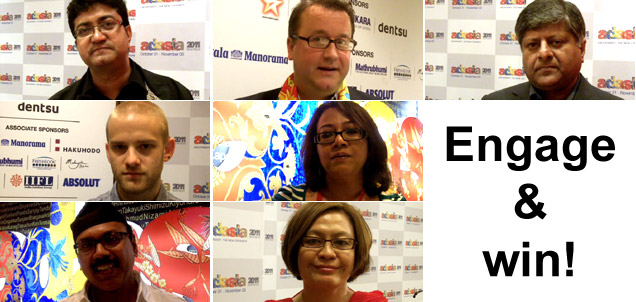
    Were expectations met? Did this AdAsia wash away the Jaipur 2003 memories? Did the Dilli chaat and the manganiyas charm the foreign delegates enough? Could it have been better? For answers to all of the above and more, MxM India caught up with some AdAsia veterans as well as first-timers on the last day of the congress.


    It was an experience to remember for quite a few, especially for the strong line-up of speakers. While first-timer Anita Nayyar, CEO-India & South Asia, Havas Media, was impressed with the creative line-up of speakers and topics, for Alok Agarwal, COO, Cheil Worldwide, India, some great content came from the non-advertising lot. He said, “…the presentations made by the non-advertising people were far fresher in their thinking…”

    Looking at the line-up, a few turned up at the congress in the hope of interacting with the industry icons. But the format of the sessions didn’t leave too much room for interaction. Coming from Pakistan, Mehwish Rafi, Chief Strategy Officer, Adcom Pvt Ltd, had a different picture in mind before she attended the sessions. But nevertheless, the sheer association with the ‘AdAsia family’ as she calls it, made it a great experience for all the 90 delegates from Pakistan.

    AdAsia loyalist, Raymond So, CEO, Mastershub, also came with huge expectations which he admitted were almost met but for the cultural experience. Recalling his grand Jaipur experience, he said, “…Jaipur had given me an excellent experience, the cultural exposure was great…and this time because of the hotel arrangement, it wasn’t as impressive as the previous AdAsia.”

    Sonal Dabral, Creative Head Asia & Chairman Bates 141 India, like most others was impressed with the content coming out of AdAsia 2011 but sharing his experience from Cannes, he gave some interesting feedback on how the content could have been showcased better. Stressing on the keyword of the trade, ‘advertising’, he said, “…I don’t think the separate seminars that happened were properly advertised… if we are in the business of building expectations, of teasing people, to creating desire about a product, I think that should have been done for each of the seminars.”

    For Chris Thomas, Chairman and CEO of BBDO in Asia, Middle East & Africa, the biggest takeaway from the conference was the vibrancy in the industry in Asia. Referring to the great work and conversations shared through the three-day congress, he said, “…there is absolutely a passion for the work, there is a sense of creativity and new techniques to be applied, and I think Asia is demonstrating its vibrancy and its importance on the world stage, and particularly in India.”

    Paresh Nath, Owner, Delhi Press, admitted to have had a great time at AdAsia 2011 as well. He said that the conversations were not just about advertising but about “communication” which happens to be an integral part of publishing.

  • Ad Asia: Acts, not Ads

    By Akash Raha

    Times have changed and with that has changed strategies of communication from brand to consumers. For much of its history, the art of advertising revolved around the creation of the ad: an expertly crafted message conveyed through traditional media and consumed by end audiences. But the audiences today have changed, they way the consume media today has changed. Audiences today consume several media forms at the same time, and to get a message across to them now is a difficult task.

    Digital and social media have upended the erstwhile models of communication. Marketing messages are now more visceral and participatory. In this era, consumers themselves can play the critical role in conveying the brand promise while energizing others to greater levels of awareness, empowerment and inspired action.

    Chris Thomas, Chairman and CEO of BBDO in Asia, Middle East and Africa & Chairman of Proximity Worldwide and Simon Bond, Chief Marketing Officer, BBDO/Proximity Worldwide in the session titles ‘Acts; Not Ads’ at AdAsia 2011 showed how ads are no longer enough. This session, deconstructed how, in today’s multidimensional media landscape, advertising messages are evolving into true social movements and acts that can affect and drive positive change. There are some old certainties which still remain certain and yet there are things that have changed forever.

    Mr Thomas said that there is a lot of uncertainty led through the forces of globalization the forces of urbanization. However, what really brings about this uncertainty is change. Giving examples from their life, both the members showed how their lives spent a decade apart had so many changes… from vinyl records to iPods, from friends on Penthouse to those on Facebook etc. These changes that we have seen in technology, has happened quicker and faster. And now, we see how information is dispensed quicker and faster in unimaginable volumes. Like a decade or two back, our values and creativity is no longer shared by two or three people but rather millions of people on digital and social media space. To emphasize this dynamic change further, Mr Bond said, “People will look back at today like they did the Industrial Revolution. It is a fundamentally changed world.”

    The panelists of the discussion gave several examples to drive home their point. The first such example was that of Yellow Pages, with an age old advertisement and with a current one. The point that they were trying to emphasize was that earlier engaging with consumers was easy as there was less interference. But today we are living in a interconnected word and customers want to interact and converse with the brand. The need is to engage with the consumers, hence, what is needed today is acts and not ads.

    A recent Yellow Pages advertisement innovated to show the efficacy of yellow pages, and an act was created, where the consumers could participate and feel one with the brand. It shows the effectiveness of advertising in the yellow pages. The implication is that the company is the same as it used to be, the customers are the same as they used to be, but the times have changed drastically. Hence, one needs to engage and innovate. Today, the consumer is in control and is in a state of absolute power. Word of mouth, trust is one of the most important things for the customers today.

    For advertisers, the essence is to create compelling content and yet, it remains important to have a clear purpose behind it. The type of communication that we are doing today is just based on the fact as how consumers react. How people buy what they buy. With modern scientific techniques one can perhaps understand this a little better now; how they buy, what they buy, but the essence to understand is why the buy. People buy not what you do, but why you do it?

    Talking about Apple as a brand and Steve Jobs the panelists stressed on how they have unleashed the power of creativity. Similarly, Starbucks too went on to say “We don’t fill bellies, we fill souls” as their campaign went from using paper cups to reusable mugs. In a new data driven world, never has creativity been more important. We know more about the consumers than ever before. But there is a danger since there is so much of information and we have to differentiate between accountability and effectiveness. We must not spend much all our attention on things that we can easily calculated and can be accounted for. The primary driver should be effectiveness… It is a little hard to predict and a little hard to account for yet it remains superior.

    Furthermore, the panel gave examples of how successful acts were created by Aviva Life Insurance and Gillette through their campaign on ‘donate books’ and ‘women against dirty stubble’ respectively. Moreover, these acts generated good content too. Similarly Volkswagen created a campaign for people car in china which became immensely successful. Through several examples, the panel showed the efficacy of acts and showed how ads are no longer as compelling. What the consumers of today need is Acts, acts which they can live and be a part of.

  • AdAsia: Brand-building in a trust deficit world

    By Akash Raha

    With a plethora of brands in the market and a cacophony of declarations from each, the result is a trust famine in the mind of the consumer.

    In such a trust deficit world, the protocols of brand-building could be a lot more complex but highly rewarding. The panel members in the session named ‘Building brands in a trust deficit world’ helped navigate through the fog of distrust and threw light on a brand becomes trustworthy.

    The panel members in this session were Robin Wight, President, Engine and WCRS; Vikram Sakhuja, GroupM, Chief Executive Officer, South Asia; Michael Boneham, President & Managing Director, Ford India; Deepa Prahalad, Author & Business Strategist and Sandeep Ghosh, CEO, Bharti AXA Life Insurance. Ms Prahalad began the discussion by asking the rhetoric question, how can a brand build trust in a trust deficit world? Trust is very important and it is not dead, but fewer brands are trusted these days. Some brands are struggling to build trust not because they are not trustworthy, but because trust is so hard to gauge and build.

    Trust is not only about what is the brand giving in terms of quality of product and services but quality of a brands conduct and the causes the brand is championing. Mr Wight went on to talk about the psyche of the consumer and said that the biological purpose of a brand is to enable the consumer to make the buying decision with little mental effort. The brain really does not want to make any buying decisions all it wants to do is pass on the genes. The brain wants to do the least work it can do and hence a trustworthy brand scores over the others. If there is decline in trust, then there is a problem and the brain has to re-think about it. For example, if the brain had to think which mobile phone to take, considering the number of phones we have in the market, it will take it years to decide. Hence today, they use the web to make their mental effort easier. Engagement that a brand creates is very important, but what we need is not only engagement but peer to peer marketing which is so successful. Peer to peer marketing depends on building trust where the consumer spread the message themselves. He gave examples of the Coca-Cola advertisement where they reached out to 80 million people with no cost to the company. The message of the World Cup was spread without the company having to spend a penny and only through peer to peer marketing.

    In recent times, we have seen a downtrend in trustworthiness of several financial service institutions after premiere banks across the globe declared themselves bankrupt. The consumer can’t help but question the bubble that the bankers create. Mr Ghosh of Bharti AXA life insurance said that there is a need for financial services structures to move away to the land of promise and begin delivering. It is essential to move from mere promises to real proof, where the spectrum of financial service provide tangible proofs and demonstrate trustworthiness.  He showed examples of two of their campaigns where they gave tangible proofs to the consumers to build trust. Such strategy of proof as opposed to shinny promises can work wonders in building trust.

    Ford is another company which stands for trustworthiness and its case is no less interesting. During recession, Ford was one of the few companies that refused bail out, and such a step only build more confidence and trust in the brand. Mr Boneham  pointed out that since then they have worked very hard around that aspect and about their independence and walking alone. “We built and rebuilt our brand for what we were standing for. Under each of these we focused on what we could do to separate ourselves from others… A few things we then focused on was quality, green, safe and smart.” The company devoted a huge amount of time with the consumers to understanding their needs and what they wanted. And it is from this that they improved on the product and built up the trust quotient. We use consumers to build experience. Even in our ads we have consumers speaking rather than celebrities. We have focused on consumers talking to consumers.

    Mr Sakhuja of Group M was the last to speak and said that the point in context is “Building trust in an attention deficit world rather than trust deficit world.” Commitment levels per se (of the consumers) are not really high rather, it is quite low. The consumers don’t give the trust away easy, but when they do, they stay with it… they are not as fickle minded as several marketers are. But there is the psychological equity to it. The question is that, are people sure about what their brand gene pool is? People are not building enough of core psychological brand equity. He gave the example of Nokia, which according to surveys still ranks high on the trust quotient even though their market share has dropped significantly. The entry barrier for phones has suddenly become low owing to the several new players that have come into the market, so people are experimenting. Yet there is the latent psychological equity to buy Nokia.

    It is also essential for brands to have consistency in the messaging over time and across all touch point to create trust. The key is to keep the old and add the new… In the urge of doing new one should not discard the old value systems for the new. Moreover, for brands to be trustworthy, they have to be modest, even when they are doing very well because one never know when the next problem is coming from. “There are no secrets anymore… Don’t talk down to the customers,” said Mr Sakhuja.

  • AdAsia: India gets Contagious

    By Our Correspondents


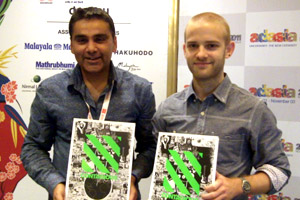
    Neeraj Nayar, President, Contagious India on launching Contagious in India
    [youtube width=”300″ height=”200″]http://www.youtube.com/watch?v=dsIx5Aahgck[/youtube]
    Neeraj Nayar on the revenue model for Contagious India
    [youtube width=”300″ height=”200″]http://www.youtube.com/watch?v=B9UkmQn_sAU[/youtube]
    Neeraj Nayar, President, Contagious India says he’s confident of the product he has to offer
    [youtube width=”300″ height=”200″]http://www.youtube.com/watch?v=MRmTbSlUYPY[/youtube]

    Contagious Communications, a complete intelligence resource, was officially launched in India on Day 2 of AdAsia 2011 in New Delhi. Neeraj Nayar, President of Contagious India, will oversee the India operations along with Will Sansom, Writer and Consultant for Contagious. As part of the launch, Contagious will bring in its much acclaimed Contagious magazine – seen as the Bible among many in the industry – and will also include in the portfolio an online feed, trend briefings and Consultancy and Special Reports.


    Talking about the launch of Contagious in India, Mr Nayar said, “There is some great ideas coming out from India and I think its important to be here and closer to the market.” The magazine which is available only for subscription will cost around 1000 pounds for a year (the magazine comes out quarterly). The pricing does not deter its promoters as Sansom pointed that it’s a niche product and very high in its content quality. There are also different packages for those who are interested in getting the maximum out of Contagious.


    Contagious was launched in 2004 to explore the relationship between brands and consumers, to predict the impact of new technologies and to make sense of the fragmenting media landscape. The magazine comes with a DVD showcasing over 100 pieces of creative work per issue.

  • AdAsia | Day 2 – Exec Summary: Food for thought, and plenty

    By Tuhina Anand

    Conversation, exchange of ideas, networking and business as usual was the order of the day at AdAsia. Day 2 of Congress at AdAsia 2011 started with a session by Frederika Meijer, Representative UNPF, India and Country Director UNFPA, Bhutan. The session was on `The Female Equation: Communicating with conscience. The session was an attempt to bring to attention, provoke debate, and challenge the minds present to think of providing creative solutions to one of the critical issue on ‘The girl child’.

    The next session on Marketing 3.0-New Rules of Engagement was an interesting session where Joseph Tripodi, Executive Vice President and Chief Marketing and Commercial Officer, The Coca Cola Company discussed how marketing is dead and engagement is in. He talked about balancing the notion of Brand Love and Brand Value. As consumer engagement is rapidly changing he pointed that the challenge is to navigate in this new universe. He talked about the `Liquid and Linked’ philosophy that the company embarked on last year. It’s this philosophy which has helped in creating the FIFA World Cup campaign celebration campaign. Tripodi introduced the newly launched campaign on Arctic Home that Coca Cola has taken to give homes to polar bears. Then he gave a peek into what the company has planned for London Olympics 2012 which again is truly a Liquid and Linked philosophy. It’s basically about unlocking the social side of Olympic and dubbed it as `integrated and ambitious’ plan. Prasoon Joshi, Chairman and CEO, McCann Worldgroup India and ECD McCann Erickson was the session anchor who threw some tricky questions to Tripodi who answered them all with ease.

    There is business uncertainty, market uncertainty and media uncertainty and that’s what the next session delved on. Kelly Clark, Worldwide CEO, Maxus, Mainardo De Nardis, CEO, OMD Worldwide discussed Media Fragmentation: How to navigate through traffic? The session was moderated by Bob O’Leary, MD, Head of Global Marketing, Consumer, Citi. The panel discussed the explosion of media in the market along with changing human behaviour and the need to find a way through this. Mainardo about the changing Asian market where the role has reversed and other countries are borrowing from best practices from Asia while the scenario was completely different few years ago.

    It was a change to see finally young blood take to stage with the next session on `Ideas that are Contagious’ by Will Sansom, Writer and Consultant, Contagious Communications. HE showed works that were truly innovative uncovering new opportunities and collaborative cultures. An interesting example was that of luxury brand Burberry which used Tweetwalk to engage consumers while managing to retain the exclusivity that only front row gets during its fashion show. Through the use of social media it engaged people to follow the brand online by putting a shot of model just before the walk thus getting its fans to follow the brand online and not disturbing the dynamics offline.

    There was also a session by TED/INK-The New Age of Advertising. Lakshmi Pratury, Host, The INK and Ronda Carnegie, Head of Global Partnerships, TED talked about the movement that provokes people to think and challenge the consumer consciousness.

    Times have change and with that has changed strategies of communication from brand to consumers. For much of its history, the art of advertising revolved around the creation of the ad: an expertly crafted message conveyed through traditional media and consumed by end audiences. But the audiences today have changed, they way the consume media today has changed. The session ‘Acts. Not ads’ deconstructed how, in today’s multidimensional media landscape, advertising messages are evolving into true social movements and acts that can affect and drive positive change. The panelists gave several examples to drive home their point of how acts are much more efficacious as compared to merely advertising. Today, the consumer wants to be a part of an ad and engage with the brand, making it an act.

    There are several brands in the market and with the cacophony emanating from brand declarations, trying to out-shine other brands, results in only a ‘trust-famine’ in the mind of the consumer. Trust becomes very important and that is what the session in adasia discussed ‘Building brands in a trust deficit world’. For the panelists, the essence of building trust was to talk and engage customer and be ethical and responsible as a brand. Consumers like to associate themselves with responsible brands. The latent psychological element of how people buy things at the first place is also important. It is essential for brands to have consistency in the messaging over time and across all touch point to create trust. The key is to keep the old and add the new… In the urge of doing new one should not discard the old value systems for the new. Moreover, for brands to be trustworthy, they have to be modest, even when they are doing very well because one never knows where the next problem is coming from.

  • AdAsia: Experiencing India

    By Tuhina Anand

    AdAsia 2011 has seen more than 1000 delegates registered from 25 different countries. While Indian delegates lead the pack as it’s the host country, there are also many delegates from different other parts of the world including UAE, Pakistan, Vietnam, Japan and Indonesia among others. At the venue of AdAsia one can see these delegates soaking in the Indian culture and cuisine and also attending the various sessions that comprise stalwarts from the industry from across the world sharing their insights with the audience. For some, travelling thousands of miles is standard networking practice, for others it’s a chance to know what is happening in the other parts of the world, learn from them and apply some of the discussed pointers back home.

    Anis Khan, the MD of Leo Burnett in Karachi, Pakistan says his reason for being at AdAsia is to get an opportunity to listen to his colleagues from across the world and pick up new learnings from their sessions and interaction with people. He said, “After the downturn in 2008, AdEx across the world has dipped though many countries have bounced back. I am specifically looking at understanding how different industry people from various countries have been combating this challenge. Also I would like to learn more on the alternate and digital media and I think the AdAsia platform will help me in this.”

    Chris Thomas, Chairman and CEO of BBDO Asia, Middle East & Africa, Chairman of Proximity Worldwide is in India as a speaker for one of the sessions. But besides that he is upbeat about the vibrancy and scale of discussions. He said, “The theme this year is interesting and content built around the various subjects around the theme is good learning. We do get an India perspective but also getting international and an external perspective to the theme. It gives us an idea how alive and kicking the industry is in Asia and particularly in India.”

    Then there are those like Keith Thomson, International Business Development Director, BlackLite Media FZ-LLC, an outdoor agency in UAE for whom the platform is a good opportunity to connect with people beyond UAE. He said, “While Arabic population is aware of BlackLite but I am looking at acquainting people with what we do beyond this geography and also people who are already spending in this market to connect with them and persuade them to allocate additional sum and look at our medium.” But Thomson says that the networking bit is bit restricted as he doesn’t know too many people here and will use the list provided by AdAsia to connect with delegates later on their emails. He says, “It’s work in progress.”

    Trung of Vietnam is at AdAsia with a group of 30 people from his country. His motive is to study and experience AdAsia and be ready when their country hosts AdAsia in Vietnam in 2013. He has one grouse though, that in his group, especially people in a slightly older age category, are not enjoying the lavish spreads laid out for the guests. There should be food that would appeal to their palate, he feels, as not everyone enjoys Indian food.

    Food is not a problem for Jerry S Justianto, Director, Masima (contents + channels) which runs a number of radio channels in Indonesia. It’s his first visit to India and he is enjoying the food to the hilt, “especially the dessert”.  He also finds a common link between middle-class Indonesia and India which he feels enjoy similar kinds of popular culture.

    The delegates have enjoyed the gala extravaganza and have talked about it with appreciation. But it’s not all work and no play – some have even managed a bit of tourism.  Yukinori Sasaki, Deputy Director, External Relations Office, Dentsu Inc, said, “Its my second visit to Delhi. I was expecting to meet lot of people and not just from advertising industry. I have managed that, but I didn’t get to meet many advertisers.” However, Sasaki has other plans on his itinerary which includes a visit to the Taj Mahal in Agra.

    Some delegates also shared what AdAsia should do differently next year. Mehwish Rafi, Chief Strategy Officer, Adcom from Karachi, said, “As far as knowledge, case studies and information goes, we have had a lot of it. But the sessions should have been more interactive. Even if there was an option of receiving questions online beforehand and then addressing those during the session, it would have made so much sense.” This definitely should be noted especially when one is talking about listening to consumers and how digital should be used, perhaps the industry should start practicing what it preaches.

  • Video Report: The new rules of engagement


    By Shruti Pushkarna

    [youtube width=”350″ height=”200″]http://www.youtube.com/watch?v=iQBVjzNGF9I[/youtube]

    Amid discussions at one of the biggest marketing, media and advertising meets, or AdAsia as we call it, one common thread to many a conversations was the changing reality of advertising from the consumer’s perspective. Several members of the fraternity expressed concern over the pressing need to ‘engage consumers’ in a fast changing world. MxM India caught up with a few to find out what really are the new rules of engagement.

    Keeping up with new technology and being able to deliver a digitally enhanced experience to the consumer is a growing area of focus but the underlying idea echoes the same old principle, ‘reaching out’ to the consumer.

    Prasoon Joshi, Chairman & CEO McCann Worldgroup India, Executive Creative Director of the Asia Pacific region and Chairperson, McCann Global Creative council said, “There are no new rules…it’s just that there is a new reality out there. You have to be able to understand the lives of consumers…I think if you are connected with your market, then rules or whatever you call them, will come naturally to you.”

    Furthering Mr Joshi’s view, Kelly Clark, CEO, Maxus Worldwide said that the new rules of engagement are the old rules of engagement and we have to start out by understanding customers’ relationships with brands.

    Shashi Sinha, CEO, Lodestar UM said that engagement has to come from a sum total of different activities, but foremost you need to know what the customer really likes and will participate in. Josy Paul, Chairman and CCO, BBDO India made an interesting point, saying that understanding the new rules of engagement starts from knowing that advertising might not be the only solution. Emphasizing on a collaborative model between advertisers, regional partners, PR partners and activation partners, Mr Paul said, “…it’s really about shedding your sense of the past and forgetting whatever you knew before but using your experience to assimilate and synthesize the new world.”

    Three rules of engagement recommended by Contagious Communications Consultant, Will Sansom are transparency, experience and meeting an unmet need. He said, “…First and foremost be honest…second rule is use emerging technology…and third is about identifying an unmet need and then meeting it.”

    Kitty Lun Chan, Chairman/CEO, Lowe China said that we live in exciting times where internet has revolutionized everything, and in this ‘socially-networked’ world, everyday new forms and new approaches of engagement are being created.

    Keeping it to the basics, Basabdatta Choudhary, CEO, Platinum Media underlined “relevance” as one of the constant rules of engagement in these changing times.

  • AdAsia: Change, the only constant


    By Shruti Pushkarna and Tuhina Anand

    [youtube width=”400″ height=”300″]http://www.youtube.com/watch?v=VswkUKXre-I[/youtube]


    The AdAsia 2011 conference opened to a jam-packed hall at the Taj Palace yesterday in New Delhi. Welcoming over 1200 delegates, Minister for Information and Broadcasting Ms Ambika Soni said who else but the government of India could understand the theme of this conference better, for which “uncertainty is truly the only certainty”. Going further with the Minister’s perception of change being the only constant, MxM India’s Shruti Pushkarna and Tuhina Anand caught up with a few delegates to see what ‘Uncertainty: The New Certainty’, the theme of this edition of AdAsia meant for them and their respective businesses.

    Through the sessions, speakers and delegates seemed to be in general agreement on how the world is changing rapidly, especially in terms of technological advancements, and it is the pace at which one adapts to this change that will determine how successful or unsuccessful one is.


    Michael Roth, Chairman and CEO, Interpublic

    Michael Roth, Chairman and CEO, Interpublic said that the focus is on change, and with the global economy changing, the highlight of this conference is the need to stay ahead of the curve in terms of new technology and new economies. While Piyush Pandey, Executive Chairman & Creative Director, South Asia Ogilvy & Mather also agreed that the focus of the theme is about keeping our minds open to change, he added, “It does not mean that you have to change tomorrow morning… but prepare yourself for the change, if you are not ready for it, you will get left behind.”


    Tom Doctoroff, JWT North Asia Area Director Greater China, CEO


    Tom Doctoroff, JWT North Asia Area Director Greater China, CEO, however also put some stress on consistency. He said while the theme of the conference might be provocative, we have to acknowledge that which remains timelessly true, like robust brand equity and big brand ideas.


    Vikram Sakhuja, CEO, GroupM South Asia

    Vikram Sakhuja, CEO, GroupM South Asia put it in simple terms, saying, “Uncertainty is the new certainty in the context of marketing primarily because communication to consumers has moved from a sequential, controlled, advertiser talking to consumer, to much more devolved, fluid and instant conversation with a consumer”.


    Ravi Deshpande, Chairman and CCO, Contract Advertising

    Talking about the correlation that the politico-social world shares with the sentiment or the idea of a brand in a consumer’s mind, Ravi Deshpande, Chairman and CCO, Contract Advertising said, “…You are bound to have an impact on marketing or advertising when the world around us keeps changing… if the world is uncertain, so are we in our business.”