Category: Uncategorized

  • 1 Minute View: Educational Shops UnLtd

    It is not surprising that advertisements inserted by educational institutions lead in the list of misleading ads by ad self-regulator Advertising Standards Council of India (ASCI). The ASCI’s Consumer Complainst Council upheld complaints against 123 ads and a shocking 56 percent of these were from the education sector.

    Note: 70 of 123 education ads were misleading. This was for the month of May 2012, the peak season for education in all parts of the country.

    The reason why these are on expected lines is because for too long we have seen fly-by-night operators proliferating in this sector and even some of the genuine ones slip in a tall claim to push their business.

    While we are not grudging the entrepreneurs returns on their investment, what’s definitely not on is taking people for a ride. There are thousands who put in all their savings for their admission of their children, only to learn that they’ve been conned.

    One of the reasons why many of these institutions are able to get away with their questionable practices is that many in our news media turn a blind eye towards them. Since the education shops are heavy advertisers, the papers and channels do not want to displease them and lose revenue.

    Time for soul-searching somewhere?


  • It’s a done deal. Omnicom & Publicis to merge


    By A Correspondent


    The Omnicom Group Inc and Publicis Groupe SA announced on Sunday evening India time that they  have signed a definitive agreement for a merger of equals, creating the world’s leading company in communications, advertising, marketing and digital services, with combined 2012 revenue of $22.7 billion / €17.7 billion. Based on closing prices on July 26, 2013, Publicis Omnicom Group will have a combined equity market  capitalization of approximately $35.1 billion / €26.5 billion.


    The merged group of more than 130,000 employees will be exceptionally well positioned to serve clients’ evolving needs, helping them to build their brands and grow their businesses in the  rapidly changing communications landscape, notes a communiqué.


    The combination, which has been unanimously approved by the Boards of Directors of both companies, brings together leading agency brands as BBDO, Saatchi & Saatchi, DDB, Leo Burnett, TBWA, Razorfish, Publicis Worldwide, Fleishman Hillard, DigitasLBi, Ketchum, StarcomMediaVest, OMD, BBH, Interbrand, MSLGROUP, RAPP, Publicis Healthcare Communications Group (PHCG), Proximity, Rosetta, CDM, ZenithOptimedia and Goodby, Silverstein & Partners amongst others.


    Said Maurice Lévy, Chairman and CEO of Publicis Groupe, said: “The communication and marketing landscape has undergone dramatic changes in recent years including the exponential development of new media giants, the explosion of Big Data, blurring of the roles of all players and profound changes in consumer behaviour. This evolution has created both great challenges and tremendous opportunities for clients. John and I have conceived this merger to benefit our clients by bringing together the most comprehensive offering of analogue and digital services. Equally important, it will offer our talented people new avenues for growth and success at the crossroads of strategic intelligence, creativity, science and technology.”


    And this is what John Wren, CEO of Omnicom, said: “Both Maurice and I believe this new company reflects our vision of  retaining the best talent, attracting an incredible roster of clients and leading innovation. Omnicom and Publicis Groupe are reshaping the industry by setting a new standard for supporting clients with integrated messaging across marketing disciplines and geographies. This combination will enable us to leverage the skills of our exceptionally talented people,our broad product offering, enhanced global footprint, and tremendous roster of global and local clients. In short, we believe this is a merger that will set our new company on a path to accelerated growth, with long-term benefits for clients, employees and shareholders.”


    Messrs Wren and Lévy said jointly: “For many years, we have had great respect for one another as well as for the companies we each lead. This respect has grown in the past few months as we have worked to make this combination a reality. We look forward to co-leading the combined company and are excited about what our people can achieve together for our clients and our shareholders.”


    Publicis Omnicom Group has been structured with balanced corporate governance consistent with the spirit  of a merger of equals. Publicis Groupe and Omnicom’s CEOs will lead the company as co-CEOs through an  initial integration and development period of 30 months, following which Mr. Lévy will become non-executive Chairman and Mr. Wren will continue as CEO. The company will have a single-tier board with 16 members, consisting of the two co-CEOs and seven non-executive directors from each company.


    For the first year following the closing of the transaction, Bruce Crawford, currently Omnicom Chairman, will be the non-executive Chairman of Publicis Omnicom Group. He will be succeeded by the current Publicis Groupe Chairperson, Elisabeth Badinter, as non-executive Chairperson for the second year following the closing of the transaction.


    According to the communiqué, the future scalability and internal synergies of the combined company are expected to generate efficiencies of $500 million / €377 million. The transaction is a cross-border merger of equals under a holding company, Publicis Omnicom Group, in The Netherlands. The Group’s operational head offices will continue to be based in Paris and New York.


    The transaction is subject to approval by the shareholders of both companies as well as numerous  regulatory approvals. It is expected to close in the fourth quarter of 2013 or the first quarter of 2014.


  • News & FM to finally get 49% FDI?


    The Ministry of Information and Broadcasting (MIB) asked the TRAI to re-examine the current limits or caps with the objective of easing foreign direct investment flows. The MIB asked the Authority to examine the FDI limits of various segments in the broadcasting sector and to furnish its recommendations.


    Accordingly, a consultation paper containing a draft proposal has been issued and comments have been elicited to reach the TRAI by Monday, August 12.


    Here are excerpts from the consultation paper:

    Foreign Direct Investments (FDI) in Broadcasting Sector in India

    Background:

    1. The Ministry of Information and Broadcasting (MIB) has sent a reference to the Authority dated 12th July 2013, indicating that the Government is re-examining the current FDI policy and liberalising the limits/caps with a view to easing FDI inflow. In this context MIB has requested the Authority to examine the FDI limits of various segments in the broadcasting sector and to furnish its recommendations.


    2. The Authority has been entrusted with the task of regulating the broadcasting sector in January 2004. Since then, the Authority has in August, 2004, September 2005, March 2006, and October 2007 given its recommendations, suo motu, on the subject of FDI in the broadcasting sector.


    3. On December 11, 2007, the MIB sought a comprehensive set of recommendations from the Authority on FDI in the different segments of the broadcasting sector. The Authority gave its recommendations on 26th April 2008. In 2009, Department of Industrial Policy and Promotion (DIPP) modified the methodology of assessment of foreign investment in Indian companies vide its Press Note Nos. 2 and 4 of 2009. In view of this, the MIB on September 30, 2009 once again made a reference to TRAI to revisit the recommendations on FDI in the broadcasting sector. The Authority gave its recommendations on 30th June 2010. Based on the views expressed by the Government, these recommendations were partially revised on 3rd June 2011. In line with the last recommendations of TRAI, the FDI limits and approval route for various segments of the broadcasting sector were revised by the Government on 20th September 2012. These may be seen at Annexure I.


    Approach adopted:

    4. In the context of the present liberalised global economic environment where economies of different countries are closely inter-linked and inter-dependent, foreign investments have a vital role to play. Foreign direct investment is not just a large and growing source of equity investment for developing economies, it also brings with it considerable benefits through transfer of technology, strengthening infrastructure, raising productivity, enhancing competitiveness of the domestic economy and generating new employment opportunities.


    5. The Authority, while making recommendations on the subject of FDI in broadcasting, recognising the growing convergence between the broadcasting and telecom sectors, has been broadly guided by the principles of ensuring a level-playing field between competing technologies and maintaining consistency in policy across sectors.


    6. Broadcasting services can be broadly grouped into carriage services and content services. Carriage services essentially provide the medium for carriage of content/ information. This category broadly refers to cable TV services, DTH services, terrestrial TV services, Headend in the Sky (HITS) services, mobile TV services, IPTV services and teleport services. Technically, it is possible for cable TV networks to also provide voice telephony and broadband. Similarly, the modern telecommunications networks are capable of triple play, i.e. offering voice, video and data services; the terms and conditions of the Unified Access Service License (UASL) agreement as well as of the Cellular Mobile Telephone Service (CMTS) license agreement permit the provision of such services. Due to convergence of telecom and broadcasting technologies, telecom as well as broadcasting networks can be used to provide broadcasting carriage services.


    7. Content services pertain to creation and packaging of content. Broadcasters fall in the category of content service providers. A TV broadcaster is primarily a provider of content and this content is delivered to the end user by a carriage service provider. On the other hand, FM radio services combine both content and carriage services as these service providers create their own content and also deliver the same to the listeners directly.


    8. In short, carriage services are in the nature of infrastructural services. They provide the pipes through which content service providers deliver content to end-users. Some content, especially news and current affairs, can be intrinsically sensitive in nature as it can influence public opinion which in turn could have a bearing on the maintenance of public order, security of the State, and maintenance of communal harmony. Content services that provide such content may, therefore, require differential treatment in the matter of consideration of FDI limits and approval routes for investment.


    FDI limits in carriage services:

    9. Currently, the FDI limit in carriage services is 74%, of which 49% is permissible through the automatic route. Any FDI beyond 49% has to go through the FIPB route. The same FDI limits and approval route were prescribed for broadcast carriage services and telecom services on the ground that both are infrastructural services akin to each other and there is a growing convergence between the broadcasting and telecom infrastructures.


    10. The Government is contemplating enhancement in the FDI limit for telecom services to 100% with FDI up to 49% through the automatic route and FDI beyond 49% through FIPB. Carrying the same logic forward, and keeping in mind the fact that the ongoing digitisation of the cable TV services in the country would give a big impetus to the convergence of the broadcasting and telecom infrastructures, the same limits and route ought to be made applicable to the carriage services in the broadcasting sector.


    FDI limits in content services:

    11. Content services in the television sector are delivered to a consumer in the following manner. First, the content is uplinked to a satellite by the broadcasters; subsequently, it is downlinked and distributed by the carriage service providers. Whereas downlinking has to be done within the country, uplinking can be either from within the country or abroad. Content can be broadly classified into two categories: news related and non-news related.


    12. For downlinking of channels, no distinction has been made between the two categories while prescribing the FDI limits. This is because the ingredients of content can only be controlled at the uplinking end. Hence, 100% FDI is allowed in downlinking of channels in India. However, FIPB approval is required. Further, in case of channels uplinked from a foreign land, additional conditions have been mandated for permitting downlinking in the Policy Guidelines for downlinking of Television Channels dated 11th Nov. 2005. These are as below:


    2.4 No News and Current Affairs channel shall be permitted to be downlinked if it does not meet the following additional conditions:

    2.4.1 That it does not carry any advertisements aimed at Indian viewers;

    2.4.2 That it is not designed specifically for Indian audiences;

    2.4.3 That it is a standard international channel;

    2.4.4 That it has been permitted to be telecast in the country of its uplinking by the regulatory authority of that country;

    Provided that the Government may waive/modify the condition under clause 2.4.1 on a case-by-case basis.

    2.5 For the purposes of these guidelines any channel, which has any element of news or current affairs in its programme content, will be deemed to be a news and current affairs channel.


    13. While granting permissions for uplinking of channels from within the country as well as for downlinking of all channels uplinked from within the country or abroad, MIB takes security clearance from MHA. Since content can be sensitive in nature, it is appropriate to have checks and balances at different stages viz. to screen for any potential hazard from a national perspective. In view of these considerations, the status quo ought to be maintained regarding the route for approval of any FDI.


    14. For uplinking of TV channels of the non-news and current affairs category, 100% FDI is permitted through the FIPB route. The status quo may continue.


    15. For uplinking of TV channels of news and current affairs category, the existing FDI limit is 26% through the FIPB route. An increase in the FDI limit for news & current affairs channels will enable access to more resources for these channels at competitive rates. These resources can be applied for upgrading news gathering infrastructure and quality of presentation. It could also reduce the dependence of TV channels on advertisement revenue.


    16. Therefore, the FDI limit for news & current affairs channels in the uplinking guidelines may be increased from 26% to 49% through the FIPB route.


    17. There are existing provisions in the uplinking guidelines to safeguard management and editorial control in news creation. These include: i) requirement to employ resident Indians in key positions (CEO of the applicant company, 3/4th of the Directors on the Board of Directors, all key executives and editorial staff), ii) the largest Indian shareholder should hold at least 51% of the total equity, iii) reporting requirements when any person who is not a resident Indian is employed/ engaged etc. If the FDI limit in uplinking of TV channels of the news and current affairs category is enhanced to 49%, then as per provision at ii) above the remaining Indian shareholding (51%) would have to be with a single Indian shareholder. The more general issue, on which stakeholders may wish to make suggestions, is whether or not any changes are at all required in these conditions. In fact, a better way to ensure that content deemed undesirable or subversive in nature is not broadcast through TV channels is by having proper content monitoring and regulation through a content code, instead of using FDI limits as the tool for this purpose.


    FDI limits in FM Radio:

    18. The Government has announced the Phase III of expansion of FM radio. In this phase it is envisaged that 839 new private FM radio stations will come up, expanding the coverage of private FM radio stations from 87 cities to 313 cities. The auction of frequencies for FM radio is likely to be taken up by the Government shortly. Easy availability of capital to operators through multiple sources at competitive rates would ensure better participation in the auction by the operators.


    19. The phase III policy also expands the sphere of activities that can be taken up by the FM radio operators. These include carriage of information pertaining to sporting events, live commentaries of sporting events of a local nature, traffic and weather, cultural events and festivals, examinations, results, admissions, career counselling and employment opportunities, public announcements pertaining to civic amenities like electricity, water supply, natural calamities, health alerts as provided by the local administration etc. For building up of infrastructure for such services, additional investments will be required.


    20. Keeping in view all these aspects, the FDI limits may be enhanced from 26% to 49% through FIPB route for the FM radio sector. In the past, FDI limits for FM radio have been fixed on the same lines as that for TV news channels, on the rationale that FM radio and news and current affairs channels are of a similar nature from the sensitivity point of view. Enhancing the limit to 49% through the FIPB route will also ensure that the FDI policy for FM radio will remain aligned to the FDI policy for uplinking of the news and current affairs channels, which is also being considered for enhancement to 49% through the FIPB route.


    21. The Phase III policy of the Government for FM Radio also prescribes a similar condition for safeguard of managerial control of radio channels as in the guidelines for uplinking of news and current affairs channels described in para 17 above. If the FDI limit for FM radio is enhanced to 49%, then, as in the case of news and current affairs channels, the remaining Indian shareholding (51%) has to be with a single Indian shareholder. Stakeholders may wish to make suggestions, about whether or not any changes are required in these conditions.



  • How the media agency networks stack up post Publicis-Omincom merger as per RECMA


    By A Correspondent


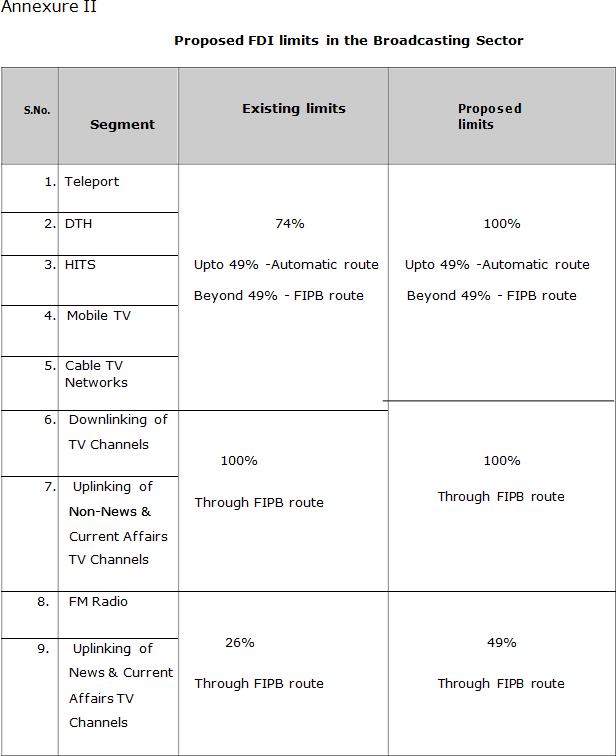
    Leading media agency research firm RECMA has released its Global Ranking 2012. While India-specific numbers are important, in a globalised order, the overall numbers are also noteworthy.


    A little background: since 1999, RECMA has been publishing annually the Global Billings Rankings report standing as the flagship report for the media agency industry. All major advertisers (media / procurement managers), consultants or media agencies use the global, regional or country rankings in their day-to-day business activities.


    This research is based on two metrics:

    1- the measurement of the buying billings based on the compilation of agency client lists with adjusted ad monitored spending allocated to each account

    2- the evaluation of non-measured media spending (or diversified services): a growing field which includes multiple areas from search to marketing strategy consulting.


    Five years ago, the sum of buying billings + specialized services (including digital) got RECMA to produce a new ranking based on the “Overall Activity” volumes. Hence, from now on, the report will be entitled “Overall Activity” – the term Billings (referring to buying media) being dropped.


    Notes a mail from the Paris-based founder Eudes Delafon and Olivier Gauthier, Partner, Director of Research and Sales Development Director: “Among the several improvements of this research, we paid a careful attention to the growth rates y-o-y to adjust the estimated Overall Activity volumes. This new point of analysis is now used as one of the 20 criteria in RECMA Qualitative Evaluations by country – a key benchmark for all industry professionals.


    Following the release of this report, we are updating the 50 country Qualitative Evaluations, starting with the Top 14 countries (to be available by the end of August). Details about the breakdown between buying Billings and Digital / Diversified services are not contained in this report. The Domestic reports as well as the Specialized Resources global report will provide data and analysis on this point.


    In the wake of the announcement that Publicis and Omnicom are merging, Recma has release a second table showing “how this historical deal overturns the hierarchy of the Groups of media networks”. Given the interest in the information, we place this table first.


    Industry shares 2012 in 6 regions
    following the creation of Publicis Omnicom group


    The Industry shares are calculated on the basis of the media agency Industry measured by RECMA.

    RECMA estimates Overall activity figure consisting in the aggregation of: buying billings (measured media spending) + non-measured spending (Digital & Diversified service).

    COMMENTS

    In Asia Pacific and in Others EMEA, the media arms of Publicis Omnicom group and WPP would hold a similar share.

    In Americas, Publicis Omnicom group would become a strong leader with a projected industry share of 41.6% versus 21.7% for WPP/GroupM.

    GroupM would remain the No 1 group in the Top 5 Europe markets, staying ahead of POG by four points.

    Finally, in the 14 countries (representing 75% of the media industry worldwide) the new POG media entity would weigh 36.8% of the industry against 27.1% for WPP/ GroupM: a 10-point gap.

    The three other groups, Dentsu Aegis Network, IPG/ Mediabrans and Havas Media-clearly stand a step behind.


    OVERALL ACTIVITY [BILLINGS] 2012 – Edition 13

    GLOBAL RANKING 2012 BY NETWORK


  • Star Plus leads Week 30 TVTs, Colors #2

    By A Correspondent


    The  viewership numbers from TAM now look larger because they are in thousands. But a few weeks of TVT-gazing should give you in sync with the new measurement order. Note: the information given is from TAM, but it is not supplied to MxMIndia by TAM but by one of the subscribers of the TAM numbers.  While all attempts have been taken to ensure these are reliable, MxMIndia urges readers to verify the numbers before firming their opinions on channels/programming or buying decisions. Figures in bracket indicate numbers for Week 29 of 2013.


    Star Plus 473998 (494326)
    Colors   455603(421134)
    Zee TV    340809 (321762)
    Sony   315840(319613)
    SAB  299761(309925)
    Life OK   239981(245616)
    Star Utsav  102361(98140)
    Sahara One 33964(35413)


    The Top 3 ranking stayed the same for non-film and non-event programming. Among the weekend shows, Comedy Nights with Kapil, Jhalak Dikhlaa Jaa and DID Super Mom were top-ranked.


  • Vizeum sets up in Kochi with Kerala Publicity Bureau

    By A Correspondent


    Vizeum India has announced the setting up of its fourth office in India at Kochi. The Aegis Media group firm already has offices in Mumbai, Delhi and Chennai. Launched four years in India with S Yesudas as Managing Director – Indian subcontinent the Kochi office happens post a strategic businesses tie-up with Kerala Publicity Bureau (KPB), the first accredited agency in Kerala.


    Announcing the Kochi launch and the  KPB association, Mr Yesudas said: “Kerala  is gaining popularity as an advertising market. The strategic tie up with KBP gives us ready access to their clients and a whole lot of others whose precious resources are “spent” today through some gut feel decisions or computer algorithms. The team announcement will happen soon”


    Talking about the tie-up, Jabyson Philip, Joint Managing Director, KPB and Jaison Philip, Executive Director, KPB said: “We felt the need to embark on this route sometime back, considering the changing dynamics and global needs.  This also coincides with our 50-year celebrations. We are excited about this partnership and welcome Vizeum into Kerala with warmth”


  • How CEOs manage CEOs


    Although this feature doesn’t specifically look at examples of companies and CEOs from media and advertising, given the number of multiple business heads and senior personnel in M&E set-ups, we bring you this as our second Big Story this weekend – Editor


    By Dibeyendu Ganguly


    When Mahindra & Mahindra COO (chief operating officer) Pawan Goenka was re-designated group president for automotive and farm equipment four years ago, he became the CEO to seven other CEOs, each of whom heads his own business unit, with separate functional heads for finance, human resources, marketing and purchase. Each is a powerful individual in his own right – some even have CEOs of smaller units reporting to them – but they are now bracketed together, reporting to a common president at corporate headquarters. “This is the only way to make such a complex business structure such as ours manageable. We have over 150 separate subsidiaries and joint ventures, each with its own CEO. When you grow to such an extent, you need to have a hierarchy of CEOs,” says Mr Goenka.


    For President Goenka, it’s been a complex exercise in organizational design – almost as complex as the Mahindra Scorpio SUV he engineered ten years ago. As a CEO of CEOs, he is called upon to devolve operational powers and take on more of a strategic role. In the process, Mr Goenka has been constantly redefining the lines of authority between himself and his CEOs. “Too much centralization is the biggest pitfall to making this system work,” he says. “At the onset, we took a call on which areas the CEOs would operate independently and which areas they would work with me. But over time, more and more decision making has devolved down to the CEOs.”


    While it was made clear at the onset that the CEOs would the have freedom to take operational decisions but would need to consult Mr Goenka on strategic decisions, it was not quite clear what constituted a strategic decision. For example, the appointment of dealers might be considered an operational decision, but Mr Goenka wanted to be consulted on appointments in the six metros, since these were large, strategic dealerships. Similarly, when it came to talent management, he wanted to have a say in top-level promotions, of those above the rank of general manager. And then there are capital investments, where the president needs to consulted if the quantum is large. But what constitutes large? “These things are never written in stone. The lines have been constantly shifting over the past four years, though I’d say they have become more stable now,” says Mr Goenka.


    To add to the complexity, not all of the seven CEOs reporting to Mr Goenka are of the same level of seniority. Those with more experience and a better track record tend to be given more leeway in terms of appointments and investments than others. These dynamics are hard to formalize and freeze into a manual, but they exist in every large organization. “For an outsider studying the system, these intricacies are not easy to comprehend. They might tend to think that every CEO is the same, but that is not the case. Managing the team dynamics is one of the important jobs of those leading a group of CEOs,” says Mr Goenka.


    Goenka’s stature as the ‘father of the Scorpio’ and his proximity to vice chairman Anand Mahindra has helped him better manage the dynamics of his team of CEOs. In the beginning, they were a fairly quarrelsome bunch at meetings and he was constantly called upon to step in and play mediator. “Now they have been working together for four years, things are much smoother. Not too much of my time goes into managing disagreements,” says Mr Goenka.


    While the hierarchy of CEOs can entail different designations depending on the organization, a CEO is generally characterized as one who heads an independent P&L (profit and loss) centre, with his own functional set up. While the Mahindra Group has designated its CEO of CEOs as president, ABB’s CEO of CEOs is its managing director, Bazmi Hussain. Reporting to him are five division heads, each of whom is designated president. Husain’s role is further complicated by the fact that each of his presidents also reports to a global business head. How does he maintain his stature as the ‘first among equals’? “My bio-data is better,” he says. “I’ve worked in multiple divisions, in multiple locations, and have richer experience in terms of both width and depth. I also have a personal brand equity with global headquarters, which is important in a multi-national corporation (MNC).”


    Mr Husain meets with his five presidents on a monthly basis, where he sees his job as breaking down barriers between the businesses and helping the organization gain synergies. “We have diverse personalities and depending on the topic, the discussions can be calm or heated. People by and large agree on what is to be achieved, but they disagree on how to do it. But I think disagreement is healthy. My role is to combine differing views into a common strategy,” he says.


    The A League

    The matrix structure followed by MNCs makes for distributed leadership, where even the CEO of CEOs has no commanding powers. Indeed, though many of them point to playing an important role in strategic decision making, the fact is that the individuals who have made it the position of CEO of a business unit already have a strong strategic orientation themselves. At GE, ten business heads report to the president & CEO for South Asia Banmali Agrawala and he believes his job is a practical one – to create a balance between sharing resources and being independent. “Sharing resources is critical to a large conglomerate,” he says. “But given the choice, the business heads would naturally like to have everything within their control rather than share. My job is to balance the need for sharing resources and maintaining the independence of each business.”


    At the corporate centre of the Aditya Birla Group in Mumbai, Kumar Mangalam Birla has appointed CEOs for every sector in which the group operates. For the carbon black business the CEO is Santrupt Misra, who has six CEOs reporting to him, four of whom are CEOs of independent legal entities located across the world. “It’s a natural phenomenon in large organizations,” he says. “It may start as a contingency, where someone at the corporate centre is given responsibility for a line of business. And it’s certainly necessary for CEOs of small profit centres to report to a bigger CEO.”


    The Birla carbon black business has operations in Egypt and Thailand and Misra has been playing a hands-on role here, since both these regions have seen instability in the past few years. Do the CEOs welcome his intervention? “You can’t remain aloof from operations if there’s a constant problem. You have to get down there and address the problem. When there were floods in Thailand, I got involved. When the Alexandria unit could no longer dispatch products to customers, I got involved. If there are frequent machine breakdowns in a local unit, I get involved. If there is a clear issue, the CEO should not resent it.”


    Given Mr Misra’s stature in the organization – he was Kumar Birla’s first top management recruit and is also group HR director – not many CEOs would question his intervention. But Mr Misra sees his proximity to the promoters as only one of the factors. “In India, where age counts, it helps if the CEO of CEOs is older and has more experience. If he is of the same age and with the same experience as his CEOs, it will be a challenge for him to establish himself. In the end, your CEOs are high caliber people and you have to persuade them to listen to you. That means you have to listen to them first.”


    In the federal set-up that is the modern day global conglomerate, one of the important functions of the CEO of CEOs is to interact with the government, the corporate equivalent of foreign policy. In companies like ABB and GE, where the level of interaction with the authorities can be high, the country head plays this role. In some MNCs, the fiduciary role is considered so important that it is the country head’s sole function. At GE, the country head’s role was largely fiduciary, until John Flannery was appointed CEO and given full operational powers four years ago. V Raja was the CEO of GE Healthcare and recalls: “From reporting to bosses abroad, we suddenly had to report to the India CEO and there was some resentment. But I learnt from GE the art of getting a buy-in from all CEOs.”


    Mr Raja is now president and managing director of TE Connectivity (formerly Tyco Electronics), where he oversees a structure similar to that of GE. How does he get a buy-in from the directors of TE’s four business units who report to him? “The fact that I’ve been in their shoes when I was at GE helps. I know how it feels when you are allocated a cost that hits your bottom line. And it also helps that I’m 55, whereas they are all in their 40s,” he says.


    The predominant characteristic of distributed leadership is consensus building, often a time consuming affair that requires regular consultation and collaboration. But the CEO of CEO was once an ordinary CEO himself and knows how it works. While there will be disagreement and dissension, a professional would seldom ride roughshod over another. At JP Morgan Chase India, CEO Kalpana Morparia is a part of a matrix with two business heads – asset management and corporate & investment banking – who report to their CEOs abroad.


    In her former assignment at ICICI, Ms Morparia was one of the several CEOs who reported to the emperor, KV Kamath. Now she’s an empress in her own right and says: “The CEO of CEOs matrix structure needs open communication and trust. If everyone’s interests are aligned, there should be no conflict.”


    Source:The Economic Times

    Copyright © 2013, Bennett, Coleman & Co. Ltd. All Rights Reserved

    Licensed to republish


  • What Goafest must learn from Designyatra


    There was hardly anyone in the corridors or at the bar when the Designyatra sessions were on. Comments from a cross-section of industry folk on what the Goafest organisers must do to improve the annual event


    Naresh Gupta, Managing Partner, Bang in the Middle

    I must first admit that my experience with Kyoorius Designyatra is double of that of Goafest. It was an art director colleague who forced me to attend KDY last year. I was smitten, so much so that I came back this year and doubled our agency’s participation from delegate perspective. I have been to Goafest just once and swore to not return to attend Goafest ever. It’s been four years since then!


    So what can Goafest learn from KDY? There are three blindingly simple answers…


    Salute!


    There is only one word that aptly sums up my sentiment on the three-day twin-fests of Kyoorius Designyatra and Digiyatra: Salute.


    A big salute to: Rajesh Kejriwal, his team at Kyoorius and the entire design and creative fraternity in attendance.


    I have been hearing much the Designyatra but just didn’t get down to attending it all these years.


    MxM launched around the time KDY2011 was happening, and I was busy with work on the Annual last year. But, having heard so much about it, we first forged a partnership with KDY2013.  We gave it the best and most premium adslots, sent mailers and supported it every possible way.


    Editorially, we covered it extensively and all because we thought it merited it.


    So, why the Salute, one may ask. Because there’s nothing like KDY that we have in the Indian ad and media world.


    Every morning, there would be crowds at the entrance waiting for proceedings to start. Quite like the way you see people at the doors of a cinema hall/screen before the show starts. Then, even after lunch or tea were announced and Rajesh or the moderator would make house announcements, not a soul would get up to step out. They wanted to consume every thing.


    But to me, and some of us who discussed it later, the biggest thing was an announcement on the last evening. There was a Gala Dinner for which people had to opt for by paying a small amount. Not everyone opeted for it, and the moderator and Rajesh took pains to inform everyone that drinks and sumptuous snacks would be served to everyone. And that happened, there was a steady flow of snacks.


    Next, Rajesh announced that people can party as long as they wanted… they were buses to the various hotels regardless of the time. Even a 3 or 4am! A gesture not everyone would forget in a hurry.


    There are a few biggies from the AAAI and Ad Club who were in attendance on some of the days of the Digiyatra and Designyatra. One hopes that they take the message to the Goafeset officebearers: get your act together… fast!


    – Pradyuman Maheshwari


    1. Invest in content. KDY is amazing from a content perspective. The speakers are eclectic. They come from all over the world, but they also come from our heartland, those who have had no training, who have don’t work for large networks and who have amazing stories to tell. KDY makes me feel like a student with lessons from life; Goafest makes me feel like a fraud who is somehow selling a pipe dream to his clients to have an alternate life.


    2. As an industry advertising needs to give up the egos of select few and become humble again. Advertising is a small industry and has no reason to have large egos. When you give up ego, you will then you will be able to see that Goafest is not currently relevant to the new emerging marketing scenario.


    3. Be eclectic. That is what the profession called communication is. Somehow Goafest is a closed user group which has very little reflection of the real world, real life and thus real learnings.


    Anil Nair, CEO and Managing Partner, Law & Kenneth
    This is my first Designyatra and for me this is a learning experience  – from two aspects. How do you go about doing something as interesting as this. KDY has actually covered the entire gamut. It’s not uni-dimensional. Personally, I have learnt a lot in the three days and I can well imagine what it means for the students out there, taking notes. There is an overall element of seriousness, no one sitting and wasting their time here. Attendance is amazing, quality of speakers is phenomenal and their preparation is very obvious.


    The effort can be seen. Contrasting this with what I have seen in Goafest, right from before the event, you hear of partisan thinking groups and there’s much amount of frivolous, gossipy stuff. That reflects on the sessions. I haven’t gone there for a couple of years, I was totally disheartened. There are great names they bring, but they don’t do any homework.


    First of all, AAAI or Ad Club should stop organizing it, and give it to someone like Rajesh who is a private body. Like Cannes is not run by an ad association, but by a for-profit body who does it well, success is critical for the organiser.


    So #1: AAAI and Ad Club have to stop being part of Goafest, give the rights to someone. Control it from a holding stake or a monetary level.


    #2: Get a real venue like this, don’t try to cut corners.


    #3: Timing of the year. You can’t have anything in Goa in April, it’s the wrong time of the year. You may be getting hotels cheaper but look at these guys: they are organizing a successful show in the last week of August and it’s a good time to be here.


    The problem starts with AAAI and Ad Club. It’s not a truly democratic process, there are the usual faces and figures. There are certain so-called cast-in-the-stone methods. There is no willingness to learn. When Pat (Prathap Suthan) started the Delhi alternative, there was a lot of hue and cry and they said they are willing to listen and learn. I don’t think anyone reached out to him to integrate him.


    At a fundamental level, it’s a fiefdom of a few. The cause is much deeper.There is no attempt to make the younger, people who came into the limelight in the last 10 years, who have a different view of things. Try to have them in any committee, any decision-making body. I am not talking of problems of Goafest alone. They are not addressing fundamental issues like talent, remuneration. Their priorities are different.


    All of them are busy, doyens of the industry. They should hand it over to others.


    Anant Rangaswami, Editor, Storyboard

    I have written so much about it, I can’t say anything new. But all that I can say is that Goafest is in serious trouble. Unless it addresses the issues, it’s the last time we’ve seen Goafest.


    There are two things that have to happen. One is handling of the Abby mess which has to be done very quickly… it can’t carry on beyond October-November, otherwise next year is a non-starter. If Abby doesn’t happen, half the reason to attend Goafest is gone.

    Second, addressing of the issue of the construct of Goafest where from morning to 3.30pm people have nothing to do but drink free


    alcohol and then at 3.30 you expect conference halls to be filled.


    You know when you come to Goa for Designyatra, you have a day that’s packed from morning to night with compelling content. And therefore you don’t make other plans like Anjuna or lunch at a shack. You won’t have time for all that. A perception from Goa is that you are going to have fun, and when the fun isn’t that much, there’s disappointment. You see kids of the same age group as those at Goafest riveted to their chairs. They don’t go to the loo, they carry bottles of water in because they don’t want to a single minute of the sessions.


    What can Goafest learn from Kyoorius? Kyoorius told itself that it will give people reasons to attend and those reasons will be content that they will profit from. That’s what Goafest needs to do – create compelling content that a delegate will profit from.


    KV Sridhar (Pops), Chief Creative Officer – India subcontinent, Leo Burnett


    One big thing I see is that Goafest is run by the industry which is prone to politics whereas Kyoorius is run by a single individual that is devoid of any politics and whose intentions are clear – to bring all the designers together and make better design. So Kyoorius is selfless in a sense whereas Goafest is all about agendas, politics, measures etc. Here they do not have any hidden agenda when it comes to awards or even speakers who promote their own cause etc.


    I don’t know if the construct is that people come to Goafest to celebrate, drink and collect awards. More focus is given on the celebratory aspect of the festival at Goafest whereas here the top focus is given to seminars. In fact the last four years we used to send many people from the design team to attend this festival but due to the ongoing crisis a few big agencies have stayed away. This platform gives them a huge exposure and also a chance to interact and focus on design. The message to everyone including myself is beg, borrow, steal but send in some people because this opportunity comes once in a lifetime and of they miss it’s like missing one year from your career. Also, a lot of design people from clients have made it here.


    Everyone needs to learn from each other; we live in a collaborative world. If you stop learning then you miss an important lesson. What Goafest needs to do is reinvent and rediscover itself after the public outcry last year. If that doesn’t happen then a lot of people will stop participating in the festival.


  • Indian marketing industry prepares to fight its way out of an ever deepening crisis

    By Amit Bapna & Ravi Balakrishnan


    One of the ubiquitous scenes in the Bollywood films of yore was a doctor stepping out of an operation theatre and with a voice heavy with emotion, telling the hero’s concerned family and friends “Dawa ke saath dua ki bhi zaroorat hai.” (You are going to need prayers as well as medicines).


    A similar fatalism appears to have large parts of India’s marketing and marketing communications business in its grasp. Almost everyone we’ve spoken to on this story believe, yes, things have never been this bad. Yes, they are hoping and praying for a good festive season, encouraged by a strong monsoon and an increase in rural demand. And beyond that, who knows?


    Traditional wisdom demands that brands spend their way through a recession in order to gain disproportionately once it’s over and done with. But how does that apply to a slowdown that has dug its heels in? How long can one spend through a situation that none of the industry pundits dares put an end date to? It’s hitting some categories a lot harder than the others.


    Auto brand sales have been heading southward nine months in a row registering a decline of 7.4% in July. Some companies have moved to a 4-5 day week manufacturing schedule to optimise efficiencies. TV campaigns in the category are being replaced with discounts and dealer incentives.


    Marketing budgets, among the first victims of a slowdown in many cases, are getting recalibrated. The beer brand Fosters which was scheduled to announce its new positioning — a shift away from the previous ‘Art of Chilling’ — has slashed its TV allocations from Rs 6 crores to Rs 4 crores.


    Piyush Mathur, president – India, of research firm Nielsen, adds wryly “Every company is going to be looking closely at the return on every dollar — or should I say Rs 67 — of expense.” While a spending freeze is a tempting option, it’s also likely to be disastrous, particularly for a crisis with an unpredictable end.

    According to Arvind Sharma, chairman and CEO – India subcontinent, Leo Burnett, “Unless you have a 60% share of the market, there are opportunities for growth if you plan right.” Short term or sales oriented work may meet quarterly results but it merely postpones the problem. “When the whole market is aligned to poor quarters ahead the approach becomes more strategic,” says Mr Sharma.

    Adds Rohit Ohri, CEO, Dentsu India, “The big challenge is being able to navigate the flux and to not wait till things improve. There need to be innovations in terms of product and bringing in new markets and consumers.”

    Which explains why, in spite of a slowdown, Godrej has no intention of changing its new product launch schedule. Many companies are instead relooking every aspect of marketing to find a workable solution. In the case of Godrej, it’s a mix of a multimedia approach and a deeper focus on consumer insights.

    Sunil Kataria, COO – sales, marketing and SAARC, Godrej Consumer Products believes, “No single medium works well in such conditions. We have to use touchpoints at a time the consumer is most receptive.” He cites the example of Godrej Hair Expert Hair Care that landed new consumers based on the insight that people colour their hair ahead of social occasions. And so Father’s Day was tapped for a campaign that played out across TV, radio, activation and print, in which children encouraged their parents to use hair colour.

    With a relatively small marketing budget, Citibank deploys a precision marketing strategy, which it believes, helps garner disproportionate brand preference in relation to its physical footprint. Shares Sanjeev Kapur, chief marketing officer, Citi India, “We deliver targeted communication across specific locations regularly frequented by our customers. These include specific malls, restaurants and cinemas. The messages are delivered either through conventional displays such as billboards, point of sales materials or through technology driven locationbased marketing.”

    Says Sandeep Singh, deputy managing director and chief operating officer, marketing and commercial, Toyota Kirloskar Motor, “We have shifted our attention from above the line to below the line activities and have enhanced our focus to non-metro areas. This has been done due to the increase in our dealer network and better monsoons which impacts non metro markets.”

    Nielsen’s clients which include some of the country’s biggest marketers are cutting back on testing of ad concepts or packaging. They are instead trying to focus on more functional research — for instance, a study of retail outlets across 29 cities to determine which shops work best for their portfolio of products.

    Expensive television and print campaigns are being put under a sharp scanner. Says CVL Srinivas, chief executive officer (South Asia) GroupM, “Clients will definitely stay away from media where there is rate inflation. They do not have the appetite to pay a premium in the current scenario.”

    Says Shankar Nath, head — marketing & direct, ICICI Lombard General Insurance, “We have a strange situation where TV and print media would feel the need to increase rates — owing to the 10+2 ruling and the increased newsprint prices respectively — whereas marketers, given the macro situation, are expecting (almost demanding) a rate reduction.”

    In such a scenario, marketers will have to harness the reach of new vehicles such as social media, mobile, activation and trade marketing. ICICI Lombard has launched their latest campaign on road safety on the digital platform.

    While initially mass media was being considered, the current mix is concentrating on the digital space with on-ground activation support. L’Oreal India is apparently earmarking a large chunk of its budgets for digital beginning 2014. Explains Vivek Bhargava, CEO, iProspect-Communicate2,

    “Digital is about maximising efficiency and it can help create a brand with a niche target audience that has the maximum propensity to buy your product.” Travel company Kuoni ran with an activation led promotion — Winter Holiday Bazaar a one-day road show offering the best deals to travel enthusiasts across various cities, shares Rajeev Wagle, managing director, Kuoni India.

    Amidst all this brouhaha about slashing budgets and reallocation, Rahul Saigal, president, Geometry Global, a WPP-owned activation agency strikes a cautionary note, “A shift must be dictated by a fundamental strategic decision to achieve something different for the brand. Such a decision cannot and must not be taken on the basis of budget availability, alone.” The role played by advertising is very different from that played by other marketing services. Activation cannot achieve what advertising can and vice-versa.

    In a recent interview, KV Kamath, chairman of ICICI Bank said, “Textbooks were written when you did not have to deal on a realtime basis with several markets. So it is time to push them to the back of the table.” It’s an apt summation of the current state of affairs and an acknowledgment that there are quite literally no textbook solutions. When the crisis is over, what marketers did to survive through it will probably be the stuff of textbooks in the making.


    Source:The Economic Times

    Copyright © 2013, Bennett, Coleman & Co. Ltd. All Rights Reserved

    Licensed to republish


  • Partha Rakshit is new Chairman of ASCI

    By A Correspondent


    Partha Rakshit

    The Advertising Standards Council of India (ASCI) unanimously elected Partha Rakshit, Proprietor, Partha Rakshit Associates, as Chairman of the Board of ASCI. Mr Rakshit has been a member of the Board of Governors for eight years. He takes charge from Arvind Sharma, CEO, Leo Burnett.


    Narendra Ambwani, Director, Agro Tech Foods, was elected Vice-Chairman and Shashi Sinha, CEO, IPG Mediabrands India and Lodestar UM was appointed  Honorary Treasurer.


    The other members of the new Board of Governors are: Advertisers:  Hemant Bakshi (Hindustan Unilever), Shantanu Khosla (Procter & Gamble Hygiene & Health Care), Jayant Singh (Glaxo SmithKline Consumer Healthcare), Media: Rajan Anandan (Google India), Sunil Lulla (Times Television Network), Benoy Roychowdhury (HT Media), I. Venkat (Eenadu), Advtg. Agencies:Subhash Kamath (BBH Comms India), Arvind Sharma (Leo Burnett), Srinivasan Swamy (R.K. Swamy BBDO).  Allied Professions: Dilip Cherian (Perfect Relations), S.K. Palekar (S.P. Jain Institute of Management), Abanti Sankaranarayanan (CIABC)


    During the year 2012-13, the Consumer Complaints Council (CCC) met 24 times and considered 3007 complaints against 788 advertisements. Of these, complaints against 642 ads were upheld, while 144 were not upheld and 2 were considered non-issues.  In 590 cases, the complaint upheld ads have been voluntarily withdrawn or modified as per the CCC’s decisions resulting in over 91% compliance rate.


    Said Mr Sharma, “Last year has been a very eventful year for ASCI. The NAMS Initiative which has seen a five-fold increase in the ads complained against (from 177 to 788) has won ASCI the prestigious EASA Silver Award for Best Practices. The CCC now meets every week and approximately complaints against 200 Advertisements are deliberated upon every month. Set up of the Online Complaints and Monitoring Services (OCMS) in the new-look ASCI website also has started getting complaints against ads coming in from consumers in large numbers. ASCI has also introduced Suspension Pending Investigation where an Advertiser is asked to suspend an Ad immediately pending investigation when that Ad appears to be in serious breach of the Code.’


    Added Mr Rakshit: “I believe ASCI’s biggest task in the coming year is to more vigorously disseminate ASCI’s guidelines through training programmes to advertisers and ad agencies who create the ads and to media who release them, so that the proportion of new ads that meet ASCI’s standards is high at the stage of release itself.  ASCI will also liaise more closely with regulators to ensure that ads which do not comply with CCC’s upheld complaint decision are acted upon as per the law of the land”.


  • Warc launches $10k prize for social strategy

    By A Correspondent


    London-based marketing intelligence service Warc has announced the Warc Prize for Social Strategy, a global competition to find the best examples of social ideas that drive business results.


    The prize will look for examples of marketing or communications strategies that inspire social effects (conversation, sharing, participation or advocacy) and also a measurable business impact. It is free to enter, and open to clients and agencies in any discipline, notes a communique.


    Warc is offering a prize fund of US$10,000. There will be a $5,000 Grand Prix for the world’s best social strategy case study, plus five $1,000 Special Awards.


    Pete Blackshaw

    Pete Blackshaw, Global Head of Digital and Social Media at Nestle, will chair a judging panel of senior client-side marketers and strategy experts from around the world.


    “This is an exciting project to be involved with. Proving the link between social ideas, in all forms, and business results is one of the biggest challenges we face as marketers,” said Mr Blackshaw. “I’ll be looking out for ideas that have social baked in from the start, and deliver meaningful results for the brands behind them.”


    “The Prize is broader than a social media competition,” added David Tiltman, Content Development Director at Warc. “Its focus is social ideas – strategies to get people talking, participating, or recommending – and the results they achieve. The prize is channel-neutral – it is just as relevant to campaigns that start in TV, or public relations ideas, as it is to specific social media strategies.”


    Further details, including the entry kit and tips on writing a great strategy case study, can be found on the Prize website, www.warc.com/socialprize. The deadline for entries is December 5, 2013, and the winner will be announced in March 2014.


  • Cheil adds digital muscle with top creative talent

    By A Correspondent


    Rajesh Bhatia
    P Murali Gopal
    Hari Krishnan
    Ranjan Nautiyal

    Cheil Worldwide SW Asia has announced an expansion to its digital team in India. The agency has brought in Ranjan Nautiyal as Group Creative Director and P. Murali Gopal as Senior Creative Director.


    Mr Nautiyal moves from Ogilvy & Mather where he was Senior Creative Director and Mr Murali from Rediffusion-Wunderman, where he was Creative Director. Both will be working closely with the creative and digital teams at Cheil India. They will be reporting to Rajesh Bhatia, SVP & Head – Digital Services and Nima DT Namchu, Creative Head and Executive Creative Director.


    Speaking on the appointments, Hari Krishnan, COO, Cheil Worldwide SW Asia said, “Ranjan and Murali are valuable additions to Cheil’s integrated creative team. They bring with them combined sensibility of insights, ideas and technology – all these dimensions are critical to create sparkling digital work within the context of the overall consumer journey. We will be able to better deliver our promise of ‘Ideas That Move’ with these new talent additions .”


    Added Rajesh Bhatia, SVP & Head Digital Services, Cheil Worldwide SW Asia, “We have always believed that excellence in digital can be truly achieved only if a layer of creativity is added to technology. These two appointments are in keeping with our goal of becoming the foremost digital and integrated set ups in the country.”