
Category: Uncategorized

  • Star India is now part of 21st Century Fox

    By A Correspondent


    The Rupert Murdoch-owned News Corporation has been demerged. News Corp will now have publishing firms like The Wall Street Journal and Harper Collins and education firm Amplify, while 21st Century Fox will have Star, Twentieth Century Fox, Fox, Sky, National Geographic, Fox News, Fox Sports and FX.


    The old News Corporation announced yesterday that it has completed the previously announced separation of its business into two independent publicly-traded companies.


    21st Century Fox’s assets will span a global portfolio of cable and broadcasting properties, including Fox, FX, Fox News Channel, Fox Sports Network, National Geographic Channels, Star, Fox Pan American Sports, as well as film studio Twentieth Century Fox Film and television production studios Twentieth Century Fox Television and Shine Group. The Company’s assets also include leading pay-tv businesses Sky Deutschland, Sky Italia and its equity interests in BSkyB and Tata Sky.


    “21st Century Fox launches as a unique force bringing news and entertainment to more than a billion customers every day in over 100 languages,” said Rupert Murdoch, Chairman and CEO of 21st Century Fox. “Our success will continue to be rooted in a deep belief in originality and a commitment to empowering creative minds and entrepreneurs around the world. Our management teams are the best in the business and we will drive growth and shareholder value by expanding our existing assets and brands, while embracing new opportunities and technology.”


    While Mr Murdoch will be Chairman and CEO, son James Murdoch isDeputy Chief Operating Officer, Chairman and CEO, International. Chase Carey is President & Chief Operating Officer of the company.


    Meanwhile, the new News Corp will be a global network brands in news and information services, sports programming in Australia, digital real estate services, book publishing, digital education, and pay-TV distribution in Australia. News Corp’s global portfolio includes Amplify, The Australian, The Courier Mail, Dow Jones, Fox Sports Australia, Foxtel, HarperCollins, Herald Sun, The New York Post, News America Marketing, REA, The Sun, The Sunday Telegraph, The Sunday Times of London, The Times of London and The Wall Street Journal. Bedi Ajay Singh is Chief Financial Officer of News Corp.


    Robert Thomson, Chief Executive of News Corp, said, “We are continuing a proud tradition and fashioning a prosperous future in the new News Corp. We have a valuable collection of complementary companies and our task is to make the new News more than the sum of these distinguished parts. We have a robust balance sheet and a team of creative, energetic and passionate employees who are determined to make the company a resounding success and to make a positive difference in their communities.”


    “The new publishing company will be a test for investors and their appetite for print assets,” noted a Reuters report, adding: “While the company also has pay-TV assets and an equity stake in a real estate classified site in Australia, it is coming out as a separately traded company during a challenging times for newspapers. Advertisers are choosing to put their dollars elsewhere, especially in digital products. Although News Corp, like other publishers, is a player in the virtual work, advertising in digital media commands lower prices than traditional print publications.”


    According to a report in The Guardian, London by Lisa O’Caroll, “The demerger is the culmination of a two-year campaign to “detoxify” the News Corp brand that started in the summer of 2011 with the abrupt closure of the News of the World and finished with the announcement in the last week that News International’s brand in London would be axed and the company rebranded News UK.”
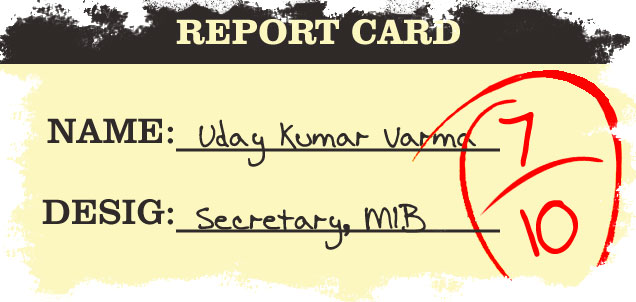

     

  • Mediaah! Report Card on Uday Kumar Varma’s tenure as I&B Secretary: 7/10


    By Pradyuman Maheshwari


    Uday Kumar Varma

    In October 2011, when Uday Kumar Varma had just been appointed Secretary in the Information and Broadcasting ministry there was much hope from the ace bureaucrat. He didn’t just have sound experience in the administration, but he also had spent a good time in the MIB.


    So he would be plug-and-play given the little time he would need to learn the nuances of the ministry.


    However, it’s one thing to be Special Secretary and another to be ‘the’ Secretary, especially when you know your stint is going to last two-odd years and you will be retiring after the tenure.


    MxMIndia had carried an article as a part of the Anchor with the headline: 5 Things the New I&B Secretary Uday Kumar Varma must do (see link: http://www.mxmindia.com/2011/10/the-anchor-5-things-new-ib-secretary-uday-kumar-varma-must-do/).


    There was a five-point tasklist. Here are the headlines:

    #1 Ensure new digitization announcement is implemented on time.

    #2 Must let self-regulators rule.

    #3 Should ensure paid contentwallahs are punished.

    #4 Push for news on FM Radio.

    #5 Empower government media – Doordarshan and All India Radio.


    I am not going to factor in #2, 3 and 5 here, because in a two-year stint there’s not much that you can expect any Secretary to achieve.


    Phase 3 of the FM radio regime has still not taken off and one can’t see independent news happening in a hurry on FM radio. It requires someone who believes in the medim to push these through with missionary zeal in what’s clearly a non-priority sector.


    Varmaji made the regular noise on self-regulation, measurement and paid content, the kind one expects from a Secretary.


    But it’s with digitization that the former Secretary has received the maximum bouquets and brickbats. At the outset, he deserves all the credit for digitization finally seeing the light of day. When the minister changed less than a week before first phase was scheduled to happen,  it was Shri Varma and his team’s conviction that ensured it takes place.


    But what happened before Phase 1 of digitization was effected was deplorable. The readiness numbers that the ministry declared were in sharp variance with the ground reality.


    It was Varma & Co’s resolve and understanding that the hiccups are inevitable is what led to the digitization been effected. Phase 2 was also pushed through, with its own share of problems, but by then the Secretary knew that it’s not switch-off-switch-on game. Every phase will have its own sub-phases.


    Had it been just the effecting of digitization, Varma would’ve got an 11 on 10, but the fact that the initial process had its share of big problems and that one had huge expectations from him given his knowledge of the functioning of the ministry, we give him a score of 7/10.


  • Umesh Shrikhande signs contract to be CEO, Taproot India. Joins today

    [updated]

    By A Correspondent


    Dentsu India Group has announced the appointment of Umesh Shrikhande as the new Chief Executive Officer of Taproot India. The former CEO of Contract India, Mr Shrikhande is an advertising veteran with more than two decades of experience. This is the seniormost appointment made in the agency after Dentsu’s stake buy in August last year.


    Indicating the significance of the announcement, a communiqué to inform the media of the appointment was sent on the Dentsu letterhead. Until now, all major communiques – including that of the hiring of Sameer Aasht as Head of Strategy and Business or the setting of the SquareRoot design unit – were sent by Taproot co-founder and CCO Santosh Padhi. Mr Shrikhande joins today (July 3).


    Welcoming Mr Shrikhande to the group, Rohit Ohri, Executive Chairman of the Dentsu India Group, said, “I’m delighted that Umesh has chosen to join us. Aggie, Paddy and I look forward to his partnership in this exciting new phase of growth at Taproot. Umesh is an industry professional I’ve always had the highest regard for and now, I’m happy to have this opportunity to work with him.”

    On Mr Shrikhande joining team Taproot at the helm, Agnello Dias, Co-founder and Chief Creative Officer, Taproot India said, “I am glad to have Umesh’s vast experience on our side, which will be a guiding light for us as we scramble around doing what we think is the right thing. He is sharp, insightful and most important possesses great clarity on the way mass communication in the contemporary world works. Everything we need.”

    “With the kind of experience Umesh has and the number of youngsters Taproot has, it will be a wonderful blend,” said Mr Padhi. When asked who Mr Shrikhande will report to, Mr Padhi replied: “Though on paper he will be reporting to Aggie, he is not hired for that…  he has been hired to take certain calls and just inform us and keep us in the loop”.

    Speaking on his appointment as the new CEO of Taproot India, Mr Shrikhande said, “Aggie and Paddy are not just immensely talented, they also happen to be wonderful people who have managed to build an attractive reputation for Taproot despite a hugely competitive environment. Our collective endeavour will be to build on Taproot’s innate strengths and culture to create a stronger organisation.”

    Mr Shrikhande, a management graduate from Jamnalal Bajaj Institute of Management Studies, started his career with Lintas (now Lowe Lintas & Partners), where he spent six years. Thereafter, he was a core member of Team Contract and took charge as the agency’s CEO in 2008. He left the agency in November 2012.

  • What’s in a name? There’s some method in the madness!


    By Mitul Thakkar


    Among the many traits that made Steve Jobs a phenomenon was his uncanny way with names. In an age when computers came with names like Type 704 and their makers were at best called Computing-Tabulating-Recording Company – the former name of IBM – Jobs took a leap of faith and named his firm Apple. And among its product line were a Macintosh, a Lisa and a Newton.


    Well, that’s one way to capture attention: by humanising your company or product. Yet, the history of incorporation reveals naming a company or a product is anything but predictable.


    A certain Tulsi Tanti, for instance, was sure that a combo of wisdom and funds is what will keep a firm going. So back in the 60s, he named his first textile venture Suzlon – ‘Suz’ or wisdom and ‘Lon’ the way Gujaratis pronounce the word loan. Subsequently, Tanti diversified into wind power equipment-making. The name, which had more to do with corporate strategy than with the product line, stayed.


    Well, personal names are still favourites – Adidas from founder Adi Dassler, McDonalds from their family name, Audi for the Latin of Horch (founder August Horch’s name was already being used by his previous auto manufacturing firm), Bridgestone for English of founder Shojiro Ishibashi (means Bridge of Stone in Japanese), Tata Sons, Aditya Birla Group et al. Names of the places of origin are also commonplace – Nokia for the Finnish village, Adobe Systems from the Adobe Creek that ran behind the house of co-founder John Warnock, Cisco is the short form of San Francisco, and back home, makers of one of the world’s selling biscuit brands, Parle.


    A Little Meaning can Go a Long Way

    Parle Products chairman Ramesh Chauhan says the group’s – and the product’s – name harks back to their humble origins from the Vile Parle locality in Mumbai in 1929. “But now people keep thinking that because of Parle brand, the place came to be known as Vile Parle,” he says.


    Brand consultant Harish Bijoor believes that when it comes to the art of corporate naming, the Bard of Avon has the final word. “Believe in what Shakespeare said – what’s in a name? You can promote any name and the brand becomes iconic by its sheer ubiquity even when there is nothing in a brand. Best brands are often created from evidently meaningless words,” says brand consultant Harish Bijoor.


    He could have been talking about one of India’s marquee tech names, Wipro, which actually derived from Western India Palm Refined Oil Ltd. The company started as a modest Vanaspati and laundry soap producer. Or Haagen-Dazs, a meaningless name invented in 1961 by ice-cream makers Reuben and Rose Mattus – European-sounding names were considered ‘classy’ then.


    Yet, a little meaning can go a long way. Tata Group combined two words for its jewellery arm Tanishq which is a combination of Tata and Nishq or gold coins in Sanskrit. In Urdu, it stands for ‘tan’, meaning body and ‘ishq’ or love. One of India’s oldest cosmetic brands, Lakme, traces its name to a French opera.


    Often, the product and services brands become so much part of the market without consumers knowing their roots. For instance, the father of White Revolution, Verghese Kurien, named the first cooperative dairy Amul, the short form of ‘amulya’ or priceless. Amul was also an abbreviation for Anand Milk Union Limited. Anand, a small town in central Gujarat, later became the epicentre of the Kurien-led cooperative dairy movement.


    Similarly, the Shah family-promoted textile and garment maker Garden Vareli’s plant is located in Vareli village of Surat district in South Gujarat.


    Gujarat-based FMCG giant Karsanbhai Patel named his washing powder Nirma after his daughter Nirupama. Instead of using the family name or symbolizing product feature, the Desai family of Gujarat opted a curious name for their brand of tea – Wagh Bakri, meaning Tiger-Goat tea. According to the company that claims to be the third-largest player packaged tea player in Indian market, “Wagh Bakri symbolises the co-existence of one and all creating long lasting relationships in society by dissolving differences over a good cup of tea.”


    Pradeep Jain, managing director of Karbonn Mobiles, sat down with his co-promoters for a brainstorming session over tea to decide the name of the company, which is now one of the top five handset makers in the country. They zeroed in on Carbon within an hour. Jain considered the number 7 extremely lucky, so an extra ‘N’ was added for luck, making the official name Karbonn. He was not superstitious about using alphabet ‘K’; a little research revealed that a jewellery chain was running their business under the same brand name. To avoid any registration issues, they changed the initial letter from C to K, making it Karbonn. Evidently, both ‘K’ and the extra ‘N’ worked for the Indian company competing against multinationals.


    For every entrepreneur conscious of what his product/company’s name mean, there are a few who are willing to fly off the handle. Like Jagdish Suri, chairman of Gurgaon-based Amir Chand Jagdish Kumar Exports. When he launched his brand of packaged basmati rice in, he chose to call it ‘Aeroplane’.


    “Around the world, children and adults alike are fascinated by aeroplanes. Hence, we branded our basmati rice as Aeroplane. With a universal name, it is easy to be pronounced and branded,” says Suri.


    Somewhere in their corporate HQs, you can see makers of Parachute coconut oil and Wheel detergent cakes nodding to the age-old wisdom of Suri.


    (Inputs from Madhvi Sally & Gulveen Aulakh)


    Source:The Economic Times

    Copyright © 2013, Bennett, Coleman & Co. Ltd. All Rights Reserved

    Licensed to republish


  • Shailesh Kapoor: Is Appointment Viewing a myth?

    By Shailesh Kapoor


    It’s a much-used and much-abused term in the television business. Appointment Viewership. Indeed, appointment viewing is the Holy Grail for the television business. It’s the acid test of a good programme or channel – Does it have the ability to get eyeballs by appointment? In simple terms, does it have the ability to make its audiences incorporate the program (or channel) into their daily or weekly schedule, in a way that it becomes a fixture for them?


    Appointment, as a dictionary word, suggests the same: ‘A meeting set for a particular time and place.’ How complex can it get, after all?


    Yet, the degree to which the concept of ‘appointment’ viewership is misunderstood in the television industry can be baffling. I discovered it about three years ago when a research revealed that a programme on a niche channel had very high appointment viewership. The client (who happened to be competition to the said programme) argued how that was possible, given the 0.7-rating of the program. I gave them an example of a 2.5-rating programme on a leading GEC that was being watched almost entirely in breaks and without any semblance of appointment viewing. How the debate went thereon is another story altogether.


    But that’s the lack of understanding I speak of. Appointment viewership is associated with high ratings, while lack of appointment is associated spontaneously with low ratings. Many media experts believe that our myopic view of the ratings system leads our television business into operating in the short-term. And this is yet another symptom of the same.


    As we have dived deep into the appointment-viewing concept over the last two years, many discoveries have happened over time. Only about a dozen Hindi GEC programme have a significant (20%+) base of appointment viewers. Others are watched for various reasons, none of which have any direct connection to the concept of ‘appointment’. Reasons such as:


    • My mother watches it, so I watch it too.
    • It’s the most watchable of all the programs on TV at that time, so I end up watching it.
    • I finish the chores and am free before dinner time, so I watch this program. (The ‘timing suits me’ reason)
    • It’s a good ‘time pass’ programme to watch.


    The ratings system doesn’t distinguish such types of viewing from appointment viewing. Back in 2010, a top-rated programme on a GEC was in an extremely vulnerable position. Research after research, viewers would trash it, saying that they are hating how the programme has moved from being a classic to a bore. The signals were clear. The viewing behaviour had moved from appointment to casual to cold & passive. But there was no strong competition to take the audience away. And hence, the ratings maintained themselves by and large, helped by sporadic high points in the story.


    The channel remained in denial on the programme for almost six months, questioning research design instead. And then, a competition channel launched a worthy show, and the much-touted show sank to less than one-third of its rating within three months, only to die an impending death over the next six months.


    But there are other examples too, where shows or channels run on a small but dedicated viewer base for months, even years. Music channels have certain time bands that manage this, by creating content affinity by showcasing music that a particular segment (e.g. retro music fans) may want to watch. News channels too rely on marquee anchors to create an appointment viewer base. Far and few in between they may be, but such properties serve their channels and advertisers very well over time.


    The confusing element in appointment viewing comes from lack of clarity in measurement. Appointment viewing should be defined as the percentage of a programme’s viewership that comes from its core, appointment-viewing base. Because this is the viewership that’s safe, secure and future-proof. The rest is all transient, or simply a matter of chance. Instead, it is often argued that a bigger audience size implies more appointment viewership.


    Only about 20 channels in India have even one programme that has a 20%+ appointment viewing base. Others are all creatures of destiny, at the mercy of the viewer, and at the mercy of events in the viewer’s life that the channel has absolutely no control over.


    I have maintained for a while that executive producers should be measured on appointment viewing proportions, and not rating points. It will be fairer on them, and on the business. But for that, we need to shed some of our obsession with the weekly ratings.


    Easier said than done?


    Shailesh Kapoor is founder and CEO of media & entertainment research and consulting firm Ormax Media. He spent nine years in the television industry before turning entrepreneur. He can be reached at his Twitter handle @shaileshkapoor


  • New weekly column by Shailesh Kapoor: Primetime Fiction – Reasons for Seasons?

    By Shailesh Kapoor


    Of all my client interactions, I enjoy the ones with foreign clients (often from head offices of their Indian companies) the most. There’s a specific reason for it. The amazement and the child-like inquisitiveness with which they react to research based on mass Indian audiences is so gratifying. Our primetime fiction content is beyond the realms of their comprehension, let alone appreciation. I was once asked: “So are you telling me that every single show that comes on weekdays primetime in India is a family drama?” My attempt to explain that ‘family drama’ is an overarching box with about 7-8 genres within it lasted only a few seconds.


    However, one of the more relevant and genuinely thought-provoking questions I’ve been asked by broadcasters from outside India is: “Why don’t you have seasons in fiction shows in India? Why does everything go on and on and on?”


    We know the stereotypical responses to this, don’t we? Three most common answers will be:


    1. Indian audiences don’t know the concept of seasons. It is a foreign thing.

    2. Only one out of four fiction shows actually succeeds, so why give it a season’s break and run the risk of not getting the audiences back.

    3. It’s a drastic idea and we are not in a position to experiment right now.


    All these responses are based on a natural tendency to exercise risk aversion. But neither the (ex) television executive nor the researcher in me approves of any of these answers. In fact, I have a robust argument here to prove why a seasonal approach to daily fiction will be a runaway success in India.


    Primetime fiction in India is based on the premise of the audience, particularly women, being addicted (and I choose the word carefully) to watching the life of certain ordinary, people-like-us characters unfold in a dramatic, extraordinary manner. All the enduring success stories in the last 12 years have come from this central thought, which our foreign friends simplistically and erroneously classify as “family drama”.


    Then why do serials begin to lose audiences? It is popular knowledge that shelf life of serials today is significantly lesser than what is was before 2008. Most successful serials peak within one year, and are well past their prime by the end of their second year. Very few like Balika Vadhu manage to complete four years of a successful run, not withstanding the hiccups on the way. Is addiction so ephemeral?


    Serials lose audiences because there is an equally powerful force that counters ‘addiction’. I call it ‘extension’. If you have had the privilege (no other word describes the experience) of attending qualitative research on serials with housewives as the target audience, you will be familiar with two phrases: “Pehle achha tha, aajkal chewing (pronounced ‘chingum’) ki tarah kheench rahe hain” and “Story ko round-round ghuma rahe hain.”


    Almost every serial becomes a victim of this ‘extension’ once it completes about 100 episodes. It becomes the proverbial chewing gum, or the vicious circle in which it has trapped itself. Only to come out momentarily before being trapped again.


    Even before 2008, serials had extension issues. But at that time, options were far and few. The number of GECs were lesser, the number of TV channels even more so. The consumer was not spoilt for choices. She accepted extension as a part of her TV life. Today, she is exercising her choice and actively rejecting extension. Because she has another serial in the same slot, waiting with a sizeable dose of addiction that is currently free of extension.


    We all know why extension happens. Daily serial production, with 260 episodes a year, is a breathless, never-ending assembly line. There is no time to take a break, because there are no episodes in the bank. Anecdotes of content being recorded on the evening of the telecast are so common; no one bats an eyelid when you narrate them, except the foreign friends of course.


    It is humanly impossible to ideate at this fervent pace round the year. Even the smartest, most creative brains will operate at sub-optimal levels when consistently pushed against ridiculous timelines. And when that happens, extension, often unknowingly, is their best friend.


    My estimate is that about 70% of an executive producer’s time (both at the production house as well as the channel) is spent on operational running of his/ her programmes. Only 30% is spent on ideation and creativity, which incidentally form the bedrock of the job profile.


    Now imagine a scenario where a top-rated show comes in seasons – One season a year of about 4-6 months. But the team on the show works round the year to make this happen. Instantly, the extension issues will be solved. There will be scripts in the kitty and episodes in the bank. There will be time to breathe, to ideate and to execute with full strength. There will be no need to stretch the chewing gum or go on a merry-go-round trip.


    What about addiction? For me, that’s the best part of it. Seasonal breaks can fuel addiction like nothing else can. Internationally, this has been proven beyond doubt. Common-sensically, if you take away what she is addicted to, she will yearn for it even more. And when she gets it back, she will see it with fresh eyes, with even more excitement than before. As long as the addiction center (read lead character) is unchanged, this will always work.


    What’s the flipside? Only one. A seasonal approach requires a higher investment to make it deliver to its full potential, because you need to commit to a team on the show for the entire year, amortized over only about 100-130 episodes, instead of 260. But compare this incremental cost to the investment that’s sunk in a serial that fails, and you know that this is a non-issue.


    Is someone likely to try this anytime soon? I will not bet on it for 2013 at least. Our GECs are more cautious and less experimental today, than they were a few years ago. The seasons idea may be too bold to buy into currently, given the musical chairs battle for the top four spots that they are currently engaged in.


    But at some stage, the future should be more seasonal. Hopefully.


    Shailesh Kapoor is founder and CEO of media & entertainment research and consulting firm Ormax Media. He spent nine years in the television industry before turning entrepreneur. He can be reached at his Twitter handle @shaileshkapoor


  • 1 Minute View: Service & Price for better loyalty

    There are many of us who get attracted to loyalty cards and schemes. There’s always that pull of discounts and special offers or gifts. But there’s also the desire to collect cards, and have a wallet full of them. Whatever be the attraction, the fact is that loyalty cards are exceedingly popular and do help induce some purchase. A lot of it purposeful, but a fair bit pointless. No pun intended.


     

    However, it’s critical for retailers or service providers to realize that that just issuing loyalty cards isn’t enough to lock in customers. What’s important is that the points or discounts offered must be meaningful and not a means to build a database so as to hawk more products or schemes.


    Loyalty schemes are good to have, but those in the business are aware that there’s a lot more that works to build a relationship with consumers.


    For a host of them, it’s price and then service that plays a crucial role and building loyalties. The neighbourhood provisions store will bring you even a one rupee pen refill that your child suddenly realizes the need for at 9pm, but the big stores will door-deliver it only if there’s a minimum billing.


    Price is important, but so’s the service. And in a country where labour is cheap, nothing works better than home delivery.


  • Retail rush at the malls as end-of-season sales zoom 40% y-o-y

    By Rasul Bailay & Sagar Malviya


    On Sunday there was a long queue of cars waiting on the driveway of the Phoenix Mills mall in Mumbai’s Lower Parel where there was no space left for parking as shoppers thronged the mall to splurge on end-of-season sales that started in the weekend.


    Sales in the first three days rose 20-40% from last year’s discount season for most brands as deep discounts and pent-up demand brought consumers out in full force, while top retailers such as Zara, Pantaloon and Westside clocked anywhere between 60% and 200% jump in sales.


    “This is unprecedented…I have never seen anything like this during any sale season,” says Rajendra Kelkar, senior centre director for west at High Street Phoenix that operates three malls in Mumbai and Pune.


    He says two lakh people descended on the firm’s Pune mall on Sunday, double that of usual holidays and weekends. “This is happening in a city like Pune that has 60 lakh population and 40% of that is below poverty line,” he adds. Mr Kelkar says sales rose 40-50% year-on-year in all its three malls.


    Coming at a time when the country is battling economic woes on many fronts including rising inflation and a sharply sliding rupee, the sudden surge in demand has come as a surprise.


    “Such a response is really surprising as the markdown or discounts offered by retailers were lower than last year,” says Nirzar Jain, vice-president at Mumbai-based Oberoi Mall that reported an average sales growth of 40%. “While the footfalls were not substantially higher than last year, the conversion rate or actual people buying were higher this time,” he said. Retailers attribute the surge in demand to a trend among consumers to hold back their purchases for the sale season that they see as bargain shopping. “Consumers are doing planned purchases very well these days,” says Pushpa Bector, head of leasing at DLF Utilities that operates malls in Delhi’s Saket and Vasant Kunj neighbourhoods. “For example, if anyone has to buy three pairs of jeans a year, he or she finds it worthwhile to wait to shop for that during discount seasons,” she says.


    At Select Citywalk mall in south Delhi, brands that have gone on sale including Zara, French Connection, Mango, Pantaloons, Calvin Klein and Swaroski have mopped up four times revenues on their first day of sale compared to their daily averages.


    Tommy Hilfiger outlet in the mall clocked sales of Rs20 lakh on the first day, a one-day record sale for any of its store in the country, a person with direct knowledge of the matter said. The Zara outlet in the mall saw maddening crowd and sales zoomed to Rs96 lakh on the very first day of the discount sale. Across the town, at Pacific Mall in west Delhi, Zara clocked Rs65-lakh sales on Day 1, 15% more than the first day sale of last year. In the first three days, the anchor tenant has accumulated Rs2.18 crore, 20% more than last year. Ditto is the case at Mumbai’s Infiniti Mall where Zara made Rs1.7 crore in the first three days, while Mango, Westside and Pantaloon had sales ranging from Rs6.5 lakh to Rs20 lakh per day, according to industry insiders.


    “There was a tendency to wait before the sale period which led to a lot of pentup demand from consumers,” says Mukesh Kumar, vice-president at Infiniti Mall, which recorded its highest-ever footfall of 77,000 on Sunday. “On an average, sales for most brands went up by 60% compared to January end-of-season sale. We are also seeing over 90% of brands participating in the sale compared to 70% earlier,” he said. Arvind Brands, which operates brands such as Flying Machine, Arrow, U.S. Polo Association, Wrangler and Lee, has posted about 25% year-on-year rise in sales in the first few days, its chief executive J Suresh says. The sales boom, although at the cost of margins, belie experts who had predicted a slower growth this year.


    Research agency India Ratings had a negative outlook on the retail sector for 2013 due to protracted weakness in consumer’s discretionary spending, marginal real wage growth and low level of macroeconomic activity. While the retail sector experienced overall single-digit revenue growth in 2012 the first time in its history, the agency had estimated a growth of 3-8% in 2013. Experts, meanwhile, say retailers may face some inventory management issue because the end-of-season sale was planned for longer-than usual 45 days.


    “Going by the initial response, most of the stocks will be cleared much before the season ends and if the retailer doesn’t plan merchandise accordingly, he can be in a dilemma to either discount fresh stocks or disappoint consumers,” head of an international brand says.


    Source:The Economic Times

    Copyright © 2013, Bennett, Coleman & Co. Ltd. All Rights Reserved

    Licensed to republish


  • Zee appoints Rajesh Sethi as CEO for TEN

    By A Correspondent


    Taj Television Pvt Ltd, a fully owned subsidiary Zee Entertainment Enterprises Ltd, has announced the appointment of Rajesh Sethi as CEO to manage the sports business. He will report to Zee MD and CEO Punit Goenka. Atul Pande, who was CEO of the sports business until Mr Sethi joined on July 2, will be offered an alternate responsibility within the Essel Group.


    Speaking on the appointment, Mr Goenka said, “His rich experience across various sectors would bring in immense value to the organization, enhancing the performance of our sports business by many folds”.


    Commenting on his new role, Mr Sethi said, “Media & Entertainment is an extremely dynamic sector, and I am glad to join a brand which is a leader in this category..”


    Wis experience of over 20 years across multiple sectors like insurance, consumer services and automobiles, Mr Sethi was until recently employed with Allianz Global Assistance as CEO and Region Director – South East Asia.


    An alumnus of the Harvard Business School, Rajesh also holds a degree in mechanical engineering and a diploma in international business and sales and marketing.


  • 1 Minute View: TAM goes monthly for some. And weekly for the rest

    It’s a twist to the tale pulled out from the books of the various soaps that you see on entertainment television. After the tu-tu-main-main like the kind you find on news television, TAM has decided to offer monthly data and in the CPT format to those desirous of it. This is with immediate effect. However, those who don’t want that, will get it weekly.


    Bizarre. We asked a few media agency biggies and bizarre and weird are the words they used. And added: whether you report weekly or monthly, we will use the metric that we  think is appropriate for our advertisers.


    Evidently, we haven’t heard the last on this one. Also, the whole idea of two different sets of numbers coming in – weekly and monthly, could only lead to more confusion. Note this move is not a result of the series of meetings that the various stakeholders (the ISA, AAAI, IBF and TAM) have been having over the last few weeks. There is reportedy no consensus yet from those meetings.


    However, what is a welcome move is that a settlement has been found to the problem and all stakeholders can now wait for the BARC-managed measurement regime to commence.


    On its part, TAM – a joint venture of Nielsen and WPP-owned Kantar, issued a statement from a spokesperson saying: “TAM, purely as an act of professionalism, is fulfilling and respecting its contractual duties and obligations that it is bound by, with individual broadcaster clients. This decision is basis individual client letter requests received by TAM from only specific few TV Channels.  Data for all other TV Channels will be reported as earlier.”


  • No method in this TAMasha!


    By A Correspondent


    The sales folks at some channels are staying put in the office because there are no calls to make. If the ads are on air, they don’t know if the money will come in at all.


    In media agencies, there is growing anxiety that if the stalemate continues endlessly, bottomlines will suffer. And if the ratings indeed go weekly, there could be lay-offs.


    While a few advertisers are happy that the ad suspension will help save valuable monies in a lean season, not all are happy with the decision.


    So if everyone is unhappy with the state of being, why the, well, sugar, aren’t they sitting across the table and smoking the peace pipe?


    Why can’t they come to a settlement when they all know what they need:

    1. CPT

    2. Weekly ratings now, eventually daily for GECs

    3. Stable ratings for smaller channels, if weekly is not possible, fortnightly or even monthly. Smaller is defined as below a certain viewership sample threshold


    What’s happening now is a loss or revenue and opportunity to explore other areas.


    In India, the television and print sector is fortunate that there aren’t enough takers for digital. Or even if there are people who advertise on digital, the monies aren’t big.


    A media planner told MxMIndia that the current faceoff could even impact print, because once advertisers sample the fruits of digital, while they’ll need to revert to television in the season for numbers, a few could switch from English print to digital. We think it’s not going to happen in a hurry, but our planner friend insists it’s a possibility.


    There is reportedly an IBF meeting today (Friday, July 19). AAAI and ISA officebearers are in constant touch. There was some jubilation a few days back when Discovery Networks wrote to TAM asking for a revert to weekly numbers, but the next day we had NGC and Fox asking for a switchover to monthly.


    What we do know is that the industry can’t do without measurement. For instance, despite the face-off, ESPN Star quoted TAM numbers in ads to highlight how it scored over some news channels for its non-live content.


    Programming, marketing and sales folk are also very keen to the ratings so that they can tweak their content, if needed. Until then it’s time for some R&R (rest and recuperation/relaxation) though everyone’s worried about the other R&R (ratings and revenues). Sigh.


  • Arvind Sharma re-elected President of AAAI

    By A Correspondent


    Arvind Sharma

    Arvind Sharma, Chairman & CEO of India Subcontinent, Leo Burnett (TLG India Pvt Ltd), was re-elected President of Advertising Agencies Association of India (AAAI) for the year 2013-2014 at its Annual General Body Meeting held last Firday (July 19).


    M G ‘Ambi’ Parameswaran, Executive Director & CEO-Mumbai, Draftfcb+Ulka Advertising Pvt Ltd, was re-elected Vice-President of the Association.


    Other members of the Executive Committee in alphabetical order are:

    Ashish Bhasin                                    Aegis Media India Pvt Ltd

    Ganesh Baliga                                    Fifth Estate Communications Pvt Ltd

    Kunal Lalani                                      Crayons Advertising Ltd

    Nakul Chopra                                    Publicis Communications Pvt Ltd

    Pranav Premnarayen                    Prem Associates Advertising & Marketing

    Rohit Ohri                                           Dentsu Marcom Pvt Ltd

    Sam Balsara                                       Madison Communications Pvt Ltd

    Srinivasan K Swamy                       R K Swamy BBDO Pvt Ltd


    Immediate Past President, Nagesh Alai, Chairman, Interface Communications Pvt Ltd, will be the ex-officio member of the new AAAI Executive Committee.


    The Advertising Agencies Association of India (AAAI) has a very large number of small, medium and large-sized agencies as its members who together account for almost 80% of the advertising business placed in the country.