Category: SPECIALS

  • @FF12: Niche isn’t niche any more


    By Rishi Vora


    It is a fact that Hindi GECs command a premium position in the TV space in India and the primary reason behind that is its mass appeal. And thereforea lot of advertiser interest tends to go in favour of the so-called mass channels.


    But there is another set of audiences that prefer a certain kind of content – speciality content such as Action, Comedy, Food, Music and so on; channels that cater to the tastes ofaudiences with a peculiar taste. These channels are termed as niche channels.


    The concept of niche channels started about 18-20 years ago, and now, as experts believe, niche isn’t niche any more as all niche channels put together command a share that is equivalent of the share of Hindi GECs and the mass channels, so to say.


    On day 2 of FICCI Frames, in a session titled “Building Sustainable Models for Niche Content” honchos from the broadcast industry such as Paritosh Joshi, CEO, Star CJ (session moderator); Smeeta Chakrabarti, CEO, NDTV Lifestyle; Monica Tata, General Manager, Entertainment Networks, South Asia for Turner International India; Ajay Chacko, President, A + E Networks I TV 18 JV; Atul Pande, CEO, Sports Business, Zee; and Rasika Tyagi, Sr VP – English Programming, Star India discussed on revenue models to sustain TV content catering to niche audiences and its long-term sustainability.


    Atul Pande talked about the launch of Ten Golf, a speciality channel for Golf followers in India. He stressed on the need to charge premium to audiences who really are on the lookout for speciality content.


    Smeeta Chakrabarti said that as a speciality channel one cannot talk about TRPs, rather it is the brand connect that what needs to be spoken about as far as ad sales was concerned. Rasika Tyagi on the other hand remarked that the whole idea of measuring a speciality interest channel should be relooked at. “It’s not about how many people are watching you, it’s more what kind of people are watching you.” She also said that the audiences of niche channels are of such quality that they do not mind paying, and that broadcast companies should look to tap into that opportunity.


    Atul Pande remarked that the Pay TV as a concept does not yield great deal of revenue as the pricing of the niche channels are on the lower side. “We keep the pricing on the lower side because we don’t want the consumers to be shocked despite the fact that some of the content that we do justifies a price in the higher range.


    On whether the industry requires a different approach as far as measurement for these channels was concerned, Paritosh Joshi said, “The big challenge with respect to measurement is that we need to find a way to measure both quantity as well as quality. The quality aspect is very critical for a speciality channel.” Monica Tata added, “We need to have a different measurement system to evaluate special interest channels.”


    As for the digitization mandate that all channels have to follow, Ms Tata was of the opinion that to move from the present model of advertising to embracing the digital opportunities will be a challenge, and something that will take time before becoming an industry norm.


    The panel also discussed the need to create global content, thus opening up monetisation opportunities across markets.


    Photograph: Fotocorp

  • @FF12: Financing, a cause for concern in media and entertainment


    By A Correspondent


    The media and entertainment industry of India has scripted a glorious growth story in the past decade or so, and the future looks even more promising with digitization and the advent of technology across media verticals such as broadcast, print and also films. But one area of concern is the lack of private equity and VC funds showing adequate interest.


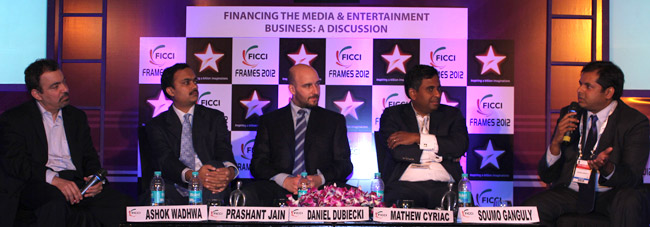
    In a session titled “Financing the Media and Entertainment Business” eminent personalities such as Prashant Jain, Executive Director, HDFC Mutual Fund; Matthew Cyriac, Sr Managing Director, Private Equity, Blackstone; Soumo Ganguly, Managing Director, Moxie Entertainment Pvt Ltd; and Daniel Dubiecki, Founder and Partner, The Allegiance Theatre, Hollywood shared their views on the subject. Ashok Wadhwa, Group CEO, Ambit moderated the session.


    Matthew Cyriac started off the session by pointing out that majority of the investments within the media and entertainment industry were made in television and print as they represent a fairly large share in terms of sheer numbers as against Internet and Radio . The Hindi GECs in TV is where typically where a lot of money into followed by regional GECs and sports channel. For print media, it was the regional publications command a lot of attention as regional advertising is very robust – one which extracts a lot of profit.


    Prashant Jain pointed out thata lot of companies in India have managed to get good funding and that it is not reflective of a very, very sorry picture as is being talked about. “It’s not that all of India in the media entertainment space not attracting funds. Companies like UTV and a few others have attracted investors.”


    Ashok Wadhwa remarked that the film industry in India is not institutionalised enough to attract private equity. Daniel Dubiecki spoke about the need to be more global in concept, widen the scope of the market and thereby making it more viable to attract investments in the films business.


    Photograph: Fotocorp

  • @FF12: Entertainment has become a revolution


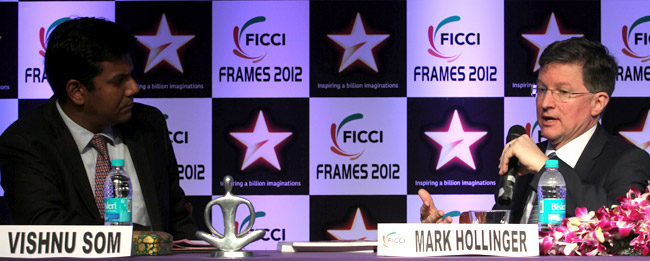
    The second session of FICCI Frames had ‘industry doyens, including key enablers, shed light on challenges and opportunities for the times ahead’. The session was moderated by Vishnu Som, Editor, Documentaries and Senior Anchor, NDTV.


    The session was opened by Mr Som welcoming Mark Hollinger, President & CEO, Discovery Networks International (DNI), who took the stage to talk about DNI’s journey in India. From a single network launched in 1995, today DNI has grown to seven channels. Mr Hollinger gave the credit of this success to DNI’s advantage of being an early mover in the Indian market.


    While talking about the process of digitisation, Mr Hollinger said that it is a great opportunity for a truly interactive pay TV experience. He appreciated the investment  made by the C&S community (the set top boxes and the marketing for the same).


    Mr Hollinger was of the opinion that the viewers today prefer sophisticated technology and the same applied for TV too. He said that digitisation is a win-win situation for all. The consumer gets a better product with ‘wider choices’ and the broadcasters will get a better business model which allows ‘faster and broader penetration of HD channels’. He stated that embracing digitisation will push broadcasters to perform better.


    In the Q&A session with Mr Som, when he was asked about the benefits of producing content v/s revenue, Mr Hollinger said one-third of their operational revenue and profits is recovered from the market due to their early mover advantage. He revealed that they spend almost $1 billion on producing content.


    Being an international channel which enteredIndiain 1995, Mr Hollinger talked about howIndia, as a country, is more open to foreign content. He also said that even then they offer regionalised content created specially for the local viewers and also the option to view the international content in the local language. Mr Hollinger stated that their strategy worked as was evident from the Brand Trust Report which has named Discovery as the third most popular channel and TLC as the fifth.


    In the Q&A session, when Mr Som questioned him about the pros and cons of local v/s international content, Mr Hollinger said that the local staff keeps them appraised about how the content is received. He said that the mix of international and local content is almost 50-50.


    Mr Hollinger saved the best for the last. While closing his speech, he announced that DNI is launching Discovery Kids in India, which is the launch pad for theAsialaunch. The channel will also be launched inIndonesiaandPhilippines.


    He also revealed plans to expand DNI’s scope to DVDs, retail, publishing and merchandising in the “biggest satellite market today”.


    Next up was Puneet Goenka, CEO and MD, Zee Entertainment Enterprises Limited (ZEEL). Mr Goenka opened his address by stating entertainment is no longer an evolution but has become a revolution. He said that digitisation of content is a good move as the drivers of today’s content are “highly motivated youngsters who are high risk takers and have large disposable income”. They have the power to influence products to be customised and digitisation will help achieve just that.


    With the help of a powerpoint presentation, Mr Goenka listed out the pros and cons of digitisation. He listed the fact that the penetration of private channels is still low and there is a lot of scope to grow as a benefit. Citing the example of Ditto TV, he said that now new media is the media to go to.


    During the Q&A session, when asked about the benefits of digitisation, he said that the sheer choice that the consumer gets is the benefit which will also be beneficial to them as the number of channels being offered in HD will go up.


    While talking about self-regulation in media, Mr Goenka said that it is still early days, as the norms have just been laid out by the news and entertainment industry. Time is needed to let them evolve and make a difference.


    Next to address the audience was Carolyn Everson, VP, Global Marketing Solutions, Facebook, whose address featured on how Facebook can benefit the media and entertainment industry. Giving the example of Open Graph, Ms Everson illustrated how Saavn in music, Zinga in gaming and films being released in theUSuse Open Graph by sharing stories built their brand on “top of Facebook”.


    Her ‘Aaha’ moment about Facebook came when, while talking to an anthropologist, she realised that communities and networks have always been around us but Facebook brings them to us at a scale never seen before due to the technology available.


    She said that Facebook is a reflection of the unique individual identity and the social graph is created using the information shared by the individual.


    Ms Everson also dealt with how Facebook is trying to take marketing from ads to stories. The thought behind the idea is that ads may be remembered once but stories are shared and remembered by millions. The best example of this is the Timeline pages for the brands which allow them to communicate one-on-one with their fans.


    During the Q&A session, Ms Everson faced some tough questions from Mr Som, when he asked her about how Facebook has been dealing with objectionable content. She answered that they work very hard to regulate content and address complaints regularly. When she was asked how and why do they decide what is unsafe or objectionable, she answered that the communities regulate the content and Facebook takes their input very seriously.


    Photograph: Fotocorp

  • @FF12: Financing, a cause for concern in M&E

    By A Correspondent


    The media and entertainment industry of India has scripted a glorious growth story in the past decade or so, and the future looks even more promising with digitization and the advent of technology across media verticals such as broadcast, print and also films. But one area of concern is the lack of private equity and VC funds showing adequate interest.


    In a session titled “Financing the Media and Entertainment Business” eminent personalities such as Prashant Jain, Executive Director, HDFC Mutual Fund; Matthew Cyriac, Sr Managing Director, Private Equity, Blackstone; Soumo Ganguly, Managing Director, Moxie Entertainment Pvt Ltd; and Daniel Dubiecki, Founder and Partner, The Allegiance Theatre, Hollywood shared their views on the subject. Ashok Wadhwa, Group CEO, Ambit moderated the session.


    Matthew Cyriac started off the session by pointing out that majority of the investments within the media and entertainment industry were made in television and print as they represent a fairly large share in terms of sheer numbers as against Internet and Radio. The Hindi GECs in TV is where typically where a lot of money into followed by regional GECs and sports channel. For print media, it was the regional publications command a lot of attention as regional advertising is very robust – one which extracts a lot of profit.


    Prashant Jain pointed out thata lot of companies in India have managed to get good funding and that it is not reflective of a very, very sorry picture as is being talked about. “It’s not that all of India in the media entertainment space not attracting funds. Companies like UTV and a few others have attracted investors.”


    Ashok Wadhwa remarked that the film industry in India is not institutionalised enough to attract private equity. Daniel Dubiecki spoke about the need to be more global in concept, widen the scope of the market and thereby making it more viable to attract investments in the films business.


    Photograph: Fotocorp

  • @FF12: IBF, ISA & AAAI announce launch of BARC

    [youtube width=”400″ height=”250″]http://www.youtube.com/watch?v=Zjuq1sB7h-E[/youtube]

    Video and Text By Shruti Pushkarna


    The Indian Broadcasting Foundation (IBF), the Indian Society of Advertisers (ISA) and Advertising Agencies Association of India (AAAI) announced the official formation of a nationwide audience research joint body, Broadcast Audience Research Council (BARC).


    The announcement was made at the inaugural day of FICCI Frames 2012 in Mumbai in presence of I&B Secretary Uday K Varma, TRAI Chairman Dr JS Sarma, Managing Director & CEO of ZEE Punit Goenka, Star India COO Sanjay Gupta, Times Television Network MD & CEO Sunil Lulla, Star CJ CEO Paritosh Joshi, Madison Group Chairman Sam Balsara and Landmarc Leisure Corporation MD Paulomi Dhawan.


    IBF will have 60 per cent stake in BARC, while ISA and AAAI will each have 20 per cent stake.


    Originally founded in 2008, BARC was earlier to be set up as a joint venture between the IBF and the ISA on a 60:40 ratio and initial investment of Rs 300 million. However, there was a need felt for the apex body of ad agencies – the AAAI – to also be part of the BARC.


    Talking about the way forward, Paritosh Joshi, CEO, Star CJ said BARC will be similar to what BARB (Broadcasters’ Audience Research Board) is in the UK. He said, “There will be a professional CEO who will be appointed, and we have learnt a lot from watching the BARB work in the UK and one of the things that makes BARB work as well as it does is that they have a professional management system. So we are going to learn from the best practices around the world and one of those best practices is to make it run like a professional setup.”


    A technical committee is being set up, now that all the stakeholders are in place. Mr Joshi said, “The Board of Directors will appoint a technical committee Chairman and then a technical committee and that is where the work actually begins. The work really is going out there and finding the best solution for television audience measurement in India.”


    BARC will not conduct audience measurement directly but commission independent specialist research vendors.


    The Board of the council will have 10 members, six members from the IBF and two members each from the ISA and AAAI.


    Talking about the formation of BARC, Abdul Khan, Senior Vice President & National Head of Business Marketing, Tata Teleservices remarked, “I don’t really think that we need another currency…I think the task is to make what we have more robust and it’s never ending. If two, why not three, why not four? So we should have one currency that is comprehensive enough to tackle major problems and be accepted by the entire industry.”


    “Maybe we need to get people from the younger generation on board  to figure because it is a rapidly changing environment. I am not seeing any changes happening in television research in India – it’s become static in a way. So we need to make it more robust.  Sample size has to increase; one also needs to look at the quality of the sample etc. It’s like if it’s not broke, why you trying to fix it,” added Mr Khan.


    Paulomi Dhawan, MD, Landmarc Leisure Corporation said, “Advertisers are always looking for transparent and robust research and in-depth insights in the rapidly changing television viewership landscape. With time, it is going to be more challenging and you will need more insights from research. We have been working together since some time to launch BARC.”


    ISA Chairman Bharat Patel added, “ISA is pleased to be a part of this joint industry body, BARC, along with the IBF and AAAI to provide continued and meaningful research.”

    with additional inputs by Rishi Vora


  • @FF12: Price control equals creative shackles for broadcast: Hernan Lopez, Fox Intnl Channels


    [youtube width=”400″ height=”250″]http://www.youtube.com/watch?v=MCkprEBcPAs[/youtube]

    Video and Text By Shruti Pushkarna


    As President and Chief Executive Officer of Fox International Channels (FIC) Hernan Lopez oversees a massive international multichannel television organization that operates over 200 channels and their related online and production units. Mr. Lopez is responsible for all operations of FIC, which produces channels primarily under the brands Fox, National Geographic Channel, FX, Fox Life, Fox Crime, NatGeo Wild, MovieCity and Star Movies. He also oversees Fox’s US Hispanic cable networks, Fox Deportes and Utilisima. On the sidelines of FICCI Frames 2012, he spoke to MxM India about digitization, the vision for the Indian broadcast industry, HD penetration and economic uncertainty. Excerpts:


    On digitization

    I believe that digitization is good for consumers, for television industry and for both on the platform side and broadcaster side and like any process of gradual change of technology it won’t be without hiccups. There will be consumers that will be confused, there will be broadcasters who will be getting more or less space than they did before but at the end of the day all television markets that have gone from analog to digital have seen an increase in consumer satisfaction, in industry revenues and in the transparency of the system overall.


    Price control equals to creative shackles

    I argued in my presentation that price controls are putting artificial limit on the total revenue that the Indian television industry can generate and that limit in turn puts a limit on how much can it spend on content, how much you can afford to pay writers, directors, etc. What I have argued is that if the price controls went away, that’ll create a new incentive for television broadcasters to invest more in drama productions that can be here in India and also exported all around the world.


    On economic uncertainty

    We have seen uneven stories as it relates to advertising in Europe, for instance pan European advertising is down in some of the southern European countries but in some European markets, it’s up and it’s also significantly up in Latin America and Eastern Asia. So overall worldwide total advertising revenue is up.


    Advertising vs. subscriptions – what’s the right mix?

    In the US it’s close to 50:50 and I believe it will take many years for India to get to that stage but I think that’s a healthy balance.


    On HD penetration

    HD is a service that today consumers see as a luxury, at some point they will come to see it as a necessity. So around the world, as global television broadcasters, we are very advanced in giving all of our channels in both HD and SD. In fact it’s very much a policy that whenever we launch a new channel we try to do it simultaneously in HD and SD. And when consumers get used to that kind of service, it’s hard for them to go back.


    Do away with price control, Hernan Lopez tells FICCI Frames 2012


    By Archita Wagle


    The morning session on the second day of FICCI Frames 2012 opened with Anto Joseph, Resident Editor, Financial Chronicle, introducing Hernan Lopez, CEO, Fox International TV. Mr Lopez started his address by talking about how India and Indian presence is felt in the US, be it Indian doctors or yoga. But he rued the fact that inspite the ideas or innovations in diverse fields, one area that sadly lacked the innovative ideas and content was television.


    According to Mr Lopez, the reason for India’s lack was due to the fact that Indian talent “operates under price control which equals creative shackles”. Citing the example of Columbia which exports its programs to 80 countries, Mr Lopez compared the two and said that inspite having creative talent, technical expertise and skilled tradesmen at par; Columbia is much ahead as it is not restricted by regulations and price control.


    Mr Lopez said that Indian television industry was almost totally dependent on advertising revenues, almost $2.6 billion per year, which coupled with the fact that there was an overabundance of channels and less number of affiliates meant that the broadcasters were in a tight bind. He added that even then, almost $700 million had to be paid in carriage fees, which meant that paying the talent came last.


    The way forward according to Mr Lopez was if the price control was done away with. He said that this would make it possible to pay the talent in the industry what it deserves and then it can operate without any constraints to produce the best possible content.


    Mr Lopez lauded the move to digitisation which would reduce the carriage fees being paid and increase the revenues for the industry. When asked what is the right ratio for advertising v/s subscription, Mr Lopez said that it is 50-50, as advertising alone can’t fund a large degree of quality content. According to him, a stronger content needs a dual stream revenue model.


    A member of the audience questioned Mr Lopez about the government sanctioning digitisation for broadcast industry and how feasible is the government intervention, he answered that in a country like India, market forces alone can’t help a technology to be established hence government intervention was needed to push the digital solutions. But he was emphatic that now decision about the pricing should be left to the cable operators and consumers can choose the price level they want to pay.


    Asked if better technology is a guarantor to better quality content, Mr Lopez said that there is no guarantee, but he reiterated that if the industry is freed from the price shackles, it will definitely produce better quality content.


  • @FF12: NBSA chief suggests independent regulation for media

    By A Correspondent


    In 1950, Jawaharlal Nehru said that freedom of speech should be granted to good and bad editors, but they should use it in national interest for he believed that if it is left to the government to decide, the good editors will be jailed and the only the chamchas will survive. This was the opening Justice JS Varma, former chief justice, Supreme Court and  News Broadcasters Standards Association (NBSA) Chairperson used for his keynote address for the session ‘Freedom of Media: Significance of self regulation’.


    Justice Varma said that freedom of speech is precious and we have to preserve it. The way to do so is self regulation as the media is mature enough to know to do it themselves and ward off the danger of state regulation.


    He said that it is not media’s right but rather an obligation to keep the people informed so that they can participate in government decision making process. It is the media’s duty to ensure transparency to ensure accountability.


    Justice Varma emphasised that the media should not give the government a chance to step in and hold it accountable. He said that the media (which reports) and judiciary (which decides) are the two strongest pillars of our democracy and they shouldn’t use their strength (power) to harm anyone, lest their power be curtailed due to lack of their accountability.


    Moving on, Justice Varma criticised the media, especially the broadcast media’s tendency for breaking news. He said that the key tenets of journalism should be kept in mind while reporting ‘breaking news’- is it true, fair and in public interest. He said that objectivity and due diligence must be applied while covering news. He cautioned the media, which has tremendous reach, to be cautious in its reporting as the effect of the news it flashes is instantaneous. He closed his address by saying “The more potential for damage, the more is the accountability you have”.


    The moderator, Barun Das, Zee News CEO and Vice President, News Broadcasters Association (NBA) spoke about how the media can’t be regulated as it is an essential pillar of democracy. He opined that free media can be good or bad but media which is not free can never be good.


    Mr Das said that regulation is a process of evolution. The media needs to introspect and understand where it stands.


    He outlined the dilemmas faced by the media while trying balance the content and the bottomline where news is trivialised for gaining eyeballs. The broadcast media especially is constantly grappling with trying to strike a balance between what the audience ‘would like to see’ and what they “should see”.


    The stage was then thrown open for the panel discussion. Each of the panellist was given time to speak and answer questions by the moderator.


    The discussion was opened by KVL Narayan Rao, executive vice chair person NDTV and President, NBA.


    Mr Rao said that there is no question of compromise on the fact that that media is free and that is the way it should be in a democracy. He said thatIndiais the largest free news market with a reach of 500 million households (news TV reaching nearly 115 million households).


    He said that in the early 2000s, after the private players were allowed in, they got together to set up the NBA to set up a code of programming and ethics which will regulate their broadcasting. He emphasised that it was important to have an independent and respected authority to keep a vigil on what is happening in the industry. He was proud of the fact that they telecast a scroll reminding the viewers that they have a forum to go to if they have any complaints.


    He also spoke about the NBSA which has been an advisory to the media with regards to improvement in news coverage and takes up issues suo moto if the media is found lacking.


    When questioned by Mr Das about balance or conflict on interest between news and business, Mr Rao was emphatic that there should be a “Chinese wall separating news and commercial interests”. He opined that news is to inform, educate and entertain the public independent of government and advertisers. He allowed that some compromise may take place but said that with digitisation, more cost can be spent on content and hence the scenario will change.


    Next to take the mike was Nitin Desai, Former under Secretary General, United Nations and member NBSA.


    Mr Desai started by saying that he disliked the term self regulation and “independent regulation would be a more appropriate term”. He said that emphasis should be given to developing the independent regulation in such a way that it is credible in the eyes of the media, the people and the view makers.


    His main concern was about the emergence of new media and challenges presented to regulate it.  He reiterated the need for due diligence to be given to fair and unbiased reporting, rights of an individual to privacy and avoiding trial by media.


    He said that he had already noticed a change in the fact that the mindset of the editors and the non-media members on the NBSA was converging due to the internalising the sense of responsibility.


    When questioned about the trivialisation of content, Mr Desai said that it was being done as the measurements showed that the audience preferred it. He said that there was a need for a different measuring system for news channels. He also opined that news channel have to stop behaving like money making operations and take responsibility to cover news that “people should know”.


    Phillip Turner, Chief of Bureau, CNN International, South Asia said thatIndiahad a long tradition of journalism but we tended to forget it. He emphasised that focus should be on stories that have a relevance to the rest of the world and maintaining the integrity of the media. He agreed with Mr Desai that the new media is presenting a challenge for regulation but he was of the opinion that everything would work out if the media stuck to the basic tenets of journalism – fair, relevant, responsible and accurate reporting.


    When asked about the need for a NBA-like worldwide authority, he wasn’t sure that such a platform could work globally.


    Kiran Karnik, member NBSA and former president of NASSCOM spoke about the challenges of new media. He said that today, when the news is available instantly as reported by citizen journalists and through the new media, it is the responsibility of the media to separate what is true and what is not. He also opined that news media today has shifted from reporting news to making news. He cautioned them to use the power they have responsibly by maintaining their standards and not infringing on the rights of the people.


    When questioned on the challenges thrown up by the new media, he agreed that technology is not amenable to censorship and also the consumer is becoming the creator and consumer. But he emphasised that there should be zero tolerance for unverified news and the news media as the aggregators of news should use their own censors.


    Mr Das wrapped up the session by stating that now is the time to convert challenges into opportunities and inclusive growth through media is the way forward.

     

  • TRAI invites views on ads policy for broadcasters

    By A Correspondent


    It was bound to happen, only its timing – soon after the not-very-exciting Budget and the uncertainties thrown up by digitization staring in its face – could’ve been unfriendlier. On Day 3 of FICCI-Frames, Big brother Telecom Regulatory Authority of India (TRAI) released a consultation paper titled “Issues Related to Advertisements in TV Channels”.


    First some background, in TRAI’s words: “The advertisement revenue has been a substantial portion of the overall television industry revenues. Perhaps, this has led to the tendency of pushing more and more advertisements in the television programmes in both pay and FTA channels. The increasing duration and distracting formats of advertisements has, however, adversely affected the consumers’ viewing experience. This has been reflected in numerous consumer complaints and opinions being expressed at various fora.”


    The TRAI is hence reviewing the existing regulations on duration of ads and how they should be presented given complaints that these are not being followed. Here goes:


    1. The limits for the duration of the advertisements shall be regulated on a clock hour basis i.e. the prescribed limits shall be enforced on clock hour basis.

    2. No FTA channel shall carry advertisements exceeding 12 minutes in a clock hour. For pay channels, this limit shall be 6 minutes.

    3. The 12 minutes of advertisements will not be in more than 4 sessions in one hour. In other words, there will be continuous airing of the TV show for at least 12 minutes each. Not more than three advertisement breaks shall be allowed during telecast of a movie with the minimum gap of 30 minutes between consecutive advertisement breaks.

    4. In case of sporting events being telecast live, the advertisements shall only be carried during the interruptions in the sporting action i.e. half time in football or hockey match, lunch/ drinks break in cricket matches, game/set change in case of lawn tennis and so on.

    5. There shall only be full screen advertisements. Part screen advertisements will not be permitted. Drop down advertisements will also not be permitted.

    6. In so far as News and Current Affairs channels are concerned, they are allowed to run not more than two scrolls at the bottom of the screen and occupying not more than 10 per cent of the screen space for carrying non-commercial scrolls, tickers etc.

    7. The audio level of the advertisements shall not be higher than the audio level of the programme.


    The text of the Consultation Paper is available on TRAI’s website (http://www.trai.gov.in/WriteReadData/trai/upload/ConsultationPapers/289/ cp_aproved_Authority.pdf). Written comments on the issues raised in the Paper are invited from the stakeholders by March 27, 2012, and counter-comments by April 2.


  • @FF12: Turning 3 into 10, a percentage issue for digital

    By A Correspondent


    While much of the adex growth in 2011 came from the obvious sectors of television and print, it was digital that stole the thunder by recording the biggest and fastest growth among all mediums. Little wonder then that the session on “Innovations in the advertising industry in the Digital world” chose to focus on why the much sought after medium was still ignored by advertisers who preferred to seek refuge elsewhere. The panellists comprised Rajan Anandan, VP and MD Google India, Olivier Fleurot, CEO, MSL (Part of Publicis group), Frederic Josue, Executive Director, Havas Media, Vikram Sakhuja, CEO, South Asia, Group M and Kapil Agarwal, Jt MD, UFO Moviez and Varun Gupta, Director, strategy transaction services, KPMG India. The session was moderated by Rajiv Makhni, Managing Editor, Technology, NDTV.


    Mr Anandan initiated the discussion, stating that India is still an emerging market where web advertising is concerned and it still constitutes about 3 per cent of the overall advertising spends in India which is estimated to be around Rs 33,000 crore. The biggest driver of growth in advertising on the web would be through the rise in the number of users of smartphones, which is estimated to touch 100 million users in 4-5 years time. Smartphones alone could boost the growth of web advertising to about 8-10 per cent, he said.


    Mr Josue of Havas was of the view that it would be content that will drive the growth of the medium in the years to come. Havas has been at the forefront in investing behind content production as that would be the driver of growth for this medium. But the medium will face its share of issues which include multi-tasking across various platforms as an attempt will be have to be made to offer content seamlessly across various mediums. Also, engagement and loyalty would be the other key attributes that would make or break business for users of digital across the world, he said.


    Mr Fleurot began by stating how the marketing and communications industry was witnessing a profound disruption due to the invasion of technology and social media. This, he said, has led to an increased level of competition in the marketplace. Signalling the essence that data will bear on the survival of players in the communications space, Mr Fleurot said that big data will be at the core of all marketing initiatives in the future. He highlighted on how the space will see the emergence of many new publishers like Youtube et al that will challenge the livelihood of the existing players in the space. The challenge, he said, was that clients today are not yet organised for the 21st century as they still prefer to work in silos. But in the case of online, the model of working in silos will disappear as all the other mediums work as a single unit on the internet. Going forward, the two key factors that will determine the growth of this medium, he said, include the speed with which marketers communicate with their users through the digital medium and the transparency with which they operate on the medium.


    Vikram Sakhuja was at his jingoistic best as he began by questioning what the term innovation in advertising actually stood for. “Innovation is a term that is broader than creativity. It is a new way of doing something better,” he said. He outlined the current scenario by stating that technology today is an overestimated medium in the short term but is underestimated for the long term. The problem according to him is that the medium has been underestimated for a long time now and that it was about time the medium leapfrogged ahead of the others – go from the current 3 to 15 percent in the shortest possible timeframe.


    Outlining the four fundamental powers of digital, Mr Sakhuja said that the first and foremost is its ability to move from being something random to attaining a consensus. The second was the power of interactivity which includes communicating in a 2-way mechanism and communicating in a social world; the third was the ability to move seamlessly across devices and lastly, the ability to enhance real-time consumption of content.


    The implications that this would have on marketing include facilitating superior targeting, marketing content that would be more UGC-led, more use of apps and videos that will alter the way clients reach out to users – 30 second ads will make way for UGC videos and banner ads; use of word of mouth will see a predominant rise, and new sales and distribution models will evolve in digital that would enable advertisers to reach out to consumers in a more linear fashion.


    Mr Gupta of KPMG pointed out though digital was seeing an increasing levels of penetration, there was a disconnect where ad spends on the medium are concerned. Just 3 per cent of monies going to the medium is still unreasonable given the numbers being thrown up by markets in the West and Europe, which exceed 25 per cent and above. A large amount of growth in digital will come through mobile, he said.


    Mr Anandan added here that one of the industries that will see a downfall would be print as already there is a lot of transition that is being witnessed in terms of clients moving away from print to digital. Real estate clients and job classifieds are prominent examples where most of the ads are now being run on the digital medium putting the scope of print in a tight spot.


  • @FF12: No disadvantage of being a woman

    By A Correspondent


    The media and entertainment industry which at one point in time was dominated by the men has today more number of women not only working at the lower and mid-level but, have even taken on leadership roles, giving a tough competition to their male counterparts. Whether it is the film and television industry or in the news media, women are not shying away from taking on responsibilities and accomplishing tasks that were once considered to be only a ‘man’s job’. Day three of FICCI Frames 2012 held a session on ‘Women in Media & Entertainment circa 2012: Leading from the front’.


    The panel members of this session were Vidya Balan, Actor; Anurradha Prasad, Managing Director, BAG Films; Jenni Tosi, CEO Film Victoria; Ekta Kapoor, Creative Director, Balaji Telefilms; Barkha Dutt, Group Managing Editor, NDTV; and Usha Uthup, Singer. The session was moderated by Rajeev Masand, Entertainment Editor, CNN IBN.


    This session discussed the journey of each of the above eminent women personalities and the challenges they faced during their journey. The moderator, Rajeev Masand simply put it this way, “Traditional media for long was dominated by men, but not any longer. It’s become outdated.”


    All the eminent women personalities claimed that despite all their challenges they had an incredible journey and the results have been fruitful.


    Ms Tosi observed that there would always be obstacles in a woman’s journey but, at the same she also admitted that at times a little bit of luck and timing also plays a part in ones success nevertheless, she must also be hard working and committed to succeed.


    According to Ms Dutt, the real heroes are actually the women who came before them i.e. those who made a mark and their presence felt in the male dominated industry. They were the ones that needed to be saluted, she said.


    One of the topics discussed at the session was whether ambition for men meant one thing and another for women, and how society reacts to ambitious women. Ms Ekta Kapoor agreed that ambition for men is a virtue, but for women it is seen as something negative. “I never took being a woman as a disadvantage and frankly, I never even thought about it. Today I am successful not in spite of being a woman but, because I am a woman,” she added. Ms Kapoor was also quick to emphasize  that 40 per cent of talent in television today consists of women.


    Ms Prasad said, “Today women have become so much mature, and so have their families. Today women have to juggle multiple roles. Had I thought that since I am a woman, and hence I cannot take on a task then I would not have been successful. If you are happy with what you are doing and at peace with yourself you will be successful in life.”


    Ms Uthup was of the view that what has really changed is the audience. “The field of Arts has been a level playing field for women. In the field of Arts you really don’t have gender bias. It’s been a fantastic journey for me and I believe if we want change to take place the people need to notice first and they must be awakened. Men and women must work together, but then there are things that women can do and men can’t and there are things men can and women can’t do.”


    Ms Balan said, “The Indian actress today has been humanized. No longer is she seen as a hero’s heroine; the actress is getting to play a part in the story. I have never seen my gender as a disadvantage, all I knew was I had to be strong to move ahead in life. There is a wide variety of roles for women today and the fact that there is no model code for women any more is liberating.”


    While all these eminent women had plenty of inspiring stories to share, each of them have had to overcome their own tough challenges, change the societal mindset about women being weak and docile, to climb their way to the top.


  • @FF12: Digital will decide the fate of TV

    [youtube width=”400″ height=”250″]http://www.youtube.com/watch?v=r_uR54g7cbI[/youtube]
    Video By Shruti Pushkarna

    By A Correspondent


    When you get a diverse set of panellists together to discuss a medium that’s been changing the way media functions in the country, there is bound to be endless debate on how the medium is preparing itself to face the oncoming challenges and opportunities of the future. And so when the panel discussion on ‘TV’s Many Personas: Evolution of Business Models and Technologies in the Digital Era’ took off, it was interesting to see the panellists move away from the usual banter surrounding the medium to the more serious and in-demand topic demanding attention – impact of digital on the medium of television. The panellists comprised Tarun Katial, CEO, Reliance Broadcast, Punitha Arumugam, Group CEO, Madison, LV Krishnan, CEO, TAM and Vishal Malhotra, Business Head – Digital, ZEEL. The session was moderated by Rajiv Makhni, Managing Editor, Technology, NDTV.


    LV Krishnan of TAM began by bringing to the fore his thoughts on audience measurement as he said, “As digitisation happens, it will be much easier to track consumers; this will be more easy to expedite than what analog does right now given the enormous constraints analog is faced with, including infrastructural challenges, pricing issues, reach, etc.” In fact Mr Krishnan provided a more bullish perspective as he said that in the US and UK, Nielsen had already made a significant progress as they already measure online content (videos), on the mobile and such evolved devices. It won’t be long before that becomes a reality in India too. He also went on to cite an example of a client – Unilever in the US, who was being exposed to the culture of GRPs, TRPs, etc – terms that are more endearing to the Indian setting.


    Tarun Katial provided a more holistic setting that his network BIG CBs was adapting to given the impending challenges that digital was casting on the broadcast industry. Mr Katial said that his network was focusing on a few key areas, namely, moving away from the traditional norm of selling DVDs in stores to selling them online and renewing focus around how does it revolutionise and monetise the content that it owns. Katial advocated that the way forward would be for broadcasters to analyse how much they are liked and needed by viewers, basis which they will be able to score an edge over peers in the business.


    Punitha Arumugam put forth her points as she bought to the fore 4Es that will redefine the way the industry will function in the future. She said that because of digitisation there is bound to be an expansion in ratings as viewership and reach is expected to rise because of digital. She cited the example of rural cities and towns that are seeing an increasing entry of DTH players in recent times. The second E that she put forth was on behalf of the planning industry as she said that agencies and advertisers were looking at engaging better with their consumers and be able to narrowcast. The third E was the need to bring about efficiency and lastly, the need to encompass all digital streams leading to better measurement. Highlighting the core issues of digital being a nascent medium to advertisers she said, “Clients are indeed excited about being on the digital medium but it is just 5 per cent of the total ad spends and therein lies the problem. This is because most clients still do not know how to go about engaging with digital but all this will change and 2012 is expected to show digital as being the third largest contributor of ad spends ranging between 6-7 per cent.”


    Vishal Malhotra, Business Head – Digital, ZEEL said that digital was a new avenue for Zee at the moment and that it had a lot of catching up to do with what other players were offering. But it was doing enough on its part to appease audiences watch content of their choice through Ditto TV, their newly launched venture.


    Mr Krishnan added further by stating that there were several myths that could be busted with digital. He said that there is a new concept of destination viewing that is evolving which will not necessarily guarantee more reach but it will guarantee enhanced reach. Another myth surrounds the viability to pay for content that is accessed, especially in the rural areas. With rural areas still finding it difficult to accept the high cost of service, the ability for content to go pay will need a revisit in marketing strategies especially in rural areas. And the biggest myth would be around measurement as content would be measured across multiple platforms like TV, iPads, mobile, etc and not through mediums as is being done now. That may bring about a significant shift in the viewing patterns of consumers, he said.


  • @FF12: How relevant is newspaper content to the reader?

    By Archita Wagle


    N Ram, former Editor-in-Chief, The Hindu, opened his keynote address by stating that there is ‘anxiety and gloom’ over the fact that journalism is in ‘meltdown’.


    Speaking on ‘Building Deeper Reader Engagement- Sustaining Long Term Newspaper Loyalty over Regions’, Mr Ram said that news media is in crisis in the mature markets, due to which there has been a decrease in the circulation and readership of newspapers. But the fact to be noted was that the decline started in mature markets like theUSeven before advent of the Internet. He added that even the broadcast media, ‘the dominant player’, has also seen a sharp decline.


    Mr Ram outlined Two Media World Phenomenon next, where the less developed countries are witnessing increase in circulation of newspapers unlike the mature market. He illustrated his point with the example of the regional, especially the Hindi, newspapers which have seen increase in their circulation. But he added a word of caution when he said that TV, even in the developing world is going through a crisis which it has so far covered by showing entertainment as part of news. Inspite of this, Mr Ram was optimistic that the medium term prospects for the media industry are looking good.


    The key factor for the decline in the newspaper is the increasing popularity of the digital media. Mr Ram called this the Digital Age Paradox and added that in recent times the newspapers have seen an increase in the readership of their online editions. But he added that the recent paid content model will impact the readership in a big way.


    Mr Ram opined that the paid content model will not replace the old revenue model of the newspapers any time soon as a lion’s share of the revenue earned goes to the search engines like Google and content providers like iPad apps.


    He added that the paid content model has put a “double squeeze” on the newspapers’ revenue, as they have to subsidise digital journalism, which in turn is cannibalizing their circulation.


    Mr Ram was optimistic about Indian newspapers surviving the challenge of the Internet as he believed that India has a “new kind of advantage” due to its fact the media here is still growing at the time when it is faced by the Internet challenge. But he said that the media can’t afford to be complacent about the time before it faces ‘a mature market-like situation’, estimating that the newspapers have around 3-7 years before the negative trends overtake us.


    After taking the audience through a detailed study of the challenges being faced by the newspapers, Mr Ram turned his attention towards how the newspapers can engage the readers to sustain their loyalty.


    Mr Ram said that readers today have real time access to information and could check out the information that was provided by the newspapers. He was of the opinion that if the newspapers stuck to the basic principles of journalism – context, accuracy, perspective, fact checking and verification – they can build a relationship with the readers, which it can rent out to the advertisers. But he was emphatic that “newspapering” must not be reduced to consumer marketing of news.


    He advised the newspapers not to target “attractive demographics” which help in getting revenues, but to provide news for all sections. He said “trust is the key to good journalism”. He asked the newspapers to be clear about their identity, core values and focus on where they want to go and cautioned them against imitating anybody else.


    He said that the readers today want shorter articles and more analyses and editorial content and views, especially in the digital viewing context. But he expressly warned against “editorialising in the guise of news”.


    He concluded his address by stressing the importance of having an internal mechanism for correction of the mistakes that ran independent of the editorial and the advertisers which will help the newspapers to do the right thing.


    Director of the Dainik Bhaskar Group Mr Girish Agarwal took the stage next for a short but relevant address. He started off by stating that he agreed with Mr Ram about maintaining the standards and fundamentals of journalism but begged to differ from him by stating that Indian newspapers are growing in their circulation and readership.


    He said that India had a huge advantage in terms of number due to the gap between those who can read and those who actually read a newspaper.He spo


    ke about the need to engage the reader by asking “How relevant are we (newspapers) to the reader?” He said the need for an intellectual organisation like newspaper is external understanding and internal adaptation. He opined that a newspaper cannot rest on its past glory but should move ahead by acknowledging and understanding what the consumer wants and giving him what they think he needs.


    He also differed from Mr Ram when he empathetically suggested that newspapers need to be simplified and adapt themselves to the readers’ requirements. He ended by saying that newspapers should have global vision and hyper local content.


    After the speeches the floor was opened to the audience who questioned Mr Ram and Mr Agarwal about threat perception of the culture of medianet and media houses being bought over by MNCs


    Mr Ram denounced paid news as a rogue practice which has been rubbished by the Press Council and Mr Agarwal added that since only one company had this practice it was not fair to generalise about the industry. Mr Agarwal said that ethically media should report anything that may be perceived as defaming by the parent company but the ground reality is not always so rosy.