Category: SPECIALS

  • Retail giants offer 0% EMI to woo clients

    By Writankar Mukherjee, Atmadip Ray & Pramugdha Mamgain


    Retailers are countering the economic slowdown by offering interest-free equated monthly instalment (EMI) schemes, which they say are not only helping them pull customers into stores but also encouraging shoppers to buy higher value products.


    Such EMI-based sales promotions have staged a big comeback at a time near double-digit inflation has put a heavy strain on household budgets, making people defer non-urgent and big-ticket purchases even on credit because of hardening interest rates.


    But transactions carrying zero percent financing have grown more than 50% over the past year, say retailers and bankers.


    From apparel sellers such as Arvind Brand’s MegaMart and Fabindia to multi-product retailers such as Future Group, Lifestyle and Godrej, firms reckon that zero-interest EMI options are the most effective discounts they can offer.


    While retailers end up bearing the interest for the duration of the credit extended, they see it as an acceptable cost of keeping the sales register ticking during the downturn.


    “EMI schemes are removing inhibitions and inducing consumers to splurge on big-ticket items,” says Mr Himanshu Chakrawarti, chief executive of Essar Group’s Mobile Store, the country’s largest mobile phone retailer. He says consumers going for six-month EMIs are buying handsets priced twice than they had initially planned and those going for nine-month to 12-month schemes are tripling their size of transaction.


    Almost a third of the high-end mobile phones, such as the iPhone and the latest models of Blackberry and Android-based phones, sold at the Mobile Store are paid for through instalments. The company, which rolled out EMI schemes at its 1,200 stores across the country over the past couple of months, recently became India’s largest seller of BlackBerry smartphones.


    Instant approval of loans and minimal documentation help speed up EMI-based transactions, says Mr Parag Rao, senior executive VP, HDFC Bank. He says the bank has seen a more than 100% spurt in this loan category over the past year with an average transaction of 30,000. “Since the amounts are much smaller compared to home or car loan, the EMIs don’t pinch much,” he says.


    Consumer durables and jewellery sellers were the first to offer such sales schemes, but now retailers across product categories are betting on interest-free instalment schemes. For consumers, this spells the return of consumer financing schemes, which had dried up during the global meltdown in 2008 and 2009 when banks turned away from most unsecured lending schemes.


    But the return of such schemes is becoming a major motivator at a time when studies are showing consumers are searching for the best deals and discounts like never before. A latest study by NM Incite, a Nielsen-McKinsey Company, shows that conversations about deals and discounts account for 50% of all conversations in social media forums this Diwali.


    “Deals are becoming the primary motivators to consider purchases. This more than anything will decide which brands will win a greater share of wallet this season,” says Mr Adrian Terron, Head, NM Incite India.


    From apparel and mobile phone sellers to furniture and computer stores, retailers across the board are reporting a jump of 10% in sales on average driven by deals like EMI schemes. They say the average bill size has also grown simultaneously by 10% to 15%.


    EMI-based sales have doubled for consumer electronics during this festive season, retailers say. In the case of products such as LCD and LED televisions, nearly 15%-17% of all purchases are being made through such schemes, says Mr Devang Mody, business head (sales finance) at Bajaj Finserv Lending.


    The lender has tied up with manufacturers such as LG, Samsung, Sony and Panasonic and durable retailers including Croma, Vijay Sales and Reliance. It expects the festive season to generate EMI-based sales worth 750 crore.


    For jewellery retailers, hit by the double whammy of inflation and appreciating gold prices, interest-free instalment schemes have become a veritable lifeline.


    Furniture retailers, staring at halving of growth to 10%, are finding a much-needed growth driver in zero-interest EMI schemes. “With inflation kicking in and discretionary spending capability of households going down, EMI schemes will become more relevant as these facilitate consumer instant gratification while paying in easy instalments later,” says Lifestyle International managing director Mr Kabir Lumba.


    Future Group’s Home Town is similarly offering products on interest-free EMIs, as is Style Spa, which joined the bandwagon a fortnight ago. Fabindia launched an EMI scheme this month on purchases of 50,000 and above, which covers apparel and other products. “We intend to tap the burgeoning professional class through this scheme,” the company spokeswoman said.


    Analysts say retailers stand to gain even as they absorb the interest component when they offer zero-percent EMI schemes. “While such schemes may impact their margins, the interest gets accounted as a cost they need to bear to generate sales,” says Mr Devangshu Dutta, CEO of retail consultancy Third Eyesight.


    Source:The Economic Times

    Copyright © 2011, Bennett, Coleman & Co. Ltd. All Rights Reserved

  • The Diwali ads that crackle


    By Shubhangi Mehta

    Though the Diwali campaigns this season did not create much hype as they were fewer than in the past, going a little back in time we have seen some absolutely delightful campaigns, from Cadbury’s “Iss Diwali aap kise khush kar rahe hain?” and Coca-Cola to Samsung’s Diwali commercial or the latest Tanishq campaign featuring Amitabh Bachchan and Jaya Bachchan.

    Which is the Diwali commercial that has been an all time favourite for the industry? MxM India asked the biggies themselves.

    Mr KV Sridhar aka Pops, NCD, Leo Burnett, said, “My favourite Diwali commercial would be ‘Iss Diwali aap kise khush kar rahe hain?’ by Cadbury, which was out almost a year ago. For me and I’m sure for everybody else, the best way to celebrate Diwali is to catch up with near and dear ones and make them happy. Hence I found the commercial very real.”

    Mr Dheeraj Sinha, Regional Planning Director, Bates, said, “The Diwali campaign that has appealed to me the most is the Fiat Festive season campaign done by Bates. The campaign goes a step beyond the Diwali promotional offers etc and talks about the philosophy of Fiat, therefore I find it more appealing.”

    Mr Rajiv Rao, NCD, Ogilvy & Mather, said, “I know it’s my own agency work but I can’t resist saying that it is Cadbury’s ‘Iss Diwali aap kise khush kar rahe hain?’ There is so much of humanity and it breaks the clichéd concept of just greeting only your family and close friends on Diwali. It is most definitely my favourite Diwali campaign.”

    Mr Bobby Pawar, COO, Mudra, however took a different tack, saying, “No ad campaign has been able to capture a place in my mind; I really cannot think of any Diwali campaign that has appealed to me so much as to be called my all-time favourite campaign.”

    Cadbury’s seems to be the brand and campaign to have captured minds and hearts, and the sweet taste of success is certainly well deserved. But with such a wealth of creativity on tap and such a rich diversity of cultural references available all over India, it is high time a new, iconic ad or campaign came forth.

    We’re waiting.

    [Link] Debrief: In the midst of the drought, the Diwali ads that caught Anil Thakraney’s eye.

  • Tight strings on wallet this Diwali (text & videos)

    By Tuhina Anand

    With inputs from Shruti Pushkarna in New Delhi (text and videos) and Insiyah Rangwala in Mumbai

    Looks like the sparks this Diwali could be less bright as for people who traditionally would see big business during the festive season be it shops selling consumer durables, gadgets and gizmos and of course jewellery are not too optimistic on the sales. The mood seems a bit muted this year what with inflation and a general  economic uncertainty. Its not that purchases are not being made but the general consensus on the mood is that people are cautious before spending.

    For shops selling consumer durables, Diwali has been a money spinner but things seem to have changed in the last 2-3 years. Mohan Singh, Branch Manager, Next Retail Ltd in Delhi in a conversation does share that sales are down as compared to last year. But he is hoping on Dhanteras purchase to make up for this slow start. He said, “Last year there was a huge demand for microwaves, washing machines and TVs but this year except for LCDs, there isn’t much demand for other products in this category. In fact I would term it as black Diwali.

    HR Giria of Girias, which is a multi-city chain of consumer durables showrooms dubs that even if the sale would be encouraging this year it would only be `marginally better’. In the meanwhile Girias is leaving no stone unturned to woo customers with both offers in shop as well as extensive advertising in print to reach to large number of customers.

    While the mood may be sombre but one thing is clear that when its comes to making purchases this Diwali, its LCDs and LED’s that is `hot’ item. Samsung, Sony and LG are the preffered brands and the 32inch seems to the most popular buy. In fact in some shops like Vijay Sales, the floor manager informs us that these panels comprise almost 50 percent of their sales.

    Small appliances like hand blenders, toasters and rice cookers are popular picks for gifting purposes. Also the shift is now on gadgets especially tablets, MP3 and smart phones and digital cameras when it comes to gifting. One does not need to be disappointed as there are also shops who have seen increase on sales this year especially in terms of gadgets like Manpreet Singh, Manager, Hari Om Electronics informs that as compared to last year gadget purchases have gone up, and says it has increased by 30 per cent.

    Most of the shops have easy availability of credits to help shoppers purchase more. Some of these have also tied up with banks like ICICI, HDFC, Amex, Citibank to encourages customers to spend more.  The average spends could be anywhere between Rs 25000-35000. Also most retailers have scratch card or other such offers mostly given by the company itself to give something more to the consumers.

    And if one is discussing Diwali purchase one has to look at gold and silver purchases this Diwali as jewellery or coins is a major part of Diwali shopping. With spiralling gold and silver rates, these purchases have become far more dearer. In fact, a jeweller in Mumbai rues the fact that this year the sales have gone up only by 150 percent whereas in the past it used to increase to 450 percent. In fact, 10 per cent of his income would come from Diwali.

    Mohit Gupta, Vice President, PP Jewellers Pvt Ltd, said, “Sales have definitely gone down this year because of the soaring gold rates. Gold and silver coins are the most popular purchases, they are seen as investment. For gifting, because of high gold rates, this year people are going in for more light weight jewelery like ear rings and small pendants. Every year we see a growth of at least 20 to 30 percent but this year there isn’t any such indication so far. We are expecting a lot of purchases on Dhanteras.”

    Even though in the last few days the price of gold and silver have gone down but the increase in prices throughout this year will be a major deterrent for buyers. In fact, World Gold Council is advertising heavily on the fact that how gold is a good investment option. So the general mood is that the market is stagnant this year or the sales will be less than last year. Even in purchases people are going for small items. As a local jeweller in Bangalore informs that last year during diwali they had sold around 350-400 silver coins and will be stocking the same this year. Currently, a 5gm silver coin will cost around Rs 260 and 1 gm of Gold is approximately Rs 2600 (prices will fluctuate according to daily rates).

    Harish Goel, Owner, Goel Jewellers sums up the mood, “Sales are very low this festive season thanks to the gold prices. There are hardly any purchases from the middle classes so to say, even from higher classes, purchases are owing more to weddings rather than Diwali. Gold and silver coins like every year are preferred items. Last year the average spend per customer was somewhere around 50000 but this year it isn’t even half that amount.”

    These retailers are pinning their hopes on Dhanteras and let’s hope that they finally have their cash registers ringing on the auspices day.

    Also on Dhanteras, people buy steel items. Talking to Sumit Jain, Owner, Gift Gallery, he said, “Crockery is always an all time favourite. Like every year, this time too crockery items are popular gifting choices. Both china and glassware are popular gifting choices but we are seeing a big dip in sales. The market is not buzzing with consumers as it does every Diwali. Dhanteras is one day we are looking forward to but those are mostly steel purchases.”


    WHITE GOODS 

    On market trends in the last few years 

    Baldev Ahuja, Manager, Aarvee Sales (electronics showroom)- Market is down…four years back the market used to be buzzing but now because everything is getting expensive people are spending less on these items.

    [youtube width=”400″ height=”250″]http://www.youtube.com/watch?v=_IVkk-gpGkM[/youtube]
    On the most popular product this Diwali (LED) Saquib, Sales Executive, Audio Voice India Pvt Ltd- LEDs are more popular than LCDs because the prices have gone down. Also LEDs are better in quality as compared to LCDs.

    Baldev Ahuja, Manager, Aarvee Sales- People are more attracted towards LEDs this year because of the dip in prices.

    [youtube width=”400″ height=”250″]http://www.youtube.com/watch?v=B-TZcccS90M[/youtube]
    On the preferred gift items Saquib, Sales Executive, Audio Voice India Pvt Ltd – People this year are opting for more gadgets rather than home appliances, they go in for phones, ipods etc more as compared to LCDs [youtube width=”400″ height=”250″]http://www.youtube.com/watch?v=RKXr2hGOggc[/youtube]
    JEWELLERY 

    On most popular purchases this Diwali 

    Neeraj, Owner, Rama Krishna Jewellers- Gold coins are very popular this year, we have coins in all denominations; people are buying and investing more in coins this year.

    [youtube width=”400″ height=”250″]http://www.youtube.com/watch?v=d2k-84Twu78[/youtube]
    On how gold rates have affected sales this Diwali Lajpat Anand, Owner, Luxmi Jewellers- Lot of difference in the market this year…only people who have to buy for weddings etc are buying and even they have cut down on their budgets; as for other purchases, people’s budgets have been messed up because of increasing gold prices.

    Rahul, Manager, Rajesh Gems & Jewels- Big difference between this Diwali and last year is the gold rate that has gone up but it hasn’t really deterred people from buying gold during this Diwali…our sales have gone up as compared to last year.

    [youtube width=”400″ height=”250″]http://www.youtube.com/watch?v=rvPwnxqv6Pk[/youtube]


    CUSTOMER VOXPOP   Mrs Shukla, Housewife- As per the trend, prices go up every year, so obviously this year also it has gone up…but what can we do, we have to buy stuff for our own use and for gifting purposes.

    Nidhi, Working Professional- As compared to last year…we spend the same, Diwali is one special festival, so no cutting in costs, Its Diwali!

    [youtube width=”400″ height=”250″]http://www.youtube.com/watch?v=UmBk-uhlOl8[/youtube]


  • No slowdown in shopping! Retail sales up 50% with Puja and Dassera

    By PRAMUGDHA MAMGAIN & SARAH JACOB


    Ms Shreya Gambhir, a 20-year-old architecture student in Bangalore, went into the Garuda mall last weekend to buy a watch, but walked out with much more. “While window shopping, I got tempted to buy a handbag worth Rs 1,975 from Accessorize,” she said.


    Shreya was among thousands of shoppers who braved rains, traffic jams and rising prices to flock to the high street and malls across metros and smaller cities, pushing sales of clothes and electronics goods in the first weekend after shradh by up to 50% more than last year.


    The consumer mood has reassured marketers who feared a slowdown in demand this season because of macro-economic concerns of rising prices and interest rates. “Robust sales during Onam and Durga Puja is an indicator of good uptake even in the forthcoming festivities,” Mr J Suresh, MD and CEO of Arvind Lifestyle Brands and Arvind Retail, said.


    The weekend sale was important because it was the first one after shradh – a 15-day period most people in the northern part of the country consider inauspicious for shopping – and preceded the beginning of Durga Puja, a mega festival in West Bengal.


    Consumer brands and retailers traditionally do 25-30% of their annual sales during the festival season, from September to early November. This time they were apprehensive due to signs of a slowdown. Headline inflation has been hovering at 10% despite the central bank’s aggressive monetary tightening through interest rate increases.


    It has pushed loan rates 3.5% in 18 months. Fuel prices have also been rising. Also, sales of cars had fallen for two consecutive months in July and August, after rising 25-30% for two years.


    So, overall, retailers had a lot to worry about, heading into the season. But the jump in sales during Onam comforted them and set the mood for Dusshera, Dhanteras and Diwali. And last weekend’s sales confirmed that inflation won’t impact festivities much. “We are a little surprised,” said Mr Sooraj Bhat, brand head of Allen Solly, a casual wear brand of Madura Fashion & Lifestyle.


    Incentives Galore


    The company had planned for 15-30% same-store growth in the festive season for its different brands, and it has already exceeded it. Allen Solly sales have increased 25-45%, he said.


    Mr Suresh of Arvind Brands, which posted over 50% sales growth during Onam, expects high demand to sustain in the North even after festivities due to winter shopping, while other parts of the country may witness a slowdown if economic environment remains bleak. Mr Kabir Lumba, MD of Lifestyle International, which operates chains Lifestyle, Max and Home Centre, and owns brands such as Splash and Bossini, said festival sales will be strong but the period after could be uncertain.


    Companies and retailers are offering incentives such as discounts, free gifts and interest-free finance schemes to enthuse buyers hurt by rising cost of food, fuel and loans, and they are backing it up with aggressive advertising campaigns.


    “We bought a lot of stuff during the end of season sale. Yet, we have come to see if we may find a good bargain in terms of festive discounts and free gifts,” said Mr Vishal Thakkar, who bought a mobile phone at 10% discount from retailer Vijay Sales at Atrium Mall in Mumbai.


    In Delhi, parking lots at malls such as DLF Promenade and Ambience Mall at Vasant Kunj ran out of space and there were long traffic jams at shopping centres where eating joints such as Mocha, Market Cafe and Smokehouse Deli were packed and retailers reported heavy walk-ins.


    “Of course, we are stung by high prices. But this is the festive season and we don’t mind spending during this period,” said Mr Abhishek Khanna, an IT professional, who was shopping at Delhi’s Khan Market. He wanted to buy clothes and home decor items.


    A sales executive at a Big Bazaar outlet at Rajouri Garden in Delhi says gift items including home furnishings, gifting and electronic items are driving sales at the store.


    One of the Lifestyle stores in Delhi reported up to 40% conversion rate, or percentage of visitors who buy from the shop. Retailers say walkins have increased 10-15% each day after Shradh. The action in Kolkata has peaked in the last two weekends with popular malls such as Forum, City Centre and South City reported up to 20% growth in footfalls and businesses over last year.


    Leading retail stores like Shoppers Stop, Fab India and Westside, and the old shopping areas like New Market and the hi-street stores in Gariahat were packed with shoppers. The average bill size of India’s largest retailer Future Group went up 20%.


    “While fashion always takes the lead during Durga Puja sales, this year a surprise growth driver has been the home segment,” Mr Manish Agarwal, business head (East), Future Group, said. Sales of furniture, curtains, home decor, bed sheets and carpets have grown by more than 50%, he said.


    Durable makers such as LG, Samsung and Godrej grew at a higher pace than last year as consumers splurged on flat panel televisions, digital cameras and hi-end home appliances.


    “We have already exhausted our inventory for 3D televisions, frostfree refrigerator and microwave oven. We expect similar rush for Diwali,” LG Electronics India Regional Head (East) Mr Ranjit Kumar said. Kolkata’s largest durable retailer Great Eastern witnessed 22% sales growth this year and did around 700 consumer finance deals a day in the last one month. While rain tempered footfalls across retail stores in Bangalore for a few hours on Saturday and Sunday evening, most families walked out with at least two shopping bags in hands.


    “We have had a steady flow of customers and expect it to continue with holidays over the next week,” a sales staff of Joyalukkas Jewellery store said.


    (With inputs from Neha Dewan in New Delhi, Writankar Mukherjee in Kolkata & Sagar Malviya in Mumbai)


    Source:The Economic Times

    Copyright © 2011, Bennett, Coleman & Co. Ltd. All Rights Reserved
  • Festive season ad spends to rise by 60%

    By A Correspondent

    Despite a slowdown in economic growth during the first quarter of 2011-12, many companies plan to unveil new products during the upcoming festival season and back their marketing plans with aggressive advertising, discount offers and brand promotion, industry body Assocham said.

    Several of them – especially fast moving consumer goods (FMCG) companies-have hiked their advertising and promotional budget by 60 per cent compared to previous year in an effort to perk up demand and shore up revenues followed by home and electronic appliances, real estate, textiles, gems and jewellery and luxury products, according to The Associated Chambers of Commerce and Industry of India (Assocham).

    Nearly 150 corporates in ten major cities including Delhi, Mumbai, Chennai, Kolkata, Hyderabad, Ahmedabad, Pune and Chandigarh were contacted between July and August. The chamber said companies selling home and electronic appliances, automobiles, textiles, gems and jewellery, luxury products and homes expect sales to go up by 30 to 40 per cent.

    The festival season generally accounts for 40 to 45 per cent of annual ad spending by Indian companies, said Assocham secretary general Mr DS Rawat. “The trend is likely to continue this year as well in spite of disconnect between macro-economic trends and micro factors.”

    Electronic appliances are on the top advertisers on TV for a 2011 followed by retail, auto and cellular services with a five per cent increase in ad spend as compared to festive 2010. Some of the brands that spent big on corporate advertising are Videocon, Whirlpool, LG, Britannia and Samsung.

    Mr Rawat further said that the consumers’ spending intentions are turning into actual spending reality, which is translating into advertising activity rapidly returning to pre-downturn levels. The average increase on advertising spending on media has been 30 to 35 per cent on a year-on-year basis.

    Festivals like Durga Puja, Dussehra, Diwali and harvest festivals in south India are also something that the people of the region look forward to.

    The survey also adds that companies too take advantage of the festive fervour making planned efforts in campaigns aimed and the enhanced customer spend expected.

    Ad spends in TV and press will be up by 45 per cent as compared to festive 2010. While FMCGs and corporate ad campaigns dominated TV, while print was a more mixed bag, with spends coming from auto mobile, durables, real estate and cellular services, according to Assocham.

    Nearly 65 per cent of the marketing heads said that companies see in the festive season a perfect time to advertise their products. Even as the media cost has been reasonable, except for certain television prime time slots, companies want to work closely through consumer touch points in retail outlets. Moreover, televison and radio media are increasingly used to promote activities in a mall or a retail outlet, added the survey.

  • Sony aims for Rs 150 crore business from Diwali season

    By A Correspondent

    Sony India has announced its ambitious business plans for Diwali season in Karnataka. The company expects a whopping Rs 150 crore sales between August and October, targeting a growth rate of 44 percent over last year. Banking on its innovative technology and the new product line-up, retail network expansion and heavy marketing investment, the company is positive about consolidating its strong position in Karnataka.

    To add to the festivities of the season, Sony has introduced innovative consumer promotion offers across categories including Bravia, Cyber-shot, Handycam and Home Theatre System. Sony will also expand its distribution network to 650 outlets in FY11, up from 500 outlets in FY10 in Karnataka. Not only this, ATL and BTL activities during Diwali will be supported by a huge marketing investment of Rs 15 crore.

    Mr Sunil Nayyar, Senior General Manager, Sales, Sony India said,Diwali festive period is extremely important since Sony enjoys an excellent relationship with customers here who look forward to offers from our side. Every year almost 30 percent of our total sales in Karnataka are achieved during the festive period.


  • [LOOKBACK 2011] Top TV & Print Advertisers


    By Ritu Midha


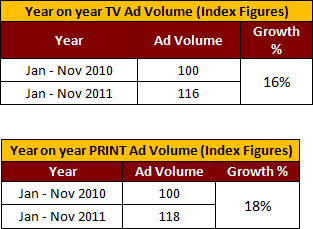
    Slowdown, as a term, might have the highest recall value for media owners in the year 2011 – more so in the case of print. Interestingly, while there would have been a dip in advertising spends in terms of value, advertising volume has in fact increased over the previous year. And even more interestingly volume growth has been higher for print media:


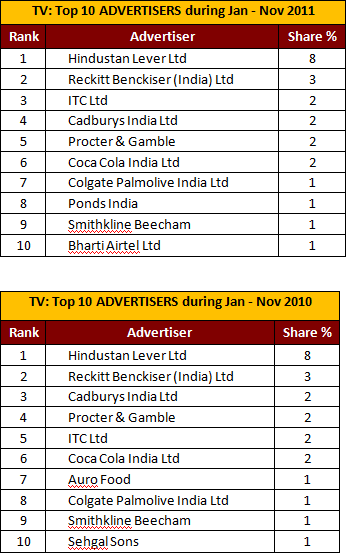
    When one moves to the top 10 advertisers for the year 2011 on television, the list seems more or less similar for 2010 and 2011, though the ranking has, of course, changed.


    Two advertisers from last year which are missing this year are Auro Foods and Sehgal Sons – both with 1 percent share.


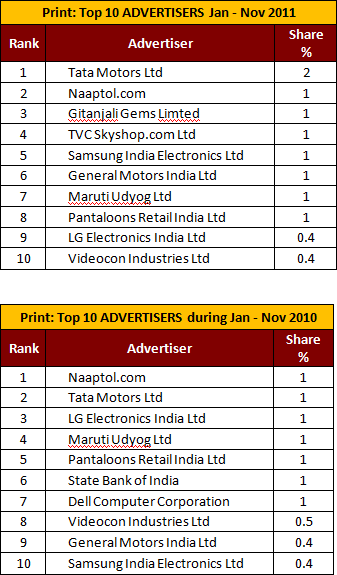
    Is the situation similar for Print? Let’s check it out: Two new entrants for 2011 are Geetanjali Gems and TVC Skyshop. The ones missing from last year are SBI and Dell Computers.


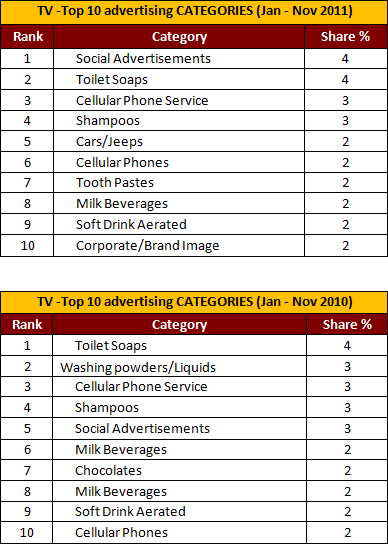
    As for the advertising categories, there are quite a few surprises when compared to the previous year, as far as television goes: Washing powders & liquids, number two category in 2010, is not in top 10 this year. Social advertisement, no 5 last, is top of the heap this year. Have a look at the tables for 2011 and 2010:


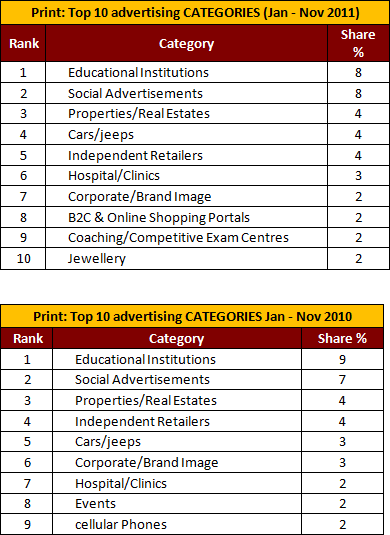
    On to print. The top five categories remain the same with just a position switch in rank in number four and five. However, there are two new entrants on eight and nine – pipping to the post the categories at those positions in 2010. Educational institutions, top category for both the years – shows a 1 percent jump in share:


    Source : TAM AdEx
    Period : Jan – Nov 2011 Vs Jan – Nov 2010
    Medium : Television & Print
    Figures for television are based on duration in seconds & are represented as index figuresFigures are based on CCMs & are represented as index figures
  • 11 reasons why I am going to be @ Frames this year

    By Pradyuman Maheshwari


    #1 This is my 11th FICCI Frames. Must say I had lost count of when the event was launched, except when I learnt yesterday that’s it’s the thirteenth edition of the event. If I remember right, I have missed out on just two years. So, couldn’t not make it this year.


    #2 This is the only time I visit the the Marriott property at Powai. The Renaissance is a great hotel and I quite prefer it to other convention hotels like Taj Palace in Delhi or Leela at Gurgaon, but three days of the trek here are enough for the whole year!


    #3 I can’t do without meeting my Frames friends. Yes, I don’t meet them for the rest of the year… these days I chat with some over Facebook or BBM, but nothing like meeting in the lobby at Frames.


    #4 Star-gazing! Thanks to the fact that Yash Chopra is chairperson of the entertainment committee and now with Karan Johar as co-chair, one can’t not find the big stars around. Last year, we had Vidya Balan pre-Dirty Picture. Now, we have Vidya Balan post-Dirty Picture. Ooh, la, la!


    #5 There is some serious discussion on digitization and with the presence of all stakeholders – the I&B secretary and the TRAI chairman, the key broadcasters and the distribution biggies, we couldn’t have had a better platform now that the sunset date in metro is a few weeks away


    #6 I enjoy Uday Shankar’s keynotes. The industry couldn’t have asked for a better champion. Given that his group is also into films in the country and his own background in news and print, there are few who have a more well-rounded view.


    #7 I am also looking forward to the session with all the legal eagles though I am unsure whether the time allotted will be sufficient for a reasonable discussion. Perhaps next year, there should be a day-long discussion with the law-wallahs.


    #8 Even though MxMIndia is a media partner and there’s no denying the fact that Frames is the premier event of India’s M&E sector, I have also been critical of a few of the earlier editions. It would get boring and I have seen no real merit in some of the deliberations. I have found media captains snooze and wish I had taken pictures of them. But I see that there is an attempt to get some new names in.


    #9 I really like Rajiv Makhni of NDTV and I’m going to try and attend all the sessions moderated by him. In fact I wonder he was only called for three of the sessions… why not all?


    #10 Clinch deals, exchange cards and pleasantries and promise to meet. Now that I am in an entrepreneurial mode, all of this assumes much importance.


    #11 And for the 11th reason why I am going to be at FICCI Frames this year: Be happy that you are part of the media and entertainment business. Okay, folks in other industry sectors may not think much of us and crib about our work – our newspapers, magazines, channels, films… whatever – but they can’t do without us.


    The views expressed here are my own, and not necessarily those of MxMIndia.com and my colleagues.

  • @FICCI-Frames 2012: TV influences life: IBF study

    By A Correspondent


    The Indian Broadcasting Foundation (IBF) has released an in-depth report on the Socio-Economic Impact of Television at FICCI Frames 2012. The IBF has conducted an extensive research in 3 phases to measure the impact of Television on Indian viewers. In the first phase, qualitative research was conducted across 20 focus groups to identify various forms in which television impacts the audience. This information was used to design the questionnaire for the second phase of the research, in which 5400 respondents were interviewed in the 7-60 years age group across 18 cities. They opined on 54 different attributes that encompassed the impact of television on their lives. The third phase of the research was a set of 25 in-depth interviews that amplified the learnings of the previous two phases. This enormous study spanned across 6 months. The research was facilitated by Ormax Media.


    The research findings are published in a formal documentthat is aptly named ‘Posi-TV-ity’. This in-depth report bears testimony to the overwhelmingly positive impact of television on audiences across the country.


    Uday Shankar, President, IBF emphasized, “Posi-TV-ity showcases the wide-ranging impact of Television beyond its conventionally understood & accepted role of being an entertainment destination. Today, television has moved ahead to offer more… a lot more. It in fact impacts the way India thinks and lives. Its impact on the socio-economic fabric of our country is indelible”.


    Today, television gone beyond entertainment and has become a medium that influences public opinion and stirs up sentiments. Everything that one sees on television has an impact and to measure that impact, this extensive study has been conducted by IBF. In this process of understanding the impact, the study has shattered several myths associated with television that were created due to stereotypes associated with it.


    In particular, Posi-TV-ity identifies 7 key roles that television plays in the life of a viewer. The study validates and substantiates these roles and impact of television in the country:


    Education – Respondents agreed that TV has helped them take more informed career decisions, financial decision and also learn new things that they could apply to their jobs.


    Personality Development – Viewers agreed that TV boosted their confidence, helped them become all-rounders and also widened their thinking.


    Social Interaction -Audience today feel that TV has helped them in having a better relationship with in-laws, keeping families together in today’s changing world, and strike a balance between Indian culture & westernization.


    Exposure – Viewers feel TV keeps them updated on the latest fashion & trends, latest products and also aids their purchase decisions. TV also keeps them informed about health related issues.


    Awakening – Respondents felt TV increases awareness of women’s rights, social issues, and rights as a citizen of India as well.


    Opportunity -It is widely believed that TV also gives opportunities to people from all over the country to showcase their talent, makes viewers feel closer to celebrities!


    Rejuvenation – Many viewers feel that TV makes sure that there is not a single boring or dull moment in their lives.


    Shailesh Kapoor, CEO, Ormax Media Pvt Ltd added, “The role television plays in the life of the Indian viewer is grossly underrated. This research identifies seven distinct roles of television, beyond entertainment. Each of these roles have a deep socio-economic or psychological connect with the viewers’ life. The research offers a new way of looking at the medium, in context of today’s India.”


  • @FF12: ‘Console gaming in India is in big trouble’

    By A Correspondent


    Console gaming today has become only an urban phenomenon, in the small towns it is the mobiles which has become a primary source of entertainment. Women too in large numbers are exploring gaming and access to mobile gaming in India is expected to further increase. In a country like India, content needs to be contextually and culturally relevant. These were some of the points raised at the Day 2 session of FICCI Frames 2012 – ‘From East to West: The Next Big Thing in Gaming.’


    This session was moderated by Mr Rajesh Rao, Founder and CEO, Dhruva Interactive. The panel members included, Mr Jithin Rao, Producer with Ubisoft; Mr Ray Sharma, Founder and CEO, XMG Studio Inc;  Mr Howard Donaldson, President, DigiBC; Mr Vishal Gondal, Founder and CEO IndiaGames; and Mr Ninad Chhaya, COO, Playcaso.


    One of the heated topic during this session was the slow death of console gaming and how mobile gaming will play a dominant role. Unlike Mr Ray who strongly believed that the Console market was in deep trouble and that there is a massive value shift happening from console to mobile gaming, his co-panelists Mr Jithin Rao and Mr Howard Donaldson believed that console gaming was here to stay and could still play a dominant role in the Country. “I don’t see the console market going away, it may still have a dominant presence despite the ongoing digital revolution” said Mr Donaldson. Mr Rao of Ubisoft said, “I don’t see console gaming going away even in the next five years because there are still hard core gamers in India. In fact we believe that every platform has its own experience to share with the consumer whether it is big screen or small.”


    Another interesting points raised during the session was the importance of mobile in the rapid growth of gaming in India. According to Mr Chhaya, “The change has been that phones are getting smarter. Consoles have become more of an urban phenomenon but, in smaller towns it is the mobile phones which have become major source of entertainment. The people in small towns are fast adapting to mobile internet. Internet on access through mobile is fast growing and the change which has come is that people have not only become more aware but, the fact that the apps system has also changed the entire environment. I would say for the better.”


    Mr Gondal observed, “Even women are exploring gaming in a big way. We are expecting four to five million Indians accessing Internet from mobile and expecting atleast 50 per cent of them playing games. In a market like India, local IP will do much better that global. On the production values, consumers are looking at higher production values with the best of the breed of contents and I believe that the consumers will not settle for anything less.”


    Mr Rajesh Rao summed up the session stating that while there are many ideas and lots of opportunities and potential in the market, the industry needs to explore them.


  • @FF12: Time to experiment with technology

    By A Correspondent


    Now that digitisation is set to come into effect from July 1, the convergence of media assumes greater significance. This was the topic of discussion in the second session on Thursday at FICCI Frames 2012.


    In a session moderated by Neeraj Roy, MD & CEO, Hungama, Sanket Akerkar, MD, MicrosoftIndiatalked about “The Converged future – Multiple platforms, technologies &transforming applications for media and entertainment”. The theme of his keynote address was significance and emergence of digitisation.


    To illustrate how connected we are today, he cited an example of how a teenaged son of a friend uses Xbox to connect with friends he was with at school and play games. Though this may common enough, he added that the group of friends used the very same environment to connect and do their homework. This can also be taken as learning life lessons of surviving in the digital world.


    Mr Akerkar said that the consumer lifestyles are controlling the conversation, citing the example the “Occupy Wall Street” movement. The industry has to takes its cues from what the consumers want. According to him, even ads will now be consumed as per the consumers’ choice and the advertisers can’t dictate the place and time for the consumption. Now the people are going to become the content creator and content consumer. The main challenge for the industry is now to seamlessly blend and enable technology to become user friendly.


    Jonathan Bill, SVP Internet and Data Services, Vodafone joined the conversation to discuss how the telco-eco system can offer better opportunity to the media and entertainment industry to monetise the services.


    Mr Bill said thatIndia’s telco-eco system is a hyper competitive market which the lowest price points in the global market. It generates the lion share of revenue in the entertainment stream for Vodafone.


    Mr Roy said that technological progress has enabled applications that recognise the customer preferences, be it the Internet or the phone.


    Mr Akerkar agreed and added thatIndiawill have 25 million smartphones by the next year and this connectivity gives the opportunity to the industry to experiment in creating applications for the users. He said that the technology is moving ahead at such speed that one only needs to use their imagination to think ‘what next innovation’.


    All the speakers were in agreement that once the digitisation bill comes into effect, the choice of content available to the user will be limitless. As Mr Akerkar said, “the challenge will be to separate content, be it mainstream or user generated into what is relevant or not.”


    They also discussed the feasibility of creating video content for mobile devices. Mr Bill was of the opinion thatIndiahas huge possibilities as it is the largest internet video consumption market. Mr Roy said thatIndiais poised to become the largest internet market in the next 3-4 years, surpassing evenChina.


    The speakers discussed how even gaming had huge possibilities if one was to look at co-developing games along with films. Mr Akerkar said that there was a business model waiting to happen if one figured how to reduce the initial cost of investment and figure out how to connect a known brand (film) and gaming.


    But the biggest challenge is the transition to the digital eco system. It is not enough to rely only on advertising revenues. Mr Bill said that the way forward is moving from free Internet content to paid content.


  • @FF12: Phase III will bring more innovation in radio


    By A Correspondent


    Radio has often been criticized for lack of content innovation, that all radio stations sound the same and that there is no differentiation in the medium currently. Although contents across all radio channels are more or less restricted to music, it is believed that once FM phase III is rolled out and multiple frequencies allowed by the government, it will lead to more innovations in content and differentiation within the medium itself.


    One of the sessions at the FICCI-Frames 2012 was on ‘Radio: Innovations in Content’ wherein industry veterans discussed at length on the innovations in content radio is witnessing currently and the enormous innovation opportunities FM Phase III would allow. While the session was moderated by Apurva Purohit, CEO Radio City, the panel members included Rabe Iyer, Business Head, Big FM; Abhijit Avasthi, Executive Creative Director, O&M; Bhavna Somaaya, Columnist and Writer; and Charles Falzon, Chair of The Radio and Television Arts School of Media, Ryerson University.


    Ms Purohit kick-started the session stating that radio currently is in a schizophrenic stage wherein on one hand the medium is witnessing immense growth, it has a huge reach in the country and the FM listenership has also further increased with higher number of mobile phones, whereas on the other hand the overall ad pie of the medium is merely 4 per cent. Ms Purohit also pointed out that in the next two years the industry anticipates another phase of growth which will bring news, sports commentary, multiple frequencies, besides further expansion into towns and cities.


    According to Ms Somaaya, “Innovation is a very subjective term and the definition changes from person to person and the state of mind one is in. I believe innovation comes only in content because technology has been exhausted and there is a whole rainbow waiting for us as there could audio books, short stories, debates, helpline etc. Radio therefore is much more immediate that any other medium.”


    Speaking about the strengths of radio Mr Avasthi first admitted that out of all the media, it is the toughest to write radio spots. He explained, “The strength of radio I believe is one can conjure up a world in the listener’s mind. What you hear on radio today is mainly restricted to Bollywood music. There are so many kinds of music still to be explored and so many types of content that can be experimented, and to break this format I believe the industry requires some amount of courage to do so.  The moment programming in radio opens up then there will be plenty of interesting opportunities for advertising in radio itself.”


    Mr Falzon highlighted the use of digital medium as a complement to engaging the listeners, “We are all experiencing a paradigm shift on how entertainment is being consumed, across the world. India has infact a better opportunity especially with the phase III expansion coming that too at a time we can think about how to use the digital medium. Digital and social media in Canada for example is being used in many ways wherein the entertainment experience of radio has been extended beyond radio.”


    According to Mr Iyer, although 80 per cent of content on radio is music and 20 per cent on the packaging of music, there has been some innovation in the medium and with the phase III launch it will bring with it immense opportunities especially on the innovation and differentiation front. Speaking on the reason radio being left out at times during advertising campaigns, Mr Iyer believed the possible reason could be because the industry has not encouraged radio creativity which in itself is a huge opportunity.


    The Q&A session which followed the panel discussion saw many people questioning the lack of innovation and the dominance of Bollywood-centric music on radio. The panelists more or less agreed that radio in India has seen lack of innovations primarily because of government restrictions which is most likely to change with FM phase III is rolled out.


    Photograph: Fotocorp