Category: SPECIALS
-
Swami Sukhabodhananda, Graham Fink and Abhishek Kapoor have joined the line-up of speakers at Goafest 2013 Additional speakers for Goafest announced
By A Correspondent
The Goafest 2013 committee has confirmed the participation of three more personalities as speakers: Swami Sukhabodhananda, Founder Chairman of Prasanna Trust; Graham Fink, Chief Creative Officer, Ogilvy & Mather China; and Abhishek Kapoor, Indian film writer and director.
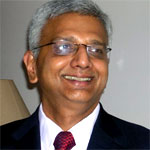
- MG Parameswaran
Goafest 2013 Knowledge Seminars Chairman M G Parameswaran said, “We have lined up a great list of speakers this year and this third set is possibly a bit different from the other names announced. We have Graham coming from China, the hottest consumer market in the world today. We also have two speakers from very different domain, and you can’t get any more different than this. Swamiji was the only speaker at AdAsia 2011 to get a standing ovation. I am sure he will bring a lot of new thought to the seminars. And who said ad awards cannot get a bit of stardust. Abhishek who delivered a super hit last month is sure to deliver a super hit talk in Goa!”

- Nakul Chopra
Goafest 2013 Chairman Nakul Chopra said, “This stellar line up of speakers is among the very best that Goafest has ever had. The added diversity that speakers like Swamiji and Abhishek bring will be a unique and welcome addition to this year’s Knowledge Seminars. We look forward to great sessions with each one of these reputed speakers.”
-
Goafest knowledge seminar convenor Dr M G 'Ambi' Parmeswaran on the thought process behind the curating of the 'gyaan' at the two-day ad festival Young also want some gyaan @ Goafest: Ambi Parmeswaran
By A Correspondent
Goafest, the annual advertising festival held in April every year, is a two-day festival of ad professionals preceded by a Conclave of senior media professionals.
This year, Dr M G Parmeswaran, executive director and CEO of ad agency Draftfcb+Ulka, is convenor of the knowledge seminars on the two days of Goafest (April 5 and 6).
Ambi, as Dr Parmeswaran, is known in the fraternity, took a few questions on the eve of the eighth edition of Goafest.
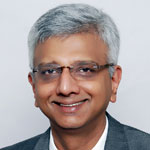 Being the convenor of the conference leg of an event like Goafest must be tough… how do you get folks to sit in for all the ‘gyaan’ when they’ve actually come to have a drink and make merry?
Over the years, we have noticed that the young are finding the seminar hangar not just a place to cool down but also for a bit of gyaan. We dramatically changed the format last year into to eight keynote speeches followed by Q&A moderated by a senior industry professional. We have also introduced a special prize for the best audience question. So instead of a panel of five people rambling on, we have one person on stage trying to engage the audience. Instead of people hesitating to ask questions, we have introduced the ‘slip’ system to curate the questions. All this added to better turn out last year. This year we are trying to bring in a couple of speakers from non-advertising domain. I am sure that will help lift the audience turn out.
So what’s been your magic formula for this year?
No magic formula, just understanding what worked last year and trying to improve on that. This year’s line-up is, in my opinion the best we have had of late. It covers a diverse spectrum. Yes, there are some last-minute snafus, and this is bound to happen when we are running the Goafest seminars on a shoestring budget. Overall the line-up is great, hope the audience think that way too.
What’s been your thinking behind inviting the various speakers – from across all spectrums – true-blue adpersons to a Swami to a tech guy to a film-maker. Expect the unexpected?
We first did a listing of areas we want to be covered -Â Creative, Strategy, Media, Digital. Once those boxes were ticked, we said let us look beyond this. We reached out to over 35 thought leaders from sociology, psychology etc. And finally decided to have it all by doing the unexpected. Swami Sukhbodananda was a speaker at the Delhi AdAsia two years ago. He was the only speaker to get a standing ovation in the entire conference. Our young professionals have not heard him, so we reached out to him and Swamiji graciously agreed. The other unexpected speaker is the Bollywood director making waves, Abhishek Kapoor of Kai Po Che fame. He has a very interesting personal story to share. Should be time well spent for the young and old in advertising.
Given that scam ads have been a discussion point in the industry, and since the key stakeholders are out there in full strength, wouldn’t an open house on the issue have been a good idea? Or is that out of the purview of what’s essentially a knowledge-sharing conference?
My agenda is to deliver a Seminar that covers a wide spectrum of topics for young and old. Your idea is a good one. May be the Abby stage should be used to have this debate, but then again that is the wrong forum.
By Arrangement with MxMIndia.com
-
Consumers have more choices but less to choose from, said the HUL chief in his keynote address at the Goafest 2013 Conclave, giving the ad industry a wakeup call to win back the trust of the people Paradox of choice is the issue: Nitin Paranjpe
By A Correspondent
It is time to listen, as the Goafest 2013 Conclave’s theme says. Hin
 dustan Unilever MD and CEO Nitin Paranjpe did exactly that in preparation for his keynote speech. He asked his team to go out and ask TV viewers what they felt about advertisements, and to his dismay, he said, he discovered that practically everyone said they found ads an unwelcome intrusion.
Thinking about what is troubling the industry today, Mr Paranjpe said, he had come to realize that the issues facing it are such that merely expecting agencies to fix them is not possible. We have to look at the larger advertising and marketing function, he said. He pointed out that the basic function advertising serves, that is, the human need to stand out, has not changed – the techniques and the medium have changed. The Why remains the same, the How has been transformed, he said.
The consumer today is faced with the paradox of choice, Mr Paranjpe said. Consumers have never had it so good. There are lots of choices, yet there is little to choose between them. Differentiation is tougher, and the pressure makes for desperate attempts to stand out, leading to meaningless differences.
In the days of Doordarshan, he said, there was no choice of channels and communication vehicles were limited to either the Hindi feature film or Chitrahaar, both sure ways of reaching one’s audience. Content was so bad that people waited for ads, he remarked. From that single channel to over 700 channels today, audience fragmentation has meant that it is difficult to reach people. Hence the bombardment of people with messages. Despite this, however, they remember nothing.
People are not interested in seeing our ads, Mr Paranjpe said, and advertisers are getting away with it because consumers do not really have much choice. But once the choice comes, he said, people will not watch ads. The cost of digital video recorders is getting lower, and with a DVR in every home, it is unacceptable that we do nothing about it, he said.
The impact of social media
Mr Paranjpe said social is transforming word-of-mouth, enabling it to become dramatically more powerful. The proverbial six degrees of separation between individuals has now shrunk to four degrees.
He said the digital revolution calls into question the precept that advertisers are the creators of content. Now, the ability of every individual to create and share content is catastrophic for marketers. In some cases the assumption that the marketer has control over social content is a mistaken one, as social media users take ownership of the content, make up their own minds about it, and it can even backfire on the marketer. He cited the case of the Vodafone #mademesmile hashtag campaign, which resulted in embarrassment when questions of tax evasion were shared using the company’s own hashtag.
Brands cannot control content any more, and in such a scenario how do we brand, how do we market? Mr Paranjpe said marketers need to profoundly rethink branding. “Yesterday was creating a myth around branding. Myths which are not founded on truth cannot survive. Today and tomorrow, branding is about finding the truth and sharing it,” he said.
Winning back the trust of the people is key, he said. “If people trust you, they will buy, recommend, share. Why don’t we do that?”
Touching on consistency, Mr Paranjpe said creativity is remarkably powerful but if it is not consistent, there is no coherence and the brand loses equity. “We underestimate the role, the power of consistency,” he said, adding that there is no disconnect between creativity and the ability to create value. “We only assume that discipline kills creativity.”
Giving purpose and meaning to advertising
The context around us today, Mr Paranjpe said, is that trust and confidence in business is at its lowest. Business cannot survive if we don’t address this. Events such as Occupy Wall Street will bring down brands, companies, governments if we don’t act responsibly.
Consumers today are more aware and concerned about big issues, but feel helpless to do anything about them. There are challenges and opportunities for brands here, Mr Paranjpe said, as a brand is basically a product to buy and an idea to buy into. Smaller brands are doing this, and big brands have to follow suit. It is possible to run a commercial enterprise while doing good, he said, and consumers who feel for the cause will gravitate to the brand which empowers them to do something about it.
The situation today is that people are cynical about brands, and about advertising and marketing. Brands have an opportunity to change this, he concluded.
Photograph:Â Shailesh Mule/Fotocorp
-
Goa Alert: Advertising cannot afford to be complacent with consumers being increasingly informed and aware + Slideshow It’s time to listen:speakers @ Conclave
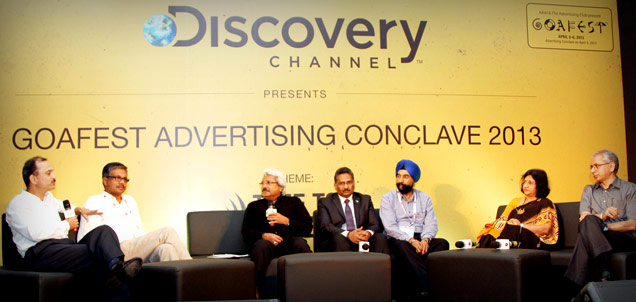
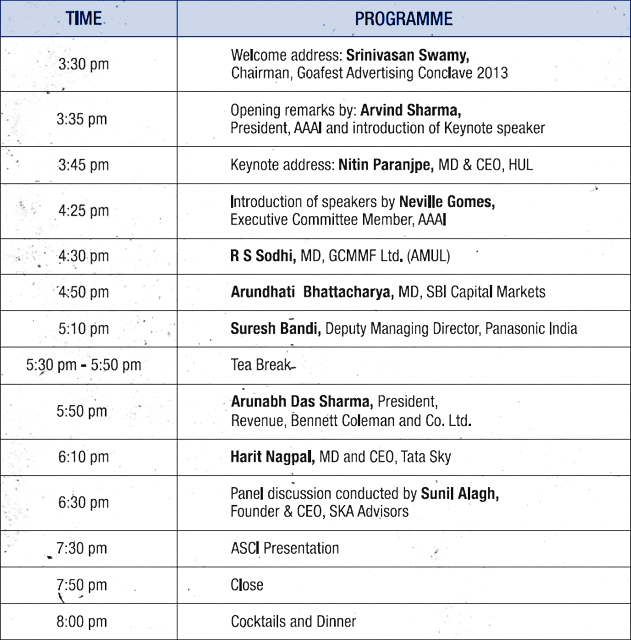
- LtoR Nitin Paranjpe, Arunabh Das Sharma, Sunil Alagh, Suresh Bandi, RS Sodhi, Arundhati, Bhattacharya, Harit Nagpal
By A Correspondent
The word Conclave suggests a serious discussion on matters of importance. While the Goafest 2013 Conclave has every intention of achieving this aim, and eventually does achieve it, one cannot put a number of intelligent, good-humoured people into the same room, ask them to speak, and then not expect at least a few chuckles.
To be fair, Conclave President Srinivasan Swamy struck a serious note when he outlined the topics the Conclave has tackled over the years, from recession, growth, change and dearth of ideas. This year, with the feeling again being that it is time to grow, the Conclave’s theme is ‘Time to Listen’, as it expects to have seniors tell the advertising fraternity what is wrong in the profession and how best to address it, he said.
Advertising Agencies Association of India President Arvind Sharma introduced keynote speaker Nitin Paranjpe, MD and CEO of Hindustan Unilever, who, he said, is a strong proponent of the idea that businesses can survive only if they seriously serve society. Most of his leadership of HUL, Mr Sharma said, has been in tough times, and he is a client who truly believes in advertising and marketing.
After Mr Paranjpe’s thought-provoking address, Gujarat Cooperative Milk Marketing Federation managing director R S Sodhi introduced a dose of levity with his presentation revolving around the engaging Amul moppet. Having worked with Amul creator Verghese Kurien, he said, had been immensely valuable as Dr Kurien understood the importance of advertising in an era when no Indian company was being advertised.
Highlighting the learnings he had gleaned from Dr Kurien, Mr Sodhi said that stability in the core team was very important, both in client and agency. Da Cunha Associates had been the custodian of the brand (Amul) from the start, and stability had paid the brand rich dividends. The core brand identity had remained the same since 1956, and there had been consistency in execution as well, which was a consequence of the complete trust there was between client and agency. In fact, Mr Sodhi said, the client sees the Amul creative only when the public sees it – that is the degree of the trust between them.
Mr Sodhi added that advertising should sell the product, not the creator of the product. “Why is creative created? It is to sell the product,” he said.
Summarising other learnings from Amul over the years, he said the agency needs to not only listen to the client, but also understand them. Raising a hearty laugh from the audience while concluding, Mr Sodhi recommended that advertising awards should be done away with. “The advertising fraternity are creating the awards and also giving them. It is the clients and the consumers who should be giving these awards,” he quipped.
Arundhati Bhattacharya, MD, SBI Capital Markets, spoke about the agency-client partnership which, she said, has to be equal. In public sector units this partnership tends to be amorphous specially since people tend to be transferred and the agency may end up dealing with a few different individuals on one account. In such cases, she said, maintaining consistency becomes difficult and the agency should make it a point to partner the organization, not the person they deal with.
For PSUs, Ms Bhattacharya said, it was often observed that agencies do not recommend new media and instead focus on traditional print. Agencies need to tailor media to the client’s needs, she said, and should understand the corporate personality and ethos. Often, she added, agency people tend to get overawed by the client to such an extent that they allow the client to dictate the ad content. Moreover, agencies need to do primary research, without which they will not have the big idea and the differentiation.
Concluding, Ms Bhattacharya emphasized the importance of keeping things simple, giving the example of the classic Jenson and Nicholson paints advertisement, which used varying visuals and the slogan, “Whenever you see colour, think of us.”
Asking the key question, “What do clients want?”, Suresh Bandi, Deputy Managing Director, Panasonic India, said the answer is Value. Value can be subjective, he said, but in general value came in the form of results, process quality, access costs and fees. Clients do not want creativity for the sake of creativity, he said. They appreciate creativity but there is a commercial objective. On process quality, he said agencies can be disorganised but there should be a method in the madness. Moreover, agency personnel must be accessible to the client – the greater the effort the client has to make to reach the agency, the lesser the value for the client. Also, he said, higher fees mean less value for clients, as they need to reduce expenses. When clients get value, it ensures their loyalty, commitment and satisfaction, he added.
Later, Arunabh Das Sharma, President, Revenue, Bennett Coleman and Co, said five trends that bother him are: Seeing the world through a 30-second TVC, separation of creative, media and account planning, the demise of planning, decline in the quality of client-facing talent, and overused excuses which leave clients frustrated.
Limiting advertising to the lens of a 30-second commercial meant both, the death of imagination and a lack of quality work, Mr Das Sharma said. He added that the decline in planning had led to lack of marketing insights, lack of imagination and consumer insights, and to media planning being subservient to media buyers.
Harit Nagpal, MD and CEO, Tata Sky, made a short and entertaining presentation on what he feels are issues that need to be addressed. Role clarity in agency-client expectations is needed, he said; Digital video recording is changing how people are watching TV, and brands must be conscious of inputs from this section; Digital is changing consumer behaviour and feedback paradigms; complexity in medium and technology means that things are no longer as they were, and both agency and client have to move with the changes; Clients have to be selective and hire professionals and specialists; and agencies have to take a stand, confront and contradict the client if required, and for that they need to hire strong people to meet with clients. Sunil Alagh, founder and CEO, SKA Advisors led the final panel with a Q&A of the speakers of the day.
Photograph:Â Shailesh Mule/Fotocorp
-
Mindshare continues dominance in awards with 10 metals at the Media Abby Goafest 2013 Mindshare tops in Media Abby 2013
By A Correspondent
>It was the first day of awards at Goafest and media major Mindshare was flying high being ahead of the pack. The Group M agency continued its domination of the media advertising agency awards scene in recent times by bagging 10 metals in all, three of these being golds.
While there were no Grand Prix awarded in the Media Abby, the highest level of awards in each category, Starcom Mediavest, Interface Business Solutions and Milestone Brandcom bagged a gold each. Although in terms of number of metals, Maxus was #2 with a tally of six, the bulk of its metals were bronze. Lodestar UM and BBDO Proximity bagged two silvers each.Crediting his team’s hunger for effective work and also awards, Ravi Rao, Leader, South Asia, Mindshare said that his clients also active encourage them to “break through the norms and come up with unique and different but also be effective in the process”.
And how does Rao expect to carry on the winning spree into the next awards season? “Well, continue to do disruptive ideas that can really come alive, implementation is key but at the end it should be effective on the brands.”
As many as 660 entries were received in the Media Abby category from 50 agencies. Of these, 16 agencies bagged 46 awards.
Other than the Media Abby, awards for three award categories from the Creative Abby were also given away. These being from the Design, Direct and Digital domains. The highlight here was that Interface Business Solution won a Grand Prix for Tata Docomo.
The Abby, which is organized by the Advertising Club at Goafest each year, is regarded as India’s most recognized award for the advertising fraternity.
Sr No Name of the Agency Grand Prix Gold Silver Bronze Total
1
Mindshare
 3
6
1
10
2
Starcom Mediavest Group
 1
1
2
4
3
Interface Business Solutions (I) Pvt.Ltd
 1
Â
2
3
4
Milestone Brandcom
 1
Â
Â
1
5
Lodestar UM
 Â
2
3
5
6
BBDO Proximity India
 Â
2
Â
2
7
Maxus
 Â
1
5
6
8
Madison Media -Pinnacle
 Â
1
4
5
9
Interactive Avenues Pvt. Ltd
 Â
1
1
2
10
McCann Worldgroup
 Â
1
Â
1
11
Mediacom Communications Pvt. Ltd
 Â
1
Â
1
Source: Goafest/Media Abby. Note: the ranking, done in the Olympic style with metal type being the yardstick, is not provided by the organizers.
-
If an organization does not act like a startup and put the customer first, someone else will, said the Razorfish CTO, speaking at Day 1 of Goafest 2013 Put customer first: Ray Velez @ Goafest 2013
 By A Correspondent
With the mantra being Digital everywhere one looks, it was not surprising that this theme predominated at the knowledge seminars on Day 1 of Goafest 2013.
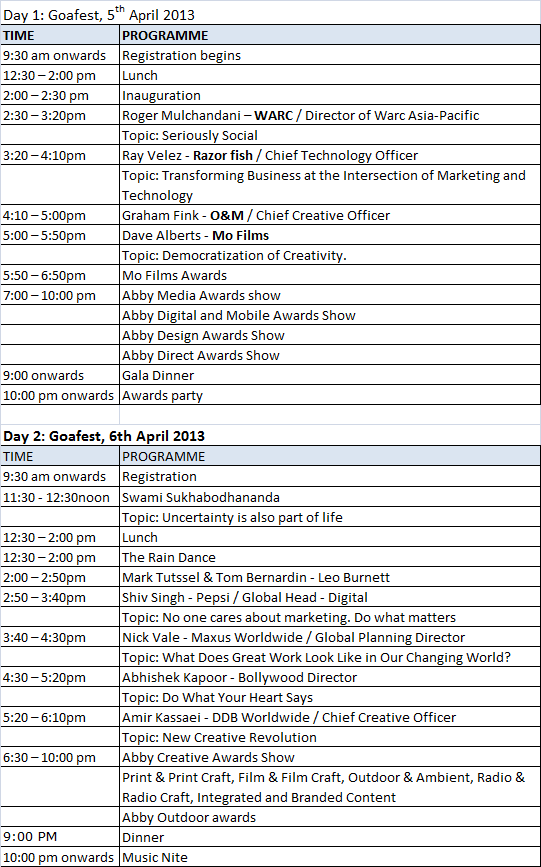
The most significant points came from Ray Velez, Chief Technology Officer of Razorfish, who spoke on Transforming Business at the Intersection of Marketing and Technology. Emphasising that technology is transforming the customer experience, he cited a Gartner study which predicted that CMOs will own more of the technology budget than CTOs.
This meant that technology plus media plus creativity made for the new brand experience, he said. Traffic is now two-way, and the hashtag is a way for customers to communicate back to the brand.
He said there are five principles that must be embraced:
1. Put the customer at the centre.
2. Think of your brand as a service.
3. Reject silos.
4. Act like a startup.
5. Embrace diversity.
Your organization must be structured around the customer, Mr Velez said. What you get is data based on actual activity, in digital more than anywhere else. Strategy must be based on actual data from customer feedback. Marketing, technology and creativity are no longer discrete activities. If you don’t act like a startup and put the customer first, someone else will.
As an example of such proactive responsiveness, Mr Velez cited the case of the Smart Car / Smart USA Twitter reaction to negative comments about the car. The tack taken was Humour the Haters, and for every wisecrack about the car, the company put out well-thought out, informed responses which gained them a great deal of goodwill and appreciation for the wit and good humour with which they had handled the comments.
Mr Velez stressed that the organization must be structured around the customer; and that if it does not put the customer first, someone else will.
Roger Mulchandani, Director of Warc Asia-Pacific, tackling the topic of ‘Seriously Social’, said the traditional way of looking at television and digital as rivals was no longer valid. TV and digital are buddies, he said, as their roles were overlapping and often symbiotic.
Social media is certainly here to stay, he said, but he also highlighted the dangers of over-reliance on it. In any given week, less than 0.5 percent of a brand’s Facebook fans engaged in any actual engagement with the brand that they are fans of. That is how effective Facebook really is, he said, and added that we need to lower our expectations of brands on social media. Social media should be used for reach rather than loyalty, he suggested.
Nick Vale, Global Planning Director of Maxus Worldwide, speaking on “What great work looks like in our changing world”, said that the focus needs to shift from the big idea to the long idea, ie, ideas that are sustainable over time and have staying power. Digital was a great enabler, as it can make ideas now live beyond the screen, he remarked. He added that the focus should be on storytelling across channels, not silo-based thinking.
Each speaker also interacted with the audience in a Q&A session at the end of their talk, and the best two questions in each session won iPads.
-
The Mo Film honcho said in hi s Goafest address that for a filmmaker the most important aspect of democratization is freedom Filmmakers need freedom: Dave Alberts @ Goafest 2013
 By A Correspondent
Dave Alberts of Mo Film, speaking on Democratization of Creativity, said that for a filmmaker the most important aspect of democratization is freedom. He said that independence of thought was key to making groundbreaking and memorable films.
He showed examples of films made independently by small and individual filmmakers, and said that technology was increasingly enabling filmmakers. “Any filmmaker can make a film of broadcast quality,” he said, quoting Francis Ford Coppola who had once remarked, “Some little fat girl in Ohio is going to make a beautiful movie with her father’s camcorder.”
“The exciting thing about the internet and technology is that it is giving creative people a stage,” Mr Alberts said, adding that the agency should keep the process simple in order to liberate creatives. This only helps the client, he said, because different films have different roles, and with democratized creative, one can make certain types of films to reach specific targets.
He said Mo Film had always encouraged independent film-makers, said Mr Alberts, and took the opportunity to announce their contest for a Durex film that interested people could bid for.
-
The dominance of digital dominated discussions on Day 1 of Goafest 2013 Digital dominates discussions @ Goafest 2013
By Vidya Heble
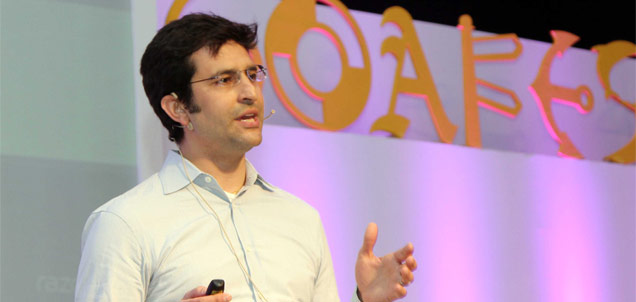
With the mantra being digital everywhere one looks, it was not surprising that this theme predominated the knowledge seminars on first day of Goafest 2013. Thursday’s speakers were part of the Industry Conclave which always precedes the two-day Goafest, the Indian advertising trade’s flagship convention-and-awards event.
The most significant points came from Ray Velez, Chief Technology Officer of Razorfish, who spoke on Transforming Business at the Intersection of Marketing and Technology. Emphasising that technology is transforming the customer experience, he cited a Gartner study which predicted that CMOs will own more of the technology budget than CTOs. This meant that technology plus media plus creativity made for the new brand experience, he said.
Mr Velez stressed that the organization must be structured around the customer; and that if it does not put the customer first, someone else will.
Dave Alberts of Mo Film, speaking on Democratisation of Creativity, said that for a filmmaker the most important aspect of democratization is freedom. He said that independence of thought was key to making groundbreaking and memorable films.
He showed examples of films made independently by small and individual filmmakers, and said that technology was increasingly enabling filmmakers. “Any filmmaker can make a film of broadcast quality,” he said, quoting Francis Ford Coppola who had once remarked, “Some little fat girl in Ohio is going to make a beautiful movie with her father’s camcorder.”
“The exciting thing about the internet and technology is that it is giving creative people a stage,” Mr Alberts said, adding that the agency should keep the process simple in order to liberate creatives. This only helps the client, he said, because different films have different roles, and with democratized creative, one can make certain types of films to reach specific targets.
Nick Vale, Global Planning Director of Maxus Worldwide, speaking on “What great work looks like in our changing world”, said that the focus needs to shift from the big idea to the long idea, that is, ideas that are sustainable over time and have staying power. Digital was a great enabler, as it can make ideas now live beyond the screen, he remarked. He added that the focus should be on storytelling across channels, not silo-based thinking.
Roger Mulchandani, Director of Warc Asia-Pacific, tackling the topic of ‘Seriously Social’, said the traditional way of looking at television and digital as rivals was no longer valid. TV and digital are buddies, he said, as their roles were overlapping and often symbiotic.
Highlighting the dangers of over-reliance on social media, he said that in any given week, less than 0.5 percent of a brand’s Facebook fans engaged in any actual engagement with the brand that they are fans of. That is how effective Facebook really is, he said, and added that we need to lower our expectations of brands on social media. Social media should be used for reach rather than loyalty, he suggested.
Each speaker also interacted with the audience in a Q&A session at the end of their talk, and the best two questions in each session won iPads.
A highlight of the day was the IAA Debate organised on the sidelines of Goafest which saw senior members of the industry debating whether with fragmentation of the media, the role of creative advertising has become more important in brand communication. Vikram Sakhuja and Anupriya Acharya from the Group M fold were against the motion while Prasoon Joshi from McCann Worldgroup India and Partha Sinha of BBH India were for the motion. The debate was won by those against the motion.
The Media Abby and Creative Abby awards in the Digital, Design and Direct categories were awarded in the evening. Saturday is the closing day of the event with some more knowledge session, the rest of the Creative Awards and a rain dance to add to the festive spirit.
-
Leo Burnett bagged 71 awards with 9 golds. McCann Worldgroup bagged 56 metals which included a Grand Prix and 7 golds while JWT India took home 48 awards with 5 golds Leo Burnett maxes metals at Creative Abby
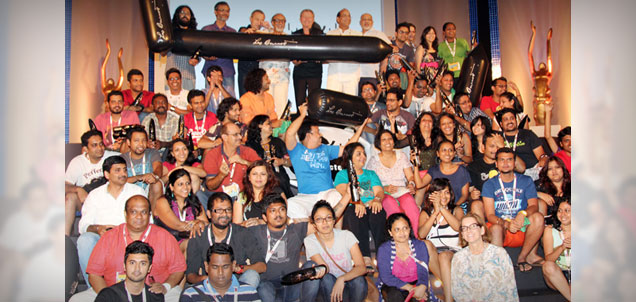
Team Leo Burnett celebrating its rich pickings at the Creative Abby By A Correspondent
The Men in Black from Ogilvy may have opted out from participating at this year’s Creative Abby but that did not deter around 4300 entries from vying for the most coveted crowns in the fraternity. The Creative Abby, as the Advertising Club’s awards recognising creativity is known, traditionally marks the culmination of the two-day Goafest.
Leo Burnett bagged 71 awards of which nine were golds. McCann Worldgroup got 56 metals which included a Grand Prix and seven golds. JWT India got 48 awards with five being golds.
Other than McCann, Grey Worldwide and Interface Business Solution were awarded Grand Prix.
The metals have four grades with Grand Prix right at the top and Bronze at the lowest. Typically, Goafest’s Awards Governing Council does not hand out rankings of agencies as per award metals received.
Last year, at Goafest 2012, Ogilvy received maximum metals and Leo Burnett was among the Top 5 with 3 Golds, 11 Silver and 21 Bronze (Total 35). JWT India has improved its performance from last year. Taproot India has dipped since last year with just one gold, four silvers and 13 bronzes (Total 18) while it was flying high with 6 Golds, 13 Silvers and 15 Bronze (Total 34) last year.
Top Awarded Agencies Agency Grand Prix Gold Silver Bronze Total McCann Worldgroup 1
7
15
33
56
Grey Worldwide India 1
0
7
6
14
Interface Business Solution 1
0
0
0
1
Leo Burnett 0
9
34
28
71
JWT India 0
5
17
26
48
Photograph by Shailesh Mule/Fotocorp
-
The second day of Goafest 2013 opened with an unusual speaker, Swami Sukhabodhananda, who advised the audience on how to tackle uncertainty. Swami steals the show on Day 2 @ Goafest 2013
- Swami Sukhabodhanand
By A Correspondent
Uncertainty may well have been the theme of the past few years, what with the weakened economy and downslides in many industries. Management guru Swami Sukhabodhananda went for the jugular of the topic, opening the innings on the second day of Goafest 2013 with pithy and good-humoured advice to the audience on how to tackle uncertainty.
Speaking on “Uncertainty is also part of life”, he started by examining the perception of uncertainty itself. “You think you are seeing right, but if your context is wrong your perception is distorted,” he said. “We need to perceive our uncertainty properly.”
Uncertainty is the problem, he said, as it distorts our perception of the world. “We operate on fear, which makes us experience uncertainty in a distorted way. Buddha said we never experience an experience because the experiencer pollutes the experience.” Sukhabodhananda had the audience roaring with laughter with intermittent jokes and humorous examples illustrating his points. He told the joke of a taxi driver, who nearly jumped out of his skin when the passenger tapped him on his shoulder. The explanation for his reaction was that it was his first day on the job after 25 years of being a hearse driver.
Shiv Singh, Global Head (Digital) of Pepsi, spoke about “Why no one cares about marketing” and outlined five ideas which he said were important in the current climate.
1 Leaving marketing behind and engage in deeper creative collaboration;
2 Think about experiences, not more ads;
3 Bet on Facebook but not for the sake of mere likes, focus on engagement;
4 Develop a 365-day culture, be with the brand consistently;
5 Capitalise on the India opportunity, lead the world. Nothing can stop you.
Speaking on the theme of “Do what your heart says”, Bollywood director Abhishek Kapoor, who received a rousing welcome with whistles and cheers from the audience, spoke about how his early years had been a time of struggle and a lot of self-doubt. Still, he said, he had persevered because he believed in what he wanted to do. It is all the more difficult to carry on when everyone around you is casting doubts on your goal, he remarked.
By this time the audience may have been mentally gearing up for the awards, but DDB Worldwide’s Chief Creative Officer Amir Kassaei grabbed and held their attention with a no-holds-barred presentation on the “New Creative Revolution”. At the outset he debunked the theory of social media, call in it bullshit. “Digital is the electricity of the 21st century,” he said. “Facebook is a way for people to connect, an infrastructure that can help marketers become more efficient about their brand.”
Receiving another rousing ovation, Mr Kassaei exhorted creative people to stop thinking about awards and about making funky ads. “We are not in the business of advertising, we are in the business of making our clients’ brands and business relevant. Winning awards only proves that you are good at winning awards,” he quipped.
Q&A exchanges followed each speaker’s presentation, with the best two questions in each round winning iPads.
The seminar sessions were punctuated with the much-awaited rain dance, and were followed by the even more awaited Abby Creative Awards.