
Category: Opinion – Archives

  • Promoting or Muzzling the Digital Media


    By Indrani Sen


    The Ministry of Information and Broadcasting issued a public notice on November 25 soliciting suggestions/ comments/ inputs from the stakeholders on the draft “Registration of Press And Periodicals (IPP) Bill, 2019”. It also announced that the IPP Bill 2019 will replace the “Press and Registration of Books (PRB) Act, 1867‟. The 152-year-old PRB Act of 1857 has been amended from time to time in the past and it is high time that a comprehensive new version replaces the act of the British period. On the face of it, industry would have been ready to accept MIB’s move.


    However, the salient features of the IPP Bill 2019 highlighted by the Ministry in the Annexure to the draft bill have raised many questions. It appears that the process of title and registration of all press and periodicals will be controlled centrally by the Press Registrar General (who will replace the current Press Registrar) appointed by the Government, doing away with the custom of publishers and printers furnishing declaration to local District Magistrate for authentication. This will undoubtedly raise the cost of the process for small publications that will have to travel to Delhi for registering their publications.


    The IPP Bill 2019 also proposes to strengthen the hands of Central and State Government by giving them the power of framing appropriate rules/ regulations for controlling the accreditation of publications and releasing of Government advertisements. This is ambiguous as if such power is entrusted with both Central and State Government and if in a particular state the local government does not belong to the ruling party at the centre, then a controversy may arise related to accreditation and release of government advertisements in the publications published from that state.


    One salient feature assures that the Bill proposes to do away with the provision under the PRB Act, 1857 of prosecution of publishers. However, going through the details of the draft, one discovers that the publishers can be fined by the Press Registrar General for not abiding by the rules and guidelines provided in the bill, but would not be prosecuted for jail terms. Reading between the lines, it appears that the publishers will have less scope of defending themselves as they would be given a dictate by the Press Registrar General and most likely would have to first pay the fine before starting a court procedure to protest against the dictate/ the fine imposed on them.


    Not highlighted as a Salient Feature but very salient for the publication industry is the proposed clause that Editors must be Indian citizens. MIB should look into how many Indian journalists work abroad as editors of foreign publications. Why should we impose such clauses restricting the scope of employment in India in the era of globalisation?


    Last but not the least, is the Salient Feature “The Bill proposes to have a simple system of registration of e-papers”. The modus operand of the simple system has not been spelled out in the draft bill. As and when MIB finally details it out, one may find it complex instead of simple. However, it is obvious that the intention of the Ministry is to bring all digital platforms dealing with news, e-papers and digital news websites under the governance of MIB.


    Some people within the industry are arguing that the registration requirements for periodicals do not apply to digital-only media houses as the definition of ‘publication’ in the draft bill says anything which is printed on paper and is meant for public distribution including periodicals, newspapers & books”. I would like to point out that the draft Bill does include a definition for ‘news on digital media’, and Section 18 of the draft RPP Bill, 2019 says that publishers of news on Digital Media shall register themselves with the Registrar of Newspapers of India in such manner and giving such particulars as may be prescribed.


    Apart from the fact that the phrase “such Particulars as may be prescribed” is dangerously open to unforeseen and unwelcome possibilities, Section 18 raises the question how do we define publishers of news on digital media? Who all are included in the definition? The digital version of traditional newspapers and TV News Channels; digital-only websites dealing with different types of news (political, sports, entertainment, industry specific, etc. etc.); OTT platforms carrying news sections; websites of various industry and technical associations carrying specialised news; websites of companies carrying news about them, their associates and links to related media releases; websites of academic institutes carrying news about their admission, courses, academic delivery, etc.- the list is endless. How will MIB control news websites not registered in India but available to Indian Netizens?


    In this game of playing catch with the digital media, MIB poses not only a severe threat to the freedom of digital media, but may also end up scrapping the proposal and making a fool of themselves. If it was so simple to control the digital media, then more advanced western nations would have done so by this time. No Democratic country in the world has been able to implement such rules and regulations for controlling the digital media. It would be interesting to wait and watch the developments in India.


    Indrani Sen is a veteran media professional and now an educator. She writes weekly for MxMIndia. Her views here are personal

     

  • What’s Hot on Online Video Viewing


    By Indrani Sen


    Hotstar, India’s largest video viewing platform, launched the third edition of its India Watch Report last week. The report is an in-depth study of online video consumption behaviour and trends of Indian viewers on Hotstar and narrates their deep connection with various genres of video content.


    As observed by ET Brand Equity on December 11, 2019, “From becoming the favourite destination for cricket lovers on the internet to making Game of Thrones a household name, where viewers in India woke up at 6:30 in the morning to watch episodes of the cult fantasy series, Hotstar has come a long way, and in the process played a critical role in shaping the country’s binge-watching culture.” (https://brandequity.economictimes.indiatimes.com/news/media/hotstar-decodes-the-online-video-consumer-unveils-india-watch-report-2019/72472795)

    The report has unveiled quite a few surprising facts, broken a few myths and has highlighted delightful insights through ‘Fun Facts’ under each topic explored in it. Uday Shankar, President, The Walt Disney Company APAC & Chairman of Star and Disney India says in the introduction “Until a few years ago, online entertainment was restricted to the urban affluent. However, we now see newer horizons of customer reach, with non-metro towns driving online consumption. Digital viewership among women has also grown by leaps and bounds. Moreover, Hotstar’s pan-India consumer base reveals how each person has unique and individual choices – men are watching drama and movies from the South are being consumed in the North. While the enchantment of cricket remains unabated, customers are increasingly getting attracted to kabaddi and football. The new Indian consumer is breaking old stereotypes and defying conventional wisdom.”

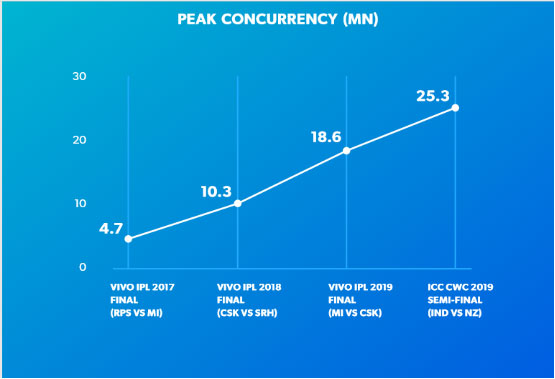
    In 2019, Hotstar saw 555 installs per minute and compared to 2018, the number of installs doubled. Video consumption went up three times compared to 2018. The chart tilted ‘Roti. Kapda. Makaan. Data.’ shows the degree of data consumption by states and surprises us by revealing that West Bengal and Bihar has more data consumption per viewer that Maharashtra and Karnataka. Live viewership of peak consumption of cricket events over 2017, 2018 and 2019 shows it is growing in leaps and bounds.


    Source: India Watch Report 2019

    95% of the video consumption on Hotstar comes from mobiles, which continues to be the primary screen for the users. An analysis of content category split by platform shows that Indians love entertainment, ranging from85% on Connected TV to 58% on Android. Sports are next in a reverse order ranging from 42% on Android to 15% on Connected TV. While most viewers happily switch their smartphone brands, viewers in West Bengal and Kerala have a loyalty to Samsung.

    There has been a shift in the demographics of online viewers of entertainment with the share of non-metros going up from 54% in 2018 to 63% in 2019 and Lucknow, Pune and Patna Surpassed Hyderabad, Bengaluru & Kolkata in video consumption. The overall share on women viewers in entertainment grew from 42% in 2018 to 45% in 2019, but overall video consumption by women grew by 3.2 times over last one year. According to the report “More women are owning their right to me-time!”

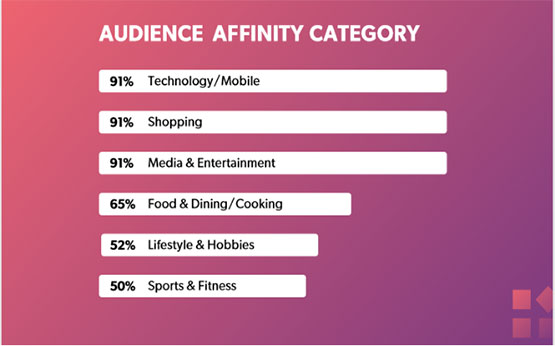
    There has been a huge surge in shopping and food enthusiasts online, particularly over the weekends with these becoming the fastest-growing affinity base on the Internet.


    Source: India Watch Report 2019

    As reflected by consumption across other media, 40% of total video consumption comes from regional languages with Tamil, Telegu and Bengali leading the list. While 80% of Tamil and Telegu video consumption comes from the native states, only 65% of Bengali comes from West Bengal. In cricket also language and loyalty went hand in hand with 2 times jump in Tamil consumptions during CSK matches, 1.6 times jump in Bengali consumption during KKR matches and 1.5 times jump in Kannada consumption during RCB matches.

    The report breaks myth of premium content for exclusive audience by highlighting 40% of Game of Throne viewers and 30% of Koffee with Karan viewers also watch Hindi family dramas. The fact that 40% of viewers of family dramas are men is also surprising as unlike the viewership of the family owned big screen TV, this data is based on individually owned small screen viewership on mobile. An analysis by genres again show men don’t dislike Hindi TV serials and their interest for family and mythological shows is at par with women.

    The report presents Leaderboard of TV shows and movies during 2019 highlighting women prefer scripted dramas over reality shows; Hindi movies are a hit with Mumbai showing the highest consumption, while Bengaluru leads the fandom for English movies.

    In 2019 online video consumption of news grew by 10 times compared to 2018 with consumption per user growing up 3.5 times. Millennials led the way with 65% of news consumption coming from the age group of 15-34. Delhi consumed the most news in India and surprisingly Lucknow and Patna watched more news than Mumbai.

    In sports, Cricket reigned supreme across India and became more interactive in 2019 as Hotstar combined viewing with video games, fandom and food. There is a section ‘Hall of Fames’ giving details of moments that gripped India during cricket matches, Leaderboard of cricket matches as well as most viewed ads during cricket matches. The report shows consumption of both football and kabaddi went up during 2019 but detail analysis shows that football is popular in South India and East India, while Kabaddi is most-watched in Uttar Pradesh and South India.

    The report presents a chart showing city wise log off timings. With the ever-growing options for entertainment and other content, sleep has taken a back seat. However, Mumbai, the city that never sleeps is not the last to sleep. Kochi and Gurugram surprise by staying awake more with Hotstar.

    Finally, kudos to the Hotstar team for the way they have developed India Watch 2019 as their marketing tool. Apart from enlightening the industry through facts and figures related to viewership on Hotstar, it has showcased case studies of how certain brands achieved their marketing objectives by advertising on Hotstar. In the disguise of a research report on video viewership, the report is an excellent marketing pitch to the advertisers and agencies for choosing Hotstar as their video viewing platform and converting non users of the medium to users.


  • Milestone Year for Mobile


    By Indrani Sen


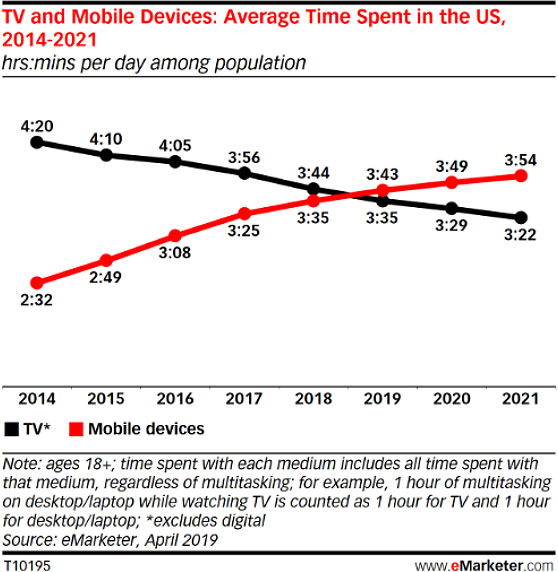
    The current year will go down as a milestone year in the history of Mobile when 5G networks, the next generation of mobile internet connectivity was launched and in US TV was dethroned for the first time by Mobile as the media channel where Adults in US spend the most time.


    In April, 2019 Verizon surprised most of the world by launching first its 5G network in Chicago and few other locations. UK was not far behind as EE launch its 5G network, switching it on in six cities in UK in May 30 2019,  followed by Vodafone launching 5G  in seven cities in July 3, 2019. Australia soon followed suit. China and Korea have also been planning 5G network for a long time and launched the services around mid- 2019. China has officially announced that they will have 150 million 5G mobile subscribers by 2020. By end of 2019, 5 million Koreans are expected to have 5G phones.


    On December 19, 2019 www.emarketer.com  announced in a report that the average US adult spent 3 hours, 43 minutes (3:43) on their mobile devices in 2019, compared with the average 3:35 spent watching TV (https://www.emarketer.com/content/mobile-year-in-review-the-launch-of-5g-is-the-biggest-story-in-a-busy-year-for-mobile?ecid=NL1001). Only three years back, in 2016 the same US adults watched nearly an hour more of TV than they spent on their smartphones and tablets (4:05 vs. 3:08). The forecast made by www.emarketer.com shows that the trend is going to continue with the share of time spent on mobile climbing higher year on year.


    In India, we are seeing the trend of increasing time spent on digital media driven mainly by mobile, but we have still years to go before an average adult Indian starts spending more time on mobile than on TV. But the trend has set in among select target audience groups including millennials at the upper and lower end of the economic ladder. A survey is conducted among college going students who including their travel and class hours spend a lot of time outside their home about time spend on TV and on mobile, may find that they are already spending more time on mobile than on TV, helped by the choices available on OTT platforms. The student community is a mix of young people coming from lower middle class to upper class homes, but almost everyone today owns a mobile which has become a necessity rather than a luxury.


    Reliance Telecom Services celebrated three years of Jio in 2019. Jio has revolutionised the use of mobile among certain working class people like auto rickshaw drivers, household maids who often indulge in seeking entertainment through their mobiles during short breaks in their work schedule. Such people usually have long working hours and as a result may have started spending more time on their mobiles than on watching TV at home. Again a survey conducted among such target audience groups may reflect the truth, but as these people have poor purchasing power, a survey among them will serve only academic interest.


    Current research conducted by different agencies are showing that time spent on digital media including mobile is growing at a faster rate than all other media in India. A recent report by McKinsey showed that with data becoming more accessible, monthly mobile data consumption per user is growing at 152 per cent annually in India — more than twice the rates in the United States and China and internet users will rise by about 40 per cent and number of smartphones will be double by 2023.
    (https://economictimes.indiatimes.com/tech/internet/internet-users-in-india-to-rise-by-40-smartphones-to-double-by-2023-mckinsey/articleshow/69040395.cms?from=mdr ) Time spent on mobile internet has gone up from 9.4 minutes daily in 2013 to 54 minutes in 2019 and is expected to reach 79 minutes by 2021.


    Global Web Index’s Social Media Trends 2019 Report showed that Indian users spent 2.4 hours on social media, in line with the global average (https://www.globalwebindex.com/reports/social) This finding is confusing as if the average time spent on mobile internet is 54 minutes then how can Indian users spent 2.4 hours on social media which is mostly consumed through mobile internet? The sample size of the social media survey covered 15000 Indians among 2.78 lakh respondents across 45 countries, but the details of the sampling frame work is not available, so it is difficult to figure out if the survey was limited to mobile users only which will explain the discrepancy.


    The writings on the walls are very clear, like the rest of the world the average adult Indian will also be gradually moving to spending more time on mobile than on TV. The global milestone year 2019 should be an inspiration for our telecom industry to accelerate their growth plans and move in that direction.


  • The Four Giant Leaps


    By Indrani Sen


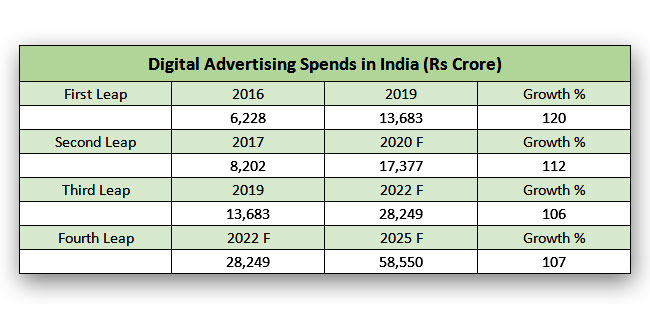
    According to the DAN Digital Advertising Reports, spends on digital advertising in India is increasing by 100%+ every three years and is poised to cross the 50,000 crore milestone before 2025. It was only in the second half of the last decade, the Indian advertising industry crossed the milestone of 50,000 crores, so it seems strange that the newest and youngest competitor for the share of the advertising pie will be crossing that same milestone by middle of this decade! We have already witnessed the first giant leap from 2016 to 2019 and it seems quite possible that in three more giant leaps digital advertising will achieve this fantastic growth.


    Digital Advertising Spends in India (Rs Crore)
     First Leap 2016 2019 Growth %
    6,228 13,683 120
    Second Leap 2017 2020 F Growth %
    8,202 17,377 112
    Third Leap 2019 2022 F Growth %
    13,683 28,249 106
    Fourth Leap 2022 F 2025 F Growth %
    28,249 58,550 107

    Source: DAN Digital Advertising Reports


    The question which comes up next is which industry verticals are contributing to this spectacular growth of digital advertising? An analysis of the DAN Digital Advertising Reports show that almost across all industry verticals, advertisers have been increasing their spends across various platforms of digital advertising. The following table shows the comparative weightage on digital advertising by industry verticals in their total advertising budget in 2017 and 2019. Except Media & Entertainment where the weightage has remained 23% and miscellaneous small categories grouped under “others” where the weightage has gone down, across all other industry verticals, advertisers stepped up their expenditure on digital media. Digital media is no longer a myth; it is a reality now competing for share of the advertising pie and propelling the growth of advertising in India.


    Weightage on Digital Advertising
    2017 2019
    FMCG 7% 19%
    Auto 12% 16%
    E Commerce 30% 37%
    Retail 16% 20%
    Telecom 28% 35%
    BFSI 24% 42%
    M&E 23% 23%
    Consumer Dur 19% 38%
    Others 9% 4%

    Source: DAN Digital Advertising Reports


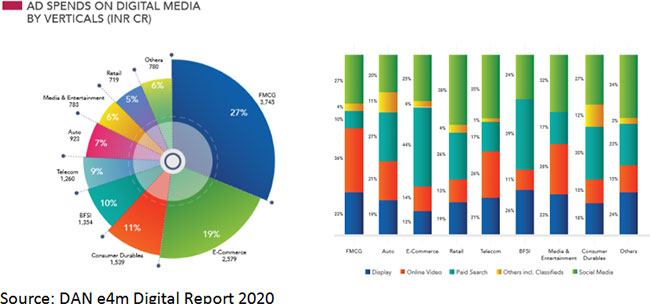
    Though FMCG as a category spends 19% of their advertising budget on digital media, it contributes 27% of the total digital advertising pie, followed by E Commerce 19%, Consumer Durable 11%, BFSI 10% and Telecom 9%, followed by others as shown in the chart below on the left. So, across all industry verticals, advertisers have got into the Indian digital bandwagon.


    The next chart on the right shows that based on the target audience and their use of different digital media, the various industry verticals use the different digital formats for advertising; while E Commerce and BFSI rely more on paid search, Retail and Telecom rely on Social Media. However, a comparison of 2017 and 2019 shows that the share of formats in digital advertising have hardly changed except video increasing at the cost of classified and paid search.


    2017 2019
    % %
    Social 28 28
    Paid Search 26 25
    Display 21 21
    Video 19 22
    Classified 6 4

    Source: DAN Digital Advertising Reports


    In 2017, 43% of the digital advertising was through mobile, which increased to 47% in 2019 and is expected to grow to 53% in 2020. Clearly, the mobile revolution in India has contributed in a large way to the growth of digital advertising. By the time digital advertising crosses the 50,000 crore mark mobile will have 60% + share in that revenue. Programmatic buying has also been growing year on year and by 2020 direct buying will be 44% with programmatic buying going up to 56%.


    The digital media industry still faces many challenges, but apart from a detail discussion on ROI for digital advertising, the current report does not touch on the other issues like ad fraud, ad blocking software, lack of metric for measurement etc. On the whole, the DAN e4m Digital Report 2020 is an informative and excellent resource and the advertising and marketing industry should be thankful to the leadership of Dentsu Agies Network for sharing it free with all concerned.


  • A Roller Coaster Ride of Adspends


    By Indrani Sen


    It appears from GroupM’s This Year Next Year (TYNY) 2020 report that the Indian ad Industry is on a roller coaster ride in spite of the slowdown in certain sectors of the manufacturing industry and hits and misses in agriculture during 2019. Prasanth Kumar, CEO – Group M South Asia expects sustained and stable investment across the media in India in 2020.


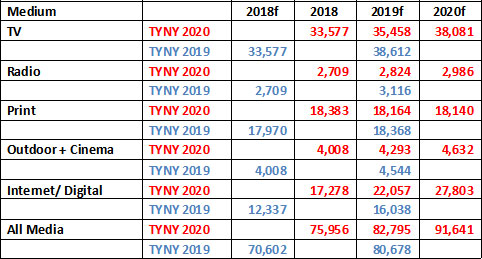
    GroupM predicted in TYNY 2019 that the World AdEx will grow by 3.67% from 2018 to 2019 and the Indian AdEx will grow by 14%, higher than the CAGR growth of the previous four years. In TYNY released last week, GroupM has estimated that world AdEx grew by 3.7% from 2018 to 2019, but Indian AdEx grew by only 9% against the earlier estimated growth of 14%. However, there was no comment on the drop of growth rate in the press release issued by Group M.


    I initially thought that probably the drop in the growth rate of adspend was due to the slowdown in the industry, but a closer look at TYNY2019 and TYNY2020 statistics showed that upward revision of the estimate of the total adspend in India in 2018 led to lowering of the growth rate from 14% to 9%. A comparison of the two reports is shown in the following table.


    Indian Adspend (INR crore)


    It is interesting to note that the forecast for 2018 for Digital as shown in TYNY2019 was increased by 40% in actual adspends of 2018 shown in TYNY 2020. Estimate for Print was also increased marginally while all other estimates remained the same. These changes in Digital and Print adspends resulted in an overall increase of total ad spend from 70,602 crore to 75,956 crore in 2018. GroupM should have added an explanatory note in their press release to warn the users of TYNY about these changes in their estimates as reflected in TYNY 2019 and TYNY 2020.


    As per TYNY 2019, India was 10th largest market in adspends in the world, the 3rd highest contributor to incremental global ad spends and the fastest growing major ad market in the world. In TYNY 2020, India continues to be the 3rd highest contributor to incremental global adspends and the fastest growing major ad market in the world and has come up to 8th position in the list of largest markets by ad spends by beating Canada and Australia. In 2020, adspends in India is predicted to grow by 10.9% against a global growth of 5.1% in adspends.


    According to Kumar, Digital would garner 65% of incremental ad spend in India in 2020. Tushar Vyas, President Growth and Transformation – GroupM South Asia further commented: “There are multiple advancements happening in technology which is transforming digital advertising and other mediums. India being a diverse country, digital will keep growing, especially with the rise of content platforms and its availability in multiple languages powered by the growth of 3Vs (video, voice and vernacular)”.


    In conclusion, I agree that Digital media has gained its own momentum of growth in India and most advertisers do not want to miss out on the opportunities offered by the new media. Slowdown in certain sectors of manufacturing industry is unlikely to affect the investment in digital advertising in particular which would be the engine of growth in ad spends in India in 2020 as predicted by TYNY 2020.


  • Well-Pitched Delivery!


    By Indrani Sen


    As per the Pitch Madison Advertising Report, in 2020 adspends in India are predicted to grow by 10.4%, while GroupM’s This Year Next Year predicts that in 2020 the same will grow by 10.9%. This rate of growth is the only aspect on which both the reports have shown some similarity.

    Even while commenting on the growth rate, GroupM sounded buoyant by comparing it with the 5.1% growth rate of global ad spends in 2020 and ignoring the Indian ground realities while Madison described the growth rate as “muted” expecting the economy to bounce back only in the second half of 2020.

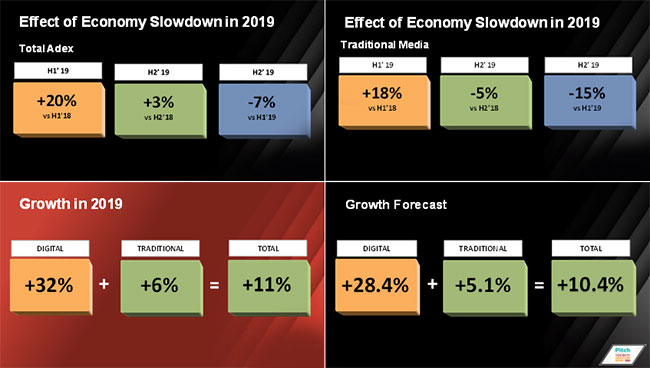
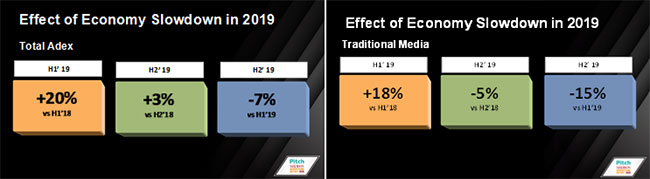
    PMAR 2020 is more firmly rooted in the Indian media and market scenario and has presented an excellent analysis of the ups and downs faced by the traditional media industry in 2019 and its consequences. In his presentation, Sam Balsara made an interesting observation by dividing 2019 in two halves and showing how AdEx grew very well during the first half riding on IPL, World Cup and Lok Sabha Elections, but collapsed during the second half due to economic slowdown. Balsara also showed how the traditional media suffered heavily during the second half of 2019, when compared to second half of 2018, there was a de-growth in second half of 2019.

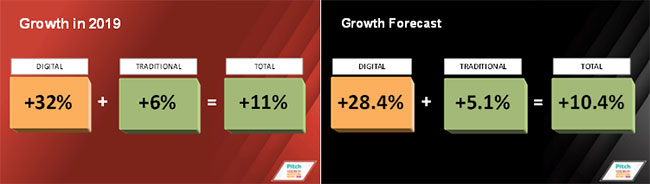
    Balsara presented  charts showing that the Digital media grew by 32% in 2019 and projected a growth rate of 28.4% in 2020 as against traditional media which grew by 6% in 2019 and is expected to grow by 5.1% in 2020.

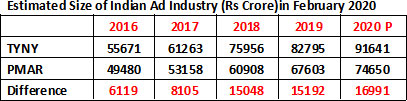
    He commented in his presentation that: “We also expect a wide variation of growth rates across mediums ranging from a low of 2% for Press, 5% for Radio, 6% for Outdoor, 7% for TV, to 20% for Cinema and 28% for Digital.” In 2020 TV will continue to enjoy the largest share of the advertising pie at 36% and Print may be demoted to number 3 with Digital securing a march over it. As of now, PMAR predicts 26.6% share for Digital and 27.4% share for Print in 2020. PMAR and TYNY also projects different estimates for the size of the traditional media, with TYNY estimating a value of TV AdEx almost 10000 crore higher than the value estimated by PMAR.

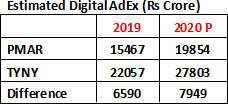
    The growth rates for Digital media estimated by TYNY is 28% in 2019 and 26% in 2020. Both the reports predict Digital as the main growth driver of Indian Adex in 2020, but there is again a significant differences between the estimated sizes of Digital AdEx.

    GroupM has revised their estimate for total AdEx upwards for both 2018 and 2019 while Madison revised their estimate for total AdEx downwards for 2019 due to economic slowdown and various headwinds faced by the traditional media industry. As a result of these revisions made by the two agencies, estimated sizes of Indian Ad Industry by TYNY are now 15000+ crore higher than the sizes estimated by PMAR, a difference which is not only difficult to reconcile, but also creates confusion in the market place.

    By now, we have learned to live with different sizes of the Indian Ad Industry estimated by different agencies. PMAR estimates are most acceptable by the industry at large due to its ability to link the market realities with their statistics supported by analysis of trends in Ad Spends as well as in depth analysis of individual media. Balsara also adds an icing on his presentation every year through advice to advertisers which are considered to be extremely useful and this year he has excelled himself on that score.


    Indrani Sen is a veteran advertising and media agency practitioner. She is now also an academician. Her views here are personal


  • India: Still a Small Player in Sports


    By Indrani Sen


    Around fifty years back, sports used to be played just for the sake of excellence in sports and not for any financial gain. The advent of television followed by satellite telecast created a global audience for sports and changed the business of sports totally. The second and perhaps more crucial change happened with the introduction of the World Wide Web and internet with sports reaching the remote corners of the world riding on the new media technology. Today, million dollar deals back big sporting events with promises of big money to all the stakeholders.


    Recently, Media Partners Asia (MPA) released a report Asia Pacific Sports Media 2020.. The report predicts sports revenues in TV and online video will grow at a 6.7% CAGR to reach US$7.2 billion by 2024. According to the report, OTT accounted for 21% of sports media revenue generation in 2019 in the 11 Asia Pacific markets. This is likely to almost double over the next five years to reach 40% by 2024. Excluding China, OTT will account for 23% of sports media monetisation in 2024 across the measured markets, up from 12% in 2019.


    The MPA report further notes: (1) Sports rights costs and revenues are seasonal and lumpy; major global events typically occur every 2-4 years and can either inflate or adversely impact sports economics on a year on year basis and (2) Global sporting events in 2020 (i.e. the Tokyo 2020 Olympics scheduled in July 2020 in Japan, etc.) will be key drivers of value in Asia Pacific markets. Currently these events are subject to risk given the global spread of the Coronavirus. Japan has already cancelled a few pre Olympic schedules and is taking extra precautions for the torch relay.  The torch is scheduled to be lit in Greece on March 12 and handed over to Japan on March 19 at Athens.


    Sports rights investments in China, India, Australia and Japan are driven by a strong domestic sports ecosystem. Rights costs in China are driven by growing appetite for domestic and international football as well as basketball with domestic baseball and football driving growth in Japan’s sports rights market. Cricket continues to drive more 85% of India’s costs and the trend is likely to continue irrespective of growing popularity of some other sports.


    In 2018, Sanjay Gupta (then MD of Star India) predicted that Indian sports industry can become a $10 billion industry in next five to seven years while speaking at the CII Scorecard Forum. Gupta said, “Over the last few years, the kind of activity around the business of sports has been tremendous. There are now over 15 domestic leagues in the country – across kabaddi, football, wrestling, boxing, badminton – from just 2 five years back…… And in my mind, this journey has only begun. Sports is still at 0.1% share of our GDP, while globally the industry is sized at around 0.5% of GDP share” (https://www.exchange4media.com/media-tv-news/indian-sports-industry-can-become-a-$10-billion-industry-in-next-5-7-yearssanjay-guptamd-star-in).


    We will still have a long way to go even after becoming a $10 billion dollar sports industry to make any mark in the APAC sports market as well as the global sports market. As per research by ResearchAndMarkets.com the global sports market reached a value of nearly $488.5 billion in 2018, having grown at a compound annual growth rate (CAGR) of 4.3% since 2014, and is expected to grow at a CAGR of 5.9% to nearly $614.1 billion by 2022 (https://www.businesswire.com/news/home/20190514005472/en/Sports—614-Billion-Global-Market-Opportunities). In spite of the media hype which gets created every year around IPL and over ICC World Cup every year, India will remain a small fish in a big pond as far as sports business is concerned unless we can improve our standards in other sports and get higher fan following across different sports to build up audiences for TV and OTT platforms.


    In March 2019, PWC along with ASSOCHAM published a report “Sports infrastructure: Transforming the Indian sports ecosystem” which highlights not only the lack of sports infrastructure in India, but also the lacuna in government’s policies and funding for promoting sports. As per PWC, collaboration of private and public sectors is required in order to uplift the standard of sports in India. If the government allows investment in sports as a part of Corporate Social Responsibility (CSR) projects and permits few companies to participate jointly in large projects, then we can probably hope to see substantial improvement in near future.


  • Just how much Covid-19 impact AdEx in 2020?


    By Indrani Sen


    Today, it is difficult to make any guess on when our country and the world at large will be free from the deadly attack of Covid-19. The UN Conference on Trade and Development estimated it may wipe off $1 trillion from the global economy in 2020. It is too early to estimate the effect of the pandemic on Indian economy and business and the consequences of the same on media and advertising industry.


    Our economy has been slowing down from last year and now various manufacturing industries are facing a forced halt in production due to lack of supply of parts and ingredients which are usually imported from China. Recently, we have been witnessing a fluctuating Sensex in a jittery stock market which is unlikely to recover soon.


    On March 12, the Indian government suspended issuing tourist visas till April 15 and on the next day BCCI postponed IPL 2020 till April 15. What miracle are we expecting to happen in next 30 days? Experts in healthcare have declared that this 30 days window is the most crucial period for India to control the spread of Covid-19 and stop it from getting into the third stage of community transmission, though some of them feel that community transmission of Covid-19 is inevitable (https://economictimes.indiatimes.com/industry/healthcare/biotech/healthcare/community-transmission-of-covid-19-is-inevitable-icmr/articleshow/74621197.cms).


    In other words, by end-March/ early-April, we will know if we have been able to contain the progress of Covid-19 and escape from getting into the dreaded stage three of community transmission. If we fail to contain the disease in stage two of local transmission, then the current restrictions may be extended beyond April 15 till we are able to curb the growth of Covid-19. Considering that from January 30 when the first case of Coronavirus was reported in Kerala, it took 40 days for 50 cases to be detected in India and then in the next six days the number climbed from 50 to 108 cases spreading across the country, the virus is an active growth phase in our country.


    What will be the fall out of Covid-19 on media spending by Indian advertisers? The industry sectors/ organisations whose production will be affected may start reducing their ad spend to mitigate economic losses. The sectors/ organisations who are dependent on Chinese supply chain, may also find their sales taking a dip as consumers are not likely to spend less and save more in the current situation of uncertainty. Some industries like travel, tourism and hospitality are already in severe loss and are unlikely to spend on advertising during the first half of 2020. Events have also taken a hit and are not likely to recover before the festive season. A lot of money rides on IPL and if BCCI is forced to cancel the tournament due to Covid-19, it will be a great loss of revenue for traditional as well as digital media.


    As severe to moderate restrictions are imposed by different state governments on their citizens, they have started avoiding shopping in crowded malls and markets and are utilizing online shopping for purchasing daily necessities and other goods. Advertisers who would like to reach out to their consumers during the next six to eight weeks can ride on this wave of online shopping. E-commerce is likely to get a boost as people also try to avoid cash transactions in brick and mortar outlets.


    With closure of schools and colleges in various states, there is bound to be an increase in content consumption across traditional media and digital media at home. It will be interesting to analyse the readership and viewership data for this period to assess if traditional media were able to get a share of the consumers forced to stay at home. Many organisations who have adopted digital technology are asking their employees to work from home which in turn can boost the other uses of internet for entertainment e.g. engagements with OTT platforms and other digital media.  However, given the current scenario of consumer spends across various categories of goods and services, it is unlikely that such consumer engagements will attract higher investment in digital advertising.


    The two other media which are going to be affected are cinema and outdoor. As state governments close down malls and cinema halls to prevent spread of Covid-19, cinema will not only loose the ticket sales money, but also advertising revenue. Due to travel restrictions, social distancing and forced staying at home, the traffic on the roads, stations, airports etc. will be less having a negative impact on OOH advertising.


    As a combined effect of all the above factors, it will not be surprising if the growth rate of AdEx drops from two digits (10.4% as per Pitch Madison Media Outlook 2020) to single digit in 2020. On the whole, 2020 does not promise to be an exciting year for media and advertising in India.


  • When Subscription Outpaced Advertising Growth…

    Source: FICCI EY M&E Report 2019


    By Indrani Sen


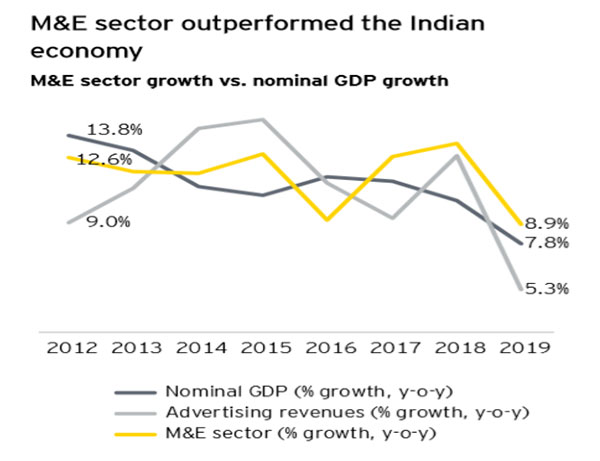
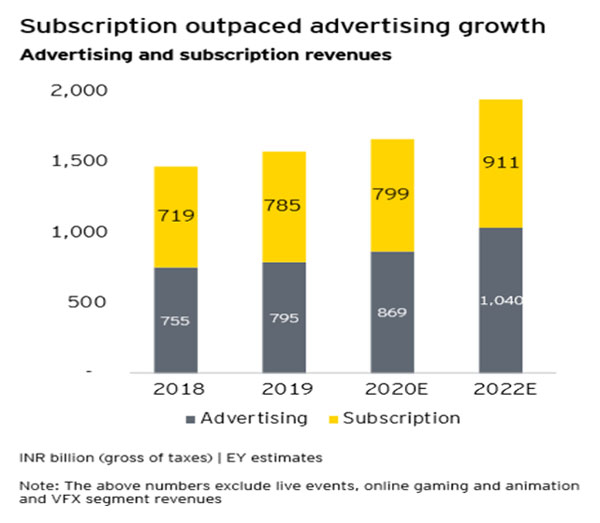
    The FICCI EY M&E Report ‘The era of consumer A.R.T. – Acquisition Retention and Transaction,’ released on March 27, 2020 shows that the Indian Media and Entertainment (M&E) sector outperformed the Indian economy (nominal GDP growth) for the third successive year with a growth of 8.9% over 2018 and reached INR1.82 trillion (US$25.7 billion) in 2019.


    Advertising revenue grew 5.3% while subscription revenue grew 9.3% in 2019. Subscription growth was driven by OTT video consumption (111%), film (10%) and television (7.5%) which resulted in EY labelling 2019 as “The Era of Consumer A.R.T. – Acquisition, Retention and Transition”.

    Source: FICCI EY M&E Report 2019


    Ashish Pherwani, Partner & M&E Sector Leader, EY India has added a word of caution in his forwarding note. “The current situation around the Coronavirus will, unfortunately, impact the 2020 estimates we have provided in this report, and we will update the same as soon as we can reasonably estimate its impact,” he has written. Coronavirus is going to affect both the Indian Economy as well as the M&E sector. While it is certain that the growth rates of both will see dips, how much they will dip remain a matter of speculation at this stage.


    As things stand now, it is unlikely that the Indian economy will see a negative growth, but it is highly possible that M&E sector may experience the same as it did in 2009 after the international financial crisis of 2008 triggered by the sub-prime mortgage crisis in the US. Effectively, we can use the FICCI EY M&E Report 2019 for reviewing the trends and growth different media in 2019 over 2018, but cannot rely on the future forecasts shown in the report, till EY releases an update.


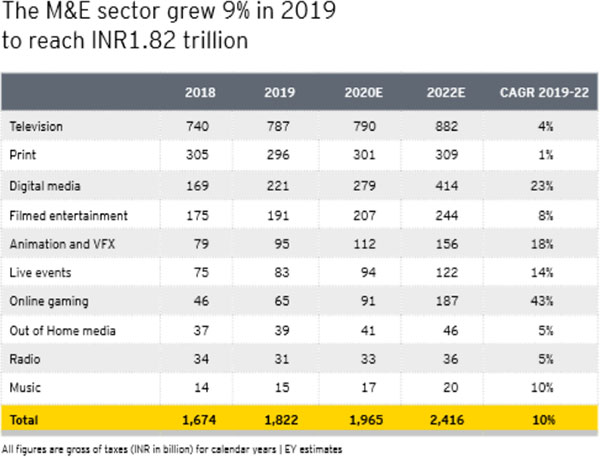
    In 2019, two traditional segments, print and radio ended the year with de-growth in ad revenues, despite their growth curves remaining relatively flat for the first seven to eight months of 2019. However, print remained the second-largest segment after television, followed by Digital media as the third.


    Digital media rode on growth of both subscription and ad revenue and overtook filmed entertainment in 2019 to become the third largest segment of the M&E sector. Digital subscription revenues more than doubled from 2018 levels and digital advertising revenue grew to attain a share of 24% of total advertising spend.


    Online gaming retained its position as the fastest growing segment on the back of transaction-based games and a 31% growth in the number of online gamers to reach around 365 million.


    The following table shows the details of the growth by different media in 2019:

    Source: FICCI EY M&E Report 2019


    A detailed analysis reflects that ad spends increased by INR40 billion in 2019 over 2018 due to INR37 billion growth in digital and an INR15 billion growth in television, reduced by a fall of INR12 billion across local traditional media (print, radio, OOH).  Advertising growth was muted due to overall economic slowdown in 2019 which also impacted festive ad spending.


    Source: FICCI EY M&E Report 2019


    The growth in subscription revenue was driven largely by the proliferation of mobile access, enabling on-demand, anytime-anywhere consumption of content across India, in both urban and rural areas. In a country with 1.3 billion population, we have 688 million internet subscribers and nearly 400 million smartphone users and a tele-density nearing 89% of households. Riding on such statistics, India’s telecom industry is poised to become the primary platform for content distribution and consumption. Today, India ranks as one of the fastest-growing app markets across the world with entertainment apps as well as gaming apps driving significant consumer engagement which is likely to accelerate as people are forced to stay at home and work from home during the current 21 days lockdown and in the event of the lockdown extending beyond mid-April, 2020.


    We can safely assume that in 2020, the effects of Covid-19 will be more on ad revenue than on subscription revenue in the M&E sector.  It is too early to make any estimate regarding the effects on ad revenue of individual segments of the M&E sector. With the rush of migrant labourers wanting to go back to their home states, we seem to be sitting on the tip of an iceberg as we step into the crucial first week of April/the second week of nationwide lockdown to fight the deadly Coronavirus, to hope and to ensure that India does not get into the stage of community transmission.


  • Forced confinement leading to increase in TV consumption, but…


    By Indrani Sen


    On March 27, 2020 Nielsen and BARC India shared the first edition of their report “Covid-19 Impact- What’s happening in the TV and smartphone landscape” with the industry at large analysing how the lockdown has increased TV viewership in India. In the first week of the partial lockdown from March 14 to March 20 (BARC Week 11), the all-India TV viewership in minutes/week went up by 8% and TV reach went up y 6%. Overall time spent on TV went up by 2%.


    BARC conducts television audience measurement in India while Nielsen passively captures smartphone behaviour through a 12,000 strong smartphone panel. The time spent on smartphones per user also went up by 6.2%. The time spent/user/week on VOD apps saw an increase of 3%. News apps saw 8% more users per week with an increase of 17% in time spent/user/week stimulated by use of non-English News apps (+87%). Gaming apps saw an increase of 2% in users/week supported by 11% increase in time spent/user/week.


    We will look more closely at changes in TV audience behaviour. In Week 11, average daily viewers grew by 32Mn supported by kids, younger age groups and NCCS A. Viewing time for Television increased by over 70 billion minutes in India with each of 592Mn viewers watching TV daily for 3hr 51 minutes. Strangely, there was hardly any growth in the primetime viewership as the growth in viewership was driven by non-prime time. GECs also grew by 32% in non-primetime slots, but saw a 15% dip in the primetime slots which was higher (23%) in the Hindi Speaking Market (HSM) than the south Indian market (5%). An analysis by genres given below show that news, kids and movies gained the most in terms of daily ATS followed by infotainment, lifestyle and youth.


    Last week, Nielsen and BARC released the second edition of the ‘Crisis Consumption: An Insight Series into TV, Smartphone and Audiences’ report of Week 12 (starting March 21) where four days  coincided with the first week of country wide lockdown, showing an unprecedented growth of  298%  in TV news viewership. The increase in the viewership of news channels was accompanied by a 15% growth of average daily free commercial time (FCT) to 6 lakh seconds in between March 21-27 (Week 12) compared to January 11-31, 2020 or the pre-Covid-19 period reflecting last-minute changes in the allocation of TV budgets.


    All the parameters reported by BARC showed increases during Week 12 with the weekly viewing minutes (total number of minutes spent watching TV) touching 1.2 trillion. The number of people watching TV all seven days a week jumped from 32% to 44%, the average time spent per viewer increased 23% from 3 hours 46 minutes to 4 hours 39 minutes. As a result, the total number of channels consumed per viewer in the week also increased from 16 to 22. This surge is TV viewership is expected to continue during the next few days of the nation wise lock down and the spread of Covid- 19 in India will decide its future course.


    It is heartening to see that the news genre has been able to get additional advertising during this lock down period. Kids’ genre, with 20%+ share of total TV viewership and only 3% share of the overall advertising space, has not been so lucky. However, on the whole the prognosis is not good when we look at ad revenue of TV channels in immediate future. Going by the current trends, TV channels will hardly be able to convert this increase in viewership to increased ad revenue. Financial Express reported on March 21, 2020 (https://www.financialexpress.com/brandwagon/coronavirus-impact-ad-expenditure-to-decline-by-50-55-on-tv-between-april-june-2020/1914445/) “As the novel Coronavirus continues to wreak havoc around the world, television is one such industry which is currently under its grip, besides other sectors. According to industry estimates, advertising expenditure on television is expected to decline 50%- 55% to anywhere between Rs 3,750 crore – Rs 4,125 crore between April-June, that is Q1 FY2021 – if the lockdown continues.”


    The economictimes.indiatimes.com reported on April 2, 2020 in similar lines, though their estimate of the loss was pegged at 30-40% than 50-55% reported by Financial Times – “Top broadcasters, media buyers and advertisers ET spoke with, feel that if the situation doesn’t improve by end of April, the TV industry will end up with a 30-40% drop in ad revenues in April and May.” (https://economictimes.indiatimes.com/industry/media/entertainment/media/broadcasters-stare-at-drop-in-ad-revenues/articleshow/74937708.cms?from=mdr)


    While we wait for FICCI-EY to release an update of their report on M&E industry, FICCI’s recent report on the impact of Covid-19 on the Indian economy has predicted that the pandemic will potentially derail India’s growth story by affecting both the demand and the supply side. We are going through unprecedented times when it is extremely difficult to predict even the immediate future.


  • Will loyal newspaper readers lose the newspaper habit given the 5+ week lockdown?


    By Indrani Sen


    I have been reading various articles on how the Indian newspaper industry has been performing since Covid-19 struck India. We are all aware about how the newspapers in major cities were forced to stop printing for couple of days due to protest by hawkers’ associations.


    Subsequently, all newspapers resumed regular printing though no one indicated if they were able to print and distribute their regular print orders. Last week, there was a joint statement issued by publishers assuring their readers about the safety measures undertaken by them to ensure that the newspapers reaching their hands in safe condition. Publishers have also claimed that newspaper distribution have largely stabilised across India. In the meantim, hard copies of most newspapers have reduced their number of pages and the lack of advertisements is noticeable even to an untutored eye.


    A sensational article (https://www.ozy.com/around-the-world/the-virus-other-victim-the-worlds-final-hope-of-a-major-newspaper-industry/293705/) published on April 10, 2020 led me to do a quick dipstick survey this weekend over the phone among 31 elderly (50+) upmarket citizens across Kolkata, Mumbai and Delhi to find out if they are receiving/reading their usual newspapers. I found that 26 of them have shifted to reading e-papers and have stopped reading hard copies of the newspapers they used to read regularly till the pandemic struck India.


    Only three of them reported that their building societies are not allowing newspaper hawkers’ access inside the complex. The other 23 have stopped reading the newspapers on their own in order to avoid the chance of getting infected by Coronavirus with some of them discontinuing their subscription even before the lockdown was imposed.


    I tried to probe the root cause of their fear. I found that they are not worried about how the newspapers are printed and despatched from the press, but about the distribution process where many people handle the same under unhygienic conditions at the roadside dumps and distribution points. Some of them have seen the messages from leading newspapers assuring that surface of newspapers do not carry the virus. All of them have received contradictory information through social media and messaging apps and have decided to boycott the hard copies of their favourite newspapers. A couple of them who are early risers are actually happy that they can read the e-copies early in the morning, much before they used to get the newspapers delivered at their doorsteps.


    All of my respondents were not ready to pay for accessing e-papers which they are now reading free of cost. Under the lockdown, those who were not browsing the internet earlier have also learnt to browse for news and have become aware that TV channels deliver the same news faster than the newspapers and keep updating the news throughout the day. Only one of these people had previously downloaded the apps of the newspaper he used to read.


    As many as 52% of the 23 (50 to 60 years in age) were unsure if they would again subscribe to the hard copies of the newspapers which they used to read earlier. The others (60+ age) would like to go back to reading the hard copies more due to the inconvenience of reading small print of the e-papers on their mobiles. All of them would prefer their newspapers to be delivered at their doorsteps rather than stepping out of their home to purchase a copy from a nearby convenience store or newsstands/ shops across the roads. I read the article by my friend Jwalant Swaroop, a veteran from the newspaper industry, a few days back arguing for a change in the distribution system of newspapers in India (https://www.exchange4media.com/media-print-news/its-time-for-newspapers-to-reinvent-their-distribution-model-jwalant-swaroop-happy-ho-103795.html). I am afraid I cannot agree with Swaroop’s view as I think the unique last mile delivery system is keeping the newspaper industry alive in India, in spite of agreeing with his observation on the prevalent unethical practices by the some newspapers to control the newspaper hawkers union and the lack of transparency in the entire system.


    The five respondents (50 to 60 year age) of the dipstick survey, who are continuing to read the hard copies of the newspapers, are more scientifically enlightened and net savvy. They have done through research on the internet about the possibility of hard copies of the newspapers carrying the Coronavirus and have compared it with the possibility of surface of other goods (milk packets, etc.) entering their household on a daily basis. On the basis of their findings, they have decided to continue with their subscription of newspapers.


    Summing up the findings from my dipstick, I can conclude that the newspaper industry in India is facing a grave crisis as many loyal newspaper readers, particularly the elderly elite, are likely to have stopped reading hard copies of the newspapers under the threat of Coronavirus. Five continuous weeks of lockdown followed by a few more weeks of staggered withdrawal would be capable of creating a time window for changing the current newspaper reading habits of Indians, even the elderly elites. Along with the policy for surviving the present crisis of fall in circulation and ad revenue, the newspaper industry needs to simultaneously draft a strategy for winning back their loyal subscribers after the dark cloud of Covid-19 disappears from our Indian sky.


  • Dark Days Ahead for Adspends


    By Indrani Sen


    Last week, KPMG released a report titled “Covid-19: The Many Shades of a Crisis” trying to provide stakeholders in media and entertainment a perspective of the effects of Covid-19 on M&E sector (https://home.kpmg/content/dam/kpmg/in/pdf/2020/04/the-many-shades-of-a-crisis-covid-19.pdf).


    The report reviews three alternative scenarios related to the overall performance of Indian economy. The first scenario assumes that the spread of covid-19 would be largely contained by April-May and Indian economy could grow in the range of 5.3-5.7% in FY21. The second scenario assumes that under the shadow of a global recession with a containment of spread of the virus in India, the country could witness 4-4.5% growth for FY21. The third scenario assumes a proliferation of the virus in India accompanied by a global recession, GDP growth could fall below 3%. However, the report does not throw any light on how the three alternative scenarios may affect the M&E sector in different ways.


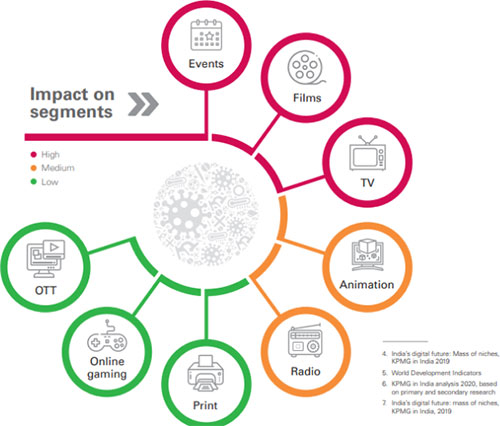
    The title “The many shades of a crisis” relates to how Covid-19 has affected the different segments in the M&E sector. The graphical presentation of their assessment (shown below) raises some doubts regarding the parameters used for making the assessment, particularly in relation to traditional media where print has been shown as having low impact against television having medium impact.


    Source: KPMG Report “COVID 19: The many shades of a crisis”


    While BARC data is showing a week-on-week increase in TV consumption, at the same time there is de-growth of advertising revenue leading to slowing down of monetisation with additional crisis of production of new content /episodes of the serials. KPMG has predicted for TV “slow ad spend recovery in medium term with long term risk due to digital competition”.

    On the other hand, KPMG has predicted “a new lease of life” for print riding on the credibility of the printed words against proliferation of fake news in social media and has advised print media to “leverage positive consumer segment and build strong digital products to capture the opportunity”. This advisory ignores the current scenario related to printing and distribution of hard copies of newspapers and the various hurdles which they may face in recovering their circulation and readership post COVID 19. It is difficult to agree with KPMG’s views that the impact of COVID 19 will be less on print than on television.


    Animation sector also has been hit severely as work from home poses a challenge to implementation of the tools and techniques which are difficult to access from home of the individual illustrators. High fixed costs and high investment costs of the animation sector clubbed with cancellation/ postponement of contracts have created a serious cash flow crisis.


    The impact on radio also has been quite high as there is a loss of listenership due to lack of travel and work from home. Many advertising campaigns on FM radio are linked with activation and events at various social gatherings which have been as badly affected as the events sector. KPMG agrees that ad spends on radio will take time to recover and assures that demand for timely localised content should remain high even after the recovery from the virus. Given the restriction on production of news content by FM radio, they can do very little to satisfy the demand for timely localised content during lockdown and after removal of lockdown.


    KPMG shows that Events and film sectors have been badly affected due to social distancing and the OTT and gaming sectors have gained riding on the additional time spent by people at home. KPMG predicts footfalls in cinemas may take a while to return to normalcy and live events may also take longer time to recover as consumers emerge gradually from the social distancing mode. Both OTT and gaming can benefit if the growth in current consumption can be converted to habitual activity.


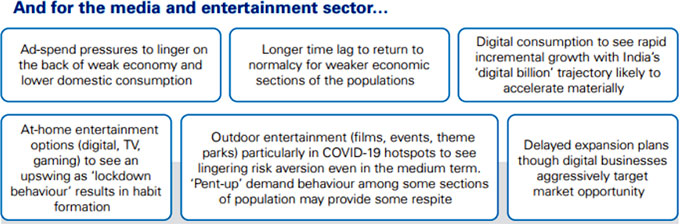
    Summing up, the KPMG report provides the following insights for the M&E sector:


    Source: KPMG Report “COVID 19: The many shades of a crisis”


    The above themes will play across the M&E value chain impacting supply chain, consumption and monetisation. KPMG apprehends that the gap between India and Bharat in consumption of various goods and services may widen due to the reverse migration from urban areas to rural areas as a result of lockdown and halt in all economic activities. Remote collaboration for creative ideation and scripting may last beyond COVID 19 altering the supply chain management of content creation permanently. Finally as far as monetisation is concerned, KPMG predicts longer timelines for ad spend recovery as the economy would continue to be under stress even after the virus is contained. The slowing down of the economy would have adverse impact on key advertisers in FMCG, auto, e-commerce etc. and they might take longer time to restore their ad spends to the level before the pandemic struck India.