
Category: INDRANI SEN

  • EY-FICCI report rediscovers Indian Customer Segmentation


    By Indrani Sen


    Indrani Sen

    It has been nearly two weeks since the FICCI-EY Report on Indian M&E Industry “A billion screens of opportunity” was released at the 20th FICCI Frames held in Mumbai on March 12, 2019. Most leading financial newspapers and industry websites have carried the press release issued by FICCI with highlights of the findings.


    This website www.mxmindia.com carried a report with highlights of the findings on March 13, 2019 http://www.mxmindia.com/2019/03/me-grows-13-rs-1-67-trillion-in-2018-ey-ficci-report/. The marketing and advertising industry experts have been busy analysing and internalising the findings and useful insights given in the report and their strategic significance.


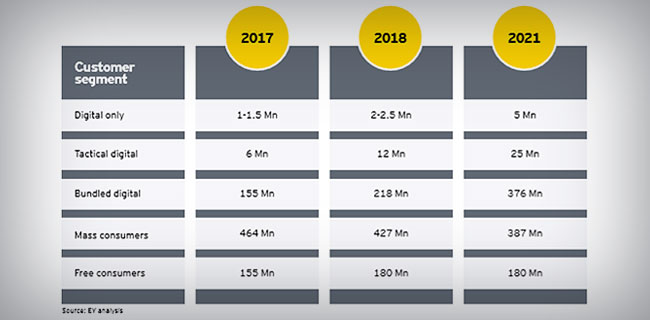
    To me, the most significant insight of the report is its estimate of the customer segmentation in India by their access to various media consumption platforms. Last year, EY introduced the idea of this type of customer segmentation by introducing us to three types of segments, digital only consumers, tactical digital consumers (Pay TV & Pay OTT) and mass consumers (Pay or Free TV & Free OTT) and projected that by 2020 there will be 4 million digital only subscribers, 20 million tactical digital subscribers and 500 + mass subscribers.  I was delighted to discover that EY has refined their estimation of the customer segmentation by introducing another segment “bundled digital” consumers (as provided by telecom services) and segregating the mass consumers from the free consumers as shown in the chart below:

    Customer segmentation by media consumption platforms
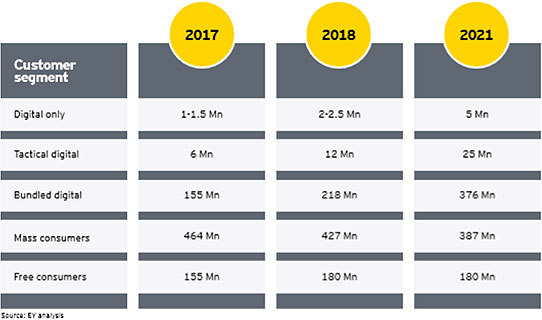
    Source: FICCI-EY Report 2019

    The broad category of mass consumers accounting for 500 +million in 2020 has become more specific with 943 million subscribers in 2021 spread across three categories. This analysis of customer segmentation introduced in the FICCI EY report not only has strategic implication for marketers in the short run, but also will help to further accelerate the growth in digital advertising in the long run.

    Digital media has been consistently contributing to the growth of M&E sector. It is expected that digital will overtake filmed entertainment (currently in number 3 position) in 2019 and print (currently in number 2 position) by 2021. TV clocked the highest share (44%) of the entire industry in 2018 and is expected to grow by 8.8% from 2018 to 2021 but its share is estimated to drop from 44% to 40%. Digital media, growing at 28% from 2018 to 2021, is estimated to have 15% share of the entire sector in 2021 from 10% in 2018. It is difficult to predict what will happen in the next ten years and EY has not ventured into that forecast, but it will not be surprising if digital media overtakes TV by end of the next decade.

    In fact, MRUC should consider adopting this customer segmentation for revising their criteria for new socio-economic classifications as the current structure based on ownership of durables etc. is not reflecting the disposable income correctly, given the availability of easy financing schemes for purchase of white goods, etc. and the aspirations of the upwardly mobile population in rural and semi-urban areas.

    Uday Shankar, Chairman of the FICCI Committee said in his opening remarks at the FICCI Frames    “… in my humble opinion, the great Indian media & entertainment story has just begun. We are standing at an inflexion point. In business strategic inflexion point is described as a period when the individually the organisations and collectively the industry needs to respond effectively to the disruptive change in the environment in order to survive and grow.  The Indian ME industry entered the inflexion point/ period in 2018, when Indian ME Industry was at the “Digital Tipping Point”. The scope of making a choice no longer exists for the various segments belonging to the Indian ME industry and in order to stay in the race they need to adapt to the disruptive changes including the customer segmentation based on access to media consumption platforms.
  • Print AdEx: The writing is clear on the wall


    By Indrani Sen


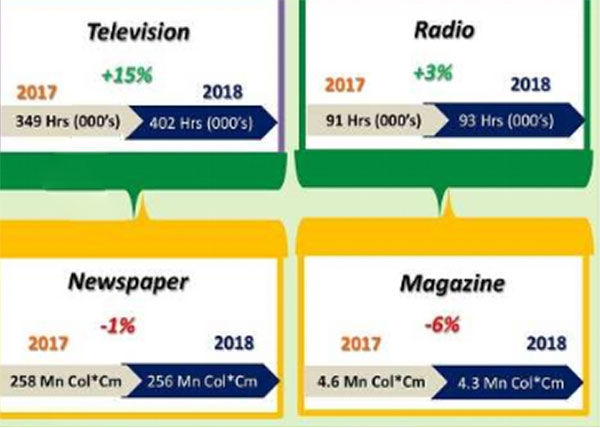
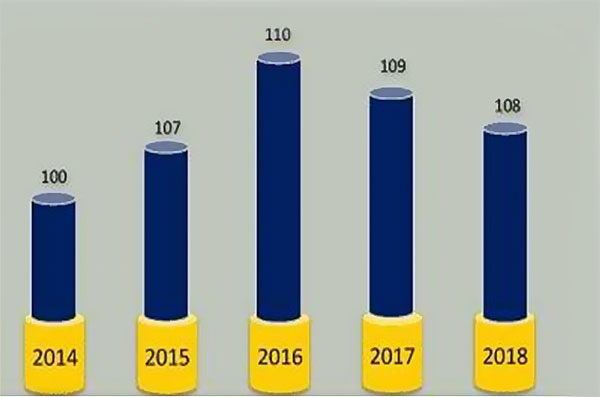
    According to a report published in Brand Equity on February 27 based on TAM AdEx data based mainly on display ads, print advertising volumes are up by 8% from 2014 to 2018, though after 2016 there has been a decrease in print advertising volumes in the next two consecutive years. (https://brandequity.economictimes.indiatimes.com/slide-shows/print-advertising-volumes-up-8-between-2014-2018-tam-adex/68172547).


    Source: TAM AdEx/ ET Brand Equity


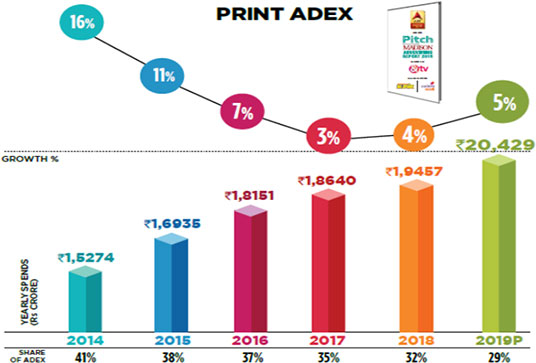
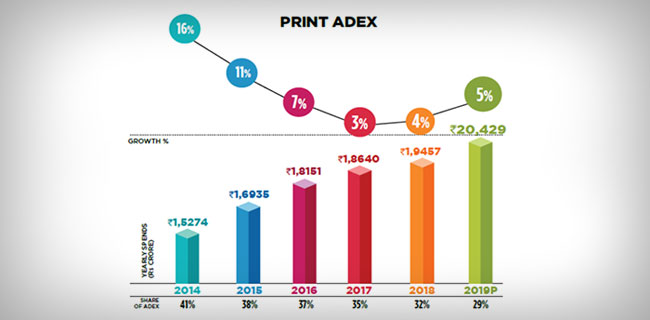
    If we compare this growth in volume with the growth in value as reported In PMAR 2019, we find that though there has been a growth in the print advertising Value by 27% from 2014 to 2018, the share of print Advertising in the total advertising pie has been decreasing steadily.


    Source: PMAR 2019


    As shown by PMAR 2019, from 2014 to 2018, the share of print advertising in the overall advertising pie reduced from 41% to 32%, a 9% drop in 5 years. In another five years, the share of print advertising in rupee value may come down to below 20% in India. The writing is clear on the wall as reflected in the diminishing/ stagnant growth rate of print advertising value.

    If we compare the above two charts, then we find that in terms of value, print advertising has grown by 27% from 2014 to 2018 as against only 8% increase in volume. Over the next five years, there may be still a growth in value of print advertising, but in terms of volume it may show a diminishing trend as reflected in the TAM AdEx comparative analysis of ad volumes across media in 2017 and 2018 where we find that magazines have lost 6% of ad volume from 2017 to 2018.


    Source: TAM AdEx/ ET Brand Equity


    So, print media needs to work out a strategy for survival which lies on one hand in promoting and monetising their online editions and on the other hand in innovative ways to tie up with other media which are still showing growth in both volume and value.

    In another recent article, Vanita Keswani, CEO of Madison Media Sigma, suggested that “Print ads will be more effective if they complement digital campaigns and entice readers to interact with brands online” (https://brandequity.economictimes.indiatimes.com/news/business-of-brands/what-print-media-needs-to-do-to-win-back-advertisers-faith/67959125). This solution however requires active support from the creative and media agencies which may not work out across categories and brands. It may be worthwhile for the newspapers to look at categories like Two-Wheelers, Cars & Jeeps and Services which are the leading contributors to the Print AdEx volume and experiment with strategic integrations.


  • Guest Column by Indrani Sen | BARC goes Rural: The Great Media Manthan

    By Indrani Sen


    The Broadcast Audience Research Council (BARC) has churned the ocean of Indian TV audience and has found the nectar of rural market reach for our marketing and advertising industry. Startling trends about urban plus rural combined TV Audience Measurement, based on data collected over 22 to 31 weeks, were revealed at the BARC Road Show in Mumbai on September 7. Adding of Bharat (rural) to India (urban) in the survey has increased the average daily reach of TV by 3 times to a whopping 450 million!


    The 30-minute total (urban +rural) gross impressions is 19.5 billion with urban share of 10.6 billion. Rural India has clocked 8.8 billion impressions against 7.7 billion clocked by 1 lakh+ C&S towns in urban!! Moreover, rural rat (number of individuals in 000s of a target audience who viewed an “event” on TV, averaged across minutes) contributes more than 50% in some large regional demographics – AP/TL 53%, RAJ 54%, UP 55% and PHCHP 59%. In the Hindi Speaking Markets (HSM) all states have 50%+ rural rat except MP and JH. In Western India, both MH and GUJ have rat shares tilted towards urban (64% in each state). In Southern India, rural rat ranges from Kerala 45% to TN 46% to KAR 48% to AP/TL 53%. Eastern India is divided into two pockets with three states (Assam &NE, Bihar and Odisha) having 50% + rural rat and the other two states (WB and JH) having around 40% rural rat.


    Among the highlights of the findings presented by BARC at the Road Show, rural rat shares of 41% in Hindi Movie genre and 45% in Hindi GECs genre were expected after viewing the shares across the states. The real shocker to the audience at Nehru Centre was 45% share of rural rat in English Entertainment genre! In the post-IPL weeks (22 to 31 weeks) 48% rural rat in Sports genre also came as a surprise. Among the various language news genres, rural rat of Hindi is 37% , followed by Tamil 38%, Telegu 42%, Kanada 45% and Malayalam 48%. Rural rat of Marathi and Bengali news genres have scored respectively 34% and 31%. With poor penetration of newspapers in rural India, it is disappointing to note that the rural rat is not showing higher share in the regional news genre. Kerala stands out as an exception with high rural penetration of Malayalam newspapers as well as Malayalam news channels.


    The advertising industry will have to sacrifice reports for ‘Below 1 lakh’ towns in order to get the rural data as BARC will report the all=India TV ratings by four pop strata, ie. Mega cities, 10 to 75 lakh towns, Below 10 lakh urban areas and rural.  Currently, out of 22,000 BARC meters, 16,000 are deployed in urban and 6,000 in rural areas covering population in 1000+ villages. The ratio is opposite of the ratio of number of people/ households in urban and rural India.  Census 2011 over Census 2001 showed a 75% growth in proportion of TV HHs in rural India. BARC has reported 153.5 million TV HHs, of which 77.5 million (50.5%) are in urban and 76.0 million (49.5%) are in rural. As mentioned before, 8.8 billion (45%) of half-hour impressions are coming from the rural sector. It may not be long before the industry urges BARC for reviewing the distribution of meters across urban and rural India and increasing the proportion of meters in rural India.


    For some time,we have seen the writing on the wall about the growth in our rural market potential as reported by many independent market surveys and realised by marketers from their own sales reports. BARC quoted some such findings in its presentation to lay the foundation for its discovery. Yes, it is a discovery as these findings will now help our marketing and advertising industry to reach the rural audience effectively through a mass media for the first time, delivering numbers which print can not deliver. Marketers will put on their thinking caps and rewrite their media briefs, plan for better distribution channels in rural India as well as logistics for reaching out faster to the rural consumers. The TV industry will rethink its programming strategies with a large chunk of viewers following the “early to bed and early to rise” policy and spending 41 minutes less time daily on viewing TV than their urban counterparts. As the combined BARC Ratings roll out on a week-to-week basis, TV programmes will also start rolling across timebands/slots trying to balance between the viewing preferences of urban and rural viewers. The ranking of the TV channels by genres may also see some ups and downs as channels struggle to understand the viewing habits of Bharat v/s India. With Rural TV Ratings becoming a reality, media agencies and media channels will engage in qualitative research to understand the TV viewership habits and preferences of our rural audience about which we do not have much clue.


    The BARC Road Show also covered the formation of the Meter Company (for lack of a given name) and re-confirmed that 12,000 TAM meters will be duly acquired and overlaid on their existing sample structure with TAM having only the responsibility of running the data files from the meters to BARC. Responsibilities for all other functional areas covering from establishment survey to sampling design to processing, validating and publishing of data stay with BARC, which emerges as the sole TV ratings provider.  Between the sections on Meter Company and highlights of all India findings, BARC talked about the fidelity in its data which has been noticed during last few months. BARC cited the Nepal earthquake, Dr Abdul Kalam’s demise, the Gurudaspur Terror Attack, etc. as examples for breaking news or topical news which caused immediate spikes in viewership.  It was also pointed out how the absence of celebrity anchors (Kapil Sharma and Arnab Goswami) led to a substantial drop in the ratings of the respective channels (Colors and Times Now). It was interesting to note the presence of Technical Committee stalwarts and senior BARC consultants on the stage during the Q&A session which followed the presentation. However, the questions raised by the audience were more general than technical which did not relate to range of relative errors or comparative stability of data, etc.


    Finally, BARC deserves an applause for its performance in delivery of TV ratings and brilliant marketing strategy. During this year,it first released the HH level data in April followed by individual level data in June and now in September it is releasing the all-India level data covering urban and rural. 2015 is not a “Year of the Rat” by the Chinese Zodiac Calendar, but the way rat’000 figures released by BARC have been jumping over the industry from week-to-week, Vanita Kohli Khandekar may perhaps like to describe 2015 as “The Year of BARC RATs” in the next edition of her book The Indian Media Business.


    Indrani Sen is a media services veteran, having worked with JWT, later Mindshare and then with Emami. In recent years, she is an independed consultant and academic. She is Adjunct Professor in charge of the Media Management programme at the Symbiosis Institute of Media & Communication, Pune. The views expressed here are her own.


  • Introducing new fortnightly column by Indrani Sen – MediaSENse: Why our Print Majors must come out of their Comfort Zones?

    By Indrani Sen


    In his recent digital pitch with media bosses in New York, our Prime Minister claimed that unlike manufacturing, in the world of media, India is almost as evolved as any other country. Does his observation hold good for our print industry on which the sun continues to shine? The print majors are basking in the comfort of the findings of FICCI-KPMG and other such industry reports which are predicting growth, but a comparison of the CAGR percentages projected over the years reflects erosion.


    Projections of Print CAGR CAGR 2011 to 2015 CAGR 2011 to 2016 CAGR 2012 to 2017 CAGR 2013 to 2018 CAGR 2014 to 2019
    Total Print Market

    10%

    9.10%

    8.70%

    9%

    8%

    Source: FICCI-KPMG Reports

    2011

    2012

    2013

    2014

    2015


    So, it is obvious that slowly but steadily the global trends have started to creep into Indian print industry.  Accelerated penetration of mobiles in smaller towns and rural areas will support the growth of digital and social media and may result in faster erosion of CAGR in the print market and the CAGR 2020 to 2025 may come down drastically.


    Instead of strengthening their arsenal with readership currency for protecting their share in the total advertising revenue, currently the Indian print industry seems to have taken up a negative stance against the IRS. Agreeably, many publications had genuine grievances against the findings of IRS 2013, but that should not be a legitimate reason for withdrawing their support from the readership survey. When the TV Industry has got a brand new currency from BARC which uses superior technology than its predecessor, the print Industry needs to rally around MRUC to ensure that IRS can also claim similar upgradation by introducing improved methodology.


    In a large scale ongoing quantitative survey, teething problems and relative errors are quite normal. Perhaps the magnitude of the errors in IRS 2013 crossed the tolerance level of some print majors, but they should recollect that initially NRS findings also had many issues which got corrected over the years. We saw emergence of MRUC and IRS as a protest against the methodology and findings of NRS and subsequently the merger of the two surveys. We are witnessing now a dark period of three years in print currency as IRS 2013 was rejected by the print Industry, IRS 2014 (based only on fieldwork of one quarter) has not been taken seriously by the advertisers and agencies, and the field work for IRS 2015 has not yet commenced. In a developed country, such a gap in a media currency is unheard of. The sooner all the stakeholders of MRUC resolve their differences and kickstart the field work, the better it would be for second and third line publications who are likely to suffer more due to lack of readership data. The media planners and buyers cannot determine the incremental reach/ OTS/ CPT for adding more than one publication in the plan and are likely to limit their print campaigns to only the established market leaders.


    Indian newspapers need to take up two challenges at two ends of the audience market. Firstly, they must try to reduce the gap between the literate population and the number of newspaper readers. Secondly, they must improve and promote their web editions and convert the internet savvy Indians to online readers. The concept of “Integrated Newsroom”, which is being advocated by many researchers and industry observers, is essential for achieving these two diverse tasks.


    According to IRS 2012, approximately 44 percent of literate Indians do not read any newspaper. This average percentage decreases as one climbs up the SEC ladder and increases in small towns and rural areas. It is obvious that the current combination of regional, national and international news dished out by most newspapers is not acceptable reading material by a large chunk of Indian population. Special, smaller editions with more emphasis on hyper-local news may be more acceptable in the small towns and rural areas.


    Most Indian newspapers have launched their e-editions, but there is lack of efforts in promoting as well as making them user friendly and interactive, perhaps due to the apprehension that the growth of online readership will cannibalize readership of the hard copies. There is a huge scope of growth for web editions of regional newspapers if they plan to ride on the growth of computer literacy in secondary schools in small towns and villages. Innovative marketing tie-ups with mobile manufacturers and service providers can increase the initial trial and subsequent conversion rate of the e-editions.


    In this connection, it will be pertinent to note the new trends in readership surveys in developed countries, particularly in UK, as we have traditionally followed the example of UK for setting up our media infrastructure, media regulations, etc. In the 1970s, Indian National Readership Survey was also modeled largely on the Readership Survey of UK. NRS PADD was introduced in UK in September2012 to provide a unique measure of combined print and online audiences to cater to the demand of a dynamic and changing digital media age. It is a fusion of data by RSMB from two independent surveys, print readership survey by Ipsos MORI and comScore digital survey. It provides a single database for planning across print and digital platforms of NRS publisher brands. (Source: http://www.nrs.co.uk). Apart from full NRS demographic and classification data for profiling and targeting, the NRS PADD provides the unduplicated reach of a print publication and its website, duplication of print titles and websites – which websites do a publication’s readers visit, and vice versa. NRS PADD: Mobile was launched in September 2014. The future lies in combining readership research across the print and digital platforms. The opinion leaders in the print Industry must realise that the digital trends are irreversible and steer the industry in that direction.


    The Global Media Report 2014 by Mckinsey & Co. predicted “Digital advertising is becoming a dominant force in the global media advertising market. Excluding the online and mobile components of TV advertising, in 2017 digital advertising will overtake TV, which for decades has been the largest advertising medium……….We project digital advertising to continue to increase at double-digit rates, growing 15.1 percent compounded annually to 2018 and accounting for 65 percent of the total increase in global advertising over the next five years. Most of that gain will come as advertisers substitute away from print media.” In India, the above trends are not likely to set in before at least another 5 years. Indian Print Industry needs to utilise this time period from 2016 to 2020 for protecting their future by ensuring immediate availability of print media currency, developing and promoting the websites and last but not the least, effectively converting more literates into readers.


    Indrani Sen is a veteran media agency and marketing services professional. She is currently an Independent Consultant and Adjunct Faculty, Media Management at Symbiosis Institute of Media & Communication, Pune. This column will appear fortnightly. The views expressed here are her own.


  • Effects of Covid-19 on M&E in 2021


    By Indrani Sen


    Indrani SenThe second wave of the pandemic is spreading all across the country and we are seeing state after state imposing various restrictions like night or weekend curfews, conditional lockdowns etc. The central government has decided not to impose a nationwide lockdown like last year which paralysed the entire Indian economy. The decision to impose restrictions for curbing the spread of the second wave has been left to the state governments. As the pandemic situation stands now in the second month of the April-June quarter, our economy is likely to see a contraction in this quarter which will have a cascading effect on M&E industry as advertisers will spend less on promoting their products and brands.
     

    Till now, most economists have predicted that the effect of the second wave of COVID 19 will be less on India Inc. than the effects of the first wave when we had a national lockdown for 70 days. However, it is too early to be assured about that prediction. The outbreak of Covid-19 is no longer concentrated in urban areas, it has been spreading virulently across villages, particularly in the Hindi hinterland of Uttarakhand, UP, MP, Bihar and Chhattisgarh. The rural areas of other states, particularly the states which recently held Assembly elections, are also experiencing a surge of the pandemic.


    Urban India contributes to 60%-65% of the sales of FMCG companies while rural India accounts for the balance 35% to 40. In certain FMCG categories the share of urban and rural is 50%: 50% or even tilted a bit more to the rural sector. Last year, when the lockdown had affected the sales of FMCG industry in urban areas due to restricted consumer spends, Bharat or Rural India spurred the growth of FMCG companies. An article published on February 28, 2021 in www.livemint.com  said: “To be sure, companies are betting on large swathes of consumers in rural India switching from unbranded, loose products to branded ones over the next few years. This gives them room to push their soaps, shampoos, biscuits, beverages and packaged staples in India’s villages, albeit at lower price points. Demand in rural markets has outstripped sales growth witnessed by companies in urban markets over the last several quarters. Companies expect India’s smaller cities and villages to continue driving growth.”  (https://www.livemint.com/companies/news/why-are-fmcg-majors-chasing-growth-in-rural-india-11614504243913.html). At the beginning of 2021, most economic analysts expected the momentum of sales in rural areas to continue. However, the ground realities have already turned out to be different which will affect not just the sales of FMCG products in rural areas, but also the production of Argo industries.


    The controversies over vaccination between the Centre and the states coupled with shortage of oxygen supply and inadequate health infrastructure have given a different dimension to the Covid-19 crisis induced by the second wave. Middle class urban families are spending their live savings, begging and borrowing to try and save their near and dear ones, in the process reducing their subsequent purchasing power. Upper class affluent urban families have realised suddenly that the big fat medical insurance in which they invested are not of any use to them if they cannot get their relatives admitted to any hospital or nursing home. Many insurance companies are refusing to give coverage for Covid treatment. These rich people are feeling the need of having large amount of cash in hand for emergency treatment of Covid, which will reduce their disposable income and affect the sales of consumer durables.


    The pandemic has already managed to disrupt our cricket calendar by postponing the IPL 2021 indefinitely to another venue in another country and it is unlikely that T20 World Cup will be held in India in 2021 which has affected the tourism and hospitality industry, the on-ground display, etc. The advertisers having peak season during summer months are putting a brake on their TV expenditures due to state level lockdowns, restricted movement of transport for delivering of goods and reduction in consumer spends due to very small windows of time available for daily shopping.


    Medical experts are predicting a third wave of the pandemic around September, 2021 which may result in further contraction of the economy in the October-December quarters, in spite of the festive season. Lack of economic recovery in the next two quarters will result in further loss of business for the M&E industry. As per the Pitch Madison Advertising Report 2021, overall AdEx de-grew by 20% and traditional media AdEx degrew by 29% in 2020 with only digital media growing by 10% during the same period. The PMAR 2021 predicted that in 2021 overall AdEx will grow by 26% touching the 2019 level. In the second month of the second quarter of 2021, it is too early to predict the overall effect of Covid-19 on the M&E industry over the entire year. The current signs indicate that it will be difficult for the AdEx to jump back to the 2019 level in 2021.


  • Adspending globally degrows only 1.2% in 2020!


    By Indrani Sen


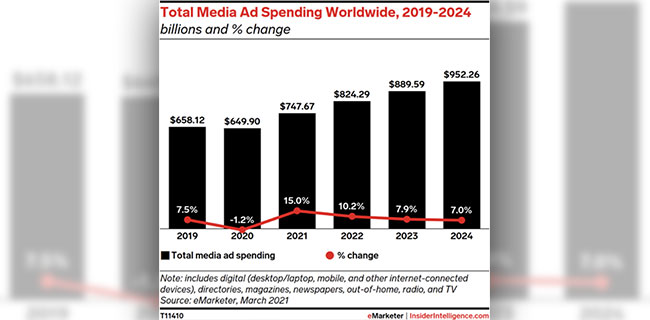
    Indrani SenLast week, I read an article “How the pandemic changed worldwide ad spending” by Etham Cramer-Flood on emarketer.com. The article compared the forecasts made by them with the revised estimates and spoke about their predictions for 2021. The reason I would like to share the highlights of that article here is due to the optimistic attitude reflected in their calculations. They pointed out that according to their analysis, the final figures for 2020 “outperformed dire mid-pandemic projections.” According to this article, the global adspending has a degrowth of only 1.2% in 2020 which is the lowest among all the various estimates seen till now. (https://www.emarketer.com/content/how-pandemic-changed-worldwide-ad-spending?ecid=NL1001)


    As shown in the above chart, after a contraction of 1.2% in 2020, the global ad pending is predicted to grow by 15.0% in 2021. Even traditional adspending will grow this year, by 7.6%.  The growth rate will come down to 10.2% in 2022 and subsequently over next two years will fall down to 7% in 2024 compared to 7.5% growth rate of 2019. By the end of 2024, ad spending worldwide is expected to be close to $1 trillion.


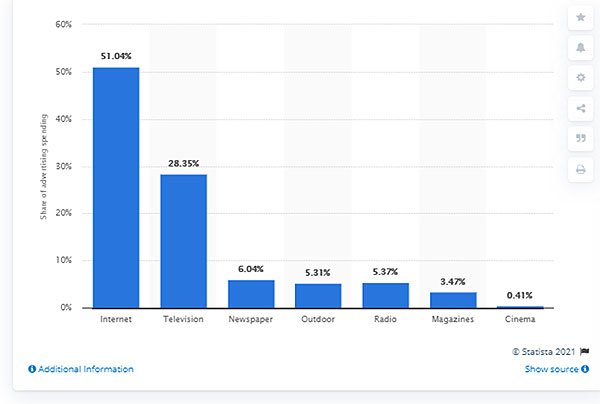
    All the various estimates on global advertising spending released so far agree that while the ad spending on traditional media suffered a huge degrowth, the overall situation was saved by growth of adspending on digital media with the share of digital advertising varying from one research to another. Traditional media were already in slow declining mode across various countries in the pre-pandemic years. The pandemic aggravated their degrowth. As the article does not have a chart showing the share of different medium in worldwide advertising spend. I have sourced one chart from www.statista.com with the medium-wise distribution of global advertising spend in 2020 which is shown below:


    Distribution of advertising spending worldwide in 2020 by medium

    Source: https://www.statista.com/statistics/376260/global-ad-spend-distribution-by-medium/


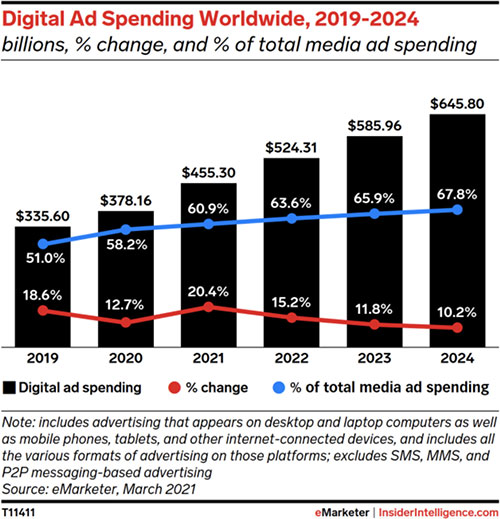
    The www.statista.com has estimated that in 2020, the shsre of digital advertising in the worldwide advertising has touched 51.%. The balance 49% is distributed among the traditional media with TV leading the pack with 28% share followed by newspapers 6%, outdoor 5%, radio 5%, magazines 4% and cineam 0.4%. The analysis of www.emarketer.com agrees that globally the share of digital advertising spend may touch 60% by end of 2021 and 70% by 2025.


    The pandemic has surely accelerated the growth of digital media across the world in the middle of major economic disruptions.  We have also been surprised by the kind of resilient growth of digital advertising in India showed in 2020. However, it will take at least this decade before the share of digital advertising in India can have the highest share in the Indian advertising pie.


  • Will Indian netizens lose their digital rights?


    By Indrani Sen


    Indrani SenOn February 25, 2021, the Electronics and Information Technology ministry notified the Information Technology (Intermediary Guidelines and Digital Media Ethics Code) Rules, 2021 for news publishers and OTT platforms giving a three-month deadline to websites to comply with the same.


    The Government introduced the new rules aiming to “establish a soft touch progressive institutional mechanism” for adherence to Digital Media Ethics Code by the news publishers and OTT platforms “featuring a Code of Ethics and a three-tier grievance redressal framework”. The new rules are applicable to all digital news publishers, social media platforms like Facebook, WhatsApp, Twitter and all OTT platforms like Disney Hotstar, Netflix, Amazon Prime, Zee Live, etc.


    The time limit of three months expired on May 25, 2021. Subsequently, on May 26 the Digital Division of the I&B Ministry has extended the deadline for OTT platforms by 15 days till June 10, 2021 through a public notice. The public notice has three different formats for furnishing information designed for three types of publishers:

    1. Digital news publishers who also publish/ telecast news through traditional media
    (newspaper/ TV)
    2. Other digital news publishers
    3. Publishers of online curated contents (OTT platforms)


    There is not much difference between the three types of forms except that for the first category under “Entity Information” the digital news publishers are only required to furnish the RNI registration number or details of TV channels licensed by the I&B Ministry under Uplinking and Downlinking rules. Where as the publishers of the other two categories have to provide various other details about their entity. In all the three formats, the publishers have to provide details of their membership of Self-Regulatory bodies in the industry.


    The first two categories of publishers are required to give details of their News Editor while the OTT platforms have to give details of their Content Manager. All three have to furnish the details of their Grievance Redressal Officer (GRO) in India.


    In the meantime, both News Broadcasters Association (NBA) and News Broadcasters Federation (NBF) have requested the I&B Ministry that traditional news broadcasters also publishing digital news should be excluded from coming under the purview of the new IT Rules. With only three days left before the new deadline on June 10, 2021 the Ministry has not yet replied / given a clarification to MBA and NBF. A reminder has issued a reminder on June1, 2021 asking all publishers on the digital media to furnish the required information to the Ministry.


    Over the last three months we have seen lot of debates in various media websites on if live news will continue on the OTT platforms and what will be the implications if OTT platforms stop live news. There has been hardly any discussion on mainline media on the implications of the proposed Information Technology (Intermediary Guidelines and Digital Media Ethics Code) Rules. If we deep dive into the three-tier structure for grievance redressal or for observance and adherence to the Digital Code of Ethics, then we find that the Level I comprise Self- regulation by the specific entity and Level II comprise of Self-regulation by the self-regulating bodies of which the specific entity is a member of. It is Level III which becomes an area of concern where Oversight mechanism by Central Government will be acting over and above the Self-regulatory bodies with power to censor and even block the contents.


    The Wire published an excellent analysis of the proposed IT rules on February 27, 2021, day after the new IT Rules were announced and commented on the three-ties system “All of this is being planned to be done without any legislative backing or a clear law made by parliament.” (https://thewire.in/tech/explainer-how-the-new-it-rules-take-away-our-digital-rights). On the same day https://scroll.in also published a detail analysis of the new It rules explaining why the same is anti-democratic and unconstitutional
    (https://scroll.in/article/988105/explainer-how-indias-new-digital-media-rules-are-anti-
    democratic-and-unconstitutional).


    Under the disguise of introducing a soft touch progressive institutional mechanism, the Central Government is about to introduce an autocratic digital censorship and rob all Indian netizens of their digital freedom as well as of expressing their own views on social media platforms. And this move is being executed when the country is still struggling with the second wave of Covid-19, when digital media is acting like a lifeline for many Covid patients, Covid volunteers and frontline medical practitioners all across the country.


    Indrani Sen is a veteran advertising professional and academic. She writes on MxMIndia on Mondays. Her views here are personal

  • Newspaper Industry in India after the Second Wave of the Pandemic


    By Indrani Sen


    Indrani SenThe Indian newspaper industry faced an unprecedented crisis last year after the National Lockdown was declared at a very short notice. Circulation fell drastically when many subscribers, particularly housing societies, shut their doors for the newspaper delivery persons for the fear of the contagious virus being carried by the newspapers or the delivery folk, leading to change is consumption pattern of newspapers. Lack of local transport also prevented the distributors and hawkers from reporting for work. This was followed by withdrawal of commercial advertising as advertisers were worried about a fall in circulation and readership and were themselves affected by choking of distribution pipelines and economic slowdown leading to loss in their sales. The FICCI EY Report on Indian M&E industry 2021 showed that ad revenue of Print came down from INR 206 billion in 2019 to INR 122 billion in 2020.


    After the National Lockdown was lifted in 2020, the newspaper industry tried its best to recover their lost grounds. As per the same FICCI EY report, it will take Print four to five years to regain the pre-Covid ad revenues level. However, the industry seemed to be recovering well during the first quarter of 2021 as TAM AdEx data for Jan-Mar 21 showed that 1350 new brands advertised on print during that period.  When compared with Jan-Mar 20, the quarter also showed 9% increase in ad space mostly from Hindi and other language newspapers. Similarly, April-May 2021 recorded better results compared to April-May 2020.


    As per TAM AdEx analysis in May 2021, when the second wave of the Covid-19 was at his peak, there was an average 58% growth in ad space per publication as compared to May 2020. However, all was not well as compared to February 2021 and March 2021, the ad space in Print saw a drop of 42% and 29% in April 2021 and May 2021 respectively. As the phased process of unlocking has begun, the newspaper publishers expect that both the ad volume and value would pick up by August 2021 and grow further during the festive season of 2021.


    It appears that newspapers were better prepared to handle the second wave of the pandemic in 2021 and the lockdowns imposed by various state governments across the country. Along with the process of gradual unlocking, the newspapers now are looking forward to recovering their lost grounds. The credibility of the printed word, the vaccination drive, revival of the corporate sector and good rain forecasts are the other factors which are expected to contribute to the overall growth of the newspaper industry in 2021. The Print industry has appealed to the government for a stimulus package and an increase in FDI in 2021. The government has not responded so far, but the industry is still hopeful of getting, some positive response though no relief was announced in terms of waiving the import duties on newsprint by the finance minister in her 2021 Union Budget.


    The newsprint prices, which saw a decline in the international market (below $300/metric tonne) in 2020, have started going up from the beginning of the calendar year 2021. The price was $670/tonne-$700/ tonne in April-May. The industry expects it to go up further. It appears that quite a few paper mills which used to export newsprint to India and other countries, either shut down their business or migrated to the businesses of producing brown papers and craft papers during last year when their business was hit due to the global pandemic.


    As India is far from being self-reliant in newsprint production, our newspaper industry, struggling to recover from the effects of the pandemic, has been hit further by this demand supply imbalance of newsprints in the international market. Many newspapers are increasing the use of indigenous newsprints to balance out their cost of productions.  However, most newspaper owners feel that this crisis of newsprint prices is not going to last for a long term and expect the international market to stabilise before our festive season in the third quarter of 2021.


    To sum up, the newspaper industry in India seems to be set on the path of recovery after a severe decline of both circulation revenue and advertising revenue in 2020. In recent times, during the second wave of the pandemic, the industry was not much affected and would have been in a better financial position if they were not hit by the crisis of newsprint prices. It is expected that by end of the calendar year 2021, their overall performance may be better than predicted earlier by media analysts.

  • Will the New I&B Minister fulfil M&E Industry’s Expectations?

    The Minister taking charge (PIB photograph)


    By Indrani Sen


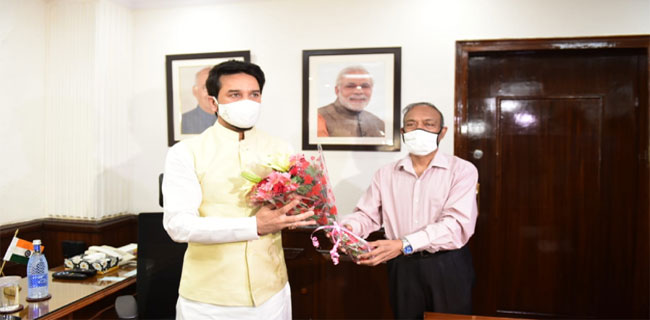
    Indrani SenLast week, in the reshuffling of the cabinet of ministers of the Central Government, Anurag Singh Thakur took over a double-barrelled charge of Sports & Youth Affairs Ministry from Kiren Rijiju and Information & Broadcast Ministry from Prakash Javadekar. He was elevated to full cabinet minister rank from minister of state rank in which capacity he has been working in the Finance and Corporate Affairs Ministry since 2019.


    Two years back, I first read about Anurag Thakur when he was appointed as a Minister of State “…’You elect Anurag with a record margin, I will make him a big leader,’ Shah had urged the voters at an election rally in Bilaspur, Hamirpur, on May 12. They did. And Shah kept his word, with Thakur being sworn in as a Union minister last Thursday.


    (https://economictimes.indiatimes.com/news/elections/lok-sabha/india/from-bcci-to-union-cabinet-anurag-thakur-enters-big league/articleshow/69585917.cms?from=mdr). Thakur first got elected to Lok Sabha from Hamirpur through a bypoll in 2008 and then won the same seat three times in 2009, 2014 and 2019.


    Amit Shah has continued to honour his promise as in two years Thakur has not only got elevated to the rank of a full cabinet minister, but has also been entrusted with the charges of two key ministries considering the importance of young voters in India and the dynamically changing media scenario in the digital age. It is expected that Thakur will be able to resolve the issues faced by both the M&E Industry and the sports industry given his record as a parliamentarian from 2008, former Chairman of the IT Committee and President, BCCI.


    Last week, various leaders from M&E industry welcomed Thakur as the newly appointed I&B minister and expressed their hopes that he would be looking into various concerns and demands of the various sectors and would provide a level-playing field for TV broadcasters, publishers on print & digital platforms, radio operators, cinema producers, etc. The various issues which are on the cards currently can be divided into two categories, one related to the content of the media and the other related to all non-content issues. Let us first look at the issues in the first category related to the content of media.


    Starting June 18, the Centre has sought public comments on the draft bill of the proposed Cinematograph Amendment Bill (2021) which includes fine and a jail term for film piracy, introduces certification on the basis of age and empower the Central government to order recertification of an already certified film following receipt of complaints. Centre had sought public comments on the draft bill starting June 18, 2021. Six film trade associations have already sent a joint representation to I&B Ministry objecting to the revisionary power sought to be provided to the Centre. Well-known filmmaker Shyam Benegal has also opposed this bill, saying that the government has no role in film certification and recertification. As this proposed amendment enhancing the role of the Central Government in deciding on the content of the films seems to be part of a bigger gameplan of the Central Government to choke the voice of Indian media, it is doubtful if Thakur in his new role will be prepared to listen to the voice of the industry.


    The timely adoption of the new IT rules by OTT and digital news channels also belongs to the content category and the bigger game plan mentioned above. Under this rule digital media publishers, publishers of digital news linked to traditional media, and over-the-top (OTT) media service platforms to furnish basic information about themselves and their self-regulatory mechanisms creating a role for a government appointed regulator for overruling the decisions of self-regulatory bodies. As I wrote earlier on this topic (https://www.mxmindia.com/2021/06/will-indian-netizens-lose-their-digital-rights/), so will not elaborate on it again. Subsequently, many publications moved court against the IT rules 2021. The Supreme Court has turned down a transfer petition filed by the Centre seeking transfer of all cases related to IT Rules to the apex court. Thakur will be expected to handle the legal cases and resolve the issue to the satisfaction of the Central Government.


    About two weeks back, the Central government introduced a three-tier grievance redressal mechanism as an amendment to the Cable Television Network (Regulation) Act with the intention of making the content related grievance redressal system for TV Broadcasters at per with the OTT and digital news platforms. The TV industry requires more clarity on this issue and its implementation.


    Among the pending issues pending for some time in the non-content category, the following require immediate attention from the new I&B minister:

    :: Certain long-standing demands of broadcasting sector related to their demand for an infrastructure status, liberalised licensing regime and a stable regulatory climate. The proposal of IBF seeking stimulus package based on economic relief and flexibility in the regulatory system.


    :: Addressing broadcasters’ concern about 5G system disrupting their transmission. Almost all C-Band satellites use spectrums between 3.7 GHz and 4.2 GHz for their downlinks and band of frequencies between 3.7 GHz and 4.9 GHz are used by most television channels for their operations which are adjacent to the band of frequencies identified for 5G usages in the country in the range of 3.00 GHz to 3.6 GHz.


    :: To come up with a solution for audience measurement of TV channels by either introducing reforms in the current system of BARC or by setting up an alternative TV measurement system. In November, 2020 I&B Ministry formed a committee headed by Prasar Bharati CEO Shashi Shekhar Vampati to examine the matter and to give a recommendation. The Vampati Committee submitted its report to the I&B Ministry in January, 2021, but the content of the report was not shared with public at large. The recommendations may also provide some guidelines for resuming the ratings of the news channels which have been suspended by BARC.


    The M&E industry at large and the TV broadcasters in particular are hoping that Thakur will address their immediate concerns impartially and will take positive steps towards making constructive changes in the media ecosystem. Industry watchers like me are keeping our fingers crossed as only time will prove the efficiency and effectivity of our new I&B Minister.


  • Identity Crisis within Social Media

    Image courtesy: https://anchordigital.com.au/


    By Indrani Sen


    Indrani SenThe discussions about the identity crisis faced by the users of social media, particularly the younger generation, started almost from the inception of social media. Lately researchers, academics and industry watchers have been talking about other identity crisises within the social media. The first crisis relates to managing one’s identity on the internet across various work related and social media related accounts/ apps and it is often said that if a person has more than a dozen of such accounts with different IDs and passwords then the person needs a ‘password manager’. A movement has ben going on for some time advocating for an unique identity per every consumer on internet which will enable them to acces all internet accounts with the same ID and password. However, this may lead to a breach of trust between consumers and their individual internet accounts as all personal information shared by them on any account can be accessed through their unique identities.


    The second crisis is the intense identity aggregation of consumers by Google and Facebook which has started pushing some internet users from the two giants to other anonymous platforms. For the purpose of marketing through their networks Google and Facebook create such aggregated buckets of identities which many consumers find unacceptable.


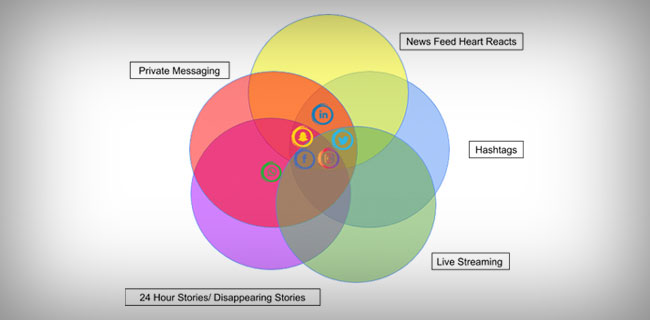
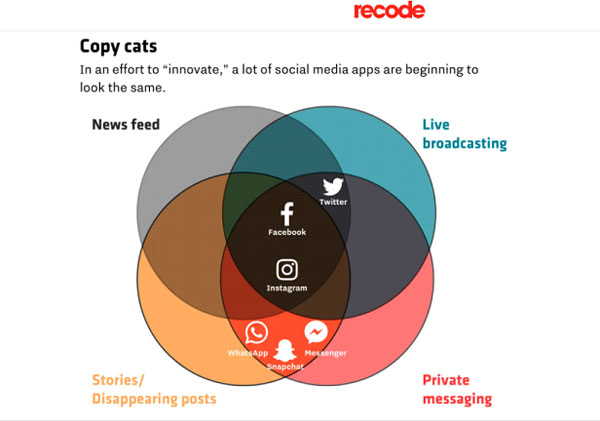
    The third and perhaps the biggest crisis is the loss of identity of different social networks / apps which has emerged during the last 5 due to the blatant copying or adopting of features of another social network. Last week I listened to an interesting podcast on www.emarketers.com talking about “…. what Facebook has become and is trying to be, what to make of social media platforms looking more and more alike, and which of these “copycat” moves might strike gold. We then talk about the significance of Nextdoor going public, how India’s social media content liability laws could impact Twitter (and others), and some changes as to what advertisers can, and can’t, do on social media.” The podcast can be accessed through the following link https://www.emarketer.com/content/podcast-facebook-and-social-media-identity-crisis-twitter-liability-retouching-ads?ecid=NL1009.


    Source: https://www.vox.com

    There is an extensive list of services/ features which have been copied since their introduction in one social media platform by others. In 2010 Instagram launched with the feature “double tap to heart react”. Instagram copied Snapchat’s stories feature first which was followed by Facebook adopting the same application from Instagram. In 2012, Facebook acquired Instagram and adopted the “heart react” feature from Instagram. In 2015, Twitter replaced it “star react” feature with “heart react”. In 2019 Linkedin introduced a set of “react” features including the “heart react”. There are many more such examples.


    In the digital age, we have seen a shift of power from organisations to consumers which has been labelled as ’transformed consumer contexts’ by Neil Perkin and Peter Abraham in their book titled Building the Agile Business Through Digital Transformation. Consumers once experiencing once a satisfactory service or a tool on a social network, expect the same capability from all other social media networks. As a result, this trend of extensively copying from each other has started in the social media sector for winning over the consumers. This trend has attracted lot of criticism as it is becoming increasingly difficult to differentiate among the social media platforms, but no immediate solution for countering this trend is in sight for reversing the identity crisis within social media.


  • India Shining in Ecommerce Growth


    By Indrani Sen


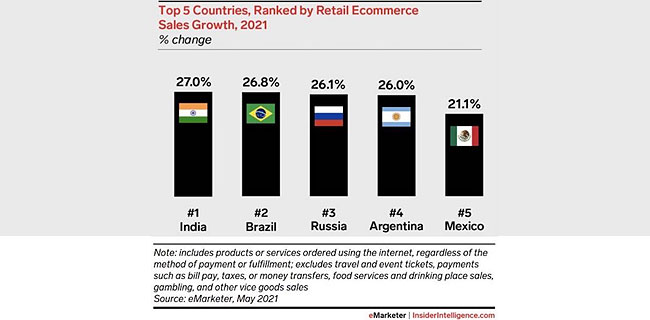
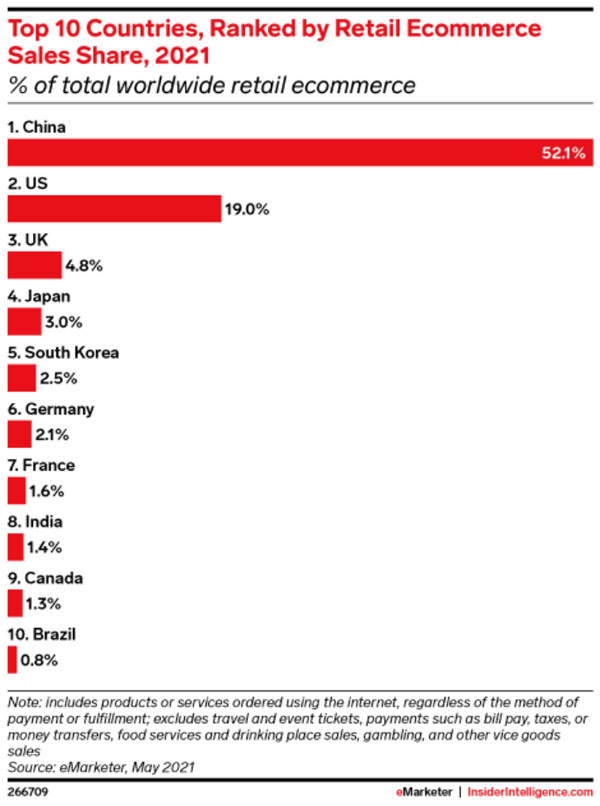
    Indrani SenA study “Global Ecommerce  Forecast 2021” conducted earlier this year, followed by articles published in www.emarketer.com recently show that India ranked eighth in the share of retail Ecommerce  sales in the world in 2020, while leading in the growth rate along with a pack of Latin American countries and Russia. The trend is estimated to continue during 2021 with China leading the pack of countries with US featuring as the poor second. India, thanks to the huge population base and the accelerating drive for a “Digital India”.


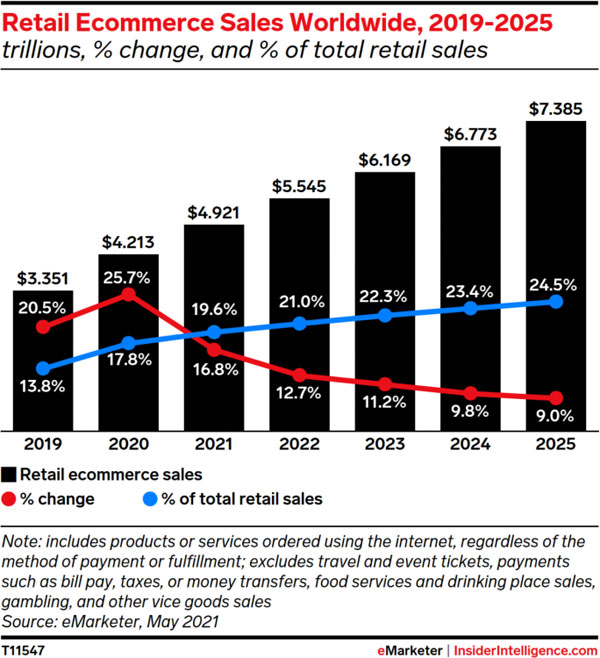
    The retail Ecommerce grew dramatically across the world at the cost of the physical stores sales in 2020 as COCID 19 raged across both developed and developing countries. In an article published on July 7, 2021 Karin Von Abrams wrote “Before the pandemic, we had forecast that total retail sales worldwide would rise by 4.4% in 2020, to $26.460 trillion. We now estimate that retail sales amounted to just $23.624 trillion last year-a decline of 2.8%. But in 2021, this figure will rebound to pre-pandemic (2019) levels, reaching $25.052 trillion.” (https://www.emarketer.com/content/global-Ecommerce -forecast-2021) 


    Another chart published in the same article reflects the worldwide growth of Ecommerce  from 2019 to 2020 and the subsequent drop in the same.


    India, however is expected to have an increase in the growth rate of Ecommerce  in the coming years and reach a size of US$ 99 billion by 2024 as also indicated in another article published on May 9, 2021 (https://www.ibef.org/industry/Ecommerce .aspx)   which lists a series of initiatives taken by the Ecommerce  industry along with Government initiatives and increasing investments as the key factors behind this surge of growth apart from growing demand and attractive opportunities. The road ahead also seems to be full of promises. The growth in this sector has been beneficial for the MSME sector in India and is expected to fuel their growth in the long run.  Along with the growth, the share of India in the world wide retail Ecommerce  is also supposed to increase propelling its rank from eighth to third after US in the coming years.


  • The Push & Pull of Print


    By Indrani Sen


    Indrani SenPrint media in India was the worst affected by the coronavirus pandemic last year. As per the FICCI EY Report on M&E industry 2021, the revenue of print shrunk by 41% from INR 206 billion in 2019 to INR 122 billion in 2020.  The report estimated that while TV will recover its 2019 level of revenue by 2022 and the combined revenue of traditional media will recover the 2019 level by 2023, it will take print at least till 2025, if not more to recover the 2019 level of revenue.


    I commented on print media in an earlier article in www.mxmindia.com “However, the industry seemed to be recovering well during the first quarter of 2021 as TAM AdEx data for Jan-Mar 21 showed that 1350 new brands advertised on print during that period.  When compared with Jan-Mar 20, the quarter also showed 9% increase in ad space mostly from Hindi and other language newspapers. Similarly, April-May 2021 recorded better results compared to April-May 2020.”


    Now, it appears from the latest TAM AdEx report that the print media has begun the first month of the July-September quarter with an upward swing. At the end of July 2021, ad space per publication on an average has grown by 35% when compared to July, 2020. Multiple educational courses, cars, hospitals/ clinics, two wheelers and real estate have topped the list of categories who advertised in print media during last month. Media planners are hopeful that the next months of August and September will see further increase in print advertising with many regional festivals, Onam, Independence Day, Raksha Bandhan and Ganesh Chaturthi dotting the calendar.  The dhamaka of 15% discount has already begun in newspapers, the tempo will surely build up further before August 15, 2021, the 75th Independence Day. This year, Onam in Kerala begins on August 12 and ends on August 23, overlapping Independence Day and Raksha Bandhan on August 22. Ganesh Chaturthi will be celebrated next month on September 10. Together these festivals will be the precursors of the main festive season of Dussehra (Durga Puja) and Diwali.


    Why print media still works in India, particularly during festivals? It is convenient to execute sales and other promotional campaigns in newspapers at short notice. The entry cost or the cost of creating static creative content for print media is less expensive than creating video creative content for TV, OTT and other digital formats. The local advertisers with comparatively small budgets rely on print media for advertising throughout the year. By definition all traditional media are push media delivering content to the users with little interactions between the media and the users. Pull media by definition is the opposite of push media where the users seek out information from media. During festive season, print media plays a dual role of both pull and push media as brands step up their advertising activity and consumers seek out information on various offers and discounts available in different stores and retail outlets. This interplay of push and pull of the print media will definitely continue for the next two or three years enabling the print media to recover its lost revenues.


    In the last month, we saw many full-page and jacket advertisements in newspapers, a trend which is likely to continue well into the main festival season. Ads placed below the mastheads as well as some other formats which were considered as innovations when first introduced by newspapers, have now become part of the regular options like half page, quarter page, etc. offered by regularly by newspapers. As per market reports the deal sizes in the print media has started going up, demand for inventory for advertising space in newspapers is also on the rise. It can be safely assumed that if the pandemic does not cause any other disturbance, print media will recover a substantial portion of their lost revenue during 2021 and will reach the 2019 level much before 2025.