Category: NEWS

  • 5th Mint Luxury Conf to explore future of lux industry

    By A Correspondent


    The 5th edition of Mint Luxury Conference will take place in Mumbai on March 23 and 24. The theme for the conference is “Luxury inIndia: At the Tipping Point”


    Over the last few years,India’s luxury industry has witnessed significant transformation. The ever-growing Indian market has drawn a lot of attention from across the globe in recent years.Indiahas been a production outsourcing destination for a long time, but now due to a steadily growing economy and globalized businesses environment,Indiahas rapidly transformed into a large market for luxury goods.


    In view of the growing importance of the country in the global luxury industry, Mint, from the house of HT Media, has initiated a conference to bring together stakeholders to a common platform.


    The Mint Luxury Conference is the largest event of its kind in this sector. Industry experts, designers, marketers and owners of prestigious international luxury brands will come together for multiple sessions spread across 2 days of the conference.


    This year marks the fifth anniversary of the Mint Luxury Conference. Among the speakers this year are legendary designers Diane von Furstenberg and Christian Louboutin; Indian design star Manish Malhotra; expert in luxury retail, Michael Ward – MD Harrods; Michael Perschke, Head of Audi India and Anoop Prakash, MD of Harley-Davidson India. The sessions range from the intricacies of design and creativity to the minutiae of the luxury market inIndia. A much anticipated session is the very topical “The Impact of 100% FDI on Luxury” which will see Ajay Dua, former Secretary, DIPP, Ministry of Commerce and Industry, Peter Beckingham, Deputy British High Commissioner to India, and Armando Branchini, Executive Director, Fondazione Altagamma, butting heads on the issue of FDI.


  • HT extends Brunch IP to live events

    By A Correspondent


    Brunch Dialogues are essentially conversations with the Indian Film Industry that are light-hearted in context, yet deep-rooted in content; just like the weekly Brunch.


    However, in its event avataar, it is a heady mix of glamour, music, spirits and style. The endeavour is to be led by Vir Sanghvi;  whom we all know best for his ‘In Conversation’ sessions at the HT Leadership Summit and the ‘Rude Food / Travel’ columns in HT Brunch – that make the Sunday read quite irresistible. It is his inimitable expertise in exploring living biopics and his astute humour, liberally laced with repartees, that forms the central character of this evening.


    While the conversations will set the pace for a racy evening, the evening will also have live performances to lift up the mood. It will culminate into a showcase of ‘THE DAMN GOOD LIFE’ – full of Fine Food, Good Wine and Smart Indulgences – something that weekly Brunch encapsulates in print every Sunday.


    A host of showbiz icons like Anil Kapoor, John Abraham, Vidya Balan, Ekta Kapoor, Kangna Ranaut, Sanjay Gupta, Naseeruddin Shah, Nana Patekar, Sonu Sood, Mahesh Manjrekar will be attending the event whoch will see some stellar musical performances.


  • BMB India wins O-SIX travel & hospitality

    By A Correspondent


    BMB India, a 50:50 JV between Trevor Beattie’s BMB and Madison World, has won the O-SIX Travel & Hospitality account.


    Prabha Prabhu, CEO, BMB India says “We won this account based on our capabilities and our category knowledge and the great work that we have done for Thomson Holidays in London. The campaign is approved and ready to roll next week. This year we will be using only Press and Digital media. We hope to however make it a highly visible campaign.”


    Leapfrog Holidays & 360 Himalaya; brands of O-SIX Travel & Hospitality have been in the business for six solid years, making the world accessible to thousands of satisfied clients who have enjoyed great holiday experiences. This is mainly due to many years of relentless research and touring being done by the company’s core team of travel fanatics.


    BMB India is the advertising unit of Madison World, a diversified Communication Group with 24 units across 10 specialized functions of Advertising, Media, PR, Out-of-Home, Rural, Retail, Entertainment, Mobile, Events and Sports; employing over 1000 communication professionals across cities in India, Sri Lanka and Thailand.


  • Long way to go for Indian athletics: Sports journos’ meet

    By A Correspondent


    The problems faced by Indian athletics in its attempt to catch up with the rest of the world echoed at the seminar on athletics held to mark the start of the 36th National Convention of the Sports Journalists Federation of India (SJFI) in Guwahati on Tuesday.


    While the elite panel comprising former internationals Bhogeswar Barua, Adille Sumariwalla, Sunil Abraham and Tayabun Nesa and eminent coach, Kuntal Roy, spoke generally on a variety of factors, the common refrain amongst them all was the need of a long-term plan, support from within the educational system and the adoption of a supportive sports medicine system for the growth of the sport in the country.


    Setting the ball rolling, Bhogeswar Barua, 800m gold medalist at the 1966 Asian Games in Bangkok, was critical of the powers-that-be who controlled the affairs of the Athletics Federation of India, for the failure of Indian athletics to really take off at the world stage. “They have really no genuine concern for the sport. Or for all the gains we have made through the years, Indian athletics could have really made a real impact at the world level by now. Power and pelf are what they are interested at, while the real concern should have been that of the welfare of the athletes.”


    Barua also said that there was no point in blaming Indian cricket for the ills plaguing Olympic sports disciplines in the country. “There is enough space to co-exist for all sports disciplines along with cricket. But then, the attempt should be to have a long-term plan which should be backed with some vision.”


    Adille Sumariwalla, former National sprint champion, emphasised the need for society to change its approach towards athletics. “The crowds are simply not there at any meet held in this country despite the fact the action provides much more thrill than any other sport. Where else, can one witness competitions in more than one event being held simultaneously other than in athletics.”


    Sunil Abraham, also a constituent sprinter of his times, pointed out that things were bound to improve only if the middle class took to the sport in large numbers. “They are our main stay and I see an attitudinal problem as they choose to shun the sport and its excitement without any valid reason. The blame for this could be the lack of commitment of the present generation of athletes despite the facilities being made available to them.”


    In her intervention, Tayabun Nesa spoke generally on how the sport had got totally removed from the educational system through the years and stressed on the need for the adoption of a sound system to take advantage of modern sports medicine. “The Government should look seriously into both these aspects if Indian athletics has to go places.”

    Later in the day, the convention was officially inaugurated by 94-year-old Pulin Das, Assam’s first sports journalist, while the daily SJFI newsletter, Guwahati Rocks, was released by Bhogeswar Barua, by handing over the first copy to former National table tennis champion, Monalisa Barua-Mehta.


  • Singapore aims fresh salvo at Indian tourism market

    By A Correspondent


    The Singapore Tourism Board (STB) unveils its latest plan targeted at the India market. “Singapore – The Holiday You Take Home with You”, the third in a series of customised and differentiated marketing campaigns after those in China and Australia, adopts a similar consumer-centric approach by tailoring experiences based on a deeper understanding of the needs of the Indian leisure travellers. By understanding their needs, better quality experiences can also be created and delivered, which is a natural evolution of the YourSingapore destination brand with its emphasis on personalisation of experiences.


    Through years of presence and engagements held with Indian consumers, STB has observed changes in the travel habits and needs of Indian travellers. Today, Indian travellers possess a more global worldview and have discerning travel needs. Indian consumers prefer for families to travel and bond together through shared learning experiences. Many also research and plan their own Free and Independent Traveller (FIT) itineraries on the Internet, and are eager to try out and learn new things.


    The new marketing campaign will focus on quality tailored offerings that appeal to the Indian audience. The core of the campaign rests on four pillars of enriching experiences, namely family fun, active lifestyle, culinary and romance. Singapore offers the promise of a deeper and more engaging experience beyond a usual holiday; through experiential and shared learning activities, the campaign wishes to draw an emotional connection between travellers and the destination.


    Randall Tan, STB’s Regional Director for South Asia, Middle East & Africa, said, “Indian travellers’ preferences have truly evolved;  they are more adventurous and seek much more out of their holidays today. There is greater interest in quality, aspirational and engaging experiences that allow visitors to build deeper relations, as well as acquire new skills and knowledge with their loved ones. They will return home enriched. Our campaign is thus an invitation to Indian travellers to explore an ‘experiential touch-do-and-engage holiday’ instead of the mere ‘checklist holiday’.


    The campaign is driven largely by a digital thrust that features online and mobile advertising, a dedicated India landing page on the YourSingapore destination website, and social media engagement, including a Facebook quiz. The dedicated webpage allows easy navigation and customisation of one’s travel itinerary, and also highlights the new enriching itineraries under culinary, family fun, romance and active lifestyle, travel agent listings and travel essentials, along with a social media component to enable travellers to have first-hand information about the latest events taking place in Singapore.


    The YourSingapore Facebook page will feature engaging applications and wall posts such as conversations and photos shared by fans, centred around the travelling behavior of Indians to help STB build a direct relationship with Indian travellers. Fans can also participate in the ‘Unravel & Travel’ quiz and stand to win holidays to Singapore. The campaign will also see strategic collaborations between STB and key specialised travel partners like Thomas Cook (India) Ltd. and Mercury Travels to co-create and offer travel packages across the four core pillars of enriching experiences.


    Madhavan Menon, Managing Director of Thomas Cook (India) Ltd added, “We are delighted to partner with Singapore Tourism Board on the launch of their new campaign, “Singapore – The Holiday You Take Home with You”. As pioneers of travel, with a vibrant heritage of over 130 years, this unique partnership with Singapore Tourism Board will bring to Indian travellers a truly enriching and experiential range of ‘Active Lifestyle’ and ‘Family Fun’ experiences. In keeping with our strong focus of innovation and exceptional customer service, our tie-up with Singapore Tourism Board further enhances our unique and diverse customer centric product-service portfolio.”


    Travel partner Mercury Travels will offer itineraries focusing on the culinary and romance pillars of enriching experiences. Its Chief Executive Officer Mr. Aashutosh Akshikar said, “Holidays are a time for memorable experiences and family bonding. Singapore’s “The Holiday You Take Home with You” campaign brings to the fore experiential travelling that helps strengthen familial bonds. From a romantic holiday to a family vacation, or even from a culinary programme to an active holiday, Singapore is certainly a great holiday destination.”


  • CLIO Lifetime Award for Piyush Pandey

    By A Correspondent


    The CLIO Awards, one of the world’s most recognized awards competitions honouring excellence in advertising, design and communications, today named Piyush Pandey as the recipient of the 2012 CLIO Lifetime Achievement Award. Mr Pandey, the Executive Chairman and Creative Director of South Asia for Ogilvy & Mather India, will be the first person from the region to receive the distinction. With a prolific advertising career spanning three decades, Mr Pandey is often revered as “the godfather of Indian advertising” by peers. He will be presented with the Lifetime Achievement Award at the 53rdannual CLIO Awards ceremony, taking place on Tuesday, May 15, at the American Museum of Natural History in New York.


    The CLIO Lifetime Achievement Award, one of the most prestigious honours in the advertising industry, recognizes the outstanding creative contributions of an individual who leads the advertising community forward.


    “Piyush truly embodies the spirit of this award,” said CLIO director, Karl Vontz. “He not only possesses wonderful creative vision, but he is a great leader who motivates everyone around him with his enthusiasm and passion. We look forward to celebrating his body of work and his ongoing contributions in the field of advertising.”


    Mr Pandey, the recipient of the 2010 Advertising Agencies Association of India Lifetime Achievement Award, has won five CLIO Awards to date. The Economic Times has rated O&M the number one advertising agency in the country eight times in a row under his leadership. The paper also named him the most influential man in Indian advertising for eight straight years. With more than 600 international awards to its credit, O&M India is ranked among the most creative offices in the entire O&M network.


    Under Mr Pandey’s stewardship, O&M India weathered the storm of the 2009 worldwide financial crisis and won Media Magazine’s Office Of The Year Award. In the same year, Mr Pandey unveiled mobile service provider Vodafone’s popular ZooZoo characters, a social phenomenon that swept India.


    CLIO established its Lifetime Achievement Award in 2001.


  • Gruner + Jahr acquires Networkplay

    By A Correspondent


    Networkplay has announced that Gruner + Jahr, the publishing division of European media conglomerate Bertelsmann AG, has acquired a majority stake in the company.


    Networkplay is India’s digital ad network with presence on internet, mobile and DTH platforms.


    Networkplay was incubated in 2008 by Webchutney, India’s leading digital advertising agency and funded by Capital18, the venture capital arm of the Network18 group. Since inception, Networkplay has successfully executed its vision of creating a highly effective and scalable advertising solution across all digital platforms. Over the last 3.5 years, the company has grown at a rapid pace to reach an execution capability of over 4 Billion impressions per month across 500 publishers and 350 advertisers. Networkplay has emerged as the partner of choice for advertisers and publishers due to solid execution capabilities, innovative services and a top notch team. Networkplay has also brought global event franchises such as ad:tech and iMedia Summits to India, in partnership with dmg::events, a leading international events company that manages over 80 events in over 25 countries.


    Sidharth Rao, Founder & CEO of Webchutney, said, “Ram and his team have built an amazing business from an idea a few years ago. We are very proud and delighted to have believed in Networkplay’s vision from the first day. A partnership with a leading global company, Gruner + Jahr, will propel Networkplay on a stronger, higher growth path”


    Sarbvir Singh, Managing Director of Capital18, said, “Networkplay’s success has been driven by Ram’s inspirational leadership and the passion/commitment of his outstanding team. I wish G+J the very best in India and am sure that best days lie ahead for Networkplay. This transaction is an important milestone for Capital18 as we continue our journey of working with extraordinary entrepreneurs in the media and entertainment space.”


    Rammohan Sundaram, Founder and CEO of Networkplay, said, “This is an exciting phase in our journey and we are delighted to partner with a global company that shares our ambition and vision. We are privileged to be part of the Bertelsmann group with operations across the world. We believe this partnership is a testimony to our unique proposition, strong execution capabilities and the extraordinary team we have built over the last few years. This is a positive outcome for all our stakeholders, especially our customers as we now aim to enhance our innovative and execution capabilities in line with the world class standards and experience that Gruner + Jahr brings to this partnership. I would like to thank Sidharth and Sarbvir for having the confidence in us and helping us grow an idea to what Networkplay is today. They shared our enthusiasm and vision and have been great partners through this journey”.


    Gruner + Jahr is one of the world’s leading media groups and its Electronic Media Sales (EMS) division is a leader in the digital advertising space in Europe. G+J recently acquired the majority of MaXposure Media and this is their second strategic investment in India.


    Dr Torsten-Jörn Klein, Executive Board Member and President of Gruner + Jahr International, said, “The expansion of our activities in India is clearly in line with the strategic priorities of Gruner + Jahr. After the acquisition of MaXposure in the print space, G+J is now acquiring Networkplay, one of the fastest growing digital companies in India and follows its strategy to build a combined portfolio of print and digital media activities.”


    Kuldip Singh, CEO, Gruner + Jahr India will join the board at Networkplay. Kuldip Singh will also be the CFO of Networkplay and he added, “Networkplay was one of the several companies we were looking at when we decided to build our digital business in India. We zeroed in on NP simply because of the brilliant team along with the strategic vision that Ram had for the company thus far, also they have shown very attractive growth in revenues in such a short time of their existence. We are extremely thrilled to bring Networkplay under the G+J Group and I am confident that with our strategic vision this company will consolidate its leadership position going forward”.


  • Dainik Bhaskar’s ‘Junior Editor’ creates history

    By A Correspondent


    Junior Editor-2011, an initiative of Dainik Bhaskar, under the umbrella of Bhaskar Champ’s club has created history by being recognised by Guinness World Records as “The Largest Writing Competition”, by ‘Limca World Record’ as “The Largest Countrywide Newspaper Making Competition for Children” and also recognised by ‘India Book of Records’ for “The Largest Number of Manually Prepared Newspapers by Kids.” A total of 67,130 manually created newspapers were submitted by children from 41 cities of 10 states. The activity commenced on February 2011 and culminated in September 2011.


    Junior Editor was an exceptional interactive programme with elements of editorial, designing, creative writing and reporting of the major happenings in and around the world. 67.130 participants of class 1 to class 12 manually created their own newspapers using the framework provided in the 8 page templates. These even had creative spaces for subject as varied as ‘Cartoon & Caricature” and ‘Ad Mad – Creativity at its best’.


    Vinay Maheshwari, Vice-President- Sales & Market Development, Dainik Bhaskar Group said, “Guinness World Record is just an affirmation of scale. The Junior Editor 2011 has made to all the three relevant records, ‘Limca World Record’ & ‘India Book of Records’ and the participation of 67,130 participants from 592 schools joining in reflects the stature of the club as well as the strong brand presence of DB Group”.


    He added ‘The idea behind the initiative was not only to engage kids but the entire family by providing them a smart reader engagement, as the participants were expected not to just cut-paste the information but to give their own interpretation and at times use imagination to complete a story, it definitely had the family interacting as a unit. That was also the focal point of Ideation”. Such initiatives tap the existing enormous potential of strengthening reader connect with the brand.’


    The participants participated in 2 categories based in level of expertise and expectations. Category- A (Class 1st to 4th), Category- B (Class 5th to 8th) & Category C (Class 9th to 12th). It was interesting to see the spectrum of subjects picked up for making the newspaper by different categories of participants.


  • Counting on digital to be M&E’s trailblazer


    @FF12: Day 1: Digital attracts ‘desirable’ status
    on Day1
    @FF12: Day 2: Seamless blending with traditional mediums – a big want!
    @FF12: Day 3: Industry expects thoughts to lead to pertinent actions
    @FF12: Takeaways: Digitization rules the roost @FICCI Frames 2012

    By A Correspondent


    Those familiar with the going-ons at FICCI Frames would testify how an infatuation gets displayed by delegates at the event each year so as to summarise the mood of the convention even before it broadly takes off across the three days that it is entitled to. But probably, the setting was a bit different this time around when the delegates – joined in unison by the media – were running ballroom to ballroom trying to ingest giveaways that were being thrown up abundantly across several sessions. May be, it was a year where each day had something new to offer to the delegates that kept them at tenterhooks throughout the 3-day event. And going by the loud decibels that were being emanated across every nook and corner of the venue, it was evidently clear that there was some motivating factor that was driving the gathering to go on an overdrive spree.


    The organisers of FICCI Frames 2012 have every right to take credit for coming up with a theme around a medium that attracted the attention of one and all. Having kept it on the sidelines till last year, digital was finally given its due at the convention as experts, authorities and enthusiastic youngsters came face to face to deliberate and come up with outcomes that would redefine the way the consumers consume the medium. From television to print to films and even radio, digitisation and the benefits and effects it would cast on these sectors were discussed in length at the venue. In fact Star India CEO Uday Shankar in his keynote address didn’t hesitate in thanking the FICCI committee for putting across a theme that would go on to redefine the way the industry functions in the future.


    What was apparently clear through the various sessions at the convention is that with the nearing of date for total digitisation across key metros by June 30 2012, and then across the country by 2014, broadcasters had to relook their distribution and content provision models so as to keep the consumer at the heart of every shift that will transpire in the future. Emphasising on the current digitisation scenario in the country, Mr Shankar said, “Most of the discussions that I have participated in are still around whether digitization will happen and if it indeed were to go through, how chaotic it would be. But all these are meaningless discussions triggered by a bunch of retrograde interests who are living in denial.” According to Mr Shankar, digitisation of distribution is a big reality and the 40-45 million homes that have bought DTH boxes at some point or the other are a conclusive evidence of that.


    Shooting back at critics who had doubted whether the makeover to digital would ever be a reality, Mr Shankar said, “To the critics and the cynics who are still wondering whether digitization would happen, my answer is: Look around, it is already happening and the rest of it is bound to happen because even in this country it would be difficult to undo such a momentous shift. To those who wonder how chaotic it would be, my response is that there would be some chaos, but chaos is not necessarily bad if the alternative is status quo or regression. When a transition at such a scale is happening that affects the illegitimate but strong vested interest in certain pockets, then there is an incentive to put up with chaos in the interest of the larger social objectives.”


    A broader outlook was provided by a few panellists who said that digitization will come in as a relief for broadcasters who will be benefitted from additional subscription revenue, relaxation on paying heavy carriage fees, and of course providing viewers with a superior content experience – MSOs and cable operators have to quickly respond to the digitization mandate by investing in set-top boxes – the cost that is only possible to recover after four years.


    Sounding off the challenges that digitisation would present for the broadcast sector, Tarun Katial, CEO of Reliance Broadcast Network Ltd said that, “For television, it will be a combination of content as well as marketing. The old model which was a combination of carriage and product, as it stands today, won’t work. The business plan which currently has a very high rate of carriage will obviously see the content taking precedence.” And as for content, it will be niche content that will call the shots for broadcasters as according to experts at the convention, niche isn’t niche any more as all niche channels put together command a share that is equivalent to the share of Hindi GECs and the mass channels, so to say.


    Perhaps the many advantages that digitisation will have on several mediums was rounded off by Vikram Sakhuja, CEO, South Asia, Group M who said, “The inherent power that digital brings along with it is interactivity and its ability to link multiple devices. Also the ability to enhance real-time consumption of content; linked to that is the entire thing about going mobile.” On the roadmap for the industry, Mr Sakhuja said, “I think integrated media is the best way forward. Today when people think of multimedia planning, they do a separate TV plan, print plan, radio plan, internet plan and so on. I believe that if you actually look at media agnostically and at common metrics of each cost per thousand impressions, these are the ways in which you can construct a media agnostic plan. What it does is, it suddenly gets more money into digital, and when more money can come into digital, that’s when focus is going to come in.”


    While digitisation was the mainstay of every discussion, the all-important issue of regulation too was taken up by panellists who chose to have the government respond to the many queries surrounding the topic. Uday K Varma, I&B Secretary, said that “if people at large seem to be happy with self regulation, I think the government would have no problem in legitimizing them. But I think the self regulation mechanism which has been set up by both the news broadcasters and the entertainment broadcasters, they’ll have to really prove it, not to the government but to the people at large.” He was joined in his cause by Prithviraj Chavan, Chief Minister ofMaharashtrawho said that the challenge would be to adopt the regulatory framework to new technology and ensure that over regulation doesn’t kill a good thing. The Chief Minister emphasised on the need for regulation and suggested that instead of the state regulating the media, the medium should look at regulating itself.


    The other important announcements that came up at the venue included the soon-to-be-passed Copyright Amendment Bill, the roll-out of the imminent phase 3 radio policy that would steer the growth of the medium and increased government aid for the film & entertainment sector.


    New ventures @ FICCI


    BARC takes wings

    In between the many promises and hopes that were being doled out at the sessions came the news of the Indian Broadcasting Foundation (IBF), the Indian Society of Advertisers (ISA) and Advertising Agencies Association of India (AAAI) announcing the official formation of a nationwide audience research joint body — Broadcast Audience Research Council (BARC).

    While IBF will have 60 per cent stake in BARC, ISA and AAAI will each hold 20 per cent stake. The Board of the council will have 10 members, six members from the IBF and two members each from the ISA and AAAI.


    Discovery Kids to flag off ops in April

    Another important announcement was made by President & CEO of Discovery Networks International, Mark Hollinger who announced the launch of its new network for children inIndia, ‘Discovery Kids’. Mr Hollinger said, “Launching in April, the network will initially be available in three languages – Hindi, English and Tamil. The channel will offer children a fun and entertaining way to satisfy their natural curiosity with stimulating and imaginative programming,” he said. The company plans to roll out the channel inPhilippinesandIndonesialater this year.


    Ten Golf tees off

    Taj Television India Pvt Ltd announced the launch of Ten Golf, a dedicated 24-hour golf channel. Ten Golf is the fifth channel from Taj Television India Pvt Ltd and began transmission on March 15, 2012. The dedicated golf channel will showcase a mix of live, non-live and feature programming. The channel will also broadcast live, high quality Golf action from around the world.

    Ten Golf has acquired rights for European Tour and Asian Tour till 2016, and has also entered into partnership with PGTI for three years to telecast the Indian Tour. Further, Ten Golf will be telecasting 400 hrs of golf programming in association with NBC.


  • MIB diktat: Digitize or get punished!


    By Shruti Pushkarna


    Reiterating the government’s stand on implementation of digitization in the Indian market yet again, Supriya Sahu, Joint Secretary (Broadband & Policy), Ministry of Information and Broadcasting made it clear that there was no alternative to digitization, that digitization has been made mandatory for all and those who don’t digitize will be subject to punishment under Section 11.


    Speaking at the CASBAA India Forum 2012 in New Delhi, Ms Sahu said, “It actually becomes punishable if you don’t give digital signal by the notified date. So after June 30 if somebody does not give digital signal and continues with analog signal, it becomes punishable as per Section 11.” Ms Sahu admitted that the biggest challenge for the Information & Broadcasting Ministry was to keep pace with the evolving technology as far as policy formulation is concerned. She said, “Policies are slower than evolving technology…By the time you have put in place a legal framework, you have another innovation come up. So the policy needs to keep pace with the technological advancement. We also need to speed up the policy making process.”


    Addressing the forum earlier in the day, Uday Kumar Varma, Secretary, Ministry of Information and Broadcasting also emphasized that digitization will run its course successfully. He said, “Digitization is a phenomenon which is sure to happen and now we need to look beyond the digital. Digitization is an idea whose time has come and the only question is that of timing and phasing, which the government has already looked into.” The Secretary also said that despite the mammoth challenge of digitization, it is set to address a plethora of issues for broadcasters, like measurement, carriage fees etc.


    With regard to the availability of set top boxes, Mr Varma said, “The country is in a fair position… as per industry estimates, we require about 10 million set top boxes in the four metros. Around 2.5 million set top boxes are in stock and another 7 million are being procured, about 1.8 million have already been installed.”


    Addressing the audience, Ms Sahu also said that Cable Television Network Regulation Act of 1995 has now been amended. It is under this act that digitization has been made mandatory. She also said that certain major changes have been brought in policy in the amendment act which will facilitate digitalization. Clearing the air on issues pertaining to licensing of MSOs and registration regime for the cable operators, Ms Sahu said, “The rules under the act have already been drafted, it is under consultation. We don’t have to bother much about the rules because we are not going to substantially change the licensing procedures for the MSOs and therefore it is not going to disturb the entire process of digitization…The licensing procedure for the MSOs and the cable operator is much simpler, it’s not going to be complicated at all because we know that we have to finish the first phase in time, before June 30.” In the new act, TRAI has been empowered in the act itself to make regulations on tariff and interconnection issues.


    Talking about the need to create more awareness among consumers about digitization, both the Secretary and Joint Secretary asserted that the government has already started taking steps in that direction. Ms Sahu said, “We have a committee which is working on the communication campaign. Our jingles are already on two of our radio stations and we just finalized our TV spots. Ministry has already gone ahead with a Facebook account, we are developing an exclusive website, our toll free numbers are already working. But I would like to appeal to the broadcasters and the broadcasting bodies like NBA to come out with their campaigns also.” The onus of bringing awareness she said, lies with both the government as well as the broadcasters.


    However, Roop Sharma, President, Cable Operators Federation of India feels that the government needs to do much more in terms of educating the consumers. She said, “Industry has done everything on its own, the government should play a better role in educating the consumer. Since government has mandated the change over from analog to digital, we want government to take a more proactive role in this. They should do many consumer workshops, many consumer awareness programmes and give some incentive to the consumer to transform from analog to digital.”


    In an earlier session titled, ‘The Big Picture’, Ashok Mansukhani, President, MSO Alliance, Management Consultant, M/s Hinduja Ventures highlighted three issues, which if addressed now, will make the deadline of June 30 possibly achievable. He said, “The first issue is to have a level playing field cable rules which align the cable rules of 2006 to the DAS act of 2012. Second is, we want a level playing field regulation for digital addressable because the August 2006 CAS regulations cannot work in DAS. And the third is, unless government says that this is a government mandate, everybody on July 1 must necessarily watch television in these 4 cities through a set top box exercising choice it will not take off.” Mr Mansukhani also said that the government needs to get its act together and get all the rules in place to avoid any chaos. He added that in his personal view the June 30 deadline was a mirage in a Siberian desert but the industry was nevertheless committed to make it happen.


    Narayan Rao, President, News Broadcasters Association and Executive Vice Chairperson, NDTV, said that digitization will provide a huge potential for the entire industry in forms of revenue. He also said that industry members need to get rid of the trust deficit and work together in order for digitization to happen by the notified date.


    Mr Mansukhani said, “Digitization should become an acceptable form of television viewing in India from now on and the industry should make consumers aware of it and take care of them.” Mr Sunil Lulla, VP, IBF and MD & CEO, Times TV Network echoed Ms Roop Sharma’s views when he said that the government needs to take more responsibility for communicating to the consumer the benefits of digitization.


    In a separate session titled, ‘The Regulatory Mandate’, speaking about the biggest regulatory challenge for the government, Anil Khera, CEO, Videocon d2h said, “The biggest challenge is to implement within the given time frame.” Mr Ravi Mansukhani, MD, IMCL said, “The biggest challenge is to create a level playing field in a world of convergence.”


    Answering a question on whether India is ready to go beyond digital, Mr Khera said, “The first 4 metros will set the pace for digitization. The success of these 4 metros will decide the pace of digitization for the rest of the country.”


    K Jayaraman, CEO & MD, Hathway Cable and Datacom as well as Mr Ravi Mansukhani expressed their disappointment with the budget which had no fiscal incentives mentioned. Although Mr Jayaraman said, “It is not a big show stopper for Phase I, I’m sure it’ll come by Phase II and III.” Mr Mansukhani said that the bigger MSOs are lucky to have an investor so money is not a problem for them but there is another smaller MSO who cannot come up with the money; it is this MSO which will be affected, and the government should set up a fund for these MSOs.


    The forum ended with a session with GroupM South Asia CEO Vikram Sakhuja talking about ‘The Advertising Revenue Advantage’. He spoke about how digital TV advertising revenue is adding value for platforms, broadcasters, advertisers and consumers across the Asia Pacific. He said that digitization has the opportunity to take measurement from sample to census. The three areas of impact for advertisers in the digitized era are targeting, measurement and interactivity. He said, “Great interactivity and involvement comes from digital TV… we are moving from lean back television to lean forward television and this will lead to increased levels of interaction.” He said we can increase the value of TV inventory by digitization. He concluded, “The new business model will be such where distribution will lead to advertising.”


  • @FF12: Adapt to the digital tide or be left out

    By A Correspondent


    In keeping with the theme, ‘Embracing the Digital World’, FICCI Frames 2012 got off to a wishful start at Hotel Renaissance, Mumbai on March 14 with a welcome address by the Co-Chair of FICCI Entertainment Committee, Karan Johar. After Mr Johar’s welcome address, Uday Shankar, CEO, Star India & Chairman, FICCI Broadcast Forum, proceeded to present his perspective on the Event and the broadcast industry in general. Making a dash for the core topic of digital, Mr Shankar began by stating, “Digitization is a big reality which will revolutionise the way content (creation and distribution) is offered.” Even though he said that digitisation will create a level playing field for the broadcasters and the cable operators, he had a word of caution to add when he said that his biggest concern was “the chaos which will be caused by the broadcast industry’s inaction”.


    Prithviraj Chavan, Chief Minister of Maharashtra was next and began by assuring how the current era was an “exciting time to be living in”. He said that the challenge would be to adopt the regulatory framework to new technology and ensure that over regulation doesn’t kill a good thing. He also said that the move towards digitization will create a huge employment opportunity but there is a need to explore how technology can empower the field of education. The Chief Minister also touched upon the need for regulation and suggested that instead of the state regulating the media, the medium should look at regulating itself.


    Following the CM’s speech, the event witnessed the release of the FICCI-KPMG Indian Media and Entertainment Industry Report 2012; FICCI-Amarchand Lawbook and ‘Positivity: The impact of television on India’ by The Indian Broadcasting Foundation.


    Uday K Varma, Secretary, Ministry of I&B, opened his address next by stating that the concerns that the industry had over digitization and the Phase 3 of FM radio have been addressed by the move to allow 839 new FM stations and 500 community radio stations. He stressed that the government is committed to ensuring time bound digitization and said that come July 1, the four metros will switch over to the digital format and the plan is to ensure that the move to digitization is completed by December 31, 2014. He agreed that the challenge was mammoth – to convert 80 million analog connections to digital format, but added that it will ensure faster and deeper penetration. “This will address a plethora of issues facing the television industry, such as addressability, carriage fees, audience measurement and consumer preferences,” he said.


    Punit Goenka, CEO & MD, ZEEL too spoke about the pros and cons of digitization, how the ratings are inadequate and how self regulation was the need of the hour for the broadcast industry. Carolyn Everson, VP, Global Marketing Solutions, Facebook elaborated on how Facebook can benefit the media and entertainment industry and cited examples from music, gaming and films to drive home her point.


    Session highlights:

    Post the promises and pleasantries doled out by committee members and authorities, it was time for some serious discussion which began with a panel debate on ‘Addressable Digitization – The way forward’. Sanjay Gupta, COO – Star India, Sunil Lulla, CEO and MD Times Global Broadcasting, Sameer Manchanda, Founder – DEN Networks and Punit Goenka, MD and CEO, ZEEL comprised the panellists. The panellists agreed that digitization is the way forward and will soon be a reality. Uday K Varma, Secretary – I&B, put the ball in the industry’s court as he said that there were no political opposition to digitization and the parliament too passed the law in December 2011, therefore it is now incumbent upon the industry to make digitization a reality. Sunil Lulla pointed out that the there is greater good in digitization, but the industry has to do a lot of work over the next few years. Sameer Manchanda was of the view that digitization is a reality and that it will bring more number of channels. The session also discussed opportunities and challenges that digitization has to offer and how the industry was gearing for digitization – whether they are ready or not?


    A session on ‘Maximising the power of digital distribution’ saw industry leaders speak about the challenges that come along as the country is experiencing the much talked about shift – from analog to digital cable – the investments that goes into and many such challenges. Industry honchos such as K Jayraman of Hathway Cable and Datacom Ltd, SN Sharma of DEN, Anshuman Misra of Turner, Asia Pacific, Vikram Chandra of NDTV, Jagi Mangat Panda of Ortel, Prof Jonathan Askin, and Anita Wallgren, Government Attorney, US Department of Commerce made up for the panel.


    The panel agreed that while digitization comes in as a relief for broadcasters who will be benefitted from additional subscription revenue the relaxation on paying heavy carriage fees, and of course providing viewers with a superior content experience – MSOs and cable operators have to quickly respond to the digitization mandate by investing in set-top boxes – the cost that is only possible to recover after four years.


    Vikram Chandra talked about the difference digitization makes to the news industry. “Digitisation is important for news players. It is leading players in the news industry into areas they don’t want to be in. In the race of chasing TRPs, people are forgetting that digital has great potential that has to be tapped, a business model which needs to be looked at.” Mr Chandra also mentioned the role of tablets and high-end devices as new distribution platforms.


    Next was a session titled “Financing the Media and Entertainment Business” where the panellists comprised eminent personalities such as Prashant Jain of HDFC Mutual Fund, Mathew Cyriac of Blackstone, Soumo Ganguly of Moxie Entertainment Pvt Ltd and Daniel Dubiecki, Founder and Partner, The Allegiance Theatre, Hollywood.


    Mathew Cyriac started off the session by pointing out that majority of the investments within the media and entertainment industry were made in television and print as they represent a fairly large share  in terms of sheer numbers as against Internet and Radio. The Hindi GECs in TV is typically where a lot of money goes to, followed by regional GECs and sports channel. For print media, it was the regional publications that command a lot of attention as regional advertising is very robust and extracts a lot of profit.


    Prashant Jain pointed out that a lot of companies in India have managed to get good funding and that it is not reflective of the supposedly very, very sorry picture that was being talked about. “It’s not that all of India in the media entertainment space are not attracting funds. Companies like UTV and a few others have attracted investors.”


    In the session on ‘Protecting Copyrights, Infringements & New Trends i.e. Remake’, the panellists chose to rummage over the impediments surrounding copyright issues in the film and music industry in India. The panellists included Sai Krishna from Sai Krishna Associates, Deborah Benattar from the French Embassy, Jagdish Rajpurohit from RCL Motion Pictures, Bertrand Mouiller, former DG IFFPA and Amar Butala from UTV Motion Pictures.


    Sai Krishna provided a hopeful insight as he said, “The industry should take heart in knowing that the Copyright Amendment Bill is currently being debated in the parliament and is expected to be passed after the current Budget Session. There are provisions that can alter the way the entertainment industry functions in India.” But he cautioned that the Bill has its setbacks too, as there are no clear guidelines when it comes to copyright issues between the writer, music composer and the producer of a film.


    Mr Butala added, “We have made huge leaps in terms of legal paperwork with actors and performers where copyright issues are concerned. But it is just the start and the challenge will be to sort out legal issues and take the offenders to Court with the hope of finding a favourable outcome from the judiciary.” The panel proceeded to discuss the trend of moviemakers bagging rights for remaking movies and that there was a need for a law that would streamline procedures for the industry at large.


    Key takeaways:

    – Complete digitization makeover scheduled for December 31, 2014

    – Copyright Amendment Bill to be passed in Parliament soon

    – Digitization will encourage niche and differentiated content

    – Need for media to self-regulate self then wait for a nodal authority to do it

    – Digitization to create more employment opportunities
     

  • @FF12: Counting on digital to be M&E’s opportune trailblazer

    By A Correspondent


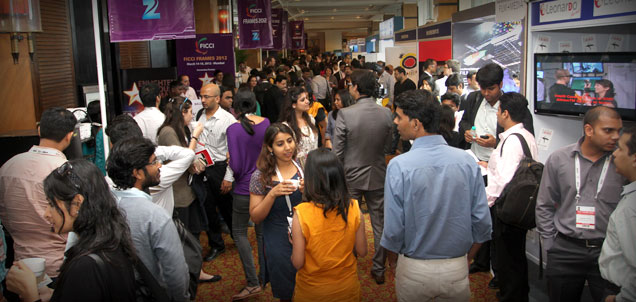
    Those familiar with the going-ons at FICCI Frames would testify how an infatuation gets displayed by delegates at the event each year so as to summarise the mood of the convention even before it broadly takes off across the three days that it is entitled to. But probably, the setting was a bit different this time around when the delegates – joined in unison by the media – were running ballroom to ballroom trying to ingest giveaways that were being thrown up abundantly across several sessions. May be, it was a year where each day had something new to offer to the delegates that kept them at tenterhooks throughout the 3-day event. And going by the loud decibels that were being emanated across every nook and corner of the venue, it was evidently clear that there was some motivating factor that was driving the gathering to go on an overdrive spree.


    The organisers of FICCI Frames 2012 have every right to take credit for coming up with a theme around a medium that attracted the attention of one and all. Having kept it on the sidelines till last year, digital was finally given its due at the convention as experts, authorities and enthusiastic youngsters came face to face to deliberate and come up with outcomes that would redefine the way the consumers consume the medium. From television to print to films and even radio, digitisation and the benefits and effects it would cast on these sectors were discussed in length at the venue. In fact Star India CEO Uday Shankar in his keynote address didn’t hesitate in thanking the FICCI committee for putting across a theme that would go on to redefine the way the industry functions in the future.


    What was apparently clear through the various sessions at the convention is that with the nearing of date for total digitisation across key metros by June 30 2012, and then across the country by 2014, broadcasters had to relook their distribution and content provision models so as to keep the consumer at the heart of every shift that will transpire in the future. Emphasising on the current digitisation scenario in the country, Mr Shankar said, “Most of the discussions that I have participated in are still around whether digitization will happen and if it indeed were to go through, how chaotic it would be. But all these are meaningless discussions triggered by a bunch of retrograde interests who are living in denial.” According to Mr Shankar, digitization of distribution is a big reality and the 40-45 million homes that have bought DTH boxes at some point or the other are a conclusive evidence of that.


    Shooting back at critics who had doubted whether the makeover to digital would ever be a reality, Mr Shankar said, “To the critics and the cynics who are still wondering whether digitization would happen, my answer is: Look around, it is already happening and the rest of it is bound to happen because even in this country it would be difficult to undo such a momentous shift. To those who wonder how chaotic it would be, my response is that there would be some chaos, but chaos is not necessarily bad if the alternative is status quo or regression. When a transition at such a scale is happening that affects the illegitimate but strong vested interest in certain pockets, then there is an incentive to put up with chaos in the interest of the larger social objectives.”


    A broader outlook was provided by a few panellists who said that digitization will come in as a relief for broadcasters who will be benefitted from additional subscription revenue, relaxation on paying heavy carriage fees, and of course providing viewers with a superior content experience – MSOs and cable operators have to quickly respond to the digitization mandate by investing in set-top boxes – the cost that is only possible to recover after four years.


    Sounding off the challenges that digitisation would present for the broadcast sector, Tarun Katial, CEO of Reliance Broadcast Network Ltd said that, “For television, it will be a combination of content as well as marketing. The old model which was a combination of carriage and product, as it stands today, won’t work. The business plan which currently has a very high rate of carriage will obviously see the content taking precedence.” And as for content, it will be niche content that will call the shots for broadcasters as according to experts at the convention, niche isn’t niche any more as all niche channels put together command a share that is equivalent to the share of Hindi GECs and the mass channels, so to say.


    Perhaps the many advantages that digitisation will have on several mediums was rounded off by Vikram Sakhuja, CEO, South Asia, Group M who said, “The inherent power that digital brings along with it is interactivity and its ability to link multiple devices. Also the ability to enhance real-time consumption of content; linked to that is the entire thing about going mobile.” On the roadmap for the industry, Sakhuja said, “I think integrated media is the best way forward. Today when people think of multimedia planning, they do a separate TV plan, print plan, radio plan, internet plan and so on. I believe that if you actually look at media agnostically and at common metrics of each cost per thousand impressions, these are the ways in which you can construct a media agnostic plan. What it does is, it suddenly gets more money into digital, and when more money can come into digital, that’s when focus is going to come in.”


    While digitisation was the mainstay of every discussion, the all-important issue of regulation too was taken up by panellists who chose to have the government respond to the many queries surrounding the topic. Uday K Varma, I&B Secretary, said that “if people at large seem to be happy with self regulation, I think the government would have no problem in legitimizing them. But I think the self regulation mechanism which has been set up by both the news broadcasters and the entertainment broadcasters, they’ll have to really prove it, not to the government but to the people at large.” He was joined in his cause by Prithviraj Chavan, Chief Minister of Maharashtra who said that the challenge would be to adopt the regulatory framework to new technology and ensure that over regulation doesn’t kill a good thing. The Chief Minister emphasised on the need for regulation and suggested that instead of the state regulating the media, the medium should look at regulating itself.


    The other important announcements that came up at the venue included the soon-to-be-passed Copyright Amendment Bill, the roll-out of the imminent phase 3 radio policy that would steer the growth of the medium and increased government aid for the film & entertainment sector.


    Session Byte

    “I think we have created some kind of history by encouraging self-regulation for the news and entertainment channels. We are keeping a close watch on the efficacy of this novel mechanism. A lot would depend on how effectively these self regulations become functional. If people at large seem to be happy with self-regulation, I think government would have no problem in legitimizing them, but I think the self-regulation mechanism which has been set up by both the news broadcasters and the entertainment broadcasters, they’ll have to really prove it, not to the government but to the people at large.”


    — Uday K Varma, I&B Secretary


    New ventures @ FICCI

    BARC takes wings

    In between the many promises and hopes that were being doled out at the sessions came the news of the Indian Broadcasting Foundation (IBF), the Indian Society of Advertisers (ISA) and Advertising Agencies Association of India (AAAI) announcing the official formation of a nationwide audience research joint body — Broadcast Audience Research Council (BARC).


    While IBF will have 60 per cent stake in BARC, ISA and AAAI will each hold 20 per cent stake. The Board of the council will have 10 members, six members from the IBF and two members each from the ISA and AAAI.


    Discovery Kids to flag off ops in April

    Another important announcement was made by President & CEO of Discovery Networks International, Mark Hollinger who announced the launch of its new network for children in India, ‘Discovery Kids’. Mr Hollinger said, “Launching in April, the network will initially be available in three languages – Hindi, English and Tamil. The channel will offer children a fun and entertaining way to satisfy their natural curiosity with stimulating and imaginative programming,” he said. The company plans to roll out the channel in Philippines and Indonesia later this year.


    Ten Golf tees off

    Taj Television India Pvt Ltd announced the launch of Ten Golf, a dedicated 24-hour golf channel. Ten Golf is the fifth channel from Taj Television India Pvt Ltd and began transmission on March 15, 2012. The dedicated golf channel will showcase a mix of live, non-live and feature programming. The channel will also broadcast live, high quality Golf action from around the world.


    Ten Golf has acquired rights for European Tour and Asian Tour till 2016, and has also entered into partnership with PGTI for three years to telecast the Indian Tour. Further, Ten Golf will be telecasting 400 hrs of golf programming in association with NBC.