Category: NEWS

  • @FF12: No disadvantage of being a woman

    By A Correspondent


    The media and entertainment industry which at one point in time was dominated by the men has today more number of women not only working at the lower and mid-level but, have even taken on leadership roles, giving a tough competition to their male counterparts. Whether it is the film and television industry or in the news media, women are not shying away from taking on responsibilities and accomplishing tasks that were once considered to be only a ‘man’s job’. Day three of FICCI Frames 2012 held a session on ‘Women in Media & Entertainment circa 2012: Leading from the front’.


    The panel members of this session were Vidya Balan, Actor; Anurradha Prasad, Managing Director, BAG Films; Jenni Tosi, CEO Film Victoria; Ekta Kapoor, Creative Director, Balaji Telefilms; Barkha Dutt, Group Managing Editor, NDTV; and Usha Uthup, Singer. The session was moderated by Rajeev Masand, Entertainment Editor, CNN IBN.


    This session discussed the journey of each of the above eminent women personalities and the challenges they faced during their journey. The moderator, Rajeev Masand simply put it this way, “Traditional media for long was dominated by men, but not any longer. It’s become outdated.”


    All the eminent women personalities claimed that despite all their challenges they had an incredible journey and the results have been fruitful.


    Ms Tosi observed that there would always be obstacles in a woman’s journey but, at the same she also admitted that at times a little bit of luck and timing also plays a part in ones success nevertheless, she must also be hard working and committed to succeed.


    According to Ms Dutt, the real heroes are actually the women who came before them i.e. those who made a mark and their presence felt in the male dominated industry. They were the ones that needed to be saluted, she said.


    One of the topics discussed at the session was whether ambition for men meant one thing and another for women, and how society reacts to ambitious women. Ms Ekta Kapoor agreed that ambition for men is a virtue, but for women it is seen as something negative. “I never took being a woman as a disadvantage and frankly, I never even thought about it. Today I am successful not in spite of being a woman but, because I am a woman,” she added. Ms Kapoor was also quick to emphasize  that 40 per cent of talent in television today consists of women.


    Ms Prasad said, “Today women have become so much mature, and so have their families. Today women have to juggle multiple roles. Had I thought that since I am a woman, and hence I cannot take on a task then I would not have been successful. If you are happy with what you are doing and at peace with yourself you will be successful in life.”


    Ms Uthup was of the view that what has really changed is the audience. “The field of Arts has been a level playing field for women. In the field of Arts you really don’t have gender bias. It’s been a fantastic journey for me and I believe if we want change to take place the people need to notice first and they must be awakened. Men and women must work together, but then there are things that women can do and men can’t and there are things men can and women can’t do.”


    Ms Balan said, “The Indian actress today has been humanized. No longer is she seen as a hero’s heroine; the actress is getting to play a part in the story. I have never seen my gender as a disadvantage, all I knew was I had to be strong to move ahead in life. There is a wide variety of roles for women today and the fact that there is no model code for women any more is liberating.”


    While all these eminent women had plenty of inspiring stories to share, each of them have had to overcome their own tough challenges, change the societal mindset about women being weak and docile, to climb their way to the top.

     

  • @FF12: Digital will decide the fate of TV

    [youtube width=”400″ height=”250″]http://www.youtube.com/watch?v=r_uR54g7cbI[/youtube]
    Video By Shruti Pushkarna

    By A Correspondent


    When you get a diverse set of panellists together to discuss a medium that’s been changing the way media functions in the country, there is bound to be endless debate on how the medium is preparing itself to face the oncoming challenges and opportunities of the future. And so when the panel discussion on ‘TV’s Many Personas: Evolution of Business Models and Technologies in the Digital Era’ took off, it was interesting to see the panellists move away from the usual banter surrounding the medium to the more serious and in-demand topic demanding attention – impact of digital on the medium of television. The panellists comprised Tarun Katial, CEO, Reliance Broadcast, Punitha Arumugam, Group CEO, Madison, LV Krishnan, CEO, TAM and Vishal Malhotra, Business Head – Digital, ZEEL. The session was moderated by Rajiv Makhni, Managing Editor, Technology, NDTV.


    LV Krishnan of TAM began by bringing to the fore his thoughts on audience measurement as he said, “As digitisation happens, it will be much easier to track consumers; this will be more easy to expedite than what analog does right now given the enormous constraints analog is faced with, including infrastructural challenges, pricing issues, reach, etc.” In fact Mr Krishnan provided a more bullish perspective as he said that in the US and UK, Nielsen had already made a significant progress as they already measure online content (videos), on the mobile and such evolved devices. It won’t be long before that becomes a reality in India too. He also went on to cite an example of a client – Unilever in the US, who was being exposed to the culture of GRPs, TRPs, etc – terms that are more endearing to the Indian setting.


    Tarun Katial provided a more holistic setting that his network BIG CBs was adapting to given the impending challenges that digital was casting on the broadcast industry. Mr Katial said that his network was focusing on a few key areas, namely, moving away from the traditional norm of selling DVDs in stores to selling them online and renewing focus around how does it revolutionise and monetise the content that it owns. Katial advocated that the way forward would be for broadcasters to analyse how much they are liked and needed by viewers, basis which they will be able to score an edge over peers in the business.


    Punitha Arumugam put forth her points as she bought to the fore 4Es that will redefine the way the industry will function in the future. She said that because of digitisation there is bound to be an expansion in ratings as viewership and reach is expected to rise because of digital. She cited the example of rural cities and towns that are seeing an increasing entry of DTH players in recent times. The second E that she put forth was on behalf of the planning industry as she said that agencies and advertisers were looking at engaging better with their consumers and be able to narrowcast. The third E was the need to bring about efficiency and lastly, the need to encompass all digital streams leading to better measurement. Highlighting the core issues of digital being a nascent medium to advertisers she said, “Clients are indeed excited about being on the digital medium but it is just 5 per cent of the total ad spends and therein lies the problem. This is because most clients still do not know how to go about engaging with digital but all this will change and 2012 is expected to show digital as being the third largest contributor of ad spends ranging between 6-7 per cent.”


    Vishal Malhotra, Business Head – Digital, ZEEL said that digital was a new avenue for Zee at the moment and that it had a lot of catching up to do with what other players were offering. But it was doing enough on its part to appease audiences watch content of their choice through Ditto TV, their newly launched venture.


    Mr Krishnan added further by stating that there were several myths that could be busted with digital. He said that there is a new concept of destination viewing that is evolving which will not necessarily guarantee more reach but it will guarantee enhanced reach. Another myth surrounds the viability to pay for content that is accessed, especially in the rural areas. With rural areas still finding it difficult to accept the high cost of service, the ability for content to go pay will need a revisit in marketing strategies especially in rural areas. And the biggest myth would be around measurement as content would be measured across multiple platforms like TV, iPads, mobile, etc and not through mediums as is being done now. That may bring about a significant shift in the viewing patterns of consumers, he said.


  • @FF12: How relevant is newspaper content to the reader?

    By Archita Wagle


    N Ram, former Editor-in-Chief, The Hindu, opened his keynote address by stating that there is ‘anxiety and gloom’ over the fact that journalism is in ‘meltdown’.


    Speaking on ‘Building Deeper Reader Engagement- Sustaining Long Term Newspaper Loyalty over Regions’, Mr Ram said that news media is in crisis in the mature markets, due to which there has been a decrease in the circulation and readership of newspapers. But the fact to be noted was that the decline started in mature markets like theUSeven before advent of the Internet. He added that even the broadcast media, ‘the dominant player’, has also seen a sharp decline.


    Mr Ram outlined Two Media World Phenomenon next, where the less developed countries are witnessing increase in circulation of newspapers unlike the mature market. He illustrated his point with the example of the regional, especially the Hindi, newspapers which have seen increase in their circulation. But he added a word of caution when he said that TV, even in the developing world is going through a crisis which it has so far covered by showing entertainment as part of news. Inspite of this, Mr Ram was optimistic that the medium term prospects for the media industry are looking good.


    The key factor for the decline in the newspaper is the increasing popularity of the digital media. Mr Ram called this the Digital Age Paradox and added that in recent times the newspapers have seen an increase in the readership of their online editions. But he added that the recent paid content model will impact the readership in a big way.


    Mr Ram opined that the paid content model will not replace the old revenue model of the newspapers any time soon as a lion’s share of the revenue earned goes to the search engines like Google and content providers like iPad apps.


    He added that the paid content model has put a “double squeeze” on the newspapers’ revenue, as they have to subsidise digital journalism, which in turn is cannibalizing their circulation.


    Mr Ram was optimistic about Indian newspapers surviving the challenge of the Internet as he believed that India has a “new kind of advantage” due to its fact the media here is still growing at the time when it is faced by the Internet challenge. But he said that the media can’t afford to be complacent about the time before it faces ‘a mature market-like situation’, estimating that the newspapers have around 3-7 years before the negative trends overtake us.


    After taking the audience through a detailed study of the challenges being faced by the newspapers, Mr Ram turned his attention towards how the newspapers can engage the readers to sustain their loyalty.


    Mr Ram said that readers today have real time access to information and could check out the information that was provided by the newspapers. He was of the opinion that if the newspapers stuck to the basic principles of journalism – context, accuracy, perspective, fact checking and verification – they can build a relationship with the readers, which it can rent out to the advertisers. But he was emphatic that “newspapering” must not be reduced to consumer marketing of news.


    He advised the newspapers not to target “attractive demographics” which help in getting revenues, but to provide news for all sections. He said “trust is the key to good journalism”. He asked the newspapers to be clear about their identity, core values and focus on where they want to go and cautioned them against imitating anybody else.


    He said that the readers today want shorter articles and more analyses and editorial content and views, especially in the digital viewing context. But he expressly warned against “editorialising in the guise of news”.


    He concluded his address by stressing the importance of having an internal mechanism for correction of the mistakes that ran independent of the editorial and the advertisers which will help the newspapers to do the right thing.


    Director of the Dainik Bhaskar Group Mr Girish Agarwal took the stage next for a short but relevant address. He started off by stating that he agreed with Mr Ram about maintaining the standards and fundamentals of journalism but begged to differ from him by stating that Indian newspapers are growing in their circulation and readership.


    He said that India had a huge advantage in terms of number due to the gap between those who can read and those who actually read a newspaper.He spo


    ke about the need to engage the reader by asking “How relevant are we (newspapers) to the reader?” He said the need for an intellectual organisation like newspaper is external understanding and internal adaptation. He opined that a newspaper cannot rest on its past glory but should move ahead by acknowledging and understanding what the consumer wants and giving him what they think he needs.


    He also differed from Mr Ram when he empathetically suggested that newspapers need to be simplified and adapt themselves to the readers’ requirements. He ended by saying that newspapers should have global vision and hyper local content.


    After the speeches the floor was opened to the audience who questioned Mr Ram and Mr Agarwal about threat perception of the culture of medianet and media houses being bought over by MNCs


    Mr Ram denounced paid news as a rogue practice which has been rubbished by the Press Council and Mr Agarwal added that since only one company had this practice it was not fair to generalise about the industry. Mr Agarwal said that ethically media should report anything that may be perceived as defaming by the parent company but the ground reality is not always so rosy.


  • @FF12: CCI is an overall market regulator: Ashok Chawla

    By A Correspondent


    Keynote speaker Ashok Chawla, Chairman, Competition Commission of India (CCI) opened his address by pointing out that the media and entertainment (M&E) industry is one of the fastest growing sectors in India today, with an expected CAGR of 14-15 percent. He attributed this to increase in disposable incomes and aspirational lifestyles.


    He said that with digitisation set to come in by July 1, the M&E industry witnessed consolidation which has ensured synergy for players looking for entry. The state has been acting as facilitator, and by not regulating directly, ensuring a balanced growth.


    Outlining this scenario, Mr Chawla proceeded to outline the role CCI performs in the industry. He said that CCI is an overall market regulator whose objective is to ensure that market forces operate with transparency and fair play. It has been put in place to identify the boundaries of behaviour of the industry.


    Mr Chawla gave an overview of the Competition Act and how it came into force in 2009, in spite of having been passed in 2002. The philosophy of the Act was that with deregulation, there is a need for a body which can look at behaviour and how businesses are conducted.


    Mr Chawla said that the Act has a two-fold agenda. It takes a look at, and if necessary action against, activities which are anti-trust and anti-competition in nature. It also ensures that the economic activity is not restricted and freedom of trade is not affected. The main objective is to ensure that the consumer should benefit by the more efficiency.


    He said that they keep an eye on the mergers and acquisitions (M&A) in all the sectors. Any M&A which goes above a certain threshold and can have an adverse impact on the market requires the mandatory approval of CCI, he added. The dissenters made to pay monetary penalties.


    Mr Chawla also outlined the role that trade associations and bodies should play. He said that rules framed shouldn’t inhibit non-members as it could be anti-competition in nature. The bodies shouldn’t encourage collective boycott of non-member players as it would be construed as engaging in anti-competition practices and abetting collusion among the members and let the consumers choose their preferences.


    He said that self-regulation was of prime importance to avoid infringement of law or market practices. He cautioned the players that consumers should be given primary importance and that should be the end goal of the businesses.


  • Freaking News: Tendulkar upstages the budget extravaganza

    By Ranjona Banerji


    Pranab Mukherjee owes a big debt to Sachin Tendulkar. By the time Saturday morning dawned, the newspapers it seemed were far more excited about the century of centuries than they were about fisccons, indirect taxation and how do you solve a problem like Mamata.


    The Times of India, Uttarakhand, had “Sachin, Thanks a Ton” as its lead headline and story. The budget was tucked below the fold. The Hindu went with convention and the budget, “Dr Pranab’s bitter medicine” but there was Sachin’s “century of centuries just below the fold. The Hindustan Times (Delhi) put Sachin as a banner on top of the budget – “God of All Things” and then said, “Reforms on Rewind”.


    The Times of India’s Mumbai edition put Sachin at the top and the bottom. There was the banner “Tondulkar goes where no one ever has or ever will”, then a graphicked-up finance minister with the headline, “Face it. Life’s got a lot more taxing” and then “Thanks a ton, Sachin” at the bottom. DNA, Mumbai went with “Budget bores, Sachin scores” which about put the matter in perspective.


    As far as headlines go, I would say Hindustan Times has won, DNA has come second, Times has tried too hard and Hindu not at all.


    Interestingly, Hindustan Times, Mumbai’s Sachin banner read “Man of the Century” which perhaps proves that HT thinks that either no one in Mumbai will get the Arundhati Roy reference in the “God of All Things” or that people in Mumbai can’t do maths (man of 100 centuries, surely?) or that the Mumbai edition just felt it had to be different from Delhi. Now that’s a legitimate desire, surely?


    Even The Economic Times could not ignore Sachin and tied the two together into one headline, “On Budget Day, Sachin scores”. The Vodafone tax case also got a cricket reference “Vodafone may have to face Pranab’s Doosra”.


    Thus the nation’s fascination with cricket and Tendulkar managed to upstage the annual extravaganza that newspapers go through every year.


    * * *


    In fact, Saturday must have been a news editor’s nightmare, trying to decide which story was bigger. After all, we’ve spent almost a year going on and on about Tendulkar’s 100th century and couldn’t give it second place even if it arrived on budget day.


    As for what the newspapers said about the budget, it was more of the same – some people liked it and some didn’t. More than likely: all will be forgotten as Mamata Banerjee plays out some new drama and Akhilesh Yadav loses some of his sheen. Pranab Mukherjee will probably have the last laugh.


  • Brand Sachin still on strong wicket

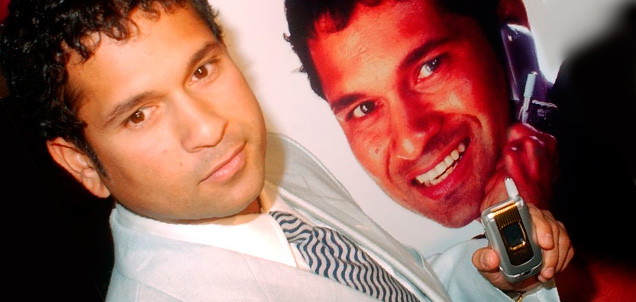
    Sachin Tendulkar launches G-Hanz Mobile


    By Tuhina Anand


    India collectively heaved a sigh of relief when Sachin Tendulkar finally reached his 100th 100. The long-chased milestone had become practically a national issue, and had also brought flak on the master blaster, especially speculation about his retirement. Sachin in his illustrious career has not only reached many cricketing milestones but along with that has also become the face of many popular brands in India. He has been seen in the ads of Pepsi, Visa, Aviva Life Insurance, Boost, Adidas, MRF, Britannia, Toshiba and Castrol India among others. In fact, Future Group has co-created the Sach brand along with Tendulkar which has products including toothpaste and bathing bars. The Sach brand proves the icon’s sheer clout, that a brand can be created with a varied range of products, and is considered a viable commercial option.


    Talking about brand Sachin, Piyush Pandey, Executive Chairman & Creative Director, Ogilvy South Asia said, “Brand Sachin is not just about cricket but it’s the persona that comes with the brand which is appealing. Sachin is a non-controversial, family man with high value systems. He is the son, father, husband, friend that one would want to have and his recognition is beyond the nation. He is a total package if one may say in terms of advertising jargon. He is a successful cricketer but along with that he is an endearing personality and therein lies his brand appeal.”


    Mr Pandey pointed out that Sachin has been able to last so long in his career and done so well only because he has been able to reinvent himself and adapted to changing times. The truth, after all, is that he is no more an 18-year-old and his reflexes will change with age but he has managed fantastically to adapt himself to this change. “Sachin is special and I can’t really think of any other person from cricket who has created such an impression. Rahul Dravid probably could come a close second. But Sachin is Sachin and beyond comparison. The only other name that comes to my mind who has successfully adapted himself with time is Amitabh Bachchan.”


    Looks like the naysayers can keep on debating on Sachin but the masses will continue to hold him in high regard despite the man himself saying: “I am not God, I am Sachin.” Prahlad Kakkar, ad filmmaker and CEO, Genesis Films who has worked with Sachin on many ad films said, “Sachin’s track record is impeccable and his dedication to cricket and the team is firm. His brand value lies in his courage, honesty and sincerity with which he plays. In fact, he is the real gentleman in this gentleman’s game.”


    He added, “Sachin is humble to the point of being irritating. There was a time when we had shot an ad with him knocking a ball with a fly swatter. When Sachin saw the final cut he was not happy with the use of the fly swatter and requested us to re-do the shot. We didn’t find anything wrong with the shot but Sachin had a point of view and we respected and understood his view and re-did the sequence. He has no ego and he is clear that the game always remains bigger than him.”


    Kakkar said that the Pepsi films, especially the one with the Sachin mask, “Sachin Ala Re”, remains his pick of the best Sachin film.


    Hemant Kenkre, former first class cricketer and communications specialist who has had seen Sachin play from close quarters, says that two qualities that stand out in Sachin’s personality is his ability to reinvent and his commitment to the game. Kenkre said, “Sachin delivers and that’s the bottom line. The cynics will be cynics and there will be talks of his retirement but I really can’t think of anyone from the younger lot who can replace him.”


    He added, “While people have been talking of the 100th ton, one should remember the 99 100s that he has scored before. I think his not getting the 100 was a minor bump towards this milestone. He is a man who is obsessed with the game and one can easily bank on him. His retirement is a personal issue and it will come the day he stops enjoying the game. In fact, his current brand value can be understood from the fact that his 100th 100 got 5-page coverage in TOI whereas the retirement of Dravid must have got him a one-page dedication!”


    So there could be speculation on Sachin getting old for the game, but people in the business vouch for his brand value which still remains consistent. Mustafa Ghouse, Head of Sport, Globosport categorically states that Sachin is still the most sought after cricketer in the country when it comes to endorsements. However, he has a point when he says that the brands that he will attract now will differ and will be for products that appeal to older age group like insurance. For youth brands he might not be appropriate.


    Manish Porwal, Managing Director at Alchemist Talent Solutions has a different view on the cricketer’s brand value. He said, “I think this is the first time but in the last two months brand Sachin has taken a beating. There has been criticism all across and this has taken a personal note than remaining professional. So there would have been some loss in terms of potential and revenues that would have come in from endorsements.”


    He added, “This however will be temporary. Indians have a skewed sense of loyalty and one success will again put him back on the pedestal. His equity so to say has fallen on account of his performance but this 100th 100 will give him the jolt and become a personal milestone because of so much speculation around it. However, in terms of his long-term brand persona and brand associations one should look at characters for brands that will express long-term maturity and consistency rather than stamina or performance.”


    Brand Sachin still remains strong and will remain strong in this cricket-crazy country. However, there is a feeling that the brand may have taken a temporary dip because of all the speculation and pressure on attaining the long-elusive 100th 100. However, the consistent view is confidence in Sachin’s ability to reinvent, hence his moving away from brands appealing to the youth, towards advertisers who look for traits like commitment and consistency. Qualities where Sachin fits the bill perfectly.


    Photograph: Fotocorp


  • Denizen explores social media to create buzz

    By A Correspondent


    Denizen, the youth brand from Levi Strauss & Co, has been using social media effectively to connect with its consumers, the most recent example of this being its ‘We are Explorers’ initiative which has been quite a success in its first phase.


    Talking about the genesis of the idea, Arvind R P, Marketing Controller, Denizen, explained, “We know that the youth of today are increasingly spending time on social media engaging with friends & making new connections. Given that Denizen is a new brand, we have been exploring ways to connect strongly with the youth and be a part of their conversations. One of the exciting ways to deliver this is to have brand ambassadors who participate in the brand’s activities, get deeply involved in the brand programs and then build around these conversations. This is an exciting way to create buzz around the brand.”


    He aded, “Denizen is a global brand and hence this ‘We are explorers’ programme had to be on a global scale. We have Denizen brand ambassadors from India, China, Mexico, Singapore and Pakistan travelling to India, China and Mexico, in three phases.”


    When the initiative kicked off, there were about 200,000+ fans on Facebook which till date has more than doubled. This is for just Phase 1, with Phase 2 and 3 yet to happen in April. Most importantly, the quality of conversations around the brand has been heartening which is something that the brands today are increasingly looking at. Not to mention that this has helped drive buzz around the brand.


    The six young explorers, chosen from a large pool of hopeful applicants via a global casting call, hail from countries where Denizen clothes for youth can be purchased. This includes China, India, Mexico, Pakistan and Singapore. The explorers will be paired up as they head to their destination country during the next two months – March and April. They will embark on an action-packed trip where they will meet new people and take on tasks and challenges centered around creating new styles of denim based on their experiences. ‘We are Explorers’ campaign is being executed in three phases while the first phase is over, the next two phases will help in maintaining the momentum and buzz over a longer period of time. The company hopes that post this global program, the brand would have attained a sustainable base of fans and been a significant part of youth conversations. The plan is to build upon it and enrich the conversations around the brand.


    On other marketing initiatives around the brand, Mr Arvind said, “An important part of Denizen’s plans is to excite the youth with relevant innovations. Super shape, a new fit for young women which enhances the body curves, has just been launched. It has a more defined curve, a slimmer waist and longer leaner legs. We are planning a sustained promotion to build the women’s franchise with this innovation.”


    The brand Denizen has been designed keeping in mind the aspirational desires of the youth who increasingly identify with global trends. Leveraging LS&Co’s rich heritage and fit expertise of over 138 years, Denizen is re-inventing fits for this young generation of consumers. Affordable yet aspirational, the brand delivers great fitting and quality jeanswear with innovations.


    Denizen had taken the social media route when it was launched in India, where it used the social networking platform to engage its consumers and did events around the seven letters that spell Denizen, including a fashion show.


    In 2010, Levi Strauss & Co launched the Denizen brand in Asia – the company’s first brand launched outside the United States. In India, Levi Strauss Signature has transitioned into Denizen in 2011. Since its launch, the brand has gone to have over 300 exclusive brand stores and over two thousand multi-brand outlets.


  • Sony Max hits a chauka with IPL mauka

    By Rishi Vora


    Sony Max has unveiled a new marketing campaign for IPL season 5.

    A series of four TV ads currently running on air capture the pulse of the audience. The theme ‘Aisa Mauka Aur Kahan Milega’ uses various relations – father-son, friends and also relatives – making the case that IPL brings people together.

    JWT is the creative agency that has conceptualised the campaign.


    Neeraj Vyas, EVP and Business Head, MAX said, “We set out to create a unique piece of communication for a very unique property, which is the DLF IPL. We at MAX are proud to bring our viewers the ‘mauka’ to enjoy DLF IPL 2012 and we are certain that our communication campaign ‘Aisa Mauka Aur Kahan Milega’ will only take the this tournament to greater heights. The films capture the one emotion that binds our country – the undying passion for cricket everywhere.”


    Gaurav Seth, Marketing Head, Sony Max said, “We do a lot of consumer research to gauge the reactions of our audiences. So post IPL 4 we conducted a research with Ormax Media and what we found out was that a lot of people thought IPL was an ‘opportunity’ (mauka, which is the campaign theme) for the whole family to come together (even though they’re not very comfortable together as the ad highlights). Similarly, we found that a lot of kids watch IPL as they have their vacations at that time of the year. Our father-son commercial captures that insight very well, where the son gets a mauka to remind his father that he should go to sleep and not watch IPL as he has office next day…and the commercial where two friends find a mauka to bunk work.”


    The TV campaign started on Feb 23. Besides TV, Sony Max will do Press, Outdoor, Radio, Activation in malls, Digital etc. Print campaign will start as the launch date nears, alongwith Radio.


    “This year you will see a very large amount of noise being created by all stakeholders of the IPL – the franchises and the BCCI. As far as our campaign goes, it’s a complete 360 campaign. We will close our deals with various media service providers next week. I’m sure that IPL will be the most talked about event on TV with all the campaigns running in full swing,” he added.


    The channel has not announced exclusive media partnerships as it aims to broadbase its reach across demographics and geographies in India.


    [youtube width=”320″ height=”200″]http://www.youtube.com/watch?v=ZGgIO6MhwLA[/youtube] [youtube width=”320″ height=”200″]http://www.youtube.com/watch?v=cEjEYmEWhoA[/youtube]
    [youtube width=”320″ height=”200″]http://www.youtube.com/watch?v=UXQsIgN_530[/youtube] [youtube width=”320″ height=”200″]http://www.youtube.com/watch?v=XdDFD08QNpo[/youtube]


  • Face the ‘Moments of Truth’ with Mindshare-Brand Equity Compass 2012

    By A Correspondent


    Media services agency Mindshare in partnership with Brand Equity is organizing Compass 2012, a day-long marketing summit at Hyatt Regency, Mumbai on March 27, 2012. This year, the Conclave theme ‘Moments Of Truth’ dwells on the truth every brand must face and conquer to propel its growth. Every session will discuss new ideas that will redefine the marketing trends of the future.


    Mindshare India has been organizing this annual marketing event with leading business daily, Economic Times, from the past four years. Each year, the summit is attended and addressed by leading constituents from the marketing and advertising fraternity who provideinsights and the latest trendsinmarketing, media and consumer behavior, setting new directionsinbrand-building. This year Shantanu Khosla, Director and CEO, Procter & Gamble India and Marco Rimini, Leader, Business Planning, Mindshare Worldwide will address the audience. In 5 years, this summit has grown to become a coveted arsenal of marketing mantras.


    Sandeep Pandey, Principal Partner, Consulting, Intelligence & Aanlytics, Mindshare said, “Mindshare and Brand Equity have partnered for the last four years to bring the best of thought leadership to the business community through the BE Compass. It has proved to be the ideal platform for leadership discourses on the most relevant marketing issues that CMOs and CEOs face today. We work very closely with the leadership of some of the top companies in each industry to identify the themes, speakers and audience for this prestigious event. The outcome is a heady brew of game-changing strategies, approaches and stories that leaders can take back to their board rooms.”

    He added, “This year’s themes revolve around the truths and challenges that the C-Suite faces around consumer growth, leadership, communication, and market penetration, including rural markets, to run their businesses effectively. As in the last years, we are sure of overwhelming response to these themes this year too.”

    Over the years, The Mindshare-Brand Equity Compass has focused on a topical agenda, with the objective of addressing the key business challenges and discovering marketing strategies that align with business goals. This year, the conference theme ‘Moments of Truth’ will talk about why it is so crucial to b2b marketers’ ability to help drive the business.

    While the emphasis remains on addressing challenges confronted by the marketing and business community, the day long summit is aimed at creating a platform wherein industry leaders can discuss strategies that can be adopted to propel growth to the next level. The Summit is divided into various interactive sessions which will focus on topics ranging from CEO’s Truth, Consumer Truth, Communication Truth, Retail Truth and Rural Truth.

    The summit will address the challenges faced by CEOs as they rally around new set of business truths, be it allocating resources or best way to nurture people and brands in 2012. Finding the true consumer insight is undeniably the most important task faced by every marketer today. The session on Consumer Truth will analyze consumer’s relationship with brands, advertising and the role of innovation. With social networking sites gaining momentum Communication Truth is evolving every day, this session will focus on lessons for the future.

    Retail has moved from being viewed as a traditional sales function to being an important component of the marketing mix. The session on Retail Truth will witness marketers discussing diverse subjects such as different formats that work in a challenged economy, how to create price premium in retail and role of advertising amongst others. With more than 70 percent of the total households in India residing in the rural areas, understanding the Rural Truth is very crucial to derive and reap maximum benefits for the marketers.


  • Ipsos Marketing reorganizes globally, sets up four practices

    By A Correspondent


    As part of the combination between Ipsos and Synovate, Ipsos has reorganised its Ipsos Marketing specialisation – the largest of Ipsos’ global business lines, representing nearly half of Ipsos’ total revenues in 2011.


    Ipsos Marketing remains under the global leadership of Pierre Le Manh, Chairman and CEO of Ipsos Marketing. Mr Le Manh is also Ipsos deputy CEO and Chairman of Ipsos ASI.


    Ipsos Marketing is now organised through four practices:


    Market Understanding and Measurement

    This practice helps clients understand consumers, shoppers and markets, differentiate their brands, optimise their distribution and allocate their Marketing expenditures. For now it is managed directly by Pierre Le Manh and mainly operates under the Ipsos Marketing brand. It also includes new and highly specialised services such as: Ipsos Business Consulting, which advises clients on emerging markets penetration strategies; Ipsos Retail Performance, which provides technology to measure and analyse traffic in stores; and Ipsos MMA, a leader in Marketing Mix Modeling.


    In India Ipsos Market Understanding and Measurement will be headed by Rajesh Nair, Executive Director, Ipsos in India.


    Innovation and Forecasting (Ipsos InnoQuest)

    Ipsos InnoQuest is the global leader in Innovation research, helping clients maximize the ROI of their innovation initiatives. From generating new ideas to testing products and services, to forecasting sales across many industries, Ipsos InnoQuest has a unique, global end-to-end offer. Lauren Demar is the CEO of Ipsos InnoQuest, with Mary-Beth Lake leading MarketQuest, our Product Testing capabilities.


    Ipsos InnoQuest in India will be led by Paru Minocha, Executive Director, Ipsos in India.


    Healthcare (Ipsos Healthcare)

    Ipsos Healthcare is dedicated to understanding the motivations, interactions and influences of the multiple stakeholders who impact commercial success in the pharmaceutical industry. It provides syndicated services through its therapy monitors as well as custom research. Michael Spedding is the CEO of Ipsos Healthcare, with Bob Douglas leading our custom research teams.


    Ipsos Healthcare in India will be headed by Monica Gangwani, Executive Director, Ipsos in India.


    Qualitative (Ipsos UU)

    Ipsos UU is the world’s leader in Qualitative research. It has developed a unique global network of talented qualitative researchers from diversified backgrounds and a consistent set of methodologies. It uses technology extensively to bring Life to life. Jacquie Matthews is the CEO of Ipsos UU.

    Rinku Patnaik, Executive Director, Ipsos in India will lead Ipsos Qualitative business in India.

    “The combination with Synovate has been a terrific opportunity to develop a new plan for Ipsos Marketing,” explains Pierre Le Manh. “We are further specialising our teams so that our clients can have access to professionals who can truly help them understand how to improve their business”.

    Ipsos, an independent market research company controlled and managed by research professionals, was founded in France in 1975, and is now a worldwide research group. In October 2011 Ipsos completed the acquisition of Synovate to form the world’s third largest market research company with offices in 84 countries.


  • Rakesh Gopal joins Mogae Media from India Today group

    By A Correspondent


    Rakesh Gopal, who was with the India Today group, last with Mail Today, as Head – Impact for Delhi, East and South India for three-and-a-half years, has joined Mogae Media as the national No. 2 for Monetisation. He will be Senior Vice-President, based at the company’s Delhi NCR headquarters.


    A graduate in commerce from Delhi University, with an MBA degree as well, Mr Gopal has more than 20 years of experience in media sales. His earlier stints were with The Pioneer and the Hindustan Times – where he was Manager Key Accounts (media marketing), as also with DNA where he was GM Marketing and was actively involved in DNA’s launch, one of the biggest in Indian print media.


    Welcoming Mr Gopal to Mogae, Ms Tanya Goyal, Executive Director, Mogae Group said, “Rakesh is a matured professional with very good client outreach. He will be one of the leaders for Mogae in monetizing mobile as a medium.”


    “I have spent two decades in media sales, largely in print. I see mobile as the new game-changer in the media business … which is why I am here to evangelize a new catalyst of change,” said Mr Gopal.


    Mogae Media is the new venture of veteran adman Mr Sandeep Goyal, focused on mobile monetization. Mogae has an exclusive tie-up with Airtel, India’s largest telecom operator. In recent weeks, Mogae has attracted Messrs Pavan Chandra (from Vivaki), AtishiPradhan (from Contract), TusharDhingra (from BIG Cinemas), and Rahul Kishore (from Zenith Optimedia) to its fold.


  • LinkedIn announces B2B Connect for Ind marketers

    By A Correspondent


    LinkedIn India has announced B2B Connect 2012 – a first of its kind event, exclusively for Indian marketers to be held on Tuesday, 17th April, 2012 at the Grand Hyatt, Mumbai. The inaugural by-invitation event will bring together leading global marketers and advertising industry stalwarts to discuss the current and future marketing potential of the online space and will seek to establish digital and social media as a core channel for B2B marketing.


    LinkedIn India has lined-up a stellar list of speakers and panelists from India and abroad for B2B Connect 2012 led by Jeff Weiner, CEO, LinkedIn, who will give the first keynote address. B2B Connect 2012’s second keynote speaker will be globally renowned B2B marketing strategist David Meerman Scott who will present on the New Rules of B2B Marketing. Arvind Rajan, Managing Director & Vice President, Asia Pacific and Japan – LinkedIn, Future Brands’ CEO Santosh Desai, Microsoft South East Asia’s Simon Mouyal and Philips Korstiaan van Wyngaarden will also address the audience at B2B Connect 2012. For more information and updates on speakers, please visit http://www.linkedinsolutions.in.

    Announcing the launch of B2B Connect 2012, Hari V Krishnan, Country Manager, LinkedIn India, said, “Indian B2B Marketers are finding that their traditional channels aren’t scaling or providing the measurability they desire. At B2B Connect 2012, we aim to bring together some of the best minds from across the globe to share their knowledge and expertise on how B2B brands can capitalize on the digital medium. The rise of social media has helped brands with the ability to reach the right audiences, and in the right context. In such a dynamic environment, it is critical for brands to be where decision makers are engaging with each other and influencers. At B2B Connect 2012, industry leaders will discover valuable insights and should leave inspired with a path forward for their brands to better market themselves in today’s connected world.”

    LinkedIn, with over 150 million members worldwide of which over 14 million are in India, has evolved into a preferred platform for marketers in the country. It is also the platform of choice for B2B marketers in many leading economies. Approximately 57% of LinkedIn members in India are decision makers. In 2011, 149 Million business leads were driven on the platform by professionals in the country. This potent member base has equipped brands including CISCO India, SAP India, Huawei Enterprise Business Group, Polycom and Trend Micro, with an opportunity to lead engagement with the right audience. LinkedIn Marketing Solutions entails a host of customizable solutions with tools including LinkedIn Audience Targeting, LinkedIn Personal Messaging Unit, LinkedIn Custom Groups, LinkedIn Company Pages, LinkedIn Content Ads and LinkedIn Partner Messages.

    “Indian brands have successfully leveraged the power of the LinkedIn professional network to reach an audience comprising of highly educated individuals in decision making capacities. This has become possible due to our approach of helping brands tailor their marketing approach as per their requirements. The combination of an empowered audience supported by unique tools and an emphasis on insights helps brands achieve a strong conversion rate and provides measurable results. At LinkedIn we provide marketers access to a product suite that caters to not only their short term tactical needs, but also long term strategic objectives,” said Dhiman Mukherji, Director, Marketing Solutions, LinkedIn India.

    Regular updates on B2B Connect 2012 will be posted on the official website and on Twitter (@LinkedInIndia).