Category: NEWS

  • Havas Media Group India reports spectacular performance in 2013

    By A Correspondent


    Havas Media Group claims it is right at the top of the performance charts of media agencies. In the midst of a slow-subdued industry and economy where GDP hit a decade low of 4.5%, Havas Media Group India on the other hand has had an exceptional year in 2013, notes a communiqué, adding: “Besides retaining existing clients, Havas Media Group has had strong new business success.”


    RECMA 2013 Compitches has graded Havas at No.1 in YTD new business achievements in both the 2013 preliminary reports. The company stood at No. 2 Media Agency position in the recently declared Agency Report Card 2013 by Campaign India – garnering 8 out of 10 points. It was also shortlisted for the Agency of the Year 2013 Awards.


    Anita Nayyar

    “2013 proved to be a good year where our state of the art product, our dedication and hard work paid. We thank all our clients for trusting us with their businesses in an otherwise tough year and our media partners for their unflinching support at all times,” said Anita Nayyar, CEO, Havas Media Group India & South Asia.


    “Given our ‘meaningful brands’ research and other ‘thought leadership’ tools, we are confident that we will replicate the success of the past years. Our ‘Digital at the Core’ avatar is in sync with the current market realities and is finding a lot of interest and traction among the clients. At Havas Village, we are consolidating creative and media through our unique Meaningful Connection Planning offering,” she added.


    Mohit Joshi

    “Taking from our ‘meaningful brands’ framework we impart holistic solutions to brand marketing which has been the value differentiator. We believe in client delight and will continue to deliver in 2014,” said Mohit Joshi, Managing Director, Havas Media India.


    Among the news busineses, Havas Media added include Emirates, Voltas, Amway, Aspiring Minds, Shaadi.com, Wonder Cement, Neo Milk Products, Halonix, Simmtronics, Mobis and Bloomberg TV India amongst others along with a roster of clients including Hyundai Motor India, Parle Products Ltd., MTS India, Quikr.com, Taj Hotels, Capgemini India, etc.


    Arena India was also launched under Havas Media Group to take on the responsibilities of the global LG Electronics win.The specialist brands Mobext India for mobile solutions and Ecselis for performance marketing are a part of Havas Media Group India.


  • Snack time is play time, says Fanta

    By A Correspondent


    Having splashed their bubbly characters across television screens all of last year, beverage drink Fanta is back with a renewed proposition this time too.

    In its latest communication campaign — Snack-time Fanta-time, the brand seeks to add a zing factor to snack time by showing a group of youngsters enjoying a snack together with a bottle of Fanta. What would be new this time around would be the introduction of a new character – the mom – who would be essaying a central role in the campaign.


    Speaking on the launch of the campaign, Debabrata Mukherjee, VP – Marketing & Commercial at Coca-Cola India & SWA, said, “Snack times are moments full of play and fun energy that represent brand Fanta. Our global body of work on Fanta ‘Play’ has been appreciated world over and this year, we have taken the core proposition further by building in local consumer insights set in the Indian context.”


    The new campaign has been conceptualized by Ogilvy & Mather led by Ajay Gahlot, Executive Creative Director; Shailendar Mahajan, Senior Creative Director and Riazat Khan, Creative Director and produced by Nomad Films. The lyrics have been written by Amitabh Bhattacharya and music composed by Vijay Antony. With its upbeat and playful tempo, the jingle has been rendered into seven languages including Tamil, Kannada, Telugu, Punjabi, Hindi, Marathi and Gujarati.


    Speaking about the campaign, Ajay Gahlaut – Executive Creative Director, Ogilvy & Mather said, “Fanta is a brand that offers a lot of creative fulfillment. This time around, we got an opportunity to produce a TV commercial with the famous Fanta characters to suit Indian sensibilities.”


    The new campaign will reach out to the consumers through an array of touch points including television ads, outdoor, radio, activation and social media.


  • Infibeam to acquire digital marketing firm ODigMa

    By A Correspondent


    Ahmedabad-based ecommerce company Infibeam has acquired a 100 percent stake in ODigMa, a leading digital marketing company headquartered in Bengaluru. The buy will help the seven-year-old ecom firm strengthen its offerings.


    ODigMa is a specialist in customer engagement via social networks and Twitter and Whatsapp. Infibeam, on the other hand, runs a B2C platform Infibeam.com and a B2B platform at BuildaBazaar.com.


    With more than 400 brands as clients, ODigMa will help Infibeam’s merchant on its B2B service. Said Sachin Oswal, COO, Infibeam.com: “The OdigMa acquisition will expand our digital marketing capabilities in the key areas of social media and SEO, SEM etc. complementing our existing strengths.”


    Advit Sahdev, CEO of ODigMa, added: “We are excited to build tools and processes to deliver transformational marketing services for SMEs and enterprise clients by attracting the best talent in the industry.”


  • FoxyMoron unveils in-house PR vertical

    By A Correspondent


    Leading independent digital marketing, ideas and media solutions agency FoxyMoron has extended its service offerings by launching its own PR vertical. With an objective to provide integrated media and marketing solutions for brands, FoxyMoron will also offer PR solutions along with other service offerings including social media marketing, web design and development, search engine optimization, media buying and planning and audio visual content creation to name a few.


    Suveer Bajaj, Co-founder, FoxyMoron and the Account Director of the Public Relations division said, “Over the last six years, FoxyMoron has conceptualized some unique communication strategies. It was only a matter of time that we integrated all our service offerings to provide brands with an additional opportunity to communicate through the same platform using different mediums.”


    According to an official release issued by the agency, the new PR vertical will provide 360-degree integrated service solutions that includes both online and offline PR. The vertical has been in the set-up phase over the last few months and is now running as fully functional unit.


    The division is currently catering to clients like Stratum Consulting, a business HR advisory firm and a national level entrepreneurship challenge called ‘Power to Empower 2013’ by the National Skills Development Corporation and India @75 and managed by innovation accelerator, Ennovent to name a few.


  • Mitrajit Bhattacharya is new President of Association of Indian Magazines

    Mitrajit Bhattacharya
    R Rajmohan

    By A Correspondent


    Chitralekha group President and Publisher Mitrajit Bhattacharya will be the new President of the Association of Indian Magazines. He takes over from Tarun Rai of Worldwide Media.


    Meanwhile, R Rajmohan, Publisher of Open magazine will be the new Vice-President and B Srinivasan, Managing Director of Vasan Publications will be General Secretary. Pradeep Gupta, CMD, Cybermedia will continue to be Treasurer.


  • BARC appoints Dutch firm Civolution for watermarking tech

    By A Correspondent


    Amidst issuing requests for proposals and advanced-level testing, the joint industry body of broadcast stakeholders BARC (short for Broadcast Audience Research Council) has contracted Dutch tech firm Civolution to provide the watermarking technology for its proposed measurement platform. The decision comes weeks after the announcement of Médiamétrie as its key technology vendor.


    Partho Dasgupta

    “India has one of the largest TV audiences in the world so it was critical for us to create an audience measurement system that is gold standard,” said Partho Dasgupta, CEO, BARC. “By leveraging Civolution and Médiamétrie’s expertise in audience tracking, technology and analytics we can now study viewers’ TV habits in precise detail, enabling broadcasters and advertisers to implement efficient strategies to reach their target audience.”


    According to a communiqué, the audience measurement system – which has already successfully been deployed by Médiamétrie in a few TV markets – relies on Civolution’s audio watermarking coding technology for automated content identification and integrates seamlessly into Médiamétrie’s TV meter system for panellists’ equipment and data processing.  It provides broadcasters with a detailed analysis of their exposure to the public, whether by the number of households tuning in to the programme or the amount of time spent watching each piece of content.


    Gwilherm Nicolas, Head of International Business Development at Médiamétrie added: ”We are very enthusiastic to embark on this project with Civolution and its watermarking technology, which is definitely the most powerful and error-free content detection technique available for TV audience measurement.  This means we are future-proofed in the fast-changing world of TV.  Médiamétrie has relied on Civolution’s technology for many years”.


    ”With so many new ways of watching TV content in this multi-screen universe, precise audience measurement has become increasingly complex. Audience measurement services must now report more accurately and reliably, from a larger number of channels, delivered through a fast-changing and diverse mix of broadcast platforms, and consumed either in real time or time-shifted” said Alex Terpstra, CEO, Civolution.


    Civolution’s audio watermark is embedded in the TV’s sound track prior to broadcast. Upon airing, the content is then identified by Médiamétrie’s TV meter, in real-time. In addition to granular measurement of the content being watched, the solution features support for catch-up TV. The technology provides cross-platform audience measurement and will enable mobile device measurement, triggering the creation of new services  and the reduction of operating costs. In parallel, the same watermark infrastructure deployed by Indian broadcasters could be used to synchronize with great accuracy their own interactive second screen applications.


    ”Through our close collaboration with Médiamétrie, we have devised a powerful solution that provides accurate and reliable audience data that will allow BARC to help broadcasters plan, entertain and monetize their TV audiences,” added Jean Michel Masson, SVP Watermarking Solutions, Civolution.


  • Local language content could push internet users drastically, says IAMAI

    By a correspondent


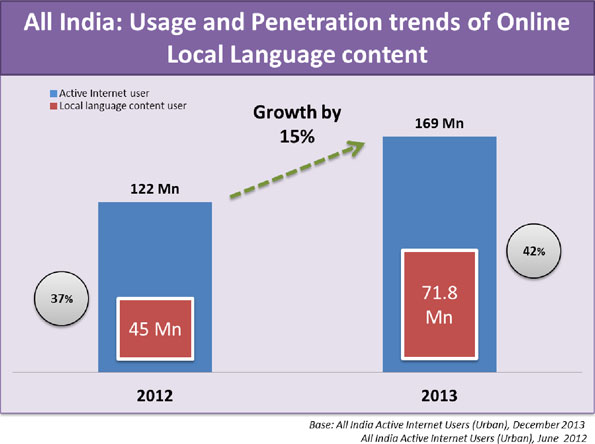
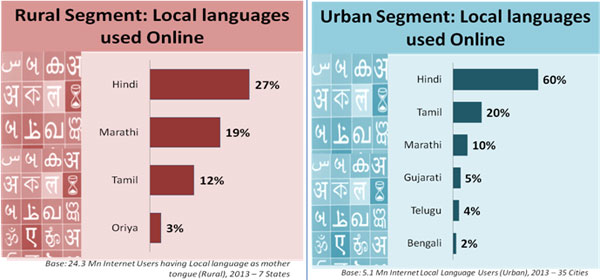
    ‘Local Language Study 2013’ published jointly by the Internet and Mobile Association of India (IAMAI) and IMRB International has predicted that the internet users in India could increase by 24 per cent if local language content is provided on the internet.


    According to the study, in the rural areas 43 per cent of the non-users of internet said they would adopt the medium if the content was provided in a local language while in the urban areas, 13.5 per cent of the non-users mentioned that they would use internet if content is provided in local languages. The report prima facie identifies local language as the single largest driver of internet growth in rural areas. The findings were based on a survey of 35 cities across seven states.


    Among the current users of Internet, the report found the current local language usage penetration among the active internet users is around 42 per cent.


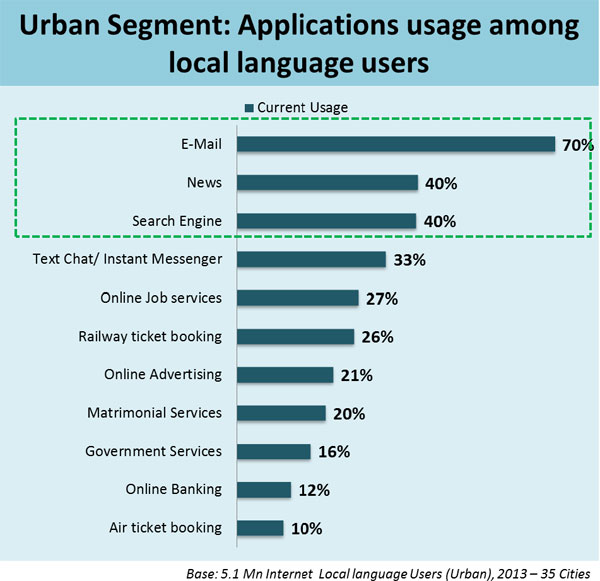
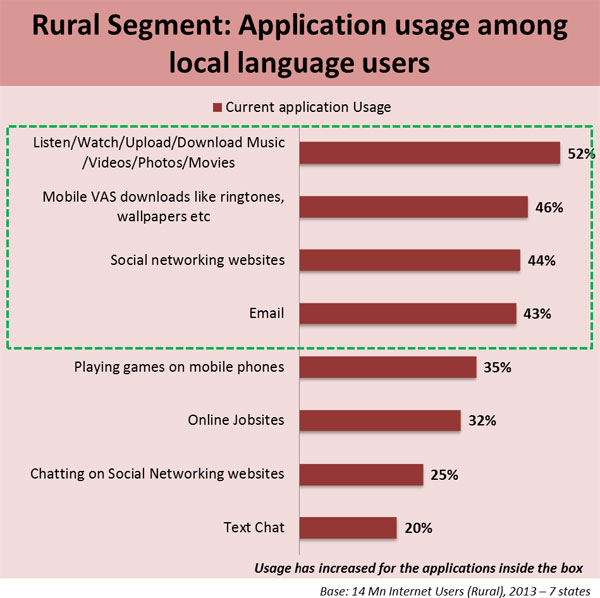
    While the local language content users in urban India are not much different from English language content users with e-mail, News and Search being the main activities, in rural India, however, entertainment, social networking and email remains the primary purpose of using online local language content.


    In rural India, 27 per cent of the users use Hindi to access online content followed by Marathi and Tamil. In urban India too, 60 per cent of the users access online content in Hindi followed by Tamil and Marathi.


  • Idea, Gionee as key sponsors of ‘Khatron Ke Khiladi’

    By A Correspondent


    Telecom major Idea Cellular and Gionee Smart phone have associated with the fifth season of ‘Khatron Ke Khiladi - Darr Ka Blockbuster’ as ‘presenting sponsor’ and ‘powered by sponsor’ respectively.

    The new season of  of the Indian version of reality show ‘Fear Factor’ on Colors will see contestants engaging in more daredevilry than its previous seasons, so it is being claimed. To up the ante this year, the channel has roped in noted director and entertainer Rohit Shetty to bring out the best among the celebrity contestants.


    Raj Nayak

    Commenting on the association, Raj Nayak, CEO, Colors, said, “Over the past few years, Khatron Ke Khiladi has created a strong brand value in the minds of the audiences who associate the show with unlimited blockbuster action and entertainment. Through innovative integration and branding opportunities, we are looking forward at creating synergies that will mutually benefit us and our sponsors.”

    Speaking about their association, Sashi Shankar, CMO – Idea Cellular said, “This is the third season of Khatron Ke Khiladi where we are associating with Colors as the Presenting Sponsor. The show has garnered high visibility over the seasons and has helped us in creating high recall amongst our target audience. This time around we are looking forward to engage with our consumers through multiple initiatives that will further our brand proposition.”


    Gionee Smartphones India Head, Arvind. R. Vohra said, “Gionee being a global brand sees Khatron Ke Khiladi as great opportunity to connect with our target audience. This genre is a perfect way to reach out and establish connect with the young and adventurous new generation. Gionee believes in creating a benchmark in innovation with every new offering and KKK is the apt choice to connect with those who too believe in taking greater risks to achieve the best. We have created some very exciting integration in the show and hope that the consumers will enjoy the same”

    Additionally Mahindra Scorpio and Amul Macho have come on board as the Associate Sponsors of the Show.

    The show will be on air next month.


  • MTS: Making 3G access a child’s play

    By a correspondent


    Internet and broadband solutions company MTS has launched a quirky campaign that delves on the benefits of its latest offering – MTS 3GPLUSâ„¢ Network.


    Conceptualised by Creativeland Asia, the campaign features a new born baby who is familiar with technology and is seen exploiting the internet straight from birth. The TVC opens in a labour room, where a woman is being coaxed by the doctor to ‘push’, as the father and the nurses watch anxiously. Suddenly, the baby’s hand pops out from under the cover and gestures everybody to stop.


    The baby crawls from under the sheet and sits on the mother’s chest. From here on the baby does a series of activities that leaves people in the room shocked. He searches for ‘how to cut the umbilical cord’ and then cuts it, takes a selfie with the nurse on a mobile phone and posts it to Instagram, creates accounts on multiple social networking sites and broadcasts himself, makes a video and even uses the GPS system to navigate out of the hospital.


    Amitesh Rao, Director – Brand & Media, MTS India, said, “We needed a campaign to reinforce our strongest differentiator – the fact that we have designed and optimized the MTS 3GPlus network specifically for data. At the same time we needed to be true to the MTS brand that talks to today’s 24×7, always-on, data hungry consumer for whom the internet is the biggest opportunity platform there is. The challenge of course was to do all of this in an engaging and entertaining manner, which is what the story of a new-born baby going online to announce himself to the world does perfectly.”


    Sajan Raj Kurup

    Speaking about the TVC, Sajan RaJ Kurup, Founder and Creative Chairman, Creativeland Asia, said, “The script for the film began with the simple insight that today’s kids seem so comfortable with technology, devices and the internet even as babies. When I see them (including my own daughter) handle tablets, mobiles and laptops, I have always joked that they look like they were born with it. We just pushed that thought a little further. It took six months of painful labor. And the baby is finally out there. ”


    The TVC has been produced by Smuggler films and directed by Guy Shelmerdine.


  • DISS 2014 showcases motivational entries from India

    By a correspondent


    The 2014 edition of the ‘Done in 60 Seconds’ competition saw a host of participants from across India sending in their entries to the coveted event.


    In November 2013, Jameson and Empire Magazine opened the ‘Done in 60 Seconds 2014’ competition with Talenthouse India to challenge budding filmmakers to recreate classic Hollywood films in less than 60 seconds. Celebrating the golden era of Hollywood, 130 shorts films were crowdsourced on Talenthouse’s platform. Globally, in 2014, India emerged as the second biggest contributor out of 16 countries with Russia having the highest number of entries. This prestigious ranking was achieved by a massive number of entries from Mumbai (50 participants) followed by Delhi and Kolkata with 13 and 12 entries respectively. Bangalore, offered 11 short movies for this competition.


    The Indian leg of the globally renowned competition saw acclaimed filmmaker Vikramaditya Motwane and film critic Anupama Chopra select India’s entry for the Jameson Empire Awards 2014 from twelve outstanding short-films at the National Grand Finale that was held on 21st February 2014. The winning entry was a one minute short film by Ritesh Varma who recreated the Charlie Chaplin classic, Modern Times in sixty seconds. His film will go on to be featured at the star-studded Jameson Empire Awards 2014 in Britain next month.


    Commenting on the event, Arun Mehra, CEO, Talenthouse said, “Talenthouse India today is a promising platform for young filmmakers to showcase their talent. In the past year alone, we have showcased over 1000 short films from over 200 amateur filmmakers. The Jameson Empire Done in 60 Seconds competition is a testament of our mission to provide life-changing career opportunities to artists.”


  • Red FM RJs outshine others in Delhi & Mumbai, notes Ormax

    By a correspondent


    A study released by research entity Ormax Media has put RJs from 93.5 Red FM as the most popular among the top 5 RJs across Mumbai and Delhi.


    According to the study, RJ Malishka was the most popular RJ in Mumbai for the third time in a row while RJ Rishi Kapoor seized the fourth spot on the list. In Delhi, RJ Swati is at No. 2 followed by RJ Raunac occupying the fifth spot. RJ Devaki in Ahmedabad and RJ Prateek in Lucknow both occupied the second spot in their respective markets.


    Since 2009, this periodic survey by Ormax Media identifies the most popular RJs in more than 15 markets. It help stations take content and communication decisions accordingly.


    Nisha Narayanan

    Commenting on this achievement, Nisha Narayanan, COO, 93.5 RED FM said, “It is a proud moment for us, as our RJs have once again been recognized for their talent and hard-work. Recognitions like these only help talents to raise their benchmarks and perform better. With our RJs amongst the top 5 in Delhi, Mumbai and Ahmedabad, I am sure that as results are declared for the other cities as well, we will do well in them too.”


  • It’s not funny! The Comedy biz gets Big


    By Rahul Sachitanand


    Just days before Dhoom: 3 was to hit the screen in November 2013, All India Bakchod (AIB), a satire start-up set up by Tanmay Bhat and Gursimran Khamba, approached the movie’s makers Yash Raj Films, or YRF, to make a parody of the film. They were almost instantly rebuffed. Despite the rejection, a quartet of them – Bhat, Khamba, Ashish Shakya and Rohan Joshi – went ahead with a parody, not of the film but of YRF, which has previously made movies such as Chak de India and Band Baaja Baaraat.


    Their work was an instant hit online as thousands of viewers watched. Even YRF came around, despite the earlier reluctance. As the movie rocked the box office – it raked in over Rs 250 crore – the venerable studio house eventually admitted that the video did more good than harm. “Cool stuff, love the way they have taken our pants off,” YRF tweeted as the video gained momentum online.


    Making Waves

    For Mr Bhat and Co, the number of viewers they ratcheted up was small compared with the storm they raised with their first YouTube video, on sexual assault. In September 2013, AIB signed up with actress Kalki Koechlin and columnist and former VJ Juhi Pandey to reinforce the line that it is never the victim’s fault. An angry country (and indeed world) quickly latched on to this dark humour, with over a million people logging on to watch the video – today over 35 lakh have viewed it.


    “You have clearly been misled by the notion that women are people too,” Koechlin says early in this video. “Because lets face it ladies…rape…it’s your fault.” “In India it is yet blasphemy to say something that is politically incorrect,” says Mr Bhat. “We got 75% of our views from outside India, we had media enquiries from 43 countries.”


    AIB targeted politicians too. A two -and-a-half-minute spoof – on AAP leader Arvind Kejrival called Dharna Dance feat Yo Yo Kejru Singh – is the rage currently. The video has drawn over 12.45 lakh hits on YouTube. The man himself thought the video worked, posting a brief “nice video” and a link on his official Twitter feed. In a country which takes itself a tad too seriously, global acclaim had helped AIB shoot in to the spotlight.


    Laughing Away to Glory

    Fifteen kilometres to the north of AIB’s office in Santa Cruz, a suburb of Mumbai, Kapil Sharma has been sending ratings skyrocketing with his show Comedy Nights With Kapil (CNWK). It has been the top rated non-fiction show in 24 out of 34 weeks it has been on air, with a TVT rating of 7,322, according to TAM data.


    TVTs or television viewership in thousands is an audience measurement system for TV shows, which recently replaced the older and more contentious television rating points (TRP) metric in use. The highest rated of these has been 11,785 TVT in week 4 of 2014 (a Salman Khan episode). As the ratings skyrocketed, Mr Sharma decreased the number of non-ticketed events such as annual general meetings (AGMs) he performs at. Today, Sharma charges Rs10-12 lakh a day for a show compared with Rs4-5 lakh when he started out. “There was a time when my funniest lines did not elicit a single guffaw and today people laugh just seeing my face,” says 40-year-old Mr Sharma.


    Mr Sharma’s emergence has catalysed other comedy shows too on TV. For example, Suneil Grover, who played Mr Sharma’s sidekick Guthi, has since started his own show called Mad in India where he plays Chutki, a small-town female character.


    Taking Comedy Seriously

    Other forms such as So Sorry, India’s first politoons by Headlines Today, also take liberal satarical swings at India’s politicians. Comedy, it seems, is set to hit the mainstream. But it wasn’t always this way.


    Vir Das’ entry into comedy was hardly indicative of his stature today. When he first ventured out as a comic in the US, over a decade ago, he tried and failed 14 times, he said in a recent media interview. Ironically, it was a burst of anger when his next attempt too flopped, and the inadvertent laughs that followed, that put him on the path to success. And, clearly he has found his calling.


    Recently, in Delhi, a front row seat at his History of India VIRitten, cost Rs5,000 a pop – and the show was sold out. His company, Weirdass, works with some 50 comedians of all sorts. If his History shows are constantly sold out, another called Battle of Da Sexes, took even less time to turn a blockbuster. A comedy festival called Weirdass Pajama Festival attracted some 5,000 attendees in 2013 and its second edition will hit three cities later this year.


    “Events around humour and comedy have now become a valid form of entertainment… a viable alternative to a movie or an evening at the night club,” says Mr Das.


    Political Moves

    In Kerala, satire has been an acceptable method to attack politicians – and they don’t seem to mind. Kerala has a different kind of attitude towards politics thanks to the quality of satire. Mimicry shows that target politicians have been a rage in the state for four decades.


    Television enhances the popularity of these shows. Professional mimicry artistes have mastered the art of mimicking AK Antony, Oommen Chandy and the late K Karunakaran for instance. The daily lampooning of powerful political figures in the state on television also helps convey dissatisfaction with the system on a regular basis and most politicians try to be on the good side of their on-stage other.


    The impact of these shows can be seen in the Malayali’s irreverence towards politicians when compared with people of the northern states. To be sure, comedy has flourished in the past in regional pockets. For decades, regional stand-up acts (Goundamani in Tamil, Sahabuddin Rathore in Gujarati and Bhagwat Mann in Punjabi) have been historically big draws, attracting loyal audiences.


    Today, humour is finding pan-India appeal. As the ability to laugh not just at others but at oneself permeates Indian society – never mind economic slowdowns and salary freeze blues – people are finding newer ways to tickle your funny bone. These range from stand-up comedy to web comics to satire on television and online.


    Regional Winners

    As the laughs have rolled in, comedians have begun to show that this can be a big business. An assortment of people we spoke to in the industry agreed that the first year to 18 months in the industry was where you made it or fell through the gaps. A novice in English stand-up, for example, can expect to earn around Rs10,000-20,000 in the first year and as one gets more shows (and gets more confident with dialogue, delivery and content) earnings can increase exponentially. By the third year, standout comedians can expect to performing over a 100 shows annually.


    In the TV industry, especially in Hindi, the emergence of Mr Sharma has queered the pitch. As he has monopolized audiences (he gets almost thrice the viewership of the next show), it has become harder for others to break through. However, advertisers such as Dabur and Eureka Forbes, who are new to this field, are benefitting from Kapil Sharma’s wild popularity. In regional languages, it is estimated that the rates paid to top comedians match those of their English-joke cracking peers.


    Online Clicks

    However, much of the attention today is being paid online and here’s where scale sells. According to comedians, you need to have a significant base of users and followers on social media to attract advertising or endorsements. For example, some like Ramesh Srivats and Krish Ashok remain resolute amateurs despite a throng of followers. Others such as Sahil Rizwan and The UnReal Times do get a small amount of advertising, but that has yet to turn them a profit.


    Sahil Rizwan’s Vigil Idiot is a must read for movie fans eager for his withering takedowns of mainstream Bollywood. The bigger the budget of the film and the more laden with stars, the sharper the satire Vigil Idiot’s regulars expect. Rather than try to add another blog to a crowded space for movie views and reviews, Rizwan decided to use web comics – his sketches use ordinary looking stick figures to pack a mean punch. “There weren’t a lot of Indian webcomics out there a couple of years ago,” says Mr Rizwan, “and even fewer that covered Hindi movies. Bollywood was such an easy target. Everyone is frustrated by it. It had to work even if the content was half-decent.”


    As everyone learnt to loosen up and look at the funny side of an over the top industry, Vigil Idiot’s popularity blossomed – it went from 10 hits a day to a 100 in a couple of months and quickly took off, with hits in the millions today.


    Satire Sells

    The UnReal Times was born on April 2011, when founders CS Krishna and Karthik Laxman, drained by months of mind-numbing work on a “Shadow Union Budget” under former finance minister Yashwant Sinha, wrote an article titled “Government mulls direct cash transfers by dropping money bags from the sky,” taking a dig at the government’s much-hyped direct cash transfer schemes.


    Buoyed by the response, the founders booked the domain name theunrealtimes.com, created the first version of The Un-Real Times and began to publish one satirical article a day.


    Today, the blog has grown. By doing parody pieces on everything from consulting to Bollywood and cricket, UnReal picked up a serious head of steam – aided by some pieces going viral on social media. “Traffic picked up from 2012 and growth has been exponential since,” says Mr Krishna. Despite this rapid growth for the likes of Vigil Idiot and UnReal, comedy has been slow to arrive on the main stage.


    However, the spread of the internet and social media has provided a timely catalyst to speed up the growth of everything humour. “We can’t compete with the numbers thrown up by [Hindi comedians] Kapil Sharma and Raju Srivastav,” admits Kunal Rao, cofounder of East India Comedy, a provider of a variety of comedy, including stand-up acts, workshops and corporate events. “But the arrival of open mike nights and earlier Russell Peters’video[s] going viral have immensely helped the cause.” East India itself was a two-person stand-up act that has today expanded to around a dozen people and does much more – it writes comic lines for movie awards, sketch comedy and corporate events.


    Today, more than ever before, veteran comics believe that humour in any shape and size is increasingly welcome. “People want a break from their stressed lives and the tensions of surviving in a tough economy with no job guarantee and bills to pay,” says veteran Gujarati funny man Jagadish Trivedi, who has two PhDs and is working on a third. “I can reach exponentially more people in a live comedy show than lecturing in a classroom,” he says.


    In 2013, he did over 150 solo shows across the country – Gujaratis everywhere love a good laugh – and even went overseas for some shows. Already, he thinks 2014 will be busier as he charts out his calendar, with unceasing demand for his jokes. “There are at least 40 Gujarati comedians and all of them have their hands full,” says Mr Trivedi.


    Yet to Laugh Loud

    Today, humour comes in many forms. It is no longer a comic on stage making some much repeated attempt at slapstick or toilet humour. While Sharma’s show may be massively popular in the Hindi heartland, comics who can joke in regional languages are in demand like never before.


    Given how simple it is to use comedy (it’s basically a boy or girl and a mike, one comedy firm’s founder says), AGMs, sales meets and other corporate events too are opting for a comic interlude to relax those in attendance. Outside of these events, English comedy is blooming; not just as simple stand-up acts we all know. Podcasts, videos, blogs and comics are all being used to tickle your funny bone.


    Sociologists too think India is beginning to belatedly discover its funny bone, although the search process isn’t quite over yet. “As a society we take things too seriously,” says Shiv Visvanathan, a social scientist. “India and Indians are only now learning to laugh at themselves,” he says.


    Comedy provides an outlet for audiences – especially those in highly charged urban centres – to let off some steam. Having seen some top-rated comedy online and on television, they also have a more finely tuned sense of humour today.


    While self-deprecation has been the staple of comedians overseas for decades, this fine art is only being discovered now by Indians. “For something like comedy to thrive, we need to go back and discover our sense of pluralism – we need a celebration of difference,” adds Visvanathan. For example, politicians such as Narendra Modi are happy shooting barbs at everyone – but get touchy when even the remotest comic arrow is targeted at them.


    In contrast, media covering the White House, the official residence of the American president, host an annual dinner where he makes jokes at the expense of the press corps and is made fun of too, in equal measure. “I look in the mirror and say, ‘I’m not the strapping young Muslim socialist that I used to be,” Obama joked in the 2013 event.


    Step by Step

    Some people argue that comedy in India has indeed regressed and not actually progressed in the past few years.


    Shekhar Suman, whose show Movers and Shakers set off the comic trend, says India has only become more and not less serious as a country. While individuals like Sharma and Sunil Pal among others are talented, ambitious and hardworking, there is a dearth of the real stand-up comedian. “I think we have regressed in fact, today you can’t talk about Raavan forget Ram! I believe broadcasters have a list of petitions of someone or the other offended. Our classics like Jaane Bhi Do Yaaro’s success is based on the humour around Ramayana. We have not learnt to laugh at ourselves, or cannot take a joke today. In fact, we are much more intolerant,” says Mr Suman.


    The audience doesn’t seem to mind. Besides a surge in demand from corporates for their annual sales meets, get-togethers and shareholder meetings, Kapil Sharma has also topped Ormax Media Research’s (OMR) last quarter study of “Characters India Loves”, a study broadcasters use extensively to understand character traits they should push in their existing shows. The cherry on the cake comes from advertisers who are willing to pay a 35% premium on rates to take ad spots.


    Nandini Dias, COO of Lodestar, a media buying firm, spotted the promise of comedy shows on TV early and grabbed ad spots when they were relatively cheap. Advertisers and brands today will have to pay much more to advertise on shows such as CNWK. ” Today it [ad rates on comedy programming] compares with the top-rated fiction shows,” she says.


    Looking for New Talent

    Charlotte Ward, who helms the Comedy Store in India (and is the granddaughter of Ian, the club’s founder), says there are too few comedians in India for the market to expand. “There are may be 50 comedians in such a big country…that is ludicrous,” says Ward. While Comedy Store has been in India for three years (it split from its partner in India and the two are in court, even as the venue in Mumbai’s Palladium Mall has now been renamed Canvas Laugh Factory), the focus now is clearly on expanding numbers. “We can’t expect the audience to see the same faces indefinitely,” she says. “We want new talent not just in English, but Hindi, Marathi and Bengali.” While Comedy Store is going to multiple cities to propagate humour, it has also got international acts to India.


    These factors haven’t slowed down those with funny lines or ideas built around humour. Twitter, for example, is full of parodies of everyone from RBI governor Raghuram Rajan to Manmohan Singh while others such as Bollywood Gandu prefer to take pot shots at everyone’s favourite target-Hindi movies. “I couldn’t understand why Bollywood churns out rubbish week after week and yet we worship these celebrities,” says the comedian behind Bollywood Gandu who did not want to reveal his real-world identity. “It was pure annoyance that comes with all the noise that Bollywood makes.” While he’s exchanged snarky tweets with many celebs, he credits Siddarth Mallya with the ability to give as good as he gets.


    Others such as Mr Srivats are different; the founder of TenTenTen Consulting, a brand management firm in Bangalore, has accumulated a cult following for his deadpan one liners. “India is full of anti-book sentiments – Hindu fundamentalists, Muslim fundamentalists, IRCTC…,” he tweeted after Penguin withdrew and promised to destroy all copies of Wendy Doniger’s The Hindus.


    Mr Srivats, an IIT and IIM grad, has been experimenting with one liners and humour since he was in college, but says he has no plans of making a full-time career in comedy. “I’ve been pursued to put out a book of my tweets, but if I do that I will definitely get stoned,” he deadpans.


    Mr Srivats isn’t the only one who doesn’t have a full-time career in comedy, but yet has his share of diehard fans. Thirty-six-year-old Krish Ashok is a software engineer with one of India’s top IT companies in Chennai, but for many folks, especially those down south, he is a provider of an assortment of comic relief. He has put together 18-20 internet memes, runs a popular blog and even uses Sound Cloud to put together re-interpreted hymns – a Greek menu recited to the intonation of a popular Sanskrit hymn. He’s not new to comedy – he’s been writing and sketching comic skits since he was in school – and says the rapid spread of broadband has helped his initiatives.


    Mr Ashok is skilled in other fields, too; he can sketch rage comics, put together a string quartet interpretation of the popular Bollywood number “Lungi Dance” and even wants to do something at the intersection of music and stand-up comedy. “It is hard to figure out if people generally are more accepting of more humour. But the amount of hate mail I receive has noticeably decreased,” he says.


    On Expansion Spree

    Vir Das, meanwhile, is going full steam ahead with his expansion plans. For example, History of India, which has had some 75 sold out shows is going on a world tour; Alien Chutney, his comic rock band, has an album and a tour in the works; and, he has signed up with well-known Bollywood director Nikhil Advani to produce full length movies. East India too is looking to expand its repertoire; it wants to experiment with different genres of comedy and also has ambitions to produce full-length movies.


    In the mass market, Mr Sharma shows few signs of slowing, despite seeing his set burnt down and partner in crime defect to another channel. Mr Sharma is undaunted and is confident his show will continue to top the charts. “I think it’s the interactive portion which engages the common man and makes him feel part of the show and keeps him from boredom,” says Mr Sharma. “That interactiveness is a reason why I think SRK came back on the show.”


    AIB, the show which began as podcasts, also has content in the form of videos (like the one starring Koechlin and Pandey) and live acts. Now it too thinks the time is ripe to expand – the founders want to do shows around live music and current affairs. Comedy in India is surely making itself comfortable in the spotlight.


    (Additional reporting by Nandini Raghavendra and KP Narayana Kumar)


    Source:The Economic Times
    Copyright © 2014, Bennett, Coleman & Co. Ltd. All Rights Reserved
    Licensed to republish