Category: NEWS

  • TRAI gets into the act on FM Phase III, issues ‘recommendations’

    By A Correspondent


    The Telecom Regulatory Authority of India (TRAI) has issued its recommendations on ‘Migration of FM Radio Broadcasters from Phase II to Phase III’.


    Phase I of FM Radio broadcasting was launched in 1999 and under which 21 private FM radio channels became operational. Phase II of FM Radio broadcasting was launched in July 2005 and 221 more channels were added. As of now, total 242 channels (21 migrated from Phase I and 221 from Phase II) are operational. In Phase III, an additional 839 channels across 294 cities would be made available for auction.


    The salient features of the recommendations are:

    I. TRAI reiterates early implementation of its recommendations on minimum channel spacing of 400 KHz for FM Radio broadcast issued on April 19, 2012, which will in effect increase the number FM channels in each city for auction.


    II. The period of permission to operate the existing FM channels on migration from Phase II to Phase III will be fifteen (15) years. The Phase II permission period was ten (10) years.


    III. Cutoff date for migration is to be decided by MIB after the completion of auction process for Phase III of FM Radio. However, the cutoff date for migration should not be later than March 31, 2015.


    IV. For calculating the migration fees, the cities have been categorized into 3 Groups X, Y & Z. This classification is based on the numbers of FM channels available in each city for the Phase III auction. Group X consists of 17 cities where no channels are available for auction in Phase III. Group Y consists of 26 cities where channels available for auction are 1/3rd or less of the total channels in that city. Finally, Group Z includes 42 cities where more than 1/3rd of the total channels in that city are available for auction.


    V. Regarding how to calculate the migration fee, the recommendations vary for the three groups.


    (i) For Group X, since no auction is possible for the cities herein, the migration fee is proposed to be derived from the percentage increase in the Phase III auction prices obtained in Group Z cities. It is recommended that the migration fee for the operators in the 17 cities in Group X should be higher of –

    • Phase II average bid of the city multiplied by a factor of 1.5; or
    • Phase II highest bid of the city increased by the average increase in auction prices in Group Z cities (vis-à-vis their reserve prices) in the same category in Phase III.


    (ii)   Group Y cities are those where auction will be held, but for a few channels. Since this is deemed to be a scarce market situation, the recommendation is that the migration fee for the existing channel operators should be higher of-

    • Phase II average bid of the Y city multiplied by a factor of 1.5; or
    • Phase II highest bid of the city increased by the average increase in auction prices in Group Z cities (vis-à-vis their reserve prices) in the same category in Phase III.


    …but, the lower of

    • The above; and
    • Actual Phase III auction price obtained in the city.


    (iii) Group Z cities, have sufficient FM frequencies available for auction and as such the actual auction price obtained in Phase III will be the migration fee.


    VI. In all of these cases, the residual value of the Phase II permission, calculated on a pro rata basis, is to be deducted from the Phase III migration fee.


    VII. The methodology to be adopted for determining the reserve price for fresh cities in Phase III should be reconsidered as the current methodology might jeopardise the auction.


    VIII. The cities in each group are:

    (i) Group X – Kolkata, Indore, Baroda, Bhopal, Jabalpur, Coimbatore, Visakhapatnam, Ranchi, Raipur, Gwalior, Jalandhar, Trivandrum, Kannur, Trichur, Gangtok, Panaji and Shimla.

    (ii) Group Y – Mumbai, Delhi, Chennai, Ahmedabad, Surat, Pune, Nagpur, Jaipur, Bangalore, Jamshedpur, Rajkot, Amritsar, Varanasi, Kochi, Madurai, Bhubaneswar, Siliguri, Guwahati, Jodhpur, Patiala, Udaipur, Kota, Puducherry, Mangalore, Hissar and  Karnal.

    (iii) Group Z – Lucknow, Kanpur, Hyderabad, Asansol, Patna, Agra, Allahabad, Vijayawada, Rourkela, Muzaffarpur, Kolhapur, Nasik, Aurangabad, Sholapur, Sangli, Ahmednagar, Jalagaon, Dhule, Bilaspur, Akola, Nanded, Chandigarh, Ajmer, Bareilly, Jammu, Srinagar, Bikaner, Aligarh, Gorakhpur,  Jhansi, Kozhikode, Tiruchi, Tirupati, Mysore, Tuticorin, Tirunelveli, Gulbarga, Rajahmundry, Warangal, Shillong,  Agartala and Itanagar.


    The Ministry of Information and Broadcasting (MIB) had sent a reference dated April 9, 2013, to the Authority, seeking recommendations of TRAI on Migration of FM Radio Broadcasters from Phase II to Phase III. The clarifications sought by TRAI were provided by the MIB by November 22, 2013.


    The TRAI issued a consultation paper on ‘Migration of FM Radio Broadcasters from Phase II to Phase III’ on December 3, 2013 seeking comments from the stakeholders. Open House Discussion was held at New Delhi on January 3, 2013. Taking into account the comments received during the consultation process and analysis of the issues, the Authority has finalised its recommendations.


    The full text of recommendations is available on TRAI’s website www.trai.gov.in.

     

  • Ronnie Screwvala sets up Unilazer Sports; Supratik Sen to head biz

    By A Correspondent


    Former Disney UTV head Ronnie Screwvala’s Unilazer Ventures has ventured into sports and has hired seasoned sports marketer Supratk Sen as its CEO for the venture. Supratik Sen joins in from Red Bull India wherein he was National Head for Sports and Events Marketing.



     

    Unilazer Sports, a division of Unilazer Ventures, led by Mr Sen will focus on teams, leagues, academies as well as creating IPs and franchises in two or three selected sports.


    This ex-national rugby player, who was also a professionally trained footballer and cricketer spent the last five years at Red Bull India leading all their marquee projects with athletes, sports projects and events in the country. Before joining Red Bull, Mr Sen worked with Australian major Repucom. He has also worked with sports, event marketing and media management companies Procam, Percept D’Mark and E-Sense Entertainment.


    Unilazer Ventures Ltd, promoted by First Generation Entrepreneur Ronnie Screwvala is a diversified entity with focus on creating ground up businesses and being a Strategic Equity Investor in others. Unilazer brings hands on business experience from its Founders backed by an expert team that adds value to strong entrepreneurs/founders in varied aspects of their business growth. While Unilazer is sector agnostic it has a leaning to new greenfield and high growth segments like Agriculture, Healthcare and Pharma, Education, E-commerce and sectors deeply entrenched in the India Consumption Story


  • FremantleMedia launches CEO’s Got Talent

    By A Correspondent


    FremantleMedia, the production company which produces India’s Got Talent, has announced a unique initiative called ‘CEO’s Got Talent’, in which CEOs will compete against each other to put their unique talents under the spotlight, that usually don’t come into play in the boardroom. The programme will feature 12 CEOs on CEO’s Got Talent and will happen in Mumbai on March 7 and will be aired on CNBC TV18.


    Produced by FremantleMedia and presented by Blackberry Messenger, the initiative will invite CEOs from India Inc. who will compete on this stage. The event will have Raj Nayak, CEO, Colors on the jury along with a host of others.


    Speaking on the occasion, Anupama Mandloi, Managing Director – FremantleMedia India said, “We are excited to launch this unique format, a first-of-its-kind adaptation of our global ‘Got Talent’ Franchise.  The response has been fantastic and we look forward to some very enthusiastic participation.”


    Proceeds from CEOs Got Talent will go to Genesis Foundation that provides financial support for life-saving and life-changing medical intervention for critically ill under-privileged children in areas of cancer, cardiac disorder, organ failure, thalassemia and extreme deformities.


    Krishnadeep Baruah, Senior Marketing Director – BBM (APAC) said, “CEOs have always loved BBM for its immediacy, trustworthiness and control features. As part of the show, CEOs will be setting up their own BBM channels and seeking a following of their fans through their channels page. The number of subscribers on their BBM channel will contribute to their overall score.” To participate write to ceogottalent@fremantlemedia.in.


  • Chill! Facebook won’t let WhatsApp lose its mojo


    By A Correspondent


    Diehard Whatsapp loyalists needn’t worry about the Facebook impacting the messaging platform. Like it happened post its Instagram buy, WhatsApp’s brand will be maintained.


    On Wednesday, Facebook announced it had reached a definitive agreement to acquire WhatsApp, the rapidly growing cross-platform mobile messaging company, for a total of approximately $16 billion, including $4 billion in cash and approximately $12 billion worth of Facebook shares. The agreement also provides for an additional $3 billion in restricted stock units to be granted to WhatsApp’s founders and employees that will vest over four years subsequent to closing.


    WhatsApp, according to a Facebook communiqué, has built a leading and rapidly growing real-time mobile messaging service, with:

    • Over 450 million people using the service each month;
    • 70% of those people active on a given day;
    • Messaging volume approaching the entire global telecom SMS volume; and
    • Continued strong growth, currently adding more than 1 million new registered users per day.


    “WhatsApp is on a path to connect 1 billion people. The services that reach that milestone are all incredibly valuable,” said Mark Zuckerberg, Facebook founder and CEO. “I’ve known Jan for a long time and I’m excited to partner with him and his team to make the world more open and connected.”


    Jan Koum, WhatsApp co-founder and CEO, said, “WhatsApp’s extremely high user engagement and rapid growth are driven by the simple, powerful and instantaneous messaging capabilities we provide. We’re excited and honoured to partner with Mark and Facebook as we continue to bring our product to more people around the world.”


    According to a communique, Facebook fosters an environment where independent-minded entrepreneurs can build companies, set their own direction and focus on growth while also benefiting from Facebook’s expertise, resources and scale. Whatsapp’s headquarters will remain in Mountain View, CA; Jan Koum will join Facebook’s Board of Directors; and WhatsApp’s core messaging product and Facebook’s existing Messenger app will continue to operate as standalone applications.


    Neeraj Arora: The man who played key role in WhatsApp’s rise

    From the WhatsApp blog:


    By Anumeha Chaturvedi


    Neeraj Arora says he is responsible for “all things business at WhatsApp” and considers himself “generally a good guy” on his website. His friends and batchmates agree, at Indian School of Business, where he earned a management degree.


    From Times Internet to Google to WhatsApp, Arora has had an uncanny ability to identify opportunities, said Mohit Garg, co-founder of training software firm MindTickle and a batchmate at ISB. “He is well-connected and this has helped him move up the ladder. He’s also very unassuming and down-to-earth.”


    With Facebook buying WhatsApp for $19 billion, Mr Arora, the vice-president for business development, is likely to be a very prosperous man indeed although everyone is tightlipped about just how prosperous.


    “I feel great” was all that Mr Arora, 35, would tell about the financial implications of the deal for him.


    “His career really took off with Google, where he was also thinking of either launching a startup or funding one,” said Shameek Chakravarty, director of product management at Yahoo, who was also the president of the entrepreneurship and venture capital club at ISB.


    When Mr Arora went to Mountain View, his role involved hunting down startups for Google and that meant meeting and connecting with numerous people in the Silicon Valley to understand what was happening in the market, Mr Chakravarty said.


    “It was not an engineering role and meant forging crucial connections with people in the Valley.” He joined WhatsApp in November 2011 when it had about 10 employees. He was specifically recruited for his corporate development background at Google. Text messages are the most costly form of data transfer and his role meant travelling to different geographies to connect with phone firms to negotiate SMS rates (users get an SMS after downloading WhatsApp; 450 million users means 450 million SMSes) and striking distribution arrangements and partnerships with them.


    “Over the years, we have connected to discuss how I should manage my startup, which I sold in 2012,” Mr Chakravarty said, adding he had even told Mr Arora that WhatsApp would make a really good exit and that he should fund his friend’s startup with his share of that fortune. In May 2013, Mr Arora said in an interview that WhatsApp is very different Google, Facebook or Yahoo.


    “Our founders came from Yahoo and they actually saw how the mechanism works with advertising. You have to collect a lot of data to have targeted advertisements. It’s a very strong stance that we have taken and I think we are going to stick with it.” Mr Arora, who studied mechanical engineering at IIT-Delhi, met his future wife Ruchi Bansal at ISB. She is a chartered accountant. “He is a really smart guy and had it all — the looks, the brains,” said Shrutkeerti Khurana, another batchmate.


    “He always got things done on time, and used to wake us up after finishing assignments. We knew he will go places as he was not a cookie cutter guy, was diligent and knew where he had to reach in life.” Mr Arora said life will not change very much after the blockbuster deal.


    Source:The Economic Times

    Copyright © 2014, Bennett, Coleman & Co. Ltd. All Rights Reserved

    Licensed to republish


    Almost five years ago we started WhatsApp with a simple mission: building a cool product used globally by everybody. Nothing else mattered to us.


    Today we are announcing a partnership with Facebook that will allow us to continue on that simple mission. Doing this will give WhatsApp the flexibility to grow and expand, while giving me, Brian, and the rest of our team more time to focus on building a communications service that’s as fast, affordable and personal as possible.


    Here’s what will change for you, our users: nothing.


    WhatsApp will remain autonomous and operate independently. You can continue to enjoy the service for a nominal fee. You can continue to use WhatsApp no matter where in the world you are, or what smartphone you’re using. And you can still count on absolutely no ads interrupting your communication. There would have been no partnership between our two companies if we had to compromise on the core principles that will always define our company, our vision and our product.


    On a personal note, Brian and I couldn’t be more proud to be part of a small team of people who, in just under five years, built a communication service that now supports over 450 million monthly active users worldwide and over 320 million daily active users. They have helped re-define and revolutionize communication for the 21st century, and we couldn’t be more grateful.


    Our team has always believed that neither cost and distance should ever prevent people from connecting with their friends and loved ones, and won’t rest until everyone, everywhere is empowered with that opportunity. We want to thank all of our users and everybody in our lives for making this next chapter possible, and for joining us as we continue on this very special journey.


    Sanjay Menon, Global Capability Lead and India Marketing Services Lead, SapientNitro:

    “The WhatsApp acquisition will enable Facebook to achieve a wider youth user base in the mobile segment along with access to real users since it is anchored to a phone number unlike Facebook users. There could be a possibility of intersecting data from both for context based promotion or targeting. We might also see a flurry of acquisitions in the wireless messaging/chat segment in the next few months. Typically, one would have imagined a company like Google to acquire WhatsApp since they have the infrastructure to leverage this additional massive consumer base to bolt on from mobile.”


    Dippak Khurana, CEO & Co-Founder, Vserv.mobi:

    Mobile is disrupting the dominance of PC Web era companies. Online-first companies are struggling to innovate in the mobile space, as many of them look at it as a mere extension to the PC Web, instead of leveraging it’s unique aspects. Many of the big players have realized this and have rapidly acquiring mobile first companies – for eg. Google acquired AdMob in 2009, while Apple bought Quattro Wireless in 2010 and Facebook acquiring Instagram 2012. The current generation of users is making the mobile their primary screen for living a connected life, so it comes as no surprise that companies are focusing their energies and investing top dollars to have the best mobile experience for their audience.


    Facebook’s overarching charter has hinged on ‘connecting everyone’ in the world. Interestingly, the global youth population, a very relevant demographic is slipping away and exploring other social apps outside of Facebook. Estimates show 62% of global teens claimed to be active on Facebook in Q2 2012, which dropped to 51% in Q2 2013, demonstrating that a vital audience is on the decline as far as Facebook is concerned.


    On the other hand, Whatsapp is the most successful and fastest growing social communication app. If you compare the growth rate over the first four years, Whatsapp also has the sharpest growth trajectory as compared to other social communication platforms such as Skype, Twitter, Gmail, Facebook etc. Over 450 million people are using Whatsapp every month, and 70% of them are active on any given day. This makes Whatsapp, a strong logical extension to Facebook’s ‘connecting the world’ goal, by helping them develop new mobile experiences which until recently was restricted to the Facebook app.


    It will be interesting to see if WhatsApp moves away from its subscription model and adopts advertising. After all, in effect, Facebook is going to be able to have access to 450 million verified mobile numbers, many of whom may not even be on the Facebook app. Additionally with Google pushing Hangouts as a default mobile messaging app, Facebook was forced into doing something in the mobile messaging space and this was the best way to capture that market. This presents a distinctive opportunity for Facebook to garner increased user engagement and a greater fillip to their mobile strategy.


  • Anand Chakravarthy joins Maxus as West Head

    By A Correspondent


    Anand Chakravarthy
    Kartik Sharma

    Maxus has announced the appointment of Anand Chakravarthy as West Head. He will lead the region from the Mumbai office and report to Kartik Sharma, Managing Director, Maxus South Asia. Some of the clients under Mr Chakravarthy’s supervision are Vodafone, L’Oreal, Tata Sky, Colors and Fiat Motors.

    Commenting on the appointment, Mr Sharma said, “We are excited to have a senior leader from the industry in the Maxus team. Anand comes with a rich and varied experience across categories and brands, not to mention his immense knowledge of working with one of the country’s largest media and entertainment brands. We are confident he will push the PACE agenda for Maxus and help our team deliver the 10/10 vision for our clients.”


    Speaking on his move, Mr Chakravarthy said, “As a marketing and broadcast media professional, I have watched Maxus emerge as a thought leader in a dramatically changing media environment. The opportunity to be part of this winning team and help create value for an enviable portfolio of clients is an exceptionally exciting opportunity I look forward to.”

    Prior to joining Maxus he was the Executive Vice President Marketing at Reliance Broadcast Network Ltd and Business Head for the Big CBS TV Network. He was part of the Executive Committee at Reliance Broadcast Network since its inception in 2006. Before he joined RBNL, Mr Chakravarthy was Associate Vice President, Strategic Planning at Lowe and even earlier at  Research International, a part of WPP’s Kantar Media.

    Although the announcement on the appointment came in on Thursday, Mr Chaktravarthy is said to have joined Maxus earlier this year.


  • Laadli media and advertising awards presented

    By A Correspondent


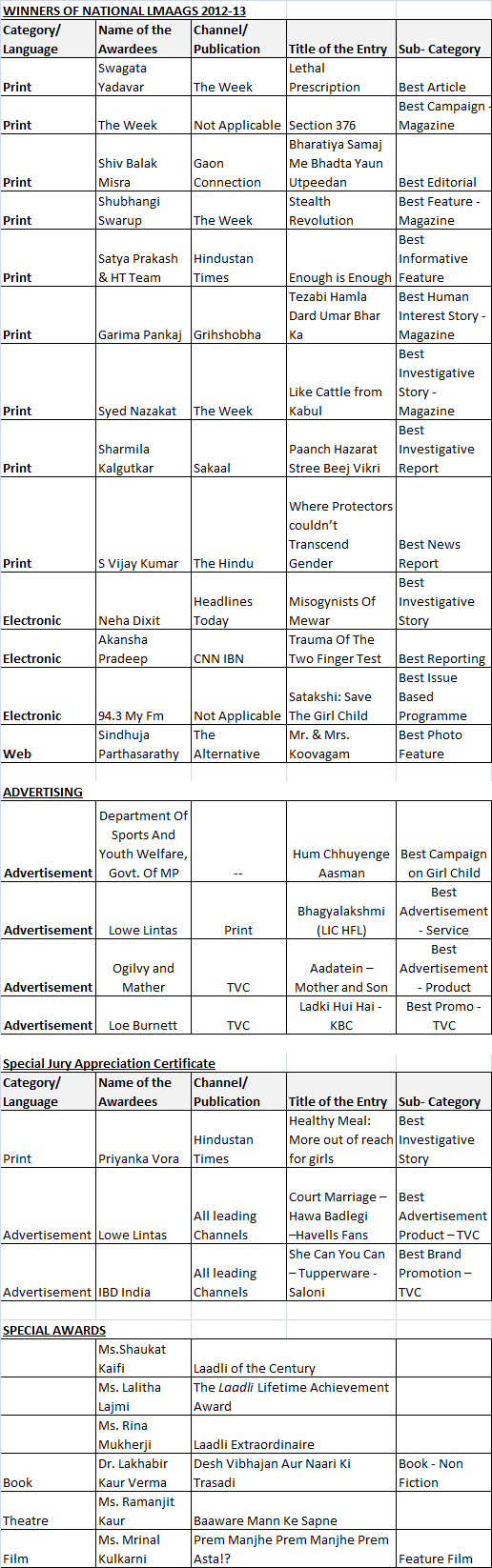
    The fifth edition of “The National Laadli Media and Advertising Awards for Gender Sensitivity 2012-13″ recognised media and advertising professionals at an event organized by NGO, Population First, on Thursday, February 20 in Mumbai. The awards are being presented by the Tata group and supported by the United Nations Population Fund (UNFPA)


    The Laadli of the Century Award was presented to Shaukhat Kaifi, noted film and theatre personality who was one of the founder members of IPTA and the theatre movement in India. The Lifetime Achievement Award was presented to well-known painter Lalitha Lajmi. The Marathi film Prem Manjhe Prem Manjhe Prem Astha! was selected under the film category.


    Starting this year, Laadli instituted a special award titled “Laadli Extraordinaire” for recognising mediapersons who have fought against gender violence, discrimination and have shown exemplary courage and conviction in their personal and professional life. This year’s award went to Rina Mukherji, who fought against an established newspaper as her services were terminated when she filed a sexual harassment complaint against a senior colleague.


    A panel of distinguished jury members comprising eminent media and social sector personalities namely Dilip D’souza, K.V. Sreedhar, Lynn de Souza, Sathya Saran, Satish Nandagaonkar, Shishir Joshi, Shobhaa De, Sidharth Bhatia, Monica TATA, Monica Wahi, Mrinmayee Ranade, Nandini Sardesai, MxMIndia Contributing Editor and columnist Ranjona Banerji and Vishwanath Sachdev selected the winners for media and advertising awards.


    Speaking about the fifth round of the Laadli Awards, Dr A L Sharada, Director of Population First said: “We received around 1700+ entries this year and more than the increase in numbers what is satisfying is the range of topics covered- from problems faced by women in conflict areas of Kashmir to the strength of women in the remote areas of Kushinagar fighting for toilets at home to the need for understanding the problems of transgenders to the trauma of the two finger test for rape. All these varied topics have been dealt with a more gender-nuanced perspective. The jury had a tough time selecting the winners. This goes to show that the concern is not just a fleeting one but here to stay. It is heartening to note that many of the winners have consciously made a decision to communicate with greater sensitivity.”


  • Wills Lifestyle appoints iContract for digital marketing

    By A Correspondent


    Wills Lifestyle, the fashion and lifestyle brand from ITC, has appointed iContract, a part of Contract Advertising, to handle its digital marketing and social media portfolio.


    After a rigorous selection process involving 12 top agencies, from which three agencies were shortlisted for the final round of consideration, iContract was selected for its creative strategy and execution plan to build the brand in the digital space.


    Karan Kumar

    Speaking on the selection process, Karan Kumar, General Manager, Lifestyle Retailing Business Division, ITC said, “The marketing paradigm has changed with the dawn of digital age. Consumer engagement and consumer dialogue has taken the forefront to drive brand salience. With online shopping going live it was inevitable for us to mandate an agency with the brand’s digital duties. With iContract on board we look forward to strengthen brand presence online including social media platforms.”


  • BBC study reveals impact of mobile ads on affluent consumers

    By A Correspondent


    BBC World News and BBC.com/news have released the results of a global study examining the usage of mobile devices by consumers around the world. The study was conducted by Millward Brown.


    The study surveyed 6,000 smartphone owners in Australia, Germany, Sweden, India, Hong Kong and the US and compared the habits of affluent consumers – the highest 20% income earners in each country – to those of the general population.


    The results reveal the increasing importance of smartphones to affluent consumers and demonstrate the extent to which mobile devices are integrated into their personal and, crucially, their business lives, as improved technology enables greater engagement with content. The study also provides clear evidence that affluent consumers are significantly more receptive to mobile advertising than the general population.


    Key findings include:

    • 51% of affluent consumers use their mobile phone for business, compared to 40% of the general population


    • 39% of affluent consumers access the internet via their mobile devices at least once an hour, which is 18% higher than the general population


    • Affluent consumers are 18% more likely to share their location to get relevant services than the general population


    • Affluent consumers are more likely to prefer mobile devices to desktop for news-related content than the general population.  The contrast is particularly notable for current affairs or breaking news, where the figure is 15% higher for affluent consumers than the general population, and business/finance news, where it is 28% higher


    • News apps are the most commonly used mobile phone apps for affluent consumers, whilst social network apps are favoured by the general population


    • A third of affluent consumers agree that, if a brand wants to be modern and dynamic, it needs to be on mobile – 15% higher than the general population


    • Mobile advertising is twice as effective as the already proven advertising medium desktop in driving key brand metrics such as awareness, favourability and purchase intent amongst the total population. This figure rises to four times as effective for affluent consumers


    • High income earners are as positive towards advertising on mobile (19%) as desktop (18%). The percentage who are happy to see ads on mobile websites rises to 41% for sites where the content is free.


    India

    • 55% of affluent Indian consumers access the internet hourly in India on mobile devices vs. 39% of total affluent consumers


    • Affluent Indian consumers are far more likely to use their phone for business (79%) vs. 51% for total affluent consumers


    • Over half of affluent consumers in India agree that their smartphone is the primary tool for organising their personal life


    • 58% of affluent consumers in India agree that an increasing amount of their work is being accomplished on their mobile device (compared to 35% all affluent consumers)


    • 56% of affluent consumers in India prefer to use their mobile device to access news, rather than using a desktop (30% for all affluent consumers)


    • 52% of affluent consumers in India are more likely to share stories on mobile rather than desktop (compared 31% for all affluent consumers).


    • 56% of affluent Indian consumers agreed that to be seen as modern and dynamic a brand needs to be on mobile (compared to 30% all affluent consumers).


    The survey emphasises the growing trend for news consumption on mobile platforms and reflects the results of the BBC’s 2012 study of news consumption -http://www.bbc.co.uk/mediacentre/worldnews/news-consumption.html- in which 59% of affluent consumers expected to consume more news on their phones over the next five years.


    When asked which single device they prefer to use for news, the number of affluent consumers who name the mobile phone has risen by 15% since 2012 and tablet is up by 9%. In contrast, the amount of people who say they prefer desktop has decreased by 17%.


    Additionally, 2012’s survey found that news consumption on mobiles was mainly restricted to scanning news headlines. In comparison, 34% of new handset users (new/latest handsets are defined as those released since September 2012) surveyed in the new study say they now dive deeper when consuming news and are likely to read additional articles connected the original piece. This is 42% higher than for those using older handsets. Owners of the latest handsets are also 10% more likely than the general population to watch news video or stream content on their mobile phones.


    Jim Egan, CEO of BBC Global News Ltd said: “The rapidly growing importance of mobile to our global audiences is one of the big themes for our industry and we are constantly working to create the best mobile browsing experience, be that with the introduction of our international BBC News and Sports apps, or on-going responsive design innovations. This new research reveals significant change in mobile consumption – people are delving deeper into stories on their mobiles, consuming more video and, significantly, growing accustomed to advertising on their mobiles. This large study provides compelling evidence that mobile advertising works with affluent mobile consumers in particular and that has big implications for publishers and advertisers alike.”


  • Indian Magazine Congress opens. Minister Tewari asks trade to look digital

    By A Correspondent


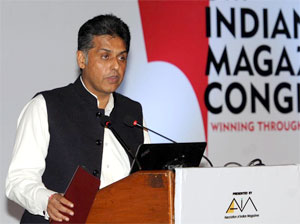
    The Minister for Information & Broadcasting Manish Tewari has called upon the magazine industry to strengthen its presence in the digital and new media age by playing the role of an objective, analytical and authentic source of information. Innovation needed to be used as a sustained tool for bringing the change in the lives of the readers rather than being a tool for ‘short-cut’ solutions, Mr Tewari stated while delivering the inaugural address at the 8th Indian Magazine Congress held in New Delhi with the theme “Winning through Innovation”.


    Elaborating further, Mr Tewari said that in recent times, many iconic publications had turned digital and the need of the hour was to empower the World Wide Web through agreed rules of engagement. It was necessary for the digital world to go through standard editorial checks so as to ensure rich and authentic content in the new media space. The challenge before the magazine industry was to withstand the flow of instant information emerging from different media streams.


    On the magazine industry trends, Mr Tewari said the industry’s future performance would be a critical player determining the macroeconomic environment necessary for print media stakeholders. This would be possible if the Industry was able to achieve greater operational efficiencies and connect with readers through delivery of high quality content. The industry could focus on profitable growth by implementing cost control initiatives and adopting technology across key business performance areas such as planning, budgeting, customer relationship management, strategic outsourcing, etc. While leading players had taken necessary steps, it was necessary that the industry reviewed the process in its entirety.


    On the trends for the print media industry, the minister stated, the market for regional and vernacular markets continued to grow in an environment which was fruitful in view of rising literacy levels, low print media penetration in certain areas and the desire of stakeholders to use the platform. Mr Tewari further added that the inherent advantages of print industry – extensive reach, localisation benefits and ability to create trust and achieve a higher ‘attention span’, were expected to serve as a base for growth and ensure that print continues to be one of the most important platforms for Indian advertisers.


    The minister said that in marked contrast to the global trends, the Indian print industry was growing with steady increase in both advertising and circulation revenues. Although, internet broadband penetration has been increasing at an enormous pace, print industry would continue an upward trajectory due to growth in vernacular and regional markets. The magazine Industry, both vernacular and English, had shaped public discourse for over 60 years and still had potential to grow.


    Speaking on digitization, Mr Tewari mentioned that the first two phases had provided a learning experience as far as implementation of the process was concerned. These learnings would be incorporated while implementing the remaining two phases. The minister reiterated that digitization was bound to be a game-changer for the sector and would define contours of orderly growth. Digitization while providing qualitative choices to the consumer would also ensure that the subscription revenues and skewed business models were rectified, he said.


  • MobileMix study puts Apple, Samsung on top in APAC

    By A Correspondent


    MobileMix, the mobile device index from the house of Millennial Media is out with its findings for the year 2013. Highlighting the various trends that shaped up the mobile device platform last year, the report sheds light on the key advertising trends in Asia Pacific, with a focus on mobile manufacturers, devices, operating systems, connected devices and more.


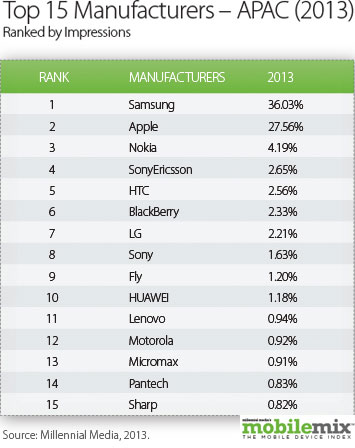
    Where the APAC region was concerned, the report confirmed Samsung as the largest manufacturer in 2013 growing over four percentage points year-over-year. It was followed by Apple that retained its position as the second largest manufacturer, but growing nearly six percentage points year-over-year. Nokia was third on the list followed by Sony Ericsson that occupied the fourth spot.


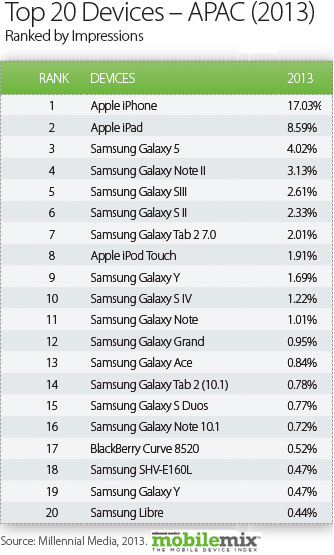
    When it came to devices, the report put Apple’s iPhone in the number one spot as it saw the largest amount of impressions in 2013, a 20 per cent year-over-year growth over the previous year. Next in line was another Apple product – iPad, that registered the second largest amount of impressions in 2013, registering a 51per cent year-over-year growth. Samsung Galaxy 5 was the third device on the list as it registered a 4.02 per cent share in 2013. A key trend in 2013 was that three tablets made it to the list of the Top 20 devices, accounting for 11 per cent of platform impressions in 2013.


    Where the device mix was concerned, smartphones accounted for 72 per cent of platform impressions while non-phone connected devices drove 21 per cent of platform impressions in 2013, representing a 35 per cent year-over-year growth from 16 per cent impression share in 2012.


    Where the operating system mix was concerned, the report put Android as the leading OS in 2013, accounting for 66 per cent of platform impressions in 2013, growing two percentage points year-over-year. iOs was the second on the list accounting for 31 per cent market share followed by BlackBerry in the third with a share of 3 per cent followed and Windows at the fourth spot with a 1 per cent share.


    Moving on to performances by individual countries, in India it was Samsung that emerged the top manufacturer, accounting for 48 per cent of platform impressions in India, followed by Apple with 13 per cent of platform impressions in 2013.


    As for devices, Apple was the top device in India representing 8 per cent of platform impressions in 2013 but Samsung had 14 devices in the Top 20 Device list, accounting for 36 per cent of platform impressions in 2013.


    As for the operating systems, Android led the category with 79 per cent impression share, up from 65 per cent in 2012. iOS was the second largest operating system with 15 per cent impression share in 2013.


  • MEC gets Sidhraj Shah to head Brand Activation unit

    By A Correspondent


    MEC has announced the appointment of Sidhraj Shah as Head of Brand Activation. His mandate will be to deliver innovative consumer experiences and to expand MEC’s brand engagement and implementation services.

    Mr Shah’s last assignment was at Wizcraft as Deputy General Manager. An MBA from Bombay University, Mr Shah will report to T Gangadhar, MD, MEC and to Dalveer Singh, Head Experiential Marketing, APAC, GroupM’s experiential marketing unit.


    With prior stints at O&M, SSC&B Lintas and Bates 141, Mr Shah has conceived and executed ground-breaking campaigns for clients such as McDonald’s, Standard Chartered, Virgin Mobile, Siemens, MTV and MiD-Day.


  • Time to call Minster’s bluff. 6.5/10 performance by UPA-run I&B ministry


    By Pradyuman Maheshwari


    It’s perhaps unfair to damn only Information and Broadcasting Minister Manish Tewari for his performance. Successive occupants of that office – under various regimes – have made a mess of things over the years. Right from the time of BV Keskar, the first mantri who banned Hindi film songs on Vividh Bharati to occupants such as LK Advani, IK Gujral and Sushma Swaraj who didn’t do much for the sector. Ministers like Priyaranjan Dasmunshi and Anand Sharma were on war with many broadcasters and Ambika Soni was by far the best of them all though the digitization execution process was messed up when she was at the helm.


    Earlier this week, as part of the Bharat Nirman series of ads, the DAVP inserted an ad making several claims under the headline “Empowering People Through A Liberal Information Order”.


    I think it’s important that someone were to call the minister and ministry’s bluff. The text in italics is my response to the points made in the ad.

    • Several policies issued and implemented for the liberalization of Print Media Sector in last 10 years

    Is it? Like? Save appeasing the sector with DAVP ad hikes, there’s precious little done 

    • Television industry grew from Rs 18,300 crore in 2006 to Rs 50,140 crore in 2014

    This would have happened any which way. No marks for the UPA 

    • Total number of TV channels increased from 130 in 2014 to 788 in 2014

    Again no credit to UPA for this. In fact, the government has been sitting on many applications and approvals over the last few months 

    • 3 Crore Set-Top Boxes installed in the first two phases of digitization

    Yes, Digitization is an achievement of the government. But look at what happened with it? Chennai is not fully digitized. Kolkata faced several hiccups. Phase 2 is nearly 90 percent, which is heartening 

    • New policy guidelines for Television Rating Agencies issued in 2014

    One is not very sure whether the government should be getting into policing television audience measurement. That should be left for the industry. Thankfully, the government hasn’t got into IRS or advising ad duration on radio and column centimetres/ad-edit ratio in print 

    • New policy guidelines issued for Headend in the Sky (HITS) Broadcasting Services and Internet Protocol Television (IPTV)

    It is fine to issue guidelines, but an IPTV, for instance, has been a non-starter. And HITS is just about a nice acronym 

    • Radio industry grew from Rs 600 crore in 2006 to Rs 1540 crore in 2014

    Would’ve grown more had news been allowed. Isn’t it ironic that all and sundry can start news channels – on satellite and cable – and our radio folks aren’t trusted? 

    • 245 FM channels in 85 cities since 2005. In the next phase 839 channels proposed in 294 cities

    Phase III? Ha ha ha ha ha ha ha ha ha ha ha ha ha ha. Phase III has become a joke. We’ve heard about it just so often. Even the Mumbai Metro would’ve started, but our government would be sitting on the papers. 

    • Community radio stations increased from 64 in 2009 to 163 in 2014

    For a country of a billion-plus people, 163 community radio stations is an apology. Not enough done to evangelise it.

    • Foreign Direct Investment for five segments of broadcasting sector revised in 2012

    And what about news? So FDI can be upped in critical segments like telecom, but not so in news. Just why?


    • Overhaul of the Cinematograph Act, 1952 by Justice Mudgal Committee

    Some welcome steps here? Implemented? 

    • National Media Centre with ultra modern facilities inaugurated

    No point having just one in Central Delhi. The Central Telegraph Offices in various cities which had press rooms should’ve been upgraded too. News journalists exist in other parts of the country too, Mr Minsiter! 

    • National Museum of Indian Cinema being set up in Mumbai

    Better late than never… but would’ve been nicer to coincide with 100 years of cinema.


    What the ad doesn’t tell us is the several things the government hasn’t been able to achieve. Make Doordarshan an independent and top quality pubcaster like the BBC, for instance. Some attempts to improve DD News were nullified by interference in newsroom operations.


    Ever since Manish Tewari has taken charge as the Minister, he has waxed eloquent on the paradoxes of the industry qua (his favourite word) exigencies of the business. He has even tried to police the cable trade on ownership issues since the networks in his home state of Punjab are managed by his political rivals.


    The government has tried its best to keep the issue of self-regulation issues alive by scaring the news media on and off. Under the pretext of protecting the interests of consumers, the 10+2 ad cap was introduced which saw much resistance from news broadcasters.


    The government hasn’t been able to do much on Paid News. Newspapers still carry paid content with or without disclaimers in fine print.


    So how would you rate the last 10 years of the UPA-run I&B Ministry? I would give it a 6 on 10. Okay, let’s make it 6.5, because it could’ve even gotten worse.