Category: NEWS

  • Robust outlook for Indian M&E: CII Summit

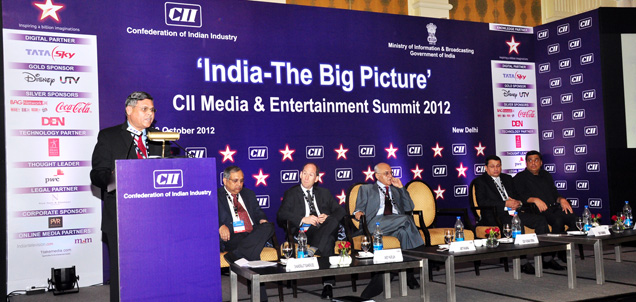
    L to R: Uday Kumar Varma, I&B Secretary, Chandrajit Banerjee, DG, CII; Andy Kaplan, President, Worldwide Network, Sony Picture Television; Amit Khanna, Chairman, CII National Committee on M & E and Chairman, Reliance Entertainment; Uday Shankar, CEO, Star India and Ronnie Screwvala, MD, The Walt Disney Co

    By Ananya Saha


    CII Media and Entertainment Summit 2012, India – The Big Picture discussed critical issues such as cause and effect of market-driven approach in the media and entertainment (M&E) sector, censorship hurdles, and the roadmap for $100 billion Indian M&E industry. The two-day conference saw the who’s who of the sector take a close look at the critical role that M&E plays in India.


    “We are drunk on our own volumes: largest number of newspapers in circulation, largest number of television viewers at 400 million, 100 million digital consumers. Digital, in particular, is an indictment of our creative and strategic limitations – we have 600 million mobile screens and yet we do not have a unique content proposition for the medium,” Uday Shankar, CEO, Star India, said in his keynote address, adding, “Our ability to convert that into corresponding value is disappointing.”


    “Media and industry is a globally growing industry – but our participation in that eco-system is zero and India is hardly factored into the global thought process of technology or content,” he added. Similarly, on the domestic front, the industry is yet to fully unlock the potential of the vast Indian market.” The size of India’s Media and Entertainment industry, which includes television, print, radio, digital media, was pegged at $15 billion at the end of 2011. The industry is growing at around 14 percent a year. “At this rate, we will still take 15 years to get to $100 billion. Obviously, we want to get there much faster. The question is: Why and how do we do that?” Mr Shankar quipped.


    Ministry of Information and Broadcasting Secretary Uday Kumar Varma, Leader of the opposition in Rajya Sabha Arun Jaitley, The Walt Disney Co MD Ronnie Screwvala, Viacom 18 Media Pvt Ltd CEO Sudhanshu Vats, Sony Picture Television President for the worldwide network Andy Kaplan, News Corp Sr Executive VP David Hill, NDTV Group CEO and Executive Director Vikram Chandra, Times Television Network MD and CEO Sunil Lulla, Sony Entertainment Television CEO Man Jit Singh, Times Group CEO Ravi Dhariwal, Prasar Bharti CEO Jawahar Sircar, eminent journalists such as Nik Gowing, Vir Sanghvi, Vinod Mehta and Aroon Purie shared their views at the summit.


    Uday Kumar Varma, Secretary, MIB, recent decision of the government to allow 74 per cent FDI in DTH, IPTV, mobile TV etc. are some of the steps that have been taken in this direction and underscored that those steps would be game changers. He said that many positive steps would be taken in revamping the FM Radio to enhance its reach and content. The empowered Group of Ministers are looking into some of the grey areas in the auction of 839 new FM radio stations across over 290 towns and cities in the country. “We hope to complete the auction of the first tranche of the stations by the end of the financial year,” he added.


    Day 1 of the summit saw Arun Jaitley, Leader of the Opposition, Rajya Sabha make a scathing attack on trial by media and said that most often such debates are based on half- truths and imaginations. Nik Gowing, Presenter, BBC World News said, “Media is greatly influenced by technology and speed in which the information travels. Political leaders and corporations have to realize that to become a leader in the technology driven environs, where they would be put to scrutiny not necessarily by the media but also by public at large, through twitters and other social media, was an onerous task.” Vinod Mehta said, “What we require is blending good business practices with news collection and dissemination, which is a formidable task of media industry.” Ravi Dhariwal, CEO, Times Group, said that media is judged by its contemporary relevance and trust it builds with the general public.


    Broadband penetration to reach 600 mn by 2020
    Speaking on the panel for ‘The Game Changers: Taking M&E industry to $100 bn’, R Chandrasekhar, Secretary, Information Technology and Chairman Telecom Commission said the government is taking proactive steps for enhancing the broadband penetration in the country from the present level of 20 million to 600 million by 2020 so as to cover the entire breadth and length of the country.

    “The government is investing Rs 20,000 crore over the next few years for strengthening the broadband network in the country. In its wake, such massive investment will give a boost to the digitization, cloud-based services and convergence to reach out to the common man in the far flung areas,” he said. The government’s role, he stressed, would be that of a facilitator and the last mile movers would be cable and telecom service providers.


    Manjit Singh, CEO, Sony Entertainment Television maintained that advertisement and subscription income from media business should be at a 50:50 basis and a business model based on these parameters would help penetration of broadband, inflow of more FDI and the government would stand to gain from realization of more taxes. The ratio of TV advertisement to GDP in India is abysmally poor as compared to developed countries and hoped that the stress on subscription would give a sustainable and healthy revenue stream to the media business. Narayan Rao, Executive Vice-Chairperson, NDTV said, “For the ambitious target to reach 100 bn, the industry needs to recognise three things: advertisers need to recognise that as audiences have grown, and thus, rates also need to grow; the broadcasters need to get rid of carriage fees; and the broadcasters need to look at alternate sources o revenue, which can currently come only from subscription revenues.”


    TGBCL’s MD and CEO Sunil Lulla said the industry needs to dream a collective dream to reach the $100 bn mark. “The industry needs to collaborate, partner and compete for a healthier industry status,” he said. Smitha Jha, Leader, Entertainment & Media practice, PWC India, observed that the game changers in the media industry would be advertisement, subscription and infrastructure and policy framework. In India, she said that the consumer spends only $7 per month as subscription as against US$ 500 in the US. Also, to help industry to achieve the potential, infrastructure has to be toned up, such as rolling out of 3G and 4G coupled with strengthening broadband network.


    Policy Conundrum

    Rahul Khullar, Chairman, Telecom Regulatory Authority of India (TRAI) stressed on the need for a separate regulator for content and carriage. He also said that the Indian market should not be compared to Western markets and stressed on the fact that India is a price-sensitive market. Harit Nagpal, MD and CEO, Tata Sky pointed out, “We are most heavily taxed business in the industry. We pay close to 30-35 percent as taxes, exclusive of the import duty on set-top boxes.” Agreeing with Mr Nagpal, SN Sharma, CEO of Den Networks said, “Taxation is going through the roof, and ultimately consumers will have to bear the costs.”


    Anuj Gandhi, Group CEO, IndiaCast, opined, “As we progress with digitisation, it is important that the issue of carriage fees is sorted out. We need to get the ARPUs right to be on the path to reach $100 bn-industry.” The panel also pointed out how the policies in India have not found the regulation support. Vanita Kohli-Khandekar, Contributing Editor, Business Standard said that tax holidays can do wonders for stabilising the industry. She also pointed out how regulation is required in the areas of cross-media monopoly; how 50-60 percent of media buying is concentrated in the hands of one agency and the ownership of news media.


    In response to the worries voiced by the panel, Mr Khullar said that the regulator is aiming at bringing out a white paper on cross-media ownership, which will be done with prior consultation. He also said that as digitisation progresses, the industry should foresee and prepare on changing business models.


    Managing M&E in digital era

    As digitization takes last steps towards sunset date, issues related to convergence have been taking centre stage at various discussions and forums. The panel on convergence issues chaired Neeraj Roy, MD and CEO, Hungama Digital Media was of the view that consumption and monetising of content, global IT systems, infrastructure and policies that deal with convergence need to be developed to provide clarity to industry players as well as consumers.


    Vikram Chandra, Group CEO and ED, NDTV, said, “With convergence and real-time interactivity taking shape, the only question that remains to be answered is how do we monetise the properties.” Vijay Lazarus, President, IMI pointed out how in absence of policy regulations, music became the first victim of technology in the form of piracy. “But then knowing there was no turning back, the music industry also embraced technology,” Mr Lazarus pointed out.


    The panel agreed that innovation in convergence will result in monetisation.


    The last panel on Sports and Entertainment focused on whether sports broadcasting in India is only about cricket or is there an opportunity much beyond which lies untested and unexplored. “The government, corporations, media and civil society should come forward to support sports beyond cricket with a long term roadmap,” maintained Atul Singh, CEO, Coca Cola India. He also hinted that dependence on one form of sports is not the ideal approach since that would lead to unbalanced growth of sports in the country.


    Mr Singh cautioned the corporations not to look for immediate results and dividends from sponsored games other than cricket. David Hill, Senior Executive Vice President, New Corp said, “Sports is predominantly a middle-class indulgence and with India’s middle class touching one billion by 2025, sports will receive a lot of attention in the future.” Referring to the lack of corporate support in India, Harish Thawani, Executive Chairman, Nimbus Communications said that corporates allot adequate budgets for CSR and massive commitment for advertisements but hardly any when it comes to sports.


    While there is no doubt that the Indian M&E industry is seeing unprecedented growth, the question is whether the industry will be able to shed policy inhibitions and grow to the $100-billion-stage by 2016.
  • Relevant content, fresh opportunities at CASBAA 2012

    By A Correspondent


    A strong push towards investment in relevant local content and newly emerging markets took centre stage on the first day of the CASBAA Convention 2012 in Hong Kong. Featuring global and Asian industry leaders, regulators, media personalities and technologists the conference line-up pinpointed key trends facing the industry today.


    “Creating relevant content is a huge focus,” said Gerhard Zeiler, President of Turner Broadcasting System International at the Talking TV session. Emmy and Golden Globe winner and Founder & Chairman of Electus Ben Silverman highlighted key innovations around local content production that are already occurring, while Ross Martin, EVP, Scratch/Viacom Media Networks noted that social media is being used to continue and further improve engagement. However, the first day speakers all agreed that content providers should not lose sight of the audience as “they are the bosses”.


    A concentration on local content for millennials is also creating opportunities in emerging South East Asian markets such as Myanmar, where the median age of the population is under 30-years-old, said Ye Htut, Myanmar’s Deputy Minister of Information. He said the Myanmar broadcast industry is opening up and would welcome foreign investment in pay-TV when a new regulatory framework is completed. He added that with over 100 ethnic minorities, his government is looking to the interests of diverse groups represented through local content.


    Diego Reck of Fox International Channels in Latin America highlighted the integration of a newly engaged audience commentary during live sports events, while Gautam Anand, Director, Content Partnerships, Asia-Pacific at Google pointed to massive increases in the use of social media. Meanwhile, Kenneth Lee, Director of Media Networks Technology, The Walt Disney Company, highlighted his company’s explorative efforts to insert advertising into the Watch Disney app.


    Monetising social media efforts spurred debate. Jonathan Ellis, CEO of TMS in Hong Kong, argued, “You should not drive people from a broadcast media into a social platform without understanding why. You need to own the social data that is being created and use it. That’s where the value lies.”


    Participants also explored the opportunities surrounding OTT. Sam Blackman, CEO, Elemental observed that OTT is now being used to enter markets where there is no other presence. However, Dennis Rose, VP, Asia-Pacific, Brightcove cautioned that complexity is not going to go away. Even so, all panelists agreed that OTT is a tool that can unleash enormous market potential, and if it not seized, will be left to enterprising pirates.


    Whether it is traditional media or social media, piracy was a key concern for all attendees. Andrew Wajs, CTO, Irdeto pointed out that tracking and monitoring is vital for combating hackers, who are becoming ever more creative. He added that for content in mobile devices, securing the device with secure software is crucial. “The idea is to make it as uncomfortable and inconvenient to view pirated content and drive viewers to legitimate sources.”


    At the opening ceremony for CASBAA 2012, Eliza Lee, the Director-General of Communications of the Office of the Communications Authority, noted, “The global communications industry is fast evolving, pushed by innovative technologies and the changing demands of consumers.” She added, “To cope with the challenges of convergence of telecommunications and broadcasting, the Communications Authority was formed early this year as a single unified regulatory body for the entire electronic communications sector.”


    The CASBAA Convention 2012 is supported by FOX International Channels, Turner, Eurosport, Dolby, A+E Networks, AMC/Sundance Channel Global, APT Satellite, ABS, AsiaSat, Bloomberg Television, Brightcove, Conax, Discovery Networks APAC, Disney Media Distribution, Elemental Technologies, Ericsson, euronews, Food Network Asia, France 24, HBO Asia, Intelsat, Invest Hong Kong, Irdeto, ITV, MEASAT, Movideo, NBA, NBCUniversal, now TV, Paul Weiss, Playboy Plus Entertainment, PwC, SES, Sony Pictures Television Networks, TBN Asia, ThinkAnalytics, Time Warner, True Visions, TV5MONDE, Verimatrix, Viacom International Media Networks, WarnerTV and YouTube.


    For a third year leading sponsor Create Hong Kong (CreateHK) has also shown its support for the CASBAA Convention by sponsoring a Community Outreach Programme. Complimentary passes have been offered to local SMEs in the TV sector and tertiary students of relevant courses to attend the event for networking and knowledge exchange. CreateHK is the dedicated office set up by the Hong Kong SAR Government to promote local creative industries.


  • Online booking of air tickets registers 7% growth

    By A Correspondent


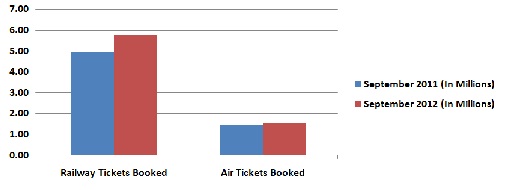
    The Internet Economy Watch Report for the month of September 2012, released by the Internet & Mobile Association of India (IAMAI) indicates a marginal growth of 7 percent in online booking of air tickets when compared with the numbers of corresponding month last year. Air tickets booked online in September 2012 were 1.55 million as compared to 1.46 million in September 2011. The growth rate is the lowest when compared with the numbers of the previous months of the current financial year. The online bookings on irctc.com witnessed y-o-y growth of 17 percent with 5.77 million online bookings in September 2012 as compared to 4.92 million in September 2011.


    Source: IAMAI/ Online Travel Portals


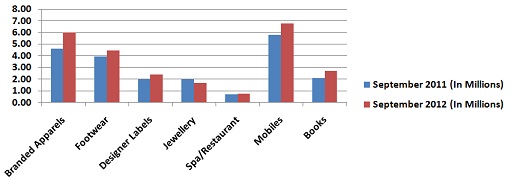
    According to the data captured from prominent e-tailing sites in the monthly tracker, the online user visit to mobile phone and book segment has increased by 17 percent and 27 percent respectively, when compared to the numbers of corresponding month last year. A significant increase has been registered in the online user visit to branded apparel segment. The number of hits has increased to 5.99 million in September 2012 from 4.62 million in September 2011. The online user visit to footwear segment increased from 3.94 million in September 2011 to 4.49 million in September 2012, a y-o-y increase of 14 percent.


    Source: IAMAI/e-Commerce sites


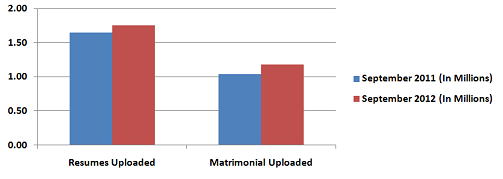
    In September 2012, the number of resume uploads on job portals and profile uploads on matrimonial sites has indicated a y-o-y growth of 6 percent and 13 percent respectively. While the number of resume uploads in September 2012 was 1.75 million as compared to 1.65 million in corresponding month last year, the number of profile upload on matrimonial websites was 1.18 million in September 2012 as compared to 1.04 million September 2011.


    Source: IAMAI/ Vertical Classifieds


    The monthly internet tracker by IAMAI is based on absolute numbers captured from various relevant sites, and encapsulates online usage for E-tailing, Online Travel and Vertical Classifieds.


  • Jaldi 5 with Vasant Gokhale, Head, Mobile Services, ABP

    Vasant Gokhale

    The Ananda Bazar Patrika Group recently announced its digital offerings for non-resident Bengalis. Though three months old, the platform is already gaining traction. MxM India caught up with Vasant Gokhale, Head, Mobile Services, ABP Pvt Ltd to know more.

     01. The digital offering is targeted at non-resident Bengalis. Is Indian market not ready for such platforms?

    We have plans to eventually reach to that point. The back-end plans are already at work. Also, we have our digital websites that are live currently in India. So, we have enough content here online for the resident Bengalis. We will launch the digital offering on same scale in India within this financial year.

    2. What are your subscription models?

    We have two subscription models. One is, standard that is offered for $5 per month and then we have exclusive premium content.

    03. How has been the response from advertisers?

    We do not have advertising options on the My Anandabazar Mobile App on iOS. Current focus is to increase paid subscriptions for overseas market. We already have over 1000 active subscribers MoM without spending a dime on marketing, and once we reach the critical numbers, advertising options can be looked at.

    04. What will be the marketing strategy?

    We will launch a robust marketing plan shortly. We have acquired the current subscriber base all on hearsay, and without spending a penny.

    5. When do you plan to break-even with the digital property?

    All I would like to say is that we are on track as far as investment and other targets are concerned.


    As told to Ananya Saha 


  • EPGP from IIM-B wins Bhaskar’s ‘Crack the Case’

    By A Correspondent


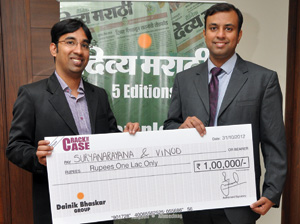
    Winners_Suryanarayana Pemmaraju (L) and Vinod Unnikrishnan (R)

    The final round of ‘Crack the Case’ drew competition from across India and sectors with 2 teams from the industry (a team from IMRB & a cross team from Maxus & Cognition Media, India) and 3 teams from top B-Schools (IIMB and XLRI) competing on Dainik Bhaskar Group’s Maharashtra Success story a case study by IIM Bangalore. The 5 teams battled it out to present the best solution to the question, ‘Keeping in mind the fast paced growth and unique market penetration strategy of the Group, which market should Dainik Bhaskar Group enter next?’ The EPGP team from IIM Bangalore – Suryanarayana Pemmaraju and Vinod Unnikrishnan walked away with the Rs. 1,00,000 Prize.


    Sharing their views on the experience, the winning team, EPGP, IIM Bangalore said, “The overall experience has been amazing. First it gave us an opportunity to work with a near live case and understand more about the print industry. Had it not been for this contest, we would probably never have known of Dainik Bhaskar Group’s success story and their out of the box approach of looking at a problem. Winning a pan-India contest organized by a leading newspaper such as Dainik Bhaskar is a matter of pride and achievement. It would be interesting to track what the group does in the near future and understand our contribution.”


    Suryanarayana Pemmaraju has a rich 8 year experience in software product development and project management with leading IT organizations such as TCS and Dell International & Vinod Unnikrishnan is a veteran engineering manager, boasting of a decade long experience across different industries and companies such as Schneider -Electric & Whirlpool.


    The judging panel included Ravi Rao, Leader, South Asia, Mindshare and Seema Gupta, Faculty Marketing, IIM Bangalore – in addition to Dainik Bhaskar Group’s Senior Management.


    The judges were looking for a solution backed strong logic and analysis. Commenting on the experience, Ravi Rao, Leader – South Asia, Mindshare said, “The teams went beyond the case, displaying an incredible level of secondary research. This forum provided a different perspective towards looking at the case. Every presentation was unique in its approach irrespective of the market they were recommending. The strategy, analysis by each group had a different flavor to their approach.”


    Seema Gupta, Faculty Marketing, IIM Bangalore who is the author of the case study said, “The case contest brought together academia, media and marketing research industry together. I was impressed by the analytical rigour of the teams. The teams combined quantitative analysis with qualitative judgment leading to divergent solutions which made the contest extremely interesting. The diligence displayed by the teams for an extracurricular intellectual exercise is admirable.”


    Commenting on the contest, Sanjeev Kotnala, VP, Dainik Bhaskar Group said, “The enthusiasm and dedication shown by the teams was commendable. We were overwhelmed by the quantity and quality of the total number of entries received. Shortlisting them and further bringing out the winner was a tough task for the judges. This was a unique experience for the Brand too since this was the first time that we have invited inputs beyond internal research teams.”


  • Draftfcb Ulka Comstrat 2012 – grand finale on Dec 22

    By A Correspondent


    DraftFCB+Ulka’s Comstrat, now in its seventeenth year, is the first ever case-study competition in the area of marketing communications, organized in association with K J Somaiya Institute of Management. The exciting youth oriented brand case study this year, Burn, has been provided by Coca-Cola India. The Case Study can be accessed at http://www.draftfcbulkacomstrat.com/index.html


    Comstrat, Communication Strategy in short, is a reflection of the strong tradition of strategy-based advertising that has been practiced by Draftfcb+Ulka over its 50 year life span. Comstrat is conducted in the area of advertising and communication strategy based on a real life marketing situation, on a live brand.


    Comstrat offers an excellent opportunity for students to work on a live case and build an interface with senior advertisers, marketers and academia, and over the years several management institutes and renowned companies across various industries have participated.


    Here is what Kinjal Medh, Chief Operating Officer, Cogito Consulting and a long time jury member of Comstrat had to say, “The first ever case-study competition in the area of communication strategy, Draftfcb Ulka Comstrat has been a huge success with increasing participation and stronger competition every year from India’s leading B-schools. Students relish the opportunity to spar with real life communication challenges and the industry benefits from inspiring out-of-the-box solutions from fresh young minds.”


    The past years have seen keen participation from management institutes across the country, and enthusiastic support from the industry. Some of the past year cases have been Hutchison Max(1997), Tata Indica (1998), Cadburys Bournvita(2000), Marico Parachute (2001), Philips (2003), Indian Oil Corporation (2004), Colgate Cibaca (2006), Hero Honda Pleasure (2007), Tata Sky (2008), Titan Octave (2009), Nokia C3 (2010) and Bru World Cafe (2011). Past winners include IIM Calcutta, MICA, Bajaj, NMIMS, KJ Somiaya, IIT Bombay SOM etc. This year the finale is to be held on 22 December at K J Somiaya’s Management Centre Auditorium. Be there to cheer the six finalists.


    Event Details:

    2pm, December 22nd, 2011

    Venue: K.J.Somaiya Institute of Management Studies & Research, Vidyanagar, Vidyavihar (East), Mumbai-400077

    http://www.draftfcbulkacomstrat.com/index.html

  • Sunny Leone the most dangerous celeb in Indian cyberspace, finds McAfee

    By A Correspondent


    Sunny Leone emerged as the ‘most dangerous celebrity’ in Indian cyberspace this year, followed by Katrina Kaif; according to security technology company McAfee.  For the sixth year in a row, McAfee researched popular culture’s most famous people, finding the riskiest celebrity sportsmen, actors and politicians across the web to reveal the 2012 rendition of ‘Most Dangerous Celebrity’ research.  In the India ranking this year, Sunny Leone displaced Katrina Kaif, who owned this title in the 2011 edition of this annual research.


    Commenting on the findings of the report, Lubna Markar, Sr. Marketing Manager India & South Asia, McAfee, said, “Cyber criminals continue to leverage top celebrities to lure people to websites with malicious software.  This year too, we saw cyber crooks leveraging Bollywood stars whereby the maximum number of malicious software laden sites pertained to Sunny Leone. This testifies her top position as the most dangerous celebrity in Indian cyberspace in 2012.”


    Cyber criminals follow the latest trends, often using the names of popular celebrities to lure people to malicious sites designed to steal passwords and personal information. Fans looking for results on search engines using strings such as ‘name of celebrity’ combined with words like ‘free downloads’, ‘hot pictures’, ‘screen savers’, and ‘videos’ are at risk of running themselves into such sites. This year, searching for a celebrity name with “sex videos” and “free downloads” as part of the search term resulted in the highest number of risky sites.


    The study for ‘Most Dangerous Celebrity’ used the McAfee SiteAdvisor site rating which indicates the sites that are risky to search for celebrity names on the web and calculate an overall risk percentage. The top 10 celebrities in India from this year’s study with the highest risk percentages are:


    Rank Celebrity
    1 Sunny Leone -This sexy Canadian model/actress who made headlines with her presence in the celebrity reality show Bigg Boss, ranks first with 9.95% chances of luring people into clicking on malicious links.
    2 Katrina Kaif – India’s ‘chikni chameli’  was the most dangerous Indian celebrity of 2011, but has slipped down to the 2nd position this year with a risk percentile of 8.25%
    3 Kareena Kapoor – The 3rd Most Dangerous Celebrity and winner of six film fare awards has a 6.67% possibility of making users fall into a trap of malware laden websites.
    4 Priyanka Chopra – This former Miss World who has been the reigning queen of Bollywood occupies the 4th position on the Most Dangerous Celebrities list with a risk percentile of 6.5%.
    5 Bipasha Basu – With Raaz 3, this Bengali bombshell has moved up the ranking from 8th in 2011 to the 5th position in 2012. She has a 5.58% percentile of leading users to a malicious site.
    6 Vidya Balan- After her ‘Dirty Picture’, Vidya Balan has a 5.33 % chance of leading users to malicious sites. The versatile Indian actress has marked her presence even in the cyber space.
    7 Deepika Padukone – This sultry actress of ‘Cocktail’ fame, was the  2nd most dangerous celebrity in the year 2011, but has plummeted to 7th  position this year, with a 4.92% chance of being led to a malicious website.
    8 Salman Khan – One of the most sought after stars in Bollywood, Salman Khan has redefined the trends of the Hindi film industry with his roles in movies such as Dabangg and Ek Tha Tiger. With a risk percentile of 4.83%, he is on the eighth position in our Most Dangerous Celebrities ranking.
    9 Aishwarya Rai Bachchan – Touted as ‘the most beautiful woman in the world’, Aishwarya Rai Bachchan, is the ninth most dangerous celebrity in India with a risk percentile of 4.58%
    10 Poonam Pandey – The Kingfisher calendar girl who was also amongst the top 8 contestants in ‘Gladrags 2010’, has a risk percentile of 4.25% and  is the tenth most dangerous celebrity


  • MPG India appoints Kavita Vohra to head buying for North

    By A Correspondent


    MPG India, the media planning and buying network of Havas Media, has announced the appointment of Kavita Vohra as Associate Vice President Investments, MPG India.


    Ms Vohra’s mandate will include heading buying for MPG Delhi with additional responsibility of Bangalore and Kolkatta. She joins with an experience of over 10 years in media planning and buying, having worked with several key accounts across categories.


    Commenting on the appointment Anita Nayyar, CEO, Havas Media, India & South Asia said, “MPG India has always been a growth leader in the region as we continue to expand our footprint and offerings to our clients. Kavita’s appointment will further strengthen our buying offering.”


    Mohit Joshi, Managing Director, MPG India said, “We are very happy to have Kavita with us. Her strong understanding of the planning function makes her an ideal candidate for heading the buying function.”
    “We are confident that with her wide and varied experience she will be able to bring in significant value to all our clients”, added Uday Mohan, Executive Director-North, MPG India, whom she will report into.


    Starting her career at Lodestar working on Whirlpool, Ms Vohra moved to Cheil Communications and handled Hyundai and Samsung. Thereafter, her role involved TV buying for Nokia Mobiles at Group M, followed by buying for Nestle and a host of other clients at Zenith Optimedia. Commenting on her move, she said, “Heading the buying arm of MPG Delhi is a natural progression towards handling a bigger and more challenging portfolio of clients. I look forward to working with the team as the journey ahead surely looks very exciting.”


  • Print-Digital Bhai-Bhai!


    By Ananya Saha


    Print readership is declining the world over. And digital subscribers are rising. Does this mean that the digital medium would lead to closing down of print editions? Not according to the speakers and attendees at that The Digital Innovation Summit 2012 by INMA.


    Yasmin Namini

    While Newsweek made a smart move by announcing its move to the web-only space, the news print industry is taking it slow and steady. Yasmin Namini, Senior VP – Marketing and Circulation and GM, Reader Applications, The New York Times pointed out how NYT has been gaining readers with their innovative paid digital content, such as, repeated payment gateways screen and 10-articles-free-per-month-limit after which subscription is necessary. NT registered 56.6 lakh subscribers till Q3 of 2012. She said that NYT has been using cross-bundling approach to optimise profitability.


    Mark Challinor

    Mark Challinor, Director of Mobile Platforms, Telegraph Media Group,Londonwas upbeat about the usage of personal mobile devices and iPads. He said, “There are more iPhones sold in the world (4.6 seconds) than babies born in the world (4.2 seconds). This gives us a clear idea of the future. Today’s 2-5-year-olds learn to operate the iPhone and iPad much before they learn to tie shoelaces.” He supported the fact that remains important, and the future of newspapers depends on reinvention of news industry.


    Indian newspapers too are smart enough to invest in their digital properties to receive huge dividends in the future. Earl J Wilkinson, Executive Director and CEO, INMA shared smart bets forIndia, “Make consumer pay more, now and create digital company outside your current company, in case the existing structures do not support digitalisation and be willing to cannibalize yourself.” He also cautioned against making digital an excuse to stop investing in print.


    vasant-gokhale

    Vasant Gokhale, Head, Mobile Services, ABP Pvt Ltd shared the mobile strategy that his company had adapted for the non-resident Bengalis. With an aspiration to reach out to wider Bengali audience settled out of East of India, Ananda Bazaar Patrika started its paid digital content three months ago targeting only non-resident Bengalis. The standard service of $5 per month and exclusive packages were launched to create a subscriber base around Durga Puja. Mr Gokhale shared “We have been growing 30% month-on-month, without spending a penny on marketing. The growing base is the result of our unique Bengali content and offering.”


    Bharat Gupta

    Bharat Gupta, Executive President – Marketing, Jagran Prakashan Ltd said, “With our unique content mix, out Hindi website has been gaining more traffic. We find Facebook very helpful in engaging our users, targeting new demographic areas and making headlines of the print publication viral.” He added that the main focus for his publication on social media was “not to gather the ‘likes’ rather get spoken about on social media.” Puneet Gupt, VP and Head of TOI.com shared how The Times of India digital story has seen growth thanks to engagement, rewards and response to consumer tastes.


    Grzegorz Piechota

    While Grzegorz Piechota, News Editor, Gazeta Wyborcza, Poland shared how the future of journalism and communities in digital age depends on campaigning and bringing the society together through causes; Marcelo Benez, Advertising Director of Folha de S Paulo, Brazil talked about where digital solution fit in the multi-media advertising mix. According to him, digital and print will co-exist in the future and help with the growth of each other. The group recently launched a magazine exclusively for Tablets, called Fohla 10 that can be consumed through various digital devices.


    Pit Gottschalk

    Mr Benez noted, “Of the total advertising pie in the country, television still claims the maximum share of 64.8%, newspaper follows with 11.7% and internet gets 5.2% of this ad pie.” Thus, to get maximum benefit, he advocated that a news company should be able to deliver their content on all platforms. He also said that the news company should engage advertisers not only through content but multi-platform special projects as well. Concurring with his thoughts, Pit Gottschalk, Director – Content Management, Axel Springer,Germany, said that news companies need to integrate digital as much as in their companies.


    Talking about his brand, Bild, Mr Gottschalk said, “Our digitisation strategy focussed on our three strengths: content, classifieds and marketing. In 2004, we defined our core strategy and created portfolio of market leaders in various geographies corresponding with our core strengths.” He further added that Bild used the classic newspaper strategies to monetise, and “we have reach 47.49 million readers everyday from 12 million few years back.” Bild’s goal of generating 50% of all income digitally has been reached, according to Mr Gottschalk.


    The one-day conference ended on high note with speakers agreeing coherently on the fact that opportunity to gain advertisers and readers will arise from print and digital integration. While it might be a long-term strategy for India given the fact that cover price of printed newspapers is so less but this is just the right time to get digital.


    Imaging : Rafiq


  • Bad news for Bachcha party: CBeebies to shut by Nov-end. So will BBC Entertainment

    By A Correspondent


    Parents of tiny tots whose kids won’t eat a morsel without Teletubbies for company may now have some trouble on hand.

     

    By end-November, CBeebies will go off air as will BBC Entertainment. Hey, didn’t we all hear just earlier this week that the channel was to air a special Top Gear show on 50 years of James Bond cars? Yes, we did. But that’s the way it is.


    On Thursday, BBC Worldwide confirmed the closure of two of its branded entertainment channels in India. BBC Entertainment and CBeebies are to be withdrawn and will no longer be available beyond the end of November 2012.  BBC World News, however, will remain available in India and continue to grow its distribution in the market.

     

    Said Mark Whitehead, Senior Vice President and General Manager, BBC Worldwide Channels Asia: “The decision to withdraw BBC Entertainment and CBeebies has not been an easy one.  India is a dynamic and fast growing media market but remains uniquely challenging for pay TV channels.  Specifically, delays in digitization and the need for channel operators to pay cable platforms for carriage makes the economics of running channels very challenging at this time.”


    Hey, Mr Whitehead Sir, digitization took off in right earnest in Mumbai, Delhi and Kolkata yesterday. 100% of Delhi is digitized, in Mumbai it is 118% whereas in Kolkata it is 85% and in Chennai it stands at 63%… and all of this information is not MxMIndia, Saar, but from the Ministry of Information and Broadcasting. So now why this Kolaveri?


    Despite this, a statement says, BBC Worldwide remains committed to India, where BBC World News – the BBC’s international news and current affairs television channel – will be available across the market, along with the bbc.com and bbchindi.com websites, BBC Hindi radio and Global India, a new primetime programme produced by BBC Hindi TV which will launch on five ETV channels later this week. Interestingly, the communiqués announcing Global India reached us a few hours before the BBC Entertainment and CBeebies closure was announced.


    In addition, BBC Worldwide operates a TV production business, a content syndication business and Lonely Planet in India. The company is also evaluating the potential for a number of digital initiatives which have been successfully developed in other markets. BBC programmes will also continue to be available on other channels in India, both terrestrial and cable, as well as digitally on a YouTube channel.


  • Star India’s Green initiative bags back-to-back awards

    By A Correspondent


    Star India has bagged back-to-back awards – the prestigious Aegis Graham Bell Award and News Corporation’s GEI (Global Energy Initiative) Innovator Award – for its green initiative that encouraged a tapeless environment.


    STAR India won the award that recognizes Innovation in TV, Broadcast & DTH for sustainability at the Aegis Graham Bell Awards, beating more than 100 nominees across categories. The Aegis Graham Bell Award follows the honour for Content Live by way of News Corporation’s GEI Innovator Award last month.


    R. Balu, Head and EVP – Broadcast Technology, Krishnan Kutty Head and EVP – Distribution and Gajendra Tijare Senior Vice President – Broadcast Technology received the award on STAR India’s behalf.


    The network’s Content Live service, rolled out in January last year, encourages advertisers to go digital while uploading marketing content, thus reducing carbon footprint. Besides, it also enables reduction in spends on traditional tapes and transportation fuel.


    “It’s a double delight for us at STAR and encourages to further work toward reducing carbon footprint,” Sanjay Gupta, COO of Star India, said. “This initiative also forms an integral part of the movement to reduce the same by discouraging the use of tapes.”


    With Content Live’s new digital workflow, the team dissolved the need for the 2,245 tapes per week and additional 2,500 from advertisers that STAR was previously receiving. This eliminated 153.3 tonnes of CO2 from transportation per messenger per year. STAR also became the first broadcaster in India to go tapeless and digital.


    Going tapeless, in addition to reducing costs, also allowed STAR’s clients remove time inefficiencies. Cost savings were delivered to customers by enabling cut in expenditure on hardware such as tapes, logistics and dubbing.


    Besides, tape-based system was also vulnerable to external factors such as custom hold-ups, traffic that can delay the delivery of tapes and thereby delaying the entire process.


    Aegis Graham Bell Awards 2012, India’s largest and the only award that recognizes innovations in field of Telecom, Internet, Media and Edutainment (TIME), was held on November 1 in New Delhi. It is an initiative by the Aegis School of Business & Telecom, 21st Convergence India 2013 and supported by the Cellular Operators Association of India. The selection of winners is validated by PwC as knowledge partners.


  • Realm Media appoints Ankur Bose as President

    By A Correspondent


    Ankur Bose

    Realm Media is moving towards becoming a full service agency by 2013. To accelerate this change for the agency, Realm has got on board Ankur Bose, who will spearhead Realm Media’s transition to a full-service media, communication and entertainment content company. He will also bring to use years of experience of mentoring and working with large teams to help Realm in setting up and training the existing team to deliver on his core expertise areas of consumer activation, shopper marketing, events & promotions, rural marketing etc.


    Yuvraj Agarwal

    Said Yuvraj Agarwal, Founder & Group CEO, Indraksh Media, the holding company of Realm Media: “We believe in chasing excellence, not success. Ankur brings with him, the same ideology and mindset. We are certain, with his varied skill-set and experience of leading large agency operations, our goals will be met sooner.”


    With over 15 years of experience, Mr Bose’s last stint was at Cheil Worldwide as Vice President – Southwest Asia where he was responsible for activation, retail, OOH, digital, advertising for non-Samsung accounts and new business acquisition. On his appointment, he said: “Realm’s progressive thinking, aggressive approach and Yuvraj’s clarity in vision towards creating a media conglomerate is what convinced me to be part of this group. I will focus in growing Realm Media as a 360-degree media agency and with time convert it into a full-service advertising agency”