Category: NEWS

  • Fevicol Marine: the bond that remains even in water

    By Tuhina Anand


    Looking at the success of Fevicol Marine, Pidilite Industries is pulling out all stops to position the product in the mainline category. The product has seen tremendous success and the demand has seen a rise post its first campaign two years ago. The company sensing an opportunity is looking to make a big leap forward. Fevicol Marine is a variant adhesive that can be used in moist and damp condition and protects furniture from de-bonding even when exposed to water.


    Its earlier TVC borrowed from the iconic Fevicol advertising featuring the Dum Laga Ke Haisha tag and focused on bringing out the functional aspect of the product. Now the TVC aims to push the product into the mainline, especially seeing that its growth has been 3 to 4 times the category growth. The latest ad keeps in line with Fevicol’s communication tone and humour and reinforces the promise of a strong bond that Fevicol Marine provides, even in water.


    Anil Jayaraj

    Anil Jayaraj, Chief Marketing Officer, Pidilite Industries said, “Fevicol Marine has progressed immensely and hold huge potential. While the first commercial talked of the functional value, we want now to match the tone and tenor with the Fevicol ads that are humorous and interesting t watch while conveying the core value of the product.”


    The TV campaign will be supported by an integrated marketing campaign. There are outdoors, POS and increased visibility at trade outlets besides a number of activation has already been initiated with carpenter programs conveying the core message of the adhesive being able to hold its bond even in wet or most conditions.


    Talking about the agency Ogilvy, that has created the campaign, Mr Jayaraj, said, “We share a unique relation with Ogilvy where we co-create the brief and that has been responsible for the success of these ads. The idea in this campaign like our other campaigns has been to make the communication interesting and at the end of it should bring a smile on the faces of people watching it.”


    Commenting on the concept, Piyush Pandey, executive chairperson and creative director, Ogilvy & Mather- South Asia says, “Keeping in mind the tone and manner that Fevicol has had for the last 20 years, the Fevicol Marine ad captures the spirit of India, borrows from India and therefore becomes a part of the fabric of India like all Fevicol ads have been.”


    The ad will be aired across key markets including entire Hindi speaking belt and supported by regional channels in South India, West Bengal, Maharashtra, and Gujarat for 4-5 weeks period starting mid-September, 2012.


    The TVC features a boatman, somewhere in the rural hinterland. His boat is filled to capacity with wooden chairs. As he rows through the serene waters, an old man waves out to him, almost as if he wants to hitch a ride. Since there’s no room on the boat, the boatman subtly gestures to the old man that he can’t take him on board. Just then the old man clarifies that it’s not him who wants a ride but his young daughter. The boatman suddenly stops the boat.


    When he sees the beautiful daughter, he decides to offer her a ride at any cost. He kicks a stack of chairs into the water and makes room for her. The girl quickly points out towards her goat. So the boatman throws more chairs into the water. Once again the girl points out towards a huge hay stack. Soon all chairs are kicked out of the boat. And the boatman happily continues his journey, ferrying the girl, her goat as well as the hay stack. And he hasn’t gotten rid of his chairs either. He’s tied them to the boat with a rope, unperturbed by the fact that the wooden furniture is submerged in water. The film ends with a VO which brings forth the brand promise: “Fevicol Marine. Wohi mazboot jod, paani mein bhi.”


    Mr Jayaraj, summing up the reason for Fevicol ads being such a success, said, “I think its because we have been consistent in our communication, we have through our communication maintained that Fevicol is the ultimate adhesive available and have been creating communication that has been interesting as well as informative.”


  • Zee launches first ever 24/7 Bangla movie channel

    By Meghna Sharma


    Zee Entertainment Enterprises Ltd is all set to strengthen its position in the regional space with the launch of a 24×7 Bengali movie channel called Zee Bangla Cinema on Sunday, September 23


    Speaking on the launch of the movie channel, Punit Goenka, MD & CEO, Zee Entertainment Enterprises Ltd. (ZEE) said, “With a strong Bengali audience in India and abroad, the Bangla film market has expanded exponentially. Zee Bangla Cinemas entry is to tap this growing potential. We are sure that ZEEs pioneering presence in the regional space would be further strengthened with the addition of this new movie channel.”


    Says Sujay Kutty, business head of the channel, “Bengali cinema is a celebration, The time is just right as Bangla cinema is going through a great patch and the movies that are being made or are available for audiences satiate all aspects of the Bengali life and their ever-changing lifestyles yet rooted to the cultural diaspora.”


    Sujay Kutty

    But is there room for a 24×7 movie channel? “There are a large number of Bengali general entertainment and other channels. However, the Bengali-speaking viewers are moving towards Hindi movie channels as they do not have a 24×7 platform where they can find a cinema in their language. The top two channels in the GEC space only run cinema on the weekends. So, there is opportunity for a Zee Bangla Cinema to come, own and dominate the space.”


    Kolkata-based media planners and media professionals too feel that it is the right time. “After the great old years of Satyajit Ray and Mrunal Sen, Bengali cinema went through a lull. However, things are changing for the good and now Bengali movies are not only being played on single screen but multiplexes too. There is a boom in the market and Im sure, people are going to glad to have a 24/7 movie channel,” feels Raj Datta, Senior General Manager, TME.


    “The channel has acquired rights of some of the great films and this will surely get them the eyeballs. And the network has already been able to create a hype around the launch. The city is filled with hoardings regarding the launch of the channel.” Mr Datta adds.


    The channel promises to offer a mixed bag of blockbusters from the golden era directors and the best masterpieces of Satyajit Ray, Mrinal Sen, Ritwick Ghatak, Tarun Mazumdar to the present movies of directors like Rituparno Ghosh, Raj Chakraborty and Anjan Dutta. With a highly youthful and engaging content, Zee Bangla Cinema will also be a ready source of trivia from film news to music releases to muhuraats, along with a mixed and exciting bag of blockbusters.


    The launch will be supported by a 360-degree campaign launch, creating a platform for the people of Bengal to celebrate Jibon Ekhon Superhit with Zee Bangla Cinema. The campaign includes radio, TV, print, digital & outdoor along with on-ground activation initiatives. “We have also used a unique approach wherein handpainted larger-than-life cut-outs of popular Bengali stars – from Uttam Kumar, Suchitra Sen/ Prosenjit/Jeet/Dev Koel are placed in prominent locales of the city to give the viewer a feel and taste of what the channel is set to create for them and an offering of having available with them an array of evergreen movies, urging people to go home and tune into the first ever 24×7 Bengali movie channel. The entire city will feel the presence of Zee Bangla Cinema through these innovative cut outs of their favorite stars,” explains Kutty.


    Will the excitement on the street work for the channel? “While the channel will get its audience, how they sustain it on weekdays is what is going to be interesting. The channel alone cannot sustain on movies. Therefore, the programming mix matters a lot here. So, well have to just wait and watch how it does overall,” says Datta.


    “Star Jalsa is the No 1 GEC followed by Zee. Therefore, what Star does next will be interesting to watch too.” adds a leading film critic with a leading daily.


    Clearly, the viewer will be the ultimate winner, and for now, its Advantage Zee Bangla.


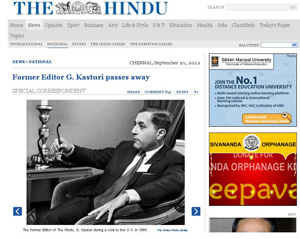
  • RIP, G Kasturi, Editor, The Hindu (1965-91)

    Screengrab of The Hindu report announcing the passing away of G Kasturi

    By A Correspondent


    Mr G Kasturi, veteran journalist and Editor of The Hindu from 1965 to 1991 passed away last Friday (September 21). He was 87.


    Reports The Hindu: “The end came peacefully at 2 a.m. on September 21. He had been unwell for some time, but was alert and active till the last. The cremation took place on Friday afternoon at the Mylapore crematorium. He is survived by his wife of 64 years, Kamala, sons K. Balaji and K. Venugopal, daughter Lakshmi Srinath, and five granddaughters and two great-grandchildren.”


    Links to coverage on Mr G Kasturi:

    Report in The Hindu and former Editor-in-Chief N Ram’s comment:

    http://www.thehindu.com/news/national/former-editor-g-kasturi-passes-away/article3919690.ece


    Photo feature in The Hindu

    http://www.thehindu.com/news/national/a-photo-feature-on-g-kasturi/article3919952.ece?homepage=true&ref=slideshow


    Links to various tributes in The Hindu

    http://www.thehindu.com/system/topicRoot/G__KASTURI__1924-2012_/


    Mahesh Vijapurkar on G Kasturi in Firstpost

    http://www.firstpost.com/india/what-made-g-kasturi-different-from-other-editors-464693.html


    Sans serif: Hindu’s longest serving editor G. Kasturi: RIP

    Hindu’s longest serving editor G. Kasturi: RIP


  • FPJ boost for small agencies


    By Johnson Napier


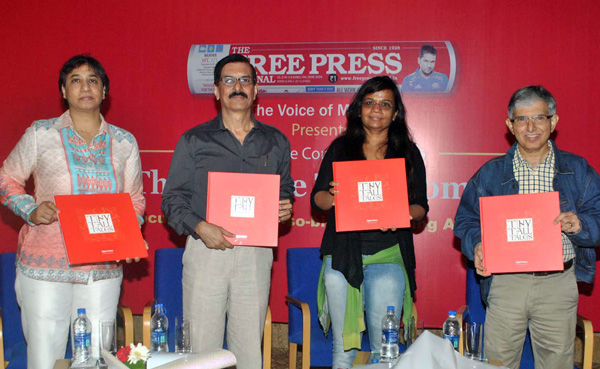
    Seldom does the media think of moving beyond the influential set of players when it comes to playing up the achievements of a particular sector or an industry. While the top 10 or 20 is what the goalpost seems for most in terms of coverage, quite often it is the players who are bundled up in the lower end of the spectrum that contribute as much if not significantly more to the growth of any sector. But this divide was almost forgotten at Grand Hyatt, Mumbai on September 22 when a host of mid- and small-sized advertising agencies came together to pick up nuances and mantras from doyens of the upper strata of the advertising industry.


    The initiative was part of the annual conclave hosted by Free Press Journal that seeks to empower SMEs in the advertising sector. The theme this year was ‘the change that cometh’. The panellists comprised Sam Balsara, CMD of Madison World, Punitha Arumugam, Director – Agency Business at Google India and Bharat Kapadia, founder of ideas@bharatkapadia.com. The conclave was well attended by the who’s who from the ‘not-so-big’ advertising agencies.


    The day began with Madison’s Sam Balsara taking the lead and enlightening the audience on the road ahead for the industry. Speaking on the topic “How to make the leap to the next level”, Balsara began by assuring all gathered in the audience that they were indeed in the right place at the right time. “Advertising is a booming business and the long-term perspective is indeed bright for all players in the industry. But while our economy continues to grow at a healthy 7-8 per cent, advertising’s contribution to the overall economic growth is not as satisfactory. Advertising as a percentage of India’s GNP is just 0.35 per cent compared to the global average of 0.8 per cent. In fact in the US, the number is around 1 per cent.” He cautioned the audience that there was no reason to be weighed down by the slowdown as there were better days ahead for the industry.


    Belting out some of the mantras that enabled Madison Media reach where it is today, Balsara highlighted that the small and medium agencies can indeed give a run to the big agencies by ‘thinking small, beating big’. “Most agencies would advocate one to thing big but we did the reverse and that’s how we managed to work our way to the top,” he averred. Balsara even went on to tag his agency as being a David amongst the Goliaths that existed in the industry, but he cautioned that it didn’t mean that one has to get bogged down by the size of the bigger agencies.


    Advocating to the audience his recipe for success, Balsara said that it was essential for the agencies to do what is right for the client only then will success come one’s way. According to Balsara, the key aspect was the need for agencies to develop core competency. Sharing with the gathering his favourite definition of advertising that steered him to deliver his best, Balsara said that advertising is the art of arresting human intelligence long enough to be able to make a person reach out and open his wallet. This will ultimately benefit the client leading to the growth of the advertising agency as well.


    Presenting the mantras that led Madison to emerge where it is today, Balsara shared the 10 immutable laws that he believed could do wonders to the fortunes of other agencies as well. These include: the law of disadvantage, law of service, law of innovation, law of research/technology, law of specialisation, law of focus, law of organisational building, law of conservation, law of patience and law of perception. Balsara further went on to burst a few myths about advertising which he believed was highly prevalent in the marketplace. These include advertising is too expensive; advertising is only for big companies; advertising is only for FMCG companies; good marketers do not believe in advertising and finally, consumers do not believe in advertising.


    Post Balsara’s unmissable takeaways, it was the turn of Bharat Kapadia to hand out his secrets as he spoke on ‘Getting ready for the future.”. Rather than term them as not-so-big, Kapadia took the liberty of altering the name to aspiring to-be-big agencies. Kapadia began by straight away highlighting the influential role that technology played today. “With technology eliminating most middlemen out of business, there is a fear whether advertising agencies may survive in the future? But according to me ad agencies won’t just survive they will continue to throw up spectacular growth as well.” Presenting his ideas on the secrets to chart out good growth and profitability for the company, Kapadia enlisted a few pointers that included: knowing well what the client’s opportunities were; understanding the role and importance of research/data in business; need to lay more emphasis on new media that is not only cheap but cost-effective as well; need for experiential marketing; and most importantly, the need for agencies to be more innovative. Kapadia shared with the gathering an innovation that he had effectively carried out in a newspaper in the recent past that was reasonably successful – Bru Coffee.


    Highlighting the strengths that small or medium agencies possessed compared to the big giants, Kapadia asserted that one didn’t need a sword to cut vegetables. A small knife itself could do the job more effectively. The possible strengths that the aspiring to-be-big agencies possessed include ability to garner more trust and ensure personalised service to clients, be able to deliver a local touch and the ability to offer specialisation services.


    Assigned the task of acclimatising the gathering to the role of new media in running any business, Punitha Arumugam of Google began by saying that the thing about new media is that if you do not know where you are going any road will take you there. Taking inspiration from her mentor Sam Balsara, Arumugam too went on to present the ten commandments of new media, which would help any agency to emerge successful in the future. The first was the need to think business: it was essential to have a big idea; being small or big by size is secondary. She went on to cite examples of Myntra.com and dollarshaveclub.com that went on to become successful case-studies in the recent past due to the power of thinking big. Next was the need to think fluidity: this was essential if one wanted to become successful and get good ROI. The third was think mind-casting: it was important for agencies to narrowcast and address a certain section of the audience as the underlying motive should be about targeting change leaders. The fourth was think re-imagine: with television and print both co-existing as effective mediums it was essential that agencies come up with ads that could work wonders across multiple mediums. The next mantra was think continuity: this had to do more about getting metrics that are used offline to be used successfully in the online world as well. The next was think solutions: this would be made possible with the help of technology that would make any solution come alive. Next commandment was think co-exist: the obvious need to see that all mediums co-exist seamlessly with a role being prioritised for each. Next was think adaption: need to pollinate offline ideas to online and do so effortlessly. The next was think structure: it was important that agencies learn to collaborate whether with generalists or with specialists if the job so demands. And the last but not the least, think covet: at the end, it is all about money. So it is okay if one desired a better share of the client’s attention and hence the business if he had to stay ahead of the race.


    The conclave concluded with a Q&A session where the panellists cleared a few doubts from the audience. This was followed by a vote of thanks by Jagdish Rattanani, business editor of FPJ.


  • Pulp Strategy adds NEC India to its client kitty

    By A Correspondent


    Pulp Strategy, a full-service experiential marketing and communications agency, has won the business pursuant to a multiple agency pitch thereby adding NEC India Private Limited to its client portfolio. Pulp Strategy Delhi office is now slated to handle OOH campaign as NEC India heralds the Indian Grand Prix 2012, in active collaboration with the Sauber F1 Team. NEC India is the premier partner of Sauber F1 Team.


    NEC India had floated a structured process whereby several agencies participated and pitched to emerge as the preferred activation partner. Pulps role will essentially comprise creative responsibilities, OOH, activation and events. Notably, Pulp Strategy also has administered the dealers’ conference for NEC India in Thailand recently.


    On the election of Pulp Strategy as its activation and OOH partner, Vijayant Khatri (National Marketing Manager), NEC India Pvt Ltd remarked, “We are confident that our partner agency will play a critical role in achieving our marketing goals. Their energy and proactive approach has inspired confidence.”


    Ambika Sharma, Managing Director & CEO, Pulp Strategy Communications said “NEC is a great brand, and we are proud to be a part of the NEC Sauber F1 Team campaign. We are a carefully constructed robust team that brings on board a strong and holistic approach to branding and activation. We look forward to partnering with NEC India.”


  • RBNL launches ‘Switch To’ campaign in run-up to digitization

    By A Correspondent


    With October 31 fixed as the D-Day for Digitization, Reliance Broadcast Network is all set to make the most of it with its new campaign titled ‘Switch To’. The campaign is designed to create enormous awareness amongst target audiences – to ‘Switch To’ the right service provider who can offer best value basis individual’s entertainment needs. The campaign also provides operators an effective tool to reach out through the marketing muscle and expertise of RBNL’s mediums across television, radio, on-ground, digital and outdoor, to gain increased visibility through this multi-media campaign.


    ‘Switch To’ launches on the back of earlier ‘Choose Your Set Top Box Wisely’ campaign that has been tailored to increase awareness and empower consumers with adequate information. The first phase of this campaign will be led across four metros: Delhi, Mumbai, Bangalore and Kolkata via BIG CBS Network’s key shows such as America’s Got Talent, The X Factor and American Idol.


    The campaign also aims at offering operators an excellent marketing campaign to strengthen their brand equity and gain optimally from the eminent revolution.


    Anand Chakravarthy

    Said Anand Chakravarthy – Business Head, BIG CBS Networks, “Digitization is an imperative step for the growth of the broadcast sector in India. While we have technologies available to improve efficiencies of broadcasting across the value chain, the lack of adoption from consumers slows the growth of the industry. This campaign enables consumers to Switch To the provider that meets their requirements, while at the same time offering the operators with an effective marketing campaign to partner with. Together, we are confident, we can bring about the much-needed Switch!”


  • India TV signs up Paritosh Joshi as strategist

    By A Correspondent


    In a yet another aggressive move, India TV has announced the appointment of Paritosh Joshi as a strategist.


    Until April 2012 Mr Joshi was the CEO, STAR CJ Network India, a STAR Group and CJO Shopping of South Korea’s Joint Venture.


    In his role as a strategist for India TV, Mr Joshi primarily will be responsible for optimizing and leading the revenue function of the existing businesses, and business development for the forthcoming ventures for the company.


    Apart from working with the Management at the Strategic level, as a mentor Joshi will also actively connect &engage India TV’s business teams including Sales, New Media and Brand.


    Announcing his appointment, Ritu Dhawan, MD & CEO, India TV, said, “Immensely experienced, Paritosh will be a tremendous resource in formulating the strategy for our new, ready to roll business plans. While we look forward to his contribution in taking independent news service to the next level, we feel delighted in welcoming Paritosh on the team. With his outstanding record, we are confident that he will be making most significant contributions in increasing our lead over competition as the most profitable media company.”


    Commenting on the assignment Mr Joshi observed, “I have had the pleasure of knowing Mr Rajat Sharma as a senior industry colleague and fellow IBF Board member for the last 6 years and we have had many lively conversations on the television business. It is from such a conversation earlier this year that the idea of this engagement began. It is a privilege to be invited to participate in this exciting journey and I look forward to a stimulating, inspiring assignment.”


  • Anshuman Misra quits Turner

    By A Correspondent


    Turner International Asia Pacific announced today that Anshuman Misra, Senior Vice President and Managing Director of Networks and Content Distribution, has resigned from his position with effect from October 12.


    After almost 14 years with Turner in Asia, Hong Kong-based Mr Misra is to take time off before embarking on his next career move.


    Said Mr Misra, “After working without a real break for more than two decades, I look forward to taking a few months off before I start the next chapter of my work life. I hope it’s as exciting as the time I’ve had with Turner. I want to thank everyone at Turner for all the support and camaraderie. I walk out of the company very satisfied but also sad to leave such a great bunch of people.”


    Steve Marcopoto, President and MD Turner International Asia Pacific said, “On behalf of everyone at Turner in Asia, I’d like to thank Anshuman for his significant contribution to the company’s success since 1998. He has been a first class colleague and trusted business partner throughout and we wish him every success in the next stage of his career.”


    Prior to joining Turner, Mr Misra was General Manager, BBC World (India) where he managed the distribution and sales of the news and current affairs channel.


  • Vikatan group to launch weekly mag Timepass

    By Tuhina Anand


    Vikatan Group which publishes nine titles in Tamil is gearing up to launch its tenth title – Timepass. As the name suggests, the magazine will focus on entertainment and will cater to those young at heart. The offering is an aberration from Vikatan’s usual tone and tenor which is seen as a serious player and stays away from relying on any kind of controversy that magazines today rely on.


    The magazine is a weekly and will be available every Saturday starting October 6, 2012. Priced at mere Rs 5, it will have 64 pages plus 4 pages of cover and will be A5 size. Initial plan is to have a print run of 5 lac copies which will include both sample copies as well as sold ones. In 3-4 months’ time the idea is to consolidate this number to 2.5 to 3 lakh sold copies. It will be sold predominantly in Tamil Nadu.


    Explaining the idea behind the new magazine, Pravin Menon, National Head, Ad Sales, Vikatan Media Services, said, “This is entirely people driven product. At Vikatan, we have introduced a concept called Hello Vikatan where people can call and listen to few tips that is addressed in our magazines. Since its launch around 7 months back, the concept has become highly popular and we have 1.5 lac calls per month. Since we already had involved readers based on the info from the calls, we did a sample of six thousand people asking them what they would want from Vikatan. The response that we got was that they would like to read something irreverent and purely entertainer from us.”


    The content of the magazine and even the pricing is all decided by the readers. However, the low pricing raises few questions as print industry is already pressed with low pricing and pressure on margins plus the debate is whether even our daily newspapers should be charged more as the case in many countries.


    Mr Menon said, “At Vikatan we don’t rely only on advertising as source of revenue and we have various innovative ways to generate revenues.” The group’s publications also has a strong digital presence.


    The group plans to go all out to promote the product and will be spending approximately Rs 2.5 crore to market it taking television, print, OOH, mall activation, radio and even cinema theater. The tone of the advertising campaign will be irreverent in keeping with the tone of the magazine.


    Vikatan Group publishes Tamil titles including AnandVikatan, Aval Vikatan, Doctor Vikatan, Junior Vikatan, Chutti Vikatan, Shakti Vikatan, Pasumai Vikatan, Motor Vikatan, Naanayam Vikatan.


  • Do pre-release star appearances work?


    By Meghna Sharma


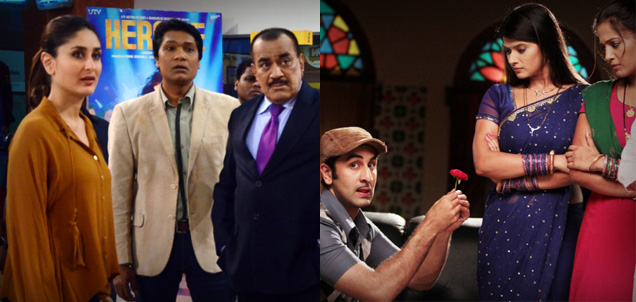
    What is common between Kareena Kapoor and Bipasha Basu? The answer is: CID. Yes, both the actors were rescued by none other than our very own team of ACP Pradyuman and his agents.


    Today, seeing actors on television is not a surprise. Most of them can be seen on the small screen as hosts or judges on reality shows. However, in the recent past one has seen them play a character or themselves in fictional shows where the plot of an episode is scripted around them. And the two actors are the latest to join the bandwagon of various other actors who have made a “special appearance” on the small screen to promote their upcoming film.


    Dinesh Rathore

    According to Dinesh Rathore, COO, Madison Media Omega, the difference between the big screen and the small screen faded away in the last decade as superstars entered the medium. “Actors making an appearance on television is a win-win situation for both. Television has vast reach so actors get to promote their films, and a channel can save money if the actor appears on their shows to promote his/her film.”


    He’s not alone, even broadcasters which are competing with each other to get the stars to their channel before others do also feel the same. Vivek Bahl, Chief Creative Director, Sony Entertainment Television says, “Big fiction shows with a dedicated & measurable viewer base is a great platform for an actor to promote his / her upcoming film with the show. And, for the show itself, one can always create buzz and sampling with the

    Vivek Bahl

    anticipation of a star appearance.”


    On the same note, Ajay Bhalwankar, ZEEL’s Content Head (Hindi GECs) feels that fiction shows are the staple diet of any General Entertainment Channel and the presence of a Bollywood celebrity is woven into the existing storyline of the fiction show, hence increasing the chances of a better recall. “As a medium TV cannot be ignored by marketers.”


    Prashaant Bhatt

    “Be it with a Jhalak Dikhhala Jaa or Madhubala, the audience for each show is varied and this is what works in favour of the movie that is promoted on the show,” explains Prashaant Bhatt, Weekday Programming Head of Colors, who believes that the trend is only going to move forward. “It is vital for any promotional activity to be present on all the mediums that helps them connect with the viewer. So, in the future, the trend could possibly be digital with the introduction of various apps etc, anywhere the audience/moviegoer is.”


    Shailesh Kapoor

    However, Shailesh Kapoor, CEO of Ormax Media feels that film star presence on fiction shows helps the films more than the channels. But the channels can use the stars in the promos and create buzz around it. It can give a viewership spike only if the star does something really interesting in the show. “In a recent study conducted by us, television emerged as the driver of both reach and appeal for film campaigns, way ahead of print and outdoor. I believe that channels should start charging film producers for such integrations, the way they charge advertisers.”


    Priti Murthy

    If both stars and broadcasters are winners here, Priti Murthy, National Director – Insights at Maxus India adds that viewers too don’t have much to lose out on. “I think even viewers win here as they get to see new faces or a new plot in their regular shows. Also, stars appearing on shows is a global phenomenon; in the west, stars appear on shows like Saturday Night Live.”


    It appears no one has anything to lose here!


  • Is there a market for radio plays and other non-Bollywood radio content?

    By Robin Thomas


    Tune into any radio station, chances are you would be listening to some offbeat programmes. Take for instance Big FM’s storytelling show – ‘Yaadon Ka Idiot Box with Neelesh Mishra’ which is already in its second season. What is even more interesting is the fact that it is aired during the primetime 9pm to 11pm, Monday through Friday. After the success of Ramayana, Fever FM launched a new radio play, Gandhi beginning March this year. Radio City only recently introduced ‘Freedom Hour’, a programme which plays only Indie music and aired every Saturday from 5 pm to 6pm across its 20 stations. These are just a few examples, even smaller stations like Radio Choklate and Tomato FM have been airing radio plays and other non-bollywood, non- music contents. While content on FM radio has been evolving ever since its existence, the question is whether the listener is listening to them or is there no scope for these contents on radio?


    According to Harshad Jain, Business Head, Radio and Entertainment – HT Media Ltd, the listener’s choice has been changing with the evolution of the radio industry. The radio industry is showing early signs of programming content that is beyond music. “Yes there is a market for non music / non Bollywood content in the FM radio space. Music has become a leveler for FM operators. The on-air treatment done through non- music based programming element like audio drama, sports, festival specials, are contents that differentiates any brand and Fever 104 FM is arguably the only station that has built a strong emotional connect with its listeners through these initiatives. Purely from an advertisers standpoint non-music content aims towards driving engagement and high interactivity.”


    Kartik Kalla, National Programming Head, Radio City believes that differentiating music is the need of the hour. “Music constitutes almost 75 per cent of the total airtime and hence it is the most important feature in programming. We have recently introduced ‘Freedom Hour’ on Saturdays between 5-6pm across all our 20 stations. This is an extension of the music that is played on ‘Freedom Radio’ on PlanetRadiocity.com. The listeners enjoy refreshing music which is a welcome change from the regular Bollywood music that’s played.”


    Besides playing Oriya music, every Sunday evening Radio Choklate is also said to air opera or plays called ‘Choklate Rangamancha’. Radio Choklate also airs a weekly interactive show wherein, letters from listeners are read out on- air and their questions answered. Monica Nayyar Patnaik, Joint Managing Director at Eastern Media Ltd was of the opinion that radio programming has been constantly evolving over the years. Earlier FM stations would play only songs, then they emphasized more on RJ talk, then they went onto non- stop music and so on. The response from listeners, particularly for offbeat radio programmes like radio plays have been very good, it also affirms that there is a market for non-music contents.


    R Venkata Subramanian, Senior Director-Investments, MPG India pointed out that while non music or non Bollywood programmes create differentiation, a listener however mainly tunes into radio for music. I believe that these shows will be able to build their properties for a longer period of time only when they are associated with brands. In addition to these, radio programmes also need to be more interactive and engaging which would click with the listeners.


    Industry players are of the opinion that while content in radio has been constantly evolving on radio, there is a market for non- music and non- Bollywood radio programmes, but it must be highly interactive and engaging with its listeners. Despite government restrictions, FM radio has been constantly finding newer ways to engage and interact with its listeners. FM Phase III rollout is expected to witness further innovation and differentiation in radio programming, especially with multiple frequencies which is expected to introduce new genres of FM radio.


  • For PR, with love… in Jaipur & Pondicherry


    By Johnson Napier


    For all the publicity and attention that follows a product launch or an event or any image-enhancing exercise, experts would tell you that behind all the glam and glory is the hard work and toil put in by a team whose only aim is a good result.


    But those that run the show also know that it is not just about satisfying the client or ensuring profitable ROI. In fact there is a larger agenda that confronts agencies like being prepared to face unforeseen challenges or being ready with a vision to convert unrealistic dreams into reality… more importantly, it is about the team being ready to be able to put up with everything and anything that gets thrown across at them. Public Relations (PR) agencies realize the need to fulfill this aspect of the business and that’s why the enhanced emphasis on providing adequate training and exposure on a constant basis.


    This November, the “training”, “exposure” and “upcoming trends” facets concerning the PR and Communications space may well be fulfilled what with a plethora of initiatives being planned.


    First up is the all-encompassing PRestival 2012 that’s being planned on a grand scale at Jaipur. Being put together by the team at PR website Image Management, the festival emphasizes the need for a common platform to bring Asia’s communications community together for a constructive and productive purpose. Touted to be the biggest such initiative in Asia, the event will witness PR and communications professionals from across 12 countries in South and South East Asia, including India, China, Singapore, Malaysia, Sri Lanka, Philippines etc troop down to be a part of the conclave. What makes it appealing is that the event has partnered with a number of key industry bodies, including the Asia Business Communication Association (ABCA) – one of China’s biggest PR associations, the Public Relations Consultants Associations of India (PRCAI), the Association of Business Consultants of India (ABCI), the Public Relations Global Network (PRGN) and the Public Relations Organisation International (PROI).


    Following PRestival 2012 would be PRAXIS 2012 that’s being put together by The PRomise Foundation for Public Relations. Being promoted as ‘India’s first weekend summit for Public Relations and Corporate Communications professionals’, the event will be held at Le Pondy in Pondicherry on November 23 and 24. The summit aims to bring together students, professionals: young & mid-level and veterans of the PR business under one roof to discuss various aspects that impact the profession. (Disclosure: MxMIndia is a media partner of PRAXIS 2012)


    Elaborating on the need for hosting PRestival 2012 at Jaipur, Kunal Pal of Image Management & Project Manager of PRestival 2012 said: “In my many interactions with PR industry leaders, something that has repeatedly come up is the need for an industry event which can balance learning and fun. Backed by this encouragement, PRestival was conceptualized and the idea is to celebrate the PR/Communications industry while bringing together professionals and students from across Asia in a collaborative, festive environment. Like most conferences, PRestival will showcase industry leaders in interactive panel discussions and speeches, but the core emphasis remains promoting learning, networking, and fun for all our delegates – from CEOs to students.”


    A somewhat similar effort is being put in by founders of PRAXIS 2012. Amith Prabhu, a public relations professional and part of a group of young Indian professionals who  have created The PRomise Foundation elaborated agreeing that “there is definite need to have a forum where individual practitioners working in PR firms or corporate communications departments can become members and come together to exchange ideas and share experiences. The Indian PR community has grown rapidly and with almost every Top 10 global PR consultancy having an India presence the need for events that bring professionals together is a much needed one. A start needs to be made and we have made a small start.”

     

    Amith Prabhu

    On the differentiation being taken in terms of PRAXIS being a weekend event, Amith Prabhu had the following rationale to share: “I worked in India for eight years and have never seen a single weekend event where PR professionals come together as a community to celebrate the profession, break bread together and learn from each other. There have been attempts by some organisations to offer such events but not in the form of an offsite where busy people can leave their work behind for a day or two, which is what we are offering. We need at least 2-3 such events annually as the PR consultancy business is growing.”


    And it’s not just the organizers who are excited about partaking in these events. The industry too is excited to be throwing its weight behind such initiatives. Highlighting the role that such events play in pushing forward the cause of the industry, Nikhil Dey, President – Public Relations, Genesis Burson-Marsteller said: “We can all benefit from forums that integrate thoughts and ideas from all ages and experience levels. While there may have been a void in past years, that is changing as we speak with the launch of two fantastic events dedicated to bringing students and youth together with industry experts for an exchange of ideas, knowledge and experiences. Both promise to be extraordinary events that can serve as a launch for the continued exchange of ideas and best practices between the leaders of today and tomorrow.”

     

    Sharif Rangnekar

    Sharif Rangnekar, CEO and Director of Integral PR & President of PRCAI said: “There are far more platforms, conferences, workshops happening focused on our industry than ever before. The last quarter of this year will in fact see a PR Festival in Jaipur and a youth-focused event in Pondicherry being staged. In both cases, the PRCAI is extending as much support as it can as an industry body and is working closely with the organizers in the area of content.”


    Nitin Mantri, CEO of Avian Media shared that it was important for PR professionals to engage with and participate in forums held by industry bodies. “I strongly feel PRCAI is one such body that can become a unifying force for the industry if everyone contributes to it. In fact, the PRCAI was formed as an initiative by a group of individuals and is currently the leading industry association. However, any initiative by individuals is also welcome and should be encouraged by all.”

     

    Nikhil Dey

    Addressing shortcomings

    While hobnobbing and exchanging ideas and mantras would be the order of the day, these events would also focus on getting the youth acclimatized and set to face the challenges of tomorrow. This would be achieved by way of lending out training exercises and modules for all, especially the youth, to emulate. Emphasizing on the need for more training programmes, Mr Mantri said that “there was a need for training modules to be undertaken by professional bodies on a periodic basis that will enhance and upgrade the skills of available talent and make them more consistent in quality.” Adding further, Mantri opined that some of the institutes were still focused on providing theory-based curriculum. “While fundamentals are important, the emphasis on real time and on-ground learning should be equal or greater. This will help us hone better PR professionals and get them more excited about their careers,” he reasoned.


    Adding his POV, Mr Dey highlighted how talent at both at the entry level and middle management was bright, young and energetic, and how they were able to multi-task and take on additional responsibilities with pride. “But they still need proper knowledge and experience to grow and improve, and this is why regular training is so important,” he added. Lending the formula practised at his own agency, Mr Dey shared, “At Genesis Burson-Marsteller, we have always fostered a robust learning and development (L&D) environment and recognize that today’s youth are tomorrow’s leaders. We created an L&D programme over ten years ago designed to address performance gaps and improvement opportunities at different levels. Also, one of our most successful programmes, aimed at entry-level team members, is called the Associate Learning Programme (ALP). After an intensive selection process, the chosen associates are put into a one-year programme which combines all three forms of learning: classroom sessions on professional and behavioral skills; coaching by the mentor while on-the-job; and self-development through reading, sharing and counseling. Associates graduate from this programme as well-rounded professionals who are ready to deliver in a knowledge-based environment.”


    Sharing his thoughts, Mr Rangnekar said that while training and a re-alignment of courses held by various institutions with market requirements, is a necessity, “PR does call for individuals to have that spirit and instinct to enjoy people not just to get along with but also their behaviour, characteristics, consumption patterns and the variety of emotions that everyone goes through.”


    For Mr Prabhu, the three key areas essential for training the youth of today include a) Writing and storytelling skills which comes from practice b) Social media skills that come from embracing the medium fully c) And the last one is a combination of discipline and honesty which boils down to ethics which one needs to imbibe at an individual level. However, according to him, organizations need to instill that culture at all levels with ethics focused training and through leading by example.


    Kunal Pal expressed, “As the role of a PR practitioner evolves, it is essential that the industry place a greater emphasis on training and supporting talent. Gone are the days when all it took to be a successful PR person were strong verbal and written communication skills. Today’s professionals need a wide range of skills and that is why, in part, talent scouting has become a much more evolved process in the industry and even universities are relooking at the kind of talent they produce. While we are making progress in this regard, there is still some way to go.”


    So while the industry seems gung-ho about playing an integral part and supporting such conclaves, what it also needs is for all to show unity in the cause. Rather than have an individualistic or divided approach it would be great if the entire fraternity worked together in achieving a common goal: that of uplifting its own survival for the future. Going by the response that these two conclaves have managed to elicit so far it’s not hard to imagine why the above would not be a reality.