Category: NEWS

  • ABCI awards night on October 19

    By A Correspondent


    The Association of Business Communicators of India will be holding their 52nd Annual Awards Nite on the evening of Friday, October 19 at the Crystal Room, Hotel Taj Mahal, Mumbai.  Last year, ABCI received 952 nominations from 32 categories for the 51st Annual Awards.


    ABCI is the only Association in India to recognize and reward excellence in creative Business Communication for the last 51 years. Entries are invited from 32 categories from Print, Electronic & Digital Medium of Business communications like Annual Report, Calendars, In-house Journal, Best Photograph in an In-house Journal, Tabloids, Article, Column, both in English & Hindi languages published in the Calendar Year 2011.  Categories for designing are also included. New Publication & Prestige Publication published from or in the calendar year 2011 are also invited. For more details log on to www.abci.in


    ABCI’s  ComFest12 To Focus On Theme:” Managing Communication in Turbulent Times” ComFest12 – The Mega Annual Event by the Association of Business Communicators of India will this year churn out thoughts from Leaders of the Industry across globe. ComFest 12 will be held on 18th & 19th October, 2012, at the Rooftop Rendezvous, Hotel Taj Mahal, Opp. Gateway of India, Mumbai. Among the star speakers attending the gathering at ComFest 12 are: Dr. Narendra Jadhav, Member Planning Commission, Government of India, Dr. Kai Rolker, Global Head, Communications, Clariant Group, Switzerland, Mr. Maxim Behar, Chairman, Hill + Knowlton, Prague, Mr. Anthony Good, Founder, Good Relations, London, UK, will be the guest speakers. This apart Yanina Dubeykovskaya, Director, Contents, World Communication Forum, Davos, Switzerland & Dr James Gillies, Head, Communication Group, CERN, Geneva based Nuclear Research Lab who in the recent past declared invention of God Particle will be special attraction of the ComFest 12.


  • Colvyn Harris to be South Asia JWT CEO, to be incharge of all JWT cos in India including Contract

    By A Correspondent


    JWT Worldwide Chairman and CEO Bob Jeffrey has announced a leadership restructure to reflect Asia’s growing global importance, and underscore JWT’s commitment to the region’s diverse and vibrant markets.


    JWT’s North Asia Area Director and Greater China CEO Tom Doctoroff and JWT India CEO Colvyn Harris will succeed Michael Maedel in the restructured region.


    Mr Doctoroff will take on the role of CEO, JWT Asia Pacific (APAC), at the end of this year. In this role, he will oversee Northeast and Southeast Asia, as well as Pakistan, Australia and New Zealand.


    Mr Harris will become South Asia CEO (India, Sri Lanka and Nepal) and take on added responsibilities of JWT’s Indian companies, including Contract Advertising, Hungama Digital Services, JWT Mindset and Encompass. Messrs Doctoroff and Harris will report to Mr Jeffrey.


    Mr Maedel, who has spent 40 years in the industry and 22 years in leadership roles at JWT, including eight as President of Asia Pacific, will move into the role of Non-Executive Chairman for Asia.


    “Tom and Colvyn are both dynamic leaders with strong connections to the markets, the consumers and the clients,” said Mr Jeffrey.  “By leveraging the strengths and strategic insights of these two very talented people, JWT is uniquely positioned to maximize growth in this critical and dynamic region.”


    These changes come at a time when JWT APAC, which has an 83-year history in Asia, continues to gather greater momentum. JWT APAC has set multiple benchmarks, bringing home first-time Cannes Grand Prix Lions for Malaysia in 2004, India in 2008, Japan in 2009 and, most recently, China in 2011.  The company has also deepened the scope and scale of the services it offers in the market, from digital to shopper marketing, through organic growth and acquisitions.


    “I am very excited to build on JWT’s past accomplishments across Asia Pacific,” said Mr Doctoroff. “We are in the midst of a revolution of consumer empowerment. I look forward to working with client partners in this fast-changing region to find new synergies between classic brand building and next-stage consumer engagement in the digital era.”


    Mr Doctoroff, who has 20 years’ experience with JWT, continues to display his commitment to building the agency’s footprint in Asia and fostering its ethos of Worldmade ideas. Under his leadership, JWT North Asia has diversified into customer relationship marketing, field marketing, promotion network management and digital engagement. A Detroit native, <r Doctoroff joined JWT in 1992, moved to Hong Kong in 1994, and became the Managing Director of JWT Shanghai in 1998. In 2002, he was appointed Greater China CEO and Northeast Asia Area Director, a remit that included Korea, China, Hong Kong and Taiwan.  Japan came under his purview in 2008, when Doctoroff assumed the role of North Asia Area Director.  He speaks fluent Mandarin.


    Doctoroff is credited as being the industry’s preeminent thought leader on advertising and marketing in China. This past May he published his second best-selling book on Chinese consumers, titled “What Chinese Want.” Prior to JWT, Mr Doctoroff worked for Leo Burnett. He holds an MBA from the University of Chicago.


    The restructuring reflects a renewed focus on India by JWT Worldwide. JWT employs over 1,500  people in India, more than any other single market worldwide, and earns a significant amount of revenue from this critical, high-growth country.


    Mr Harris, who has 33 years at JWT, continues to lead India’s largest and most admired advertising agency as CEO South Asia. He has held various industry leadership roles, including President of the Advertising Agencies Association of India, and has addressed global audiences as a speaker at the World Economic Forum, London Business School and The Wharton School.  Under his leadership, JWT India has built a formidable reputation with a diverse spectrum of traditional, mainstream, activation, events and digital marketing services capabilities.


    “We will continue to build and acquire the most diversified platforms to deliver on the market ambitions of the clients we service, thereby further consolidating our leadership position. Brands are the center of our focus, and with our skills and capabilities we deliver marketing solutions across the most diverse of offerings to meet the challenges of the dynamic markets we operate in,” said Mr Harris. “This new development ensures that our clients continue to have greater access to the best of our services and talent, not only in the country, but across South Asia.”


    Mr Maedel, who will continue to stay in Singapore, will work with Messrs Doctoroff and Harris in an advisory role until he retires 2014.


    “Michael’s exceptional leadership skills have cemented JWT’s reputation as a leader in both strategy and creativity in every region he managed, from Europe to Asia,” said Mr Jeffrey.  “The creative and commercial success that JWT APAC has enjoyed is a testament to his leadership.”


    Mr Jeffrey continued, “Michael is deeply respected by staff and clients, and the entire company has benefited from his vision and guidance. He is an unparalleled resource, and we are thrilled that he will remain a core part of the management team until his retirement.”


    Mr Maedel, who holds a degree in Economics from the University of Vienna, started his career at Young & Rubicam, and in 1985 became Chairman of Ted Bates Werbagentur. Maedel joined JWT in 1990 as Chairman and CEO of JWT Germany, and in 1993 added the role of Area Director Central and Eastern Europe.  In 1997, Mr Maedel was named the President of Europe, Middle East and Africa, and in 2004, Asia was added to his portfolio.  He has served as a member of JWT’s board since 1992.


    “I’ve had the real pleasure of charting a course for our company in some of the world’s most dynamic regions through periods which have seen our industry go through some pretty seismic changes. I’ve also been privileged to work with some of the most talented people around the world,” said Mr Maedel.  “I look forward to working with Tom and Colvyn through this transition period.”


  • iPads, smartphones set to replace gold & silver wares as corporate gifts this Diwali

    By Madhvi Sally & Sutanuka Ghosal


    Luxury watches and pens, iPads, smartphones and even toasters and sandwich makers are set to replace gold and silver coins, idols and puja thalis as corporate gifts this Diwali as prices of precious metals soar through the roof and slowdown-struck companies cut back on festival spends.


    Jewellers across India do not see bright prospects for the festive season what with prices of gold and silver northward-bound. Since mid-August, gold has risen 6.6% and silver 18%. “There are no orders. We feel companies will go for other gift items as gold and silver prices remain firm,” says Bharat Zaveri, managing director of Ahmedabad-based Zaveri & Co.


    The shift away from gold and silver gifts is also being spurred by a younger generation that is more enthused by luxury goods. Sanjay Bansal, chairman of the Ambootia Group, a producer of Darjeeling tea, says: “We have stopped giving gold and silver coins as corporate gifts during Diwali and are now giving consumer durables and iPads to clients. The prices of these gifts vary between Rs 1,000 and Rs 25,000.” Ten grams of 24 karat gold is currently quoting at a little over Rs 32,000 and a kg of silver at roughly Rs 64,500.


    “Corporate gifting of gold and silver coins during this Diwali is on decline. Jewellers who had placed orders during the India International Jewellery Week (IIJW) last month are holding back physical delivery of gold. There is some reluctance among jewellers to create an inventory for the festive and wedding season,” says Bachhraj Bamalwa, chairman of the All India Gems and Jewellery Trade Federation.


    Organized by Gems & Jewellery Export Promotion Council, the IIJW saw participation by over 862 diamond and jewellery companies. Nearly 65% of jewellers who had placed orders during the expo are now in a wait-and-watch mode.


    Good News for Appliance Makers


    Most jewellers who had placed orders during the IIJW are watching the situation before entering into a final transaction, says a jeweller who participated in the show.


    He adds that orders worth a little over Rs 5,000 crore were placed during the jewellery exhibition. Leading players such as Rosy Blue, Karp Impex, Dimeson, Gitanjali Group, Rio Tinto, PC Chandra, Anmol Jewellers and the World Gold Council had participated in the show.


    Harmish Arora, director of National India Bullion Refinery, a refiner of gold and silver, says demand for gold coins has slowed down and there were hardly any investors in the market. “People are selling gold and not buying,” he says.


    That’s good news for marketers of everything else other than gold — including domestic appliances. Says Gautam Sengupta, vice-president, Videocon: “We are seeing demand for light home appliances for corporate gifting purposes. Corporates are interested in items such as toasters and sandwich makers. We expect order flows to improve further from early October.”


    It’s not curtains, though, for gifts of gold – not yet. Ajay Mitra, managing director (India & Middle East), World Gold Council says: “Despite the uncertainty, it is important to remember that there is still a lot of latent demand for gold; and with the upcoming festive and marriage season, we should see an upsurge in demand.” Ved Prakash, director at MMTC, India’s largest bullion importer, adds that although sentiment is low, Indian buyers may be prompted to buy in October, when prices are expected to dip; and that could well jumpstart sales.


    Source:The Economic Times

    Copyright © 2012, Bennett, Coleman & Co. Ltd. All Rights Reserved


  • Spuul’s 1-stop entertainment to beat piracy

    By A Correspondent


    Spuul.com was founded by Sudesh Iyer who is the Founder of Sony Entertainment Television and S Mohan, the Founder of Accellion, buUuk and a number of other technology and venture companies. Spuul.com was launched in 2010 and aims to combat online piracy by trying to acquire newer movies immediately after their theatrical release and offer them to consumers in good quality and at a relevant price. Spuul.com, which aims to launch newer genres of Indian content too, wants to be a one stop entertainment destination for Indian content in the long run.


    Spuul.com is an advertising supported subscription service that provides on-demand access to the best of Bollywood movies and television programmes via the web and mobile devices. If the year 2011 was all about focusing on technology and content acquisition, the year 2012 will see the company increasingly focus on building up its content. Only recently this year, Spuul.com had launched the iOS app i.e. the apps for iPhone and iPad etc, thus making it easier for the users across the globe to watch Indian contents online whether it is Hindi Cinema, television shows or even regional contents.


    Spuul.com offers three levels of content to its consumers, ‘Freemium content’ which includes access to a broad range of free movies. ‘Specials’ which are pay per view movies, available at a certain price (pay per movie for 72 hours of unlimited views) and premium subscription which provides consumers access to the very best of Bollywood for a month. Spuul.com is said to be receiving good traction from India, and particularly from other parts of the world namely, the US, UK and even Middle East wherein users are increasingly visiting Spuul.com and consuming Indian contents online.


    Prakash Ramchandani

    According to Prakash Ramchandani, South-Asia and India Head, Spuul, “We are in the evolution phase and we want to grow and set a benchmark in the industry. Content consumption is getting more fragmented today. We see a trend in India as well as internationally that there is no dedicated service which is legal, purely for Indian content. So we are targeting just the Indian segment, which includes the Hindi cinema as well as television programmes as well as regional content. Thus we will be across multiple content genres, pan India for consumers across the world. We want to be ready for India when India is ready for it.”


    Spuul.com which is said to have pre-roll ads that does not interfere or disrupt the consumers viewing experience, also aims to combat piracy and make it a better monetization model for the producer and the content provider. “Our entire focus is to combat piracy and to provide better monetization model for the producer and content provider. If we can get the movie as soon as possible post theatrical release and give it to the consumer on the go, it is better than somebody giving it away for free. Our focus is also providing good content and customer experience. In fact we had our first subscriber within one hour of launch, this shows that there are consumers and that they are ready to subscribe or buy online if they are given different content, at the right price and with a good customer experience, they will buy it” added Mr Ramchandani.


    In the long run Spuul.com wants to be a one stop entertainment destination for Indian content wherein its breath of content would include all types of genres as long as it is premium focused.  Currently, Spuul.com has a total of 15 employees in its Singapore office, it has also has an office in Mumbai and aims to open more offices across the globe in the near future. Speaking on the future of online video streaming in India, Mr Ramchandani was of the view that smart phone and tablets will drive the online video consumption as the growth of smart phones will be much faster in the near future than what it was in the last six years. “Online video streaming is exploding in India and globally and this is the best time for the second screen i.e. mobile” said Mr Ramchandani.


  • Aegis launches global single-source consumer behaviour study

    By A Correspondent


    Global media network Aegis Media has launched its proprietary research based tools Consumer Connections System (CCS)  & OCS in India, today. Originally launched 12 years ago in the UK, CCS has now expanded globally and is available in 40+ countries covering over 250,000 respondents accounting for over 90 percent of global advertising expenditure.  In APAC, CCS is currently active in China, Australia, New Zealand, Japan, South Korea, Thailand, Malaysia, Singapore and now India.


    CCS will provide India and Aegis Media clients actionable insight into communication usage and engagement across bought, owned and earned digital, experiential and media channels. The investment in the tool stems from a belief that digital is changing everything, and, crucially, contributes to the way advertisers put an understanding of how consumers think and behave at the heart of everything they do.


    With a focus on digital, this is the first study to have a significant focus on the digital touchpoints and e-commerce which is on a growth spurt in India. In-depth information is available for the first time in India through CCS which is capable of evaluating the comfort of the consumer with e-commerce.


    CCS is owned by Aegis Media and gives the agency and their clients a valuable insight into how today’s consumers choose and use media in our rapidly changing world. In the new era of media, CCS and OCS help to create powerful connections between our client’s brands and their most valuable consumers.


    Specifically on the digital space and e-commerce which has been an area of added focus, the research shows a growing role for e-commerce in the market, and early studies suggest:

    Of the 18 percent of the population (amongst SEC ABC) who have accessed internet, 40 percent of them have bought something in the last 12 months

    48 percent regularly research / look for products online.

    Top categories being:

    Books – 14.78 percent

    Clothes/Shoes/Accessories/Jewellery – 12.83 percent

    Insurance – 12.5 percent

    10 percent have bought groceries and other household items online.


  • IPAN Hill & Knowlton re-brands as IPAN Hill+Knowlton Strategies

    By A Correspondent


    IPAN Hill & Knowlton has announced a change in its name to IPAN Hill+Knowlton Strategies, as part of its global shift in corporate identity. This change is in line with the rebranding of Hill & Knowlton, the leading international communications consultancy.


    “The new brand points to a shifting market for our clients, one with an explosion of information and a revolution in the ability of almost everyone to find that information. This democratisation of information is fundamentally changing the way they do business,” said Jack Martin, Global Chairman and CEO, Hill+Knowlton Strategies.


    Radhika Shapoorjee, President, IPAN Hill+Knowlton Strategies, India, said, “The renaming reflects a renewed emphasis on strategic communications advice that ensures a client’s business imperatives are achieved. We believe that the public is at the centre of the client’s business and we can help build a positive influence and sentiment across the various stakeholders backed by research and insight, built upon a rich heritage of our public relations strength.”


    The rebranding and new name comes into effect from September 18, 2012. More information is available at www.hkstrategies.in.


  • Indian entries win 47 awards at Spikes Asia

    By Ananya Saha


    BBDO was presented with the Network of the Year trophy with DDB coming second followed by Leo Burnett in third, at the Spikes Asia Festival of Creativity 2012. The Media Agency of the Year trophy was awarded to Mindshare, Mumbai, with Cheil Worldwide, Seoul taking second place and in third, Whybin\TBWA Group, Sydney.


    BBDO India, Mumbai, bagged Creative Effectiveness Spike for its Gillette Mach 3 Turbo Sensitive ‘Shavesutra’. Elated Josy Paul, chairman and national creative director, BBDO India, said, “We thank our clients, our partners and the international jury at Spikes Asia for honouring us with six awards including Asia Pacific’s first Creative Effectiveness award. This recognition, along with our 17 shortlists, have helped us become India’s most awarded agency at Spikes Asia with the highest number of award points. What is heartening is that we’ve earned it for real transformational work on large brands.”


    In the Film Crafts, Indian managed one gold, three Silver and three Bronze metals. Taproot India walked away with two Silver metals for its ‘Mumbai Mirror- I am Mumbai’ campaign while Contract Advertising, Mumbai, bagged the coveted Gold Spike for Corruption campaign for Morphy Richards, and O&M received a Silver Spike for IPL-Carnival campaign.  BBH India’s Google Chrome, Taproot’s ‘Mumbai Mirror-I am Mumbai’ and McCann’s ‘Leave the Night Behind’ campaign won Bronze Spike. In the Design category, TBWA India, Mumbai, walked away with Bronze Spike for Elephant Combos Logos Design it did for MKV Households. BBH India, Mumbai, also managed a Bronze Spike in the Digital category for its Tanjore Google Chrome campaign.


    Of the total 43 entries in Film Spikes, India managed four Silver medals and one Bronze. The Corruption campaign for Morphy Richards conceived by Contract Advertising got a Silver Spike along with Taproot’s ‘Mumbai Mirror-I am Mumbai’, Google Chrome campaign by BBH India and ‘Deadman Talking’ public service campaign by DDB Mudra for Consumer Education Research. Taproot managed another metal – Bronze – for its ‘Cleavage’ campaign for Fox Movies in this category.


    The campaign for Kissan Ketchup, ‘Where What You Grow Is What You Eat’, by Mindshare Mumbai, received the Grand Prix and Gold Spike in the Media Winners.  The category saw Mindshare winning two Silvers Rin Detergent and Bru Gold. The rage of Kolaveri Di got Jack in the Box a Silver Spike. Two of three Bronze Spike in this category were lapped up by BBDO for Gillette Fusion ‘You Shave. I Shave,’ and ‘Twwet-a-thon’ for 7Up. The third Spike went to Cheil’s campaign for Samsung Printers, Minus One Project.


    Of the seven metals in Outdoor Category, McCann managed six while O&M got a Bronze Spike for Anti-smoking Initiative for Cancer Patients Initiative. The campaigns that got McCann the metals include: Franklin Gandhi, Mao Queen and Lincoln Fahd for Western Union Money Transfer. The campaigns got Silver and Bronze Spike each.


    India received three Bronze Spike and One Silver Spike in PR Category. Cheil Worldwide for Samsung Printer (Silver), Bang Bang Films for Kolaveri Di got one Bronze while BBDO India’s campaigns for Gillette Fusion got two Bronze Spikes. Grey Worldwide India won a Bronze Spike in Print category for its campaign for Fujifilm. Three Bronze Spike campaign went to DDB Mudra for Volkswagen campaigns. Radio Winner from India was Leo Burnett with its campaign for Strand Book stall.


    The winners of the Spikes Asia 2012 Awards were announced on September 18 at the Grand Theatre, Marina Bay Sands in Singapore. Ten juries chose 397 winners from an initial 4,860 entries. The 2012 awards were given as follows:


    Branded Content & Entertainment *New* – 17 winners: 1 Grand Prix, 1 Gold, 9 Silver, 6 Bronze

    Grand Prix: Host Sydney, Australia, Air New Zealand, ‘The Kiwi Sceptics’


    Creative Effectiveness *New* – 4 winners: 1 Grand Prix

    Grand Prix: Clemenger BBDO Melbourne, Australia, Nab, ‘Break Up’


    Design – 28 winners: 1 Grand Prix, 4 Gold, 8 Silver, 15 Bronze

    Grand Prix: Iyamadesign Tokyo, Japan, Kamoi Kakoshi, Mt Ex Taipei


    Digital – 29 winners: 1 Grand Prix, 4 Gold, 12 Silver, 12 Bronze

    Grand Prix: Dentsu Tokyo, Japan, Honda Motor, ‘Connecting Lifelines’


    Direct – 28 winners: 1 Grand Prix, 6 Gold, 11 Silver, 10 Bronze Grand Prix: JWT Melbourne, Australia, Melbourne Writers Festival, ‘Wi-Fiction’


    Film – 43 winners: 1 Grand Prix, 10 Gold, 18 Silver, 14 Bronze

    Grand Prix: Cheil Worldwide Seoul, South Korea, Amsung Electronics, ‘What Does Your Mind See’


    Film Craft – 23 winners: No Grand Prix, 3 Gold, 7 Silver, 13 Bronze


    Integrated – 8 winners: No Grand Prix, 2 Gold, 2 Silver, 4 Bronze


    Media – 41 winners: 1 Grand Prix, 6 Gold, 14 Silver, 20 Bronze Grand Prix: Mindshare Mumbai, India, Hindustan Unilever, ‘Where What You Grow Is What You Eat’


    Mobile – 13 winners: 1 Grand Prix, 1 Gold, 4 Silver, 7 Bronze

    Grand Prix: Party Tokyo / Dentsu Tokyo, Japan, Sony, ‘Make TV’


    Outdoor – 50 winners: 1 Grand Prix, 10 Gold, 14 Silver, 25 Bronze Grand Prix: Ogilvy Shanghai, China, Coca-Cola Company, ‘#Cokehands’


    PR – 17 winners: No Grand Prix, 2 Gold, 6 Silver, 9 Bronze


    Print – 24 winners: 1 Grand Prix, 4 Gold, 6 Silver, 13 Bronze

    Grand Prix: DDB Sydney, Australia, Volkswagen, ‘Bikers-Police’


    Print & Poster Craft – 18 winners: 1 Grand Prix, 2 Gold, 6 Silver, 9 Bronze

    Grand Prix: Ogilvy Shanghai, China, Coca-Cola Company, ‘#Cokehands’


    Promo & Activation – 37 winners: 1 Grand Prix, 10 Gold, 14 Silver, 12 Bronze

    Grand Prix: 303Lowe Sydney, Australia, Ikea, ‘Ikea Catalogue’


    Radio – 17 winners: 1 Grand Prix, 3 Gold, 5 Silver, 8 Bronze

    Grand Prix: JWT Singapore, Singapore, Unilever Singapore, ‘Radio Prank’


    During the Awards, the prestigious Advertiser of the Year accolade was presented to P&G Asia in honour of their commitment to engage their consumers by not only embracing but also expecting creativity in their product communications around Asia. Freddy Bharucha, Chief Marketing Officer of P&G Asia was on stage to collect the award.


    Also announced at the Awards were the winners of the Young Creative Spikes Competitions. India took the gold metal in the Young Spikes Media Competition whilst the team from Hong Kong took gold in the Young Spikes Integrated Competition.

     

  • Kareena Kapoor calls CID for help!

    By A Correspondent


    Today Bollywood stars are a common sight on the small screen as they make “appearances” on other shows. The latest to join the bandwagon is Kareena Kapoor.


    The gorgeous heroine has shot for a special episode of CID on Sony Entertainment Television, where she will play herself, an actress. The plot revolves around an obsessed fan, who threatens Kareena to the extent that she considers leaving her career in films and actually marrying him. In the episode, while promoting one of her films, she discovers that her life is in danger and she solicits help from the CID bureau headed by ACP Pradyuman.


    When asked about her experience working with ACP Pradyuman (Shivaji Satam) and his team, she said, “CID is one of the biggest shows running on Indian television. I am happy and delighted to work with such talented people who are running the show successfully for over 15 years. I thoroughly enjoyed myself while acting with the CID team and wish them all the very best as they continue to entertain their viewers.


    The special episode airs this Friday, September 21, coinciding with the release date of the actor’s new film Heroine as well as her birthday. It was shot at Fun Republic Cinemas in Andheri West.


  • Genesis Burson-Marsteller retains Visa

    By A Correspondent


    Genesis Burson-Marsteller, South Asia’s leading integrated communications consultancy, announced it has signed on Visa, global leader in technology payments solutions. Genesis Burson-Marsteller, as part of a one-year retainer, will support Visa in further communicating the benefits of electronic payments, and the company’s latest developments in safe and efficient payment innovations. Further, Genesis Burson-Marsteller will support Visa’s commitment to financial inclusion for all of India.


    “Visa is moving at a fast pace in delivering access, safety and ease to financial transactions for businesses, governments as well as individual consumers around the globe,” stated Prema Sagar, Principal and Founder of Genesis Burson-Marsteller. “As Visa further develops what is already the most advanced payment processing network in the in the world, we are delighted to be working with them to highlight these advancements through strategic and targeted communications.”


    Genesis Burson-Marsteller will lend counsel and tactical support to Visa’s ongoing communications efforts using targeted media outreach in the technology and consumer space, as well as conduct stakeholder education and engagement. The programme will be targeted at showcasing Visa’s leadership in the sector.


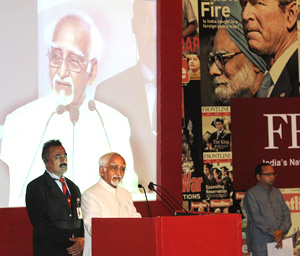
  • Vice-President Hamid Ansari lauds relaunch of Frontline

    By A Correspondent


    “I may be forgiven for admitting that I am moderately conservative and tolerably radical – conservative in habits and radical in thinking. For this reason, I was less than enthused when the Shri Venkitesh Ramakrishnan met me with the suggestion that I attend today’s re-launch function,” said Hamid Ansari, Vice-President of India at the re-launch of Frontline. The fortnightly magazine from The Hindu Group will not be available for Rs 40.


     

    “I could not help recalling the old maxim don’t fix what is not broke. To me personally, ‘Frontline’ has always been a stimulant to the mind apart from providing good reading on most matters that I care to spend time on. The need for a remix in Bollywood terms therefore did not arise. Nor was there a need to replace persuasion with titillation,” said Mr Ansari.


    The magazine was re-launched in the presence of N Ram, former Editor-in-Chief, The Hindu, and Professor Romila Thapar.


    “In today’s age, the audio-visual media has emerged as a dominant medium for quenching the thirst of the target audience for real time news on current affairs, culture
    and entertainment. Despite this, there remains a real and popular demand for serious publications on topical issues which cannot be substituted by the ‘breaking news’ culture and short-attention span snippets in the domain of the electronic media,” Mr Ansari added.


    The new Frontline will hit stands in October, and will have 150 pages.


  • GSF Accelerator is for the entrepreneurs and of the entrepreneurs: Rajesh Sawhney

    By A Correspondent


    The Indian digital economy is on the upswing but, what is expected to further fuel this growth and the growth of the Indian economy as a whole is the growth of well established startup companies. The irony however is that unlike in the west, it is a huge challenge for aspiring entrepreneurs to start-up in India. A non-supportive government, lack of mentorship and lack of funds or capitals are said to be some of the big roadblocks for aspiring entrepreneurs.  GSF Accelerator, said to be the single largest funding platform for the Indian start-ups, aims to change this by helping start-up companies, particularly those that are product oriented and primarily those into mobile, social, local and cloud.


    Rajesh Sawhney

    GSF Accelerator which is perhaps India’s first multi-city start-up accelerator launches on October 15, 2012. It is said to have received backing from 30 leading founders and five venture funds. GSF Accelerator is an initiative by Mr Rajesh Sawhney, Founder, GSF Superangels, a network of 30 leading digital founders and investors. The key advisors to GSF include Mr Naveen Tewari, CEO and Founder, Inmobi, a global mobile platform which is said to have raised $ 200million from Softbank recently; Mr Avnish Bajaj, Founder, Matrix Partners, one of the leading Venture fund; and ex founder of Bazee (acquired by ebay), Mr Saul Klein, Partner at Index Ventures, co-founder of TAG and Seedcamp; and Mr Dave McClure, founder of 500 Startups, one of the leading early stage investor in the Silicon Valley.


    The GSF Accelerator initiative is said to have been built around three core values namely, ‘intensity of mentorship’, ‘deep collaboration with the ecosystem’, and ‘creation of a global springboard’ for the next generation of Indian start-ups. This program is designed to create the next wave of product-oriented technology start-ups in the areas of mobile, social, local and cloud.


    In conversation with MxMIndia, Mr Sawhney explained, “Our goal is to precisely help these start-ups who are product oriented primarily in mobile, social, local and cloud and provide them the best experience you can give them. I have personally designed 25 workshops which I think are absolutely critical to the early days of startup i.e. for the first one year. We will be providing initial capital which will be the global benchmark i.e. providing US $ 25,000 to 30, 0000 for single digit equity, and we will be in line with that.”


    According to Mr Sawhney, in the long run India will see a quantum leap in startup companies, however the problem today is that most of these companies are not being funded at their initial stage, which is very crucial for growth. “We are not providing enough mentorship to young companies and we are not funding them at their initial stage. Although, there are a lot many companies being formed even today, if aspiring entrepreneurs can get the right amount of capital, the right amount of mentoring, then I don’t see why we cannot build great companies in India with global impact. We are seeing huge entrepreneurial activities across cities but, what is really missing in India is the eco-system support.  Therefore GSF Accelerator is for the startups and by the startups and that’s the core of this initiative.”


    The GSF Accelerator program will run simultaneously in Delhi, Mumbai and Bengaluru between October- November, 2012, and each location will be hosting four start-ups. Extensive coaching will be provided to each of the 12 GSF start-ups over a period of seven weeks by a mentor pool of over 200 leading co-founders and digital masterminds from across the world. The GSF accelerator start-ups is said to attend 25 intensive and proprietary workshops conducted by global experts.


    In addition to this, GSF Accelerator has inducted 10 serial entrepreneurs with deep domain expertise in technology and start-ups as Entrepreneurs-in-Residence (EIR).  It is in the process of announcing three or four more EIRs who will be conducting this workshop and these EIRs will also work as buddy mentors during the seven weeks time i.e. between October and November 2012. “All these EIRs will be attached to one company each to help them steer through the program. All these EIRs have been carefully chosen; they are in their 30s, large tech orientation, many of them have worked in startups, many have established their start ups, etc. so they bring huge knowledge base to this workshop. More importantly they have been selected for their entrepreneurial attitude which we think is very important.”


    In a prepared statement Mr Sawhney stated, “12 start-ups will receive initial funding from GSF this year. This is the single largest funding platform for the Indian start-ups. GSF Superangels will provide further funding to a few start-ups at the end of the program. The 12 start-ups will also be showcased at the GSF2012 (The Second Global Superangels Forum) on November 26 and 27, 2012, where 400 leading early stage investors from across the world will meet start-ups.”


    When asked about expanding the initiative to newer cities and towns, Mr Sawhney said that while Mumbai, Delhi and Bengaluru are the three big hubs for startup companies, expansion to newer markets is also on the horizons for 2013. “We believe in India the three big hubs for start-ups are Delhi, Mumbai and Bengaluru hence we would be keen to look at other markets only based on our experience this year”, he said.


    So, with more start-up companies setting up in India in the near future, what impact will it have not only on the digital economy but, the Indian economy as a whole? “What we are not seeing in India is more innovation and therefore many of the startups are not able to break-through in the overseas market. We are looking for those kinds of stories which have the potential to break through to global audience, so that is the key impact a startup should have. The problem however is that the venture community is not getting enough high quality startup companies. So, I think it will be a very significant effort in the way the startup eco-system gets shaped in India in the coming years,” observed Mr Sawhney.


  • Promising tales of tiny, tall agencies


    By Johnson Napier


    The last few weeks were rife with news of independent — or shall we say not-so-big — advertising agencies that were going all out to make their presence felt in the M&E space in India. Whether for the awards they had bagged across festivals or the largescale client wins that they had managed to pocket in their kitty, these agencies were in the news for some reason or the other. But while it may be the ‘popularity’ tag or the affiliation to a large parent company that may have done the trick for these agencies, there are others that fall shy of this honour.


    For instance, one may have faint acquaintance with an agency that goes by the name Apex Advertising or for that matter Flagship Advertising but if one were given a glimpse of the kind of clientele they have to boast – be it RBI, Taj Group of Hotels, BSNL, Pantaloon Retail, Pidilite Industries, MTV Networks etc – or even the kind of billings that they manage to pile up that ranges anywhere from Rs 5 to 50 crore, it would make for an interesting cover. And that’s precisely where the industry seems to be holding back or rather not giving these small yet powerful ad independents their due.


    This lacuna is currently being addressed by veteran print player Free Press Journal, that has come up with an interesting coffee table book titled ‘Tiny Tall Tales’. As the tagline suggests, this book plays up the initiatives of small agencies that are making it big. Said to be a slice of the coverage from The Free Press Journal’s column ‘Small Size Big Ideas’, the book will be launched at FPJ’s second roundtable conclave on 22nd September by Lynn De Souza, Chairman and CEO, Lintas Media Group.


    Abhishek Karnani

    Throwing light on the thought-process and the merit behind warranting such an effort that has been the benchmark of FPJ for some time now, Abhishek Karnani, Director, Free Press Journal said: “There are around 180 accredited ad agencies in Mumbai but we always hear and talk about the Top 15 agencies. There is life beyond them and these not so big agencies are doing great work away from the limelight. These agencies also represent a substantial business and have close affinity with the clients. We are proud of this initiative of the Free Press Journal, where we have taken time to look not at the obvious leaders but at those who are important and often overlooked by the media. This outlook builds on our worldview that there is deep value in the big and the small and it is important to study the not-so-big to learn about ground realities and to spot trends and understand markets that much better.”


    Sharing his experience, Author & producer of the book Sandeep Singh said, “Traditionally if you see, everybody just loves to talk about the top 10-15 agencies but there is a whole volume of business that comes from smaller agencies. Some of them are intentionally small because they want to be creative or whatever way you want to look at it, but great works do come across from them. This book is an attempt to cover these agencies.” Elaborating on the participation factor on behalf of the agencies, Singh said, “Though a few agencies refrained from participating citing some reason or the other, the book profiles most of them. Also, it is worth noting that the minimum billing of the agencies in this book is around Rs 5 crore while the maximum is pegged at Rs 50 crore.”


    Elaborating on the scope and scale of the initiative, Jagdish Rattanani, Business Editor, Free Press Journal who along with his team has helped in putting together the book said, “We hear a lot about the top 10 or 15 small ad agencies in India who are spoken about and praised a lot by the media but if you go beyond there are these ‘not-so-big’ advertising agencies that are still big in terms of what they manage to bring to the table. They are big in being strong and powerful enterprises and are dealing with a lot of interesting ideas. We sensed that there was a lot of energy and growth potential amongst these small agencies. Also we found that nobody ever tries to cover them and understand their perspective or see what they might need in this era of change to make the next big leap. That’s what encouraged us in taking this initiative further.”


    As for the point on finding the cause to be an apt fit with the model with which Free Press Journal itself moves forward with, Rattanani asserted by saying, “Though Free Press Journal is not among the biggest of the big, it is but the oldest Indian-owned English newspaper in Mumbai. Basis this, we said that we have a special interest and focus on trying to look at the others who are as good but are not so big and thus started the journey of deliberately trying to exclude the very big and focussing on the not-so-big,” affirmed Rattanani. Adding further he said, “For this exercise, we ended up going and visiting these agencies and even ran features over a period of two years and tried to play up their point of view and perspectives. All said and done, the larger story is of the ideas that lie just beneath the surface.”


    On whether the initiative was carried out to bring about intangible benefits for the newspaper group in terms of revenue from advertisers, Karnani thwarted the thinking by suggesting, “We are rendering this as a Corporate Social Responsibility. Our only concern is to help this segment to take a leap to the next level. We want to empower the not so big ad agencies to not only survive but also thrive and outgrow the market in these times.”


    In fact the group is looking at other avenues to take forward similar causes on behalf of the industry. Asserted Karnani: “We have already kickstarted our Knowledge Series wherein we invite experts to come and share their views with this group. We are also in talks with international ad associations wherein we plan to use their platform to host events for the not-so-big agencies. Also, we are also hosting our second exclusive conclave “The Change That Cometh” that is focused on the not-so-big advertising agencies. So there is a lot to look forward to.”


    While it is too early to predict the outcome of the book from peers from the ad industry, Singh is hopeful that the book will receive a positive approval from all concerned. He avers: “I hope the bigger agencies are happy and take note of the initiative in a positive light.”


    As for its plans of coming out with a sequel to the book, Singh said, “We would like to explore an opportunity of coming out with a sequel to this edition but it is still early days to be talking about that.” Agreeing with Singh, Rattanani said, “I can only say that the idea is rich and we can build on this idea but how the idea will further shape up only time will tell.”