Category: NEWS

  • An overdose of Kareena Kapoor?

    By A Correspondent


    (c) Perfetti Van Melle India

    Some time back it looked like Priyanka Chopra had gone on an overdrive with her brand endorsements; and now it looks like it’s Kareena Kapoor’s turn. She has just been roped in to endorse Philips’ hair care range. This development comes close on heels of the announcement that she is being signed to endorse iBall’s mobile phones. Then there is Head & Shoulders’ new ‘namaste’ campaign with beau Saif Ali Khan that is being aired on the TV currently. Besides these, she already endorses Airtel, Sony Vaio, Vivel, Alpenliebe Choco Eclairs, Lavie, Boro Plus, Mahindra Duro, Anne French, Lux, Pepsi, Globus, Citizen, Sangini Diamonds and few others.


    So what is it that makes Ms Kapoor such a hot pick for brands? Her popularity as a style icon and being one of the most recognizable faces for the consumers, is definitely is a pull. So like any celebrity who rules the endorsement brand wagon when at his/her peak, Ms Kapoor seems to be doing the same. However, the question is, whether there is an overkill of Kareena Kapoor for brand endorsements and should the lady now go slow rather than mint money when the sun (her popularity) is shining?


    Manish Porwal, Managing  Director, Alchemist said that it’s given that female celebs will be used heavily for personal care category, hence we see a lot of Kareena, Priyanka and Katrina endorsing these categories. He added: “However, the change today is that female stars are being used for non-FMCG categories, hence we see Kareena endorsing i-Ball, Mahindra Duro and even Sony Viao.”


    He also pointed that the heroines have a lesser shelf life than their male counterparts, so we do see them going for lesser brands and more days or more brands and lesser days. He said: “I don’t think Kareena Kapoor has gone on a signing spree all of a sudden. The truth about endorsements inIndiais that it is heavily skewed towards celebrities, especially those in the movie business.”


    Talking specifically about Ms Kapoor and her visibility, Harish Bijoor, brand expert & CEO, Harish Bijoor Consults Inc, said: “Yes, there certainly is too much of Kapoor, Sharma and Chopra altogether on the small screen. When brand endorsers endorse more than two brands at a time on television, there is a lack of credibility and distinction between brands, appeals and values. There is a brand-endorser promiscuity going around in the market, and this is a disease for sure. We need a bigger menu of star-faces that endorse diverse sets of brands.”


    He however feels that the brands that Kareena represents use her well. She is fresh, sleek and fits brands that want to appeal to groups that seek sleek and fresh. Kareena does not however work equally well with the broader mass of the population.


    Mr Bijoor cautions though: “It is important for Kareena to phase out one endorsement deal before taking on another.”


    When bringing a celebrity on board, the brand should think about the fit and not just rope in the flavour of the season, which is usually the norm. Alpana Parida, President, DY Works feels that there is lot of vanity branding in case of Ms Kapoor which is not appropriate. She said: “There has to be an alignment between the personality of a brand and that of the celebrity who is brought in to endorse it. In Kareena’s case it’s not been true in few cases. She is definitely not the girl next door, so she could be used for products that want to portray aristocracy or exclusivity.” Giving an example of good use of a celeb in recent times, Ms Parida points towards the Aliva ad featuring Vidya Balan which portrays her in her on-screen avatars, thus making it relatable.”


    With so much of Kapoor and brands, one thing that comes to the mind is that has she left behind the males in this race and emerged as the lead in celebrity brand endorsements? To this, Mr Bijoor, said: “That is a good sign. I do believe we need to break this gender inequality in Bollywood and its more important commercial avatar of ‘advertisingwood’ as well. Female stars firstly need to be paid as well as male stars are in advertising endorsements.”


  • Satvikshop for natural living @ doorsteps

    By A Correspondent


    Bridging the gap between consumers and their quest for a natural lifestyle, Satvikshop.com was launched recently, offering consumers a large collection of organic and ayurvedic solutions and products from reputed brands.


    The website offers free consultation with a panel of experts who can best advise you about treatments for various ailments. Consumers can post their questions online and receive answers from the experts. A full-fledged call centre guides consumers on a 24/7 basis.


    Consumers can view and buy ayurvedic products by browsing through various categories, including gender, diseases, organ care, and common ailments. Consumers can search through products from multiple brands as well as all products of a single brand, with around 1000 SKUs already at satvikshop.com.


    The website boasts a strong knowledge base with information on herbs, certifications and their importance. Product attributes include detailed description, brand, ingredients, symptoms, contra-indications, side-effects, user reviews, recipes, nutritional facts, and dosage.


    The e-shop offers free shipping for all orders. The website also features an active blog with regular updates related to  organic and ayurvedic lifestyle.


    “It is our endeavour to promote Satvik living – free of chemicals, pesticides and pollutants that have entered our lives without us noticing”, said Subhanker Sarker, Business Head, Satvikshop.com and Indiatimes Shopping. “With reputed partners such as Dabur, Organic India, Morarka Organic Foods and many more, we are confident of reversing this trend and bringing a healthy lifestyle to our consumers. Pre launch consumer engagement has been very encouraging and we already have a Facebook community which is 15,000 strong.”


    Krishan Guptaa, M.D & Global CEO,Organic India Pvt. Ltd. Said “Association of Organic India and Satvikshop.com is the ideal partnership to deliver authentic Organic products to our consumers. Both companies have similar vision to ensure everyone in the chain from Mother earth, farmers, associates , employees , consumers and planet as a whole wins with this unique partnership.”


    “MOFL being the single largest and oldest retail organic player in India has always been supportive of initiatives that creates awareness and makes organic food more accessible to the masses.  The availability of organic food has not yet spread to every nook and corner of this country, though the health conscious consumers live in every place. We are sure that many consumers who have not been able to buy from shops will now be able to buy it on line. Satvikshop.com provides consumers with a fantastic platform to access the same.The credibility of indiatimes will also convince them to do so.” said  Mukesh Gupta,CEO,Morarka Organic Foods Ltd, Jaipur and Executive Director – Morarka Foundation.


    Times Internet’s latest vertical – Satvikshop.com eyes Rs 160 cr+ by 2013
    By A Correspondent 

    Times Internet recently launched a vertical e-commerce site – Satvikshop.com. It offers consumers wide range of organic and ayurvedic solutions and products from reputed brands. Satvikshop.com is a vertical which is powered and funded by Indiatimes Shopping. The website offers free consultation with a panel of experts who about treatments for various ailments. Post launch, Satvikshop.com will take a 360 degree marketing approach wherein it will leverage all the properties within its group. In conversation with MxMIndia, Subhanker Sarker, COO and Business Head of Indiatimes Shopping & Saatvikshop.com spoke at length about his new vertical, the break-even plans and the post launch marketing plans for Satvikshop.com, the growth targets and much more.


    Q: Despite having a horizontal e-commerce site, Indiatimes shopping, why the need for a vertical – Satvikshop.com?

    Satvikshop.com is a vertical which addresses a need gap of providing organic and ayurvedic product to the Indian consumer, and is powered and funded by Indiatimes Shopping. Indiatimes Shopping is a horizontal portal which has various categories and is probably one of the most per capital efficient e-commerce players. What we figured is that ayurveda in India is estimated to be a humongous Rs. 6,000-crore plus industry. Organic food is estimated to be in excess of around Rs 650 crore now, growing at a CAGR of 15 per cent. So very clearly Indian consumers are adopting health products, and this trend we realize is not limited to large cities but also tier 2 and tier 3 cities. This is where we saw this opportunity of an e-commerce player capable of delivering to the entire country as a brand. Satvikshop.com is therefore also a pioneer in this space. Once this vertical stabilizes we also plan to provide the same product in our horizontal portal i.e. Indiatimes Shopping.


    Q: What kind of research was undertaken before the launch of the vertical? How did you realize the need for an e-commerce site on ayurvedic and organic products?

    We did not do any specific research but we had enough secondary data available which indicated the need and highlighted the opportunity to bring both ayurvedic and organic properties together. Even in the offline scenario you have shops but you will not find one shop which sells both organic and ayurvedic products, thus we saw this as an opportunity.


    Q: You had a soft launch last week; what is the kind of response you have been receiving from consumers and marketers alike?

    A month before the launch, we opened a Facebook page on Satvikshop.com. We received encouraging response in terms of engagement with our potential consumers. Today we are on the fifth day of the commercial launch and our transactions have touched over 100 per day which is also very encouraging.


    Q: Are you in partnership with any brands for the site? Which ones?

    In both ayurveda and organic there are roughly 20 odd brands which contribute to almost 95 per cent of the consumption. We have partnership with most of the significant players, namely Dabur, Morarka and so on. Now, these are different levels of partnership, it ranges from revenue sharing to commission.


    Q: What is the business model that you follow at Satvikshop.com?

    There is a need gap and consumers are looking for a solution, some amount of consultation and recommendations and products are mostly sold on MRPs in India. This is the strength you will find in the offline scenario. As far as online is concerned, here too we are selling the product at the right price, but we will provide free consultation as well as free home delivery, and because it is addressing a need gap, the business has a healthy gross market.


    Q: What is your post launch marketing strategy? How do you intend to reach out to your consumers?

    We will leverage on various properties on our group, and take a 360-degree marketing approach. Our TG is any health-conscious family in India, especially those in tier 1, 2 and 3 cities.


    Q: Do you have a mobile strategy too?

    Mobile as a strategy is linked to Indiatimes Shopping, we already have a very vibrant Android and iPhone app where some amount of transaction is happening. We are looking at innovative ways of mobile payment and all of those will get integrated with Satvikshop.com as well.


    Q: And when do you plan to achieve break-even position?

    We will be profitable within the first 12 months of our launch.


    Q: And the nature or the kind of investments put into Satvikshop.com?

    Satvikshop is a vertical powered and funded by Indiatimes Shopping. Satvikshop will leverage Indiatimes Shopping’s technology platform and supply chain infrastructure to be able to deliver organic and ayurveda products to households across India. We have invested to build a diet and health consultation platform and customised customer support, and will further invest in the infrastructure as we scale up. We will also invest in building the brand Satvikshop.com with a 360-degree approach.


    Q: What are the revenue and growth targets for Satvikshop.com for this year and the next?

    We are targeting nearly Rs. 60 crore this FY and in excess of Rs. 160 crore by the next year.


    Q: Lastly, what are your views on the e-commerce business in India?

    The last couple of years had seen the definitive adoption of online shopping by Indian consumers in a big way, almost across all categories. The trend clearly indicates that e-commerce business in India will grow exponentially. We believe that Indiatimes Shopping, with a planned Gross Margin of 3 per cent and Revenue per Employee per year of Rs. 1.2 crore, is aligned towards a path to profitability as an ecommerce player. Our ASP of Rs. 2200 is highest among all horizontal e-commerce players. Indiatimes Shopping is highly capital efficient and is easily scalable to 10X because of a robust in-house technology platform and the process/model leverage that we have.


  • I-Cube Report: Mobile crucial for rural India to access Net

    By A Correspondent


    There are about 38 million claimed internet users in rural India today. The penetration of claimed internet users in rural India has grown from 2.6 per cent in 2010 to 4.6 per cent in 2012, a CAGR of 73 per cent. On the other hand the penetration of active internet users has grown from 2.13 percent in 2010 to 3.7 percent in 2012. These are some of the findings from the latest I-Cube Report on ‘Internet in Rural India’ which was released by the Internet and Mobile Association of India (IAMAI) and IMRB.


    According to the report, the number of claimed internet users in rural India is expected to reach 45 million by December 2012. The report further states that mobile phones are fast emerging as an important point of internet access in rural India. As of June 2012, there were 3.6 Mn Mobile Internet Users in India, a growth of 7.2 times from 0.5 million in 2010.


    In a prepared statement, Dr Subho Ray, President of IAMAI stated, “This is just the tip of the iceberg, in the next two years, a combination of affordable smart phones, optic fibre backbone and local language content is likely to change the beat all projections of internet growth in rural areas.”


    Anurag Gupta, Founder and MD, DGM India explained the possible impact of a growing rural internet usage on digital advertising. He was also of the view that local language contents, hyper local information etc will lead to higher internet usage in rural India. “Internet penetration is growing in the urban areas and now it is percolating to the rural areas, this is very good news as it bridges the digital divide across the country and empowers dual India with a level playing field of knowledge and information. There will be a growth in digital spends as the users grow, so for the digital advertising industry this is a very heartening sign.”


    Usage of Indian language or local language content is also said to be on the rise. According to the report, the availability of content in local language encourages the rural user to go online and although 79 per cent of the users access content in English, 32 per cent of the users access content in Hindi.


    A whopping 42 per cent of the respondents said they were not aware of internet. This is also one of the reasons for the non-usage of the internet. As more and more people begin to use the internet, infrastructure facilities is also bound to grow. While more initiatives are certainly needed to build the internet infrastructure, evangalising of the medium to the rural masses is equally the need of the hour for further growth of the medium. In addition to this, local language content is also said to play a critical role in order to fuel the growth of internet usage in India.


    Point of Access:

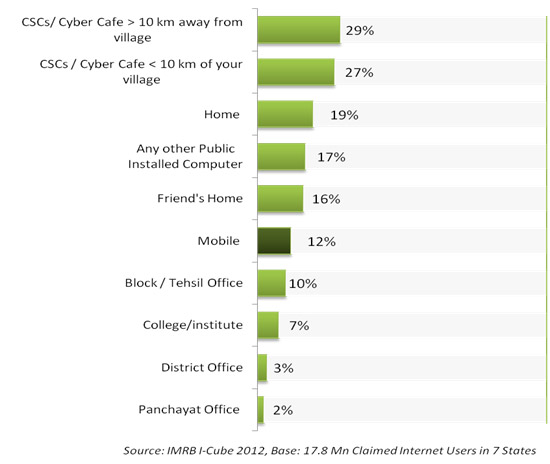
    One of the reasons for the increase in rural internet usage is probably because of the availability of cyber cafes and community service centres. Interestingly, majority of internet users in rural India (i.e. 57 per cent) have access to internet via cyber cafes and community service centres, only 19 per cent are said to have internet access at home and 12 per cent of the internet users access internet through their mobile phones.


    Purpose of Internet Access:

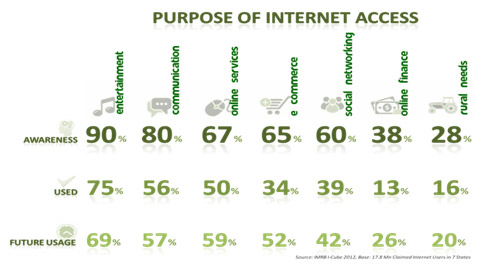
    Entertainment is the primary driver of internet use in rural India. 75 percent of rural users use internet for entertainment while 56 percent use it for communications Users like to access Music, Videos and Photos for entertainment.


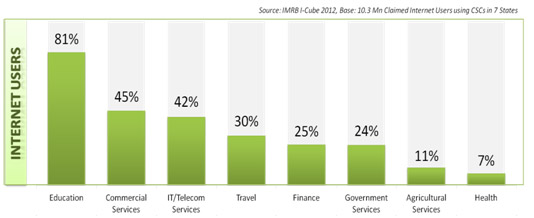
    There is a growing interest amongst the rural constituents seeking information on education. 81 percent of claimed internet users seek information pertaining to school / university and exam centres.


    Primary research is said to have been conducted in line with ‘I-Cube’ reports, an annual syndication of eTechnology Group, IMRB International. The syndicated research is based upon a primary research survey that interviewed about 15000 people from various age groups, across SECs and genders from the states of Assam, Maharashtra, Orissa, Tamil Nadu, Andhra Pradesh, Rajasthan and Uttar Pradesh.


    The Internet and Mobile Association of India (IAMAI) is an association which is said to be representing the entire gamut of digital businesses in India. It was established in 2004 by the leading online publishers. IAMAI is also said to be the only professional industry body representing the online and mobile VAS industry in India.


  • Bengal (paper) tigers set to roar


    By Ananya Saha


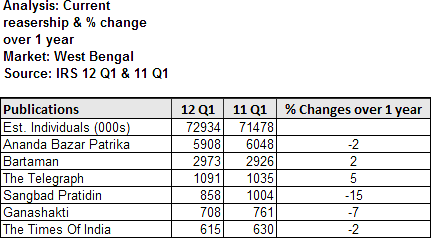
    Once the domain of Ananda Bazaar Patrika,West Bengal is now readying itself for an emerging newspaper war. The Times of India has trumpeted its entry into the traditional market with the announcement of its Bengali broadsheet Eyi Shomoy, and is putting its marketing muscle behind the promotion of the product. The Bengali broadsheet from BCCL will have to fight for numbers with Bartaman, Pratidin, Ganashakti and of course Ananda Bazaar Patrika.


    This is also for the first time that ABP’s dominance is facing a huge challenge. Whether as a gameplan or a coincidence, ABP has announced its evening tabloid Eyi Bela at the same time. The industry veterans are calling it mother of print battles: BCCL’s strong marketing and distribution against ABP’s loyalists. ABP currently dominates the print market with many of its publications aimed at each segment: Ananda Bazaar Patrika (Bengali daily), The Telegraph (English daily), Desh (Bengali magazine), Anandamela (Bengali children’s magazine), Anandalok (Bengali cinema magazine), Sananda (Bengali women’s magazine) and Sportsworld (English sports magazine).


    While some may argue that ABP is entrenched in this polarised Bengali market, others say that TOI will be able to make a definite dent in the market. Call it retaliation or just a good act, but ABP is said to be lowering rates, and increasing the pages of the newspaper. This is something that the Bengali newspaper has not ever done to counter any of the other newspapers’ entry. Meanwhile, it remains to be seen if TOI’s youthfulness will reflect on its Bengali broadsheet as it takes ABP on home turf.


    So far, the Bengali print market has been without any incident, and nobody has been able to impact it. A media veteran said that TOI will not have it easy. Why? “The Kolkata market is biased and opinionated. With its regional paper, TOI will not be able to address the local Bengali readers… It may do well in a Delhi or Mumbai where people do not have the time to read opinions.”


    ABP, moreover, has emerged as a clear (and consistent) leader in the market. It is true that when the English daily Times of India entered, ABP’s Telegraph did feel the jolt. Currently, in the market of 15-16 lakh readers, APB’s readership is close to 12-13 lakh, according to an analyst who has been observing the market keenly. But media specialists are sure that the TOI Bengali edition will pick up well when it launches, and managing two lakh copies initially will not be difficult for Eyi Shomoy. However, a media veteran noted that even with its marketing muscle, TOI’s Eyi Shomoy may find it tough to get the numbers until it  addresses the Bengali janata the way ABP’s Bengali daily does or is capable of.


    Currently, 70-80 percent of newspaper revenues are lapped up by ABP of the Rs 250 crore (rupee/advertisement) Bengali print market. The share of revenue by ABP is much more than readership, noted the media analyst. The idea of ABP’s launch of Bengali tabloid Eyi Bela is probably to target the lower-end advertisers in various districts and smaller cities. This may well become the golden opportunity of revenue for the paper, since it could attract a bulk of advertisers who are not able to advertise in high-priced media vehicles.


    Also, Eyi Bela is aiming to attract the growing youth population of the city. Industry analysts are divided given that the commuting culture in the city is different from Mumbai’s. “The evening segment dynamism is missing in this market,” noted an analyst.


    However, Sundeep Nagpal, Director, Stratagem Media, differs. He said, “I am actually surprised that no one launched an evening tabloid earlier in this market. Wherever there is a commuting culture, the tabloid can succeed. However, in this case, it is going to be the case of high distribution since an eveninger’s content cannot guarantee readership.”


    Even as the politically aligned market is going to see new entrant, the dynamics within the market is also undergoing a change: the rise of double-income couples, the need of smaller retailers to reach out to the aspirational class, evolving youth and rising city phenomenon. The evening tabloid may cater well to this segment.


    Media veteran Sajal Mukherjee shared his observation, “The West Bengal market is one of the oldest traditional markets inIndia. One might argue that the Bengali community is loyal to ABP but it is also true that readers want value for money. And loyalties shift depending on the value they get. In the Karnataka market, Prajavani had a stronghold where Vijay Karnataka challenged it and succeeded. Similarly, Divya Bhaskar was able to make a clear dent in the Gujarat market, which was led by Gujarat Samachar and Sandesh.”


    “If there is good marketing support in the new market, combined with good benefits to the readers, the loyalty will obviously be dislodged. TOI has had enough experience in the local markets, and it will be a good war to watch in Bengal,” Mr Mukherjee noted.


    What may also act in favour of TOI is that they will be able to offer a 360-degree national bouquet on good rate to advertisers. Mr Mukherjee opined that Eyi Shomoy has huge scope to gain the second spot in the market. TOI is already making itself familiar to the local audience by sponsoring ground events. This might work in the favour of the new broadsheet since people will be ready to subscribe to it. TOI is clearly aiming at growth for the future, and is not looking at short-term benefits. The industry veterans note that after Eyi Shomoy hits the 3-4-lakh mark, it might get troublesome for ABP.


    But ABP will not let go of its domain so easily. Will it result in a new strategy? Can Eyi Bela actually make a new market in Bengal? And will Eyi Shomoy’s challenge to ABP be tackled more forcefully? Advertisers and analysts might differ, but it is readers who are bound to get the sweetest deal.


  • Radio Mirchi appoints Starcom as media partner

    By A Correspondent


    Starcom Worldwide has bagged the media mandate of leading radio network Radio Mirchi. The account will be handled from Starcom’s Mumbai office. It was previously with Madison. The agency is reported to started work on the new business.


    The win adds to a series of new business wins at Starcom MediaVest Group (SMG) since the middle of last year, among which are Aircel, Dabur, Axis Bank, Zee Learning, Supermax, Sterling Holidays etc. SMG has also been aggressively strengthening their media product in India. The agency recently launched its proprietary Web+TV optimiser, billed as the first of its kind in the market.


    Confirming the news, G G Jayanta, National Head of Marketing, Radio Mirchi said: “we are pleased to appoint Starcom since we needed a partner who is future focussed and can help us navigate the new media landscape. Their in-house research and tools are very impressive and their media product and philosophy are pretty solid. We look forward to a long and rewarding association with Team Starcom”.


    Commenting on the win, Malli CR, CEO of SMG India said: “We are thrilled to win the Radio Mirchi account. Given the developments in this sector, we look forward to exciting times. We have planned some specific research and insights projects using our proprietary tools and optimisers”.


  • Milk brand Gopaljee rebranded Gopaljee Ananda

    By A Correspondent


    Popular dairy brand Gopaljee undertaken a rebranding exercise calling itself ‘Gopaljee Ananda’. The company has unveiled its new logo with new tagline ‘Joy of fresh Milk’. The company has invested Rs 3.5 crore in the rebranding exercise which includes dealer meets, BTL activities like vehicles Branding (both company owned and distributor owned ), shop boards at retailers end , wall painting , hoardings ; metro branding , ATL activities like newspaper ad / regional tv advertising / radio activity and entire merchandising activity.


    According to Mr. R.S. Dixit; CMD – Gopaljee Ananda, “As we expand and innovate our products, we believe our customers will be supportive of our choice to do the right thing. What matters most is that the experience will be exactly the same, only our name will be different.”


    The packaging need was designed to create such a differentiation that people could identify the packs instantly and uniformity across all the packs could be created and maintained.


    Aqua Communication is the creative agency which has designed the new logo and entire branding of Gopaljee.


  • Colors launches Jhalak Dikhhla Jaa online game

    By A Correspondent


    General entertainment channel Colors announced the launch of a first-of-its kind online game allowing viewers to be a part of the popular dance reality show, Jhalak Dikhhla Jaa. Exploring digital avenues to enhance the popularity of the show, the initiative allows fans to partake in the Jhalak Dikhhla Jaa experience online. Designed by BBC Worldwide Productions India, the game takes fans on a whirlwind ride while allowing them to learn and experience different dance forms that makes the show a hit among audiences.


    Commenting on the launch of the game, Vivek Srivastav, Digital Head – COLORS said, “With the Jhalak Dikhhla Jaa game, we aim to connect with our strong online fan base which elevates the show to a higher mass platform. The more virtual formats we explore, the more it enables us to tap newer audiences across the world.”


    Elaborating about extending the Jhalak Dikhhla Jaa experience across digital platforms, Myleeta Aga, General Manager & Creative Head – BBC Worldwide Productions India, said, “We are very excited to explore newer avenues in the digital media space and bringing the television experience of Jhalak Dikhhla Jaa to the virtual world. We believe that with the launch of this game, the overall experience will create an addiction among the Jhalak Dikhhla Jaa fans and dance lovers.”  The game can be accessed at http://colors.in.com/in/jhalak-dikhhla-jaa.


  • Sujoy Ghosh quits BCCL as Joy Chakraborthy returns

    Joy Chakraborthy

    By A Correspondent [updated from Friday]


    It’s now official. Bennett, Coleman and Co Ltd’s long-serving Director-Response Sujoy Ghosh has decided to move on as Joy Chakraborthy is set to take the position. Mr Chakraborthy will report to Arunabh Das Sharma, President, BCCL. A mail is said to have been circulated to senior employees on Friday evening.


    Mr Ghosh was not reachable for comment, but is rumoured to be keen on pursuing entrepreneurial interests. Mr Chakraborthy is scheduled to join today (Monday, September 3). This will be his second stint with BCCL.


    Meanwhile, there have been rumours that Dr Bhaskar Das, President and Principal Secretary to the MD at BCCL was also not planning to pursue his service extension following his retirement. Dr Das has denied this to MxMIndia.


  • i next launches Indore edition

    By A Correspondent


    Adding yet another city to its kitty, i next is launching its 14th edition (13th being inextlive.com) in the ‘sweet’ city of Indore on 2nd September. This edition allows the leading compact daily from Jagran group, which already has big presence in four states (UP, Uttarakhand, Bihar and Jharkhand), to spread its wings across Madhya Pradesh, a key Hindi speaking territory. To the readers, i next Indore edition would reach in combo with Nai Duniya, which is already an established name in newspaper industry in MP.


    Set to complement Nai Duniya, i next as a relatively new and youthful daily offers a right balance to the mix; the former being a part of Indore’s famous journalistic traditions and its socio-cultural journey for more than six decades now.  The development is likely to slake the rich and diversified tastes of Indorians.


    Commenting on the launch, Shri Mahendra Mohan Gupta, CMD Jagran group held, “In the past six years, i next has moved from strength to strength. Its presence will also consolidate the already strong position of Nai Dunia.”


    Recently in news for winning World Young Reader ‘Newspaper of the Year, 2012’ award at WAN-IFRA summit, i next eyes for market expansion through an aggressive integrated campaign completing the loop between the readers, advertisers and the agencies. The development is set to alter the industry equations. Revealing the strategy behind the move, Salil Tandon, VP marketing, Nai Duniya said, “Indore is an education hub and a well read city. There is a huge variety in tastes and preferences of the readers here. We would try to leverage on this by giving our readers the combined advantage of a regular newspaper and an exciting compact daily.”


    He further emphasized the relevance of a tabloid like i next in the young city like Indore. “There are a lot of well off and progressive youngsters out here which have always been a core Target Group for i next. With its unique style of presentation and storytelling, I am sure, i next would be able to win their hearts.”


    Shailesh Gupta, Director, Marketing, JPL provided a perspective, “Indore is a very active market. A vibrant mix of traditional and modern attributes; be it entertainment, fashion, food, education or real estate. The infrastructure development has triggered a spate of growth in almost every industry here. From marketing point of view, Indore presents a huge retail market to benefit from.”


    The launch is being actively promoted through the campaign ‘Indore is my next’, supported by outdoor, radio, digital promotions, print Ads, banners and road shows. The targeted communication is being undertaken to introduce i next to the young audience of Indore.


  • We need an Indian voice in our ads: Ram Madhvani


    By Anil Thakraney


    I did a few ad films with Ram Madhvani nearly 18 years ago. Both of us were very young at the time, quite fresh into the ad business. But there was one difference: While I was floundering around, trying to find my way, Ram was already on top of his game. He was confident, committed and meticulous in his work.


    As the years rolled by, Ram has cultivated a powerful name for himself in the Indian ad world. He is, for many ad agencies, the go-to filmmaker. But it’s not been a linear journey. The director has had to keep re-inventing himself to stay relevant in a market that has seen many rapid changes. And this is the key reason behind his continuing success; Ram has thrived even as many big names in the ad filmmaking business fell by the wayside. The director’s dazzling portfolio contains many memorable commercials. Happydent (which won two Cannes Lions), LMN, Hippo, Airtel, Coke, Bisleri and Adidas, to name just a few.


    Over a long session, we discuss his craft, his sensibility and his views on advertising and filmmaking. This is not an interview; it is a solid training session for all those associated with the ad world. Not just on filmmaking… on life itself.


    Director Ram’s Mantra
    1. The director’s job is to have a vision, and then to pass it on to the team. To the art department, the camera department, the actors, etc2. Intellectual rigour without intellectual rigour mortis.3. Have an opinion and not a judgment.4. Don’t organize shoots, host them.

    5. Meditate daily to connect with your own self.

    6. Try to see how cinema or advertising can be the vehicle to self knowledge.

    7. Have a conscience. Can you face yourself, look yourself in the eye, on the work you do?

    8. ‘If you don’t know where you are going, all roads will take you there.’ (From the Wizard of Oz.)

    Q: How did a nice Gujju boy become an ad filmmaker? Didn’t want to pursue the family business?

    I was very clear from the age of 16 that I wanted to be a filmmaker. Actually, there’s an interesting story. My school friend tells me it happened because of the smell of burning film. We used to watch all kinds of movies when I was at school in Panchgani, this used to be on Saturdays in the assembly hall. There was this old projector, and the film would tear and burn. Maybe that’s how it started! Films, of course, happened much later, after college and theatre. My father expired early, and I had to earn a living. I sold carpets, I sold diamonds, I sold milk, in fact, I even worked as a peon for a while. (Laughs.) But in the evenings I would either do theatre or catch up with international cinema. Later on I did a course at NYU, when I worked for a while with my elder brother who was in America. I came back and joined Equinox. And two years later, Sumantra (Ghosal) offered me a partnership.


    Q: But why ad films?

    Because the family felt that rather than getting into the big bad world of feature films, it’s better to get into the big ad world.


    Q: Which was your first ad film as director?

    Baygon Spray – ‘No entry for pests’. I still have a copy of the cheque with me. (Smiles.)


    Q: Is Sumantra still active? Or are you the sole owner of Equinox?

    No, he’s retired, I am now the sole owner. Sumantra is of course the Chairman and he’s on the board of directors. He’s my guru; I consult him on many things. He is more than an elder brother… in fact, Sumantra gave away my wife.

     

    “I have to re-invent, I have to be on top of the game. I would hate it if people said, ‘Ram used to make great films at one time’”

    Q: It’s been over two decades. What keeps you going?

    Fear. That I will become a has-been. I have to re-invent, I have to be on top of the game. I would hate it if people said, ‘Ram used to make great films at one time’.


    Q: Which ad film turned things around for you? You did a number of mediocre ads when you started out, and I recall I was one of those guilty of palming off rubbish storyboards onto you.

    (Laughs.) You know, sometimes you take on work in order to convert it. In the hope that because people saw the hard work you put in the film, tomorrow you will be considered for a better film. At the same time, when you are doing that work, you do think it will be of some import.


    Q: I always thought you made such films only for money.

    To be honest, I haven’t been a profitable director for this company till as recently as a few years ago. I would not be living today in a 2BHK house in Prabhadevi if I had made lots of money. In fact, if I had made a lot of money, perhaps I wouldn’t be in the game today. People know if you are out there to do your work, or to make money. Also, very often a friend calls up and says, ‘This is how much I have, will you do it?’ There is no option but to say yes, and then try and figure how to make it work. Because if I say no, they’ll go to the next person and forget me! (Laughs.) I was reading somewhere that the Sistine Chapel was the world’s biggest hoarding for Christianity. Who commissioned Michelangelo? The Pope did it. And when you look at it, it was meant to advertise a certain thing. So if Michelangelo can be commissioned, why can’t I be? (Laughs.)


    “From last year I have started doing theatre workshops for every film, I bring all the actors together, I do familiarization and touchy-feely exercises.”

    Q: Still, which was the first film that made you proud?

    I had done a lot of good work for a long time. Tata Steel, Thums Up, Dunlop Spectrawide, etc. But I wasn’t considered an A-Lister. And I was very upset about this. I thought maybe I am not a pedigree top dog. So I went for a week to my friend’s farm in Kodaikanal, and I sat down and wrote what I needed to do to at least become a footnote in the history of advertising film producers and directors. I decided the first thing to do is to acknowledge that you are a mongrel. Two, look at what’s your voice, and what is everyone else’s voice. And having done that, see where you want to go. Then I decided I will only do films with a visual language. Because, at that time, I wasn’t too respectful of the Indian tradition of acting. Which was about ‘to show’ and not ‘to be’. A number of my friends suffered because I took their scripts and converted them into visual language films, and I screwed up a lot. But three or four films got talked about. One of them was Adidas with Sachin Tendulkar. And then for five years I followed the visual language route, and it culminated with Happydent. And then I realized that people are now expecting me to do a certain kind of work. So last year I decided to become a humanist, I re-invented again! You must have seen that with Airtel’s ‘Har Ek Friend’. My mission now is to try and get truth into acting. On how do I make the audiences believe that these actors existed before ‘Action’ and after ‘Cut’. For e.g., in the Airtel ‘Classroom’ ad, those kids in the classroom have a life before and after the ad. From last year I have started doing theatre workshops for every film, I bring all the actors together, I do familiarization and touchy-feely exercises.


    Q: Is there one aspect of filmmaking you enjoy the most?

    I don’t like shootings. I have been trying very hard to make the shooting space like my home. So I am figuring out how to do housekeeping. When I go to a studio floor, my production team has to show me a map on where things will be kept. I also do human traffic policing. When I walk from my video assist to my actor, sometimes I feel I have to wear a rugby helmet just to push people out of the way. I have a very polite person stationed at the shoot, whose job is to ensure people stand where they are supposed to stand. I think I am 25% there in terms of making it my home environment. I don’t want to organize a shoot, I want to host it.


    Q: What is the sensibility you bring to your ad films?

    What I like to be is an experimental filmmaker, one who’s precocious and is looking upon, with curious wonder, at this art and this craft. And practicing it in a non-judgmental manner. I am here to play with clay. Currently, as I told you, I like to do human work. Now when you look at a film, you won’t be able to say, ‘That’s definitely Ram.’ Right now, I don’t know what my voice is, but I know what I have lost. I think I have lost a bit of the experimental nature, I have become too popular. (Laughs.) I actually want the surprise factor. I want people to say, “Haila, he did that?”


    Q: You made the Tata Docomo ‘maid’ film, where the bai was seen stealing a mobile phone. It was criticized for promoting a stereotype. Regret the film?

    No, I don’t. These things shouldn’t be taken so seriously, there was no such intention. It was not a judgment on all maids, it was about this one character in the film. It did not even occur to any of in the team that we are stereotyping someone. But I must tell you I don’t do fairness creams. There no logical reason for this, it’s just a stupid hang-up. I don’t want to tell people that if you are white, you will become this or that.


    Q: How do you keep yourself refreshed and relevant in the changing milieu?

    I have the greatest collection of books on films. I have also been a voracious reader. But in the last few years, I have stopped reading. Every book I read entertained and enriched me in that moment, but it hasn’t enriched me in the long term. Apart from a few books, like the Bhagwad Gita and Patanjali’s Yoga Sutras. And these are the kind of books I am now reading. I have become very sceptical about Western philosophy, because the epitome of that philosophy is: ‘I think therefore I am’. The epitome of Eastern philosophy is: ‘Don’t think’. The whole purpose of life is to find peace rather than the buzz in our heads. Western society wants us to have more buzz. Eastern philosophy told us 5,000 years ago that the mind is not where you reside, you reside in your heart. The greatest distance I have traveled in the last twenty years is between the mind and the heart. From the intellectual side, I have moved to the emotional side.


    Q: Do awards meaning anything to you?

    Yes, they do. Because I am living in a world where they do, people do judge you for that. I have won two Cannes awards, and it has helped. At the same time, I have no creative envy, and that’s happened because of Sumantra. There was an indoctrination of creative generosity that happened at a young age. Whenever I see a great ad film done by anybody, I send out a congratulatory SMS. And that generosity gives me greater joy that what envy would have given me.


    Q: Creative directors you most enjoy working with.

    Prasoon Joshi. He’s got a poet’s mind, and he’s also a true intellectual. And Aggie (Agnello Dias). He’s very rooted. I would also include Raj Kurup and Ravi Deshpande.

     

    “I am finding that nobody in Indian advertising is doing pure emotional work. Kal Bhi Aaj Bhi Kal Bhi and Hamara Bajaj had soul, they made you cry, and that is something we have lost.”

    Q: Is there something that disappoints you about ad agencies in India?

    I think we need more of the Indian voice in the ads. Right now what’s happening is the universal joke. If there is one nation that can teach the world about heart and emotion, it’s us. The reason Bollywood works is because they are purely in the emotional territory. I am finding that nobody in Indian advertising is doing pure emotional work. Make me cry, I am sick and tired of being made to laugh. Thailand has a voice, so do South America and England. Kal Bhi Aaj Bhi Kal Bhi and Hamara Bajaj had soul, they made you cry, and that is something we have lost.


    Q: Anything else?

    There is too much internecine warfare amongst the ad agencies. Everybody is out to get each other. I don’t know why that is, it’s perhaps the very nature of competition. Maybe it was different when Mr Subhas Ghosal and Mr Gerson Da Cunha were around, maybe there was a certain camaraderie then. Also, there isn’t enough of passing on of knowledge. So if I want to learn, there is no trade journal. A lot of it is I-Me-Myself.


    “There is too much internecine warfare amongst the ad agencies. Everybody is out to get each other.”

    Q: I watched your feature film, Let’s Talk. It was very well received and yet you didn’t make another film.

    I was supposed to direct a big budget film with Vidhu Vinod Chopra producing it. It was a fantasy film called Talisman. But I wasn’t happy with the script. I have been approached by many people, but I think they are approaching me for my craft. And I believe cinema should have something to say. Now, the things I want to say, I am not getting the money to say them. And what they want me to say, I don’t feel like saying it. Right now I am in a situation where the universe has not conspired and grace has not descended. (Laughs.)


    Q: Which genre of cinema excites you?

    Three of them. Love and infidelity. Food. And spirituality.


    Q: Er, why does infidelity excite? Worried about it?

    As a warning! (Laughs loudly.) In this business, you do get close to people. And you have to tell yourself, ‘Hey, hang on!’. I am extremely happily married for 24 years, and I have no such desires. But I get completely amazed with other people when they go through it, because it’s so much heartache and suffering. Why don’t they just do their work yaar? (Laughs.)


     

  • Centuryply looks at growth from unorganized sector

    By Tuhina Anand


    Centuryply has gone aggressive to get a larger share in the branded plywood and related business. In fact, recently we have seen a spurt in the activity by the players in the segment and this has to do with the fact that the branded players are eyeing the unorganized sector.


    Abhra Banerjee

    Explaining this fact, Abhra Banerjee, Executive Business Head, Centuryply, said, “Our industry is under transition as there is higher knowledge about the category among the consumers. This could be attributed to the digital and social media which has led to consumers finding more about products before making a purchase decision. This had led to a move where the branded category is growing and the players are looking at growth as the unorganized sector here is shrinking. So, as we are all fighting for a share of the unorganized sector, one sees more activity from branded players like Centuryply.”


    Further Mr Banerjee explained that Centuryply in its bid to get a greater share and also revamp its brand perception has entered the readymade home furniture business with its retail store Nesta. Putting things in perspective he said, “Four years ago when we did a survey post our campaign, we realized that while people saw Centuryply as a trustworthy market leader with superior quality products, there was also a perception that the brand was lacking youthful appeal and was not modern and contemporary.”


    The company then took measured steps to revamp its perception, among other things becoming more aggressive, and one way was to get into readymade lifestyle products. The furniture business emerged as a natural brand extension, thus also creating something that is lifestyle oriented and aspirational. This was one way to grab a contemporary avatar for the brand Centuryply.


    There was also a shift in its media strategy and the company got into branded entertainment and partnered with big budget movies. It also partnered with designers from National Institute of Design to make kids range of furniture and leading Indian architects for contemporary product designs. The effort yielded result and Centuryply as another study revealed was being perceived as a trendy brand.


    In fact all these efforts have led Centuryply to have a CAGR of 28 percent for the last five years. While it has been impacted with the slowdown as other fields like real estate have been hit but Centuryply is still clocking double digits growth albeit a bit slower than previous years’ growth numbers.


    It has recently launched its new campaign with the tagline ‘Sab Sahe Mast Rahe’. The campaign was preceded with a high decibel teaser. The new campaign highlights the brand’s strengths as a modern, contemporary, youthful and a trustworthy market leader while highlighting Centuryply’s patented technology which makes it 100 percent borer- and termite-proof and gives it the strength to withstand all abuse.


    The new campaign of Centuryply aims at redefining the brand image and increasing consumer involvement with the plywood category through Bates’s proprietary ‘Changengage’ tool. The campaign is targeted at upwardly mobile urban male in the age group of 35-45 years who is a homeowner and digital savvy.


    Bates Kolkata has ideated and conceptualised the campaign titled “Sab Sahe Mast Rahe Part 2”. The campaign is based on a basic human insight. When people get angry, they lose control over themselves behave like a monster, and unleash their anger on objects around. Mostly, it’s doors, windows, wardrobes, tables and other pieces of wooden furniture that bear the brunt. The furniture stands in silent testimony to this human emotion, takes all the battering in its’ stride and gives peace and tranquility in return. The campaign kicked off with a high decibel teaser campaign across different media platforms and the TVC was launched on World Anger Day to leverage the communication relevance.


    Besides TV, Centuryply has drawn a multi-media campaign plan to reach its TG by using effective media vehicles like OOH, Radio, Multiplex & Digital platforms. The campaign will go on till March 2013. To ensure consumer engagement, some interesting BTL activities like multiplex, mall and trade activations have been planned. The TVC has been shot in Poland by Vinod P Vijay of Lemon Yellow Sun Films.


  • Divya Marathi now a case study at IIM Bangalore

    By A Correspondent


    The fast paced growth and unique new market launch strategy of Dainik Bhaskar Group, an Orbit-shifting innovative process featured as a case in IIM Ahmedabad, and the successful launch of Divya Marathi, the group’s Marathi newspaper, this time has attracted IIM Bangalore to study and create a classroom case on group’s success through the years.


    Seema Gupta

    Prof. Seema Gupta of IIM Bangalore did a detailed analysis of Dainik Bhaskar group processes in her attempt to understand what makes this group succeed. She met with the senior management across verticals; Editorial, Production, circulation and marketing to deep dive into their independent and cross-functional working. Result; ‘Dainik Bhaskar group: Aspiring Growth’ a case study by IIM Bangalore.


    The case delves into the history of the group, the aggressive launch strategy, accelerated business growth and robust marketing plan. It strongly points out that launching of a newspaper and venturing into a monopolistic market space is definitely a decision that is governed by the faith in the brand. Considering the nature of the category, where reading habits are relatively strong and the market leaders create high entry barriers including the competition-intensive cut-throat ground zero strategies, it makes for an interesting study in management strategies, processes and execution. Success in such situations cannot just be attributed to the business acumen, understanding of market dynamics and identification of the need-gap within the market. There are other elements like agility, empowerment, passion and high ambition across the employee set that is a real differentiator and helps convert strategies into reality.


    Elaborating on selecting Dainik Bhaskar Group for the case, Prof. Seema Gupta said, ‘Dainik Bhaskar with its ambitious growth plans exemplifies gutsy business strategy and marketing. It changed the contours of the marketplace by entering into markets with strong and entrenched incumbents. This task was even more arduous considering the nature of the category as it is difficult to change the habit of readers. Newspapers touch the life of every consumer and hence the case would drive strong emotional connect and animated discussion in the classroom. The focus of the company on tier II towns makes it an apt material for case study as small towns would be the drivers of future growth of Indian economy.’


    The case in detail traces the sustained leadership strategy adapted by Dainik Bhaskar Group over the years. It places importance on the way the group evaluates and  identifies the gap between supply and demand. And the process of creation of a product that truly answers the overt and latent needs in the ever evolving market. It identifies that the core business philosophy of the group remains a singular focus on close in-depth understanding of the consumers’ pulse and being consumer-centric in its product creation.


    Girish Agarwaal

    Speaking about this development, Girish Agarwaal, Director, Dainik Bhaskar Group said, “It is always a moment of pride when an institute of repute like ‘Indian institute of Management Bangalore’ seeks to study the organisation and creates a case study. We do believe that in the process of the case creation and discussion, the group also benefits in getting some raw, unbiased and unfiltered views. We attended the first classroom sessions held on July 20 at IIM-B, where second year students discussed the case. It has been a healthy experience and we respect the level of analysis that the students presented in their understanding of the challenges faced by the group.”