Category: NEWS

  • The Half-Year That Was-III

    By Team MxM


    Presenting the concluding part of our feature asking some business leaders to review how the January to June 2012 period was for the industry as a whole and/or their specific sectors and organizations.


    Read the earlier parts at: Part 1 Part 2



    Mohit Joshi

    Mohit Joshi, MD, MPG

    There has been a marginal growth (under 5 per cent) in adex in Jan-June 2012, as when compared to the same period in 2011. Some sectors that have been slightly depressed are auto and cellular phone service while sectors that have gone up are education/ institutes, jewellery and insurance.


    Jaideep Shergill, CEO, Hanmer MSL

    Jaideep Shergill

    I would say the PR space is growing but it has not been a year where there have been some big pitches that one would expect. That was what 2010-11 was all about. Although there has been some business, it has been more of an organic one. One of the factors that led to the sluggish growth is the economic scenario which has been going through a hard phase recently. But I would want to think of it as otherwise – when there is a general lack of trust in the market, I think that is where PR has a larger role to play. But that is not what usually happens. For our group too, it has been a good year but it could have been better.

    As the market conditions get more complicated, clients are looking at other streams to expand their business. And that’s where social media is playing a huge role. Our social media unit itself has been seeing some tremendous traction and we have hired more people in the unit. So the medium will continue to see some good growth. But the other thing about social media is that it is evolving continuously – what was happening a year ago and what is happening now is completely different. The medium has been evolving at a good pace.

     

    Pankaj Raj

    Pankaj Raj, Director, Search Value Consultants Pvt Ltd

    I would summarize hiring as still being slow and sluggish in this space. There are 2-3 observations that I would like to bring across. The first is that most organisations today are in ‘sensible hiring’ mode. This is really about replacement, immediate benefit kind of hiring. The second trend that I am seeing is that there is a huge sense on cost consciousness, whose effects are seen in the hiring space as well. The third trend that I am seeing is that increments haven’t been really good. So there is a level of concern amongst employees in the M&E sector. But having said that, some organisations are still hiring and not in standstill mode.


    As for the next six months, it’s a function of revenues – on how the September quarter turns out for the advertisers. Also, the December quarter is a peak season from an advertiser point of view; a lot of advertisers are active during this period. But to predict growth for the March quarter next year is a bit difficult. We will have to wait and watch how the growth pans out till then.

     

    Abha Kapoor

    Abha Kapoor, Executive Director, K&J Consultants

    The Media and Entertainment sector is not an island. This space is as affected as any other by the global and national environment. What’s going on in the rest of the world, and in our own country – the economic indices, inflation, governance or the lack of it, have a universal effect on all sectors, not just Media. So if the indices and sentiment are looking southward, then we are as affected by it as any other sector. You have to consider the macro perspective as also the ones specific to us to probably understand the lull in the hiring market.


    There is likely to be a spike from September-October onwards, during the festival period. That’s when you see brands spending more. Therefore, there is likely to be a more optimistic/feel good factor and an expansion (need-based) in hiring. But it is not likely to be at the rate and scale that we have seen in the past.


    In our case at K&J – we are used to working on three start-ups simultaneously like television, radio and digital – which used to be the case a couple of years ago, but no more! So the pace has definitely slowed down. Digital is the new kid on the block, so there is a lot of activity happening in that vertical.



    K Jayaraman

    K Jayaraman, MD and CEO of Hathway Cable and Datacom Limited

    The industry is been focused on digitization, as its on the anvil and the Indian broadcasting space is in the process of witnessing the dawn of a new digital era with its implementation proposed by the Government of India. With this, the government has paved the way for transition to a Digital Addressable Cable TV system (DAS).


    For the average Indian family, the TV is the primary source of news, entertainment and education. The liberalization of the Indian economy starting 1991 has led to what it termed as an explosion of channels catering to different genres. Today we have more than 550 channels broadcasting leaving out the count of local channels specific to regions.


    As per The Cable Television Networks (Regulation) Amendment Bill, 2011, the cable TV industry is required to migrate all subscribers from analog signals to digital. The overall objective of the industry has been to expose every television viewer to an experience which will invariably give consumers the opportunity to resolve some of the issues they have faced with analog cable systems.


    At Hathway our aim has always been to providing consumers with enhanced viewing experience.

     

    Sanjay Dua

    Sanjay Dua, CEO, Network18 News Media

    This year has been a mixed bag for the industry quite frankly. On the advertising front, the decline in economic sentiment has created a challenging environment, especially for some genres. So, while growth continues to exist, its pace has been muted and variable. However, given the positive move towards digitization, a possible revival in outlook and the impetus of festival spending, the second half holds a lot more promise for broadcasters. We are cautiously optimistic about the scenario going forward.



    Rahul Razdan

    Rahul Razdan, President – ibibo Games & Mobile

    The gaming industry in India witnessed a concerted shift towards mobile gaming on the iOS and Android platforms. Games are now ubiquitous across platforms.


    Games exploiting the touch and tilt features of smartphones were very well received. Our game – Can You Draw, which we’d made for our web platform two years back – became one of the top games on the Android platform within weeks of being launched there.


    While the first phase of web social games plateaued out, live multiplayer games maintained their growth and continue to be the top games on our platform.

     

    Dr. Subho Ray

    Dr Subho Ray, President – Internet & Mobile Association of India (IAMAI)

    I would say that the year began with a bang. Between January and April there were serious hopes that that this would be a bumper year for the industry. However, in the last two months, there have been some caution and apprehension. The very positive performance was the result of key factors like secular growth of traffic both in urban and rural areas, investments coming in on time and some friendly regulatory announcements like removal of service tax on digital advertisement. The more recent sentiment of caution is led by primarily European crisis. However, so far it is only a caution and alert stage.



    Jogi George

    Jogi George, CEO, Percept Sport & Entertainment

    To be frank, the first half wasn’t as it was expected to be. There was business, but it was more about collections. Also, for our company, some of the major projects have been moved to the second half. Hopefully, this trend won’t continue and things will improve once the rupee stabilizes. As for the overall industry, it’s not that people aren’t  ready to spend, but they have become more cautious and selective as some of the sectors are experiencing a gloomy outlook. Hence, there is a wait and watch attitude.



    Hemal Thakkar

    Hemal Thakkar, producer, Playtime Creation

    It’s been a mixed year so far, a major setback was Imagine shutting down and a big welcome was Life Ok. Lot of new format shows have been launched this year – the biggest being Satyamev Jayate. Inflation has put lot of pressure on the industry, and with rising cost of programmes, we have to put together a skilled team to manage our shows within budgets. In future, rising expenses are going to be major burden for the industry. Playtime Creations has had good start with Ruk Jana Nahi and as a company, we feel that this show has given us the opportunity to experiment with new content. There are couple of other projects in the pipeline which we are excited about. The best aspect of our industry is it keeps us on our toes and so we expand rediscover and reinvent and keep breathing.
     

  • Vijayavani launches 9th edition in 3 months

    From the MxM Infodesk


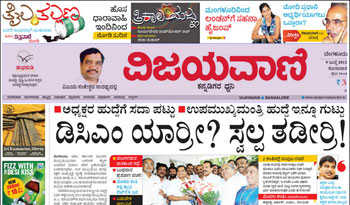
    Vijayavani launched its ninth edition in Karnataka from Gulbarga on June 30. The Kannada daily started with only three editions when it launched on April 1 this year. It now has editions from Bengaluru, Mangalore, Hubli, Bijapur,Mysore, Gangavathi, Chithradurga, Shimoga and Gulbarga.


    Vijayavani was launched by Anand Sankeshwar, a leading businessman in the logistics space and a former newspaper baron. Mr Sankeshwar’s logistics company, VRL Logistics Ltd, has a fleet of commercial vehicles in the private sector. The company operates from 1,000 branches and franchisees across the country.


    In the last 3 months, Vijayavani is said to have averaged more than am innovation every week. An average main issue of 16 pages comprises four pages on local/ hyperlocal issues, two pages each on national, state and sports, one calendar page on entertainment/events, one page on serials/stories and  one page on commerce/business.


    In addition, Vijayavani carries  four page-supplements on various subjects – Vittavani (Commerce), Lalitha (Women), Masth (Youth), Samskruti (Culture), Cinivani (Cinema), Putani (Children), and VijayaVihara (Sundays). The paper is the only daily in Karnataka with all colour pages across all its editions.


  • Metro Tyres unveils new visual identity

    By A Correspondent


    Metro Tyres Limited unveiled a new logo along with a new advertisement campaign. The new identity is designed to profile Metro as a company that understands youth aspirations and reaches out to young people, India’s dominant demographic segment, with cutting-edge products.


    “Metro Tyres has evolved significantly over the years with a view to stay ahead of the dramatic changes in the Indian business sector. Today, our company is present in more than 53 countries and is the largest exporter of bicycle tyres and tubes from India,” said Rummy Chhabra, Managing Director, Metro Tyres Limited. “Our new visual identity consists of a re-designed Metro name, appearing in italics to represent motion and speed. Complementing the logo, our advertisement campaign is a story of transformation: from a child to a youth. In doing so, it reflects who we are today and the company we aim to be tomorrow.”


    Metro has an exclusive tie up in two wheeler tyres with Continental, Germany, one of the world’s largest tyre companies. The link with Continental provides Metro with distinct advantages: access to the latest technology in the field and exports to the most advanced economies of the world including USA, Canada and the European Union under Continental brand.


    With a market share of 24 per cent in India, Metro Tyres manufactures close to 30 million tyres and 30 million tubes annually in its seven state-of-the-art plants inNorth India. It is the supplier to Honda Motorcycle and Scooter India, Bajaj Auto, Piaggio, Suzuki, Hero Cycles, TI Cycles, Atlas Cycles, Avon Cycles, among others.

  • Maa network goes aggro on OOH

    By A Correspondent


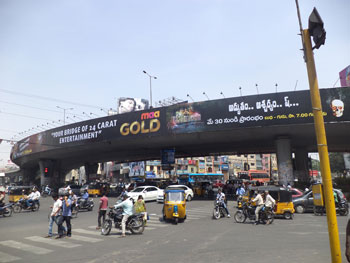
    To target all the sections of Telugu viewing population in Andhra Pradesh, Maa TV has gone out on the streets to promote their programs using the outdoor medium. The channels have been heavily promoted using flyover bridges, unipoles, centre medians and other offside promotions include train & bus branding too. The total outdoor units used are 200 Hoardings, 200+ Centre Medians across Andhra Pradesh.


    The highlight of the campaign was the selection of specific locations to place the outdoor creatives that have additional cut out of characters in heavy traffic areas.


    The channel was promoting their upcoming annual awards function, Cinema Awards 2012 heavily and also 2-month long programs that are running on Maa Gold.


    Maa Television Network has promoted all their programs in major parts of the state -Hyderabad, Vishakhapatnam,Vijayawada, Tirupathi and other few towns. It will be top among the GECs in Andhra Pradesh promoting the programs in a huge scale.


  • MIB amends law, asks cable trade to furnish correct DAS info or face cancellation/ suspension

    From the MxM Infodesk


    Although the news was flashed by the wires last week, it got official only on Saturday. The Ministry of Information and Broadcasting has decided to amend the Cable Television Network Rule, 1995 (Cable Rules) making it obligatory for every Multi-system Operator (MSO) and Local Cable Operator (LCO) to provide correct and timely information to the Ministry as and when it is sought for.


    The background: The I&B ministry has been closely monitoring the preparedness of various activities for the implementation of Distributed Antenna System (DAS). The success of DAS depends on timely seeding of STBs at the consumer premises. As such, availability and deployment of set-top boxes (STBs) by MSOs / LCOs are paramount important for the implementation of DAS. Timely availability of accurate data with regard to the seeding of STBs by service providers (MSOs/LCOs) is also critical for the Ministry to ensure digital switch over within the timeframe as well as for taking mid-course corrections if necessary. While assessing the preparedness of DAS in four metros, the Ministry has come across numerous inconsistencies of data provided by the service providers, particularly MSOs, in regard to inventory position of STB and its deployment.


    In the Cable Television Network Rule, 1995(Second Amendment) Rule, 2012, a new rule, namely, rule 10A – Obligation to furnish information – has been inserted making it mandatory for MSOs and cable operators to provide information as and when it is sought for by the Central government or state government or authorized officer or any agency of the Central government. The obligation to furnish information under the amended rule 10 A has been incorporated as one of the terms and conditions of registration of cable operator under Rule 5 A and MSOs under rule 11 D.


    As per sub-section (7) of section 4 of the Cable Television Networks (Regulation) Act, 1995, the Central government may suspend or revoke the registration of cable operators or MSOs if they violate one or more of the terms and conditions of registration. Incorporation of rule 10 A as one of the terms and conditions of registration of cable operators and MSOs will empower the Central government to cancel or suspend the registration of cable operators or MSO if the information sought for by it is not provided by them. This, MIB hopes, will ensure correct and timely submission of information by cable operators and MSOs.


  • Stay solo or scale up with a biggie?


    By Tuhina Anand with inputs from Shruti Pushkarna


    Creative hotshops have always co-existed with the bigger networks and every now and then one hears of a celebrated hotshop being taken over by a network. Publicis Groupe, which already had a stake in BBH, has now taken 100 per cent stake in the agency. Considering that BBH is among the most celebrated creative boutiques, the development makes one think that the lifespan of an independent has become short and for them to scale, being part of a network has become a necessity.


    Bharat Dabholkar, who collaborated his agency Zen Advertising with Publicis Groupe in 1999, is very clear that the only way to scale up is to merge with a network. He said: “When we started, we were servicing homegrown brands; but we realized that with global brands coming in, we had a handicap in getting them on board. By being part of the network, we immediately got access to big, international brands. I think it’s a personal choice, if you are happy servicing a handful of clients, then you can remain independent; but if you have ambitions of growing your outfit, then the way ahead is to merge with a network.”


    Also read:

    Anil Thakraney: BBH must remain the black sheep

    “I have also felt that when a client is small in size or have just started with their marketing activities, they will come to a small agency but after having tasted success with grown ambitions, they ditch the small agency and would want a bigger agency on board. They still might continue to work with small agency, but that usually is on few projects,” he added.


    Giving an understanding of the situation, a well-known financial advisor to media groups said: “First of all, it depends on how well the creative hotshop is doing. My view is that if it’s doing well and wants to scale up, the only way to do that is to align with some network. And the network will align only if you are doing well. If you are just a creative whiz who’s not doing well, nobody will go after you. They will go after you only if you can bring something to the table. I think one has to also look at the age profile of the creative guys. If you are young, then you can afford to be in the saddle of a creative hotshop for a long time without considering the possible money that you can make because you can afford to wait. If you are in the mid 40s, then it’s time to sell it whenever you are at your peak. So that’s an important consideration, what stage are you in.”


    The scale a network offers is one way that helps the creative hotshops. The second is the access to full-time retainers with most of the bigger clients. The advisor echoes what Mr Dabholkar said: “Whatever you see or hear of bigger clients working with smaller agencies, it’s not a permanent relationship and it goes from campaign to campaign. So when you have that scale, you might end up being the only agency on the roster. So that’s an advantage. Also you need to look at networks which don’t have a great reputation in India, they would like to go after these agencies. For instance, Ogilvy would not like to go after anybody because they have a good reputation here. Whereas for a Omnicom, which is internationally well-known for its creative body of work, there’s nobody here in India. So the networks also look at it from that perspective, because it will be an image booster for that group in India.”


    But then what about losing one’s independence? After all in most cases the reason the creative people to start their own outfit is the independence that comes with it as opposed to being with bigger agencies. Mr Dabholkar clarified: “As for losing our independent streak being a part of network, my experience was different. Publicis was a delightful network to work with, as it was understood that we had an entrepreneurial streak so they didn’t interfere in our day to day functioning. However, the big help came in terms of sharing knowledge and supporting us with key inputs on businesses.”


    Sajan Raj Kurup

    Mr Dabholkar set up a small agency in Tanzania which has seen positive growth. He is not averse to collaborating this agency to a Network; however he feels that latter would not be interested at this point of time as they wouldn’t see much value in that part of the world in terms of advertising. However, he says that such collaboration helps the people who have worked, as it widens their horizon and opens new windows of opportunity.


    So it is clear that to scale up sooner or later, either selling of stake or some kind of collaboration is required. However, Raj Kurup who started CreativeLand Asia is very clear that he wouldn’t want to sell because he clearly believes in the India growth story, though he is open to partnering on his own terms. He is looking at expanding footprint and opening office in London. CLA already has a regional office in Singapore.


    Even Scarecrow Communications that was set up two years back is clear that they have enough going on their own and wouldn’t want to sell stake but are open to collaborating with partners that will help them in maximizing their potential.


    Naresh Gupta

    Naresh Gupta, Managing Partner, Bang in the Middle, who along with partners has got on this entrepreneurial venture recently, said: “There is a future for independents, and a big one at that. Yes BBH got acquired, and some more may get over a period of time, but that for me is the process of evolution. BBH did path breaking work, made a name for itself, and as brand will still stand for the same black sheep thinking even if it’s a part of a network. I see the same thing to happen here.


    Independents will be the new force. They are nimble, they don’t have previous baggage, they will take greater risk, be more lateral in terms of business model, and be a challenge to the large networks.


    The larger networks at some stage will always be interested in the independents precisely for the values of thinking different and taking risks. Till the large networks protect those values, it may not even be a bad thing.”


    Prasanth Mohanachandran

    Clearly there are both merits and demerits of aligning with bigger players. Prasanth Mohanachandran, Founder Director, AgencyDigi, said: “A network always has one advantage – of scale. The other advantage they have is, when it comes to multinational brands, most of the brand decisions are not taken in India but in other parts of the globe. When independents come into play, learning is going to be tough because it’s actually two companies talking. The good part about independents is that it is easier for them to think beyond conventional framework. Network agencies think through a set framework, there is a standard process for creative ideation. Also, in independents, egos are smaller.”


    Mr Mohanachandran feels that while scale is important, when it comes to talking to different markets, it might be difficult to take an idea across to different international markets. “If you play cleverly there are ways around it. If you have like-minded partners, it is easy to work with independents. They have the power to take an idea across the globe, someday it will happen, but it’s still few years away.  In a network of course, there is a larger pool of experience behind running an organization. There are more people, in a network you don’t have to worry about too many things so that’s always a benefit,” he added.


    So ultimately, it’s a personal choice. You can remain small and thrive or you can have ambitions to scale up where merging with a network seems a better option. Naved Akhtar and Freddy Birdy have been among the most celebrated duo in advertising who quit and started their own agency in 2003, are very clear that they want to remain independent.


    Naved Akhtar

    Naved Akhtar, who quit after spending close to 25 years in mainline advertising, said: “For us it was a question of what we want to do with our life. You can grow and keep running endlessly but we wanted to do our own thing, remain independent and enjoy a quality life. We deliberately don’t want to expand but remain small. We have some big clients like ITC and we are comfortable working with them and never felt that our size was an impediment in delivering.”


    Clearly, there is no clear answer to advertising agencies aligning with large networks. To each it’s own, we guess.


  • We’ll continue focus on customer delight, says Myntra’s Bansal

    E-tailing in India has seen some brisk business being conducted by a few players in the recent past. While some may brand the space as crowded, there are a few players who have created a niche and are gaining handsome dividends too. Like Myntra.com, that has been consistently doubling its revenues every 5-6 months for the past 15 months and is currently doing over 8,000 transactions daily. According to Mukesh Bansal, Founder and CEO, Myntra.com, the opportunity to offer the widest catalogue across national and international brands, 24/7 shopping, 30 day returns and Cash on Delivery are some of the features unique to online shopping and have helped grow the market.



     

    In an interaction with MxMIndia, Mr Bansal talks about the growth story of Myntra in a crowded marketplace, on the USP that sets it apart from its peers and what are its plans to derive next phase of growth in India. Excerpts:


    What according to you are the factors that are driving the growth of the e-commerce marketplace in India?

    Some factors that are enabling the growth of the e-commerce in India:


    > Internet penetration:India, currently at 120 million users, is one of the fastest growing internet markets in the world and is expected to touch 300 million by 2015. This has led to opportunities for a vast number of businesses to mushroom online. E-commerce is the largest and the fastest growing segments online.

    > Success of online travel sites & ticket bookings: This has led to increased confidence among consumers to venture into online shopping.

    > Convenience: Widest catalogue across the best national and international brands, 24/7 shopping, 30 day returns and Cash on Delivery are some of the features unique to online shopping and have helped grow the market.

    > Investment from VCs and private players: Investors are looking at e-commerce as a long term investment portfolio as the space has shown tremendous potential to become a multi-billion dollar business.


    How would you analyse Myntra’s growth story in India over 2011-12?

    Myntra has been consistently doubling its revenues every 5-6 months for the past 15 months and is currently doing over 8,000 transactions daily. Our daily traffic has grown to over 4,00,000 visits and our network has grown to cover 1,200 towns and cities across the country. With over 350 of the best national and international brands, Myntra is, today, the largest online retailer in the fashion and lifestyle segment.


    We are also one of the well-funded companies in the space and at the current growth rate, we are confident of achieving our target of Rs500 crore by the end of this financial year.


    The e-tailing space is flooded with players offering the same set of user services, what is the USP that Myntra brings to the table? 

    Back in 2010, Myntra took a bold decision to enter the full catalogue, current season segment to retail merchandise on MRP. Along with the largest catalogue of marquee brands, Myntra was able to target untapped markets across the country coupled with on-time delivery and flexible policies.


    Cash on Delivery as a payment option became an instant hit among our shoppers and today constitute about 65 per cent of our overall business.


    Could you summarize what your core TG of online shoppers looks like?

    Our typical shoppers fall in the age bracket of 20-35 years (SECAB) with about 70 per cent of our shoppers being male. About 55 per cent of our shoppers are from tier 2 & 3 cities with the rest in top 10 cities.


    What is the emphasis you lay on the distribution/delivery across India?

    One of the biggest challenges for any e-commerce player is to effectively manage its supply chain and logistics. At Myntra, we are constantly upgrading our processes to provide a hassle free shopping experience while strengthening our in-house logistic network. We are currently operational in over 12 cities across the country and plan to reach as much as 70 per cent of our customers directly via our own logistic network by the end of this year.


    What is the impetus that you are laying on the marketing/communication plans for Myntra?

    Our latest TVC hit the networks in June 2012 across major national channels. We are now entering regional markets in the south with language specific ads in Tamil, Kannada and Malayalam.


    We are also partnering with various other properties that enhance our fashion quotient.


    Do you think e-tailing is gaining ground in India at the expense of other modes of shopping?

    The overall lifestyle category in India is pegged at approximately $50 billion, growing at 16 per cent CAGR. This is one of the largest categories, not considering travel & tourism. The industry is expected to cross $100 billion in 2015 with approximately 5-8 per cent of this being online. This clearly indicates that the market is big enough for both to co-exist.


    What are the challenges in running a successful e-tailing network in India?

    The biggest challenge for any e-commerce player is to effectively manage its supply chain (inventory, logistics etc) and customer experience. Delivery team and customer support being the two main touch point for an online retailer, utmost importance needs to be given to both these aspects.


    At Myntra, we are constantly upgrading our processes to provide a hassle free shopping experience while strengthening our in-house logistic network. We are also constantly training and motivating our CC teams to imbibe the Myntra core values and pass them on to our customers.


    What are your plans for the next phase of growth in India?

    According to recent reports, online apparel will be a $2 billion market by 2015 and we see great potential to grow in this environment. Our investments in technology, brand and supply chain is already paying dividends and we will continue to focus on delighting our customers.


    We are also adding new features on our interface to aid our customers in their buying process and helping them make the right fashion choice with our fashion blog called Style Mynt.


    Social media is a very important platform for us and we are making steady progress with over 6.5 lakh fans on our Facebook page while Twitter, Google and Pinterest are gaining momentum.


  • Mobile handset revenues drop 5% to Rs 31k cr

    By A Correspondent


    The Indian mobile handset market saw a drop of 5 per cent in revenues in FY 2011-12. The revenues dropped to Rs31,215 crore from Rs33,031 crore a year back. The annual survey of the Indian telecom industry by CyberMedia Group’s flagship journal for the telecom industry – Voice&Data attributes this drop to de-growth in the feature phones sales as well as lower average selling values (ASVs).


    The 17th annual study ‘V&D 100’ surveyed over 30 mobile handset firms – both multi-national and Indian – selling feature phones, multimedia phones, enterprise phones and smartphones in India.


    The disappearing act by the home-grown handset makers was a big surprise of the year. Barring Karbonn and Lava, none of the Indian handset players could face intense competition. Their main stay – feature phones – saw a negative growth while the entry level smartphones of various companies saw a marginal rise.


    “Indian mobile phone brands that had hoped to make a mark by sourcing Chinese handsets and selling them only on the price plank were in for a big surprise. These players will have to quickly rethink their product, marketing and service strategy afresh to put their house in order,” said Ibrahim Ahmad, Group Editor, Voice&Data.


    Top 10IndiaMobileHandset Vendors: Voice&Data 100 survey 2012
    Revenue in Rs Crore
    Rank 2011-12 2010-11 Change Mkt Share in %
    1 Nokia 11925 12929 -8 38.2
    2 Samsung 7891 5720 38 25.3
    3 Micromax 1978.0 2289 -14 6.3
    4 Blackberry 1460.0 1950 -25 4.7
    5 Karbonn 1327.0 1004 32 4.3
    6 HTC 923.0 450 105 3.0
    7 Spice 790.0 920 -14 2.5
    8 LG 780.0 1834 -57 2.5
    9 Huawei 750.0 626 20 2.4
    10 G’Five 670.0 1326 -49 2.1
    Total 31,215.0 33,031.0 -5 100.0
    Source: Cybermedia’s Voice&Data Annual survey of the industry 2012


    Nokia remained the number 1 player in the handset business in FY 2011-12 with revenue of Rs11,925 crore, despite a 8 per cent  drop. The Finnish company lost market share in smartphones and multi-media segment to Samsung, HTC and Apple, among others.


    Nokia felt its absence in the Android ecosystem dent its performance, it made a head way in the dual SIM phones category but lost out in the smartphone market and ended the year with a market share of 38.2 per cent.


    The Korean giant Samsung, grew its revenues 38 per cent to Rs7,891 crore at the second spot with a market share of 25.3 per cent. Voice&Data analysts attribute Samsung’s success to its rich product portfolio based on Windows, Android and Bada operating systems. Samsung’s Galaxy Note, a hybrid between smartphone and tablet was a trail blazer selling 40,000 units each month since launch in late 2011.


    “As consumers look for applications beyond voice and SMS, the market will see fight for high-end feature phones and smart phones intensify further. Consumers can also look forward to steeper price drops and more features in the same price,” said Mr Ahmad.


    Homegrown handset company Micromax with revenues of Rs1,978 crore ranked third among Voice&Data100 Top10 mobile handset brands, recording a 13 per cent negative growth and a market share of 6.3 per cent.


    The only other Indian player to post revenues of over Rs1,000 crore was Karbonn. The company grew its revenues 32 per cent to emerge as the No 5 player with a market share of 4.3 per cent.


    Among the global companies in the V&D100 Top 10 players, BlackBerry maker Research In Motion dropped the most- 25 per cent – to post revenues of Rs1,460 crore. At No 4, Blackberry had a market share of 4.7 per cent on the back of entry level smart phones last year.


    Taiwanese handset maker HTC saw maximum growth among all the brands surveyed by Voice&Data. HTC’s revenue more than doubled to Rs923 crore to inch a 3 per cent market share.


    The other key players in the Top 10 list include Spice Telecom (Rs790 crore), LG (Rs780 crore), Huawei (Rs760 crore) and G’Five (Rs670 crore),


  • Kapil Tammal promoted as Scarecrow ECD

    By Shubhangi Mehta


    Kapil Tammal

    Kapil Tammal joined Scarecrow Communications, Mumbai as creative director almost two years back and has now been promoted to Executive Creative Director. He moved in from McCann Erickson, Mumbai where he was a creative director. At Scarecrow Communications, Mr Tammal reports into the agency’s co-founders (cum directors) Raghu Bhat and Manish Bhatt and will continue reporting into them.


    On Mr Tammal’s elevation, Manish Bhatt, founder, Scarecrow, said: “Kapil has completed almost two years at Scarecrow. We are now looking at building a strong team headed by Kapil. As a worker Kapil brings in a lot to the table in terms of hard work, quality and he has a wonderful sense of design and idea. We knew hiring him was a great decision, but with his performance he has not left any doubt anywhere. At Scarecrow, we believe in growth of deserving workers and we decided to promote Kapil and credit him for his immense hard work.”


    Manish Bhatt

    Kapil Tammal, now ECD, Scarecrow, said: “It’s been a fantastic year. I’m happy and hoping to build a very strong team and put forth as much as I can in terms of great work.”


    Mr Tammal studied at the Sir JJ Institute of Applied Art and some of the brands he has worked with in the advertising industry, include Vaseline, Pears, Liril, Maybelline, Hanes, Wonderbra, The Economic Times, Onida, Siemens, Britannia, Nerolac, NDTV, Cathay Pacific, BIG Cinemas, EsselWorld Theme Park, NEO Cricket/Sports, Indian Oil Corporation, SBI, UTI, HDFC, Tata Indicom, Eureka Forbes amongst others


  • Marketing, Cycle-ishtyle

    By Tuhina Anand


    Arjun Ranga

    Cycle Pure Agarbathies has been finding unique ways to build connect with its consumers. One thing that stands out is the company’s attempt to invest in innovative advertising, unlike its competition that focuses mainly on trade-oriented promotions. In 2011, during the World Cup, it had very successfully launched Pray forIndiacampaign to connect with the masses.


    The brand, Cycle Pure Agarbathies, belongs to the parent company NR Group, which has a turnover of Rs650 crore. From its very inception, the company has been focusing on reaching the rural masses.


    However, three years back, it intensified its initiative and started focusing on reaching villages with a population of 10,000 and more. It modified its target in 2012 to reach places which have a minimum population of 5,000 people. In its bid to reach the interior most locales of India, the company has branded vans that move across hundreds of towns and villages in India. These vans have Cycle products that are ready to be sold to the public. The company also ensures that it participates in the community fairs and exhibitions that take place in villages and towns.


    Besides this, the company has been focusing on initiatives to preserveIndia’s dying culture and traditions. The company has been focusing on cause-related marketing activities, specifically on preserving India’s culture and heritage.


    To encourage young minds to appreciate India’s rich culture and heritage, the company has initiated a heritage quiz. The quiz is framed on many themes of India heritage including monuments, epics, mythology, origin of various festivals among others. The quiz just concluded its first session in Chennai on July 7 and will be held in Kolkata on August 25 followed by Ahmedabad in September this year.


    From 2009, the company has also been organizing the ‘Cycle Sheri Garba’ – Sheri Garba is a traditional art form of Gujarat- in its attempt to resurrect the original style of garba which is now crushed under commercialization. The organizers of Sheri Garbha have appreciated Cycle’s effort in reviving the Garba with its traditional practices.


    The company also started Rhythm Ta Ta Thai Thai to showcase the young female dance talent in and Rhythm Dhaker ladai, a contest for drum beaters in West Bengal.


    In a category like incense sticks, where building brand is difficult, Cycle has been quite successful. Arjun Ranga, Managing Director, Cycle Pure Agarbathies, elaborated: “We have unique fragrances with formulations handed down from generations that help in elevating mood for sampoorna dhyaan (complete concentration). Our prime focus is to get superior raw materials and provide consistency in quality. Besides, we have been bringing innovations across the value chain.”


    He added: “From the very inception, brand building was given priority, which was a key differential compared to competition. Well known advertising agencies were roped in. Over the year’s consistent quality, distribution, promotions and advertising have built up strong brand equity, and created a strong consumer pull.”


    While building the brand Cycle, there have been few parameters that include distinctly superior quality compared to competition, value for money offerings, exclusive fragrances, commitment and ethical practice, customer focus, constant innovation and investment in brand building and significant focus on R&D.


    The company has been launching occasion related pooja kits – like a kit for Ganesh Chaturthi. Mr Ranga also pointed out few other initiatives that include the rural marketing/saturation coverage in all parts of the country, intensifying involvement in cause-related marketing and focusing on social media and digital marketing.
    The Mysore-based NR Group was founded by N Ranga Rao in 1948. Interestingly, Mr Rao decided to call his range of incense sticks Cycle as the symbol recognized across the globe. Today Cycle Pure Agarbathies is widely known incense brand.


  • IdeaBox Works sets up in Bengaluru

    By A Correspondent


    IdeaBox Works, a boutique agency has been launched inBangalorewhich promises to provide clients with creative audio visual solutions for their advertising and communication needs.


    The company is the brain child of Smitha D’ Souza, Sowjanya Kashyap, Shanawas KA and Karun Venugopal. While Ms D’Souza and Ms Kashyap have rich experience of almost a decade in radio and television programming and content creation, Mr Shanawas has a 10 years of strong experience in Media and Mr Venugopal has extensive media strategy, planning and buying experience having worked with leading advertising agencies in the country for almost 30 years.


    The company aims to break away from run of the mill radio productions, to offer clients a distinct sound for their brand. “Radio ad breaks are a tune out only because each spot sounds like the one before it or the one after. Brands spends heavily on buying media and a bad creative can only ensure all their media spends have just gone down by the drain. Obviously client complains of an ineffective campaign,” they say.


    The company aims to put its collective television experience to good use by developing cost effective and quality TV commercials and corporate videos for their clients. “We have brought in fresh thinking to the concepts we develop for our clients. Having interacted with clients and audiences in various capacities of our professional lives, we have come to understand their needs and what interests the consumers. In fact, some of the clients that we’ve worked with, are delighted with our innovations.”


  • Discovery APAC wins Indo-Am Corp Excellence award

    By A Correspondent


    Discovery Networks Asia-Pacific (South Asia) has been awarded as the best US company operating inIndiaunder the Media & Entertainment category at the 8th Indo-American Corporate Excellence Award 2012 held in Mumbai on July 4.


    Discovery Networks Asia-Pacific (South Asia) was selected on the basis of its overall contribution to the Indo-US business and other parameters like human capital management and corporate social responsibility were also considered. The award commended Discovery’s programming and production excellence and its stellar performance in the country.


    The company broadcasts eight unique content channels inIndia– Discovery Channel, Animal Planet, TLC, Discovery Turbo, Discovery Science, Discovery HD World, Discovery Channel Tamil and Discovery Kids.


    Rahul Johri, senior vice president and general manager –South Asia, Discovery Networks Asia-Pacific, said: “This award is recognition of Discovery Networks Asia-Pacific’s commitment to engage and entertain Indian viewers with unique and credible programming. It exemplifies and values the positive contribution that the network brings inIndiathrough its innovative content.”


    Indo-American Chamber of Commerce (IACC) is the only bi-lateral Chamber of Commerce committed to promotion of Indo-US Trade & Economic Relations by facilitating joint venture, strategic alliances, trade, technology transfer and investments. IACC has over 2,600 members who together represent a wide spectrum of business and economic segments: manufacturing, exports, services et al.