Category: NEWS

  • MMC and ISBA join forces to enhance transparency

    Media Marketing Compliance (MMC), an independent financial compliance auditor, and ISBA, the association representing brand owners advertising in the UK, have announced a strategic partnership aimed at fostering greater transparency across the marketing supply chain.

    ISBA is dedicated to supporting advertisers by increasing their knowledge and improving the management of their agency relationships. MMC will leverage its expertise to assist ISBA and its members in navigating critical issues and the complexities of contract management in today’s marketing landscape.

    The partnership will feature a programme of joint events and content accessible to ISBA members as part of their membership benefits. MMC will also assist members who need their expertise and thought leadership.

    Said Nick Louisson, Director of Agency Services, ISBA: “MMC and ISBA have shared priorities to drive greater transparency and accountability in our industry. MMC’s insights have assisted how ISBA supports members, and we look forward to a formal partnership to advance transparency and accountability in agency relationships.”

    Added Stephen Broderick, Senior Director (Global), Media Marketing Compliance: “MMC has a well-established relationship with ISBA, having previously advised them on financial transparency and contract templates across the marketing disciplines. This new partnership underscores the growing importance of transparency and the necessity of educating advertisers. We are excited to collaborate with ISBA and the members to help them safeguard their interests.”

    Now, what’s stopping something like this happening in India? Or is that an incorrect question to ask in public? Shhhh!

  • BookMyShow introduces a Fan-First campaign

    [updated]

    BookMyShow has launched a fan-first campaign celebrating the upcoming release of Marvel Studios’ Deadpool and Wolverine.

    Said Dolly Davda, Head – Marketing, BookMyShow: “There is an incredible fandom for Deadpool & Wolverine and we’ve partnered with the Studio to make this movie experience unforgettable for fans across the country. We’ve curated an out-of-the-box campaign to reward these early birds who book tickets in advance with personalised letters from Deadpool in his unique wisecracking style. Plus, a few lucky fans will score exclusive, official movie memorabilia! We are super thrilled to bring these memorable experiences to our amazing fans!”

  • BGMI strengthens focus in South India

    Krafton India is strengthening its focus on South India with campaigns in Malayalam, Tamil, Kannada, and Telugu languages, delivering tailor-made experiences that speak directly to the heart of every gamer.

    Notes a communique: “The new campaigns pay homage to the cinematic moments and pop culture icons that define this beautiful region, bringing smiles and nods of recognition to our gamers,” adding: “Prominent regional content creators are also contributing by producing BGMI-related reels in their unique styles, beautifully integrating the brand into their content. This multi-channel approach not only amplifies BGMI’s presence but also fosters a vibrant, engaged community both online and offline.”

  • EssenceMediacom promotes Averill Sequeria to Chief Strategy Officer

    EssenceMediacom, the GroupM media agency, has elevated Averill Sequeria to Chief Strategy Officer in India.

    Said Navin Khemka, CEO – EssenceMediacom South Asia: “Averill’s appointment as Chief Strategy Officer at EssenceMediacom India embarks on a new phase of creative strategies and growth, highlighting our commitment to excellence in media strategy. She is a proven leader and change agent with an impressive track record of strategic innovation. With her vast experience, we are confident she will drive significant progress and accelerate our ongoing success.”

    Sequeira will be based out of the Bengauru office and report into Navin Khemka.

  • MediaMint appoints Rajeev Butani as CEO

    MediaMint, a global AI-powered revenue and media operations services provider backed by Everstone Capital and Recognize, announced the appointment of Rajeev Butani as Chief Executive Officer. Butani replaces current CEO and co-founder Aditya Vuchi, who will continue to support MediaMint as a member of the company’s Board of Directors.

    “As we continue to accelerate innovation and revenue realization for businesses worldwide, we are excited to have Rajeev serve as CEO to guide us through the next phase of MediaMint’s expansion,” said Vuchi, who served as MediaMint’s CEO for the past 14 years. “Rajeev has served as Executive Chairman of the company and understands our business and culture and we look forward to his collaboration with MediaMint leadership, employees, and customers to build on our past successes.”

    “Rajeev is the right person to help drive adoption of MediaMint’s next generation services and going forward to help us identify acquisitions that will complement MediaMint’s vision of an AI-powered platform of services,” said Avnish Mehra, Vice Chairman, Private Equity at Everstone Capital, and David Wasserman, Co-Founder and Managing Partner at Recognize. “We are delighted to have Aditya’s full support in this transition and look forward to Rajeev’s stewardship as we expand MediaMint’s global business.”

  • Parle tops Kantar’s annual Brand Footprint India report

    Kantar released the 12th edition of its annual Brand Footprint India report. The report ranks the Most Chosen (in-home and out-of-home) FMCG Brands based on Consumer Reach Points (CRPs). CRP considers the actual purchase made by consumers and the frequency at which these purchases are made in a calendar year.

    Key findings: In-Home segment:

    1. With a CRP score of 7980 million, Parle holds the top spot for a record 12th year in a row, followed by Britannia, Amul, Clinic Plus and Tata Consumer Products.
    2. Consumer Reach Points (CRP’s) continue to grow, however is slightly lower than last year. Overall, CRP’s have increased almost 33% in the last five years.
    3. All sectors have seen a CRP growth slow down, except dairy:
    4. Brands chosen more often have greater probability of growing in CRP:
    5. Haldiram’s and Balaji are the only two brands in the 2024 top 25 in-home brand list to grow by more than 30% in CRPs in 2023.
    6. Sunfeast leads the way in biggest penetration gains in 2023 at 6.4. The following brands make it to the top 10 list:
    7. Seven brands in the top 25 in-home rankings show more than 20% penetration increase in the last decade. Britannia leads the way, followed by Surf Excel, Sunfeast, Haldiram’s, Patanjali, Brooke Bond and Vim.

    Key findings: Out of Home segment:

    1. Britannia leads the way in the 2nd edition of OOH brand rankings with 628Mn CRP’s. It is followed by Haldiram’s, Cadbury, Balaji and Parle. The top 5 rankings are all snacking brands and remain the same as 2023.
    2. The five Most Chosen OOH beverage brands in India are Thums Up, Frooti, Amul, Maaza, & Bisleri.

    Speaking about this year’s report and rankings, K. Ramakrishnan, Managing Director- South Asia, Worldpanel Division at Kantar said: “Consumer choice is very reliable strength test for a brand across market conditions and Brand Footprint has been a widely acclaimed ranking system to measure this for over a decade now. As we see over the years, consumers are making increasing trips for purchase and that adds their options and in-turn, their choice. This is reflected in the constant increase in CRP’s. We also introduced an out of home rankings last year as OOH consumption is on the rise and has different choice triggers.”

  • Sony Sports to air of Lanka tour

    Sony Sports Network will air live the India tour of Sri Lanka. The series, starting Saturday, July 27, will be broadcast live on the Sony Sports Network from 7pm onwards. This will be on Sony Sports Ten 1, Sony Sports Ten 5 (English), Sony Sports Ten 3 (Hindi) & Sony Sports Ten 4 (Tamil & Telugu) channels.

    Said Rajesh Kaul, Chief Revenue Officer – Distribution & International Business and Head – Sports Business, Sony Pictures Networks India: “The broadcast of India Tour of Sri Lanka solidifies Sony Sports Network’s position as a global multi-sports arena for audiences in India. These are exciting times for Indian cricket with the team’s recent T20 World Cup victory, the rise of new young players and the appointment of new head coach. India Tour of Sri Lanka comes at the perfect time for Indian fans who will be eager to watch the new-look team in action at prime time.”

    Added Ashley De Silva, CEO, Sri Lanka Cricket: “We are delighted to welcome India for a limited-over series for the first time since 2021. It will be exciting to see how the team performs under the new head coach. The two teams have a fair share of history between themselves, and it will be exciting to see some top-quality matches during the series, which will be broadcast on Sony Sports Network.”

  • Ranjona Banerji: Bhakt meltdown post Budget

    Ranjona BanerjiSocial media on the Union Budget was definitely amusing. Try as they might, most BJP-Modi supporters could not find enough to be happy about as taxes went up, indexation was removed and so on. Even the stock market, their dear indicator and their reference that all is well in Modi-land, fell after the Budget was announced. Given that most national budgets do not get the same attention elsewhere in the world – government expenditure, income and debt – in India, it’s always been a spectator sport. With high profile commentators (like Nani Palkhivala), interpreters and since economic liberalisation introduced by Dr Manmohan Singh as Union finance minister in 1991, a boon for graphic artists and editors addicted to comic strips.


    Let us also be honest: most budgets introduced by successive Modi governments since 2014, whether by the late Arun Jaitley or Nirmala Sitharaman, have been pretty dismal, uninspiring and lacking in both vision and thought.


    But this one has upset the BJP’s core supporters the most. Social media yesterday was full of Bhakt meltdowns, many of them people who work in some capacity in money, finance, real estate, the share markets etc.


    Or, it is possible that they’ve been upset for years and it is only the election results which have given them the courage to speak out? The loss of a few seats has changed India in so many ways…


    As amusing as the anger was the reaction of the BJP’s IT cell which now had to attack its own people, its core supporters. Now that is not good PR, is all I can say. The small money people, the merchants, the brokers, these are the BJP’s most constant support base. Billionaires are fickle, they will sway with the wind. For all the flak that Mukesh Ambani faces today from non-BJP people, do not forget that his father Dhirubhai Ambani was a hardcore Congress supporter. So were the Birlas, the Bajajs and so on.


    I know this is useless advice. The BJP IT cell’s main job is to protect Narednra Modi, and so what if it’s from the BJP’s own people.


    I have even heard rumours that some TV anchors, like Sudhir Chaudhury on Aaj Tak have criticised this Budget.


    How’s this for a headline, from the Times of India: “How not to create jobs, help allies”?


    Or this, from the Hindustan Times: “FM disappoints investors, rewards (some) taxpayers”?


    The Indian Express offers this: “Budget 2024: Modi 3.0, an economy in search of a plan”.


    The details of the Budget are not my concern here. The upshot appears to be a post-election result budget – a bit of this and that, big money to the NDA allies who shore up the BJP’s numbers in Parliament, the TDP and JD (U) and according to the Congress Party, quite a bit borrowed from their manifesto. From a political point of view, this is a Budget which has tried to keep some people happy, pretend that it has some ideas about the state of the nation and widespread economic misery and also create some money for empty coffers while actually doing nothing.


    The two funniest takes on social media are from businessman and TV personality Ashneer Grover: “Budget 2024: ‘Boring, Lifeless and Meaningless’

    Instead of delivering this Budget they could have just said – “Iss baar man sa nahi kar raha – agli baar delh lenge kuch karna hai tho”.

    Actually watching yet another Ambani wedding function over this – would’ve been more value and better use of time”.”


    And influential Youtuber and entrepreneur Akshat Shrivastava: “The best career path in India (after today’s budget):


    Rather than becoming an FnO trader, become a bridge/road contractor in Bihar.”


    The only happy people appear to be one TV person who informed us all about Sitharaman’s sari and a newspaper journalist for the Hindu who felt that the Budget reflected political pragmatism. Both are well-known for their love for Modi, no matter what.


    Ranjona Banerji is a senior journalist and commentator. She writes on MxMIndia on Tuesdays and Fridays. Her views here are personal.

  • Aniruddh Naik: The Not-So-Sweet Masking: A Marketer’s Wake-Up Call


    Aniruddh Naik
    Aniruddh Naik

    In 2014, our marketing professor in my first year MBA showed us a Dary Milk case study. And I was blown away. Brilliant idea.

    Probably every marketing person has heard of this transformation idea brought along by Ogilvy in those times that changed the fortunes of the brand in India.

    What’s that? Dairy Milk’s Kuch Meetha Ho Jaaye.

    Cadbury Dairy Milk had gone through a similar change a few years ago when a lady ran across a cricket match savouring the chocolate in her hand. That shifted the brand’s target out from children to all adults who have a childlike side to them (which is everyone, I believe).

    So now the brand was falling short of its business- Children- done, adults- done. But the frequency of having chocolates was apparently low.

    Cometh ‘Kuch Meetha Ho Jaye’ from Pappu Pass Ho Gaya with Amitabh Bachchan to an assorted box for Rakshabandhan to Diwali.

    The idea: position Diary Milk as a replacement for your Mithai.

    And once TVs were flooded with ads, streets stamped with hard-to-miss hoardings, the idea caught on. I remember buying a Dairy Milk gift box for Raksha Bandhan. It became a lazy gift choice. Don’t break your head trying to find something useful, just thump a box as gift. Much like an earlier version of Sonpapdi.

    And the marketing bards composed songs elevating the heroism of the idea.


    Cut to June 2024.

    A CNBC-TV 18 anchor, Shibani Gharat. posted this video on Twitter

    I was running peacefully in rain this morning till I saw this hoarding!! Why??? Why? It is my petition to save 🙏🏽 #puranpoli pic.twitter.com/7bHE7WAjNs— Shibani Gharat (@ShibaniGharat) July 7, 2024

    First, puranpoli is not the breakfast of Maharashtra. Second, it is not to be had with Nutella as supporting dish.

    They wish to position it as a cheese spread or tomato ketchup. Put it on everything. It’s the same trick. To position Nutella as a regular sweet spread or as an ally. And how can you do it?

    Cadbury Dairy Milk showed the way. In this case, the suggestion is to have a traditional Marathi special sweet dish that’s eaten with ghee or milk or both with chocolatey Nutella.

    I am not being a disappointed food culture activist.

    But before another professor shows this up as a case study and bards compose new songs on how Nutella penetrated India as a LinkedIn post, here’s something about Nutella all of us should know.

    Nutella has 56gm of sugar in per 100gm of its serving.

    Net weight of a Nutella is 825 gm. Do the math. Sugar is 462gm.

    Which is 110 teaspoons of sugar

    20-30% of Palm Oil to add fat

    And it is positioned as a breakfast item. A sugar-heavy dish for breakfast item!

    A chocolate spread that’s only positioned as a spread because some great category manager in India said: “Let’s continue to the spread global idea of pushing Nutella for breakfast with non-breakfast items.”

    In October 2023, the read-label educator and influencer Food Pharmer educated what Nutella always stood for. By reading the label.

    The read-label idea is now being spread by not only influencers but brands like The Whole Truth and Yogabar. Influencers care more about being true and honest to their followers. They are perfectly fine to reject the paid collab and promote anything they see as misguiding. Or marketing tactic.

    Brands are being built and legacy brands are running in the wrong direction. In times like these, there will be roar and not cheers for being dishonest with positioning and marketing. You cannot distract the customer with distraction positioning. Social media is not controlled unlike TV where just because you advertised, nothing negative can be published. Per Statista, India has 350+ Million (close to United States population) monthly active users. Any such attempt by cool sounding concepts or agencies will be called out and will gain traction.

    And we as marketers need to wake up. Do we stop selling then? No, but find another way to position or sell. There are many food guilty-pleasures. Or get your agency to be creative.


    Aniruddh Naik usually attempts to follow First Principles in digital and brand marketing with experience in creating visibility and consideration for brands. Currently works with a global engine oil and lubricants company. His views here are personal.

  • Digital Transformation 1-2-3 with Sanjay Mehta: Part 2

    Digital Transformation 1-2-3 with Sanjay Mehta: Part 2

    Few people in the advertising and marketing ecosystem are better equipped than Sanjay Mehta to lead this online Masterclass on Digital Transformation. In our discussions with him, we were inspired to ask Sanjay Mehta to formulate a three-part series aimed at motivating founders and owners of mid-sized businesses in India to embrace digital transformation. 


    While Digital Transformation is a much-touted (and often incorrectly used) buzzword in Indian business circles, Sanjay Mehta’s series highlights the real growth potential that comes with the right retooling. This insightful series, ‘Digital Transformation 1-2-3 with Sanjay Mehta’, will culminate in a Zoom-based webinar on Wednesday, August 7, at 3 pm IST. The webinar is exclusive to 40 professionals on a first-come, first-served basis.


    Masterclass #1: July 17, 2024 – Boards and Founders need to see “outside the box” for the multiplier effect (published last week. Link: https://www.mxmindia.com/advertising/digital-transformation-1-2-3-with-sanjay-mehta-part-1/)

    Masterclass #2: Today, July 24, 2024 – Exploiting Opportunities, Overcoming Challenges

    Masterclass #3: July 31, 2024 – The Specific Nature of the Beast

    Masterclass #4: August 7, 2024 – Live webinar (Registration will open on July 31)


    By Sanjay Mehta 


    Exploiting Opportunities, Overcoming Challenges 

    In the first part of this three-part set of articles, we saw that there are many growth opportunities for a company, not just ordinary regular growth, but potential growth multipliers, and within the company, the skills may be limited, to exploit all of those. The idea then being that companies, and Boards and Founders should be open to think outside the box and reach beyond and outside their current set of directors or leaders, to find the right help to enable them to crack these growth multipliers.


    When we think around the larger aspect of generating growth, it is about increasing revenues increasing profits.


    Breaking it down further, increasing revenues could include:

    • Getting more customers to buy
    • Getting existing customers to buy more frequently
    • Getting existing customers to increase their average spends each time they buy
    • Increasing product lines / categories
    • Increasing distribution channels
    • Increasing geographical reach
    • Getting new kinds of customers – some new cohorts
    • etc.


    Likewise, increasing profits could include:

    • Reducing cost of new customer acquisition
    • Generating repeat sales from existing customers, preferably unaided or at least additional cost
    • This could then include remarketing, marketing automation, CRM being done well
    • Ensuring against loss of customers, or basically enhancing lifetime value of an acquired customer, so that you can keep generating revenue from that customer
    • Ensuring a good brand reputation so that a miss there does not cost sharp drop in customers and transactions
    • If people are a key to your success, ensuring a good employer reputation, which translates to long-term and good employees, and reducing cost of hiring good new talent
    • Reducing all other costs and expenses in general, to improve profits
    • Using tech solutions for internal processes to enhance productivity and efficiency
    • Using AI tools to get significant improvements in processes and efficiencies


    These bullets do not indicate any kind of exhaustive and comprehensive lists here. There could be many more things that one could think of generically, and many others that one could think of, specifically for a certain business.


    However, what the list indicates is that one can take each of these bullet points, examine either the opportunity that can be exploited and converted into a growth multiplier, OR in case there is a weak spot, then it may be seen to be a challenge and work to overcome the same.


    Let’s look at an example from the revenue side. Say, you are selling a product which in a way, has an end life, and then a new one must be purchased. You could be speaking of printer cartridges or milk bottles or a car battery or a whey protein or whatever. In all such cases, either you exhaust the content and need more, or there is an end of life, and then you need to replace the product. Now, as a seller, you may have the knowledge of a buyer in as much as what specific SKU they are purchasing, what is the likely life of that, what date it’s been purchased on, etc.


    Once it approaches for the time to buy again, the customer is up for grabs. Open to be acquired by your competitor, as loyalty pull may not be that strong. But the customer is yours to lose. So, do you have a comprehensive strategy around this? Is it in place, is it working, what are the metrics to confirm the same?


    Done well, this is a classic growth strategy as you continuously increase the lifetime value of the customer, you get more sales without corresponding cost of acquiring a customer, and your new customer acquisitions continuously grow your base of customers.


    Do you have the skills and expertise to think through the strategy to make this happen, and then the necessary technical support to execute this and the ability to measure the ROI on this effort?


    Let’s look at a second case, which may be in challenges. And if not addressed, it could be hurting your growth and your revenues.


    Let’s consider the matter of your online reputation. This can be manifested by conversations on social media, mentioning your brand. It could also manifest as reviews on Google, reviews on Amazon and other marketplaces, that people have put. If you are an employer and people are a key, the reviews on HR portals like Glassdoor become crucial, etc. I have often seen people not taking these with much seriousness. When people shop on Amazon, your rating and review can make a difference between a customer buying your product or your competitor’s. Over time, this factor alone can make a big difference to your sales. Likewise, if there is a poor mention of your company on Glassdoor, that could be the reason that good talent is not joining you. And so on.


    Finally, all those factors play on your growth – of revenues or profits.


    Again, as a company, are you handling these and more? Who’s looking at the larger opportunity grid? And the challenge grid? Who is prioritising what you need to be doing from amongst those items? And then, who is executing and monitoring progress?


    Here again, for the building out of the opportunity and challenge matrices, in case in-house expertise is not available, it goes back to the Part 1 – that think outside the box, and get experts from outside the current base, bring them in to work closely with the Board or with the Founder etc.


    Next week (Wednesday, July 31, 2024): Masterclass #3: The Specific Nature of the Beast


    Sanjay Mehta is one of the pioneers in the digital world in India, having founded and spearheaded several companies: HomeIndia, Mirum (earlier SocialWavelength before WPP took it over) to name a few. He is also an author and commentator on all things digital, and beyond. He is an investor, mentor and also helps organisations – large and small – in their process of digital transformation.

    He tweets @sm63. Linkedin.com/in/spmehta

  • Disability in the Spotlight: Controversies, Triumphs & Passionate Debates

    Disability in the Spotlight: Controversies, Triumphs & Passionate Debates

    Shruti PushkarnaThe last few days or maybe weeks have been brimming with news around disability. These include several updates in the form of a historical court ruling, controversies, (presumably) offensive videos, distasteful representation on a reputed magazine cover, influential individuals’ responses to brewing disagreements and more.

    Believe you me, this makes me happy. Or even excited. At least we don’t have monotonal deliberation around disability. There is anger, frustration, vociferous expression, hearty articulation, a whole flurry of emotions in the public space.

    Disability is complex and so should be the conversations around it. That’s what makes it real. Let me begin by citing some of these sensational items.

    #1 Famed disability rights activist Nipun Malhotra filed a lawsuit against Sony Pictures for one of its productions, ‘Aankh Micholi’ which portrays persons with disabilities insensitively. In response, the Supreme Court ordered an immediate injunction of the film in its current form. It also mandated respectful and accurate depiction of disabilities in films, issuing a detailed set of guidelines to prevent disparaging future portrayals.

    Grateful to the Supreme Court of India for creating guidelines on portrayal of Persons with Disabilities in visual media, following my petition against @SonyPicsIndia for lampooning PwDs in ‘Aankh Micholi.’
    Happy about the distinction made in the judgement between “disability… pic.twitter.com/UC9YMD8EpN

    — Nipun Malhotra (@nipunmalhotra) July 8, 2024

    It’s important to note that the court distinguished between ‘disability humour’ and ‘disabling humour’, the latter demeaning individuals with disabilities. The seven-point guidelines designed to foster inclusion focus on avoiding derogatory terms like ‘cripple’ or ‘spastic’, steering clear of myths and stereotypes, consulting disability experts, sensitising creators and so on.

    Of course, there’s the other side which feels that this impinges on their right to freedom of expression. In fact, that debate simmers and amplifies further in the next incident.

    #2 Former Indian cricket team players Harbhajan Singh, Yuvraj Singh and Suresh Raina posted a video on Instagram where they were seen grooving to Vicky Kaushal’s latest song, Tauba Tauba. Except their movements were awkward and para-badminton star Manasi Joshi was the first one to call them out for mocking the gait of polio-affected people. Then ensued a series of clamorous gripes online.
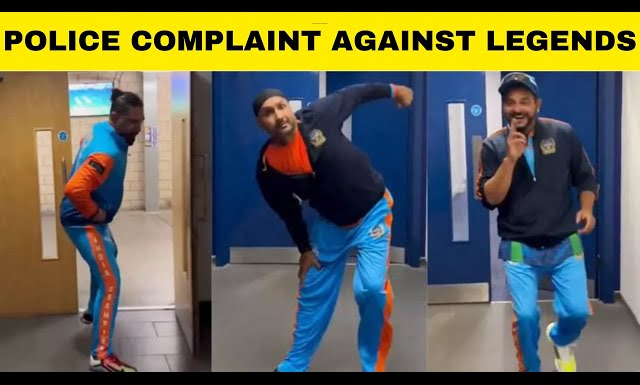
    While most disability advocates fumed at the inconsiderate act of celebrated sportsmen, some cautiously piped in their alternate views on tolerating a joke. However, an official police complaint was lodged by Arman Ali, Executive Director of the National Council for Promotion of Employment for Disabled People (NCPEDP).

    Here’s my take. We have become a society of increasingly easily offended people, thanks to the cultural shift propelled by polarising politics. So why should we expect any different reaction from Persons with Disabilities, who are equal citizens of the same country you and I inhabit. It’s a bad joke, one that reminds of me children in school, mimicking a certain teacher’s amble given her osteoporosis-ridden knees.

    Should they have done it? No. Is it insensitive? Yes. Have we blown it out of proportion? Certainly. I say this about all news political as well. There is no need to play up silly occurrences and utterances as primetime headlines. Ditto for this one. By the way, a public apology was issued by the players.

    #3 Trainee IAS Officer Puja Khedkar’s selection to civil service has come under the scanner. There is a criminal case accusing her of “misrepresenting and falsifying facts” to appear for the UPSC exam multiple times. She obtained three disability certificates in three years and a fake caste certificate. In 2007, while securing admission in a medical college, she was declared ‘medically fit’. In 2019, she secured a certificate of vision impairment from Ahmednagar district hospital. In 2021, she got a combined certificate of vision impairment and mental illness from the same hospital. In 2022, she filed an application for locomotor disability in a Pimpri hospital.

    She also sought relaxation under the OBC quota, which was questioned after her father, Dilip Khedkar, a former Maharashtra government officer, was suspended facing a corruption charge. Her mother, Manorama Khedkar, who is a sarpanch, was arrested in an Arms Act case when a video of her brandishing a gun threatening some farmers surfaced on social media.
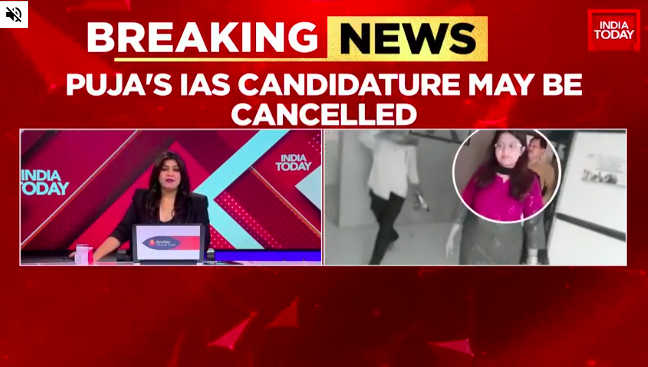
    Disability rights groups have been united in their reaction to this egregious act. While opinions were circling around the misuse of disability and the usual ‘one dirty fish spoils the whole pond’, reactions from the non-disabled audience validated the analysis.

    Senior Telangana IAS Officer Smita Sabharwal stirred a fresh row questioning the need for disability quotas in All India Services (AIS). She tweeted, “Does an airline hire a pilot with disability? Or would you trust a surgeon with a disability? The nature of AIS is field work, long taxing hours, listening first-hand to people’s grievances, which requires physical fitness.”

    Unfortunately, this was seconded by Former CEO of Niti Aayog, Amitabh Kant (Former N) when he said, “I am in favour of SC/ST or OBC reservation. These reservations should continue, with the creamy layer regulations being enforced. However, the existing reservations for the physically and mentally handicapped and the proposed 1% reservation for the third gender for the top Civil Services need to be reviewed. They are being misused.”

    Now that’s taking it a bit too far, because reassessing appropriate implementation of provisions and policies, will be opening an abysmal Pandora’s Box! By the way, I can instantly name Pranjal Patil and Beno Zephine. two women with disabilities who are IAS/IFS officers and have been doing superlative work despite the odds.

    #4 And there’s been some contentious news across the Pacific Ocean. So far, we’ve only had Former US President Donald Trump taking jibes at persons with disabilities, and specifically those in the media. Well, stupidity and ableism don’t come with any copyright, do they? After the disastrous show by President Joe Biden in the first presidential debate and consequential speeches, The Economist featured a walker adorned with a Presidential Seal on its cover. And the headline read, “No way to run a country.”
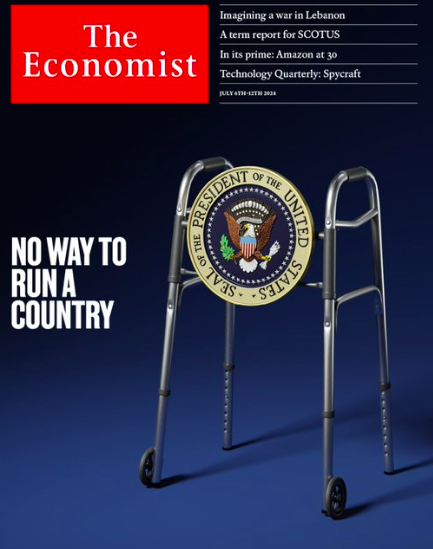
    Several slips there. Ableist representation in the use of a graphic that shouts, ‘crippling’ or ‘disabling’. The cover implies that if a person is physically disabled, or needs a crutch, he or she is incapable (read incompetent). Also, disrespecting several world leaders with disabilities. Like, Franklin D Roosevelt who was left paralysed waist down due to polio. Winston Churchill who had a speech impediment.

    A rather poor editorial call by a publication one least expects it from. The only thing that can possibly change media representation of disability is the act of hiring and working alongside persons with disabilities. Also, bold calls like the photo carried by The Indian Express in November 2022 following the appointment of 50th Chief Justice of India, DY Chandrachud. It’s a candid shot of him with his family which includes two foster daughters who have a disability.


    #5 But let’s end this piece on a rosy note. Or should I say pinkish? As part of this year’s global Barbie Fashionistas lineup, Mattel Inc. introduced the first ever Blind Barbie reinforcing inclusion and representation for all. Throughout the design process, Barbie partnered with the American Foundation for the Blind (AFB) to develop accessories, elbow articulation, textured fabric, accessible packaging, distinct eye gaze et cetera.

    Last year, Barbie had introduced the first-ever doll with Down Syndrome (DS), partnering with the National Down Syndrome Society (NDSS). Again, fixing the right hair, sculpt, glasses, outfit and so on. They have introduced its next Black Barbie doll with Down Syndrome along with the Blind Barbie. These dolls will soon be available in Indian stories as well.

    Clearly the disability landscape is evolving across the world. One day, we cite progress and hullabaloo on another. As long as the discourse is relevant, consistent and moderate, I think we are headed in the right direction. It is these complexities surrounding disability that will open up the dialogue to challenge stereotypes of all kinds. 

     Wondering why MxMIndia publishes a disability advocacy column? Well, we strongly feel that the media can dramatically transform the world for persons with disabilities. This series attempts to help bring forth issues that the media must champion to create a truly inclusive and accessible India. Writing  this column is Shruti Pushkarna, a former journalist and now a disability inclusion advocate based in New Delhi. Her views here are personal. To access the archives of her 95-plus columns, please visit: https://www.mxmindia.com/category/ columns/shruti-pushkarna/

    If you have a view on the issues raise or would like to align with MxMIndia on this cause, write to us at editor [at] mxmindia.com.

  • Before there was diving and relays, there was the Poetry Olympics…

    Before there was diving and relays, there was the Poetry Olympics…

    Jonas Åkerström’s 1790 work, Session of the Accademia dell’Arcadia on August 17 1788.
    Nationalmuseum/Cecilia Heisser


    By Katrina Grant

    Ever wondered whether you’d have a better chance at winning an Olympic gold if you could fling words rather than a javelin? Or maybe you could beat down your opponents with comedic wit? If so, you may have been a strong contender at the Poetry Olympics, held in Rome around 1700.

    Some 200 years before the modern revival of the Olympics as we now know it, a group of poets met in a garden in Rome to revive the ancient games in their own way. Their Giuochi Olimpici (“Olympic games” in Italian) was based not on speed or strength, but on one’s ability to string together a poem or win a debate.


    An ode to the mythical pastoral poets

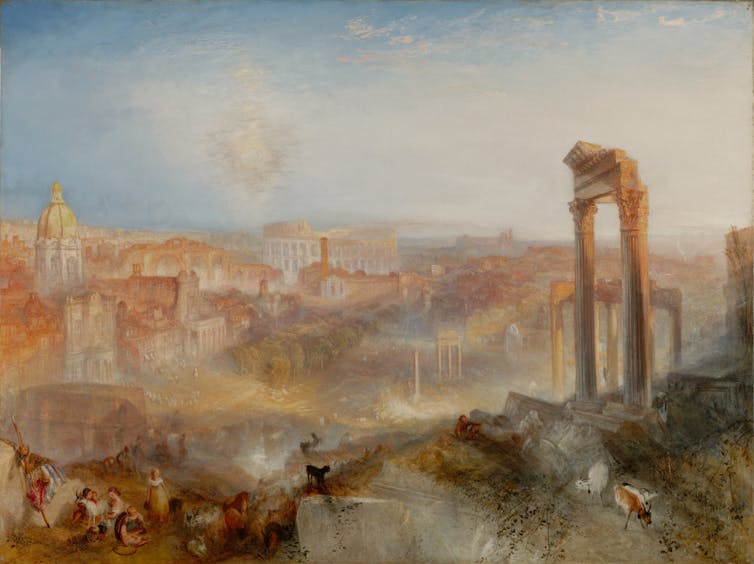
    The first of these new games was held in 1693 and they ran semi-regularly into the mid-18th century. The group met outdoors in places including the Farnese Gardens, a lofty site on the Palatine Hill in Rome overlooking the ruins of the Ancient Forum.

    Joseph Mallord William Turner’s 1839 oil painting, Modern Rome – Campo Vaccino, shows Baroque churches and ancient monuments in and around the Roman Forum.
    Getty Museum Collection

    They was a mix of (mostly male) poets, writers, lawyers, clergymen, nobles, artists and musicians. All were members of the Arcadian Academy, a group named for the region of ancient Greece – Arcadia – that was regarded as the “home of poetry” in Early Modern Europe.

    In 1504, the writer Jacopo Sannazaro had published a poem called Arcadia that presented an ideal vision of a world in which shepherds lived in harmony with nature.

    This idea took hold of writers and artists, who came to view such an idyllic landscape as a necessity for poetic invention. They imagined shepherds and shepherdesses roaming with their flocks and conversing in poetry with nymphs and satyrs – an image that was further popularised in 17th-century paintings by Nicholas Poussin and Claude Lorrain.

    These later 17th-century writers longed to inhabit this world of mythical pastoral poets. When they met, they cast aside their real names to use pseudonyms as shepherds or shepherdesses. They pretended the garden they met in was an Arcadian wood. The garden they built in Rome is still called “Bosco Parrasio” or Parrhasian Wood (Parrhasia was a region in ancient Arcadia).

    They described their meetings as “democratic” gatherings, which was highly unusual in Rome at the time, as all aspects of daily life were governed by social hierarchies and strict etiquette. But the naturalistic setting of the gardens and the playful disguises as shepherds or shepherdesses allowed for a bending of the rules.

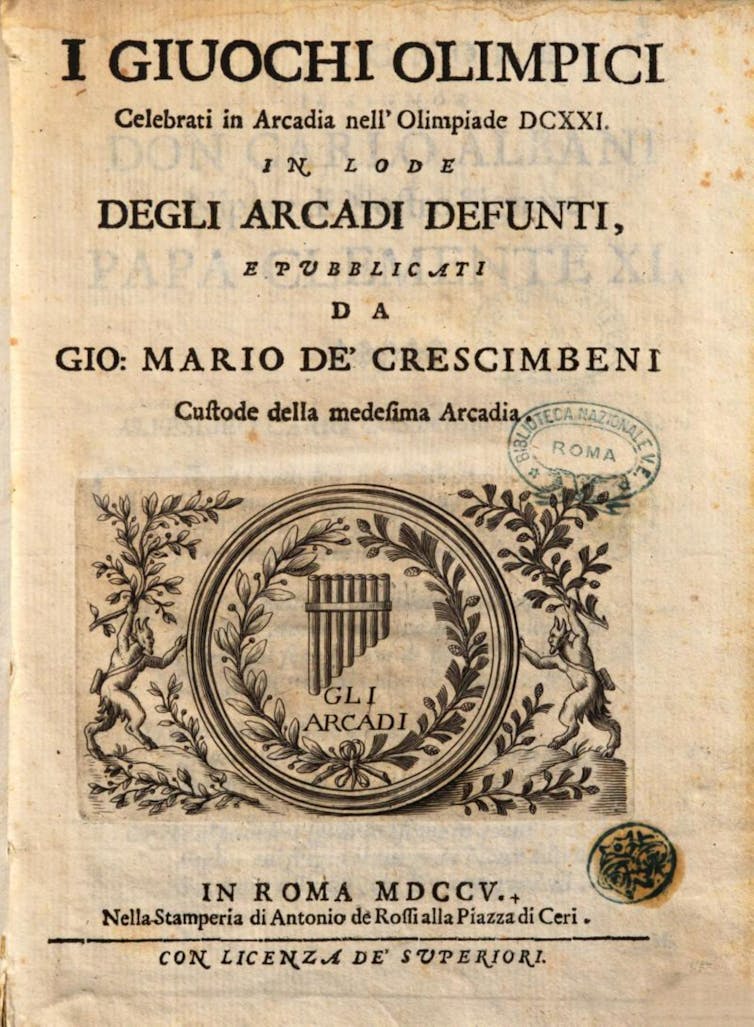
    The title page of one of the published editions of poems composed during the Poetry Olympics held in Rome in 1705.
    Internet Archive

    It was in this setting the poetic revival of the Olympic games took place. It was one of a few revivals in 17th-century Europe, with several sporting competitions in England also calling themselves “Olympicks” or “Olympiads”. But the Olympics in Rome was the first to focus only on poetic and literary performance.

    Later on, poetry also became an official part of the first of the modern Olympic games – and remained so until 1948.


    Intellectual combat

    The Poetry Olympics took the ancient pentathlon, but replaced the five sporting competitions with five new games based on poetic composition and intellectual debate. A description from 1701 lists these as “the foot race, the javelin, the discus, the wrestling and the long jump”. Each was intended to showcase skill in poetry, wit or song.

    The foot race became a game called “the oracle”, in which a debate was held on a topic set by the custodian of the games. The javelin became a game of dispute, in which the “shepherds” took part in friendly poetic disagreements. They were encouraged “to sting and prick each other with verses” to dispel any “bitterness that may have occupied their minds”.

    The third game, the discus, became a game of wits in which the poets bested each other in composing witty songs.

    Wrestling changed to a “game of transformation”, drawing from the myth of the metamorphosis of the ancient Arcadian King Lycaon, who was transformed into a wolf by Zeus after he sacrificed his son (one origin of the werewolf myth).

    The poets presented sonnets about transforming into inferior things such as animals and plants, and then considered the virtues of these new states. In one poem that was recorded in one of the short books published after the event, a competitor imagines becoming an industrious bee, going from petal to petal and creating sweet honey to help them bear the “bitterness of the world”.

    In the fifth game, called “the garland”, the winner was the person who could weave together the most beautiful poem in praise of nature. This was the only game in which women could compete.

    While this may seem exclusionary, it was actually very permissive for Rome around 1700. Most women at the time received less education and were expected to live relatively cloistered lives. The more relaxed social structure of the academy and the games allowed women to participate in poetic performances and socialise beyond their immediate households.


    A way to build bridges

    The 300-year-old gathering of poets in a garden in Rome might seem very distant from athletes converging in Paris for the 2024 Olympics, but we can draw some parallels.

    Structured play, with its clear rules of engagement, is often regarded as a way of mimicking more serious types of social confrontation. The “play” of games at the Olympics – whether poetic or physical – allows all of us (spectators included) a chance to move through the emotions of combat, disagreement, disappointment and elation in a friendly way.

    Gathering for play also encourages us to envision new and better ways to come together as people. Roman poets in 1700 used wit and metaphor to push against the limits of courtly society. In 2024, leaders can point to the Paris Olympics and ask us to imagine a world that comes together in friendly competition, rather than conflict and disagreement.The Conversation


    Katrina Grant is Research Associate, Power Institute for Arts and Visual Culture, University of Sydney. This article is republished from The Conversation under a Creative Commons license. Read the original article.