Category: NEWS

  • 2 shortlists in Film Craft for India


    By A Correspondent [Updated]


    There is every chance of India putting up a good show at the Cannes Lions festival under the category of Film Craft. After sending a record 41 entries this year, two of them have found mention in the shortlisted entries so far. And both of them stand a great chance of emerging winners given the adulation it has managed to receive on its own national shores. Of the 33 entries sent last year, only Ogilvy’s entry – Train for Indian Railways received a metal in the form of a Gold.


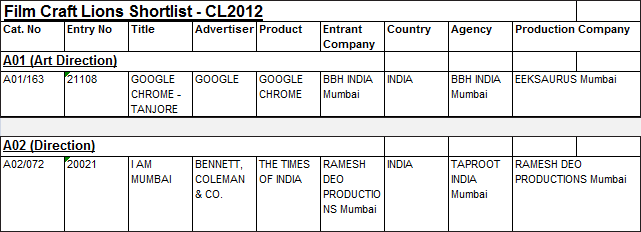
    Of the two shortlists India has received this year, the first is BBH India’s entry for its client Google Chrome under the category of Art Direction. The second entry to be nominated is Ramesh Deo Productions’s entry for its client The Times of India titled ‘I am Mumbai’. The entry has been nominated under the category of Direction and Taproot India is the agency.


    Introduced in 2010, the Film Craft Lions honours the craft of the filmmaking process – the direction, copywriting or editing, or the skilful use of music or sound design. A total of 1721 entries from 48 countries have been submitted into the Film Craft category this year, an increase of 30 per cent compared to 2011. The countries that have sent maximum entries include USA at 640, United Kingdom at 315, France at 77, Brazil with 76 entries and Germany with 72.


    Representing India at the Jury is Sneha Iype Varma, Executive Producer/Partner, Nirvana Films.


    The trophies will be presented during the Film, Film Craft, Branded Content & Entertainment and Titanium and Integrated Lions Awards Ceremony, which will take place on Saturday evening 23 June in the Grand Auditorium, Palais des Festivals.


  • 1 Gold for Ramesh Deo, 1 Bronze for Bacardi

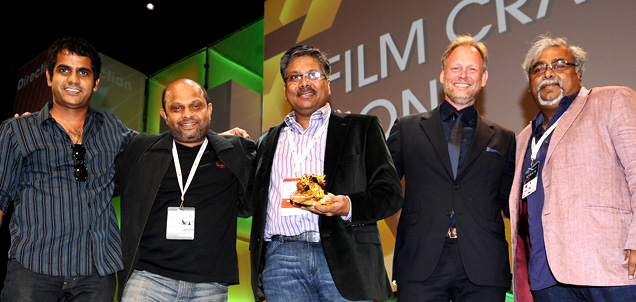
    Santosh Padhi and Agnello Dias with Arunabh Das Sharma and Sujay Ghosh receiving the Film Craft Gold bagged by Ramesh Deo Productions

    By A Correspondent


    The last day at Cannes Lions 2012 brought mixed cheer for the Indian contingent.


    So while Indian entries won a Gold and a Bronze, more metals from the five shortlisted entries didn’t happen.


    The Gold was won for Film Craft by Ramesh Deo Productions in the Direction sub-category. Abhinay Deo is the director of the film and the agency is Taproot India. The commercial titled ‘I Am Mumbai’ was made for Bennett, Coleman and Company Ltd for Mumbai Mirror (see entry details).


    And the Bronze was bagged by Bacardi India in the Branded Content & Entertainment category for The Dewarists in the sub-category “Best non-fiction program, series or film where a client has successfully created a reality, documentary or light entertainment show around a product(s) or brand(s)” (see entry details).


    With this, the number of metals bagged by Indian entries is 14 with the tally for Indian wins being as follows:


    Cannes Lions 2012 Winning Entrant

    Gold

    Silver

    Bronze

    DDB Mudra

    1

    1

    Leo Burnett

    2

    1

    McCann Worldgroup

    1

    Ramesh Deo Productions

    1

    Ogilvy India

    3

    BBDO India

    2

    Cheil Worldwide

    1

    Bacardi India

    1


    [updated report later in the day and tomorrow]


    [Photograph: www.CannesLions.com]


  • It’s A Real Aha Moment for Grand Prix Winner Mak

    By Delshad Irani


    He is perhaps one of the busiest persons at the 59th Cannes Lions International Festival of Creativity. No, it’s not Sir Martin Sorrell. He’s chatty we were told. But more importantly he’s creative. It’s Jonathan Mak, a twenty-year-old Hong-Kong based communication design student. Mr Mak is an ad aberration. At his age he took one of the most iconic images of our time and turned it, not just into a tribute to a man he admires and a global viral hit, but also an example of great design and what it can achieve.


    If that isn’t enough to make you feel like an under achieving member of the human race, or at least the advertising race, the following might just hit the spot. He won a Grand Prix, the highest accolade at Cannes , for the work he did for Coca-Cola and Ogilvy & Mather Shanghai. A poster that is, quite literally, a visual translation of the brief he was presented with – sharing a coke. The silhouette titled ‘Coke Hands’ is on a red background, and it’s, simply put, two ribbons of white combining to create the illusion of two hands sharing a coke. Asked to fly in on short notice, Mr Mak arrived just in time to pick up his award as thousands of advertising professionals from across the world cheered for him.


    However, this former teenager is no stranger to the limelight and looked like a seasoned adman. He can’t describe the process of creation, he’ll tell you, “It’s always tricky to explain a minimalist design.” The Steve Jobs image has similar design aesthetics to Coke’s poster, yes. But Mr Mak says it is an iconic image and he put a twist on it: “I always try to give viewers a real ‘aha’ moment.”


    Not a big fan of people typecasting his work, he says, “It’s not like Coke asked me to do something similar.”


    Source: The Economic Times

    Copyright © 2012, Bennett, Coleman & Co. Ltd. All Rights Reserved


  • Rules of creativity rewritten at Cannes

    By Ravi Balakrishnan


    As the week progresses, it’s become obvious that you need to ‘friend’ social media if you’d like to win atCannes. Almost every single award case study this year in the more functional result- driven categories like Direct, Promo and Activation and Creative Effectiveness came complete with a laundry list of social media successes.


    Indian agencies and the smattering of marketers who continue to lament the country’s performance atCannesthis year would do well to heed some of the new rules of creativity. According to Manish Bhatt, founder, Scarecrow Communications, and a jury member on Direct: “The definition of creativity is changing. Everybody is now talking about making a difference to the world. It’s a tall claim we all know, but creative effectiveness alone cannot get you to a Grand Prix.”


    A few jury members go so far as to say creativity is almost playing second fiddle in some cases to ‘earned media’ – getting spontaneous mentions in news sources – the more global, the better and being widely shared across social media. And in rare cases, an endorsement from the president of the United States Barack Obama who tweeted about Small Business Sunday, a campaign from American Express that won both in Promo and Activation and Direct and is said to be a close contender for the highly prized Titanium category.


    Even this year’s press winner for Benetton, ‘Unhate’ which featured photoshopped images of notoriously antagonistic political leaders kissing, was a news and social media success long before it reached the jury. It’s not thatIndiadoesn’t do socially relevant advertising; it’s just missing a trick in viewing such campaigns as ‘awardworthy.’


    Prasoon Joshi, president – McCann Worldgroup,South Asiasaid: “If Team Anna had entered their campaign that would have been a Grand Prix in my book. It was well managed in social media and everything. But in our country that consciousness is not there: that social movements and social good by brands is a big thing.”


    The serious exception to the rule of corporate ‘good’ winning applies to work that takes a radically different view of the possibilities a category represents; never mind if it seems almost too bizarre for their own good. A global brand like Mercedes lost the Grand Prix on radio to an entry fromBrazil’s Go Outside magazine from Talent,Sao Paulofeaturing a radio station with allegedly mosquito repellent properties.


    Source: The Economic Times

    Copyright © 2012, Bennett, Coleman & Co. Ltd. All Rights Reserved


  • Channel [V] says goodbye to Bollywood music

    By A Correspondent


    Star India’s Channel [V] is ready for a change from July 1 when it will discontinue all music slots in its programming. With this transition, the channel is set to consolidate its position in the youth entertainment genre.

     

    This move is being made to strengthen its stance as a holistic youth entertainment channel. The drastic change in the content strategy took almost three years. Speaking on the move, Prem Kamath, Executive VP & GM, said: “This shift in programming strategy is rooted in our continuous effort to remain a unique entertainment destination for the youth. We recognize the affinity the youth have developed for our shows and we can only oblige them with greater hours of these preferred shows.”


    In an effort to increase weekly hours of original content, Channel [V] will convert its teen crime show, Gumrah – End of Innocence into a daily. And, it also plans to launch new fictional shows like ‘The Buddy Project’ which will occupy the 6pm slot from Monday to Friday.


    However, the channel promises not to distance itself from music. “As for music, it can never go out of the youth DNA. We will continue our on-ground and on-air properties that are based on music. We will simply stop airing Bollywood music slots.”


    Launched in 1994 and reaching out to over 25 million viewers, the channel’s current mantra – Bloody Cool – manifests itself not only through its shows, but also through the broadcast persona and out of TV alliances created to engage with the youth.


  • Mindshare & Google launch ‘Mobile Garage’

    By A Correspondent


    Mindshare and Google have announced the launch of ‘Mobile Garage’, a unique venture designed to use Google’s best in class mobile expertise to supercharge the use of mobile by Mindshare’s global client base.


    Mobile Garage will see the setting up of mobilehubs around the globe – initially New York, London and Singapore – where Mindshare clients will gain access via dedicated teams to mobile strategists and product experts. The hubs will consist of a mix of Mindshare and Google employees and will work across all aspects of the mobile eco-system, from search optimisation and app development, to strategy, planning and creative optimization.

    Nick Emery, CEO Mindshare Worldwide said: ‘We designed Mindshare to be open source and to work with the best partners for the benefit of our clients. It’s about trial, experimentation and speed to re-design our business. Working with Google on mobile will give our clients a competitive advantage in a key battleground both now and for the future.”


    Mobile Garage will give Mindshare clients a unique advantage in the race to harness the growing global trend of mobile device usage. Mobile search traffic has increased 400 per cent over the past 2 years, and its potential goes even further. The GSMA, the industry body for mobile operators, and research company Machina, predict there will be 24 billion connected devices by 2020 creating an industry worth $4.5 trillion and covering innovations such as connected cars, building automation and traffic management. In addition the venture will also give Mindshare clients competitive advantage in emerging markets, with KPCB’s Mary Meeker recently showing that mobile internet usage had surpassed desktop internet usage in India.

    Matt Brittin, VP, Sales and Operations, Northern and Central Europe at Google said: “We have adopted a ‘mobile first’ philosophy at Google to keep pace with the rapid acceleration in consumer mobile usage. We are delighted to team up with Mindshare on a similar strategy for their clients. Mindshare have already shown strong momentum in the mobile marketing space, and have a great opportunity to lead their clients to win on mobile in the future.”


    Mobile Garage will complement Mindshare’s existing relationship with WPP’s mobile agencies Joule and H-Art.


  • Never make a film to win at Cannes, because then you’ll never do: Abhinay Deo

    By Meghna Sharma


    The final day at Cannes Lion 2012 turned out excellent for Taproot’s campaign for Mumbai Mirror – I am Mumbai. The advertisement was shortlisted in Film and Film Craft categories and went on to bag India ‘s first ever Gold in the Film Craft category.


    The campaign was entered in the Film Craft category by Mumbai-based Ramesh Deo Productions. The film was directed by Abhinay Deo whose work has been shortlisted at Cannes Lion before too. MxMIndia spoke to the winning director to know what it takes to make an award-winning campaign.


    It is India’s first ever win in the category, were you expecting a Gold?

    Honestly speaking I wasn’t. It’s my job to make a good film and keep entering them at such prestigious award functions. The rest depends purely on the quality of the work!


    What goes into directing an award-winning film?

    There is no thumb rule for it. All I can say is that one has to be honest to the craft. Never make a film to win an award be it cannes or any other, because then you surely won’t. (Laughs)


    The cast had never faced the camera before, so was it difficult to film it?

    When you have a cast which has never faced the camera before, it can either be extremely difficult or easy. It all depends on how you break the ice with them because they are bound to have apprehensions and fears about the whole thing. Sometimes such a cast can do wonders and have a film which even a seasoned actor couldn’t have been able to do better. I was sure that I wasn’t going to film the campaign with trained actors or celebrities.


    What was the thought process behind shooting the ad in black & white?

    Over the years, the city has lost its character. Today, everything is muddled-up; so, to show consistency, we decided to shoot it in black & white. Also, it was a polarised concept and I believe colour would have softened it. It was meant to be a hard-hitting one and B&W helped us achieve that.


    How important is an idea to direct for a concept like ‘I am Mumbai’?

    Both are important for a concept to work. The idea won’t work without good direction and vice-versa.  Without each other, it will just flop.


    How involved was Taproot in the ad?

    It was Aggi’s idea all along. Only after the idea was conceptualised, did I take over. And while shooting, it was my baby alone. It is great that Aggi and I know, and are able to understand, each other well, which helped both of us. We were able to execute each other’s ideas and thoughts well.


    Some of the reports that are coming out on Cannes Lions attribute the agency for the award. Do you think in advertising, perception-wise, it’s the agency which gets all the credit and not the film company and director?

    The campaign won the award for Film Craft category, so I think the award should be attributed to the craft.


    As a director, do you have any preferred agencies you work with?

    I have worked with most of them and have loved the experience. And I would continue to work with all of them. There are no preferences when it comes to work!


    Meanwhile, how’s the work on ’24’ going? When do we see the first season? Since TV is said to take so much of one’s time, does it allow you time for ad films?

    The series is in the scripting phase and, hopefully, will soon move to the execution stage. And when the shooting begins, I will give it all the time needed. In the past too, when I was making my two feature films, I didn’t make any advertisements. So, if needed I won’t be taking up advertisements till the series is over. Dedication and honesty towards work are important for me.


    Photograph of Abhinay Deo: Fotocorp


  • Audi Q3 ‘Start Young Music Movement’ showcases young talent

    By A Correspondent


    The Audi Q3 ‘Start Young Music Movement’ launched by Creativeland Asia has been successful in providing Audi fans with a platform to showcase their creativity and has encouraged them to start young towards achieving their dreams.
    Created by Creativeland, the microsite www.audi-q3.in enables Audi fans to create their own music video in 4 simple steps and submit it to win exciting prizes.


    On the online editing timeline, participants can simply pick pictures from their Facebook page and mix them up with the clips already created by Audi, or they could even record their own footage. The video can be then edited to the ‘This Is Our Time’ soundtrack created specifically for this. The videos then can be shared with friends and people around the world. Twenty videos with the maximum number of likes will be shown to the jury selected by Audi for this purpose.


    The music video ‘This is our time’ has been created by Creativeland Asia exclusively for the Audi Q3 ‘Start Young Music Movement’.


    [youtube width=”400″ height=”225″]http://www.youtube.com/watch?v=8-SmBSFPq8k[/youtube]Credits:

    Creative agency: Creativeland Asia
    Record Label: Creativeland Records
    Production Company: Pixel Tonic Films
    Director: Deb Medhekar
    Music: Mikey McCleary
    Vocals: Nikhil D’Souza


  • Zee to go paranormal with ‘Fear Files’

    By A Correspondent


    [youtube width=”400″ height=”225″]http://www.youtube.com/watch?v=rXrE1Apj9bE[/youtube]

    The Zee Network hopes to repeat the popularity of its once popular Zee Horror Show with a new programme called ‘Fear Files’. The show will focus on events that are experienced by those who have lived to tell their story.


    “Horror has been a part of our lives for years now. Almost all of us have heard stories of paranormal activities – some of us believe in them and some don’t. But there is no denying the fact that it hasn’t touched our lives. So, through this show we want to tell real life stories of people who have experienced the unexplainable,” said Sukesh Motwani, fiction programming head, Zee TV.


    Sukesh Motwani

    He added: “But this time around we have kept the gory details out. One can call it “intelligent” horror.” Fear Files was shot at haunted locations in a drama-documentary style. Thorough research was done for each story and at the end of each show, a paranormal expert will share the rationale view on all unnatural phenomena. The 26-episode show will go on air from June 30.


    Talking about the weekend late night (10:30 pm) slot, Akash Chawla, Senior Vice President and head -marketing, national channels, Zee TV said that he is keeping his fingers crossed: “Data suggests that the weekend 10:30pm slot has been doing well. And since the show will be aired right after DID Little Masters, we hope to cash in on the slot. Also, the genre cuts across age-groups and gender and as many find it intriguing; we hope our TG (25-44 age-group) won’t be disappointed in the show.”


    Akash Chawla

    The channel is going all out to market the show. “Apart from promoting the show on our channels, there are going to be a lot of innovative print ads as well. Also, this time, we plan to spend around 12 per cent of our marketing budget on the digital platform,” said Mr Chawla.


    “Marketing such shows is definitely a challenge,” he added. Innovative ways have thus been lined-up to promote ‘Fear Files’ as the channel felt that people have grown up and want to see something ‘reasonable’.


  • Local retailers partner global brands to launch own labels

    By Sarah Jacob


    Ramesh Tainwala believes that “women kindergarten teachers tend to be more confident mothers.” As analogies go, this one may border on the stretched but what the chairman of Planet Retail is attempting to convey is that retailers like him can pick up learnings by partnering with marquee brands, and then use them to boldly build labels of their own.


    Planet Retail, which has brought brands like Debenhams, Acceorize, Nautica and Next into the country, has begun flying solo with handbags brand Lavie. It’s not the only domestic retailer following a learn-and-launch strategy.


    DLF Retail, which has tied up with brands such as Claire’s and DKNY, launched in-house home decor chain Pure Home + Living a year ago. It is now set to flag off another format called Pure Kitchen Studio by November. Or take Lalit Kishore, master franchisee of sports footwear brand Lotto in India, who has launched his own brand of footwear called Globalite. And then there’s Devyani International, a franchisee for Pizza Hut, KFC and Costa Coffee in India, which has introduced South Indian fast-food chain Vaango independently.


    “It is easy to open outlets on your own. But international partnerships help in understanding the economics, food preferences and processes for standardised delivery,” said Virag Joshi, president & CEO, Devyani International.


    Alliances can provide the domestic partners with a slew of insights across the entire retailing process. Rohit Aggarwal, promoter of Lite Bite Foods, which started as a franchise for Subway, gives an example. “One takes for granted that the freezer or chiller is cold, but (working with an) international brand teaches you that the temperature needs to be checked every 30 minutes.” Lite Bite is now a Rs100 crore operation running not just Subway outlets but home-grown chains like Punjab Grill and Street Foods of India.


    International partnerships also help build a sophisticated team with focused skill sets. “Skills that the management feels can be leveraged without an additional cost to build their own brand in parallel with the primary brands,” said Gaurav Marya, president of Franchise India Holdings, which helps brands partner franchisees in India.


    There are plenty of synergies that can be availed of from sharing support functions and the supply chain. Economies of scale come into the picture on the advertising front, distribution, hiring and office space, too.


    Devyani International, for instance, has a common production unit or commissary in Gurgaon for brands across its portfolio. And Mr Kishore’s Globalite rides on the wholesale supply chain that is used to retail Lotto across multi-brand stores.


    Companies say that in the initial stages having international brands in the kitty helps with prospective trade partners. “A foreign partner carries a lot of weight,” said Mr Aggarwal.


    Kanchan Lall, associate VP at management consulting firm Tecnova, likens this trend to the development of private labels by retailers. “Once you grasp the understanding of a business, you look for avenues with higher margins and decision-making flexibility,” she said.


    The domestic brand builders rule out potential conflicts of interest, pointing out that the local labels typically operate in a different market segment. “Globalite would not matter to Lotto as the two cater to different price segments,” Mr Kishore explained. While Lotto retails at Rs2, 300 a pair on an average, Globalite is priced around Rs1,500 a pair.


    The seven-store handbags chain Lavie gains by being bundled with international brands in Planet Retail’s portfolio. “At the same time, Lavie also helps refine the strategy for the premium and super-premium brands in the portfolio and supports them with assurance of higher footfalls when negotiating with a mall,” said Mr Tainwala.


    Source: The Economic Times

    Copyright © 2012, Bennett, Coleman & Co. Ltd. All Rights Reserved


  • Cannes Lions Grand Prix JurySpeak

    By A Correspondent


    A diverse set of Grand Prix Lion winners were announced at the 59th International Festival of Creativity, Cannes Lions 2012 over the last week. It was a hectic week for judges with an interesting array of campaigns and creative projects being thrown up to dig out the Grand Prix awards.


    Four agencies won two Grand Prix each, Creative Artists Agency for Chipotle; R/GA for Nike; and Crispin Porter + Bogusky and Digitas, who teamed up on American Express.


    Nick Worthington

    The Outdoor category saw Jung von Matt’sInvisible Drive for Mercedes honoured along with Ogilvy Shanghai’s Cokehands posters. Coca-Cola was a double winner in Outdoor for a student-designed poster and in the inaugural Mobile Lions contest for its role in Google’s Project Rebrief. In the PR category JWT’s musical-based campaign for a Puerto Rican bank and BBH won Creative Effectiveness for its Even Angels Will Fall campaign for Lynx/Axe.


    The Promo & Activation Grand Prix was won by Crispin Porter +Bogusky’s ‘Small Business Gets an Official Day’. Jury President Nick Worthington, speaking about the winning campaign, said: “It’s just an extraordinary piece of work. It’s so audacious, it kind of breaks the boundaries of what advertising is, what promo and activation is…It’s very easy to do the stuff that comes and goes but these guys have achieved a legacy.”


    Bruce Duckworth

    This year’s Design Lions Grand Prix was awarded to ‘The Solar Annual Report 2011’ by SERVICEPLAN. President of the Design Lions Jury, Bruce Duckworth said that one of ways you know a work is great enough is when you wish you would have done that work. Speaking about the winning entry, he said: “It’s got a great idea. It’s taken a client which is a solar powered company and it’s the annual book for that. You take it out in the sunshine and magically from a blank book, the information appears. It’s like magic, it made the hair on the back of my neck stand up and it wasn’t just me, it was the whole jury.”


    David Jones, President of the Creative Effectiveness Lions Jury explained why the jury selected BBH London’s Axe Excite for American Express as the Grand Prix winner: “It won for a few reasons. First, they did a fantastic job of proving the contribution of advertising and the tangible business results associated with that. And they also did a great job of discounting the other facts, showing that it wasn’t a bad price or increased distribution or a massive increase in media spends.


    David Jones

    The case they made for RoI was very powerful, also we were impressed by the fact that it had some great consumer insights. And finally it was the best proof of what we all know, which is – in today’s world where you can’t buy attention anymore, you have to earn it – a brilliant creative idea that engages and cuts through is the best way of driving effectiveness, and we thought it was a fantastic idea that was bigger than the product…”


    For more insights from the jury on what went into picking the best and how the selected winners stood out from a clutter of entries, MxMIndia put together a video playlist where Jury presidents and members discuss and explain the reason for choosing the Grand prix winners in the respective categories.


    MxMIndia gets you an assortment of videos where Jury Presidents and members speak to Cannes Lions TV to explain why they chose the winning entry for the Grand Prix in different categories.


    1. Nick Worthington on the Promo & Activation Lions Grand Prix 2012: Jury President Nick Worthington talks to Cannes Lions TV about the 2012 Promo & Activation Grand Prix, which was won by Crispin Porter + Bogusky’s ‘Small Business Gets An Official Day’ for American Express. [youtube width=”300″ height=”169″]http://www.youtube.com/watch?v=8VueDxGaCgA[/youtube]
    2. Gideon Amichay on the Direct Lions Grand Prix: Jury President Gideon Amichay explains why his jury selected Crispin Porter + Bogusky’s ‘Small Business Gets An Official Day’ for American Express as the 2012 Direct Lions Grand Prix winner. [youtube width=”300″ height=”169″]http://www.youtube.com/watch?v=jt5tvuTobaw[/youtube]
    3. Gail Heimann on the PR Lions Grand Prix: Jury President Gail Heimann explains why ‘The Most Popular Song’ by JWT San Juan,Puerto Ricowas awarded the PR Grand Prix – the first in the country’s history. [youtube width=”300″ height=”169″]http://www.youtube.com/watch?v=8t3HIi49v0U[/youtube]
    4. Lo Sheung Yan on the Outdoor Lions Grand Prix: Jury President Lo Sheung Yan explains why ‘#Cokehands’ and ‘The Invisible Drive’ were both awarded Grand Prix at Cannes Lions 2012. [youtube width=”300″ height=”169″]http://www.youtube.com/watch?v=cTNNgv-hzdY[/youtube]
    5. David Jones on Creative Effectiveness Lions Grand Prix: Jury President David Jones explains why his jury selected BBH London’s Axe ‘Excite’ for American Express as the 2012 Creative Effectiveness Lions Grand Prix winner. [youtube width=”300″ height=”169″]http://www.youtube.com/watch?v=GFGN5gqZNWg[/youtube]
    6. Mainardo de Nardis on the Media Lions Grand Prix: Jury president Mainardo de Nardis, OMD Worldwide’s CEO, explains why the ‘Google Voice Search’ campaign by Manning Gottlieb OMD London picked up the 2012 Media Lions Grand Prix. [youtube width=”300″ height=”169″]http://www.youtube.com/watch?v=ZydFdfA9hE8[/youtube]
    7. Rob McLennan on the Radio Lions Grand Prix: Jury president Rob McLennan, the Executive Creative Director at Net#work BBDO, explains what set ‘Repellent Radio’ by Talent São Paulo apart from the other entries and earned it the 2012 Radio Lions Grand Prix. [youtube width=”300″ height=”169″]http://www.youtube.com/watch?v=sEcalIah40w[/youtube]
    8. Bruce Duckworth on the Design Lions Grand Prix: Jury president Bruce Duckworth explains why this year’s Design Lions Grand Prix was awarded to ‘The Solar Annual Report 2011’ by SERVICEPLAN Munich. [youtube width=”300″ height=”169″]http://www.youtube.com/watch?v=706cGnjT44Q[/youtube]
    9. Tham Khai Meng on the Press Lions Grand Prix: Jury President Tham Khai Meng explains why his jury selected United Colors Of Benetton Apparel’s campaign for the 2012 Press Lions Grand Prix. [youtube width=”300″ height=”169″]http://www.youtube.com/watch?v=nlck0BMSCyE[/youtube]
    10. The Jury On The Cyber Lions Grand Prix: Three members of the Cyber Lions jury, including president Iain Tait, discuss the two winning Grand Prix pieces. [youtube width=”300″ height=”169″]http://www.youtube.com/watch?v=CGPF9nkpavU[/youtube]
    11. Tom Eslinger on the Mobile Lions Grand Prix: Jury president Tom Eslinger explains why Google’s ‘Hilltop Re-Imagined For Coca-Cola’ was awarded the first-ever Cannes Lions Mobile Lions Grand Prix. [youtube width=”300″ height=”169″]http://www.youtube.com/watch?v=qOqjRbjgE-s[/youtube]
    12. Avi Savar on the Branded Content & Entertainment Lions Grand Prix: Jury president Avi Savar explains what set the first-ever Branded Content & Entertainment Lions Grand Prix apart from the rest of the entries. [youtube width=”300″ height=”169″]http://www.youtube.com/watch?v=6z380OGlyRg[/youtube]
    13. Espen Horn on the Film Craft Grand Prix: Jury President Espen Horn explains more about the Film Craft Grand Prix, indicating why it stood out from the crowd. [youtube width=”300″ height=”169″]http://www.youtube.com/watch?v=PiPgwTtAZfU[/youtube]
    14. Rob Riley on the Titanium & Integrated Lions Grand Prix: Jury President Rob Riley takes a moment to give us some more information about why made the Titanium Grand Prix so special and worthy of the prize. [youtube width=”300″ height=”169″]http://www.youtube.com/watch?v=2NSmpkR6Ap8[/youtube]
    15. Tham Khai Meng on the Film Lions Grand Prix: Jury President Tham Khai Meng takes a moment to reveal the 2012 Film Lions Grand Prix and explain why it picked up the prize. [youtube width=”300″ height=”169″]http://www.youtube.com/watch?v=mA8OxP0gpNA[/youtube]


  • Digital adoption by Asian CEOs limited to device ubiquity: MEC-CNBC study

    By A Correspondent


    Top executives are taking up digital technology, but their extent appears to be tempered by their need to remain in control of their business ecosystem, according to new research by MEC and CNBC. The research surveyed 32 CEOs in multi-national companies across Singapore, Hong Kong, India and China.


    Adoption of digital technology is currently limited to new devices (smartphones, tablets, and so on), being used for information aggregation and synchronization.


    Attitudinally, CEOs in Asia acknowledge the positive benefits of using digital technology in the work place, citing upturns in growth and productivity, a levelling of the playing field and changing business formats. They believe that digital technology will change the way they work in the future. “We’ve only just started but digital technology will significantly change the way we deal with our peers, colleagues, clients and suppliers”, said a CEO from India.


    Behaviourally, Asian CEOs consider themselves “fast followers” and claim to be undaunted by the proliferation of new gadgets – they remain in control over how and when these devices are to be used. A CEO in Singapore said he does not “want to be controlled by anyone or a piece of machinery”. An example of this is how mobile phones are often switched off and handed over to secretaries during meetings, for undivided attention.


    These CEOs believe that digital technologies are not the “be all and end all” of everything. The same expectations in communications from the past applies in today’s digital age too, from “paying full attention when someone is talking” to having control of their time. As a CEO from a HK company said: “When I’m at home, it’s my time. Unless it’s very urgent, everything can wait till the next morning.”


    In essence, CEOs continue to and expect to remain in control of their time and schedules.


    CEOs tend to have well-established working behaviours, so technology and devices perform an efficiency or enhancing role, especially on a personal level. New technology has not intrinsically changed the way they behave; it is merely facilitating existing behaviours. “I want to be thoughtful, not just compelled to reply right away. I use these devices to add meaning,” explained a CEO from Singapore.


    However, it is clear that CEOs recognize the benefits of technology and how it can revolutionise their business, but also recognise that they have a long way to go.


    iPad – the game changer?

    Interestingly, the iPad is possibly the one gadget that has been observed to subtly alter the CEO behaviour. With the trend of consumerisation of technology and more companies embracing the BYOD (bring your own device) policy, the iPad has quickly become a business as well as a personal device.


    The iPad is a perfect fit for the needs of this niche target audience. CEOs have expressed a fondness for it, especially for browsing and presenting. A CEO from Singapore said: “When the opportunity arises, I take out my iPad and make a presentation, rather than use my laptop which makes me look like a salesman.”


    It is slowly replacing the laptop for short trips and they express a certain liberation that comes with doing that.


    “Given that they need to manage complexity, tablets satisfy a specific need from CEOs – simplicity. CEOs are highly selective with their content and only consume what they perceive will add real value to their work and personal lives.  Therefore, brands seeking to communicate with CEOs need to ensure that content is delivered in a concise manner and optimised to be viewed and interacted with on these devices,” said Junji Sumitani, Vice President, Advertising Sales, CNBC, Asia Pacific.


    Selective levels of engagement with social media

    Asian CEOs acknowledge that the social media bandwagon is a wave they have yet to, or are hesitant to ride on, either for themselves or for their companies. Personally, they cite valuing their privacy as the reason they are, at best, passive observers of social networks.


    Due to the inherent social nature of these networks, there seems to be a fear of opening up access to themselves and not having the bandwidth to deal with it. As a CEO from Hong Kong described it: “There are all these requests I need to accept and I just don’t want to get started on dialogues.”


    The innate need to remain in control would clearly be at risk.


    However, they do realise the potential of using it for their businesses. Internally, there is some but limited use of social networks for internal communications, stemming from a need to provide a platform for employees to air their opinions rather than as a way to connect and engage with them. “Clearly young people today feel they have a right to question and understand why something is working the way it is and if you don’t provide a mechanism for them to ask that questions and express themselves, they will go outside.  So it is better for us to provide that space within the organization,” said a CEO from India.


    Externally, CEOs are starting to explore the benefits of what these networks can do. “It becomes a very interesting B2B tool, so that’s something we are experimenting within the office – how to use social networking for marketing and promotion and positioning for the company.”


    “Social networks are not the way to best communicate with CEOs since they are reluctant to lose control of their communication structures. However, they seek recommendations as much as anyone else, often through respected media brands. Hence B2B brands have an opportunity to partner with these media brands to provide valuable, timely content,” commented Jon Wright, Head of Analytics and Insight, MEC Asia Pacific.