Category: NEWS

  • Milestone Brandcom executes campaign for Jhalak Dikhhla Jaa

    By A Correspondent


    Milestone Brandcom has brought out the glitz, glamour, magic & star power straight from the sets of Jhalak Dikhhla Jaa out onto the city streets.


    Jhalak Dikhhla Jaa is the Indian version of BBC’s Strictly Come Dancing and ABC’s Dancing with the Stars that went on air on June 16. The dazzling launch was supported by an extensive OOH coverage in over 22 cities across a wide array of 1,500 high impact media touch points; coupled with a mixed bag of innovative ideas that have been conceptualized and implemented by Milestone Brandcom along traditional and unconventional media mix generated the desired buzz and hype around the launch of the show.


    This is the first time that Colors is broadcasting this famous international format. The show brings together 12 celebrities along with one common man who will compete with each other along with their choreographer partners for the title. These 13 pairs will be judged by 3 celebrity judges – Madhuri Dixit, Karan Johar & Remo D’souza.


    The media mandate / communication objective to Milestone Brandcom was to bring out the spectacular extravaganza from the show, live on OOH. The core communication objective was to create intrigue for the upcoming show and to build salience for the brand and maximize impact through high visibility, scale and innovation.


    The main media objective was to drive tune ins for the channel thereby increasing TRPs.

    To ensure the right audiences were reached, a high intensity OOH plan was executed across the key target markets – Mumbai, Delhi, UP, Gujarat, MP, Maharashtra and Rajasthan across mass media touch points varying from billboards, bus shelters, metro signages, pillars, bus panels, lift branding, station branding and utilities. The viewers were intrigued at every OOH transit point with thrilling visuals of the judges.


    The 2 innovations executed for the show were conceptualized around the “disco ball” element that relates directly to dance; were a perfect brand fit for the show. The first was a Gigantic Disco ball at Mahim causeway. The disco ball, sparkling through the night was set up on a rotating disc. It was visible from a distance of over 500 metres and ensured that every passerby stopped & glanced at it. The second execution at Juhu, Tulip star junction was that of a “shiny disco ball.” The hoarding was lit from various points & it appeared as if the disco ball was glistening in the night.


    Commenting on the campaign Rajesh Iyer, Head Marketing, COLORS said: “Since this was the first season of Jhalak Dikhhla Jaa on Colors, we had a dual task in hand – to communicate the launch of the show along with building recall for the time slot and the channel. Along with Milestone Brandcom, we developed an idea of using the “disco ball” imagery through-out the campaign to bring out the essence and star power of the show. Due to the awareness created by this innovative and creative OOH campaign, Jhalak Dikhhla Jaa has stood out distinctly and created excitement. This concept has helped us in creating buzz for the show and certainly created the desired impact.”


    “We tried to being out the action from the sets of the show out onto the OOH campaign. In order to complement the exuberance of the show it was essential to build presence along every key arterial route and important transit junction in the key markets and that is exactly what we delivered,” said Hanoz Patel, Founder Member & Managing Partner, Milestone Brandcom.
     

  • IRS 2012Q1: Downward is the way for Language publications

    By A Correspondent


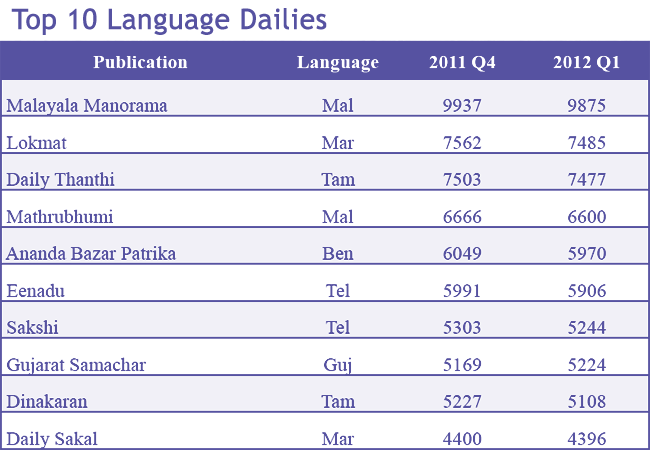
    Maybe it’s the shortage of ideas or lack of opportunities but language readership is certainly not seeing the best of times inIndia. Of the top 10 Language dailies to have made it to the list, just one newspaper – Gujarat Samachar – has seen growth; nine others have seen a decline in 2012Q2 readership over 2011Q1. Gujarat Samachar with an AIR of 5,224 is marginally better than its AIR number of 2011Q4 at 5,169.


    Leading the charts at the top is Malayala Manorama which has recorded an AIR of 9,875 as against an AIR of 9,937. Marathi daily Lokmat follows next with an AIR figure of 7,485 as against 7,562 it reported last quarter. Tamil daily Daily Thanthi is next with an AIR of 7,477 as against 7,503 recorded in 2011Q4. Mathrubhumi follows next with an AIR of 6,600, Ananda Bazar Patrika with 5,970, Eenadu with an AIR of 5,906, Sakshi with an AIR of 5,244, Gujarat Samachar with 5,224, Dinakaran with an AIR of 5,108 and Daily Sakal with an AIR of 4,396.


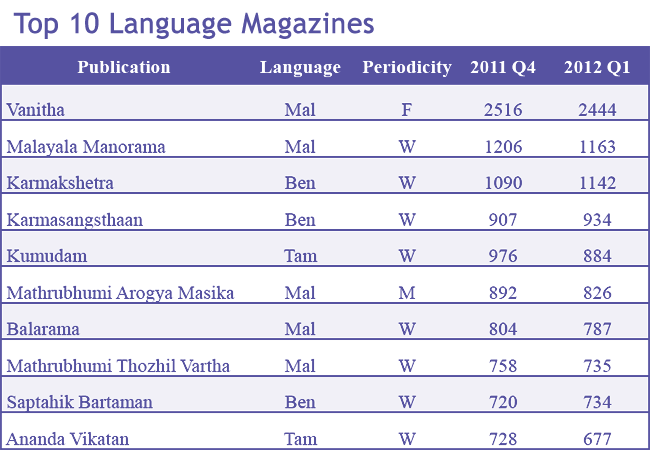
    Where magazines are concerned, three out of ten have shown marginal growth while seven have seen a decline. Vanitha leads at the top with an AIR of 2,444 followed by Malayala Manorama with an AIR of 1,163. Karmakshetra is third with an AIR of 1,142 while Karmasangsthaan is fourth with 934. Kumudam is fifth with an AIR of 884 while Mathrubhumi Arogya Masika is sixth with 826. Balarama follows with an AIR of 787 while Mathrubhumi Thozhil Vartha is next with an AIR of 735. Saptahik Bartaman is ninth with an AIR of 734 while Ananda Vikatan wraps up the list with an AIR of 677.


    Explaining the trend, Dinesh Rathore, Vice President, MediaVest Worldwide said: “As for language dailies and magazines seeing a decline, I think they have reached a saturation point; there is only so much that they can grow by. The percentage of people who speak Tamil or Malayalam in states other than their hometown is not that much, so there is not much enthusiasm by these players to launch editions in other states.”


    (AIR numbers; all figures in ‘000)


    (AIR numbers; all figures in ‘000)


  • IRS 2012Q1: Hindi readership sways its way towards +ve growth

    By A Correspondent


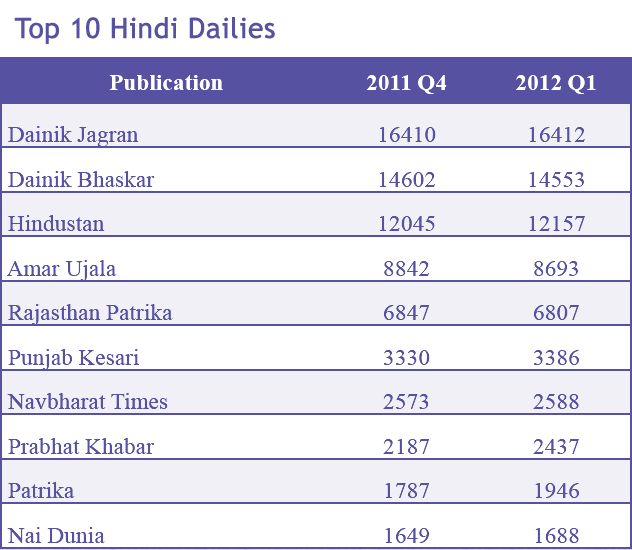
    As a large population of this country continue to swear by the usage of the national language – Hindi, it is no surprise that newspapers and magazines in this language have seen moderate growth in IRS 2012Q1. In the Top 10 Hindi dailies, Dainik Jagran dominates with AIR of 16,412 versus 16,410 that it reported last quarter. At second place is Dainik Bhaskar that recorded an AIR of 14,553 as against 14,602 in 2011Q4.Hindustancomes next with an AIR of 12,157; Amar Ujala at fourth with 8693 and Rajasthan Patrika at fifth with an AIR of 6807. Punjab Kesari has posted positive growth with an AIR of 3,386 compared to 3,330 in the last quarter. Navbharat Times is next with an AIR of 2588. Prabhat Khabar is the best placed with an AIR of 2,437 compared to 2,187 reported last quarter – an 11 per cent growth. Patrika is next at 1,946 (growth of 9 per cent) and Nai Duniya at 1,688.


    (AIR numbers; all figures in ‘000)


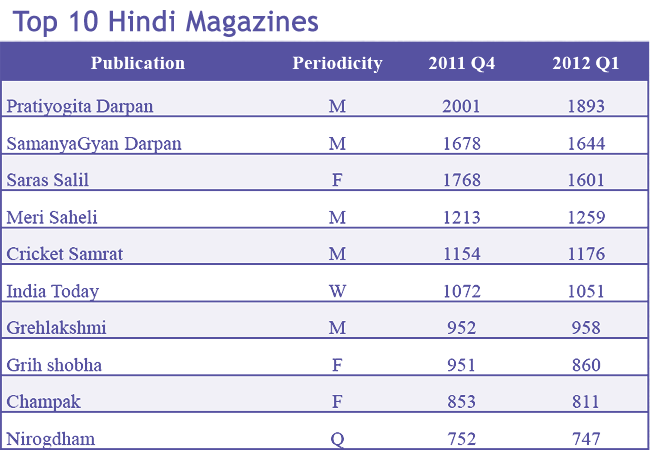
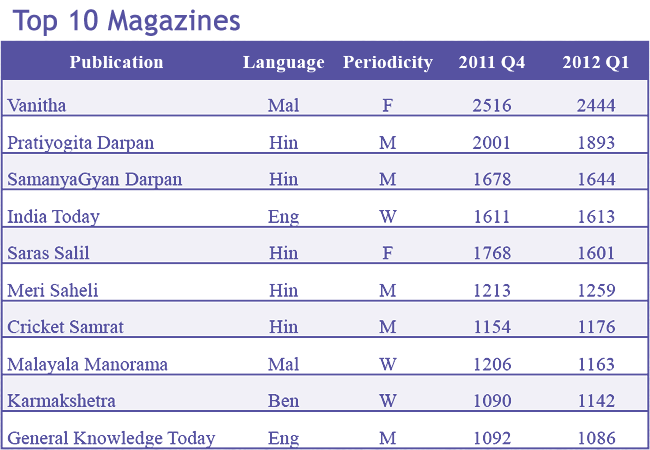
    Among the magazines, there has been a moderate effect that has been witnessed in the Hindi readership. Pratiyogita Darpan has seen a drop of 5.4 per cent with an AIR of 1,893 compared to an AIR of 2,001 in last quarter. SamanyaGyan Darpan has posted an AIR of 1,644 versus 1,678 recorded last quarter. At three is Saras Salil that has seen a big drop with an AIR of 1,601 versus 1,768 recorded last quarter – a drop of 9.5 per cent. Meri Saheli is steady at fourth with an AIR of 1,259 and Cricket Samrat is next with 1,176. India Today is next with 1,051 while Grahlakshmi follows with an AIR of 958. Completing the list is Grihshobha with an AIR of 860, Champak at ninth place with an AIR of 811 and Nirogdham with an AIR of 747.


    (AIR numbers; all figures in ‘000)


    Dinesh Rathore, Vice President, MediaVest Worldwide said: “The population of people who speak Hindi and English is seeing a rise and that explains the overall rise in readership of these language editions. Also, a lot of players are moving out of their markets and launching in other states leading to newer set of readers. Players like Dainik Jagran, Dainik Bhaskar, Rajasthan Patrika are launching in many new states. So this explains the rise in the readership of their papers.”


    Adding inputs, Anamika Mehta of Lodestar UM said: “By launching in newer markets you are creating specialists products to cater to those markets and therefore, language readership will see a rise to an extent. Also, as explosion of business happens in small towns and markets the regional media will follow suit and grow too. That is what we have seen in television too. For SMEs and business houses, print will continue to be an important medium for them.”


  • Stagnancy stages a comeback in IRS 2012Q1


    By A Correspondent


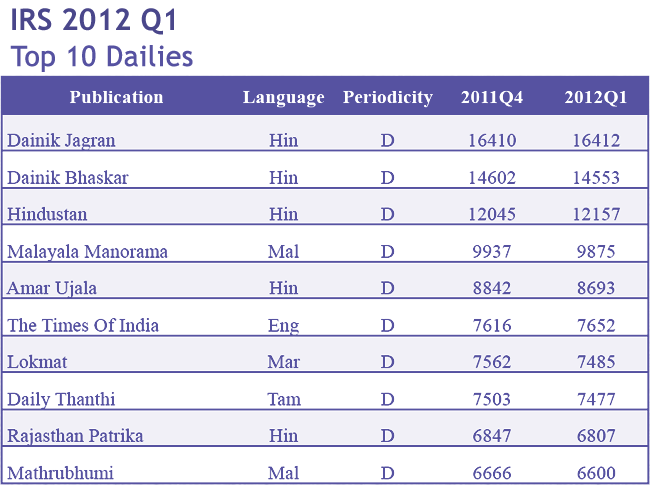
    The IRS 2012 Q1 readership results released by MRUC and Hansa has nothing new to tell but the obvious tale of the apparent rise in numbers of a few publications and the decline in readership of a majority of players. Going by the Average Issue Readership norm, in the Top 10 dailies there has been no change in the pecking order of the top performers but the readership of 7 out of 10 dailies has seen a marginal decline. Of the ten publications, five are Hindi in origin, two are in Malayalam, and one each in Tamil, English and Marathi.


    Emerging a frontrunner once again, Dainik Jagran manages to hold its forte showing slight readership growth with 16,412 in 2012Q1 as against 16,410 that it reported in 2011Q4. At No 2, Dainik Bhaskar has reported numbers totalling 14,553 a decline by 0.33 per cent from 2011Q4 figure of 14,602.Hindustansits comfortably at the third spot having reported a 1 per cent growth of 12,157 as against 12,045 reported in 2011Q4. Malayala Manorama is at the fourth spot with an AIR of 9,875 as against 9,937 in 2011Q4 – a drop of 0.6 per cent. Amar Ujala is next reporting an AIR of 8693 against an AIR of 8842 in 2011Q4 – a drop of 1.7 per cent. The Times of India English edition continues to see growth and comes in sixth with AIR of 7,652 as against 7,616 registered last quarter. Marathi daily Lokmat sees a marginal decline to end 2012Q1 at 7,485 compared to 2011Q4 AIR of 7,562. Tamil daily Daily Thanthi is next with AIR numbers of 7,477 as against 7,503 recorded in 2011Q4. Rajasthan Patrika with 6,807 and Mathrubhumi with 6,600 end the tally occupying the ninth and tenth spot respectively.


    Reacting to the overall trend, Dinesh Rathore, Vice President, MediaVest Worldwide said, “The study hasn’t thrown any new surprises. What is known is that the readership time spent on print is coming down these days, which is even lesser in case of magazines. Newspapers as a habit are not going to die soon but the time spent is surely on a decline. Also, if people were subscribing to more newspapers earlier, they are subscribing to one less now because of the options available on digital.”


    Highlighting her stance on the numbers, Anamika Mehta of Lodestar UM said: “What I infer is that the drop is very marginal. Print will continue to hold its ground in India. With literacy rates going up and the launch of several new products print will continue to drive growth in India . Also, what is seen is that there is a growth of consumption that is happening on the web and moreover, India is a very young country. Almost 60 per cent plus of the population are younger than 35 years. With these audiences the consumption is more on the web than on the physical newspaper. Also, we are seeing a lot of launches by players in the regional markets. So it’s not as bad as it seems.”


    Voicing a similar opinion as given by Mr Rathore, Priti Murthy, National Director – Insights, Maxus said, “I am not surprised by the overall trend that has been thrown up. Why do we read newspapers and magazines, for the sheer content that it provides and content is available faster in other mediums today – definitely digital and to a large extent even TV. I see this trend continuing in the next 3-4 years after which it will reach a saturation point. Also, how much ever tactical initiatives publications engage in to increase circulation, it clearly shows that readership is not going to increase. The time spent in reading newspapers and magazines will continue to see a decline. Also the new generation that is growing up may not grow up on a newspaper alone. They rely on mobile and other AV modes to receive their communication.”


    (AIR numbers; all figures in ‘000)


    The downfall story continues with magazines as well with leader Vanitha (Malayalam) reporting an AIR of 2,444 as against 2,516 in 2011Q4 – a decline by 3 per cent. Pratiyogita Darpan too sees a decline of 5.4 per cent having registered an AIR of 1,893 in 2012Q1 as against an AIR of 2001 in 2011Q4. SamanyaGyan Darpan sees a marginal decline with an AIR of 1,644 as against 1,678 reported last quarter. India Today is the topmost English magazine in this list and figures at the fourth spot with 1,613 as against an AIR of 1,611 reported last quarter. Saras Salil is next on the line-up and has reported a big drop of 9.5 per cent registering an AIR of 1601 as against an AIR of 1,768 reported in 2011Q4. Meri Saheli and Cricket Samrat have posted growth with an AIR of 1,259 and 1,176 respectively. Malayalam Manorama at 1,163 has seen a decline of 3.5 per cent while Bengali magazine Karmakshetra has seen a growth in its AIR at 1,142 as against 1,090 in 2011Q4. General Knowledge Today completes the list with an AIR of 1086.


    Throwing light on the trend spotted in magazines, Anamika Mehta said: “In the case of magazines, what we are seeing is that the time spent on magazines is going down but there are a lot of new and niche products being launched. A lot of international players too are coming into this market. So that should give it some scope for growth. But right now I think magazines are in a more worrying state than dailies in India but having said that I do not see the death of the medium coming here anytime soon.”


    (AIR numbers; all figures in ‘000)


  • IRS 2012Q1: English readership throws up usual pattern

    By A Correspondent


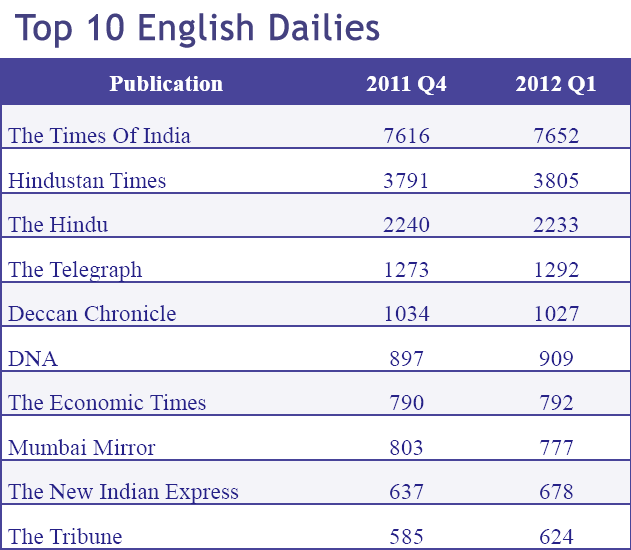
    A favourite with the urban zones and also with the advertisers, English dailies and magazines have shown an average readership trend in 2012Q1. Leading the list yet again for the dailies is Times of India that has recorded an AIR of 7,652 as against 7,616. Hindustan Times is next with an AIR of 3,805. The Hindu has seen a gradual decline with an AIR of 2,233 and occupies the third spot. The Telegraph comes fourth with an AIR of 1,292 while Deccan Chronicle is fifth with an AIR 1,027. DNA has shown a slight growth recording an AIR of 909 as against 897 it recorded in 2011Q4. The Economic Times follows with an AIR of 792 followed by Mumbai Mirror at 777. The New Indian Express is ninth with an AIR of 678 while The Tribune rounds off the list with an AIR of 624.


    (AIR numbers; all figures in ‘000)


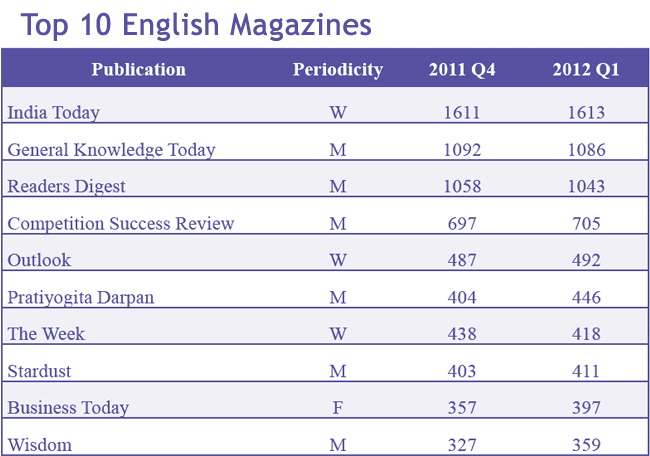
    The trend for magazines is somewhat similar to that delivered by dailies. India Today, retaining its top spot, has shown a small hike with an AIR of 1,613. General Knowledge Today is second on the list with an AIR of 1,086. The going is downhill for Readers Digest that posted an AIR of 1,043. Competition Success Review is next on the list having posted an AIR of 705. Outlook follows next showing growth with an AIR of 492. Pratiyogita Darpan is next with an AIR of 446. The Week follows with an AIR of 418 while Stardust is next with an AIR of 411. Business Today is ninth on the list with an AIR of 397 while Wisdom ends the list with an AIR of 359.


    (AIR numbers; all figures in ‘000)


  • Digitization in 4 metros put off to November 1

    By A Correspondent


    Given the varied and protracted deliberations with stakeholders, the Government of India has announced that the sunset date will be October 31, 2012 for the four metros with a complete switchover from November 1 in Chennai, Kolkata, Mumbai and New Delhi.


    Here goes a prepared statement issued:

    The Cable Television Networks (Regulation) Amendment Act, 2011 has made it mandatory for switchover of the existing analogue Cable TV networks to Digital Addressable System (DAS) by December 2014, in a phased manner. In respect of four metros of Delhi, Mumbai, Kolkata and Chennai, the digital switchover is mandated to be completed by 30th June 2012.


    The Task Force, comprising of all stakeholders, constituted by the Ministry in April, 2011, has been monitoring the progress made by various stakeholders towards digitisation. The task force has also undertaken field visits and interacted with local stakeholders. Discussions have been regularly held with Broadcasters, Multi System Operators (MSOs), Local Cable Operators (LCOs), while the Ministry of Information & Broadcasting has been in regular contact with the concerned State Governments on this issue.


    Regulations on Tariff & Interconnection were issued by TRAI only on 30th April 2012 instead of being issued in January, 2012, as expected.  The Quality of Service Regulations and the Consumer Complaint Redressal Regulations were issued on 14th May, 2012 by TRAI. As per these Regulations, every Broadcaster and MSO was required to publish its Reference Interconnect Offers (RIOs) within 30 days of issue of the Regulation.  Another 30 days are required for negotiations between Broadcasters and MSOs.  Thereafter, the MSOs and LCOs arrive at agreements which enable the consumers to have a clear indication of the terms and conditions for installing Set Top Boxes and the prices of channels on an a-la-carte as well as on a bouquet basis.


    The second order of TRAI of 14th May, 2012, has mandated that every MSO or its linked Cable Operator has to put in place a Consumer Complaint Redressal System consisting of a complaint centre with toll free consumer care number, web based complaint monitoring system as well as appoint or designate one or more nodal officers and publish consumer’s charter for DAS.


    Both these orders of TRAI have not yet been substantially implemented.  As a result of this, the installation of Set Top Boxes has not picked up necessary pace for the completion of the process of digitalisation by 30th June, 2012.


    The assessment of these ground realities, compels the Ministry of Information & Broadcasting to set a new deadline.  It is, however, imperative that the modified target deadline is set with strict benchmarks to ensure that no complacency sets-in in the system and the new target date is achieved collectively by all the stakeholders.


    Therefore, keeping in view public interest and after intensive and extensive consultations, as well as written commitments from all the stakeholders, for fully implementing the regulations of TRAI, the Ministry of Information & Broadcasting has decided to modify the 30th June deadline for a complete switch over to 31st October 2012 for all four Metro Cities i.e Delhi, Mumbai, Chennai and Kolkata.


    All the TRAI regulations for DAS will come into effect from 01st November, 2012.


    The Ministry of Information & Broadcasting will closely monitor the process of digitalisation over the next four months.  The Ministry of Information & Broadcasting will issue warning letters to those going slow on their written commitments.  Needless to add that both, the Ministry of Information & Broadcasting and TRAI, will take action under the provisions of the Cable Act, wherever and whenever necessary.


  • Ormax offers tool to measure effectiveness of big media tie-ups

    By A Correspondent


    Media research & consulting firm Ormax Media announced the launch of its proprietary model for brand association measurement – Mpact. Mpact is a scientific tool that measures the strength of association of a brand with a big-ticket, high-impact media property.


    Mpact can be used by brands and media agencies to test effectiveness of their brand’s association with high-impact properties across media, e.g. Sporting event associations, reality shows sponsorships, AFPs, print and television innovations and roadblocks, product placements, co-branded campaigns, and so on.


    In the Mpact model, consumer data is used to calculate the Mpact Score, a single-number measure of the effectiveness of the association for the brand.


    Speaking on the launch, Shailesh Kapoor, CEO – Ormax Media: “When an advertiser pays a premium to associate with an impact property such as IPL, KBC or Bigg Boss; takes a false cover on Times Of India; plans a roadblock on a top channel; or associates with a big film such as Ra.One or Bodyguard – returns that go beyond just the day-after recall of the association are expected. Mpact is a simple but powerful method of measuring how effective the association has been for the brand, beyond just a recall score which is extremely transient in nature. In effect, the Mpact Score is a surrogate ROI measure of the association.”


    Mpact has been developed and tested across more than 50 media associations by leading brands in various categories, including ‘Airtel presents Satyamev Jayate.’

  • Kenichiro Hibi is MD, Sony India

    By A Correspondent


    SonyIndiahas announced the appointment of Kenichiro Hibi as its new Managing Director with effect from July 1. Mr. Hibi will be responsible for spearheading the overall growth and profitability of the company within the region, by driving robust business strategy, providing thought leadership and guiding excellence in market performance across all categories.


    Mr. Hibi brings with him over 23 years of diversified experience in Sony, with a host of senior level positions to his credit. His last role was as Managing Director, Sony CIS, where he played a crucial role in making this region emerge as one of the most potential contributors in Sony’s global growth map. While managing the CIS region for over six years, he was successful in developing a sound business strategy, which adjusted to market turbulence while maintaining focus on customer orientation.


    Mr. Hibi will be replacing Mr. Masaru Tamagawa, the current Managing Director, Sony India, who will move on to the position of President, Sony Europe, with effect from July 1.


    Announcing the new appointment, Mr. Haruyasu Nagata, SVP in charge of Global Sales and Marketing, Sony Corporation, said: “I am delighted to appoint Mr. Kenichiro Hibi as the new Managing Director for SonyIndia. He has already successfully contributed to Sony’s growth in the rapidly evolvingRussiamarket, and we are confident that his experience and expertise will take our Indian operations to the next level. Mr. Tamagawa made an exceptional contribution in making SonyIndiaa top ranking sales company contributing significantly to Sony’s global sales, and I am confident that Mr. Hibi will build on this momentum by augmenting our overall market share and the customer experience we deliver in this rapidly growing market.”


    Expressing his delight on the appointment, Mr. Kenichiro Hibi said: “Indiais one of the key markets for Sony globally, with an immense growth potential across categories. I am excited to continue Sony’s journey to success in one of the most dynamic markets in the world.”


    Mr. Masaru Tamagawa has been Managing Director, SonyIndiasince 2007 and has overseen the emergence of SonyIndiaas a major organisation and growth market, holding the top share of the electronics market inIndia. He previously ledSonyGulf, based inDubai.

  • 9XM celebrates World Music Day with 9XM Wall of Music

    By A Correspondent


    9XM is celebrating the World Music Day on June 21 with a unique on-ground innovation. The channel is creatingIndia’s very first digital music wall called the ‘9XM Wall of Music’ offering free downloads of the latest Bollywood songs. The 9XM Wall of Music will be installed at the Chatrapati Shivaji Terminus in Mumbai and DAME Shivaji Stadium inDelhi.


    Based on the augmented reality technology, the 9XM Wall of Music will enable multiple songs downloads from the latest Bollywood movies. People can download songs by scanning the Bollywood movie posters placed on this wall, with their smart phone devices. People who do not own a smart phone can also download songs from the 9XM Wall of Music by sending a SMS to 54646 to get the song link on their phones for further download.


    Speaking on this initiative, Amar Tidke, Sr. VP & Content Head, 9X Media Group said: “June 21 is celebrated as the World Music Day across the world. This designated day of free music will be celebrated by 9XM by providing unlimited free downloads of the latest Bollywood hit songs. We are confident that this unique offering will make the World Music Day extremely memorable for Bollywood music fans.”


    The World Music Day originated inFranceand is celebrated annually on June 21. It is a day when the world celebrates the magical gift of music. Anyone can make music on World Music Day, in some cases in any location, provided one rule is followed: The music must be free.


    The 9XM Wall of Music will be promoted with a 360 degree plan across on air, print and digital platforms.

  • 1 Gold, 1 Silver & 5 Bronzes on Day 4


    By Delshad Irani


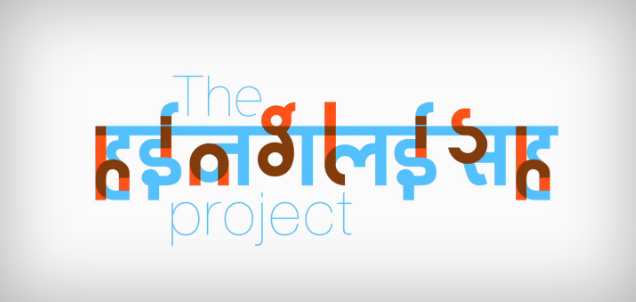
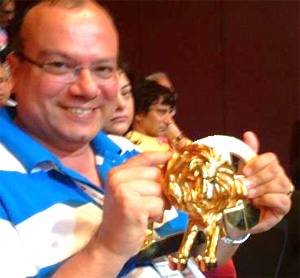
    DDB Mudra Chief Operations Officer Pratap Bose put up this picture with the Design Gold on his Facebook page

    Cannes on Day 4 won more gold for India, taking its tally to two. ‘The Hinglish Project’ from DDB Mudra Group took home a gold Lion in design.


    The design entry is part of the ministry of tourism’s Incredible India campaign. Abhijit Bansod, jury member and principal designer and creative head, Studio ABD, said this is perhaps a new beginning for hybrid typographic design work that combines cultures.


    “It really stood out amongst the typographic work we saw during the judging process,” he adds. India had a total of eight entries on the shortlist with three originating in DDB Mudra Group, including a campaign for Volkswagen India.


    ‘The Hinglish Project’ has been awarded a bronze Lion, too. A total of four categories were judged on the day. Press, a traditional favourite with Indian entrants, kept India’s ad engine chugging along. There is one silver Lion in Press for Leo Burnett’s work for Bajaj Electricals.


    Ogilvy took home two bronze Lions in the same category for its work for Perfetti Van Melle and Mattel Toys’ Hot Wheels brand. And, BBDO India has one bronze Lion, courtesy its work for White Collar Creatives.


    The Grand Prix winner in Press is United Colors of Benetton’s Unhate campaign that cooked up a storm in many places around the world and got it the much-coveted top prize at the Cannes Lions.


    In radio there’s a lone win, another bronze Lion for India as well as Leo Burnett. Titled ‘Punishment’, the work interestingly was written entirely in Hindi. The work for Mumbai-based book store Strand Book Stall is in the form of a conversation between Mahatma Gandhi and a little boy.


    According to Rob McLellan, executive creative director, Network BBDO South Africa, and Radio Lions’ jury president: “It is a heart-warming piece of work. India is very similar to South Africa in many ways. Radio is still the most popular medium and sometimes the only way to reach people. I think the piece is a worthy winner.”


    This brings us to Cyber category, a disappointment of digital proportions. Out of the 27 entrants, not one made the shortlist. About India’s non-existent presence in this category Anita Varma, jury member and director of Digital Driftwood, said it’s a shame because we are great storytellers but falter on how best to use the technology at our disposal.


    Source: The Economic Times

    Copyright © 2012, Bennett, Coleman & Co. Ltd. All Rights Reserved


  • Life OK and SAB: The see-saw continues…

    By Meghna Sharma


    In India there is no dearth of television channels. The competition is only growing and the race to lead in the TRP race is heating up. In the past few weeks, the two channels which seen an increase in their TRPs are Life OK and SAB TV which have been fighting for the fifth spot in the TRPs race.



     

    Life OK, the newest entrance in the GEC genre from the Star India stable, was launched in December last year. The network renamed and re-launched their youth-oriented channel Star One with new tagline ‘cherishing what you have’.


    On the contrary, SAB TV has been around for over a decade now but has gone through various transformations. In March 2005, SAB TV was acquired by Sony Entertainment Television and was transformed into a youth-centric channel. In June 2008, the channel announced that it would return to its roots by being repositioned as a comedy-centric channel.


    So what does the race for TRPs mean for the two channels and do they pose a threat to other GECs? MxMIndia spoke to a few media planners to see what is the future of the GECs and what shape will this ‘war’ take.


    According to the latest TAM data, in week 24, SAB TV has toppled Life OK and regained No 5 position. Whereas, last week (week 23), Life OK was the fifth most watched GEC.


    Sundeep Nagpal

    Sundeep Nagpal, founder director, Stratagem Media feels that these are momentary fluctuations and cannot be contributed to anything per se. “These channels have a small base; therefore, even a single factor can affect the ratings of the show – positively or negatively – depending on how it did on a particular week. Hence, I don’t think we should be alarmed by such fluctuations. And they won’t be able to impact the top 4 slots.”


    The two channels have positioned themselves differently, too. SAB TV is a comedy-centric channel which portrays itself has a family channel, whereas Life OK has shows full of melodrama like other GECs.


    Janardhan Pandey, associate vice-president, DDB Mudra Max feels that the two cannot impact each other drastically. “SAB has its own set of audience which won’t get influenced by other GECs and vice-versa. They will continue to do well in their own categories; the fluctuation between the two is possible but they don’t have the same hold as other GECs do. They still have a long way to go.”


    Jai Lala

    On the other hand, Priti Murthy, national director – Insights, Maxus, feels that though these channels might be still small fish, they cannot be ignored entirely. “Like these two channels, even number two and three slots have been fluctuating for a while now. So, slot five and six can create an impact too. One cannot rule out the possibility of them gaining to higher positions in the future if they come up with new and better content.”


    On the channels growth, Mindshare’s principal partner, Jai Lala feels that the two channels have grown since Imagine TV, a Turner International India Pvt Ltd entity, was shut down earlier this year. “The shutdown of Imagine TV has benefited these two who are now turning out to be competitors. However, they still have a small base compared to others and unless and until they cross the 200+ threshold, I don’t think that they can or will affect the channels like Star or Zee or Sony which have been ruling the top slots in the TRP race for a long period of time.”


    Uday Mohan

    “While these channels are doing well they have a long way to go in terms of reaching the numbers of the mainline GECs. They still don’t have the kind of appointment viewing that the mainline GECs generate….they might eat into the shares of other frequency channels but will not threaten GECs, at least not immediately,” added Uday Mohan, executive director – North, MPG.


    Most experts believe that there is nothing to be alarmed about the two channels see-sawing. What they do feel is that both the incumbent SAB and challenger Life OK will have to work harder if they want to reach the top slots.


  • Colors jumps to No 2, thanks to JDJ

    By A Correspondent


    Reality shows are the flavour of the season; and the latest entry to the bandwagon is Colors’ Jhalak Dikhla Ja.  The celebrity dance show in its fifth season premiered on July 16 on Colors and thanks to the show, the channel saw its highest growth this week. Colors has jumped to No. 2 again.


    According to the latest data for week 24, Star Plus is on number 1 position with 268 GRPs this week (last week 269). Zee TV has slipped to No. 3 with 212 GRPs (last week 203). Sony Entertainment Television went below the 200 mark, at No. 4, the channel has recorded 187 GRPs (last week 201).


    DID Little Masters on Zee has been doing well for the channel, but saw a drop in TVR ratings (2.8)  as Jhalak Dikhla Ja  got a 3.13 TVR. Both are dance shows, but whereas one deals with children, the other has celebrities like Madhuri Dixit and Karan Johar to its credit.


    So what worked for the show as well as the channel? Dinesh Rathore, vice president, India- West, MediaVest Worldwide, feels that though celebrities do arouse curiosity and makes them switch to a particular channel, there is no dearth of celebrities on television today as most reality shows feature them. “I think the show has done well on its opening weekend because of the initial curiosity. It would be difficult to say if it will continue to do so for the channel. We’ll just have to wait and watch.”


    Monaz Todywalla, general manager, Madison Media, said: “From the content point of view, the show is well packaged and promoted. Hence, it was bound to get such ratings on the opening weekend. However, the channel cannot rest on the shows shoulders alone. If it wants to remain on the slot or even reach the numero uno position, it will have to do a lot more, especially content wise.”


    Meanwhile, Zee TV’s DID Li’L Masters which earned a launch rating of 5.8 is adding a Bollywood flavour to its show on the coming Sunday with a tribute to the iconic dancing stars of Indian cinema.


    Surely what we have seen is a mere ‘jhalak’ of the two warring dance shows.