Category: NEWS

  • The Social Consciousness of Advertising Agencies

    The Social Consciousness of Advertising Agencies

    Ashoke AgarrwalMany think of advertising people as hustlers. A few voice their opinions with wit; for example, the comedian Steven Wright said, “I saw a subliminal advertising executive, but only for a second. ”

    Those of us in advertising know that the average advertising man is only as unscrupulous as the average human being.

    There are many reasons for the societal image of advertising people. Though advertising, by and large, plays a valuable role in society as a source of helpful information and entertainment, most people, at one time or another, have been seared by it at the personal level, consciously through the post-purchase dissonance that they blame at advertising’s door. And subconsciously because the lifestyle much of the advertising portrays makes them dissatisfied with their circumstances.

    Another reason was the glamour associated with advertising a few decades ago. Advertising no longer has that problem as it has shifted from brand custodians peopled by stars to quotidian vendors largely peopled by drones.

    Beyond the general populace’s extant image of advertising people, the pertinent issue is the advertising profession’s societal responsibility. At its core, advertising is a profession with highly specialised skills as much as the practice of medicine and the law are professions. I would even include politics as a profession. The issue is that the professions of medicine, law, accounting, architecture and engineering are codified and guided by a stated or unstated set of rules; soft professions like politics, advertising and management are not. The harm done to societies worldwide by having the profession of politics open to all and governed only by the mandate of “anything goes in politics” is evident.

    Management and advertising, on the other hand, are answerable to stakeholders and the rigours of the market, and even without codification, a relatively tight set of rules and guidelines has evolved.

    What, then, are advertising’s societal responsibilities? Mark Twain once said in jest (I hope) that advertising is legalised lying. Anyone who has been in advertising knows that consumers and markets are brutal masters and will weed out those who think advertising works because it fools people. Advertising works because it is based on the consumer’s deeply held conscious and subconscious attitudes and beliefs and seeks to effect behaviour aligning with these beliefs.

    The advertising profession’s speciality is in unearthing beliefs and attitudes and crafting arresting messages that align with these beliefs and attitudes in suggesting or reinforcing an action.

    Commercial advertising does not attempt to change underlying beliefs and attitudes because doing so would require budgets far beyond the commercially viable range. Instead, it addresses an existing set of beliefs and attitudes most conducive to its commercial objectives.

    Advertising, in its commercial sense, is value-agnostic. If a deeply held belief in a vital section of the audience that driving a fast car is a symbol of sexual potency, then advertising will run with it. If being woke about gender equality or secular values is a strong belief in another section, advertising will run it no matter whether it is for a detergent or jewellery brand.

    Advertising plays a societal role in enabling a consumerist society, a central pillar of modern economies. It also subsidises media – mass, digital and social – and thus enables the cultural and communication milieu of societies.

    However, the advertising profession can go beyond its commercial role and use its unique skills to do good to society more directly.

    Advertising can do in the societal space what it is wrongly accused of doing in the commercial space. It can zero in on beliefs and attitudes that harm individuals and societies and change them with the right messaging and level of persistent exposure.

    Such advertising, blandly known as Public Service Advertising (PSA), is currently reduced to a hoax category at advertising award functions. Advertising that juiced up creatives let rip on issues and causes they barely understand.

    Decades ago, when advertising agencies sat at the business and marketing high tables and had a different image of themselves, the Advertising Agencies Association of India (AAA of I) devoted some of their resources to creating effective PSA campaigns and persuaded the media to give them meaningful exposure. One worthy recently told me that they could not think of such activities nowadays as the agencies fight for their existence in the age of Google, Facebook, ad tech, and now, God forbid AI.

    Au contraire, wouldn’t creating powerful PSA campaigns that improve societies’ dynamics be the best way to revive recognition of the high art of advertising and, thus, the prestige and influence of advertising agencies? Wouldn’t traditional and digital media wholeheartedly support such an effort because they, too, are under existential pressure?

    Time was when Doordarshan was the only TV channel in the country, Kailash Surendranath and Suresh Mallik got together to create the inimitable “Mile Sur Mera Tumhara” campaign – the ultimate PSA for its time.

    The world is much more complex today, so PSAs must dig deeper. My decades of campaign planning experience have taught me that the more complicated the problem and the deeper you dig, you come up with a startlingly simple solution. For example, one of the critical problems facing societies today is increasing tribalism, the deep division of societies into “Us and Them” factions based on politics, religion, ethnicity, age and class. At the surface level, the reasons are complex, and tackling each cause of division individually is intractable. But dig deeper; the core cause is losing the ability to listen universally and without a filter. To do so would not just create a lowering of barriers between individuals but would make life richer and more meaningful for each individual. The advertising planners and creatives will dive deep and unearth those beliefs and attitudes that prevent listening and those latent ones that can support listening and create messaging that negates one set and reinforces the other.

    The above is just one illustrative example of how deep a PSA can go.

    To reassert, advertising agencies can find the high table again if they deploy their unique skills to address society’s urgent psychographic needs. Let’s think of this as a core business development strategy.

  • Bad P for the Big C

    Bad P for the Big C

    Ranjona BanerjiNow that the excitement over Poonam Pandey’s supposed death has died down, is it too late to discuss the implications of her stunt? Reactions have been largely negative, not unexpectedly. To claim to have died of cervical cancer only to resurrect yourself the next day because you wanted to raise awareness about cervical cancer is both extreme and trivial. That this death followed the announcement of a government scheme and the launch of an indigenously-manufactured HPV vaccine by an Indian company, and knowing that Pandey likes a bit of publicity for herself, rung a few alarm bells, but evidently not enough.

    In that, it’s hard to dismiss a formal death announcement as a publicity prank, and yet that is what it was.

    A columnist on this website, Vikas Mehta, tried yesterday to negotiate through all the reactions – shock, laughter, outrage – and came to two conclusions: that younger people did not see the event as angrily as most people, and that any publicity is good publicity. And shock tactics often work in the world of advertising.

    The last is a well-known axiom in the world of publicity. And Poonam Pandey is skilled in the art of staying in the news for doing as little as possible. The Kardashians you might say are masters of the craft. To become famous for being mildly famous and then use that fame to build zillions of careers, not least the family’s own. Pandey is not quite in that category… but she tries poor thing.

    Is awareness about cervical cancer important? Definitely.

    Is awareness about a vaccine that can prevent cervical cancer important? Without the shadow of a doubt.

    Do you have to pretend to die to create this awareness?

    Well.

    It is not clear whether Pandey jumped on to this cervical cancer bandwagon herself, or whether she was hired to do so. Were either the Union Government or the Serum Institute of India part of this? No clarity on that yet, although even I would be shocked if they had paid for this.

    The agency which organised the death issued a statement after the event, which included this explanation:

    “There was no change in people’s curiosity regarding Cervical Cancer when our Honourable Finance Minister mentioned it no less than a few days ago during the Union Budget.

    “The act by Poonam has now resulted in making Cervical Cancer and its related terms the most searched topic (s) on Google.”

    From a publicity point of view then Pandey and her team feel they have won. She’s got her two minutes and then will move on to a new demo of her untested skills.

    Some media watchers have blamed journalists for carrying the news of her death without checking, given Pandey’s history. Others make the excuse that since the death announcement came from Pandey’s own team, how could journalists have further confirmed this death?

    No clear answer there.

    But this is what will happen. For one, cancer patients and their families, and those who have lost loved ones to cancer, will feel the pain of someone trying to benefit from their suffering. This feeling will not go away just because she did this to raise awareness. All of us cancer patients, victims, survivors, whatever we call ourselves, know the shock within when you get the diagnosis of the Big C, of mortality, of fatality, of imminent death. Yes, life is a sexually transmitted terminal disease. But we all feel we should get the chance to complete our three score years and ten, and hopefully then some. Pandey’s stunt played on the worst of our fears and attempted to profit from them. And then, trivialised the journeys of millions, not all of whom survive their cancer diagnosis.

    Secondly, it is doctors who need maximum awareness about this vaccine, especially first response doctors. Oncologists enter the picture later in the journey. How many gynaecologists have started jumping about saying “O yaay, Poonam Pandey pretended to die and now my patients can get a vaccine”?

    The change will come from the medical community, from camps conducted, from taking healthcare to slums and remote areas, to targeting women at Primary Health Centres, those who get left behind in the race for health.

    Regardless of online fame, cancer and death are real. Rarely fun. And sometimes, bad publicity is just a bad idea.

    Ranjona Banerji is a senior journalist and commentator. She writes on MxMIndia on Tuesdays and Fridays. Her views here are personal. 

  • E-Gaming Federation collaborates with NLU, Delhi

    The E-Gaming Federation (EGF) has signed a Memorandum of Understanding (MoU) with National Law University (NLU), New Delhi. The MoU underscores the commitment of both organisations to strengthen India’s policy framework and contribute to the enhancement of standards in the gaming and technology sector through cutting-edge research and innovation.
    Speaking on the occasion Prof (Dr) GS Bajpai, NLU said: “EGF’s concerted efforts to encourage the online gaming sector are noteworthy and inspiring. We are enthusiastic about this knowledge development journey with EGF and believe that our collaborative effort will provide informed insights to promote legal awareness and achieve political, social, and economic justice. We look forward to the opportunities for capacity-building and collaborative learning that this partnership will bring.”

    Expressing delight over the MoU, Anuraag Saxena, CEO of EGF added: “EGF is developing a community in pursuit of education, research, and scholarship in the field of online gaming in India. By fostering an environment of collaboration and shared learning, we aim to recognise the importance of advocating for progressive policies that aid innovation, ensure consumer protection, and promote responsible gaming. We are excited to join hands with National Law University and think that this alliance would be a significant step towards leveraging academic expertise for the benefit of the industry stakeholders and wider community.”

  • Malcolm Raphael quits TOI, joins Sideways

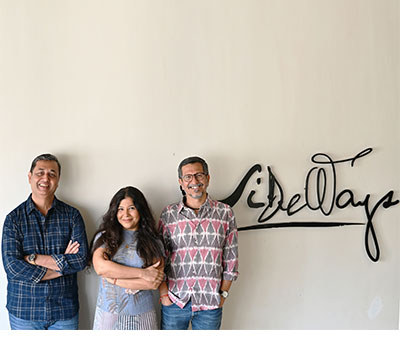
    Abhijit Avasthi’s Sideways is set to take its offerings to the market even more aggressively and to do this, it has on-boarded Malcolm Raphael as Chief Growth Officer. Raphael was last Senior VP and Head, Creative Strategy, Brand Content, Innovations and Trade Marketing at the Times of India group.

    Speaking on the appointment, Abhijit Avasthi, Founder, Sideways, said, “Till now we have grown only organically, by word of mouth, without participating in pitches, solely on the basis of our work and reputation. While we have worked with over 100 companies till date, I believe we can add exponential value to a lot more businesses  – it’s just that we have been very quiet about what we do and most companies are unaware of what all can Sideways do for them. Malcolm is the perfect person for taking the Sideways story to the world. Because of his varied experiences, he intuitively gets what Sideways does.”

    Commenting on his new role with Sideways, Raphael said: “What attracted me to Sideways is its unique approach to solving a business or brand problem. They are unlike any other agency or consultancy I have come across. I subscribe to their belief that in today’s environment, solutions to complex problems lies at the intersection of disciplines. They are able to provide these thanks to an eclectic team of strategists, technocrats, writers, product designers, management consultants, UI/UX and graphic designers and many others. I am looking forward to telling their story to the world.”

    At the Times Group, Raphael spearheaded initiatives like the Power of Print IP, Brand Equity Times Ahead, Innovation Roadshows and BrandScope, where he created consumer brands from scratch. He also led the Cannes Lions relationship and drove the Young Lions and Young Spikes competitions in India. He is part of the Advertising Club managing committee and has been part of the Effies, Emvies and Abbys juries.

  • Brand Strategist Sharad Gupta launches brand advisory firm

    Sharad Gupta
    Sharad Gupta

    Sharad Gupta, former Vice President & Lead-Corporate Communications at Escorts Kubota Limited, has unveiled his new venture, WNN-WhyNotNow, a brand advisory firm dedicated to transforming the landscape of marketing and strategic brand development.

    Speaking on the new venture, Sharad Gupta said: “With WNN, our unwavering commitment is rooted in empowering businesses to transcend their potential by offering unparalleled expertise in marketing, strategic communication, and creative innovation. WNN hopes to be a beacon for Start-ups, SMEs, and Unicorns, catalysing their journey towards success. As India emerges as one of the largest ecosystems for startups globally, boasting over one lakh startups, WNN is poised to play a pivotal role in supporting their GoToMarket and business journey, specifically focusing on marketing push and brand development to ensure their success. Our mission is to foster a collaborative synergy that propels our clients business goals, ensuring they not only survive but thrive in today’s fiercely competitive marketplace.”

  • 8Bit Creatives partners with Rooter

    8Bit Creatives, the gaming influencer talent management agency, has partnered with Rooter, a gaming and esports content platform. The objective: to “bolster the nation’s Gaming Creator Economy”.

    This collaboration will see 8Bit Creatives’ notable gaming influencers, PC gamers, and GTA roleplay creators, such as Tanmay Singh aka ScoutOp, Parv Singh aka Regaltos, Raj Varma aka Snax, Salman Ahmad aka 8Bit Mamba, Mithul Nayak aka 8Bit Binks stream and curate content on the Rooter platform.

    Said Animesh Agarwal aka 8Bit Thug, Founder & CEO, 8Bit Creatives: “Our collaboration with Rooter will act as a catalyst for the sustained growth of India’s gaming creator economy. We are excited to bring our gaming influencers and creators to a platform that shares our vision for excellence in gaming content as well as the prosperity of the community. Together, we aim to create an immersive and unparalleled gaming experience for millions of fans across the nation.”

    Underlining the shared focus behind the partnership, Dipesh Agarwal, Co-Founder and COO, Rooter added: “8Bit Creatives shares our strong drive to unlock massive growth opportunities for the Indian Gaming ecosystem and we are excited to collaborate with a partner like them. We’ve been facilitating multiple monetization opportunities for creators through partnerships with ~100 brands, fan donations, and more. With this collaboration, we will be working closely with the 8Bit Creatives team to elevate value creation for the creator community. We also aim to develop innovative marketing playbooks and solutions at the intersection of gaming, content, pop culture, and social media, which will establish new operating benchmarks for the ecosystem.”

  • Poonam Pandey & Cervical Cancer: A Case of Generation Gap?

    Poonam Pandey & Cervical Cancer: A Case of Generation Gap?

    With apologies to none at all

    Vikas MehtaBy Vikas Mehta

    Things moved fast last week. On Thursday, February 1, Union finance minister, Nirmala Sitharaman, announced in her interim budget speech that the centre is proposing a plan to encourage use of vaccine for preventing cervical cancer amongst girls 9-14 years of age. Cervical cancer is the second-most common cancer in India and almost a fourth of global cervical cancer deaths happen in India. No details of the government scheme were forthcoming but the initiative was lauded and welcomed.

    The very next day, news came in through her media team that controversial and newsmaker model Poonam Pandey had died at the age of 32 of cervical cancer. For me, it sounded too much of a coincidence but social media was trending with the news and there was much shock reaction too.

    Then a day later, Ms Pandey appeared to say that the news of her death due to cervical cancer was part of a campaign to raise awareness of Cervical cancer.

    And yesterday was World Cancer Day.

    All hell broke loose after Ms Pandey’s disclosure. My social media was full of angry friends and acquaintances. Influencer marketing had hit a new low, said someone. Another mentioned Ms Pandey’s past and said that she is not new to controversies. Her act may be for a noble cause but given her past it could cast a shadow on her intent, opinioned another. Someone mentioned that this marketing stunt had crossed all limits. The editor of this portal lamented the death of journalistic good practices as breaking news was more important than checking it out first.

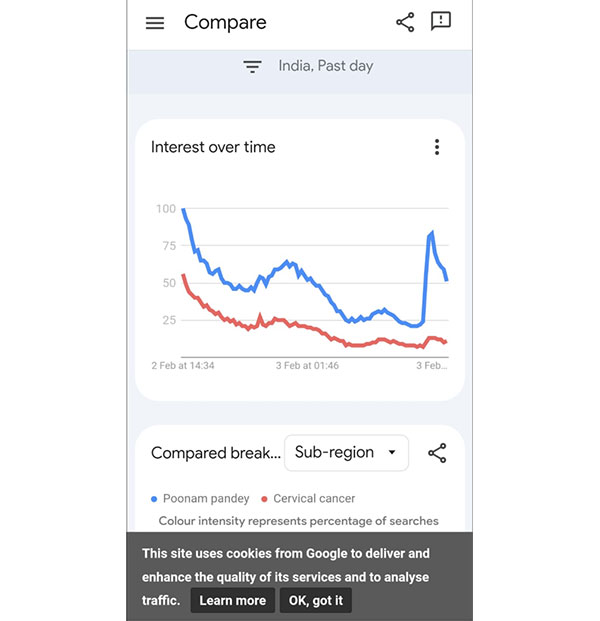
    A digital guru tweeted (or should I say Xed) a google analytical graph that demonstrated that search for Ms Pandey had gone up substantially whereas cervical cancer search was languishing.

    In the meantime, I had posted about this marketing deed on some groups which are solely populated by GenZ and the reaction I got was exactly opposite.

    How clever, said one. Don’t know who she exactly is but she seems to be famous and has used her fame well, chipped in another. Fake news is bad but nothing wrong in using fake news for good was another response I received.

    Sensing a generational gap (me, my friends and acquaintances are all over 50) and also a distinct shift in values and ethics, I challenged GenZ with similar comments as listed above by my generation.

    What I am narrating below are not my views but as generated by GenZ.

    • She didn’t die and willingly gave her name to a cause. What’s wrong in that?
    • We see worse fake news which is actually fake. This was not actually fake.
    • I did not know about cervical cancer and when my mother shared this news with me (of a celebrity dying so young), I found much more about it.
    • She did not kill anyone. She did not hurt anyone. She did not cause a loss or a scam. So how does it matter?
    • She may have gained lot of publicity for herself but it has brought cervical cancer in the news too.
    • Ethics and morality evolve with times. I am told a few decades ago it was not right for a boy and a girl to meet alone. Today it is accepted.
    • My parents want me to get high marks in exams. They don’t bother how. If I cheat and get it, it does not matter. The end result matters. Here too the end result is good.
    • What matters is grabbing attention. Nowadays news portals give sensational headlines which are only half true or in some cases not true at all. Or brands send message that my card is waiting despatch when I haven’t even applied for a card. If they can do so to catch attention then what’s wrong in this stunt?
    • Journalists anyways are all sold out and have no spine. So why expect them to chase the truth or research well before publishing a news (hear hear Mr. Editor!).
    • She seems to be old, but she thinks like us. Maybe I will follow her.
    • She should not have done this as it is inauspicious to fake death was a stray comment. But it was latched on to by 2-3 others and attacked. How can one be so old fashioned and traditional was the refrain. Do not believe in such superstitious things. Don’t you wear black?
    • I never knew that a form of cancer can be prevented with a vaccine. At least now I am aware.

    This last point resonated with me. I have a daughter who is now approaching her twenties and neither me nor my wife had ever heard about the dangers of cervical cancer or its vaccination. As I write this, my wife is talking to our doctor to see if she can be vaccinated.

    Now let me add my two bits to this generational gap issue.

    I do confess that initially I too was dismayed at this whole issue. In fact, because it was Ms Pandey and the news was released by her team and not family had seemed quite odd. But I could never suspect that someone will fake one’s own death unless it was for some subterfuge. So, my morality, traditional thinking and values were shaken.

    But when I heard some of the arguments, I realised that there are worse things happening to be upset by this. And it definitely was for something good. Even though data shows that the cause was a distant second to the influencer at least it had been stirred up. A small technicality too. I don’t think Ms Pandey is an influencer. At best she is a celebrity.

    This episode not just highlighted the generation gap but also reinforced a marketing dictum. Your users may be many but identify your target and talk to them. Don’t forget that this initiative was not Ms Pandey’s. It was initiated by the HPV vaccine and they should be lauded for targeting teenagers to get their attention to the dangers of cervical cancer.

    It also tells me how sharply segmented we are by demographics. News portals and social media like Facebook which are more frequented by the older generation have been quick to criticise Ms Pandey. Issues more relevant to this older generation like ethics, morality, tradition, good old days etc matter more and that dictates their writings and rants. It becomes a closed circle where nothing else matters or exists.

    The GenZ is not too troubled by these attributes. They are more open, not affected by past and more result focused. Some of my generation call GenZ instant gratification generation, but I think that’s unfair. They live in the present because they have no history to dwell upon. And with the rapid technology evolution, history becomes historical rapidly.

    Let’s not forget that brands have in the past also used half news or fake news to create sensation and frenzy. As a friend reminded me, Taj Mahal tea ran a PR campaign in the 2000s announcing that Ustad Zakir Hussain, who was the brand endorser, had decided to stop playing tabla. There was lot of frenzy and health speculation until it was revealed that it was a challenge, wherein the Ustad had announced ‘find me a better tea and I will stop playing tabla’.

    Wasn’t this also spreading fake news? Distorted news? So how was that acceptable? For, last I heard that became a case study on how to do good PR. How come Ms Poonam’s case was going to an extreme and falling to a new low? Or her past will shadow the noble deed? Or was it just because Poonam Pandey was used and not a “more respected celebrity”.

    Come to think of it, this campaign (that’s what I will call it from now, not a stunt) was about shock value but maybe it will also fall into the awe category.

  • Ranjona Banerji: No Graphic for the Budget?

    Ranjona BanerjiThe editor never even sent me a message asking me to write on the Union Budget today. Both of us belong to the newspaper era which really created excitement around Union Budgets. Every small bit of taxation on bobby pins and rubber bands was carefully dissected. Post-economic liberalization, the excitement reached peak limits. Massive graphics dominated the front pages, Marvel and DC super heroes most often.

    A couple of years after India’s economic liberalization in 1991, I was sent to cover legendary jurist Nani Palkhivala’s much sought after annual post-budget speech. This was at the Brabourne Stadium in what was still Bombay. Thousands gathered to hear the great man depose on the Union Government’s annual expenditure. At the end of his analysis Palkhivala however announced that he would no longer be dissecting the Budget. Liberalisation he said had changed everything and the Budget no longer had the same significance as when the economy was controlled and restricted.

    Newspapers however took no notice of the great man, and carried on with their massive spreads. I cannot describe the tremendous excitement which consumed newsrooms. Every department and desk from city to crime to sports to glamour was on Budget duty. The graphics and art departments were stretched to their absolute limits! Is it a bird or a plane, no it’s Budgetman! This was the 1990s when print still set the trends in media, so television followed suit, with their split screens, graphics and talking heads spewing their psychobabble. Since then however, everyone has calmed down a bit.

    And although we have had 10 years of the Best Government and Best Governance and Best Overall Life EVER in the history of India, Bharat and so on, not even the most diehard fan of the dispensation in the media has managed to sustain excitement over the annual budgets. A cursory look-through of yesterday’s news suggests that even the stock market, usually so loyal and overjoyed with everything this government does, did not in fact rise to massive, unprecedented heights?

    I picked up the basics from a couple of comedians. Some guff about women, farmers, youth and something.

    For clarity I would go no further than Vivek Kaul:

    https://www.newslaundry.com/2024/02/01/what-the-finance-ministers-budget-speech-tells-us-and-what-it-doesnt

    **

    What is happening, which obviously the mainstream media will not focus on except when it can blame the victim, is the palpable increase in attacks on Muslims ever since the Ram Temple was inaugurated at Ayodhya in January. Once again, Hindutva mobs have been given a free pass. This in an election year, Jai Shri Ram was been turned from an expression of faith to a war cry and the Indian media is a happy participant in this war against democracy. This week, the Supreme Court of India allowed Hindu prayers in one more “disputed” mosque, covered by the Hindutva movement – Gyanvapi.

    The daughter of an Indian politician and diplomat disagrees with the state participation in a temple inauguration. For this, she receives a letter from the president of the Residents Welfare Association, for a property owned by her father which objects to her views and then demands that she and her Father apologize and if not, move out of their property. At least this absurd bit of majoritarian bullying got some publicity. But only because the Father in question is the redoubtable, outspoken Mani Shankar Aiyar.

    Umar Khalid will obviously never get bail for his terrible twin crimes of being Muslim and of being pro-democracy. The chief minister of Jharkhand has been swept into the Enforcement Directorate’s clutches for not being BJP – is there another explanation? The election for the mayor of Chandigarh displayed public snatching and defacement of ballot papers by the presiding officer and the BJP to ensure that the BJP won.

    These are a few small stories about today’s India…

    There is no media graphic which will put the overall picture in place for we the people.

    I wonder why. Or do I?

    Ranjona Banerji is a senior journalist and commentator. She writes on MxMIndia on Tuesdays and Fridays. Her views here are personal. 

  • IAB Tech Lab launches Accountability Platform

    IAB Tech Lab, the global digital advertising technical standards-setting body, has announced the launch of Accountability Platform, a technical audit framework designed to help businesses deliver greater transparency in using personal data for addressability.

    As per a communique, companies that pass and receive data to support personalized advertising can leverage the Accountability Platform to audit that their business partners are honouring consumer-provided consent signals throughout the supply chain. This includes brands and publishers, supply-side and buy-side technology companies, identity resolution technology providers, other third-party data providers, processors, and data collaboration solutions (aka clean rooms).

    Said Anthony Katsur, CEO, IAB Tech Lab: “Compliance without assessment is a promise unfulfilled. The goal of the Accountability Platform is not only for companies to be able to say they are adhering to the privacy choices of consumers but to be able to prove it through a normalized set of compliance data usable for self-assessment, and third-party assessment. Without consistent and widely accepted accountability measures in place concerning the disclosure of consumer privacy preferences in digital advertising, there is a risk that organizations may only fulfil their obligations superficially, leaving room for non-compliance or unethical practices.”

  • Dentsu mandate for TTK Healthcare expanded

    TTK Healthcare has expanded the mandate for Dentsu Creative India. The agency will now manage the social media and media duties for three of its brands – Skore, Eva and MsChief. The account will be serviced from the agency’s Mumbai office.

    Speaking on the win, Arjun Siva, DGM – Digital Marketing & eCommerce, TTK Healthcare said: “We are delighted to extend our relationship with Dentsu Creative and add MsChief to the set of brands that we partner on with them. We’re confident their proven expertise and consolidated creative and media strengths will help us enhance our digital presence and drive business for our brands.”

    Added Sahil Shah, President – Digital Experience, Dentsu Creative India: “With this consolidation, we have further solidified our position in strengthening TTK Healthcare’s digital efforts. And, for us, the most exciting part is that we are able to see through end-to-end digital – creative, media, and data included – for these ambitious challenger brands. I am extremely confident that we will deliver both brand and business results through the power of integrated digital for TTK Healthcare brands.”

    Said Manika Juneja, Managing Partner – Digital Experience, Dentsu Creative: “We are ecstatic to strengthen our collaboration with TTK Healthcare! Our journey began with Skore and Eva, and now, with the addition of MsChief, we are truly grateful. Our team is poised to inject integrated digital excellence into these brands, ensuring they not only stand out but thrive. The ongoing partnership promises exciting success, and we look forward to achieving new heights with TTK Healthcare as our valued partners.”


  • Mallika Sarabhai & Nexion enter into a three-year partnership

    Nexion, the Indo-Italian company in the production of sintered stone, entered into a sponsorship agreement with the Darpana Academy of Performing Arts in Ahmedabad, India. This collaboration was proposed by Mallika Sarabhai, an internationally renowned activist, prestigious actress, and celebrated dancer in Indian classical dance. Sarabhai and Nexion decided to form a three-year partnership to sponsor an artist residency at the Darpana Academy.

    Said Luca Majocchi, CEO, Nexion: “Since its inception, we have brought the Italian way of doing business to India. With our commitment to societal contribution, we seamlessly align with Darpana Academy, celebrated for its rich legacy in promoting art and culture. Massimiliano’s participation in the residency further underscores our shared dedication and efforts. This commitment extends to our core values, where we prioritize people’s well-being through the consistent delivery of high-quality products. Our holistic approach interweaves cultural exchange and community well-being, creating a meaningful connection between our values and endeavours.”

    Added Sarabhai: “Working on Macbeth with Massimiliano was a delightful experience. His diverse background as a theatre director, film maker, and puppeteer aligns well with the varied artistic fields at Darpana. The synergy between our culture and artistic approach allowed for the emergence of new and exciting elements during the collaboration.

  • NBA launches of ‘Nets for Change’

    The National Basketball Association (NBA) has launched ‘Nets for Change’, a new campaign to repurpose discarded underwater fishing nets at basketball courts in India. The discarded nets, which pose a threat to marine ecosystems, are being repurposed as basketball nets at courts that are missing a fundamental element of the game – a functional net.

    In collaboration with Publicis Communications, Middle East and Africa, the pilot project launched at a school in Mumbai with plans to expand to other markets. The league and Publicis are working closely with seaside communities in Mumbai to retrieve abandoned fishing nets, which are then transformed into durable, eco-friendly basketball nets.

    Said NBA India Head of Marketing Murtuza Madraswala: “The launch of ‘Nets for Change’ reflects our commitments both to environmental responsibility and to growing basketball across India. Discarded underwater fishing nets pose a significant environmental threat, and through this initiative we will give these nets a new purpose, so that aspiring players have higher-quality courts where they can come together to play the game.”