
Category: MEDIAAH!

Season 3 of Pradyuman Maheshwari’s no-holds-barred commentary on the media

  • Hang your heads in shame, NBA Board!


    By Pradyuman Maheshwari

    The News Broadcasters Association has some really big industry folk on its managing committee… the Board of Directors as they call it.

    At a personal level, they are all achievers, and I respect them. Click here for the list. Now, let me first say very unequivocally: I hold no brief for Republic TV. I must confess I am not really a huge admirer of the Arnab Goswami school of journalism. MxMIndia – with our Consulting Editor Ranjona Banerji chiefly and myself – has damned his shows enough when he was on Times Now.

    But that’s my – or our – personal view. We believe it’s a free world, and if he does transgress – as in, cross the line, there are enough forces – political, business and legal to correct him. For the now, the masses are lapping him up. He’s the voice of the new Indian.

    The fact of the matter is that the Arnab Goswami brand of news television has worked wonders. And this not just in terms of viewership or ratings, but also with those with the monies. Republic TV’s list of benefactors tells the story.

    So when he decided to start his own channel, there were worrylines all over. Here was a man who could rewrite the rules of the business if he has enough staying power – moneywise.

    Remember just having a credible, independent voice is not enough. If that was the case, MxMIndia would’ve been super-super-successful revenue-wise. But that’s not the case, we don’t aggressively solicity advertising. We just nudge. Those who believe in us, back us.

    But this is not our story. This is the story of an industry association leadership that must indeed hang its heads in shame.

    Or perhaps wear bangles, like this:



    Gosh, have we gone too far… bahut ho gaya?

    Nahin. Nooooo. Do you recall the disrobing of Draupadi in the Mahabharata? What happened on Thursday evening is something as bad as that.

    Or let’s look at another example. We all know that the examination-oriented system of education has major problems. We also know that papers leak. We also know that kids cheat. But do we just exit the system screaming “Screw it!”. Will a school or a parents’ association advise students not to take their exams because the Class 10 or 12 exams are a sham?

    Well, we can exit the education system. It’s possible to flourish without the degree or certificate. But you’ll need to figure how the world will assess you.

    I am not convinced that the News Broadcasters Association – which is headed by some very discerning names – could be buckling under pressure from some members who perceive Republic TV as competition.

    If it genuinely felt aggrieved, there were other things that NBA could do. Like when it realised that BARC was going to go ahead with the release of ratings, if it felt it had a genuine case, it could’ve approached an appropriate Court of law (and not the Courts set up by some of our anchors across various channels) and urged for a stay!

    Why didn’t it do that?

    Why doesn’t the NBA issue a diktat to all its members asking them to not go in for any ratings-boosting activity like dual LCNs, landing pages/slotsetc?

    As I write this, I am aware that some advertisers are reconsidering their advertising on the English news channels. They may threaten a pull-out very soon. And much as I would like every media entity to flourish, the English news channels who have pulled out of BARC ratings need to see reason. Or be shown the stick.


    Here’s what needs to be done:

    1. The NBA must reverse the advisory to its English news channels to pull out of BARC

    2. The English news channels must get the watermarking back

    3. The NBA, ISA and AAAI must convene a special meeting – which may be convened by the CEO of a network/channel who has no skin in the game – like NP Singh of Sony Pictures or any other respected industryperson like, say, Sameer Nair (now CEO of Balaji). Note I have not mentioned the names of Star India Uday Shankar because he is a former news television CEO. Also the Zee and Viacom18 heads have sibling channels in the news business.

    4. All broadcasters must take a joint decision on the issue of dual LCNs, landing slots

    5. The AAAI must be urged to only deal with channels/entities that are affiliated to the IBF or NBA, so that it will ensure that all channels toe the IBF/NBA line

    6. All advertisers on television channels (Patanjali included) should be convinced to become ISA members to ensure that the rules are followed. Similarly, broadcasters should only deal with AAAI-membered agencies.

    7. IBF and NBA must admit members provisionally without any delay, on clearance of cheque/RTGS/NEFT etc

    8. Since NBA has limited number of members, and there can always be charges that all the channels can gang up against a new entity, there should be a recourse available to an aggrieved member to go to a joint committee of the IBF, NBA, AAAI and ISA which may be set up

    9. Meanwhile, BARC must set up a clear deterrent as a rule that if any channel decides to opt out of its ratings, it will not be allowed to return for a period of one year or payment of Rs10-25 crore or some such

    10. IBF and NBA must ensure that the BARC advisory/guideline on channels advertising is followed strictly. Those who are repeated defaulters should be penalised in the form of a lower payout of advertising monies on the channel. And eventual debarring of payment.


    All of the above needs to be actioned before the Week 20 BARC numbers are released.


    Pradyuman Maheshwari is Editor-in-Chief, MxMIndia. The views expressed here are his own

     

  • 10 Reasons why English News Channels have been generating a Frown…


    By Pradyuman Maheshwari


    If you’ve been subjecting yourself to the developments of the last few weeks, you would possibly be left wondering whether the same news media that sermonises on what’s wrong and what’s right in India has embarked on a path that’s very uncool. Uncool is perhaps too soft a word. As the road sign says: Danger lies ahead.

    Let’s start with the beginning:

    01. Shout as if there’s no tomorrow: I was among the first commentators to applaud Arnab Goswami in 2008 for asking the tough questions. But is it right to forever keep raising your voice – with 6 to 8 talking heads screaming and shouting? Perhaps not. And even on nationalistic issues, if Pakistan is Enemy #1, why call people from there? How about some neutral, global commentators? And look at what’s happened when Goswami left Times Now? Another bunch of noise-makers!


    02. There’s no really neutral English news TV channel. Sadly, there is no clearly neutral English television channel. NDTV 24×7: Appears neutral only because it doesn’t gush about the government, but clearly left liberal. CNN-IBN is mostly neutral and isn’t obviously pro-Modi even though it’s Mukesh Ambani-owned, but given its ownership, it can’t obviously be neutral. Must say that it hasn’t been tested on this score yet. India Today: Rajdeep Sardesai is exceedingly neutral, but Gaurav Sawant? And why did they need to cover Yogi Adityanath live for nearly two days. And Times Now: unlike the paper, the channel is pro-BJP, and in my mind, it’s to the extreme. Sorry, I don’t watch enough or any of NewsX and WION to comment on them, but from what I remember of it, NewsX isn’t exactly neutral and WION is as of today too insignificant to matter


    03. Legit, but unfair distribution marketing: Using multiple frequencies to promote themselves on different genres is wrong as per the rules, but almost every channel has been reported to have indulged in it – in the distant and recent past. At one level, it’s an unfair practice. But why should the government or TRAI bother. An activity likes this costs top $$$s (in fact $$$$$$$$$$s), and a channel can’t do it forever, unless it cares a damn about its bottomline. Crying to the quasi-government TRAI and the ministry too often can backfire bigtime!


    04. Pulling out from the BARC ratings is incorrect. The joint industry body was set up by the ecosystem – broadcasters, agencies and advertisers. And the setting up was accelerated because of a news network’s angst against the earlier measurement firm (TAM). The likelihood of relative errors is a reality, and needs to be factored in at all times. Does this mean one must pull out of the measurement system. What the News Broadcasters Association (NBA) has done doesn’t augur too well for the entire ecosystem. In fact it was Regressive. Let’s capitalise that: REGRESSIVE!


    05. While television channels can be aggrieved, industry associations should be above interests of individual channels. The NBA erred on that. NBA President Ashish Bagga, is also CEO of TV Today Network, which runs the India Today channel and the decision to advise member English news channels to pull out was taken under his leadership. From what I hear, NBA may not be a divided house on this decision, but it’s clearly not united on it. There are some who believe that the episode could’ve been handled better. Meanwhile, I believe constituents of the ecosystem mustn’t handle them with kid gloves, as I think they have been.


    06. The secretariat of the two key industry associations could do with some attention. The reason why NASSCOM or the much larger FICCI and CII are so successful is not because of the Chairman or Presidents, but because of the Secretary Generals or whatever the head of the secretariat is designated. The IBF, which is 60 per cent owner of BARC, chose to stay mum on the issue. And the NBA secretary-general chair perhaps needs a new occupant. The issue could’ve been handled better had there been a more dynamic head of both these bodies


    07. Times Now has been making optimum use of its siblings The Times of India and Economic Times for promotion. What it doesn’t realise is that its readers see through the negative propaganda and every printed report actually gives more publicity to Arnab Goswami’s Republic TV. While it’s got India’s most celebrated journalist as a mascot, Republic got a major shot in the arm with all the publicity in the #1 paper of the country. Earned media or whatever it’s called! PS: the page slug on the ET page that carries the report today says: Pure Politics.


    08. Cross-ownership issues have sprung up again with the Times of India and Economic Times offer prime space for negative stories on Republic TV. The stories make for good fodder for a trade site, but for a broadbased general news or a business daily? Had it been any other country, there would’ve been complaints on cross-media ownership. In India, no such luck. Governments are just too scared of the print mediawallahs


    09. BARC guidelines not followed on advertising: This is something that Republic TV is going to get nailed on. By promoting viewership numbers for just one or two weeks, one is going against the guideline of advertising viewership numbers. The problem is that the reprimand, if any, happens when the damage is done. And the only way in which this malaise can be corrected if an industry association issues a diktat and imposes penal action.


    10. The NBA and all the English news channels must realise that while the wars may have resulted in greater viewership attracting undue attention can be counter to their overall interests. For instance, the repeated statements by various people that the English news channels audiences don’t really matter. Etc, Etc. In the longer run, the perception sticks while making advertising decisions. And all of it is very bad for the genre as a whole.


    Pradyuman Maheshwari is Editor-in-Chief, MxMIndia. The views expressed here are his own


  • Time for Vineet Jain & Arnab Goswami to smoke the peace pipe?


    By Pradyuman Maheshwari

    There are liars, damned liars and statisticians. And that couldn’t be truer when it comes to TV viewership claims.

    Data can be misrepresented and quoted by slicing and dicing to an unsuspecting public, marking a dwarf look tall. That’s exactly what’s happening in the English News Genre lately.

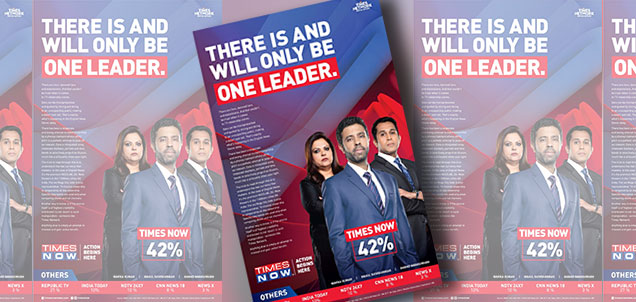
    There has been a desperate and losing attempt to claim leadership by a phoney claimant whose shrill pitch is pathetic attempt to pass off as relevant. Data is misquoted using irrelevant markets, periods and time bands to selectively project an illusion, much like a silhouette show uses light.

    The trick to read through this is to understand the real currency that matters. In the case of English News it’s the premium NCCS AB, 22+ Male Viewers in the 1 Million+ cities All India. The six Mega City data is also representative. TV channel viewership is compared by all day viewership. Specific time bands are used only when comparing shows and not channels.

    Another way to know, is if the source itself is of highest credibility and known to not resort to such manipulation – someone like Times Network.

    Anything else is simply an attempt to mislead and gain undue benefit.

    No marks for guessing who the ad is targeting. Republic TV, of course. And since the recently launched news channel is all about its founder, editor-in-chief and chief promoter Arnab Goswami, it’s hitting out at Goswami. The phoney claimant whose “shrill pitch” being “a pathetic attempt to pass off as relevant” is hence none other than Goswami, the former Times Now bossman.
    But one must say that the ad has happened after much ‘tu tu main main’ between the bosses of Times Now and Republic TV.

    Sources within the Times Network establishment as well as in the news broadcast industry say that  more than the war of the Times Network (the broadcast arm of the Times of India group), it’s a war of sorts between the group’s managing director Vineet Jain and Goswami.

    Prior to the launch of the Republic, Goswami has compared the battle for supremacy between the two channels like that of a David versus Goliath. There was a controversy around certain trademarks filed for and there was a very clear and loud offensive from both ends.

    At MxM, we have observed each and every move of both channels and both owners, and we can say that both have tried their best to outwit each other. Goswami and his crew have also not stopped short of taking potshots at the Times group, though they may not be be as vitriolic as the text of the advertisement.

    The News Broadcasters Association (NBA) which has the Times Network CEO in its top leadership also got into the act asking for measurement body BARC to not publish Republic TV data because it employed an incorrect trade practice or multiple LCNs. After Republic pledged to the Courts that is not resorting to dual LCNs to shore up its numbers, both channels got into the act of landing pages.

    Landing pages is until now not an illegal practice, but requires a spend of big monies to the distribution trade. According to unverified information that we have received, the collective spends from the two channels per annum would be in the region of Rs 20-30 crore. The bulk of the spends is from Times Now.

    What landing pages helps achieve for both channels is that the viewership numbers leapfrog, but that doesn’t necessarily mean an increase in time spent on the channel. In fact the average could go down as people view a certain channel only for a minute-odd and then switch to the channel of their choice.

    Industry seniors MxMIndia spoke with aver that the amount spent on pushing distribution in an inorganic manner is a waste. I would rather have the monies being spent on newsgathering and improving the quality of the content or even other outreach activities, said one trade captain.

    But the stakes are high for both channels. Republic TV, given the reputation that Goswami had built for himself at Times Now, needed to be on top of the charts to create an impact. And for Times Now, being part of India’s biggest news media company, it needed to show that it’s not dependant on any single individual to stay on as the leader.

    Sadly, the network doesn’t seem to have learnt from its mistake, and in the case of Mirror Now, it is only propping up the channels primetime anchor and editor-in-chief Faye D’Souza.

    Times Now has tried its damnedest to ensure that it doesn’t get affected, but even some insiders concede that the channel has taken a beating post the exit of Goswami. Also, the primetime alternatives that the channel has put up don’t really match up to Goswami.

    However, it is creditable that the channel has not lost out very much, and that has been done thanks to its extensive reach and also editorially, it has ensured that it keeps raising the bar, even though content-wise – and in the pro-Narendra Modi, pro-rightwing genre – Republic is clearly a better channel.

    Sadly, the channels with more neutral content – like India Today and CNN-News18 haven’t been able to measure up on the ratings roster. A more anti-Narendra Modi NDTV 24×7 which has been facing some heat given its financial past has also not been able to put up good numbers on the weekly BARC charts. In fact there was a time when the channel even exited from the Top 5 English news channels.

    According to audience measurement numbers that we have seen, there is a clear inorganic rise of both Times Now and Republic TV. That of the former is very evident given the average numbers it generated before the launch of Republic.

    Our view: For the larger good of the news business, it’s important that both Times Now and Republic TV and specifically Vineet Jain and Arnab Goswami smoke the peace pipe and stop wasting money on pushing distribution. And indulge in this ‘tu tu main main’.

    It’s vital that broadcast trade associations like the IBF and NBA make the two see reason and back off. Let the content do the talking, and not fight via advertising and inorganically generated viewership numbers.

  • Let’s get together to save Mumbai!


    By Pradyuman Maheshwari


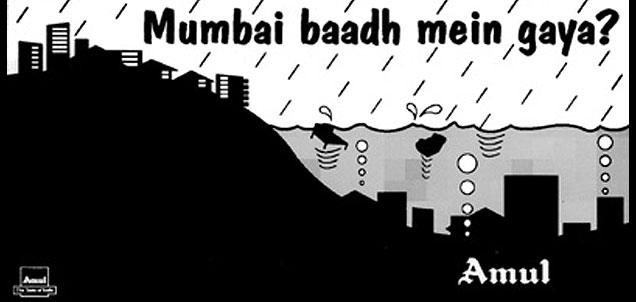
    Baadh mein gaya Mumbai. This was the Amul ad from August 2005 on the unprecedented heavy rains flooding Mumbai causing loss of lives and havoc to people, their homes and properties.

    There have been a few other Amul ads, that you can see here.

    Perhaps the folks at da Cunha are working on an all-new creative for this year’s downpour. The quantum of rains may not been a patch in comparison to what we had in 2005, but it was more than the normal.

    What got the entire country talking about it was the presence of a hyperactive social media, messaging platforms like Whatsapp and of course very belligerent English news channels. The belligerence has gone up ever since Republic TV launched earlier this year, with news anchors turning the tough questions to a screaming-and-shouting match.

    There are several issues here. While one understands that even the world’s best urban infrastructure can’t handle heavy rains beyond a point, the scene in Mumbai was largely manmade and mishandled.

    For instance, why was there no advance warning that there could be very heavy downpour. Why can’t we have graded alerts that ask people to stay indoors and keep schools and colleges shut?

    What about the drainage systems of the city? Was there enough done?

    Also, the potholed roads. Part of the problem of traffic jams is the presence of major craters at key positions.

    Mumbai surely deserves better.

    And it’s the community that reads MxMIndia – the advertising, media and marketing fraternity that needs to get into the act and force the government to act.

    Let’s us have a safer Monsoon 2018.

    But for that, we need to wake up now. And act immediately.

    Else, Mumbai really baadh main jaayegi.


  • Mediaah!: #AreYouSeriousTimesNow


    By Pradyuman Maheshwari


    I have no special love for Rahul Gandhi or the Indian National Congress. While we have seen some good things happening in the country when the party governed the nation, we have also suffered from years of misrule and corruption. And casteism and votebank politics.


    I also don’t think too much of Rahul Gandhi. Okay, let me correct myself: I also didn’t think too much of Rahul Gandhi. But since his US trip a few months back, I can see an all-new persona. Perhaps it’s created by the media, perhaps we are looking at things with a different filter. Or perhaps it’s angst against the Narendra Modi-BJP dispensation that has altered my perception.


    While it’s true that it’s the winner who finally matters, this is not a game of tennis or cricket. The fact is the Congress came a not-too-distant second and with some margins being wafer-thin. So while the BJP retained Gujarat, it wasn’t too bad a loss for the Congress.


    There have been various attempts by people from across the spectrum – journalists included – to discredit the Congress by saying that only the winner matters.


    We know that Karnataka, Rajasthan and Madhya Pradesh go to the polls next year along with a few others and the general elections are scheduled to happen the year after (2019). And the performance of Rahul Gandhi and the Congress in Gujarat will have a significant impact on the entire political landscape.


    It’s quite likely that the 2019 General Elections will see the return of Narendra Modi as Prime Minister. But even the Prime Minister is said to have admitted to aides that a course correction is critical. Like the revision in GST rates helped save the day in urban Gujarat.


    There have been issues about how serious Rahul Gandhi will be now that he has taken charge as Congress President. Will he take off for longish holidays? This is a question which I heard even being raised by Rahul Kanwal on India Today.


    In the context of this, Times Now made a “dramatic disclosure” of Gandhi Jr going for a film – Star Wars – on Monday evening, hours after the results were confirmed in both Gujarat and Himachal.


    Personally, I don’t see any major virtue in anyone being a workaholic. It’s important to chill, take breaks. It keeps you healthy. And it’s critical that the country is governed by people who are health-conscious. Nothing wrong if they take a break or watch a movie or step out for a meal.


    I didn’t watch Times Now last evening (Dec 19), but my Twitter panel was full of posts damning the channel for a show it aired, hashtagged: #AreYouSeriousRahul. A post on Twitter said:  “6 hours after Gujarat loss, Rahul Gandhi was watching ‘Star Wars’ at a cinema hall in Delhi. #AreYouSeriousRahul Watch @thenewshour with @navikakumar”. There was a good primetime show on it anchored by Times Now editorial head Rahul Shivshankar: http://www.timesnownews.com/india/video/rahul-gandhi-indian-national-congress-gujarat-himachal-pradesh-star-wars-cinema-hall/179827


    Shivshankar doesn’t scream and shout, and does try to balance things, but why raise an issue when there is none? Why is Times Now trying to discredit Rahul Gandhi when there’s no need to do it. And does his going for a movie mean that he doesn’t care about the country or his party. On the contrary, I think it made him appear cool (spelt kewl?) and would appeal to the large number of young urban voters.


    It’s ironic (and thankfully so) that The Times of India, the popular English daily from the group is significantly more reasonable than Times Now.


    One may argue that this is how Times Now has always been and the editorial policy was set by Arnab Goswami when he was President – News and Editor-in-Chief shaping the channel to be a pro-right news entity. But when Goswami left, Times Now had the opportunity to rewire, change things and turn neutral in its political ideology.


    That didn’t happen, and things only got worse. Result: while Republic TV launched in May this year, Times Now tried to be a me-too and failed miserably. It boasts of high ratings in sliced age groups and not the relevant viewing mass as released by BARC. While the high numbers in the big cities are significantand perhaps 50-plussers don’t matter, at an overall level Republic TV is far ahead of Times Now. (Do read Ranjona Banerji on Times Now at http://www.mxmindia.com/2016/05/ranjona-banerji-has-times-now%e2%80%99s-news-hour-gone-totally-beyond-journalism-as-we-know-it/).


    This story by Times Now hit a new low in journalism, and I’m shocked at the mindset of the editorial thinktank at the channel.


    I have spoken with a few people within the channel, and they too aren’t too happy at the stance taken, but then they need the job. And who really cares about their sentiments.


    Perhaps the folks at Times Now don’t realise it, but stories like these are doing a great disservice to their own brand. And whatever value it still retains.


    There’s only one person who wouldn’t be complaining. Rahul Gandhi. He now appears to be as the leader of a new India. Young, restless. Works hard. And loves his R&R.


    The views here are personal


  • Are our Print Pashas mature enough to accept IRS 2017?


    By Pradyuman Maheshwari


    The Indian print industry is much-pampered. While television should rule in a country with a low literacy rate, it’s the print players who appear to get all the sops. There’s a 5 per cent GST on advertising in print. It’s 18 per cent in other media.

    There is no restriction on advertising volume in print. And there is no government rulings or guidelines for bodies in the business of audience/reader measurement of newspapers and magazines.

    Net-net, it’s a near-free-for-all.

    Now what happens when you leave kids without any control. They can grow to be very independent and confident adults, or can go offtrack. Our print players may not have gone astray, but it wouldn’t be incorrect to say that many of them have acted with loads of immaturity when it comes to readership measurement.

    We aren’t recommending government intervention in monitoring as the broadcasters led by news channels invited upon themselves, but there’s reason for worry given that the Advertising Agencies Association of India and the Indian Society of Advertisers, the two apex bodies of agencies and clients, haven’t flexed their muscles and told newspapers and magazines that if they reject measurement studies, they will not get any ads.

    IRS 2017 is due to be released in the third week of January 2017. While there is no specific date given, this would mean any day starting Monday, Jan 15 to Friday, January 19.

    According to a communique, the “IRS Techcom, RSCI, MRUC along with the Nielsen team have left no stone unturned in their endeavour to provide the industry with a reliable and robust study. The team focussed on enhanced levels of scrutiny adopted via frequent field visits, backchecks, use of GPS tracking devices, audio recordings, and quarterly validations. There was also an encouraging response from media agency personnel who took part in field backchecks and accompaniments. Data validation for all the four fieldwork quarters for IRS 2017 was successfully completed last month.”


    Commenting on the release of the report, Ashish Bhasin, Chairman, MRUC and Chairman and CEO – South Asia, Dentsu Aegis Networks, said: “Absence of IRS data in the past three years or so has impacted our industry in many ways. It was difficult for the agencies to plan without the availability of a comprehensive and reliable study, which provides valuable information on product ownership, demographics, and media consumption habits, across markets. Advertisers and Publishers, in particular, relied heavily on intuition and market perception, leading to loss of opportunity in maximising profitability. We are delighted that the IRS is back and we expect that this will set a new standard for Print Research globally.”


    Pratap Pawar, Vice Chairman, MRUC and Chairman, Sakal Media Group, added, “The print industry has been eagerly awaiting the release of IRS. I would like to thank the stakeholders for having shown tremendous patience and also for providing their unstinted support to the industry study, which was really great to see. Going forward MRUC and the IRS would continue to deliver the best and tread on higher paths of glory.”


    And this is what Shashi Sinha, RSCI Managing Committee Chairman, and CEO, IPG Media Brands, stated: “There is no other readership study in the world other than the IRS that caters to a complex and diverse market like India with a sample as large as 3 lakhs plus households, and with a methodology designed to deliver gold standard research. I believe the RSCI Techcom and the MRUC has put in a lot of effort to perfect the upcoming Report, making it future-ready and synonymous with the market truths.”


    Added NP Sathyamurthy, Chairman – RSCI Technical Committee and Executive Director, DDB Mudra Group: “After months and months of dedication, we have come out with a product that we believe is truly world-class. The IRS has constantly innovated with new technology led solutions to improve veracity of data capture quarter-on-quarter, and the sheer focus on data scrutiny which we deployed makes us believe that the new improved IRS would reap rich dividends for the industry stakeholders.”


    It’s important to read the above quotes at what they are stating and what’s possibly written between the lines:


    So let’s interpret these quotes for you:


    Ashish Bhasin: Lack of measurement data has nailed the industry and resulted in loss of opportunity in maximising profitability of newspapers doing well.

    Pratap Pawar: Thanks for the patience folks, we are back.

    Shashi Sinha: Conducting an IRS is a complex task but we’ve achieved it

    NP Sathyamurthy: It’s new, improved


    Now here’s what the four gentlemen possibly wanted to say, but they couldn’t have in an official communique:


    Bhasin: If you don’t accept IRS 2017 as currency, print players are going to get screwed

    Pawar: Grow up, guys. Accept the data.

    Sinha: We’ve done as well as we can. It’s robust. Now junk it at your own peril

    Sathyamurthy: We’ve taken care to not repeat the mistakes of the past, so please accept the data

    Having tracked readership and audience measurement systems actively for a while, it’s clear that it’s a lose-lose if the print majors rejected IRS 2017.


    According to the grapevine, the going may not be as bad as it was the last time. Care has been taken to plug all possible holes, and ensure that there are no booboos. Also, the data has been validated and is kind-of under control.


    But it’s possible that English newspapers will take a hit given the emergence of digital as a big force. And this could lead to some angst. It’s possible that there will be some reversal of fortunes among some regional players too given that a lot has happened over the last five years.


    Does this mean that there could be litigation and MRUC/RSCI will be taken to court? It would be foolhardy to think there wouldn’t be. And MRUC/RSCI would be well-advised to have their lawyer retainership renewed and ready with her/his arguments.


    ~~


    It’s important to note here the tremendous work done on the establishment of BARC for television measurement in the last three years. That BARC has been a super success despite the stakes being much higher in television is thanks to a variety of factors.


    1. Television is largely professionals-driven. While owners are active, professionals understand the dynamics of the business and do know that what is down can also go up.

    2. The importance of the owners and CEOs to deal with data with maturity. One of the primary reasons for BARC taking off was the presence of Punit Goenka as Chairman. Despite flagship channel being humbled in the first few weeks, Goenka is said to have given the green signal to the launch of BARC. Does MRUC/RSCI have someone who is even close to Punit Goenka in terms of maturity to deal with indifferent data?

    3. A robust technical committee: The BARC techcom is headed by IPG Mediabrands CEO Shashi Sinha, who heads RSCI, the real ‘custodian’ of the IRS. It’s critical for any techcom to be wordly wise as well as firm and able to take along the diverse ecosystem. Sinha managed that fantastically, and the print sector is lucky to have him active on IRS.

    4. A superstrong secretariat. No industry-owned body can be successful if you do not have a secretariat that’s strong and can ward off the nasty (if not evil) forces. In CEO Partho Dasgupta, BARC had that. The next few months will need MRUC CEO Radhesh Uchil to be the same with all the holy cows of the business. And if necessary bare his fangs…


    At MxMIndia, we will monitor the launch of IRS 2017 and also give you the real story post that. But in the interests of the industry and the print sector, we hope we don’t have to do burn the midnight oil post the launch.

  • Time to celebrate the all-new Abby


    By Pradyuman Maheshwari


    Pradyuman Maheshwari

    A few years back, on the sidelines of its internal Envies Awards, Piyush Pandey had told the media that he found that some members of his agency did not have any respect for the Abby Awards won by them and found the metals strewn all over. Not his exact words, but this is what he meant to say.


    For long, former Lowe Lintas has rubbished the Creative Abby and was the first amongst the big boys who stayed away from the Abby.


    Interestingly, both Ogilvy and Lowe are active participants of the Effies, though in the last edition, the MullenLowe Lintas group stayed away reportedly not because of any angst against the organisers. Bottomline: both agencies have nothing against the Advertising Club, but they don’t really much for the Creative Abby.


    Juniors in the agencies have often cribbed that they don’t have Creative Abby metal honours to sport on their CVs, but the attraction of international awards and participation in the Effies has been some consolation for the rank-and-file. Ogilvy of course has been participating and is an active supporter of the Kyoorius Creative Awards.


    To be fair to Ogilvy and Lowe, the Abby Awards (and the organisers) deserve some credit for letting the rep of the awards slip a few years back. It required the gentle aggression of Shashi Sinha to start the cleaning up, followed by Pratap Bose and later Ramesh Narayan to ensure that things were brought in order.


    But I am delighted to note that in the 2018 edition, the Ad Club and Goafest thinktank have taken some dramatic measures to cleanse the system.


    So the countless categories that were added to the list over the years have been dropped. This has resulted in a significant loss of revenue to the organisers, but it also ensures that the awards are rationalised.


    Ad Club this year persuaded Ajay Kakar to take charge of the Awards Governing Council. Kakar, who has spent the bulk of his working years on the agency side of the business but now CMO of the high-spending Aditya Birla Capital,has been a closer watcher of what has worked and what hasn’t for the Creative Abby. He has also been head of the Effie Awards as well as some international juries so is clued into the ways in which jury processes ought to happen.


    So this year, he unveiled a masterstroke in the form of the Masterjury where he called upon 15 creative hotshots to lead the judging process end-to-end. Including the initial sifting to the final judging. Also, the earlier pre-requisite that only representatives of agencies participating was done away with.


    I understand from the grapevine that not all were happy with the constitution of the jury. There were some who felt that there shouldn’t have been two biggies from one agency. And then there was a sentiment that the emphasis was on big name creative biggies. What about those who’ve been doing great work, winning awards, but belong to smaller agencies.

    And last and most importantly: there is no Piyush Pandey in the Masterjury. There’s no Sonal Dabral either… in fact there’s no one from Ogilvy. The official reason given is that Pandey and Dabral weren’t available, but there are some other theories doing the rounds. That Kakar wanted the Masterjury to be a ‘Jury of Equals’ with no chairperson or jury chair, and there was one view that Pandey should be given the honour, given that he is unarguably the most celebrated Indian creative adguru.


    Some seniors in the system told me that the awards process has Pandey’s blessings, and takes care of many of his peeves against the Abby. If he and others find it clean and well-run, they’ll be back next year.


    Let’s hope they do. I am all for multiple advertising awards. For instance, MxMIndia (and I) backed the Kyoorius awards very actively in the first few years. It’s not that I don’t back it now, but then Kyoorius is now established and doesn’t need any evangelising. Rajesh Kejriwal is an integral part of the A&M industry and he was even a member of the Abby Publishers’ jury. The exchange4media group also runs a score of advertising awards, and the participation in them underscores the fact that the industry finds them credible and has lapped them up. The Ad Clubs of Bengaluru, Kolkata and Delhi have their own awards, and they get a healthy set of entries too. There’s the Pepper Awards in Kochi. I don’t know if it’s still affiliated to the Kochi Ad Club or it’s an independent trust. There was some exchange of angst there, but I am told things were sorted out after the intervention of some local gods.


    Back to Abby Awards 2018. I am going to be there yet again from April 5 to 8 and will watch them closely. I will also of course listen to all the conversations before and after and during the awards ceremonies. The Ad Club and Goafest office bearers aren’t in it for the money. In fact, they spend a sizeable sum in carrying out the responsibilities. In many ways, it’s a thankless task.


    I think the industry owes it to itself to give the Abby Awards a good chance.


  • Times Now goes partly Hinglish. Will TRAI act on it?


    Mediaah! is back, and hopefully more regularly. There are risks involved in writing it, but then, there is a crying need for some no-holds-barred commentary.


    By Pradyuman Maheshwari


    Many moons ago, or so the story goes, a leading detergent powder, trying to impress its clients that it offers more ‘safedi’ with its wash, placed its wares strategically in the sales counters offering white shirts. Nothing wrong in doing this, in fact the innovation was perhaps an Emvie-winning one.


    But such things are not kosher in broadcast-land.And perhaps with (some) reason. So last year, the telecom and now media regulator (all media, except ‘holy cow’ print, that is) frowned upon dual LCNs. They tried to frown upon landing pages which many channels had (have still?) deployed, but that didn’t work in right earnest.


    Now we hear that regulator Telecom Regulatory Authority of India and BARC have received a complaint of Times Now going to distributors to put it in the Hindi genre in the EPG. While one may wonder that the channel will be the loser given that no Hindi viewer will turn to it, the reality is that it will actually help increase the reach of the channel. This also has an impact on the advertising front, as marketers pay top dollars for their slots in the premium English news space.


    We tried to reach the corpcomm of Times Now via Whatsapp to reconfirm the developmentt. The message was blueticked, but there was no reply. Meanwhile, Times Network is said to have deferred plans of its Hindi channel, and is currently relying on the morning Hindi band, and peppering its news bulletins with a bit of Hindi.


    A few days back, for instance, we found a noontime bulletin with headlines in Hindi and English. Perhaps it would be good for an all-new genre called Hinglish or Engdi.


    For now, our sources tell us that TRAI hasn’t been as quick on its feet on this one, as it has been with other issues in the past.


    Times Now is facing some heat ever since it lost Arnab Goswami in November 2016. Although it didn’t slip into oblivion, and has been a good #2 and rated fairly high with some slicing of data, it has lost the numerouno English channel status to Republic. While it has achieved success out of Mirror Now, there’s a view that it should’ve concentrated its energies on just one channel.


    Faye D’Souza as the primetime 9pm anchor would’ve been far better than Navika Kumar. And now with Anand Narasimhan gone – pictures of a farewell with his 10pm team posted on Instagram, there is another void that the channel faces. Of course some parts of the channel’s thinktank felt that Narasimhan looked like Goswami so he never really got the 9pm pride of place. Whatever be the reason, and if he actually does join CNN-News18, the channel will need to build an all-new face.


    Back to the Hinglishification of Times Now, we think it’s important that before the TRAI acts on the matter or the Courts step in, the News Broadcasters Association gets its members to sit together and have a clear set of ground rules.


    PostScript: Will Anand Narasimhan’s move to CNN-News18 change the fortunes for the channel? Despite having maintained a fair consistency in quality and not gone pro-ruling party as one feared it would, the English channel still needs to go some distance in the ratings war. Unlike the Hindi channel News18 India which has taken rapid strides for over a year now. Not yet the #1-3, but galloped way ahead. More on Battleground Hindi News on Mediaah! soon


    Pradyuman Maheshwari is a senior journalist and commentator. He is also Editor-in-Chief of MxMIndia. The views here are personal


  • Time for newspapers to up cover price!


    By Pradyuman Maheshwari


    The print media in India has reason to be sore with the government. Barring a few, most newspapers and magazine weren’t too negative on the previous regime, and in a sense contributed to its return to power. While some publications may indeed have aired anti-Narendra Modi views in the run-up to the elections, the dosage of that was limited and, one may say, controlled.

    Indian newspapers have forever worked on a lopsided business model. Masterminded by Times of India group vice-chairman Samir Jain in the 1980s, newspapers were being sold at very low cover price to attract and retain readers, and combat (and hence bleed) competition. The ‘invitation pricing’ policy was followed relentlessly by TOI and almost every old and new newspaper thereafter. Casseroles, soaps and assorted gifts were offered to readers in the form of subscription offers. But the price of the papers – especially the English-language ones – were far, far below the monies that went into the making of each issue.


    Newspapers that have profited over the last three decades have done so thanks to their leadership and thereby their ability to attract advertising or through allied or dramatically different businesses. Advertising from government or quasi-government organisations ensures that the money registers keep ringing even as the cost to consumer continues to be abysmally low.


    Over the last few years, as in the case of internationally sourced products like crude oil, the price of newsprint has also been rising. This has adversely impacted the bottomline of most print media businesses. In fact in the last few years, price of imported newsprint that is largely deployed by English as well as high quality regional papers, had skyrocketed. It went south in late-2018, but by then the ad volumes on print touched a new low. Adspends have been low for other media too, but print has been hit badly with digital steadily weaning away its readers. The Indian Readership Survey 2019 may have shown growth for newspapers but that’s only with the Total Readership metric. With the more widely acceptable Average Issue Readership, the future doesn’t look very bright – esp in the metros.


    So if the newsprint prices go north, the cover price should’ve also headed the same way, right? No, instead, newspapers have traditionally been quick to cut their content often even rejigging the mix. Publishers are worried that a hike in the cover price will impact their readership, which could well be true, but clearly the newspaper organisations need to integrate their digital operations better and foresee a future that helps them make monies from their e-presence.


    To blame the government for their new-found woes is incorrect. I am sure Prime Minister Narendra Modi will reverse the import duty hike. He has done that in the past, and could do it again.


    Yes, our readers are fickle in their ways. They don’t mind spending Rs 20 or whatever on a vada pav, idli sambar, chaat or jhaal-muri, but they will crib about Rs 10 for a copy of the morning newspaper or Rs 60 or 100 for a glossy and informative magazine.


    Newspaper owners meanwhile need to smell the coffee – or ink – and up the cover price. Over-dependence on government largesse is detrimental to an independent media. And it’s time that consumers learn to pay for quality content.


  • Regular churn. Sections of media trying to sensationalise routine moves: Anupriya Acharya, CEO, Publicis S Asia

    By A Correspondent


    It was a communique announcing the exit of Digitas CEO Amaresh Godbole, and we saw this para at the end of the release and thought it must be pulled out for special attention. It carries a quote by Anupriya Acharya, CEO, Publicis Groupe South Asian on “the recent exits”.


    Now there have been murmurs about some senior executives quitting the Publicis Communications part of the Publicis Groupe after the dramatic exit of former CEO Saurabh Varma.


    Varma has since announced that he will be venturing on his own. Independently, we have heard of a few messages sent to a few advertisers of the setting up of a new advertising agency with some honchos of an advertising network and that they (the advertisers) should consider moving their business to this new agency. We haven’t seen the messages ourselves but suffice to say that we have had very senior industry folk telling us about it.


    So here’s what Acharya has said in the press release: “There is a regular churn which is there in all organisations as talent seeks newer experiences – we have seen enough cases even in recent times where people move from advertising to start-ups, from media to marketing, from broadcasting to platform companies and such. And some of course to competition. That’s the nature of the market today. It’s unfortunate that some sections of media are trying to sensationalise routine moves. We continue to do great work, stay focussed, deliver on all fronts.”


     

    Sections of the media sensationalising? Hmm. It’s not a sweeping statement on all media, but we think it’s incorrect to damn the media – section or otherwise – in one brush and in an official statement. The Publicis Groupe should know that if the media – MxMIndia included – had chosen to truly sensationalise developments in the conglomerate, it could have. Perhaps the ‘Groupe’ should speak up on the various allegations that are floating around in the marketplace. We are surprised that the Publicis Groupe – which has a leading communications agency like MSLGroup as its part and some seasoned hands on its rolls – could go on record damning “some sections” of the media.


  • Mediaah! will be back. Wef Friday, Sept 18


    By A Correspondent


    So Mediaah has been around in the last nine years of MxMIndia. But not very regularl. Once in a blue moon.


    Given the circumstances in which the Indian media finds itself today, we believe the time is right to be back.


    Present the news with Mediaah’s very own style of commentary.


    The only difference this time around is that we are considering putting it behind a paywall. So you will need to pay to read. There will be a monthly and annual plan for the same. This is also our way to experiment with content behind a paywall.


    Friday, September 18 is the date.


    Wait for it. It will be fun.


    PS: And, yes: khabardaar!


  • Ratings Bandh! BARC to stop releasing viewership data for individual news channels


    By Pradyuman Maheshwari

    [updated with News Broadcasters Federation story link]


    Ring-a-ring-a Ratings,

    A mess-up full of claims,

    Yeh Dishoom, Yeh Dishoom!

    We all fall down


    Pardon this hurriedly written parody of everyone’s favourite nursery rhyme by a friend. But kya karein. C’est la vie.

    As we wrote last week, ask anyone associated with the television broadcast business, and they’ll tell you how news channels are the Indian television measurement business’ Achilles’ heel. However advanced the measurement craft, successive regimes in the TV measurement business have experienced testing times thanks to the mess dealing with the news business. Plus the penchant to run to the government, and complain. “Uncle, uncle, see this guy is acting very funny.” Not funny at all.

    It happened with the previous ratings body TAM. NDTV took it court, and that eventually led to TAM losing its measurement business, its mojo. And this despite all the might of then co-owners WPP and Nielsen.

    Then BARC happened, it was all hunky-dory in the early days. NDTV was still not high on the ratings roster. But soon enough the news biggies started getting tough on the BARC bosses.

    But we aren’t batting for BARC and TAM. Ask the newswallahs. They too will cite various reasons for being upset with things. With reason. After all when your ratings are low, despite the belief and in actuality you are doing a good job.

    The final straw was the ratings controversy of last week. Mumbai Police Commissioner’s declaration that threw in Republic’s name for allegedly rigging ratings, and Republic’s expose of an FIR naming India Today.

    Conventional wisdom would say that it’s not right to base stories on allegations by folks or FIRs. They are not based on any investigations and chargesheets. Or even court orders. But, darlings, that’s conventional wisdom. We are talking of the news business.

    Over the last week, there is been a bloodbath. Unfortunately. Some media companies haven’t fallen short of anything. Arnab Goswami is being painted as Villain #1. There are many who don’t like his journalism. There are many who think he’s too pro-BJP and the Narendra Modi government. But then there are issues with many others too.

    This report is not an attempt to list the kind of stories which news channels keep doing. And their editorial stance.

    It’s about the decision that BARC has taken. In the light of the recent developments, the BARC Board has proposed that its Technical Committee (Tech Comm) review and augment the current standards of measuring and reporting the data of niche genres, to improve their statistical robustness and to significantly hamper the  potential attempts of infiltrating the panel homes. This exercise would cover all Hindi, Regional, English News and business news channels with immediate effect.

    Therefore, starting with the ‘News Genre’, BARC will cease publishing the weekly individual ratings for all news channels during the exercise. This exercise is expected to take around 8-12 weeks including validation and testing under the supervision of BARC’s Tech Comm. BARC will continue to release weekly audience estimates for the genre of news by state and language. So no individual numbers.

    Explaining the need for this move, Punit Goenka, Chairman of BARC India Board said: “Given the most recent developments, the BARC Board was of the opinion that a pause was necessitated to enable the industry and BARC to work closely to review its already stringent protocols and further augment them to enable the industry to focus on collaborating for growth and well-natured competitiveness”.

    Added  Sunil Lulla, CEO, BARC India: “We at BARC take our role in truthfully and faithfully reporting ‘What India Watches’ with the greatest sense of responsibility and work with integrity to ensure that our audience estimates (ratings) remain true to their purpose”. He added: “Besides augmenting current protocols and benchmarking them with global standards, BARC is actively exploring several options to discourage unlawful inducement of its panel home viewers and further strengthening its Code of Conduct to Address Viewership Malpractice”.

    Meanwhile, the News Broadcasters Association has welcomed the 12-week suspension of TV ratings. NBA, which represents a large section of news broadcasters – but not the entire universe of news channels, believes that the suspension is an important step in the right direction. [update: News Broadcasters Federation has opposed the BARC move. Please read: https://www.mxmindia.com/2020/10/daggers-drawn-nbf-opposes-barc-move-says-it-wasnt-consulted-on-ratings-pause]

    Said Rajat Sharma, President, NBA: “Recent revelations have brought disrepute to the measurement agency and by extension the broadcast news media. The corrupted, compromised, irrationally fluctuating data is creating a false narrative on What India Watches and has been putting pressure on our members to take editorial calls that run counter to the journalistic values and ideals of journalism. The current atmosphere of toxicity, abuse and fake news is no longer tenable and NBA as the custodian and guardian of Indian broadcast media believes a bold step of putting ratings of news genre on hold will help in improving the content. For many years NBA has been highlighting its concerns about the veracity of TV viewership data, which have been prone to irrational fluctuations. Recent events have shown that there is much more at stake than just the measurement of news channels’ popularity. Indeed, a healthy and vibrant TV news industry is vital to Indian democracy. We expect that the period of suspension will be utilised to implement important reforms at BARC. To safeguard the integrity of viewership data, human intervention in its collection and processing must be totally eliminated. Data security, including encryption and restricting access to key information, must be ensured. Complaints, if any, should be dealt with in an independent and transparent manner. NBA also expects greater consultation and openness when important decisions are taken by BARC.”

    What led to this? Loads of things. The last straw was the expose, the threat of government intervention, and the summoning of media agency network stalwarts for an intense conversation with the Mumbai. Madison World CEO Sam Balsara is said to have spent seven-and-a-half hours with the cops. IPG Mediabrands CEO Shashi Sinha and GroupM CEO Prasanth Kumar some 4.5-5 hours. All on Saturday, when many of us may have been taking it easy with a siesta.

    So what happens now? You couldn’t have invested so much time reading this just to get the same stuff that’s on other platforms. It’s a win-win for everyone. But only prima facie. Channels that are doing well currently will be stay on top in terms of perception. So Advantage Republic TV and Republic Bharat. Not too much of a disadvantage for the others who are getting the revenues – like Aaj Tak and the other leaders of the pack. For those which are emerging or getting out of the woods, the absence of ratings is a setback.

    That something needs to be done with the ratings has been spoken about by TAM and BARC in the past. LV Krishnan will tell you that. As will Partho Dasgupta. And now Sunil Lulla will as well. But folks like Goswami and some others are said to have been opposed to the idea. The leader after all wants it to be known that s/he is the leader.

    And what does it mean for BARC? Some peace of mind. Messrs Lulla & Co can sleep those extra 10 minutes every day, and 20 on a Thursday, the day ratings are published. Also, as a wag said: Even if news channels were to go out of BARC’s measurement it would mean 10 per cent revenue gone but 90 per cent of the problems as well.