Category: MEDIAAH!

Season 3 of Pradyuman Maheshwari’s no-holds-barred commentary on the media

  • RIP, King of Soft Focus

    Mediaah! is updated three to four times a week. What you read here is a set of posts put up on September 13:

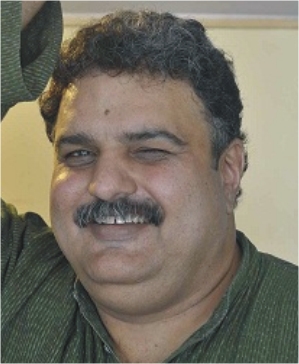
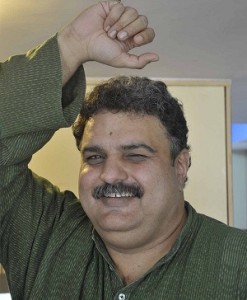
    We still remember his soft focus pictures of Rekha on Filmfare covers. One of the best known film and glamour photographers in the country, Gautam Rajadhyaksha passed away this morning due to heart attack. His photographs have adorned several magazine covers and newspaper supplements.

    Some tweets that we noticed since morning. They kind-of say it all.

    Shobhaa De: My darling Gautam Rajadhyaksha no more.Saddened beynd belief.Farewell confidante-cousin.Thank u 4 your generous love nd soft focus memories.

    Amitabh Bachchan: Gautam Rajadhyaksha the most gentlest of humans, and one of the finest photographers in the Industry, a friend,family favorite ..RIP

    Atul Kasbekar: My Guru n Mentor, Gautam Rajadhyaksha passed away this morning. my principal influence n a truly wonderful, gentle, kind n talented man

    Karan Johar: Gautam rajadhyaksha was one my most favourite people in the fraternity…funny,sensitive and always positive..I love you gautam and I miss u

    Sneha Rajani (Sony/MSM): RIP Ace photographer Gautam Rajadhyaksha. Thank you for the memories.

    If you had a great face and reasonable acting skills, a portfolio by Gautam was sure to land you a reasonable role. While he has also written the story and screenplay for a few movies, he would be best remembered for his contribution to film journalism. Mediaah! and the media will miss him.

    If you have an interesting Gautam Rajadhyaksha story, email us at pradyumanm[at]mxmindia.com (we’ve a Mediaah! address soon).


    Also read:

    NDTV story: Photographer Gautam Rajadhyaksha, 60, dies of heart attack


    Wikipedia infosheet on him

    Twitter feeds on him (may ask for a username and password)


    Great expectations from AKB and SD


    Our messenger hasn’t stopped buzzing. There have been many reactions to the two Business Standard appointments we reported yesterday. Just two reactions to Shailesh Dobhal’s appointment. So let’s get them out of the way.  Hope Shailesh is able to bring in some buzz to BS. Something that he didn’t have to do in ET and couldn’t do in FE. There’s another that said:It is interesting to see Ninan adopting a news features guy to this job.

    There is another reason why Mediaah! is happy to record Dobhal’s appointment. He is the second advertising and marketing journalist in the recent past after Rahul Joshi who covered the beat and who has moved mainstream. Ad and media beatwallahs are generally not considered pinkblooded journos by the economy, markets and corporate guys. In the good old days when business was called commerce in newspapers, even corporate was kind-of pariah, but when the news on Reliance meant more than just the business group’s fight with the Wadias and others or its rise on Dalal Street, the companies or corporate beat took centrestage.

    BS was incidentally one of the few papers which was very strong on corporate stories. It still is, but the big boys almost always grant the exclusives to Eco Times. That’s a challenge that AKB and Shailesh and the captains of other editions will achieve.

    On AKB, well, we must admit that there’s a past (between Mediaah! and him) when we had alerted him about a plagiarism case in the paper.But that’s the past. We spoke to a cross-section of current and former employees to find out, and while there’s some optimism given that he will give, others are a little more cautious. The consensus of course is that while they want the emphasis on hard news to increase, the need for a contemporary feel plus an open and fresh approach to business journalism are needed.Baru ensured that as he was very receptive to new ideas and not living in the past.

    Watch this space for more.


    New York Times starts an India-specific site

    This has been reported by Medianama before, but needs a quick mention. Thanks, Srinivasa Prasad (Professor, Manorama School of Communication, Kottayam) for sending us the link, it would’ve slipped a mention.

    The New York Times has started a section called India Ink, its first ever, country-specfic site for news, info, culture and general chatter. It’s got a pretty large team of writers and a coordinator, so if you are interested in the NY Timesy-kind of intellectual writing, go there. We will.

    There’s also a Twitter handle: @nytindia. And the site’s at: http://india.blogs.nytimes.com/

    PS: Don’t know what you think, but we thought that a bit of J&K was lopped on the India map? True or are we imagining things? Let us know at any of the following coordinates: pradyumanm[at]mxmindia.com, 23050B5D, Gtalk: pradyumanm[at]gmail.com, @pmahesh.

  • Baru’s bye-bye to BS

    By Pradyuman Maheshwari

    It’s a story which MxM should’ve flashed on Friday. But guess our machinery is not so well-oiled yet. We got to know about it only the next morning and coincidentally Mint had also featured it the same day. Since we do not have an edition on weekends, we could get away with it.

    I have interacted with Sanjaya Baru just once. He was keynote speaker at an exchange4media conference on public relations last year. His speech, very anecdotal, was excellent. And I thought it was a brilliant idea to have him, he was indeed the star of the day.

    Earlier, Baru’s entry to Business Standard was received with much fanfare. He had after all held the all-important job of press adviser to Prime Minister Manmohan Singh. There was much talk also because editor-in-chief T N Ninan was going to be stepping down and also laying the roadmap for the future.

    Baru, as per media blog , has posted the following status message on his Facebook page: OK, now it is final! From 1st November I step down as Editor, BS and take over as Director, Geo-economics and Strategy at the International Institute of Strategic Studies, London (iiss.org). But, based in Delhi.

    A quick look at the IISS site revealed, that Baru had joined the thinktank in September 2008. He is designated Consulting Senior Fellow for Geo-Economics and Strategy with expertise in South Asia and Economics.So we guess he had this consulting assignment even when he held the BS job or it’s just that the IISS site wasn’t updated. Nothing to be alarmed about either.

    Meanwhile, more on Shailesh Dobhal and his appointment as BS resident editor for Delhi tomorrow.

    Read:

    The IISS site with the Dr Sanjaya Baru bio

    The Mint Story

    The Sans Serif blogpost

    A BS piece on geo-economics: (if you don’t know what geo-economics means, check the Wikipedia descriptor)

    Super stories

    Bio: National Univ of Singapore’s School of Public Policyand India Habitat Centre award jury bio

    MxM story on Shailesh Dobhal appointment as RE (Delhi)


    Weekly v/s Monthly Ratings for News TV


    The various media players are lucky that given all of what’s happening in the country, MIB mandarins especially mantri-mahodaya Ambika Soni would rather not be bothered about the age-old problems of TAM ratings. Now, don’t be too surprised if you hear shouts that the only reason why the news channels aired so much of Anna Hazare was because they wanted to up ratings.

    Discerning advertisers and their media agencies will tell you that they aren’t too bothered about weekly spikes. It’s a long-term game and save the ads and claims and oneupmanship in ads in the trade media, the weekly v/s monthly ratings debate is poppycock.

    TAM has been smart in saying that it will want to hear the voice of all stakeholders before taking a decision. If the newswallahs are indeed serious of getting a decision, am sure they can prevail upon the agency and advertiser folks. But even as NBA has been emphatic in its demand and believes all the malaises of the business can be solved with this move, we are not sure if independently some of the stronger members would want it. At least one such member sent us a wicked grin smiley on the instant messenger.

    Perhaps powerful broadcasters like Uday Shankar or Puneet Goenka could help broker some peace.

    Read:

    Our friend and former News Broadcasters Association (NBA) board member Rohit Bansal on the Zee News website

    Report by Anita Sharan with a view from LV Krishnan, Punitha Arumugam, Navin Khemka, Broadcast Editors Association secretary N K Singh and an NBA Statement


    Gruesome pictures

    Comments in Sevanti Ninan’s Hoot:

    In The Hindu

    (I wonder why the aside that Even a tabloid like Mail Today was more restrained. Agreed it’s tabloid in size and goes in for smart packaging, but Mail Today has been a fairly sober paper. We don’t think it’s right to rubbish tabloids thus).

    The Hoot on Times Nows horrific pictures


    Social media karo!

    This one should specially interest our friends Rajesh Lalwani (Blogworks), Parveez Modak (Hanmer MSL), Raju Raut (Deadline) and Rohini Kapur (Sepia Media). The Times of India reports that the department of info technology (DIT) has advised all government departments to make social part of their day-to-day work to communicate with citizens.

    If the government departments decide to give out work to external agencies, then it could be windfall for the social media agencies. Or at least professionals.

    “The civil society is making effective use of social media. But in the absence of a framework on use of social media, government organisations have restricted its usage. Government officials are unsure whether to use it for official purposes or not. Hence, framing guidelines for usage was important as the medium is highly effective, speedy and reaches a large number of citizens,” additional DIT secy Shankar Aggarwal Timess Swati Shinde Gole last week.

    Link


    Remembering Funnie…

    Just learnt that it was Indrajit ‘Funnie’ Lahiri’s birthday yesterday. Brilliant teacher, great human being and a fun guy to have a drink with.

    My first contact happened thanks to Mediaah. He was a regular reader and would be in active contact until I moved to Pune and became good friends. Wish he was around to see MxMIndia and Mediaah’s third coming.

    I had wanted to institute an award for young media school talent in Funnies memory. I tried suggesting it to two award organisers I was associated with, but it couldn’t happen. I am not very sure if MxMIndia will want to institute awards for news TV, but need to find a way to keep his memory alive with the frat and the generations to come.

    Tailpiece: Wanted robot journalists
    You have to read this. A start-up in the US has developed technology that can mimic human reasoning and write text. We’ll be waiting for this technology to happen in India. Wink, wink. http://www.business-standard.com/india/news/in-case-you-wonderedreal-human-wrote-this-column/448814/


    Buzz me if you have a story to tell. Confidentiality assured. There are various ways you can reach me: pradyumanm[at]mxmindia.com, 23050B5D, Gtalk: pradyumanm[at]gmail.com, @pmahesh, 98338 76278

  • Wanted: a mast, mast Mid-Day

    Pradyuman MaheshwariBy Pradyuman Maheshwari

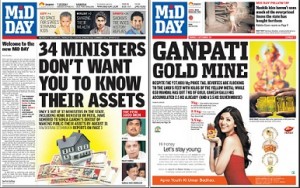
    We’ve been promising a review of Mid-Day. It would’ve been unfair to do one by just appraising a single day’s edition, so we thought of doing that over the last 10-odd days since the paper went for a new look.

    First off, a couple of disclosures. Okay, let me use the ‘I’ instead of ‘We’. I worked with the group for seven years (1993-2000), was a shareholder for a bit and I take great pride in the rapid strides that current executive editor Sachin Kalbag has been taking in his career.


    Yet another disclosure, I was invited to write for the paper’s new-look, but declined the offer because of a Medianet-like scheme that Mid-Day runs for part of the paper.

    But let’s get to the relaunch. I’ve always perceived Mid-Day as a Mumbai institution, with the paper celebrating the city and reporting on what’s happening in here. At first, it lost its constituency of the society circuit to Bombay Times and over the last six-odd years, Mumbai Mirror has been steadily eating into Mid-Day’s dominance on civic and Bollywood news.

    The Medianet-like practice that the paper started was the final nail on the coffin. When I spoke to former owner Tariq Ansari for an interview with Impact last year, he said he was against the concept but was forced to given commercial considerations. Well, a couple of crores of revenue is good to have, but all of it at the cost of integrity?

    While The Times of India group clearly says that Bombay Times is an ‘advertorial entertainment promotional feature’, while the statement upfront is a step in the right direction, it’s not enough as it ought to make a very clear announcement of what it means on its main Times of India page as well as on Bombay Times. I’m sure not many have noticed that small line under the Bombay, Delhi etc Times mastheads

    Back to Mid-Day, I believe it must reinforce as identity as a Mumbai paper. The Page 1 story must be ‘Bambaiyya’ in content and outlook, the feel ought to be tabloidy and the stories must have punch. I would like to see the Mate and snippety Diary back on Page 3. Or at least Page 2.

    Despite an edit page and some pretty good (and serious) content, Mid-Day was always known as a timepass read. Sachin was around in Mid-Day those days, so he should know.

    Agreed the look-and-feel has got to be more contemporary, but if it wants to create the same magic as it did until a few years back, it’s got to get its masti back.

    Why jail only for political paid content

    Beware, media barons and editors accepting money for publishing editorial content. While the election commission can do precious little about the corrupt practices of media entities carrying content in lieu of money and not clearly tagging it as an advertisement, it’s heartening to note that all those who are doing it for politics will be put behind bars for 2 years.

    Now, what about those doing it for lifestyle products? Shall we count the years?

    Read: an IndianTelevision report

    What’s a piece on the Campaign A-List doing on MxMIndia.com?

    If you’re surprised why the MxM anchor has Everest Brand Solutions president Dhunji Wadia telling us why it’s great to be on the Campaign India A-List, don’t be. It’s not that he put my name on the mail instead of the Campaign editor’s. We asked him to write it. He did that in record time, in between meetings. (Read Dhunji on the A-List)

    Here’s my take on the issue: MxMIndia is media-neutral and would like to write about every media entity. We will write about all the activities of even those who consider MxMIndia it’s rival. For in my books, no one is. I’ll be happy to cover the activities of all business publications and the media trade publications. This includes the Campaign A-List, the afaqs events, the exchange4media group events etc etc. That is, of course, if an MxM reporter is allowed in.

    Buzz me if you have a story to tell. Confidentiality assured. There are various ways you can reach me: pradyumanm[at]mxmindia.com, 23050B5D, Gtalk: pradyumanm[at]gmail.com, @pmahesh, 98338 76278

  • Why MxM India?

    Offo, ek aur nayi media website! I can’t promise you a Maya Alagh smile when she mouthed a similar line launching Promise toothpaste eons ago, but I can guess at what’s running through your mind even as you read this.

    Agreed MxMIndia isn’t the first off the block. We are in fact Website #15 if you count the outdoor, digital and telecom sites. I have much admiration for the owners, publishers and editors of many of these. They’ve been pioneers, risk-takers and have jointly created a niche that’s unparalleled in the business-to-business media space.

    So if there’s much mush and gush, why MxM? Why fill your inboxes with more content, when there’s enough of it? Because when I spoke to some 300-odd marketing and media professionals over the last few months, I found there was much gap between demand and supply. Yeh dil surely maange more!

    Also, for many of the players, integrity and ethics are fashionable words but not really put into practice. Stories and covers being sold for ads or cash, awards for favours — past, present and future… there is much decay in the system. In fact the decay has set in so much that it may take a few Annas and Kejriwals to cleanse the mess. So while media houses run high-pitched campaigns against corruption, they happily espouse dubious paid content practices.

    I am a huge believer that it’s possible to conduct business ethically. I also believe that if we ask the world to rid itself of corruption, the media must have a squeaky clean rep.

    Hey, I am not here to sermonise. It’s important for you to know how MxMIndia will conduct itself. But we are no prudes. We don’t think innovative advertising is a no-no. We don’t think that there is a way to do away with fake ads. We just believe, as our good friend Arnab Goswami would say, that the nation wants to know more than just what’s on the surface of the world of marketing and media.

    My one-line advisory to my editorial and business team is: we will write about people and companies regardless of whether they advertise.

    After 25 years of working in various jobs (save for a bit when I tried my hand at blogging and assorted consulting), this is an honest attempt at starting an enterprise. MxMIndia has hired some of the best available talent. We believe this is the only way to start if we wish to be counted as the website of choice for mediapersons and marketers. What you see now is the Beta version of the site. There are still many loose ends and the content will only get richer and the sections under each of channels will open up. Please let us have your feedback.

    MxM in our name stands for Media and Marketing and it was suggested by my friend Prashant Basrur. The logo was designed by his art team at Deadline Advertising. Thanks hugely to the entire Deadline team for bearing with me all these months. The site was developed by Mediology Software in Gurgaon (Merci, Gaurav Bhatnagar and Manish Dhingra… and Arun Nair and team). Thanks to Raj Pandian for showing me the way with the numbers, and Nandita Saikia and Saikrishna Associates for the legalese. Thanks to Mahalakshmi DM for being around in my early days and Deepak Joshi for help with all the paperwork. My sincere gratitude to the various people whom I bugged for advice and all of you who I turned to for support.

    MxM wouldn’t have happened without my family supporting me. A big thanks to each member of the MxMIndia founding team, associates and our star writers present and who have agreed to write in the immediate future.

    We will make it happen. Hum honge kaamyaab. Not ek din, but soon, and ethically.


    Pradyuman Maheshwari

    Email pradyumanm[at]mxmindia.com

    BBM: 23050B5D

    Twitter @pmahesh, @mxmindia


  • Mediaah!: Of a toothless Press Council and spineless Editors’ Guild

    By Pradyuman Maheshwari

    Apologies for not being regular. A colleague has been indisposed. We’ve been getting our share of exclusives and firsts. So a good part of the day is spent in ensuring that MxMIndia turns into a broadbased media website. So all of you who’ve been missing your daily dose of Mediaah!, chill! I don’t think the blog will be a daily, but an update at least three to four times a week?!


    Mint editor R Sukumar’s ‘Edspace’ is a delight to read. Pity it doesn’t appear every Saturday. Delight for me because it deals essentially with the media, and often on ethics. For instance, last weekend, he wrote about journalists being responsible for the state in which the profession is in the India – the corruption levels given the direct and indirect favours journos take (see link). Like awards, being part of a government committee. Sukumar hopes the Editors’ Guild of India will debate these issues.

    Being a Delhi-based editor and “an unacknowledged member” of the Guild, I guess he hopes the apex association of editors will do something. My own belief is that it will not. It could do precious little when the paid political news controversy first surfaced a couple of years back and Medianet did a decade ago.

    If the Press Council of India is toothless, the Guild is spineless. And this is despite having editors like T N Ninan, M J Akbar and Rajdeep Sardesai at the helm. Guess it’s one thing writing about the government or demining, say, a Narendra Modi, but another to take on biggies in their own biradiri.


    Paid news and Mid-Day

    Mid-Day exec editor Sachin Kalbag makes a brave defence for the paid news practice that his paper indulges in. Quoted in The Big Story on MxMIndia.com earlier this week, he defends the ‘Centre Stage’ feature in his paper that contains advertorials. Just 15 percent of the content is paid for. He also calls the tagline under the Bombay Times masthead as a disclaimer.

    I don’t think people see it as a disclaimer. If The Times of India and Mid-Day are serious about informing their readers that some of the stuff in their papers is published not on the merit of its editorial content but the amount someone’s paid for it, they must clearly state that they are doing it. They must tell the reader that the content in question must not be construed as that done by the paper’s journalists. Just as Mint has been doing about its advertorials. So in every sense of the term, the 15% of the paper’s Centre Stage section is paid content.

    So, lemme repeat what Sachin says:

    My opinion on paid news is very simple: It’s an abhorrent practice. It demeans journalism. I don’t really know when this crept in, but it has plagued the media for decades. Unscrupulous journalists have been on the take for several years, and this is not a new phenomenon. The widely cited example of institutional selling of content space is Bombay Times which introduced a rate card for coverage in the supplement. Recently, the supplement began putting a disclaimer under its masthead. The phenomenon of institutional selling of content space crept into the media for various reasons – but the root cause was always to increase revenue.

    Our editorial policy is very clear: any “Advertorial” is placed in a two-page section called Centre Stage, which is part of the Classifieds section of the newspaper. Centre Stage in Mid-Day is differentiated in various ways from the editorial part of the newspaper. Here’s how: 1) The Centre Stage carries a prominent disclaimer in a large point size under the masthead “People, Parties, Promotions”. This has been happening since the day Mid-Day started Centre Stage, which was more than two years ago. In Centre Stage, we carry items on movie releases and profiles of actors, fashion designers, parties, etc, that happened in Mumbai that week, apart from product launches.

    Close to 85 percent of the Centre Stage advertorial section is non-paid, that is to say the Centre Stage team of writers (this team is not part of the Mid-Day editorial team) interviews people or writes about their parties or products. Around 15 per cent of the items are placed where the content space is sold by the sales team. Once again, these items are only about Bollywood, fashion, parties or product launches. There is a separate, specialized sales team that sells this space, and at no point in time do they dictate terms to

    Editorial, mainly because Centre Stage is not editorial space, but marketing real estate. In fact, there have been several instances when the Editorial staff in Mid-Day has trashed Centre Stage advertisers in the review section of the newspaper, and the sales team has gotten into trouble due to that negative coverage. Yet, we are very clear at Mid-Day that the Sales and Editorial wires do not cross, and that the Chinese wall between them stays even though we may be good friends outside the office.

    We are also very clear that Centre Stage will not carry any “news”, but only information on these three or four categories listed above. There is neither any opinion nor any recommendation made in the section that is endorsed by the editor. In the strictest sense of the term, it is an advertorial. Mid-Day, therefore, has stayed away from “paid news” and will continue to do so.

    Thus, Centre Stage in Mid-Day is institutional selling of content space which I guess has a rate card. I am told revenues are healthy and though they don’t run over a 100-odd crore as Medianet is said to be generating, but even if it’s 1/100th that, it’s too much to sacrifice for stupid things like editorial integrity.

    Guess for some publications, editorial ethics is also an abhorrent practice. It demeans ad sales!


    Dabbang Sinha!

    As a strategy, it’s a win-win. He took on the information broadcasting minister in public saying that ever since DNA went ballistic with the anti-corruption drive of Anna Hazare, the government stopped advertising in his paper. (Link to column)

    Now, from whatever I’ve known of Ambika Soni, she’s a pretty reasonable minister. Given all the complaints that every I&B mantri receives, she could’ve made life miserable for media players. Especially broadcasters. Like her predecessors did.

    A senior journalist in the Capital told me that Aditya Sinha’s column last Sunday is sure to see his scalp. Subhash Chandraji could find it too hot to handle, and the Zee supremo needs the government for his plans a helluva lot.

    But this is why I said it’s a win-win for Sinha. If he gets the sack, he will turn a martyr (that doesn’t help much, I can tell you from experience). And if he continues, he’ll turn into a hero because after all, few have had the balls to say the government is kinda blackmailing the press.

    Sample some gems from his column:

    > Soni’s statement led us to infer that our Anna Hazare coverage was being punished by a suspension of government ads, and that Soni met our ad executives just to ensure the point was driven home.

    >This was not surprising because DNA recently has faced suspicion and hostility from the government which has apparently adopted an attitude of “you’re either with us or against us”. The prime minister’s media advisor has privately accused DNA of an agenda against the government, and its Editor-in-Chief of being close to a political party in the opposition.

    >The day after the meeting with Soni, DNA started getting DAVP ads again. Presumably, from the government side, mission was accomplished

    >Loss of business can be measured, but the loss of credibility cannot. Above all, that someone in government tried to be petty and vindictive is, to us, validation that we were doing our job right

    The views expressed here are my own and are not necessarily those of MxMIndia and its editorial team. In fact often it’s in variance with their views. Meanwhile, buzz me if you have a story to tell. Confidentiality assured. There are various ways you can reach me: pradyumanm[at]mxmindia.com, 23050B5D, pradyumanm@gmail.com, @pmahesh, 98338 76278.


    Tomorrow:  Is The Times of India taking on Times Now?

  • Mediaah!: Is Arnab Goswami the “over-the-top anchor” in the TOI ad?

    By Pradyuman Maheshwari


    This is not the first time that someone from within the Bennett, Coleman & Co empire has taken on Arnab Goswami and Times Now. In the past, Prashant Panday went hammer and tongs at Arnab. The post was on Prashant’s Facebook wall, and didn’t beat about the bush. I must say I was quite surprised that the CEO of a group company which runs the very popular Radio Mirchi network could write all of it so openly (read: An open letter to Arnab ).

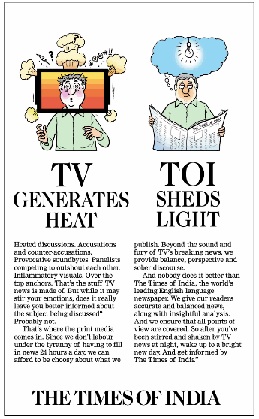
    The fact that Prashant wrote it and still has his job speaks volumes for the internal democracy that exists in the group. Though my wicked brain thinks there’s more to it… especially when I saw this ad on the sports pages of the Mumbai edition. Chhota 15×3 ad, but very interesting.

    You must read the text… all of it.


    Heated discussions. Accusations and counter accusations. Provocative soundbytes. Panelists competing to outshout each other. Inflammatory visuals. Over-the-top anchors. That’s the stuff TV news is made of. But while it may stir your emotions, does it really leave you better informed about the subject being discussed? Probably not.

    That’s where the print media comes in. Since we don’t labour under the tyranny of having to fill in news 24 hours a day, we can afford to be choosy about what we publish. Beyond the sound and fury of TV’s breaking news, we provide balance, perspective and sober discourse.

    And nobody does it better that The Times of India, the world’s leading English newspaper.We give our readers accurate and balanced news, along with insightful analysis. And we ensure that all points of view are covered. So after you’ve been stirred and shaken by TV news at night, wake up to a bright new day. And get informed by The Times of India.


    Not all of it is untrue. Panelists do outshout each other on news TV. Put Jayanthi Natarajan and Ravi Shankar Prasad in one discussion and there’s more noise and less discussion. Also you can be sure you won’t find all the news on television… esp the private channels. Doordarshan News has a lot more meat, but it is soooo boring.

    What deserves another look and no real reading between the lines is a bit from the first para:

    Heated discussions. Accusations and counter accusations. Provocative soundbytes. Panelists competing to outshout each other. Inflammatory visuals. Over-the-top anchors. That’s the stuff TV news is made of.

    So let’s look at the people who dominate the nightly news on the English non-business news channels, which I guess is what the TOI ad is talking about: Rahul Kanwal (Headlines Today), Rajdeep Sardesai and Sagarika Ghose (CNN-IBN), Vikram Chandra, Barkha Dutt, Prannoy Roy (NDTV 24×7) and of course Arnab Goswami on Times Now. There’s also Rahul Shivshankar on NewsX, but my cable operator doesn’t offer the channel, so would reserve comment on him.

    Rahul Kanwal is aggressive and provocative, but he is not sound and fury. Rajdeep has mellowed (and become very good once again), but Sagarika can go high-pitched. On NDTV, Dr Roy and Vikram C are exceedingly softspoken and can’t harm a fly. Barkha still attempts to ask some tough questions, but like Rajdeep isn’t what she used to be around the time of the Gujarat riots.

    The one man who fits most of the attributes described in the Times (of India) ad is Arnab Goswami. I don’t agree with him being over-the-top, though there are many who believe so. I think he asks the tough questions, and is possibly the only one to do so day after day. Yes, he gets carried away, but needs to be cruel with our politicians. And even as I join others in lampooning Arnab for his the-nation-wants-to-know-line, the fact of the matter is that we all really want to know.

    I do feel that Times Now overstretches itself on issues like Pakistan, China or racism, but heck we need it.  As for inflammatory visuals, I think the print media is also fairly irresponsible. Though the impact of television is a lot, lot more on the common man or woman.

    Let’s keep this discussion on. Email Mediaah! at pradyumanm@mxmindia.com and I will carry the best comment here when I am back on Tuesday.


    Pataudi, RIP


    But for the time when he patted me on the back and gave me an autograph, I’ve never met him. But heard loads about him.

    When the news of Tiger Pataudi’s passing came in last night, almost by reflex I called a colleague to check if we could get someone in adland to reminisce dealings with him for endorsements. Then we tried checking on his connections as editor of Sportsworld and for his stint at Dev Features. The Sportsworld team is scattered all over. There’s an interesting tribute by Derek O’Brien in The Telegraph.

    I called Vivek Sengupta on reading his tweet, and finally convinced him to write a few lines. That was around midnight. Vivek may have turned into a public affairs and PR practitioner for a while, but he’s essentially a journo. He knew I wanted him to write, and sent his copy in an hour.

    Meanwhile, we had no luck with getting an adman to write on Pataudi’s ads. But here are two of his TVC that I found on YouTube (the  first a rather long Gwalior Suitings ad and the other being the recent Lays TVC with Saif)

    [youtube width=”350″ height=”260″]http://www.youtube.com/watch?v=iei989o4l-I[/youtube]


    [youtube width=”350″ height=”260″]http://www.youtube.com/watch?v=dTVIrhnt5x4[/youtube]


    Buzz me if you have a story to tell. Confidentiality assured. There are various ways you can reach me:

    pradyumanm[at]mxmindia.com, 23050B5D, pradyumanm@gmail.com, @pmahesh, 98338 76278.

  • RIP, Vasant Sathe, grand patron of colour TVs in India

    By Pradyuman Maheshwari


    Not many amongst mediapersons and marketers may know that former minister and veteran Congress leader Vasant Purshottam Sathe, who passed away last Friday, was the man who fought with a variety of lobbies and brought colour television to India in 1982.

    I still recall the news reports on Sathe in the very early ‘80s where as information and broadcasting minister had a tough time with the black-and-white television lobby. Finally, it was the Asian Games and World Cup Hockey that did the trick. Guess the fact that Rajiv Gandhi was general secretary of the Congress then and was actively involved with the Asiad would’ve also helped.

    Sathe was also instrumental in spreading the Doordarshan network by setting up low power transmitters. This eventually led DD introducing the National Network.  He is reported to have faced opposition to introducing sponsored programmes, but later the pubcaster was receptive to the concept. And how!

    I don’t remember much about this, but I read on a bio on his website that he also helped in clearing the controversies around Richard Attenborough’s Gandhi.

    While it’s true that colour television would’ve eventually entered India even if Vasant Sathe had not intervened, but surely it wouldn’t have happened in 1982.

    1990 possibly.


    Photograph: Image of his book cover on vasantsathe.com


    **

    My Delhi trip and MxMIndia.com’s code of ethics


    Met the awardwinning CEO of an awarding winning channel at the Delhi airport while I was on my way back yesterday. I was in the Capital to meet the MxMIndia team and interview a few possible recruits as also attend a luxury magazine’s awards do. The event was at the Jaypee Greens Golf and Spa Resort which is located some 20 km from Noida in Greater Noida.

    I accepted the offer for a night’s stay because while Jaypee Greens is an excellent place, it is in the back of beyond. Plus I wanted a sneak peek at some of the facilities being created for the F1 next month.

    So how does a junket like this work with your Code of Ethics, the CEO asked me. One, our report on the event will clearly carry the disclosure in the story that we are subjected to the hospitality. And, two, while any degree of hospitality extended would amount to it being a junket, the only reason I accepted it was that I believed that attending the awards would help me understand the high-end luxury content space better as also interact with the people who matter in the business. Which I did. As a bonus, I also met a few senior mediapersons at the do.

    Had to trek back to South Delhi for my meetings and finally to the airport.

    However, having been quizzed by the CEO and realising that MxMIndia and I are going to be subjected to some scrutiny on this count, I guess there is need to be even more vigilant in ensuring that we adhere to the Code.

    Aatma chintan, as the BJP calls it.

  • Mediaah!: When Delhi Times and HT Cafe reported that Metallica performed

    By Pradyuman Maheshwari

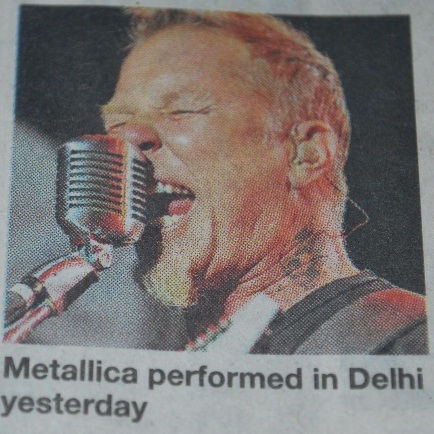
    The Delhi Times clip
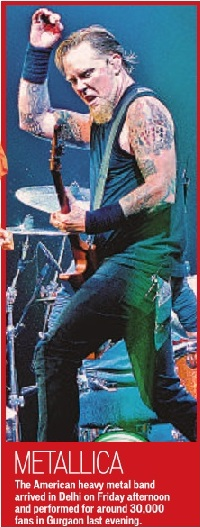
    The HT Café photo-story

    It’s not something that’s not happened before. I recall Time magazine doing it in the late 1970s when it reported that an Indian politician had visited China when in fact he had called off the trip last-minute.

    I was alerted on this thanks to a Facebook post by a former colleague, Narendra Kusnur. The city supplements of both the Hindustan Times and Times of India in Delhi reported that the Metallica concert had happened on


    Friday. While the front page of the main paper did make a mention of the chaos at the venue, that of their supplements – which Kusnur believes happened because of an early deadline – was incorrect.

    I am sure this is more than just a severe embarrassment for the editor and management of both publications. It’s not the case of an error in reportage or a typo or even a wrong picture that was printed. And mind you it doesn’t appear to be an inadvertent error.

    Here was a case where the paper’s editors cheated their readers by deliberately printing incorrect information. We got to know about it thanks to a vigilant reader and also because it was a much-hyped event.

    But my worry is what if the editors do such acts habitually, with other events too. Also a cause of concern is that the city supplements of the two leading newspapers in the capital carried a similar error. The Times of India blanked out the news item on the epaper, while HT didn’t do that. So obviously the decay exists not just in one publication.

    I went through the front page of HT City and Delhi Times on Sunday to see if there’s any apology. I didn’t see any in the epaper edition. Times magazine, btw, had apologised for the error.

    This only further accentuates my distress that the reader is being taken for a ride and no one really appears to care.


    The Niira Radia exit. Good riddance or sad to see her go?


    I still remember the days when Vaishnavi was setting up. The Tata group accounts were consolidating under an agency with a name unlike the other PR agencies. In the early days, the folks were working out of makeshift office at the Taj Mahal hotel and the Army and Navy Building in Mumbai.

    But the proof of the pudding is in the eating, and I found it very pleasant interacting with Vaishnavi staffers. For a period when I was with the Dainik Bhaskar group, we had recruited Vaishnavi with an assignment which again was executed very well.

    The PR industry grapevine always had assorted stories about how the Vaishnavi bosswoman Niira Radia had managed to net the entire Tata group account. Needless to say most of it was out of jealousy. Guess they found some merit in getting the entire business group to go to just one agency for PR just as you tend to do for, say, media buying.

    My sense is that this policy doesn’t work. It’s always good to get a few different players, given their strengths in various business areas and have experience professionals available in the locations you want them.

    Two questions: now that she’s gone (well, as of close of business today), what’s the view. How would the world remember Niira Radia? High profile lobbyist or a quality communications professional? Lobbyist yes, but perhaps incorrect to stretch it to her being a wheeler dealer.

    There’s a lot that exists as part of the deliverables under public affairs, and there’s nothing wrong if the influencing has to happen beyond media folk. For instance, if a senior politician from Kerala thinks he or she is not being recognised by the powers that be in Delhi, then there’s nothing wrong in pushing your way around in Delhi.

    And if there’s a journo or bureaucrat who is amenable and can get influenced, it’s surely not the crime of the practitioner.

    That both the Tatas and Reliance groups entrusted their responsibility to Radia speaks volumes for her skills.

    There is a lot on Radia that the various enforcement agencies are busy with. I don’t see anything happening to her. She has enough contacts to get her out of any mess and has enough dirty stuff on people to pull the trigger if anyone gets naughty.

    Question 2: were the Tatas wise by going in for Rediffusion? I would be interested to know what swung it for Arun Nanda. After all, he doesn’t have the best PR brains with him any longer.  Perhaps that’s why tied up with Edelman.

    But then 10 years back when the group went in for Vaishnavi, similar questions were being asked. Radia’s team put up a decent show. The Tatas can obviously spot talent where not many of us can.


    PostScript: Are news media professionals worried about the mutterings of Press Council chief retired Justice Markandey Katju. Read this hilarious account on Legally India. Must-read. More on Katju’s comments on the media next time (which I promise you won’t happen after three weeks!)

  • Mediaah! Katju ko bolo katli maaro, says NBA

    Pradyuman MaheshwariPardon the forced usage of Bambaiyya, but with a name like Katju and this being the season for mithai, one couldn’t help the play on Kaaju Katli. With apologies to the lovers of the Kaaju Katli. I am not too concerned about how Mr K reacts… in any case he finds journalists irresponsible and unintelligent.

    There’s been a lot of song and dance about the Press Council of India chief Markandey Katju’s outbursts to all and sundry. Yesterday, the News Broadcasters Association asked the Prime Minister to ask the Press Council of India to mind his own business and stop effing around with the news TV wallahs.

    The Prime Minister is in Cannes attending the G20 summit and I won’t be surprised if he does precious little about it.

    There have been various reports on the News Broadcasters Association asking the Prime Minister to restrain the Press Council of India chairman to not comment on areas that are beyond his jurisdiction. I found the one on former friend and benefactor Anil Wanvari’s Indiantelevision.com the most exhaustive. Here goes: http://www.indiantelevision.com/headlines/y2k11/nov/nov28.php

    But before you slam the man any further, as our editor-at-large Anil Thakraney writes, there is a point that Katju is making. There are scores of occasions when you do have our news channels transgressing all lines of decency. I have stopped some of the channels – especially a few in Hindi – because of the trashy content that’s there on them. Even on Big News Days, these guys don’t seem to get over their obsession with the Occult. And the Inane.

    Former Aaj Tak CEO and also bossman of a dozen industry associations G Krishnan would often argue for the trade about this with a “We are like this only refrain”.  Whoever says news has to be only current affairs. And whoever said current affairs shouldn’t include who Ranbir Kapoor was in bed with last night.

    (aside, these days channels could also do similar stories about mediapersons, but we’ll come to that some other time… or perhaps will never do it.!)

    (aside 2: the last time, Mediaah! tried to write on the private life of a mediaperson, we had to kill ourselves).

    I am not armed with the stats, but the fact of the matter is that all news broadcasters aren’t members of the NBA. And it’s impossible for the NBA to coerce channels to turn members. There’s nothing out of the ordinary about this. In other trade associations too, large players don’t become members.

    So, as the NBA has said, let its self-regulation policies rule over all news channels. In fact the uplinking and downlinking policies must make it mandatory for all news channels broadcasting out of India to subscribe to a self-regulation code of the NBA.


    Should the Press Council be made the Media Council?


    First, do we need a Press Council. The newspaperwallahs have their INS, the magazine guys have an AIM, internet and mobile dudes have IAMAI, the ad folk have their AAAI and ASCI, so why the Press Council.

    It’s a body with no teeth. It can’t do a thing to police newspapers. I remember receiving a few letters from the Council in the ‘90s asking my paper to apologise for some flimsy reason. I was advised by my publisher to ignore the notice, and when one realised there was no need for the paper to issue an apology, I trashed the missive. It’s not that the newspaper lost its licence or was penalised. We went about our business peacefully only to trash the next letter that came in.

    I am a little surprised that the Press Council didn’t have news channels under its jurisdiction all these years. When it was set up in 1966 (with the Press Council Act taking coming into existence only in 1978), we only had the government-owned Doordarshan and All India Radio so I guess no one found the need for policing the airwaves.

    Para 1 of the ‘about us’ section of its site says:

    The Press Council of India was first set up in the year 1966 by the Parliament on the recommendations of the First Press Commission with the object of preserving the freedom of the press and of maintaining and improving the standards of press in India. The present Council functions under the Press Council Act 1978. It is a statutory, quasi judicial body which acts as a watchdog of the press. It adjudicates the complaints against and by the press for violation of ethics and for violation of the freedom of the press respectively.

    There is a self-regulator for news and non-news television and advertising and there is none for print and digital media. So I guess there is merit for a self-regulator, but ideally it should be done by an industry body and not someone set up by the government. As for ensuring the freedom of the press, we surely don’t need a Press Council of India to police that.

    Our democratic set-up will ensure that governments can’t get away with stifling the press. As for media owners muzzling their own employees, I don’t think the Press Council or any minister or Parliamentarian can do anything about it. The owners almost always have the final say.


  • The spirit of Mediaah! lives on

    Hoshiyaar, Khabardaar! Mediaah! cyberspace mein waapis aa gaya hai!The blog is rechristened Mediaah! s3. s3 being short for Season 3, thisbeing the third coming for Mediaah!


    After six years of self-imposed exile, Mediaah! returns. In line with the current media order, it’s going to be called Mediaah! s3. s3 being short for Season 3… this being the third coming for the blog. Trittiya, as Amitabh Bachchan would call it.

    And, yes, Mediaah! has a new home @ the all-new homebase for mediapersons and marketers: MxMIndia.com

    Wish me luck. Its my third attempt at being brutal and honest. But like I read Sunil Gavaskar say somewhere that his words may have softened with time, I guess I too may have mellowed in these last few years.

    Plus this time around, Mediaah! is going to be part of a website that I run along with a committed team and friends.


    Fastforwarded Flashback


    But first some flashback to what really got me off cyberspace and what I’ve been doing all these years. One fine morning, in the middle of the night, on a fine, warm day in the year 2005, I was subject to legal missives from the most powerful newspaper group in the land. My sources in the group’s office told me that the orders were to nail me. There were several friends from India and elsewhere in the world who were willing to fight my case. I tried reviving Mediaah!, but the top legal eagles in the country advised me to be careful. So I depressed the Pause button, and continued with my full-time employment.

    Cut to 2008, where I chucked my job with a leading mainstream media player. I wanted to start an MxM-like site, but I switched to consulting with a college buddy turned journalist and entrepreneur who would run Indiantelevision.com. I was there for just a few months and hopped on to exchange4media.com. Upset with the switch, the buddy even sent my new employers a legal notice.

    I had a fun stint with e4m.com and impact. It’s run by an enthusiastic trio, and a team that’s pretty committed. Little wonder that it’s doing so well. But there were issues which got me to move on.

    It wasn’t easy quitting a cushy job. I felt awful that my family was paying for my principles. But then it’s a great feeling to be able to be able to sleep easy with a clear conscience.


    My concerns for Mediaah! s3

    I am not sure if it’s going to be smooth sailing for Season 3 of Mediaah! In fact, I am worried whether I would be able to be as no-holds-barred as I would in the previous seasons. This is because the very people I write about are the folks who will advertise on MxM India. It’ll be a tightrope walk, and I hope to be able to maintain the balance.


    The masala

    Okay, okay, I know what you want to know from Mediaah!. What do we feel about G Krishnan’s exit from TV Today. And where’s he going? Are the rumours of his joining ABP or Fox true? What’s the buzz at Bloomberg UTV? Is a former newspaper CEO taking the top job there? What’s our view on the new-look Mid-Day? Can the new look help the paper regain old glory?

    Read all this and more in Mediaah! as we go along. We’ll be back next week. Tab tak ke liye, alvidaah!


    Buzz me if you have a story to tell. Confidentiality assured. There are various ways you can reach me:

    pradyumanm[at]mxmindia.com, 23050B5D, pradyumanm@gmail.com, @pmahesh, 98338 76278.


  • Mediaah! Extra: Now, Vice Prez Hamid Ansari calls for debate on erosion of editor

    Pradyuman MaheshwariIt had to happen. Everyone has a view on how a newsroom should be run. The aam aadmi (and aurat) has a definite opinion on how newspapers and news channels ought to be run. They also know how Sachin Tendulkar must bat to score that hundredth hundred, but that’s another story.

    Here’s what the Vice President, Government of India, said while inaugurating the Press Council of India’s National Press Day celebrations.

    “Finally, I venture to hope that your debate would also focus on the erosion of the institution of the editor in our media organisations. When media space is treated as real estate or as airline seats for purpose of revenue maximisation, and when media products are sold as jeans or soaps for marketing purposes, editors end up giving way to marketing departments.”

    The Vice President didn’t go into  the controversy over his host Marandey Katju’s recent outbursts, but did talk on paid news. But it would be interesting to note how the big boys in the business (especially @ The Times of India group) have to say to this. Am sure they’ll laugh it off. After all, if the editors (and the tribe of journalists) don’t have a problem, why bother.

    Here’s what the VP said, courtesy the Press Information Bureau’s communiqué:

    “It gives me great pleasure to inaugurate the National Press Day. I congratulate The Press Council of India, its Chairman and Members, on this occasion.

    In over 45 years of its existence, the Council has fulfilled to a significant extent its mandate, as a quasi judicial body, of preserving the freedom of the press and of maintaining and improving the standards of press in India, and adjudicating complaints.

    Ours is an age of great change – social, economic, political and above all technological. Each has impacted on our individual and collective thought processes. Major premises are being revisited and the certitudes of an earlier era called into question. The answers are often disconcerting, in many cases tentative.

    The theme of today’s celebration is Media as an instrument of public accountability. A useful starting point of discussion would be to enquire into the basic premise of being a democracy.

    An essential feature of democracy is constraint on unlimited exercise of power. Democratic practice seeks to bring about accountability of actions of institutions and individuals in an objective, verifiable and transparent manner. While common understanding of constrains on power is limited to exercise of ‘public power’ by state actors, it is important to remember that it also extends to ‘private power’, of non-public authorities, especially when such entities acquire or exercise power traditionally associated with state structures.

    It is a truism that humans are social creatures who formulate rules of interaction aimed at furtherance of harmony and common good and avoidance of anarchy.  Rules and rule-based regulations are thus essential and unavoidable, more so in a democracy that eschews arbitrary exercise of power.

    Another truism is that some form of media has been integral to human civilization since time immemorial. Its principal purpose, to inform, remains unchanged. Technological innovations like the invention of paper and the printing press, radio transmission, TV broadcasting, and the World Wide Web have spawned new media platforms and devices for consumption.

    Today, the convergence between news media, entertainment and telecom has meant that the demarcation between journalism, public relations, advertising and entertainment has been eroded.

    The new trends in technological development and media conglomeration characterized by an emphasis on commercial values and outcomes, pose challenges to traditional public service values in news broadcasting.

    How do they impact the lofty ideal of journalism – of communicating reliable, accurate facts in a meaningful context?

    This aspect is of relevance because the media is the fourth estate in a democracy. It plays a major role in informing the public and thereby shape perceptions and through it the national agenda. Its centrality is enhanced manifold by increased literacy levels and by the technological revolution of the last two decades and its impact on the generation, processing, dissemination and consumption of news.

    Media outlets today assume importance not only for marketing and advertisement but also for the ‘soft power’ aspects of businesses, organisations and even nations. It is a harsh reality that media entrepreneurship is now a necessary condition for a business enterprise, a political party and even individuals seeking to leverage public influence for private gain.

    It would be instructive to study how other democratic systems have dealt with the media revolution and the convergence of communication technologies. Three stable democracies, namely the United Kingdom, the United States and Australia can be studied for best practices.

    In December 2000 the United Kingdom published a White Paper entitled A New Future for Communications in Britain. It suggested conceptual restructuring to bring together the five sectors of telecommunications, television, radio, broadcasting standards and radio spectrum allocations under a single-umbrella communications regulator. In addition, it proposed covering access, choice, content and competition.

    The White Paper proposed a new three-tiered regulation of broadcasting so as to provide a level playing field between the broadcasters, depending on the extent of their public service role. It stressed that all broadcasters be subject to minimum standards, impartiality in news, provision of protection of minors and access of people with disabilities.

    Emanating from this, The Communications Act 2003 established the Office of Communications (OFCOM) as the regulator for all communications industries to further the interests of citizens and consumers. It was tasked with ensuring optimal use of electro-magnetic spectrum, availability of electronic communication services, a wide range of TV and Radio services of high quality, maintaining plurality in broadcasting, applying adequate protection for audiences against offensive or harmful material, and against unfairness or infringement of privacy.

    The British experience of transition from a multi regulator to a single umbrella regulator, accountable to Parliament, and covering telecommunications, broadcast media and wireless spectrum, indicates that turf battles between economic sectors, government departments and individual companies have to be carefully managed in the midst of building a national consensus and enacting legislation.

    The experience of the United States and its Federal Communication Commission in regulating communications by Radio, Television, Wire, Satellite and Cable for over 75 years is also instructive. It promotes competition, innovation and investment in communications, encourages the best use of spectrum and revises media regulations so that new technologies can flourish alongside diversity and localism.

    American law imposes limitations on multiple ownerships and cross-ownership of media establishments across radio, television and print media to prevent emergence of monopolies and to ensure adequacy of independent media voices in the market that could serve public interests, localization of news and bring about diversity.

    In the case of Australia, it is The Australian Communications and Media Authority which is responsible for the regulation of broadcasting, the internet, radio communications and telecommunications sectors. In its role as a broadcast regulator, the ACMA plans the channels that radio and television services use, issues and renews licenses, regulates the content of radio and television services, including digital services, and administers the ownership and control rules for broadcasting services.

    The regulator enforces statutory control rules based on license area and audience reach, limitations on multiple and cross-ownership, limits on foreign control of the mass media, regulations on transfer of media operations and media groups, and determines acceptability or otherwise of media diversity. It seeks to bring about programme diversity, help foster a national cultural identity, bring about fair reporting of news and ensure respect for community standards.

    While media outlets in Australia have the main responsibility for ensuring that the broadcast content reflects community standards, most aspects of such content are governed by codes of practice developed by industry groups. The regulator registers these codes once it is satisfied that the codes contain appropriate community safeguards and are a product of public consultation. National content and children’s programmes on commercial television are regulated by compulsory programme standards determined by the regulator after consultation with the industry and the general public.

    You would notice that the experience and practice of other democracies indicates that media licensing and regulation is seen as a normal and essential activity to help its functioning as the watchdog of public interest. One is reminded of Gandhiji’s dictum that “an uncontrolled pen serves but to destroy”.

    In our country today, media represents a sector of economy that is the envy of others because of the extremely buoyant growth rates witnessed over the last two decades, in an environment characterised by minimal or no regulation. In the absence of any other government regulator, the focus has shifted to self-regulation by the media organisations, individually or collectively.

    Collective self-regulation however has yet to succeed in substantive measure because it is neither universal nor enforceable. Individual self-regulation has also failed due to personal predilection and the prevailing of personal interest over public interest.

    In an address at the Indore Press Club earlier this year, I had mentioned that while economic deregulation has been the dominant trend of the recent past, it is premised on a dynamic market place with a system of independent regulation, especially competition regulation, to prevent cartelisation, abusive behaviour by dominant firms and corporate transactions that derail the competitive processes in the market.

    Two questions arise here. In the first place, who will step in to address the gap when the government, the polity, the market and the industry are unable to provide for full-spectrum systemic regulation that protects consumer welfare and citizen interest?

    Secondly, can the constitutional safeguards on freedom of speech be used to evade regulation of the commercial persona of media corporates and groups? Where does public interest end and private interest begin?

    The experience of other countries shows us the way. The ongoing national debate on the subject should involve all stakeholders leading perhaps to the publication of a White Paper. This should lead to further consultations and evolution of a broad national consensus so that appropriate frameworks can be put in place combining voluntary initiative, executive regulation and legislative action, as appropriate.

    Such an effort can cover issues of multiple-ownership and cross-ownership, content and diversity, and a cogent national communications policy that covers print, radio, television, cable, DTH platforms, video and film industry, internet and mobile telephony, and electro-magnetic spectrum.

    Our democracy is poorer without active media watch groups engaged in objective analyses of the media, discerning prejudices and latent biases, and subjecting the media to a dose of their own medicine. For an industry that has over fifty thousand newspapers and hundreds of television channels, systematic media criticism is non-existent in India. This should be remedied and I hope your deliberations would address this important aspect.

    A related matter pertains to the recent controversy over ‘paid news’. It has been debated extensively in the Press Council and other fora, including Parliament. It is a matter of some satisfaction that the ‘culture of silence’ on the subject is being replaced with an attempt to grapple with this malaise at multiple levels.

    Finally, I venture to hope that your debate would also focus on the erosion of the institution of the editor in our media organisations. When media space is treated as real estate or as airline seats for purpose of revenue maximisation, and when media products are sold as jeans or soaps for marketing purposes, editors end up giving way to marketing departments.

    I would like to conclude by saying that all stakeholders – the government, the media organisations and the industry, civil society, advertisers and sponsors, and the audience and readership of the media – must address the various concerns regarding the profession and work towards securing and defending the public good.

    I thank the Press Council and Justice Katju for inviting me to the National Press Day Celebration. I wish you all success in your deliberations”.


    You’ll read more on this on MxMIndia (and Mediaah!) in the coming weeks.
  • Mediaah!: Oh MiD-Day, my MiD-Day!

    By Pradyuman Maheshwari


    Its paid content strategy is rubbish, but it’s a great newspaper. It’s a Mumbai institution, just as The Times of India is (see disclosure below). Sadly, it flopped miserably in Delhi and Bengaluru (and Pune) in the past and I wasn’t surprised to learn that the paper was shutting shop in the two metros. Pune stays, but it’s serviced totally by Mumbai, save the local reporting talent.


    When Jagran bought Midday Multimedia last year, it was evident that the group was interested in the flagship Mumbai edition, Inquilab and Gujarati Mid-Day. In fact, Inquilab fitted the gameplan perfectly to dominate UP.


    While we mediapersons sermonise endlessly about how corporates should deal with retrenchment, we are awful in handling such situations in our own backyard. The mail from the CEO was very casual and while he may have thought it was cool, there are better ways to do effect a closure.


    Do it face-to-face. Personally visit one of the centres and request your editor who was in Bengaluru to interview the Apple co-founder to stay back and break the bad news.


    Those in power must never forget that the same fate could strike them.


    Now what? The team in Delhi is up in arms. Over social networks they say that they were being asked to voluntarily resign and have heard that bouncers will stop them from entering the office today. I don’t know what’s the state in Bengaluru, but some protestors asked MxMIndia to report on the matter. We haven’t done a story on the issue, because it was too late to get a comment from the Mid-Day bosses.


    From what I know of the Jagran management, the Guptas are cool and considerate. They are open to reason, and I’m sure they’ll correct the wrongs. They are interested in the big picture, and will not want to dirty their image with such petty matters. Mid-Day is just one of the publications in their acquisition plans… there are many more in the pipeline.


    Yes, the Delhi and Bengaluru editions didn’t work. With abysmal readership and a nil score on the IRS Q2/2011 numbers for urban centres like Gurgaon and Noida, even the journos knew that the editions weren’t going anywhere.


    But you’ve got to give the jhatkas with compassion. Jaago, Jagran, jaago.


    * Disclosure: I have spent some of the best years of my professional life working with Mid-Day from 1993 to 2000.


    Hey Minister! Leave the cyberspace alone!

    My heart goes out to our dear central mantrijis. They’ve are subjected to the whims and fancies of all and sundry. The Prime Ministerji, Madamji, Babaji, Betiji, Saaleji, other Mantrijis and Mukhyamantrijis, various MPjis, some friendly Opposition leaderjis too. And the Babus, the secretaries, chaprasis and even the drivers. Not to forget the barber and the occasional masseur.


    But in the mother of all wtf-ness, I was shocked to see the otherwise reasonable Kapil Sibal making a hash of himself (literally, with an idiot prefixed on Twitter) by asking social networks etc to regulate content. Sibal, poor man, is under hajaar fire. 2G, 3G and of course the G family.


    There has been furore on the twitterosphere and for that matter all media. Monsieur Sibal should know that the internetwallahs aren’t divided and won’t sit quiet after a while like broadcasters and newspaperwallahs. Consequence: the issue has got internationalised and India is being compared to China. Which is silly. We aren’t.


    Time for credible awards

    I was at the Time-Out food awards on Tuesday evening, and the creme de la creme of restaurantwallahs were in attendance. Funnily, every other winner had just one thing to say: that being from Time-Out, the awards were credible.


    I think the credit for this goes to editorial head Naresh Fernandez and owner-bosswoman Smriti Ruia Kanodia. I’ve known Naresh for a bit, and must say he can be brutally credible. Which is perhaps why I trust Time-Out thoroughly. If Time-Out says the food at Restaurant X is good, you can be sure it’ll be good. Can’t say that about some other reviewers who love the free stuff, or at least whose publications do not have a policy of serving honest content. Ms Kanodia deserves credit for having survived Naresh and been successful despite his (and the Time-Out parents’ ) insistence that they will not bow to  advertiser diktats. Okay, okay credit also to the business and sales folk for being able to sell despite all these odds.


    Back to the point of awards not being credible. It’s unfortunate that the general perception is that awards instituted by media companies aren’t aboveboard. More on that some other day.


    Who’s the most IMPACT-ful of them all?

    It’s the big night for media professionals. It’s also for the first time I will not be attending an Impact Person of the Year. Guess the promoters there are still peeved that I quit to set up MxMIndia. As a career journalist, I couldn’t have turned to farming after moving on. Yes, I could’ve gone back to mainstream media or set up a Firstpost-like site that I was intending to, but, heck, I think it’s possible to have a good, clean media and marketing portal. With content that’s not got strings attached. Like afaqs and a few others.The market is waiting to grow.


    For the record, none of the ex-e4mers who’ve joined MxM were pulled out of their jobs. They’ve either joined me after quitting, or moved out because they saw a brighter future. The fact is that I did attempt to poach a few, but they didn’t join us.


    Before I digress any further, here’s my take on the nominees. First, I think it’s a great idea to have just eight nominees. Yes, there will be people who’ll be unhappy to have not made it to the List, but that’s fine.


    It’s a tough call… all the people are very, very worthy winners.


    Let’s take a look at the Eight:

    > Agnello Dias, Chairman & Co-founder, TapRoot India
    > Haresh Chawla, outgoing Group CEO, Network18 and Viacom18
    > Madhukar Kamath, MD & CEO, Mudra Group and Chairman, AdAsia
    > Man Jit Singh, CEO, Multi Screen Media
    > Rajiv Verma, CEO, Hindustan Times
    > Ronnie Screwvala, CEO and Founder Chairman, UTV
    > Sandeep Goyal, Non-Executive Founder Chairman, Dentsu India
    > Vineet Jain, Managing Director, Times Group


    I must confess I know who the winner is. So it would be incorrect to be a spoiler. I wish I had written this a week back, but I didn’t get down to it.


    But if I were to do a shortlist from the above and for their spectacular performance this year and also the way the voting works, here’s my shortlist:


    Agnello ‘Aggie’ Dias, Madhukar Kamath, Man Jit Singh, Ronnie Screwvala and Vineet Jain.


    > Aggie for producing some marvellous work in an industry dominated by Ogilvy and JWT.

    > Madhukar for dressing up Mudra beautifully and making it matter in the creative world and finally hawking majority stakes to an international major.

    > Man Jit Singh for finally getting all MSM channels in top gear

    > Ronnie Screwvala because his UTV Stars is doing so very well, the others are on action mode, Bloomberg-UTV is near-sold to Reliance and cementing the deal for 100 per cent stake to Disney.

    > Vineet Jain: well, you know about my reservations about Medianet, but otherwise the company rocks. Editorially, both The Times of India and Times Now set the agenda. The Anna Hazare movement and Commonwealth Games scams gave the government sleepless nights thanks to the belligerence of TOI and TN. Times Internet is doing well, and other brands are also flexing their muscles.


    As for those not in my shortlist: both Rajiv Verma and Haresh Chawla have been running run their empires with entrepreneurial zeal , and as for Sandeep Goyal, the man who sold his stake to Dentsu for Rs 240 crore, this line from ‘3 Idiots’ comes to mind: ‘Ustaad, tussi great ho!”


    Buzz me if you have a story to tell. Confidentiality assured. There are various ways you can reach me: pradyumanm[at]mxmindia.com, 23050B5D, pradyumanm[at]gmail.com, @pmahesh, 98338 76278.


    Disclaimer: Although Pradyuman Maheshwari is CEO of MxMIndia other than being editor-in-chief, he chucks those hats while writing Mediaah! So, the views expressed here are entirely his own and not those of the website and the team that runs it (especially the National Sales Head!).