
Category: MEDIAAH!

Season 3 of Pradyuman Maheshwari’s no-holds-barred commentary on the media

  • Mediaah! Sad that one more small giant got gobbled up

    By Pradyuman Maheshwari


    Yes, it’s great to hear of deals happening in the Indian media. It’s nice to know that the Chhajlani and Sethia families of Nai Dunia are getting significant value for their newspaper (and all in cash, I learn). It’s also good to see the Dainik Jagran group turn into a ‘huger’ force to reckon with.


    But it’s indeed sad to see one more regional superpower sell out.


    Others have done so in the recent past. Vijaya Karnataka, a very successful newspaper group in Kanataka sold to The Times of India group. Mid-Day sold to Jagran two years back and now Nai Dunia’s gone.


    Jagran has made its plans known on acquisitions. In fact it is mandated by its investor benefactors that it must grow inorganically. So rather than set up operations afresh, it’s buying smaller superpowers. In fact soon after the Mid-Day deal, director Shailesh Gupta had indicated to me that there will be more announcements coming soon.


    Rumours of buys in Orissa, Assam and Nai Dunia have been doing the rounds for over a year. There have also been a couple of papers in the Hindi belt that could be up for grabs if the price is right.


    It’s indeed unfortunate to see the owners of smaller players like Mid-Day and Nai Dunia having to sell out. In fact after the Jagran deal, Tariq Ansari told me three things in an interview in Impact magazine:

    • I am a big believer in the newspaper business but there are significant challenges: delivery is a challenge, younger people not reading newspapers is a challenge, volume share of the advertising pie is a challenge and I think that any small newspaper company needs to look at these challenges and think how it’s going to get around them…
    • I hate to admit it but I must say that this is the conclusion that I’ve reached, in the last two years when there was a slight drop in the economy, the small newspapers got clobbered. If you don’t have the resources to weather that kind of storm, to invest in things you need to, I think it’s rough going
    • The problem with raising money is that your investor wants to know where am I going to put this money when I get a hundred per cent returns. The way the newspapers are going to be in the next five years, to my mind, you are not going to be able to guarantee those returns. You need to have somebody who believes in newspapers, understands newspapers…


    Tariq Ansari admitted that his spends on the outdoor business were possibly a mistake. Chhajlani may also find that in retrospect his investments (in monies and mindspace) on NewsX wasn’t the right thing to do.


    But my own sense is that to be able to fight a big player requires a rigour that both groups didn’t have when required. (for Mid-Day: the competition from Hindustan Times, DNA and Mumbai Mirror and for Nai Dunia: Dainik Bhaskar and Rajasthan Patrika)


    I haven’t been able to speak with Vinay Chhajlani since yesterday’s announcement. But will do so, as I did after he acquired NewsX along with Jehangir Pocha. NewsX has been on the block for a bit, and although Web Dunia is a successful enterprise, I won’t be surprised if that also goes out to an international giant. Vinay Chhajlani will reinvent himself and possibly do what he’s best at: running a software enterprise with systems and processes.


  • Mediaah! What did Turner imagine a GEC wud do?

    By Pradyuman Maheshwari


    I am as shocked and upset as Sameer Nair about Turner’s closure. Very few in the organisation of the move until Thursday mid-morning when the staff was called for a meeting to be informed of the closure.


    Remember, it’s a ceasing of business operations and not a suspension. There could of course be a revival at some day in future, but as of now the chances of that are 0%. Turner isn’t suggesting anything. In fact the staff has either been served notice or accommodated elsewhere in the system – either permanently or temporarily.


    But the moot question is: why did Imagine fail? Why did it not garner enough ratings? And was it wise for Turner to buy the channel from NDTV?


    In an interview to MxMIndia, managing director for South Asia Siddharth Jain says it was a carefully considered decision to acquire Imagine. If the window it gave the channel to success was so short, guess it was an unwise move. Remember in Sameer Nair, Turner had possibly one of the best brains in Indian broadcast.


    And as the former Star India CEO rightly maintained, it needed just one great programme for the channel to come alive. Sadly, that never happened. Zor Ka Jhatka with Shah Rukh Khan was a huge flop draining Turner upwards of Rs 50 crore. The Turner bosses weren’t willing to wait for Sameer Nair to make yet another big attempt to win the ratings game. His wings were clipped and that in many ways was the beginning of the end. In May 2011, Sameer quit and wasn’t replaced.


    Mind you, this has been Turner’s second attempt at running a general entertainment channel. While some of its other channels are doing well, Real – a product of its jv with Alva Brothers – was a disaster. Imagine, under NDTV, was promising and that’s essentially because of Sameer Nair and team. Agreed even SAB outpaced it in channel shares, but that’s essentially because of an improper strategy. But SAB’s story is special. In fact had it not been the endless reruns of CID, SAB would’ve been ahead of Sony too!


    If this was the decision that they were going to take (and Imagine was indeed going nowhere in terms of ratings), my belief is that the team at Turner did a disservice to its stakeholders. They should’ve pulled the plug the moment Sameer quit last year.


    The move has folks in tellyland worried. If a foreign network (hence assumed with deep pockets), like Turner can turn off the tap for them, so can anyone else, they say. Turner has assured the trade that its interests will be taken care of and the signals aren’t off yet, but it does impact many lives. As it does for the employees of Imagine.


    We’re sure they’ll get placed soon. But this jhatka was I think a bit too zor ka.


    Buzz me if you have a story to tell. Confidentiality assured. There are various ways you can reach me:

    pradyumanm[at]mxmindia.com, BBM 23050B5D, Gtalk pradyumanm@gmail.com, Twitter @pmahesh and of course the mobile: 98338 76278.


    Disclaimer: Although he is CEO and Editor-in-Chief of this site, Pradyuman Maheshwari’s views in Mediaah! are not necessarily those of the rest of the team and MxMIndia.com. And decidedly not those of the sales team 🙂


  • Mediaah!: So what let to the Star-ABP split? Will Star start a new news channel?

    By Pradyuman Maheshwari


    In many ways, Mediaah! owes its existence to the controversies around Star. Many moons ago – in July 2003 to be precise – the network was facing rough weather from rival interests on the issue of foreign equity in some of its ventures – especially news and radio. Most pro-FDI media entities were muted in their response, and realising that it was necessary to have an independent and active media observatory, I set up Mediaah!.


    Given the pains that both parties went through to get together in their early days, it’s sad to learn of Star withdrawing its branding from its news channels managed by MCCS, an joint venture with the Ananda Bazar Patrika (ABP) group. No, Rupert Murdoch hasn’t exited the Indian news TV business. Star will continue to be a 26 percent partner in MCCS, but the only difference is that the channels will no longer be prefixed Star, but ABP. So: ABP News, ABP Ananda and ABP Majha.


    Before the Kolkata-based Ananda Bazar Patrika turned majority (74 percent) shareholder (in September 2003), there was a time when the Star News was part-owned by folks like Kumarmangalam Birla, Vir Sanghvi and Suhel Seth.


    So what led to this divorce? The reason that a Star India communiqué says is:

    “Given the current regulatory environment and structural issues ailing the Indian cable and satellite television market and the news genre in particular, Star took this extremely difficult decision to withdraw its brand from the genre. Star, ABP and MCCS sustained this affiliation for a lengthy period of 8 years and Star is grateful to its partners, ABP and MCCS for acting as guardians for the Star brand during this period.”


    The communiqué adds that this was “one of the steps proposed to be taken by Star in its endeavour to refocus and re-energize the core strength of its business viz. general entertainment channels”.  Note the choice of words in this carefully drafted statement. Announcements of this nature have been subjected to various checks, so you’ve got to read between the lines.


    Hence it’s possible that Star might withdraw entirely from the venture. But what’s this bit about re-energizing the core strength of its business – GECS… Star recently exited Hathway, a cable TV company where it had minority stake. Could it therefore also move out of Tata Sky?


    Meanwhile,  given the regulator environment cited for withdrawl, does it mean that Star will not return to the genre? Also, there has been no change in the regulatory framework in the last 8 years… why this shift in thinking now?


    My questions to Star India have not been answered, but from I understand, yes, the restriction on ownership is the real reason. Star, my sources tell me, wanted greater control of the network (which is impossible with minority control). Since it already handled distribution, it also wanted to look at other non-editorial operations – specifically sales. Star now leads the sales effort for NDTV.


    Even on content, Star wanted some say. As the channels bear the Star branding, there have reportedly been occasions when the GECs have lost business due to what’s aired on Star News. Since the Star brand is well-known, the network’s top brass would often be at the receiving end from governments and private corporations.


    The problems have been simmering for a bit. Star was apparently unhappy that ABP launched a Bengali GEC to counter its own Jalsha and ABP in turn was said to be upset when Star chose to handle sales for NDTV. MCCS insiders also tell me that these differences were cramping their work and impacting the company’s desire to grow.


    “It was an ego battle,” a senior manager told me adding that I shouldn’t be surprised if Star were to come up with a rival channel a year from now. There could be issues on that score though. There is apparently an 18-month cooling off, no-compete period. But, of course, the new channel needn’t be christened Star News. Also, Star India is said to have served the notice on ABP in January this year, so 18 months is just a year away.


    Remember, Star India CEO Uday Shankar was CEO of MCCS, a role that he took on after many years as a journalist and editor, and from he has told me in the past that he isn’t happy with the way Hindi news channels were doing (in content) and wouldn’t mind going in for a news channel if and when possible.


    So what next?

    MCCS staff is happy to be part of the ABP group, known for its progressive outlook and emphasis on quality deliveries. Not that Star isn’t that, but the ABP group is known to be a fair employer. What they are worried about is the immense challenge that Star News will face with the rechristening. In fact, given that it’s been doing rather well in the TAM ratings roster, this development is a blow. Even MCCS CEO Ashok Venkatramani, in his interview to MxMIndia, concedes that while Majha and Ananda were popular prefixes, the new identity for Star News will be a challenge.


    The ABP News logo is ready was unveiled to the staff, with an advisory that it should not be leaked out. Bossman Aveek Sarkar is said to be keen that the switchover happens even before May 31.


    My own sense is that Star India will eventually get out of the jv entirely. MCCS is now profit-making and it aggregated sales of around Rs 300 crore in the last fiscal. Private equity players may invest in the enterprise but will be a little wary of how much the Star exit from the brand will take away from the company’s shine?


    The brands may take some to regain their shine, but the one thing that is certain to grow at the all-new ABP News channels will be quality journalism. That much one has to grant the Sarkars.

    As for Star, remember Rupert Murdoch is essentially a newswallah. So’s Uday Shankar.


    Buzz me if you have a story to tell. Confidentiality assured. There are various ways you can reach me:

    pradyumanm[at]mxmindia.com, BBM 23050B5D, Gtalk pradyumanm@gmail.com, Twitter @pmahesh and of course the mobile: 98338 76278.


    Disclaimer: Although he is CEO and Editor-in-Chief of this site, Pradyuman Maheshwari’s views in Mediaah! are not necessarily those of the rest of the team and MxMIndia.com. And decidedly not those of the sales team 🙂


  • Mediaah! The business of Akshaya Tritiya & the plot to shift Mother’s Day to make money!

    By Pradyuman Maheshwari


    Many years ago, the CEO and promoter of a well-known consumer product company came to meet me at my office at Mid-Day. He brought with him a large volume and said he wanted to seek my advice.


    He said that a group of varied Indian organisations had got together to find a solution to a problem: find an appropriate ‘day’ for mothers. While Diwali and Christmas-New Year were good occasions for gifting,  Valentine’s Day had become a great success thanks to “their collective efforts”. There ws a long gap between Feb 14 and Diwali which falls in October and November. Now, the study conducted by a well-known market research firm said the person whom Indians love the most is the mother. So, what’s the problem, I asked.


    Well, he said, the issue is that Mother’s Day falls in May in India and that’s when most schools and colleges are shut. And then he dropped the bombshell. So, we were wondering if we can shift the Mother’s Day to sometime when educational institutions are open as kids pick up the maximum of cards and soft toys etc?


    I must confess I was struck by the ingenuity of the idea and how some of the most discerning names in Indian industry had got together to consider this.

    The CEO-businessman wanted my views on the issue, and whether the media would pan the move. They had even looked at alternative dates and were considering August 28 since it coincided with Mother Teresa’s birthday.


    This meeting happened sometime in June and I wondered how it could be done since we had already had a Mother’s Day that year? No problem, he said. We’ll have two this year, and told me that the group spearheading the move had considered this and didn’t think it would have any problem. We then spoke of how Shivaji Jayanti was observed on two different dates in Maharashtra and it didn’t bother people.


    After this meeting, I kept waiting for a fresh date for Mother’s Day that year and in the next, but figured that wider sense had prevailed and the companies didn’t change the date.


    A few years later, when I had relocated to Pune, I discovered that Akshaya Tritiya was being celebrated in a big way.  I was told that it was the next auspicious festival after Gudi Padwa for Maharashtrians, and thought it was essentially Pune thingie. Two years later, when I was back in Mumbai, I found that the day had taken roots here too. And now we have most of the country celebrating it. A festival had come out of nowhere.


    I have been somewhat radical with some of my religious beliefs, and had faced some heat from colleagues. I think Karva Chauth is regressive and since this occurred to me a decade-and-a-half back, I have ensure that all the publications that I have worked with didn’t carry any pictures of the celebrations. But I was quite pleasantly surprised to read this outburst by Hindu editor Siddharth Varadarajan (courtesy Sans Serif).


     Read this carefully:

    “We carried a ‘jacket’ on Monday in our Tamil Nadu editions that featured a message – laid out in the form of an in-house advertisement – to readers on the occasion of Akshaya Tritiya on behalf of “The Hindu”.


    “Neither I, as Editor of The Hindu, nor anyone from the editorial side, was involved in the drafting of this message. Nor did we know of, let alone approve, its contents.”


    Makes sense, you would say. But the clincher is Para 3:

    “For the record, it is not The Hindu’s editorial position that Akshaya Tritiya, an occasion that has risen to prominence only relatively recently, is one of “the most auspicious days in the Hindu religion.” Nor can we possibly endorse this statement – “The belief that buying gold on this day would make you prosperous throughout the year is shared by one and all” – or others contained in that message.”


    One doesn’t have to dream much to figure what Siddharth Varadarajan’s sentiments are on Akshaya Tritiya. And I don’t think he’s incorrect. I don’t read Hindu since I don’t get it in Mumbai, but am surprised that this announcement was carried. So while it would be interesting to know what CEO Arun Anant has to say on his editor’s comment on what his marketing team would’ve done, there’s no denying that the festival has become as big as it has today thanks only to the collective zeal of some marketers.


    **


    I am delighted to inform that not all business-to-business publications are giving in to the demands and diktats of advertisers. Especially when it comes to editorial content.


    Hoshie Ghaswalla

    My friend Hoshie Ghaswalla, recently appointed CEO of the Cybermedia group (publishers of Dataquest, PC Quest, CIOl etc) has now issued an advisory to all his editors that they oughtn’t worry about the whims of large corporations who love bullying trade media. Note: these are my words, not his.


    Hoshie and his editor noticed some misgivings among employees of a laaaarge software corporation on salary raises even as the company had declared huge dividends to shareholders. CIOL went to town on the issue a fortnight back, and if the corp hasn’t done it already, it will soon announce wage revisions.


    Hoshie tells me that he has advised his editor on a similar story with a large international computer hardware company. “The problem,” he confesses is “that journalists have for far too long been not wanting to upset large companies who are also big advertisers”.


    I jumped to defend his editors and said this must be because of his editors who’ve worked in the past would’ve on their own or were told by his predecessors on not damning the big advertisers. Puff pieces only.


    Hoshie didn’t agree. I didn’t complain at all. It’s good to see a sales-driven CEO ask his editors to screw erring companies (who may be existing or potential advertisers). This especially in the trade media where there are many who are known to compromise on editorial integrity and ethics.


    ***

     

    Agnello Dias

    It’s been over a week since Goafest happened. While I am happy that the Abby went through peacefully, I was surprised that Taproot didn’t win the Grand Prix for the Airtel ad. It deserved every bit of it, and although the Agnello Dias and Santosh Padhi were pretty cool about it when my colleague spoke to him soon after the awards (see link), he has shared his disappointment in an interview with Anil Thakraney (see link). Though not in so many words.


    I sincerely hope that Taproot continues to bring us great advertising, attracts some $$$s (okay, let’s make it $$$$$$$$$$$$$s!) from the Big networks and is always rooted to the real world.


    Buzz me if you have a story to tell. Confidentiality assured. There are various ways you can reach me: pradyumanm[at]mxmindia.com, BBM 23050B5D, Gtalk pradyumanm@gmail.com, Twitter @pmahesh and of course the mobile: 98338 76278.


    Disclaimer: Although he is CEO and Editor-in-Chief of this site, Pradyuman Maheshwari’s views in Mediaah! are not necessarily those of the rest of the team and MxMIndia.com. And decidedly not those of the sales team 🙂


  • Mediaah! | 6 ways to make Goafest 2013 bigger, better & more purposeful

    By Pradyuman Maheshwari


    It’s been a little over a week since Goafest 2012 ended, and even though I wasn’t there personally, detailed accounts from colleagues and friends who were present got me to offer my two-bit. One of the problems which afflicts the Indian trade media is that it doesn’t put up tough observations and posers. Perhaps because the Goafest committee comprises biggies in the business, and it doesn’t want to upset them. But that doesn’t help any one in the long run… and almost all the officebearers will in private agree with these comments.


    Here are my 6 suggestions for making Goafest 2013 a finer fest:


    1. Get Lowe, or else…

    Until last year, we didn’t think too much of the Creative Abbys. And then a toughie organizing committee chairperson in Lynn de Souza and a tougher and determined Shashi Sinha ensured the Creative Abby was cleansed. Now in its second year of being squeaky clean, I think it’s time that the folks at the Abby go that extra mile to ensure Lowe participates. In an interview to MxMIndia editor-at-large Anil Thakraney a few weeks back, Lowe bossman Balki gave us his reasons. Which I thought were very valid, and I would urge the collective brainstrust at the Advertising Agencies Association of India and Advertising Club Bombay to incorporate Balki’s suggestions and get him on board. So get Lowe…. or someone else will.


    2. Need for one and all to be there…

    Is Goafest attended by all those who matter in advertising and marketing? No, it isn’t. I was trying to compile a list of those who didn’t attend this year, but couldn’t get the time to do it. Perhaps the organisers must. Also, find out who was present only at the Advertising Conclave and not on the other days and ask they Creative and Media Agency folk why some of them came in just to collect their awards. Guess they all had better things to do.

    It’s important that Goafest announces its schedule much in advance. Do it now. You know you’ve have it a few weekends before after the Good Friday-Easter weekend, so just let people keep their calendars free. For info: next year (2013), Good Friday falls on March 29.


    3. No Jan-Feb…?

    Hey, wait a minute before firming Goafest 2012 dates. Goa is forever humid, but April is dehydratingly hot. Even a countless pints of beer aren’t enough to keep you cool. I know there are issues – yearend for some folks and a possible tight schedule of other international awards, but there’s got to be a way out. Goa is a super place… it’s close to Mumbai and Delhiwallahs love to get here anyway. But we’ve got to find a solution!


    4. Get the marketers in…


    It’s a problem: true blue marketers don’t think much of what happens at a Goafest. Which is wrong, because there’s a lot of good. They just need to be exposed to it once. In fact next year, just as there is an attempt to woo the under-30s, perhaps it would be good to motivate the 40-plus-ers to also head here. Just ensure there’s a good single malt sponsor around J


    5. Could we see some serious stuff in?

    Sam Balsara’s comment that the Advertising Conclave must see some quality discussion on the business of advertising and the way-forward must be deliberated on. While many of the debates can’t happen in a public forum, some can well be. In addition, workshops, tutorials and assorted classroom sessions on the sidelines would do a world of good. There exist a few already, but carefully thought out ones – and in enough quantity and catering to all stratas – would be ideal.


    6. And lastly: plan early.

    It’s important to work on Goafest 2013 now. Appoint the key functionaries and agencies rightaway. That way we can be sure of a kickass fest!


    A good part of this column is also in MxM’s special print edition for Goafest. Meanwhile, buzz me if you have a story to tell. Confidentiality assured. There are various ways you can reach me: pradyumanm[at]mxmindia.com, BBM 23050B5D, Gtalk pradyumanm@gmail.com, Twitter @pmahesh and of course the mobile: 98338 76278.


    Disclaimer: Although he is CEO and Editor-in-Chief of this site, Pradyuman Maheshwari’s views in Mediaah! are not necessarily those of the rest of the team and MxMIndia.com. And decidedly not those of the sales team 🙂


  • Mediaah! Is our media free to report the truth?

    By Pradyuman Maheshwari


    It’s World Press Freedom Day today and I’m sure most journalists in India don’t even know that the day is celebrated as that. There will be a few speeches, an I&B ministry communiqué and a statement from the President or Prime Minister… at the time of writing even these haven’t come in.


    I guess in India the issue of press freedom isn’t as grave as it is in some countries. Though we’ve known even Chief Ministers and local leaders using brute force or the law on those who even attempt to be tongue-in-cheek in their cartoons, one wouldn’t say that democracy is under threat in the country.


    Earlier this week, the International Federation of Journalists (IFJ), an NGO that studies issues like press freedom, presented its annual report on press freedom in South Asia. Here’s the vital para on India: “India has, in its vastness, displayed diverse trends. There are parts of the country where journalism functions with few constraints and dangers apart from the constant pressure of commercialisation. In the conflict prone regions such as Kashmir, the North-Eastern states and the Maoist insurgency districts – where journalism that tells the full story could make a difference – tensions persist and dangers are ever present”.


    In an overall comment, the IFJ communiqué notes: “The shift towards contract and casual employment has led to a weakening of professional commitment and the growing influence of commercial and advertising departments in the functioning of media houses”.


    So, the report isn’t gloomy as I remember it was a few years back. However, there’s an uneasy calm. And with reason.


    Some months back, just after the Anna Hazare agitation, DNA’s editor-in-chief Aditya Sinha wrote in his column how his paper had lost government advertising thanks to its belligerent stand on the government in Anna’s fight against corruption.


    The malaise of using advertising revenues to stifle the media and ensure a positive media is widespread in the private sector. Nearly every other publisher will relate the story of how his or her publication lost vital revenues thanks to its editorial content.


    I have had ad managers do the same. Not yet at MxMIndia mercifully, but in the past and elsewhere, I do know how big and small business bullies the media.


    So with CNBC TV 18 and Bloomberg UTV part of the two Reliance groups and rumours of NDTV also having benefitted from some largesse (from a business house), there’s worry about how independent the biz channels will be. So far I don’t think there’s anything amiss, but you never know!


    On the Ambani investment in Network 18, the IFI report notes:  “Reasoned media debate on the matter has been suppressed by the enormous advertising clout that Reliance retains”. I don’t think that’s entire true. Save possibly Mint, Outlook magazine and independent voices like Moneylife and some bloggers, our media – mainstream or otherwise – seldom discusses the goings-on in other organizations.


    The pressures on the media come from various quarters. If you are in the business of conducting film awards, you can’t critique the stars as they may get upset and not attend your show. And that mind you is quite serious because the ratings and revenues can take a beating if there aren’t enough stars walking the red carpet. Ditto with municipal corporations, schools where the boss is seeking admission for his/her kid and the list could go on. There are just too many holy cows


    Often journalists must blame themselves for some of the pressures. We are too worried about upsetting sources and sensitivities. So, while at one level we may critique the world for its ills, we are worried about being on the wrong side of friends in high places. By doing so, journalists are devaluing themselves as the biggies they know will never really respect them for their true worth.


    It’s also vital for media owners to know that that by compromising on core journalistic values, they are only killing their own brand. One may argue that the publications that have been indulging in paid content publicly for over a decade are in fact prospering. Perhaps, yes, but that’s because the masses still don’t know what’s really up. However, the few who do will not forget it for a lifetime and will tend to discount the motives of every story that appears in the paper or channel.


    I don’t really know what’s the format of the Aamir Khan’s Satyamev Jayate. Perhaps he (and Star) must train their cameras on whether truth is actually allowed to prevail in the Indian media.


    Buzz/ping me if you have a story to tell. Confidentiality assured. There are various ways to do that: Mail: pradyumanm[at]mxmindia.com, BBM: 23050B5D, Gtalk: pradyumanm@gmail.com, Twitter: @pmahesh and the mobile: 98338 76278.


    Disclaimer: Although he is CEO and Editor-in-Chief of this site, Pradyuman Maheshwari’s views in Mediaah! are not necessarily those of the rest of the team and MxMIndia.com. And decidedly not those of the sales team 🙂


  • Mediaah! Thank you, Star Plus. Thank you, Aamir Khan

    By Pradyuman Maheshwari


    I know it’s not a great idea to gush thus about a television channel, network and presenter. But can’t help doing that, for, in one masterstroke, Star India and its flagship channel Star Plus have atoned for the sins of not only unleashing regressive saas-bahu/domestic disharmony content over the years, but also shown the finger to all those who’ve been calling our broadcasters irresponsible.


    There’s been much buzz about how it was going to be a desi Oprah Winfrey Show. Perhaps that may have been the inspiration and the impact created is possibly quite like that of an Oprah. It’s not that Indian television hasn’t attemped social issues earlier. There have been some groundbreaking talk shows on social issues in the past. Priya Tendulkar’s Rajani in the mid-1980s was splendid. It was entertaining, thought-provoking and activisty. I remember noted litterateur Kamleshwar doing a show on social and current issues called Parikrama on Doordarshan in the late 1970s and 80s, but am fuzzy about its content and don’t find any detailed reference to on the internet.


    There’s a lot being said about Satyamev Jayate. On MxMIndia and elsewhere. What Satyajit Bhatkal and Co have done is no rocket science. It’s what a good, well-researched story in a newsmagazine or a weekend paper would be (and ought to be). Or a nice, detailed focussed programme on news television (sadly, the concentration these days is on panel discussions). But the dramatic differences are: 1. Aamir Khan and 2. The way the call-to-actions and online media have been weaved in.


    Every big star in Bollywood has been associated with social causes, and so’s Aamir. But given the movies that he’s been making over the years, his insistence on not accepting film awards, and more importantly his style of commitment and involvement with projects has worked towards building a unique aura around the man. Yes, there are many stories of directors exiting films or not wanting to be associated with projects that Aamir is involved but the proof of the pudding is in the eating. And if the final outcome of his films is any indication, I see nothing wrong with the star being aggressively active in the projects he has immersed himself in.


    Will Satymev Jayate make a difference? Yes, it will. The female foeticide problem is now a national problem. Don’t be surprised if you find the Rajasthan Chief Minister making a statement soon. Or it turning into a political issue. I am sure forthcoming episodes of the show will be as well-researched. That’s something you can be sure an Aamir Khan productions show will guarantee.


    It’s strong on the Emotional Quotient no doubt. I must confess I was much moved even though one is hardened by many such accounts as a journalist. I know of people sobbing almost uncontrollably in the first two segments, and it required an Aamir Khan to calm us down and get to action.


    He does it so very well.


    I am happy to learn that Star News (ABP News wef June 1) has tied up with Aamir to take the discussion forward after every episode.


    What next? What do other GECs do to counter AK’s SJ? Or SMJ as the Twitter handle abbreviates it.


    Since the season is going to last just 13 weeks, they just need to sit back and see how it unfolds. After all, the investments that Star has made are phenomenal and if it works for the channel, it would be nice to other GECs too trying something similar.


    My hearty congratulations to Uday Shankar and his team at Star India for boldly doing what no private television network CEO has ever done before. I met Uday on the evening before the show at the Press Club awards and he appeared confident that it would work. He also praised the attention to detail by Aamir and said he hadn’t seen anything before.


    I must confess I have been a little upset with Star for the way it has ignored many in the non-mass business and trade media on Satyamev Jayate. Sad. Perhaps we need an Aamir to champion our cause.


    For me, what Satyamev Jayate has achieved is beyond just a victory for Star India, Uday Shankar or Aamir Khan. It’s a huge win for the Indian entertainment television sector. Activists, retired judges, commentators and politicians of all hues have dubbed it irresponsible. Not all of it is without reason. Also, for too long have entertainers said that non-fiction shows like Satyamev don’t work. If the mix and presentation are right, we’ve seen that it can. Even news channels which have been riding on primetime chatshows should feel encouraged to attempt documentaries and discussions that may not be very ratings friendly. I am certain if the programme quality is good, the ratings will happen.


    Buzz/ping me if you have a story to tell. Confidentiality assured. There are various ways to do that: Mail: pradyumanm[at]mxmindia.com, BBM: 23050B5D, Gtalk: pradyumanm@gmail.com, Twitter: @pmahesh and the mobile: 98338 76278.


    Disclaimer: Although he is CEO and Editor-in-Chief of this site, Pradyuman Maheshwari’s views in Mediaah! are not necessarily those of the rest of the team and MxMIndia.com.


  • Mediaah! Broadcasters suffer with ad restrictions while print & web publishers have fun

    By Pradyuman Maheshwari


    So the TRAI has finally chosen to subject the television channels to its regulation over ad duration in the guise of quality of service. Assorted politicians and consumer groups who’ve been complaining about the ads on telly should be happy, but I would see the development as unfortunate.


    Yes, some of the practices adopted by our broadcasters are reprehensible. They deserve to be damned.  But should the government directly or via a regulator like TRAI be getting into the act? I don’t think it should.


    Market forces will force channels to ensure viewer experience isn’t impacted beyond a point. In fact in the chase for ratings, the entertainment-wallahs have already done that.
     

    My heart goes out to the news channels who are going to be impacted the maximum. Ads in the form of tickers etc amount to revenues of around Rs 100 crore across channels, I was told.


    The battle is going to move to the Courts/TDSAT, I am told. I hope the learned souls there see reason.


    What about other media?

    If broadcasters get carried away with commercials and if the government and/or TRAI sincerely believe that they are taking consumers for a ride, then what about newspapers, radio and the internet?


    Full page ads on Page 1, half-jackets, ads flowing through editorial… etc etc etc. All of this in print.  Radio has ads camouflaged as RJ mentions. On the web: innumerable innovations, site captures, interstitials, awful and annoying innovations done by some of the trade sites.  And then innumerable advertising mailers. I must add here MxMIndia too carries site captures and while we don’t send more 5-6 mailers or at most 10 a day, guess we’re getting there.


    Now, other than our readers cursing the publications in question, there’s no one stopping the print and web players from carrying intrusive adverising. Also, the ad-edit ratio can well exceed 70-30 on big occasions like Diwali or Akshya Tritiya.


    Wanted a top quality lobbyist for TV!

    Perhaps the television industry must hire a top draw bureaucrat to lobby its case to the powers that be. The fact is that the Indian government policies are skewed against the television media. Even on issues like service tax, while advertisers don’t have to pay any levy for an ad in print, they’ve got to cough up the entire 12.36% for TV, the web and I guess radio too.


    Even though television has some rather powerful players, it’s evident that the print folks command more respect. Or at least the government tries to not meddle in their affairs.


    It’s not that established print players don’t have a broadcast interest… we have BCCL, India Today, ABP, Malayala Manorma, Lokmat, Sakal, Mathrubhoomi and Eenadu amongst others, but it’s just that they are more revered for print than television.


    Now that INS president Ashish Bagga also heads up the TV Today Network as CEO of the India Today group and the MCCS channels are better integrated in the ABP group, perhaps the old warhorses must exert pressure.


    Buzz me if you have a story to tell. Confidentiality assured. There are various ways you can reach me:

    pradyumanm[at]mxmindia.com, BBM 23050B5D, Gtalk pradyumanm@gmail.com, Twitter @pmahesh and of course the mobile: 98338 76278.


    Disclaimer: Although he is CEO and Editor-in-Chief of this site, Pradyuman Maheshwari’s views in Mediaah! are not necessarily those of the rest of the team and MxMIndia.com.


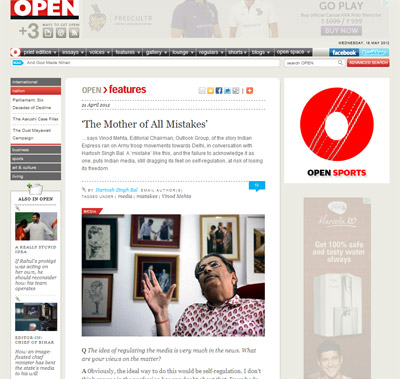
  • More Mediaah!: Indian Express, Shekhar Gupta & Co send notice to Open, Vinod Mehta. Demand Rs 500 cr as damages

    By Pradyuman Maheshwari


    The Indian Express group and four of its senior journalists (including editor-in-chief Shekhar Gupta) have sent a legal notice to Open magazine, its editor and other professionals. And above all to Vinod Mehta. The reason: in an interview to Open, Outlook’s Vinod Mehta rubbished the Express expose of a coup-like situation in the Capital.


    The Express is also upset with the publication of reactions that the interview elicited.


    I strongly recommend a read of the legal notice (currently posted in a blog that seems to have been created for the purpose — http://nobodyisusingthedword.wordpress.com/2012/05/15/indian-express- shekhar-gupta-threatens-to-sue-vinod-mehta-hartosh-singh-bal-open-magazine-c-repor/ .  Please don’t miss Pages 6 and 7, where the notice highlights a contradiction in Mehta’s statement on how he quit The Independent in the interview (as also made in a speech at the Press Club Bombay awards recently) and his book Lucknow Boy.


    The lawyer has asked for an apology, removal of the interview from the site and Rs 100 crore each for her clients. Note the money must be remitted even after the publication of the apology.


    Mediaah! view: I think the Express should’ve just let the interview be (link: http://www.openthemagazine.com/ article/nation/the-mother-of-all-mistakes). I don’t think the interview is damning the reputation of the Express or its editor-in-chief. And even if there is a belief that Vinod Mehta ought not to have said what he did and Open shouldn’t have published it especially since the coup story hasn’t been proven to be wrong, initiating a legal procedure is perhaps a bit much.


    Moreover, though it has established itself as an independent, gutsy publication, Open isn’t mass-circulated as, say, The Times of India. I must confess that even though I had been told about the interview, I read it only yesterday, after I heard of the notice. There is sure to be a fair bit of buzz in the social networks.


    I spoke to a senior member of the Open team who said the company lawyer was planning to respond to the notice and the magazine has no plans to pull the story off the Web.


    Final words: It’s imperative that while the media subjects everyone to criticism, it must be willing to take the heat whenever it’s subjected to it. Now, let’s hope Mediaah! doesn’t get a legal notice for writing all of this 🙂


    Buzz me if you have a story to tell. Confidentiality assured. There are various ways you can reach me:

    pradyumanm[at]mxmindia.com, BBM 23050B5D, Gtalk pradyumanm@gmail.com, Twitter @pmahesh and of course the mobile: 98338 76278.


    Disclaimer: Although he is CEO and Editor-in-Chief of this site, Pradyuman Maheshwari’s views in Mediaah! are not necessarily those of the rest of the team and MxMIndia.com.


  • Why media purists needn’t worry about Kumar Mangalam Birla’s 27.5 % in Living Media

    By Pradyuman Maheshwari


    On April 10, the TV Today network clarified to the Bombay Stock Exchange on rumours that the Aditya Birla group was acquiring a stake in the India Today group. The clarification said the Company (TV Today) was not aware of any such transaction and was not in a position to confirm the contents of the media reports.


    A little over a month later, the same organization sent the BSE a copy of the press release stating that 27.5 per cent of Living Media India, better known as the India Today group, was sold to the Aditya Birla group.


    A senior member of the AV Birla group told this correspondent that the investment was made by chairman Kumar Mangalam Birla on a personal level and not by any of the group companies.  After the customary approvals in a few months, we would get to know the real numbers. Late on Friday, Ashish Bagga, recently appointed CEO of the entire group (including TV Today), informed staff of the development by way of an email.


    The question which everyone wants to know is the price that Mr Birla paid for the 27.5%. There have been various figures floating around… that the money paid is in the region of Rs 350-500 crore. In the communique issued, Mr Birla is quoted saying: “The media sector is a sunrise sector from an investment point of view. I believe that Living Media India offers one of the best opportunities for growth and value creation.”


    Also read:

    AV Birla group buys 27.5% in India Today group


    Birla may use personal money for buy, Mail Today may now launch editions in Mumbai, other metros


    Loss of plurality is worrying: Paranjoy Guha Thakurta

    And here’s what Aroon Purie, chairman of the India Today group said: “I am delighted to partner with the Aditya Birla group to aggressively address the current and future potential of the Indian media business which is at a tipping point. The Aditya Birla group with its strong leadership global footprint, diversified business interests and its shared values of integrity, commitment and social responsibility make it a perfect fit with the India Today group.”


    So where’s the money going to be used? For one, it would mean expanding its current businesses. Specifically, Mail Today to move to markets like Mumbai and other cities and for TV Today to get into the regional space, and possibly a business channel. With a question mark on overall growth of newsmagazines, Living Media needs to invest its resources on segments with a growth potential.


    It has already done so by investing in smaller, niche magazines which have a smaller print run and attract fair amount of advertising as also bringing in international content.


    The TV Today network has also been in pressure in recent months with competition gaining ground. The radio station -Oye 104.8 – also needs to grow on the ratings roster.


    And what does it mean for the industry? Although a 27.5% equity will give Mr Kumar Mangalam Birla a toehold in media, it’s not significant enough for him to wrest editorial control. However, while there is fear of how big business money may impact the media, the fact is that it is already doing so. Even today, there exist managements and editors which buckle under pressure from large advertisers and influential individuals. There are enough stories of vested interests at play in Indian journalism, and for the media as a whole, the infusion of money from big business houses and foreign players could possibly ensure better salaries and hence lesser corruption. Standards of journalism are bound to improve.


    Also, it’s not that business empires haven’t been in the media already. The KK Birla group runs Hindustan Times, the Tatas would own the Indian title of Reader’s Digest until it sold to Living Media and there are other smaller players too who are known to back media players. Zee TV’s Subhash Chandra has a successful enterprise running under the Essel brand and even The Times of India group’s Jains have had long-standing interests in other fields.


    Since the media needs to increase scale, it needs the money for expansion. A route followed by some groups like Dainik Jagran, Dainik Bhaskar and Deccan Chronicle has been to go public. Still others – like Network 18 and Television 18 – have been public and also secured investment. Last year, the Abhey Oswal group bought 14.17% in NDTV.


    The Reliance Anil Ambani group has significant presence in the media with radio and television. It has also acquired a majority stake in business channel Bloomberg UTV. Just yesterday (Sunday, May 22), one saw a programme airing consumer complaints with a subscribers’s peeve against Reliance Communications. So it’s not that Bloomberg UTV blanks out all criticism of Reliance ADAG activities.


    According to me, more than the possibility of business empires exerting pressure after investing in the media, the worry is when the situation reaches oligopolistic proportions. This has in fact been seen with media groups having a stake in allied business like radio, television and events.


    Buzz me if you have a story to tell. Confidentiality assured. There are various ways you can reach me:

    pradyumanm[at]mxmindia.com, BBM 23050B5D, Gtalk pradyumanm@gmail.com, Twitter @pmahesh and of course the mobile: 98338 76278.


    Disclaimer: Although he is CEO and Editor-in-Chief of this site, Pradyuman Maheshwari’s views in Mediaah! are not necessarily those of the rest of the team and MxMIndia.com.


  • Mediaah! Is media really a ‘sunrise’ sector?

    By Pradyuman Maheshwari


    I had just got down to writing this when the day’s newsletter from Moneylife entered the inbox. The top story was an analysis by editor Debashis Basu titled ‘Kumar Birla’s Living Media investment is a bet on a sunset sector’.


    Basu is scathing in his criticism about Birla’s investments. “Kumar Mangalam Birla’s investments in “sunrise” sectors over the last decade have been garments, retailing, telecom, financial services and software. All these have fetched very poor returns. Now comes his investment in the messy, unprofitable and sunset media sector,” the article says (see link: http://moneylife.in/article/kumar-birlas-living-media-investment-is-a-bet-on-a-sunset-sector/25819.html). The last sentence kind-of captures the drift of the piece: “Kumar Mangalam Birla seems to have not only got carried away once again in his quest for sunrise sector but this investment is surely one of his worst.”


    Not having tracked the Aditya Birla group companies in possibly the way Debashis would have, I am not going to comment on all of Birla’s ventures and his specific decision on investing in Living Media. Yes, the market is tough, spends are down and competition is up, but Living Media would count among the better run media companies in the country.


    Although Purie’s daughter Kalli is actively involved, Living Media is managed by CEO Ashish Bagga. After G Krishnan’s exit, the TV business is also under Ashish (who is president of the Indian Newspaper Society), and I am certain that he will work towards the profitability of his business without compromising on core editorial values.


    My point is different: is media really a sunrise sector for investments as KM Birla says it is. And as Aroon Purie puts it, at a tipping point?

    While I am happy to see that a corporate biggie like Kumar Mangalam Birla believes in the media, this is not what everyone in this country believes is true. Entertainment television requires deep pockets and just having those and/or people who have struck gold before is not enough. The examples of 9X and Imagine are too fresh in one’s memory to attempt that. News channels are a weird game. Try producing one with quality content and your viewership will be very low and if you sensationalise, you devalue yourself.


    Mass print is expensive and the digital media hasn’t really taken off in right earnest for advertising. Social networks and Twitter are a rage with a section of urban India and not beyond.


    So sunrise? Perhaps, but a cloudy one. But if Mr Birla thinks it isn’t, why complain?


    Tomorrow: The decaying state of media education


    Buzz me if you have a story to tell. Confidentiality assured. There are various ways you can reach me:

    pradyumanm[at]mxmindia.com, BBM 23050B5D, Gtalk pradyumanm@gmail.com, Twitter @pmahesh and of course the mobile: 98338 76278.


    Disclaimer: Although he is CEO and Editor-in-Chief of this site, Pradyuman Maheshwari’s views in Mediaah! are not necessarily those of the rest of the team and MxMIndia.com.


  • Mediaah!: Will cross-media restrictions force Star, Zee & Sun to exit distribution?

    By Pradyuman Maheshwari


    There is no official word on it on the ministry website, but some journalists in Delhi were told about how the I&B secretary Uday Varma has written to newly appointed TRAI chairman Rahul Khullar to look into issues of cross-media ownership.


    “Major players are looking for expanding their business interests in various segments of print and broadcasting sectors. In this scenario, issue of media ownership and the need for cross media restrictions assumes great significance,” Varma wrote in his letter to Khullar, according to a Press Trust of India (PTI) report on EconomicTimes.com


    Adds the report: “Sources said that the I&B Ministry has asked TRAI to look into both horizontal and vertical aspects of cross media ownership, and then give its recommendations. In his letter, Varma has written that at present companies have control and ownership across Print, TV and Radio leading to horizontal integration. While at present there is no restriction for a company to have ownership across Radio, TV and Print mediums, but apprehension have been expressed in the past that control of media organisations in a few hands may prevent plurality of news and views, official sources said.”


    According to the PTI report, in his letter, Varma is also have said to noted that there were other implications related to cross-media ownership which included ensuring quality services at reasonable prices. The I&B secretary is reported to have further asked TRAI to look into the issue of vertical cross-ownership where companies owning TV channels were venturing into various distribution platforms like Cable TV distribution, Direct to Home (DTH) and Internet Protocol Television (IPTV).


    Hmmm. So this is why the headline: will cross-media restrictions force Star, Zee & Sun to exit distribution?


    Now before going any further, and for the benefit of those not in the know, let’s understand what vertical and horizontal cross-ownership means.


    Vertical would mean a media company that has ownership of, say, a TV channel also controlling a distribution (cable/direct-to-home/satellite/etc) company. And horizontal  cross-onwership would be a company that has interests in various media vehicles – newspaper, radio, TV, digital and even telecom!


    Way back in 2009, TRAI had issued some recommendations which I had commented on. My belief then and now is that the government and TRAI seem to be ducking the more sensitive issue of horizontal integration – namely, a media company with interests in print, radio, television etc. The TRAI believed that there was no threat due to horizontal ownership, but vertical integration – for television was a problem. So, while it was okay for a newspaper or a magazine to have its own distribution facility, that’s not the case for television. But of course the circumstances for print and television are different. In the 2009 recommendations, TRAI felt that there should be a 20 per cent cap on ownership and existing players would get three years to restructure.


    It’s been over three years already, and I guess that’s what has got the government moving its feet again.


    Mediaah! view: I don’t really think there’s any need for the government to intervene as regulatory and legal actions are already in place. And competitive pressures of course. For instance, a DTH operator cannot blank out a rival network’s channels.


    Mind you, the problem is graver with horizontal ownership. The PR executive of a radio station complained to me how she couldn’t ever get publicity in some key markets because rival stations were owned by newspapers. Thus even a minor activation gets a photograph and a report in the paper while that of a rival does not. Competition writes about you only if there’s something negative, she complained.


    Similarly television marketers crib how channels owned by newspaper companies have it easy with advertising and editorial space. Thankfully, media buyers are discerning and don’t get taken in by claims – correct or otherwise.


    The 2009 recommendations had also seen TRAI saying that limits on licences by a single entity were “adequate” and there is no restriction on control of ownership across telecom and media. Note this was to be reviewed after two years (that is, 2011), though the real changes in dynamics have happened since January 2012 given Reliance Industries and the Aditya Birla group getting involved, albeit indirectly.


    My sense is that given recent developments, the TRAI will also look at the issues of mergers, acquisitions and alliances in a bigger way. What the government/TRAI needs to also do is ways to determine and factor in ‘benaami’ ownership. For instance, even if as a broadcaster I may not own over 20 per cent of another ‘vertical’ media entity, what prevents a family member/friend to do it?


    It’s not an easy policy to work on, but am sure like various other complex issues it has tackled over the years, TRAI will come up with recommendations for this too.


    Buzz me if you have a story to tell. Confidentiality assured. There are various ways you can reach me:

    pradyumanm[at]mxmindia.com, BBM 23050B5D, Gtalk pradyumanm@gmail.com, Twitter @pmahesh and of course the mobile: 98338 76278.


    Disclaimer: Although he is CEO and Editor-in-Chief of this site, Pradyuman Maheshwari’s views in Mediaah! are not necessarily those of the rest of the team and MxMIndia.com.