Category: Events

  • Colors takes the live route with Rising Star

    By A Correspondent


    Over the nine-odd years that it has been in existence, Colors has caused a fair deal of disruption in the time-and-tested programming format of general entertainment channels. But on Tuesday, it unveiled what’s possibly its toughest. And some may say even its boldest.


    Call him a ‘Khatronka Khiladi’, for,Colors CEO Raj Nayak is aware that Rising Star isn’t an easy act. But after having decided on the internationally popular format to occupy the 9pm slot on weekends from Feb 4 (post-Bigg Boss 10), there’s been no looking back.


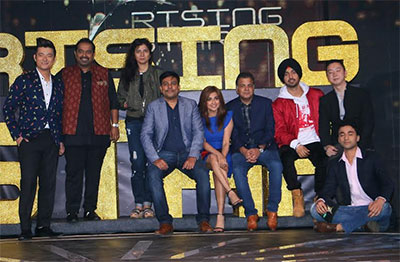
    Rising Star will be aired live and the judging will be done by home audiences via the Colors TV mobile app with celebrities Shankar Mahadevan, Diljit Dosanjh and Monali Thakur essaying the role of experts and not judges.


    Said Nayak: “You will now see a show that is absolutely live with no room to create, fabricate or produce anything. It’s what you see is what you get, with the reigns of the show completely handed over to the viewers, as they decide the course of the show. This is a first-of-its-kind kind of an experiment on Asian television, let alone India.  With more and more people getting attuned to smartphones and the country moving towards Digital India, we are proud to announce that we are future-ready,” adding: “Colors has always been a pioneer in introducing cutting edge technology and heightening viewer engagement. With this show, we are taking this commitment one step further.”


    He further added, “We would like to welcome Oppo Camera phones on-board as Presenting Sponsors on ‘Rising Star’. Through this partnership, we are furthering our individual brand promises to drive synergies amongst our target audiences.”


    Colors has roped in Oppoas Presenting Sponsor for Rising Star, other sponsors include Tata Motors Commercial Vehicles on SD and Kajaria Tiles and Jaquar bathroom products on Colors HD.


    Talking about the association,  Will Yang, India Brand Director at Oppo Mobiles said: “‘Rising Star’ further extends our association with Colors post 24 season 2 and Bigg Boss 10. It has a unique format which encourages usage of innovative technology across the country which is something we believe in and thus it was an easy call for us to associate with the show. We hope that the association and the show is a huge success amongst the audience.”


  • Twitter announces Amplify partnership with FilmFare and Jio

    By A Correspondent


    Twitter announced a partnership with Jio Filmfare Awards through Twitter Amplify, a content sponsorship package that will enable the brands to extend their presence to targeted Twitter audiences in India. The first Twitter Amplify deal in the entertainment industry in India, @Filmfare will broadcast exclusive curated content live from the Twitter Blueroom at 6:30pm IST on 18th February 2017, an hour before Jio Filmfare Awards television telecast, available worldwide to Twitter’s logged-in and logged-out audience and connected devices.


    The special broadcast will include a special show LIVE on Twitter from the #BlueRoom with film director Karan Johar (@KaranJohar) and Jitesh Pillaai (@jiteshpillaai), editor Filmfare; hosted by digital creator and comedian Abish Mathew (@abishmathew). The special broadcast streamed from @Filmfare will see Karan and Jitesh revealing inside scoop on Bollywood’s biggest stars and sharing interesting backstage trivia from this year’s awards. As the trio speak about movies and more and engage in a fun Rapid Fire Round that will pit Karan and Jitesh against each other, fans will get a special sneak peek into Bollywood’s biggest night exclusively on Twitter.


    Jio’s pre-roll video will be added to the multiple creative executions including behind the scenes, sneak peeks from the Red Carpet, nominations and celebrity reactions from the event itself. The Amplify deal for the 62nd JioFilmfare Awards 2017 began with the Red Carpet episode and runs through the final broadcast of the awards on television this weekend.


    Twitter Amplify enables media companies and brands to capture the excitement on TV and distribute it to fans and audiences across Twitter, far beyond their existing followers. Audiences can immediately relive that moment or experience it for the first time on their mobile phones while they engage in Twitter conversations.


    Viral Jani, Head of Entertainment, Twitter India said, “People come to Twitter to be a part of the social TV conversation around celebrities which is constant on Twitter. Twitter is where the virtual world of entertainment unfolds and we are excited to have Jio and Filmfare on board to further enhance Twitter’s second screen experience. Our collaboration with Filmfare will give fans a sneak peek into exclusive content that they can engage with on Twitter while viewing the content on television.”


    “Filmfare is always looking for innovative ways to bring the best of Bollywood to fans all over the world. We are thrilled to team up with Twitter and provide users around the world never before seen glimpses from the event and behind the scenes peek to one of the most prestigious awards in the film industry.The idea is to enhance the digital footprint of the Filmfare brand with this first of a kind partnership for any awards property in India.” says Deepak Lamba, CEO, Worldwide Media that owns Filmfare.


  • Nyka Events signs Pitchfork Partners as strategic advisors

    By A Correspondent


    Nyka Events have signed on Pitchfork Partners Strategic Consulting LLP to advise themon delivering various changes management initiatives the firm is currently exploring to take the organization into the next phase of its growth cycle.


    Hariharan Subramanian, Co-Founder and Partner Nyka Events says, “Nyka has been a pioneer in the events industry and has been steadily growing for nearly two decades. To continue this growth and achieve even greater heights in the coming decade, we believe changes are required. Pitchfork Partners’ strategic expertise is a perfect fit for our company’s change management needs. We’re looking forward to this partnership and are extremely delighted to have them on board.”


    Commenting on the appointment, Jaideep Shergill, Co-founder, Pitchfork Partners, exclaims, “We’re really excited to collaborate with Nyka Events. Being in the events business for nearly 2 decades, Nyka has established a unique position in the events industry and is known for its creativity & innovation. We are committed to helping our new partners increase this growth trajectory and achieve even greater goals in the future through our strategic and insight driven change management initiatives.”


    Pitchfork partners will be responsible for providing overall strategic business direction by leveraging distinctive, insight-driven analytics and proven methods to increase the pace, certainty and successful outcomes of Nyka’s change programs.


  • Lokmat Sur Jyotsna Award is a platform for aspiring singers in India

    By A Correspondent


    Dedicated to celebrating musical excellence, Lokmat has announced the fourth edition of its musical award show – Lokmat Sur Jyotsna Award. This year, a ‘popular’ category is also added and singers can upload their video and audio files on a website. The winners will be rewarded with the cash prize of Rs 1 lakh in each category along with a trophy.


    Speaking on the occasion, Devendra Darda, Managing Director, Lokmat Media Pvt Ltd said, “Surjyotsna Music Awards is conceived with the vision of identifying unique musical talents from across the country. A dream dreamt by us three years back has today emerged as one of the platforms for upcoming singers and that has given us confidence to scale up the competition level. As we bring in the 4th edition of Surjyotsna Awards, we look forward to celebrating another exciting year in Indian music and recognizing new talent.”


  • Nandini Dias on Festival of Media Asia 2017 jury

    By A Correspondent


    Nandini Dias

    Nandini Dias, CEO, Lodestar UM India is part of the jury  at the Festival of Media Asia Awards (FOMA) 2017 to be held in Singapore on March 22. Rewarding the best in media thinking and communications, FOMA is the only awards ceremony dedicated to the evolution of media across the APAC region.


    Said Dias, who has been a long serving Jury member at Emvies, Effies, Media Abby, Cannes Lion, Spikes Asia, Festival of Media, Press Club of India, amongst several others: “Judging the Festival of Media Asia Awards and seeing the best in creative and innovative work that is happening in the region and around the world is always inspiring. I am extremely excited and happy to be part of the Jury this year,” adding:  “We are in a fast changing media landscape, where we are all grappling with the challenge of short attention span of the consumer. Therefore, I am looking forward to seeing the work that stood out in the clutter and made the consumer sit up and notice the brand.”


  • 14% growth over 2017-21: FICCI-KPMG report


    By A Correspondent


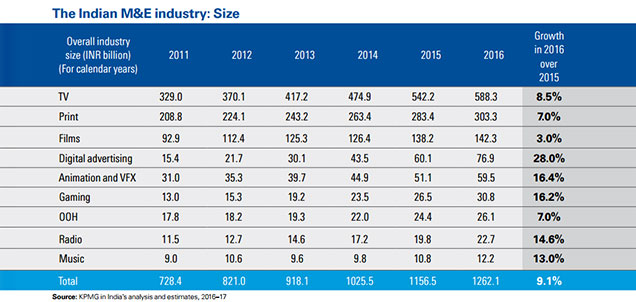
    The Indian media and entertainment industry in 2016 was able to sustain a healthy growth on the back of strong economic fundamentals and steady growth in domestic consumption coupled with growing contribution of rural markets across key segments. These factors aided the industry to grow at 9.1 per cent on the back of advertising growth of 11.2 per cent, despite demonetisation shaving off 150 to 250 basis points in terms of growth across all sub-segments at the end of the year. The ‘FICCI – KPMG Media & Entertainment Industry Report 2017’ launched at FICCI Frames 2017 in Mumbai, aims to capture a comprehensive picture of the industry’s growth story, challenges, future projections, and key underlying themes.


    The big story in 2016 has been the evolution of FTA channels post expansion of rural measurement in the television segment coupled with the impact of the 4G rollout and the resulting price wars. Both these factors have resulted in media consumption penetrating deeper into India, resulting in a realignment of strategy by media companies and advertisers alike.


    Compared to 2016, the industry is projected to grow at a faster pace of 14 per cent over the period of 2017-21, with advertising revenues expected to increase at a CAGR of 15.3 per cent. The year 2017 is likely to witness a marginally slower rate of 13.1 per cent as the economy recovers from the lingering effects of demonetisation and initial uncertainties arising from GST implementation.


    Commenting on the industry’s performance and way forward, Uday Shankar, Chairman, FICCI M&E Committee and Chairman & CEO of Star India, said: “The industry has gulped down the bitter pill of demonetisation trusting its long-term benefits and yet is set to bounce back to a steady growth, thanks to strong fundamentals. Building solid infrastructure and continued government support will help the industry reach the tremendous potential it holds for employment and creating socio-economic value for the country. A commitment towards a quick transition to digitisation will ensure growth for all stakeholders.”


    Added Girish Menon, Director, Media and Entertainment, KPMG in India: “[The year] 2016 was a mixed bag for the industry with digital media making its way to the centre stage rapidly from being just an additional medium. It is compelling existing players to rethink their business models. To accelerate growth, M&E organisations must rebuild their strategies to fit and thrive in the changing, digitally-oriented landscape. Nimbleness and flexibility will be at the core of sustainable businesses…. The long-term factors driving the future growth are expected to remain positive, with growing rural demand, increasing digital access and consumption, and the expected culmination of the digitisation process of television distribution over the next two to three years.”


    Sector-wise analysis:

    Television:

    The TV industry clocked a slower growth in 2016 at 8.5 per cent, attributed to tepid growth of 7 per cent in subscription revenues and a lower than estimated 11 per cent growth in advertising revenues. A key theme in 2016 was the emergence of FTA channels as a key focus area following the expansion in rural measurement by BARC and the resultant increased interest by both broadcasters and advertisers. Additionally, strong performance of sports properties and increased spending for the launch of 4G by telecom operators helped alleviate some of the pressure. The industry is expected to grow at a CAGR of 14.7 per cent over the next five years with advertising and subscription revenues projected to grow at 14.4 per cent and 14.8 per cent, respectively. The projections remain robust due to strong economic fundamentals, rising domestic consumption and growing contribution of rural markets coupled with the delayed, but eventual completion of digitisation.


    Print:

    The revenue growth rates of print continued to witness a slowdown at 7 per cent in 2016, as English newspapers remained under pressure. Regional language papers demonstrated strong growth, but were adversely affected by demonetisation given their high dependence on local advertisers. Print is expected to grow at 7.3 per cent, largely driven by continued growth in readership in vernacular markets and advertisers’ confidence in the medium, especially in the tier II and tier-III cities. Rise in digital content consumption poses a long-term risk to the industry.


    Films:

    Films grew at a crawling pace of 3 per cent in 2016. The segment was impacted by decline in core revenue streams of domestic theatricals and satellite rights, augmented by poor box office performance of Bollywood and Tamil films. Expansion of overseas markets, increase of depth in regional content and rise in acquisitions of digital content by over-the-top platforms are expected to be the future growth drivers that would help the segment bounce back at a forecasted CAGR of 7.7 per cent. However, factors such as dwindling screen count and inconsistent content quality could prove to be limiting factors.


    Digital advertising:

    Continuing to ride on a high growth trajectory with a 28 per cent growth in 2016, digital advertising has captured 15 per cent share in the overall advertising revenues, with a minor hiccup due to demonetisation. 4G rollouts and the resultant data price wars are providing further impetus to the growth as digital consumption and habits are becoming more mainstream. It is projected to grow at a CAGR of 31 per cent to reach INR294.5 billion by 2021, contributing 27.3 per cent to the total advertising revenues. Advancement in infrastructure, evolving audience measurement technology leading to better content and lowering data costs will drive user habits towards greater digital consumption, driving tremendous growth for the industry.


    Animation and Visual Effects (VFX):

    The industry grew at 16.4 per cent, driven majorly by a 31 per cent growth in VFX due to increase in outsourcing work, growing use of VFX in domestic film productions and increase in demand for domestic animated content on television. The industry is estimated to grow at a CAGR of 17.2 per cent over 2017–21.


    Out of Home (OOH):

    The industry registered a slowdown in growth rate at 7 per cent majorly due to adverse impact of demonetisation. OOH is projected to grow at a CAGR of 11.8 per cent primarily driven by development of regional airports, privatisation of railway stations, growth in smart cities, setting up of business and industrial centres, and growing focus on digital OOH.


    Radio:

    Radio recorded a 14.6 per cent growth led by volume enhancements in smaller cities, partial roll out of Batch 1 stations and a marginal increase in effective advertising rates. However, weak uptake in Batch 2 auctions of Phase 3 and delays in the rollout of majority of Batch 1 stations, coupled with adverse impact of demonetisation dampened the overall sentiment. Nevertheless, it is expected to be the fastest growing amongst the traditional mediums at a CAGR of 16.1 per cent, arising from operationalisation of new stations in both existing and new cities, introduction of new genres and radio transitioning into a reach medium.
     

  • Hotstar ready for 2017 edition of IPL with latest campaign

    By A Correspondent


    Hotstar, Star India’s video-on-demand platform, has launched its Vivo IPL 2017 commercial a 60-second film, to be followed by shorter films as the campaign progresses. The campaign has been conceptualised by independent agency Creativeland Asia.


    The film, set to a track composed by SnehaKhanwalkar and performed by rapper Naezy, opens with people from different walks of life in a typical Indian city, getting their game face on. What’s different, however, is that as opposed to the years where IPL meant life grinding to a halt, we see fans going about their lives, while effortlessly catching all the unpredictable and hot IPL cricket action.


    Commenting on the film, Ajit Mohan, CEO of Hotstar shared: “With Hotstar, the old narrative of cities turning into ghost towns during IPL is passé. The audience’s lives have gotten busier and thanks to IPL on mobile with Hotstar, there is no longer any need to make a trade-off between your passion for cricket and going on with daily life. The action on the field can heat up at any time and Hotstar is your ally for not missing a single hot moment, no matter where you are. Na life rukegi, na game rukega.”


    Added Sajan Raj Kurup, Founder and Creative Chairman, Creativeland Asia: “This has been an unbelievably action packed project from the word go. The insight was that Hotstar allows you to go about your life while still catching all the IPL action live. So, no matter what you’re doing – working, studying or travelling, with Hotstar you’re constantly in a state of readiness to catch every bit of every hot match. The fielding stance is a great metaphor for readiness. We used this metaphor to show people around the city being ready for every ball of the IPL.  From the script idea to the composition of the music/lyrics and shooting from road to road with a smallish feature-film crew, this is perhaps the most anecdotal project we have done in recent times.”


    Now one needs to see which anthem gets more popular: Sony’s 10 SaalAapkeNaam or the one created by Hotstar.


  • Lokmat Parliamentary Awards 2017 honours Lok Sabha & Rajya Sabha members

    By A Correspondent


    Leading newspaper group Lokmat launched the Lokmat Parliamentary Awards 2017 with a panel of well-known jury members to select winners across eight categories and acknowledge the contribution of political leaders.
     

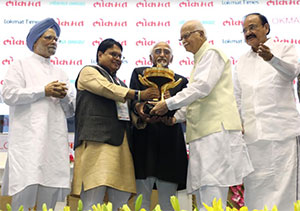
    The met atleast six months back to shortlist the winners basis the criterion decided. Said Vijay Darda, Chairman, Lokmat Media Group: “As the leading regional daily, Lokmat is deeply rooted in the strong foundation of true journalism and nationalism. Founded by freedom fighter, Jawaharlal Darda, Lokmat has emerged as an institution that has become the voice of change and progress. Being instrumental in driving people’s issues to providing a platform recognizing Maharashtra’s talent, Lokmat has created unique thought leadership by creating first-of-its-kind awards as Lokmat Parliamentary Awards.”


  • 5Ts & Creating an Organisation of the Future


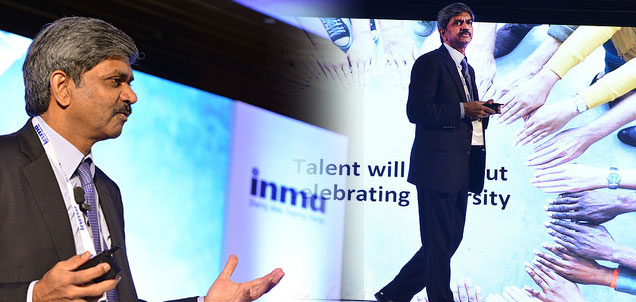
    Pepsico India Chairman and CEO D ShivaKumar is one of the best thinkers among the current generation of corporate captains. His presentations are a must-watch and as someone studies business practices and organisational and leadership behaviour, beyond being a great business leader himself, ShivaKumar shared his perspectives on how organisations and industries can reinvent themselves in a rapidly-changing environment.


    We reproduce here the presentation that the Pepsico India boss made and although it’s not the same to be viewing it live with all the explanations and the commentary, the slides are fairy self-explanatory.


    The session revolved around ShivaKumar’s premise that the organisations of the future will be built around the five Ts of Trust, Talent, Technology, Teams and Time


    ​Do read the PDF…

    http://www.inma.org/Modules/Event/2017SouthAsia/Presentations/Shivkumar-Southasia2017.pdf


  • Amazon Prime Video ventures into reality shows in India


    Amazon Prime Video India has announced the creation of multiple reality shows for India, a first for a digital streaming service. The lineup comes to life with three new reality shows – Jestination Unknown, The Remix and Comic Kaun featuring stars such as Vir Das, Anu Menon, Amit Trivedi, Sunidhi Chauhan and Nucleya; and comedians Tanmay Bhat, Sumukhi Suresh and Abish Mathew.


    Said James Farrell, Head of Content, Prime Video, Asia Pacific: “Reality shows are now more popular than ever, across a variety of genres. Customers globally have told us how much they enjoy reality shows, like the Japanese Prime Video fan favorite, The Bachelor Japan. With the launch of multiple new Original reality shows, we’re aiming to offer our Indian customers a variety of quality new reality content to enjoy.”


    Added Vijay Subramaniam, Director, Content, Amazon Prime Video India, said: “We’re always looking for new ways to engage with our customers. We know Indians enjoy reality TV, so we are creating new originals with the best new concepts and local Indian talent. We’re excited to add more variety to our service, and continue to reinvent the way Indian customers watch TV.”


  • Text of Sudhanshu Vats’ keynote @ CII Big Picture Summit

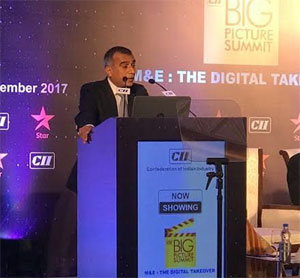
    The CII Big Picture Summit is on in New Delhi. The biggest M&E event held in the capital, the Big Picture Summit plays host to a verity of  industry captains. This is the text of the keynote address by Sudhanshu Vats, Group CEO, Viacom18 and Chairman, National Committee on Media & Entertainment, CII… Published with permission


    Respected colleagues, friends and dignitaries on the dais – Sri Amitabh Kant Saab, Sri Vempatiji, Shri Ramesh Sippy Saab, Shri Amit Khanna, Smt. Amita Sarkar – and our well-wishers in the audience. Thank you very much for making it to Delhi for the 2017 edition of the Big Picture Summit.


    The theme for this year is ‘The Digital Takeover’. In my honest assessment, this is an extremely provocative theme – and one that can mean different things to different people. I can imagine some of my colleagues from the broadcast sector feeling upset – after all they represent the largest chunk of the revenue and profit pools that make us a 125k Cr to 135k cr behemoth that we are. I can also imagine what some of my younger colleagues who are already social media influencers thinking – this theme is passé, the takeover was complete a few years ago! I know there are others who will be more balanced in their thinking. I don’t want to pick a side at this stage. This topic itself has loads of nuances that need to be addressed – and I’m certain that no definitive side can be picked. I am hopeful that over today and tomorrow, the panels will help you think through the theme for the event and form your own distinctive understanding of where we stand today and the direction in which we are likely to head tomorrow.


    That being said, I wanted to take this occasion to share with you the first thought that came to my mind when I came across this theme. To me it sounded like the onset of the digital takeover that is likely to lead to greater automation and fewer human jobs. Talk about tangential thinking, but this is a topic that I have been thinking a lot about over the last few quarters. You might be wondering what this has to do with Big Picture and our industry, but let me try and connect the dots.


    You see India has a workforce of 460 million. As per several estimates, the working age population grows by 15-16 million every year. While we have this massive workforce that’s growing, we also have to remain competitive as globalization and trade grow. There is also a large trend of automation of jobs wherein machines are being used to perform ‘routine’ jobs or tasks that are repetitive; plus, they can do these in a cheaper and better way. Clearly in the next 5-10 years we are going to see both these forces taking each other head-on. Some people can argue that this will take even longer in India because labour is relatively cheaper and others will argue that it will be felt sooner because we will lose our competitive advantage as developed countries manufacture more without labour. Irrespective of the side you find yourself in you cannot find fault with the fact that while this fear may playout sooner or later – eventually, it will. Fact is, that Indian policymakers displayed a great deal of foresight by making a reference to Universal Basic Income – wherein every Indian gets a fixed subsidy – in the Economic Survey earlier this year. Personally, I found it very progressive to at least put the issue on the table – contrary to what people think it’s probably more important for India than it is for developed countries because of the sheer size of our workforce. People are debating about its costs etc. but if you think about the government’s success with the ‘Givitup scheme’ where the creamy layer is giving up its LPG subsidies, the cost of UBI could also be reduced with some innovative behavioral economics.


    Now you might wonder why I am going on and on about our country’s workforce and labour market challenges when we have gathered here as leaders of the M&E industry. You see our sector directly employees anywhere between 1.1-1.2 million Indians. In the next 5 years, we will add ~ 1mn jobs, basis conservative estimates, thereby playing our role in assuaging the challenge. If we achieve breakout growth, that number can also touch 5mn. However, I would like to draw your attention not to the number of jobs but to their quality.


    The skills required to thrive in our sector are the bedrock of most ‘non-routine’ jobs. Creativity, story-telling, emotional intelligence and cognitive ability – all skills that M&E professionals can be proud of are the ones that are automation proof. These are also the skills that can be transferred to other sectors – making us a part of the solution. Of course, we too will face our share of the burden. Some roles will be automated – and the media organization might look very different in 2027 – but our core will still be automation-proof.


    This is truly a complex challenge and a promising opportunity. If we get it right the generations to follow will harvest the fruits of our efforts. To get it right, all constituents of our society need to come together and set the stage.


    The government needs to continue its support to our sector so we can grow at double digit speed and add more, future-proof jobs. A lot has been done and a lot more can be done. The policy framework for the new labour economy – which is a gig-based, independent artist economy – needs to be laid.


    The private sector needs to be more ‘creator-friendly’ or ‘freelancer friendly’. This means having the right kind of tools and technology to spot and empower talented individuals and then compensate them in a transparent manner. Imagine leveraging blockchain technologies to manage royalty payments. Some work is already happening in this space but the question really is can we do more? We also need to hire more individuals who can help create and leverage these tools and technology. Take for instance, programmers and data specialists. These are not easy to find and retain. As an industry, we need to respect them more if we are to attract them. Industry bodies can take the lead and be evangelists in this space. It might set the stage for all of us to follow.


    Non-profit organisations and educational institutions need to ensure that the right kind of training programmes are provided that are scalable, low-cost and wide in reach with a quick turnaround time. Arts education, including liberal arts programmes, need to be dialed up wherein students can look at studying music and computer science or film-making and finance.


    This is the only message I’d like to leave you with. In a future where the labour market will undergo several changes – and more changes – our sector might hold the key to creating a future-proof, agile, dynamic workforce that can take its skills and drive impact across industries. I have immense faith in our sector and the promise it holds. With the right kind of impetus and co-ordination it can truly power India as we take on the mantle of a Vishwa Guru in every sense of the word. We have a tendency of placing revenue milestones for the future – and it might even be the right thing to do. I however believe that we’re better off aspiring for a larger goal for ourselves – one that places us at the centerpiece of a resilient, modern and equitable society. This is the only ‘takeover’ I aspire for.


    Thank you ladies and gentlemen, thank you for your time and attention.


  • Dainik Bhaskar hosts financial seminar in Mumbai

    By A Correspondent


    DB Corp Limited (DBCL) announced the successful conclusion of its event last week that saw a representation of over 70 professionals from the financial services industry including top merchant bankers, analysts from reputed broking houses as well as leading media and advertising agencies.


    The event with theme “India’s growing equity culture” Joint Secretary – DIPAM, Ministry of Finance Dr Dheeraj Bhatnagar as Chief Guest who also delivered the keynote address. Bhatnagar reiterated the government’s efforts and commitment to reforms that have paved the way for stronger economic growth. Dr Bhaskar Das, Executive President, DB Corp presented the current capital market environment and how equity has been delivering breakthrough performance as an asset class triggering more allocation towards financial savings, primarily driven post demonetisation. Dr Das also discussed the key IPO markets in India, Dainik Bhaskar Group’s presence in these regions and how leading publications as Dainik Bhaskar and Divya Bhaskar are supporting the industry to expand the nascent equity culture across India’s tier 2 and 3 cities which have emerged as the country’s new growth engines.


    Said Girish Agarwaal, Promoter-Director, DB Corp: “These are exciting times that the country is witnessing. With key reforms paving the way for stronger economic and industrial progress, India is moving on to the next phase of productive growth. India’s macroeconomic fundamentals demonstrate that the economy is now poised to take off. As India’s largest media conglomerate, Dainik Bhakar Group through its publications in four languages, 66 print editions across 12 states; has been playing an active role in supporting the expanding equity culture in India. We are even more committed to extend our strengths to the financial services industry in particular; to expand financial and capital market literacy to reach out to retail investors across India. While significant potential across industries is being gradually unlocked, a key aspect of this future progress also includes the simultaneous growth of India’s retail investor community. Discussing the way forward based on a collaborative approach, was the primary objective of the successful event. We thank Dr. Bhatnagar for gracing the event and all our guests who made the discussions so engaging.”