Category: TV

  • Zee pumps in $250mn for wellness content

    By A Correspondent


    Subhash Chandra, Chairman of Zee group, today announced the creation of a $250 million content development, production, co-production and acquisition fund in the United States that will benefit Veria Living, a network devoted to showcasing wellness programming and related content across multiple media platforms.


    The New York-headquartered Veria Living television network is available throughout the US to the Dish Network, Verizon FiOS and Frontier Communications subscribers. Veria Living offers the world’s largest line-up of first-run, original programming – connecting viewers in a contemporary and accessible manner to the benefits and joys of living a healthy lifestyle.


    The establishment of the $250 million fund is yet another step in Zee’s five-year plan to further expand Veria Living’s presence in the US and beyond as the go-to-source for all things health and wellness. Said Mr Chandra, “We are firmly committed to growing the Veria brand across the television, internet, mobile and OTT platforms. By focusing on original content development and production we’re not only looking to build a broad US audience for Veria Living, but also setting the table for the expansion of the brand globally over the next couple of years.”

  • TV-wallahs eager for digital wave


    By Rishi Vora


    The television distribution scene in India has for many years seen the dominance of cable wallahs. Digitization only started in a big way when DTH players pumped in huge sums (there was no ordinance then) and succeeded in building a critical base of subscribers in the country. As a result cable operators were seen as laggards. Sample this: there are about 40-45 million DTH homes out of the total viewing population of more than 225 million households, so DTH has grown despite competition from cable and is likely to increase the subscriber base substantially with the recently passed ordinance by the government.


    As for the cable operators and MSOs, they are left with no option but to invest in infrastructure. Den Networks is investing Rs 1,000 crore and expects to get 2.5 million subscribers in the phase one. Hathway will invest Rs 500 crore and they are also bullish about increasing the subscriber base. Analysts feel that now is the perfect time for MSOs to increase their share in the business.


    So, while it seems all good for the industry, the fact is that digitization is something that was always talked about, and is now a work in progress as far as complete digitization is concerned. The government has, in a recent development, pushed the sunset day for four metros from March 2012 to June 2012. The date for cities with a population more than 1 million is March 31, 2013.


    For broadcasters, this is a big relief from the carriage fees, which in the past have resulted in loss of revenues. The four metros is a big market with 20 million households; and digital homes eating into cable and analogue… But, digitization, for broadcasters, also means that the consumer will now have a choice of what channel to pay and watch. That in experts’ minds is a challenge many broadcasters will have to face – to keep their viewers’ interest levels high and for the long run.


    Subhash Chandra, Chairman, Zee opines, “Digitization will only help the television industry further grow. The government’s decision on clearing the ordinance is a very positive move. It will give a boost to the cable and satellite industry and help create a more sustainable business model for the television industry.”


    On the growth of DTH players in the county, he said, “DTH is leading the adoption of digital technology. There are about 39 million gross DTH subscribers in the country. Now they have a great opportunity to consolidate their businesses.”


    However Dinyar Contractor, Editor-in-Chief of Satellite and Cable TV Magazine, has a contrary view to the whole scene. He feels that there is still some time for digitization to happen pan-India (2014) as the ordinance states. And that broadcaster are wary of going digital, or are wanting to delay the process of digitization of TV in India, as the profits are not much, plus there is the risk of losing eyeballs, as there will always be viewers who are not open to the idea of paying and viewing, as against the concept of free-to-air channels.


    Tarun Katial, CEO, Reliance Broadcast Network Limited, feels, “Digitization will bring-in fair reporting of subscriber base, which will lead to standard pricing and subsequently eradication of local monopoly. It will help companies increase subscription revenues and reduce down carriage fees for broadcasters in a phased manner.


    Ajay Chacko, President, A + E Networks | TV 18 JV, says that the move will bring in more accountability in the business. And apart from additional subscription revenues, he believes that digitization offers a whole new benchmark for broadcasters, and a platform which is more measurable than cable and analog.


    Neo Sports COO Prasana Krishnan welcomes the ordinance. “This is the much needed change in the industry. What it will do to the industry? I think it will revolutionize the broadcast landscape in India.”


    If the ordinance were not passed, Mr Katial is of the opinion that the current capacity constraints in analog cable would have stifled the growth of new channels and introduction of technologically advanced content. “The carriage costs paid by broadcasters which currently remain high in view of the limited bandwidth of analog cable would decrease post digitization. This would allow broadcasters to make higher investments in programming and marketing, thus improving the customer experience,” he explains.


    Another advantage the industry will see over the years in the fast adoption of HD television and 3D, which will open new revenue streams. As far as television distribution industry is concerned, the ordinance will lead to more transparency and greater accountability. It means opportunity for all stakeholders – broadcasters, distribution platforms including cable companies, MSOs and DTH.

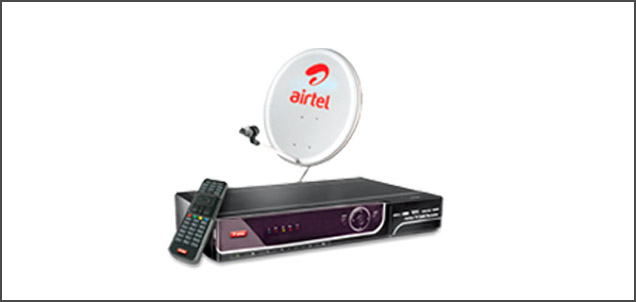
    Photograph: Airtel Digital TV HD Recorder from airtel.in

  • Movies Now: Riding high on popular titles

    By Tuhina Anand


    It’s going to be a year since Movies Now from the stable of Times Television Network launched in December last year. Ever since its launch, the channel has managed to upstage its competition, some of which have been in the business for much more than a decade like Star Movies and HBO and the newer players including PIX. What has worked in favour of the channel is its promise of an enhanced viewing experience because of being available on the High Definition (HD) platform, relying on popular titles, getting its distribution correct besides the backing of the Times conglomerate that definitely has helped in marketing the channel.


    Amongst the English channel category, it is the English movie channels that comprise 30 percent of the market share. This is the highest reach in this category.  The English Movie category also has a reach of around 29 percent of the total television viewers. These numbers definitely moves the genre which was earlier seen as niche to be highly influential hence even catching advertisers eye especially those marketing premium products because this is the category where the potential customers are on.


    With launch of Movies Now last year the category underwent a change especially because of the performance of the channel thus putting competition on their toes. The launch of the channel had catapulted the growth of the category from 50 GRPs to 72 GRPs and witnessed growth of 43 per cent. The category reach increased by 20 percent and now reaches out to 5.5mn individuals every week. Besides, Movies Now enjoys the highest viewer time-spent in the category, which is nearly double of other English Movie Channels.


    Talking about the success, Ajay Trigunayat, Channel Head, Movies Now, under whose  leadership, the channel has been charting success shares that his firm directive towards the channel’s Audience Management Plan included Content, Brand & Marketing and that has helped Movies Now break-through the clutter and carve a distinct identity in the mind of its consumers and a firm place in their daily lives, culture and ethos.


    He said, “Movies Now India is witnessing an ever increasing English speaking audience. Also, the target audience is no longer residing only in the metros and is now moving into the Tier 2 and Tier 3 cities. Thereby, we have a category which growing rapidly and demanding far more English content paving way for the new players in the market.”


    The talking point of channels success has been its limited but popular library. Kunal Jamuar, Head of West India and Executive Director, Mumbai at MPG India explains how he sees the channels growth. He said, “It has a limited library but good titles that has ensured first appointment viewing and later stickiness. I think they have consciously kept a limited library thus giving viewers the much more opportunity for stickiness so in that sense they have changed the paradigm for English movies category.”


    “However, I think going ahead they need to address larger demographics which I think is getting ignored like paying attention to various time bands and playing movies accordingly.”


    Rajneesh Chaturvedi of MEC Global, said, “Movies channel is primarily driven by its title where Movies Now has scored well. They have managed their distribution well so in a year’s time they have done well for themselves and the category. Going ahead, they have to keep on adding popular titles which they have been doing currently to get viewers to stick to the channel.”


    INTERVIEW


    ‘Providing the best to the viewer’: Ajay Trigunayat, Channel Head, Movies Now

    Ajay Trigunayat has been instrumental in conceiving & nurturing the launch of Movies Now – Hollywood in HD, the English Movie Channel from the Times Television Network. Prior to Movies Now, he has worked with Media Agency Middle East, Dubai as CEO (2006-07) handling Sales, Event Management & Broadcast, Brand & Marketing for the Arab Youth Football Championship. He has spent 4 years at Zee Telefilms Ltd. and was the driving force behind the re-branding of Zee English, Zee MGM to Zee Café and Zee Studio in 2004 – at the same time re-vamping the content through key strategic partnerships with Disney, Warner, Sony, Fox and Universal.

    Mr Trigunayat has spent a decade in Advertising agencies honing his Brand and marketing skills across Rediffusion Y&R , Lintas and Contract. Here, Mr Trigunayat in conversation with MxM India offers a peek into the working and success of Movies Now.


    Q: How do you see Movies Now poised amongst competition in this category?

    Movies Now has achieved category leadership from the very launch day itself; and is the leader across all channels, across weekdays, across weekends, across day parts and despite 2 key cricket events (World Cup and IPL) the category viewership has grown by a whopping 80%. Our reach has nearly doubled for the category from 36 mn viewers per week to 60 mn + viewers today and Time Spent per viewer has grown from 35 minutes per week to 55 minutes per week!

    We have excellent feedback from our viewers on the our HD picture quality, 5.1 surround sound, selection of titles and our overall look and feel.


    Q: What is the advantage that Movies Now has as compared to the other players in this category?

    Better Movies, Better Picture, Better Sound! Movies Now – Hollywood in HD is a

    complete sensorial treat. It is an exponentially better English Movie watching experience

    in India.


    Q: In terms of future growth for the channel, where do you see it coming from?

    Growth will come due to significantly better viewing pleasure, furnished through significantly better digital distribution; with government mandating CAS across all metros.


    Q: What has been the biggest challenge for the channel since its launch?

    Keeping up the good work and increasing the gap with competition!


    Q: How do you view the current trend of subtitling. Does it help in garnering greater viewership?

    No. Sub-titling does not lead to increase in viewership; but it does provide better comprehension to a large section of viewers who are not familiar with foreign accents.


    Q: In terms of acquiring new titles, what have been your top two priorities?

    Only one priority: provide the best to the viewer!


    Q: There are lot of repeats of a movie, what policy does Movies Now follow on this?

    We let the repeat pattern be decided by the viewer. Thus some movies have few repeats and some movies have many repeats.


    Q: To go beyond metros, what are the few pointers that the channel is following?

    Currently the significant chunk of viewership is delivered from Metros even though we are present across the 1 mn+ universe. We will extend distribution as the viewers across the country take preference to our category


    Q: What should we expect from the channel in times to come?

    Loaded Viewer Engagement with Hollywood in HD.

  • Viacom18 leads in accolades at PromaxBDA Asia

    It was the Big, Big Night for the folks into on-air promotion, branding and advertising for the promo-wallahs (and of course many others). Vying for the much-sought-after Promax Muse and BDA Isis were satellite, cable, broadcast television, radio station and associated new media, their agencies and production houses. The holder of the awards are instantly recongised as the best in Asia.


    Indian companies generally fare well at Promax. And at the 2011 awards held on Tuesday (Nov 22) in Singapore, they dominated. Nearly half the honours in the 48 categories went to Indian entries.


    Viacom18 companies led the tally followed by (in no specific order): Star, MSM, Zee, UTV, Turner, MCCS and the BBC.


    Here’s the tally, sorted by company name.


  • Subhash Chandra gets Emmy Directorate Award

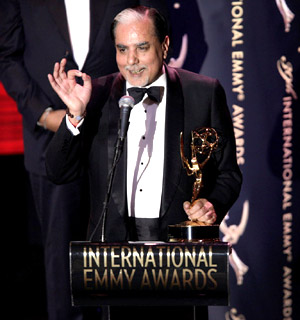
    Zee Group Chairman Subhash Chandra giving his acceptance speech at 39th International Emmy® Awards, held at the New York Hilton in New York City (CREDIT: Chip East / PSG)

    By A Correspondent


    Subhash Chandra, founder of Zee Group, has received the 2011 International Emmy Directorate Award. Mr Chandra made history by becoming the first ever Directorate Award recipient from India. The award was presented at the 39th International Emmy Awards, which took place on Monday, November 21 at the Hilton New York in New York City.


    “Subhash Chandra is a one of a kind visionary – a self-made entrepreneur who made his mark on the Indian television industry by launching the first privately-owned channel in India,” said Bruce Paisner, President & CEO of The International Academy of Television Arts & Sciences. “We happy to present him with our 2011 International Emmy Directorate Award as Zee Entertainment Enterprises prepares to celebrate its 20th anniversary, in 2012.”


    Remarked Mr Chandra, “India is the cynosure of the world today and it’s a great privilege to be the first Indian recipient of this award. It really means a lot to me, Zee Group and the Indian media and entertainment Industry.” He added, “While there have been many representations from India in the areas of technology and retail, this puts India’s media industry on the map and raises the profile of India with regards to its media and content.”


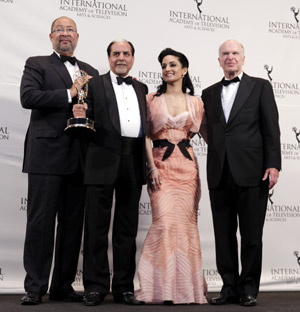
    Zee Group Chairman Subhash Chandra with Richard Parsons, Citigroup chairman and former chairman and CEO of Time Warner (far left), and Emmy Award-winning actress Archie Panjabi (The Good Wife), who both presented him with the 2011 International Emmy® Directorate Award, as well as Bruce Paisner, President & CEO of The International Academy of Television Arts & Sciences (far right) at the 39thInternational Emmy® Awards, held at the New York Hilton in New York City. Marks the first time in history that an Indian received this honor. (CREDIT: Allison Joyce / PSG)

    Richard Parsons, Citigroup chairman and former chairman and CEO of Time Warner, along with Emmy Award-winning actress Archie Panjabi (CBS Network’s critically acclaimed hit drama “The Good Wife”) presented the International Emmy Directorate Award to Mr Chandra during The International Emmy Awards Gala.


    The 39th International Emmy Awards were hosted by Jason Priestley, who was joined on stage by a cast of international celebrity presenters. Actor, director and producer, Mr Priestley was hosting for the second consecutive year. He was joined on stage by a starry cast of presenters including Brazilian actor Vladimir Brichta, Jeff Hephner (Starz’ Boss), Edward Herrmann (Gilmore Girls), Rick Hoffmann (USA Network’s Suits); John Larroquette, Danny Pino (NBC’s Law & Order: Special Victims Unit), Ally Sheedy, Blanca Soto (Univision’s Eva Luna and El Talismán), Jessica Szohr (Gossip Girl); Wendy Williams (host of syndicated talk show The Wendy Williams Show) and Goku and Luffy (characters from Toei Animation’s animated hit Dragon Ball Z and One Piece).


    The International Emmy Awards recognize excellence in television programming produced outside the United States. The awards gala is attended by 1,000 international entertainment decision-makers every year. For a list of nominees, visit http://iemmys.tv/news_item.aspx?id=136.

  • The Pix plan for genre leadership

    By Rishi Vora


    Sony Pix, the English movie channel from the Multi Screen Media Pvt Ltd (MSM) bouquet is, with aggressive content acquisition and marketing strategy, looking to push its channel share up in a bid to get to the top league. Where competition is quite intense between Star Movies and Movies Now. This year, the channel shifted its focus from its positioning – ‘We Tell Stories’, to ‘Hollywood is Here’. The strategic tie-up with Sony Pictures Entertainment has given enough strength to the channel as far as content is concerned. The deal was finalised in 2010, which means starting 2011, Pix has done enough on the programming bit to enter the much-desired Hollywood mainstream space.


    Commenting on the progress of Sony Pix, Executive Vice President and Business Head, Mr Sunder Aaron said, “The channel has delivered great results over the last couple of years. Today, we’re a consistent major player in the category. We have been fortunate to achieve our goals in terms of ratings, reach and distribution. The channel’s new library from Sony Pictures Entertainment, which includes some of the finest titles and  block busters have delivered great numbers.” Elaborating on the channel’s content efforts, Programming Head, Mr Amogh Dusad, said, “This year, we premiered six to seven movies every month, all blockbuster films. And that helped us improve our overall ranking in the category.”


    The channel saw yet another big change in 2011 – on the packaging and presentation aspects. Himmat Butalia, Marketing Head, Pix, said, “We consciously tried to look at the younger audience and see how we could engage them in various ways. As for promoting our titles, every movie has a different kind of a marketing angle to it.”


    “The Movie Club, one of our major properties, has done well. We’re at 15,000 members now from 4000 a few months back. The reason it’s such a fantastic property is that it allows viewers to watch movies absolutely free of cost. The channel’s marketing efforts include a mix of offline and online (Facebook brand page and YouTube, Webisodes etc) campaigns.


    With a host of programming and marketing initiatives, Mr Aaron referred to how Sony Pix beat HBO in the ratings game, in 36 out of 47 weeks.”Ratings of the past quarter shows that Pix has upped its market share to 19 per cent as compared to HBO which stands at 14 per cent (source: TAM, CS 15 +, 6 metros, SEC AB, Week 27-39).”


    For the next quarter, we want to take Pix into the leadership position. While we have been No1 in the category, and have been No 1 in every market from time to time, we want to be in that position on a more consistent basis. The performance of the channel over the past 18 months has shown that this is achievable. The growing response from our fans has overwhelmed us. The future also holds a lot more big titles premiering on the channel. We will do our best as a channel and as a brand to continue innovating, surprising and delighting our audience.”


    The Movies Now- Star Movies tussle; Opportunity Sony Pix
    The launch of Movies Now shook up the line-up a bit. One week after launch, the channel managed to grab the No 2 position. This, as experts view, happened at the back of a huge distribution push, investment on content – acquiring a few big-ticket movies, and then the strategy to repeat those titles on a regular basis. What Movies Now success did, is broad-based the category, so from 60 GRPs, the category of English movies has increased to about 75 GRPs. However, the channel did begin to see a dip with Star Movies catching up. Mr Dusad remarked, “Movies Now being beaten by Star Movies is an indication that sustaining leadership is a challenge if you’re not investing in content on a regular basis, acquiring new titles, doing premiers etc.” In the last six months, Mr Dusad pointed out that Pix beat HBO in 23 weeks, and that they’re looking at taking on the top two players with a host of new initiatives in 2012 (TAM CS 15 +, SEC AB, 6 metros). The idea is to first get to channel share of 20 per cent.


    The challenges for Pix are on two grounds: one is to be No 1 in the category emphatically and convincingly, beating both Star Movies and Movies Now, and then to ensure profitability and growth quarter after quarter, year after year.


    Another challenge as Mr Aaron pointed out will be to increase the number of advertisers on the channel, and help generate higher revenues, thus leading to higher budgets in acquiring bigger and better titles. On how well has the channel done in the past one year revenue wise, Mr Dusad said, “I can’t share the numbers, all I can say is that we’ve been growing at a decent rate. Clients are happy to spend more with us. Every year, our range of advertisers is increasing and the money spent by them on the channel is also increasing. And we’re seeing a lot more stability in our growth.”


    Digitisation will bring in subscription revenues – a big opportunity, now that the ordinance is passed by the government. The category growth, which is about 30 per cent, the channel will do well to achieve similar growth. There’s a lot to be done for Pix to be No 1. Who knows what’s in the offing. Zee Studio is behind Pix, though with a much lesser share. Coming from the Zee stable, one cannot write the channel off.

  • AIM slams penalty against Times Now

    By A Correspondent


    Tarun Rai, President, Association of Indian Magazines (AIM), has reacted strongly to the penalty against the Times Now channel in the defamation case brought against it by Justice P B Sawant.


    “The quantum of penalty levied on Times Now is unheard of. It is not only unreasonable but can set a precedent that would threaten the independent functioning of news media in the country. Media in India is very vibrant and has helped uphold the strong democratic traditions of our country. It should be allowed to function and grow. At AIM (Association of Indian Magazines) we are extremely concerned about this development and hope for a fair outcome that will encourage media in India to continue to operate independently and fearlessly,” said Mr Rai in a statement to the media.


    The Indian Broadcasting Foundation (IBF) and the News Broadcasters Association (NBA) earlier had also reacted strongly to the impact of the Supreme Court’s dismissal of the Special Leave Petition filed by Times Now. The channel had asked for relief against the Bombay High Court order directing Times Now to deposit Rs 20 crore and furnish a bank guarantee for Rs 80 crore to hear an appeal in a defamation case.


    The directive occurred following a district court in Pune asking the channel to pay Rs 100 crore as damages in favour of Justice (Retd) PB Sawant for alleged defamation. The defamation case was registered after the channel published a photograph of Justice Sawant in place of another judge with a similar name, in connection with the Ghaziabad Provident Fund scam.


    Times Now had appealed to the Bombay High Court.

  • Primetime debates an excuse for doing TV cheap: Mark Tully


    By Shruti Pushkarna


    [youtube width=”350″ height=”200″]http://www.youtube.com/watch?v=2RilcOb3GrQ[/youtube]
    [youtube width=”350″ height=”200″]http://www.youtube.com/watch?v=PdgXFlJ8g1g[/youtube]

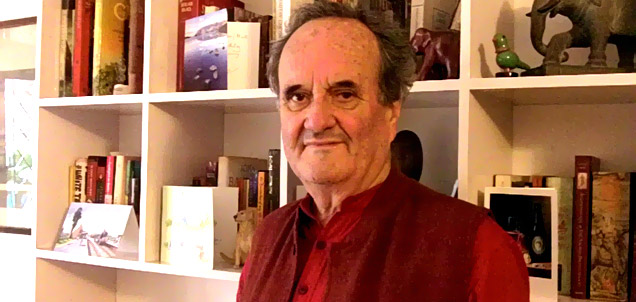
    He likes to refer to himself as ‘British who is much influenced by India’. Often called an ‘expert on India’, Sir Mark Tully is famous for his extensive reportage of the changing social, political and economic trends in India as the BBC India Correspondent and as BBC Bureau Chief later. He quit the BBC in 1994 after an argument with the then BBC Director General, John Birt, where Mr Tully accused him of running the corporation by fear. But his deep-rooted familiarity with India and its culture made him stay on here even after his term ended with the BBC.


    Sir Mark Tully has co-authored and authored quite a few books on India, his latest being Non Stop India which he released in the capital last week.

    He is currently the regular presenter of the weekly programme, ‘Something Understood’ on BBC Radio 4.

    In this interview with MxM India at his Nizammuddin residence, the veteran journalist shared his views on what he thinks of the Indian media today. Mr Tully also shared some instances from his BBC days to point out the changes that the media has seen over the years. While he seemed extremely hopeful of the print media, he felt there is a need to hold back the expansion in Indian television to see what’s going on really. “Technology,” he says, “is being badly used to overload journalists, particularly in multimedia organizations, to make journalists into radio, television and online journalists at the same time, with the net result that they have absolutely no time to find out what’s going on.”


    And although he believes that India has a great future, he urges India to stop following the western model and to create its own way forward.


    Q: Much has changed from the time you wrote No Full Stops in India. If you were to write that book now, what would change?

    I think the big thing that would change would be that India is in a very different position economically than it was before, and India is in a very different position in what I call ‘morale terms’ as well. At the end of the ’90s, things were looking very bleak in India, we’d had twenty years or more of Neta-Babu Raj and the economy was stagnant basically because of that neta-babu raj and all the bureaucratic controls that existed, particularly controls on investment and on doing business. So that would be very different. But one thing I would say which would not be different would be the emphasis on that India must find its own way ahead and not simply ape and follow American or the western model.


    Q: The Indian media has gone through an explosion in the last five to 10 years. As someone who dominated the airwaves just before that, what’s your take on the current explosion?

    Well I don’t think I ever dominated the airwaves but what has happened basically is that television has taken over in a big way and sadly radio, the media which I love best and which I think is a very very important media, has not been allowed to develop properly because the government has restrained control over news and current affairs. Television has expanded and I believe that what is now needed with television is to sort of in a way call a hold to the expansion and look at what is going on on television and see whether improvements cannot now be made in that.


    Q: We have had a Press Council Chairman Justice M Katju virtually damning the media and media persons. There are many who agree with him but say he’s got no right to say it. As an outsider now, do you agree with Justice Katju’s views?

    I think that maybe he overstated the case, probably he did. But I don’t think we should react hysterically as journalists. I think that we should examine ourselves and see what is going wrong and there are things which are going wrong. And the first thing I would say is our failure to stand together to resist the onslaught of commercial pressures which have turned television and newspapers, and even radio into commercial rather than news organizations. Secondly, I think that we journalists, very much need to examine the way we exercise the editorial function. There isn’t, particularly in television, enough editing going on. I’ll give you one example, the Bombay attacks, if the editor in the studio had exercised tight control over reporters in the field then we wouldn’t have gotten into the mess that we did over the Bombay attacks. That’s just one example. Time and again, you see examples of shows which drift on, breaking news which drifts on without any apparent editorial control. And thirdly, what I find whenever I ask anyone in television, whether there are reviews of what has gone on the day before or a week before so that people can learn from their mistakes, so that you can criticize and benefit from that criticism, I’m always told that reviews don’t take place. When I worked in BBC World Service Radio, we used to have two meetings regularly every day; part of that meeting was looking forward to the news we would be covering that day or expected to have to cover and part of it was very much a review, and a critical review of what we’d done the day before.


    Q: Your views on the long-drawn-out debates with the usual suspects as panelists on Indian television prime time news?

    Well, as someone who is sometimes on these panels, frankly I am amazed that there are so many of them. There is a stage army of people really who come on to these panels and they always get politicians, and the political parties send the same people every time. And I think this is largely an excuse for doing television on the cheap. I personally believe that we should have other ways of presenting the news, discussing the news than endless panel discussions, and of course one way which you would have seen nearly often enough is through news and current affairs documentaries.


    Q: And while Indian media has gone through this explosion, how would you think the British media has seen the last decade?

    Well I think that the British media has changed a great deal in the last decade because of course of the media which you are in, the internet and the electronic media, that has had a very considerable effect on newspapers. Newspapers have been the main victims really and you’ve got a situation in London for instance, where a historic paper like the ‘Evening Standard’ is now given away free because it couldn’t get enough circulation to attract advertising. I think the commercial impact has been there in Britain as well. And the other thing I think change has come to over very much, which I think is a pity, is that there is far more of correspondence giving you the news in conversations with presenters rather than properly crafted news stories; and very often television just turns into bad radio. The other day I saw a comedian do a wonderful imitation of these dreadful interviews where clearly the presenter has warned the correspondent of what the question is going to be. So the presenter very earnestly asks him a question like, ‘Is the rupee going to fall further?’ And the correspondent says, ‘Yes, yes you are quite right, that is the big question.’ That sort of thing rather than the properly crafted news stories. And also like in India, because it is so much easier to broadcast from the site, there is too much broadcasting from the site now and too much repetition. I was watching the night that Gaddafi was killed, and you saw the same pictures going round and round and round.


    Q: Since the time you were active and on the field in India, what do you think has been the changes that the political class has had towards the media?

    I think the political classes have become more organized, they have these spokesmen now and all that. I think some of them rather like coming on the Tele, they weren’t so interested in coming on the radio. When I was with the BBC, it was a strange fluke of history really because the transistor radio had come and so radio listening was very widespread but all the listeners had was to listen to the All India Radio. So lots of them turned to the BBC as an alternative source of news and we became in effect, a domestic news broadcaster. So that meant that the politicians were much more concerned about the BBC than I think they are now, their attention is much more on the local media now.


    Q: And vice versa? Journalists towards the politicians? After all they are all in the hunt for the exclusive?

    I’m not sure that there has been any big change about that except one thing, I wouldn’t say they are in the business of exclusives, they are in the business of much less worthwhile, which is ‘bites’. Time and again, when I go to a book launch or something like that, quite often a young journalist would come up to me and say, ‘can you give me a bite?’ That didn’t use to happen nearly as much. And we used to have many more set-piece interviews. I must in my time have done five or six interviews with the Prime Minister, with Indira Gandhi, I interviewed Rajiv several times, I interviewed Morarji, I made a whole film about Morarji. Now you don’t see those set-piece interviews and the big leaders don’t seem to have as many set-piece press conferences as they used to have.


    Q: What’s your view on the Indian print media? With the breaking news constituency now clearly dominated by news television, has Indian print been able to adapt itself to the new times?

    I think that the Indian newspapers do seem to have adapted quite well, circulation figures as far as I know are doing very well. What there has been I think which is very important and very good thing really, is there has been a realization of the power and influence of the media in languages other than English. Even twenty years ago, general assumption of advertisers was why bother to advertise in a Hindi or Punjabi or Bengali media because people who read those papers, they don’t have much money, they can’t buy what we advertise. So all the stress was on the English media. Now if you look at the top ten newspapers, you will find there is only one English newspaper in that, and that was the Times of India. So I think this is a good and healthy development which has taken place.


    Q: Do you think a News of the World-like scandal could ever happen in India?

    Yes it could happen anywhere. I’m not saying that I have evidence that people are tapping phones here but there’s obviously a risk that journalists will fall into that. If you take the whole question of sting operations which comes fairly near that, there have been cases In India where sting operations have been mounted against the wrong person or not for proper reasons and that has caused problems and we do know perfectly well that in the local press, in remote areas, sting operations are sometimes used as a way of blackmailing people. In my view, sting operations should only be used when there is a story of very considerable importance and there is no other way of getting at it.


    Q: Rupert Murdoch isn’t a bad name here in India… our values are different.

    Perhaps he’s not a bad name in India because he isn’t a name here really. Yes he is involved marginally in television here but you don’t have Murdoch newspapers here and you don’t have a channel like Fox News either. And you haven’t had a phone-tapping scandal like the News of the World one. So maybe he is comparatively unknown here, although maybe he wouldn’t like to hear that.


    Q: And what about our corporate sector? You have written a whole chapter celebrating the Tatas. Did the Radia tape controversy impact your views on the group? Especially Mr Ratan Tata?

    Well that’s all very muddy and I mentioned in my chapter about Ratan Tata and I mentioned that his voice was heard but I didn’t come to any conclusion about it. The reason why I’ve written about Tatas in my book was something which some people haven’t quite understood. It wasn’t really to investigate them and say that are they good or are they bad, what is good about them, what is bad about them. The thing was really to bring to the attention of people, the remarkable achievements of the Tata group once they were freed from the restraints of the Neta-Babu raj and of the license permit raj. So that was the intention, to demonstrate the enormous ability that there is in India if only we can get governance right. And also to get into the book some criticism of the government and bad governance by business because I always contend that if only business will raise its voice against bad governance then we may get something done about bad governance; because if business doesn’t flourish, then the economy doesn’t grow and all the politicians seem to be interested in is the economy growing. But I would just add one thing there, I don’t believe that business should be able to dictate the policies of the government; I do believe that business needs to play a role in a balanced economy in which all sorts of other elements are also playing a balanced role.


    Q: The fact is that the news media is dictated by technology these days. Is that a good thing or bad?

    Well, you know, I didn’t think things in life to be wholly good or wholly bad. There are advantages in technology and disadvantages. The great disadvantage I think of technology now is that it is the ability to transmit news on the spot is being badly misused. It’s being badly misused by the endless badly edited breaking news syndrome. It’s being badly misused by this overuse of this syndrome of a presenter talking to a journalist on the spot. And it’s being badly used to overload journalists, particularly in multimedia organizations, to make journalists into radio, television and online journalists at the same time, with the net result that they have absolutely no time to find out what’s going on. So the ability to communicate in any way is of course valuable but we always forget that there can be over-communication. I think many people spend far too much time in front of screens rather than meeting people face to face. Recently I did a radio programme about the difference between talking to people on the net and talking to people face to face.


    Q: India doesn’t have any news on private radio (except of course the government saying that private FM saying you can take All India Radio feeds). Do you think that once in, there could be yet another dramatic change in the way we will see news?

    Yes, I think there would be a dramatic change, I think it will make a difference to FM radio. It would give FM radio many more listeners. If you take the example of Britain, the No. 1 political show of the day is not on television, it’s on radio; the one which sets the agenda is the Today programme on BBC Radio 4. If you go to Britain and you talk to a lot of people, for many people it’s almost become fashionable to say ‘I don’t watch television but I do listen to radio’. Radio is a hugely powerful medium and of course news can be prepared to broadcast on FM radio, it will make a big difference to radio and I think there will be many people who’ll turn to FM radio for their news.


    Q: And one final question: Telling a story on radio versus telling a story on television?

    Well I think telling a story on radio is much harder than telling a story on television. But, and I firmly believe this, the pictures on radio are better than the pictures on television. And the pictures you tell/show on radio, you describe on radio, the stories you tell on radio are much more likely to stick in people’s heads than television shows are. The art of radio broadcasting, in many forms of radio broadcasting, is to make each listener think that you’re speaking to them individually and I think you can do that in a much deeper and more meaningful way on radio than you can do on television.
  • Sai Kumar to replace Haresh Chawla as Network 18’s Group CEO

    By A Correspondent


    The transition is in place. After the surprise exit of Group CEO Haresh Chawla, trusted aide and Group COO B Sai Kumar, 37, has been appointed successor at Network 18.


    This was conveyed to the Network 18 team in an internal circular by outgoing CEO Haresh Chawla. While Mr Sai Kumar will be Group CEO of Network 18, he will also be on the boards of Homeshop 18 and Viacom 18. The respective CEOs of both companies will report to the Board, the memo said, adding that given his (Mr Chawla’s) sharing of time with Viacom 18 in recent times, Mr Saikumar has had rich experience running the Network 18 businesses.


    In his assignment as Group COO, Mr Sai Kumar, led management teams across group companies and works closely with business heads to optimize business value and revenue generation.


    He has been a core member of the group’s business strategy team and through his decade-long stint has been responsible for providing operational leadership and enabling stellar organic growth across the group’s market leading brands. Mr Sai Kumar has also played an integral role in the various inorganic forays of the group across business verticals.


    Prior to joining the Network18 Group, he was with The Times of India Group, where he worked with Times Music, Times Retail and Times FM. He holds an MBA in Marketing and an undergraduate degree in Statistics.


    Adds a communique from Network 18:

    In his new role, Sai kumar will be responsible for the strategic and operational management of the Network18 Group. He would have direct responsibility of the Group’s News, Web, Publishing, Factual Entertainment and allied businesses which would include the IBN General News Network, CNBC TV18/ Awaaz Business News Network, Web18, Yellow Pages, Forbes India, AETN18 and the niche magazine stable among others.


    Sai kumar will also shortly be joining the Boards of Viacom18 and HomeShop18. The current CEOs and Management Teams of Viacom18 and HomeShop18 will continue to report to their respective Boards. Raghav Bahl, Founder and Editor of Network18 is expected to step up engagement with the Management Teams of Viacom18 and HomeShop18 and Sai kumar will be working closely with him on both of these businesses.


    Earlier, as Group COO, Sai kumar was responsible for leading management teams across Group companies apart from being a core member of Network18’s Business Strategy Team. Through his decade long stint, he has been responsible for providing operational leadership and enabling stellar organic growth across the Group’s market leading brands. He has also played an integral role in the various inorganic forays of the Group across businesses.


    On this announcement, current Group CEO, Haresh Chawla, said -“I am absolutely delighted to handover the mantle to Sai, who has worked very closely with me for over a decade, as we built the Network18 franchise. He has seen the Network grow from its very early days across various businesses, which has given him a width of experience that is tough to find in the media business. He is an accomplished leader and a true people’s person and I have no doubt that he’ll take the legacy forward to even greater heights. I will always be available to him as a friend and mentor and wish him success. ”


    Sai kumar added “It’s an honour to lead this world-beating team at Network18. The next phase of growth promises to be exciting and I look forward to it. Building upon the inspiring legacy left behind by Haresh, we have some very ambitious dreams for the future and we intend to see each one of them fulfilled.”


    Sai kumar will be reporting into Founder and Editor, Raghav Bahl in this new capacity.

  • Viacom18’s ‘Sonic’ plan to dominate TV-land

    By Rishi Vora


    After announcing the launch of Comedy Central, Viacom 18 has now unveiled yet another offering in its bouquet: Sonic, a sci-fi entertainment channel catering to young adults, falling in the age bracket of 10-17. The channel will bank on Action, Adventure and Animation – the three main areas around which the programming strategy will revolve.


    What Sonic’s launch does to the market is extend its scope a bit. With other channels in the kids’ genre typically falling in the age group, largely between 4- 14, Sonic extends that to slightly older kids, up to 17 years – a segment which constitutes 30-40 percent of the 4+ market, and the one which is underserved in India. For Viacom 18, it is a significant development, for now as a group it caters to every segment in the Indian entertainment industry. Colors – the Hindi GEC, MTV in the youth category, Nick catering to kids aged between 10-14, and Comedy Central – a comedy channel for 14 + audiences.


    But it is too early to tell, whether Sonic will make an impact. A senior member from one of the kids’ channels, who did not wished to be named, said, “While we welcome one more channel in the genre, these are early days to comment on what it does to the segment – will it succeed, will it not? So it is only fair to wait and watch. Coming from the Viacom stable, all I can say is it’ll be interesting to see how the channel progresses.”


    Nikhil Rangnekar, Joint CEO, Spatial Access said, “It’s going to be challenging for the new player to establish itself, with its new positioning of catering to young adults. It will be interesting to see what differentiation they bring to the genre, as animation and adventure is a game that existing players are already playing.”


    Viacom 18 execs, however, are confident of putting up a good show. Mr Haresh Chawla, Group CEO, Viacom 18, said in the official communique, “Sonic further expands Viacom 18’s presence in a demographic bracket that has remained un-tapped, but is probably the biggest influencer on family purchase decisions. Like our other businesses, we are confident of Sonic establishing a dominating presence within the first year of its operations.”


    He further added, “The next 12 months will see Viacom 18 in an expansion mode and Sonic is the first step in that direction.” Mr Bob Bakish, President and CEO, Viacom International Media Networks said, “The launch of Sonic is significant in many ways. Not only does it further expand the Viacom 18 Network in India but it also opens up an interesting category for both viewers and advertisers. The Viacom 18 Network can now take pride in being the only entertainment network that has specific brands to entertain viewers across every possible age segment.”


    Mr Chawla’s comment on reaching a dominating position is a clear indication that the channel will pump in distribution monies, and of course investments on content acquisition. The plan is to reach 40 million households in India. So distribution and content acquisition are two key areas of investments the channel is looking into, in its bid to be a significant player.


    Executive Vice President and General Manager, Ms Nina Elavia Jaipuria said that the channel’s efforts will be to have a large set of loyal viewers and keep them engaged through never-seen-before digital initiatives. Elaborating on the TG, she said, “It is going to be a challenge to hold the attention of our TG – the young adults – ones who are on the cusp of adulthood. They’re rebellious, impatient, tech-savvy, hyperactive, confident and competitive. They’re early adapters, experimental, extremely opinionated and big influencers on matters such as purchase decisions.”


    Revenue-wise, it will be both advertising and subscription. Though digitization will help, the channel’s foremost challenge is to bring a wide variety of advertisers, from different categories on the channel.


    The tagline for Sonic is ‘Thrills. Guts. Glory.’ For presentation and packaging aspects, UK-based company – Red Bee has been hired. Scarecrow is the creative agency and Vizeum will handle media duties.


    December 2011 is when Sonic will go on air. The marketing will roll out soon, it’s going to be a 360-degree campaign to start with and digital initiatives as an on-going strategy to engage and interact with tech -savvy young adults.


    As history suggests, in other categories of course, many channels have launched with a bang. On being asked what her expectation were at launch, Ms Elavia Jaipuria chuckled, “Wish I could get 30 percent share and even surpass Nick. On a serious note, it will be only be right to review the channel’s performance post four to five weeks of launch.”

  • Viacom 18 uses Measat for Asia beaming

    By A Correspondent


    Viacom 18 has tied up with MEASAT Satellite Systems Sdn Bhd to use the Measat-3a satellite for the international distribution of Viacom 18’s channels across the Asian region.


    “With wide coverage and a powerful Asian footprint, Measat -3a is the obvious satellite choice for distribution of our international services,” said Piyush Gupta, Chief Technology Officer, Viacom 18.


    “Measat is excited to be working with Viacom 18 to distribute its popular international channels via Measat-3a” said Yau Chyong Lim, Senior Director, Sales and Marketing, Measat. “The addition of Viacom 18’s channels further enhances the assortment of premium channels on Measat’s 91.5°E Asia video neighbourhood.”


    Viacom 18 is a 50/50 joint venture operation in India between Viacom Inc. and the Network 18 Group. The joint venture includes leading brands across television, film and digital media to build one of India’s leading multimedia entertainment powerhouses. The brands include MTV, Nick, VH1, Colors and Viacom18 Motion Pictures.


    The Measat -3/3a satellites distribute News, Lifestyle, Music, General Entertainment, Sports and Documentary channels across Asia over a bouquet of SD, HD and 3D channels.

  • Thakraney: Sony after KBC. Reality shows must face the music

    By Anil Thakraney


    I really don’t know what Sony’s revenue model was for the recently concluded KBC. As in, did the channel actually make money on advertising and sponsorships after deducting the massive costs? Which include phenomenal sums going to the host Big B, not to speak of all the prize monies (Mr Sushil Kumar alone walked away with five crore rupees). Maybe they did make a little profit on the show, maybe they did not. But here’s what has happened immediately post the show: On the ratings chart, the channel slipped to No 3 from its position of No 2.


    Now, traditional programming logic suggests that expensive reality shows and blockbuster cinema films play the role of a magnet, of getting a channel some stickiness with the viewers. Having come onto the platform, viewers would taste the regular fare on the channel and hopefully stay on. Well, KBC doesn’t seem to have delivered on that promise. After enjoying the show, clearly many viewers defected to the other channels. This naturally raises a doubt in the mind: Are reality shows over-hyped in the desi entertainment channels? Are they worth all the effort and the expenditure? Is too much expectation being loaded on them?


    There are no easy answers to this one. But one thing is clear: You can tempt patrons into a restaurant by offering an outstanding dessert, but they will only return if the food is delicious. You can’t build loyalty through window dressing. The idea should be to first build a powerful back-end… which is to create super regular programming. And then run a huge reality show, so that viewers like what they taste when it comes to the ‘bread and butter’ shows.


    In this context, one has to wonder if Sony put the cart before the horse. Star Plus’s consistent No 1 position should provide a way forward for other channels: Which is to first do the basics rights. And then dial Mr Bachchan’s number.

    ***

    PS: LOL! Watch this ad for Snickers. A good example of how to (literally) use research methods in advertising, AND make it work very nicely!