Category: TV

  • Amit Sinha joins India TV as VP – Strategy & Research

    By Our Staff


    Amit Sinha has joined India TV as VP – Strategy & Research. He was worked over a 15 years in the television media, and his last assignment was with TV Today Network over five years.


    In his professional journey he has worked with Sahara News Network, Teammates Media Research & Content Communication India.


    Commenting on Sinha’s appointment, India TV Managing Director, Ritu Dhawan said: “research plays a pivotal role and with Amit’s understanding of the news category, he will add more power to our existing strong team. We welcome Amit to India TV family and look forward to set new benchmarks in the Hindi News genre”.


  • Big Ganga partners Lowe Lintas for KaamWapasi initiative

    By Our Staff


    Big Ganga, the Zee Entertainment channel, has joined hands with Lowe Lintas for its KaamWapasi that aims to cater and resolve the on-going unemployment issue amongst migrant workers in India.


    Prathyusha Agarwal

    Said Prathyusha Agarwal, Chief Consumer Officer, Zee Entertainment Enterprises Ltd said: “As a responsible media & entertainment platform, we at ZEE believe in serving the community to the very best of our capabilities, coming together with like-minded partners to create extraordinary solutions. The KaamWapasi initiative in partnership with Lowe Lintas is a purposive step in that direction enabling our Big Ganga audiences to take active charge of their livelihoods for a tomorrow that’s better than the pandemic-hit today. Providing a tech-enabled tangible route to employment, we see the platform perfectly complementing the government’s efforts to fuel the economy by accelerating the unlock on a greater scale. This initiative we hope, will not only set the bar for what could be done to serve society in one the most-difficult times but would also further encourage brands and people to come together and take ownership of improving the situation.”


    Samrat Ghosh

    Added Samrat Ghosh, Cluster Head East, Zee Entertainment:, “The initiative in partnership with Lowe Lintas is a perfect amalgamation of what Big Ganga stands for. Staying true to our brand ethos of upholding and enhancing regional pride the brand understands that employment is a key social pillar towards ensuring the same.  The association with KaamWapasi serves as an endeavour towards the same restoring the same that caters towards the pressing issue of unemployment and bridges the widening gap between employers and workers in a tech-led effective manner. As a brand our philosophy apart from offering inspiring and aspirational content, we intend to enrich the lives of our viewers through multiple initiatives & the said initiative will help to enrich and brighten their lives.’


    Added Shantanu Sapre, Executive Director, Lowe Lintas: “It’s really wonderful to collaborate with a brand like BIG Ganga who has always come forward to support and help people in the hour of need. Through the KaamWapasi intiative, we are trying to re-build the strong foundation for the workers who have lost their jobs unfortunately in pandemic.  The initiative not only aims to re-connect them with urban employers but further propels growth and development in the economy taking it towards the road of recovery.”


  • Zee Entertainment appoints Nimisha Pandey to head originals for Zee5

    By Our Staff


    Zee Entertainment Enterprises has roped in the National award winning writer and director, Nimisha Pandey, to head Hindi originals for its digital entertainment platform, Zee5. She will report to Punit Misra, President – Content and International Markets, ZEE.


    Noted a communique: “In line with the ZEE 4.0 Strategy, creating extraordinary entertainment content will continue to be a key area of focus for the company. The appointment of Nimisha is in line with this approach. In this leadership role, Nimisha will be responsible for creating quality original content for Zee5.”


  • Divergence over Convergence: The Uniquely Indian Story


    By Shailesh Kapoor


    Shailesh Kapoor

    The week that was saw India win a Test series in Australia, despite all possible odds stacked up against them. In India’s 89-year Test cricket history, this has to count as the most memorable and cherished win.


    Will this huge cricketing achievement reflect in viewership numbers when they come in next week? Almost certainly not. If the peak viewing of the Gabba test touches even 50% level of the weakest IPL 2020 match, it will be a surprise. While the non-prime timings contribute to limiting the viewership, the wider ‘issue’ with Test cricket, of being able to engage large sections of the audience, especially the youth, remains.


    As a result, while T20s and even ODIs are profitable formats, Test cricket is a struggle to monetise. The upcoming India-England series in India has five T20s lined up. The money they will take will be enough to fund the four Test matches. A new format (T10) has come up in recent times, and there’s a well-promoted T10 tournament in Abu Dhabi scheduled from January 28. The duration of the ‘perfect’ cricket match for the masses will continue to shrink with time, till it reaches the soccer level of 120 minutes from start to end, including the breaks.


    Which brings us to the larger question: Where does content like Test cricket, which has a niche but very loyal following, sit in the scheme of things? Cricket may find its way through, because even the ‘niche’ numbers are in millions, but what about niche content in other genres such as GEC, movies or news? It virtually has no chance to survive in a viewership system that is designed around the lowest common denominator (LCD). And because our television models continue to be ad-dependent in major part, the subscription-only route is not viable too.


    Here’s where digital comes in. It may be time to reconcile that unlike the West, where “TV” has two branches, linear and on-demand, India will see two very distinct and divergent categories emerging more clearly over the next five years. Linear television will continue to become more and more aligned to the LCD, while SVOD services will get more and more specific in the niches they will target.


    The abbreviation “OTT” has emerged as a uniquely Indian one. But there’s a good reason why that’s happened. Because unlike the West, we cannot use “TV” for a medium that does not look or behave like classic television at all.


    All this while, convergence has dominated discussions around the growth of different content distribution options in India. Catch-up television and sports are good examples of convergence, as are reality shows like Bigg Boss and KBC. But a lot of that, except sports, is AVOD. AVOD is essentially like YouTube, which ends up being LCD-aligned more often than not. But it’s the SVOD end where convergence with other distribution platforms, especially linear, family-viewing-based television will be impossible to believe.


    A relevant question then is: Which is a bigger opportunity – a huge LCD monolith of millions of people, or the sum of several smaller, niche offerings to a divergent set of taste segments? The answer would vary for the content creator, the distributor and the advertiser. But this divergence, rather than convergence, is inevitable. And that’s an exciting story to look forward to.

  • ABP Studios to produce non-news content

    By Our Staff


    ‘ABP Studios is all set to add a slew of new services to ABP Network portfolio.

    Driven by a team of multilingual, platform-agnostic storytellers, the new productions are already underway and will soon make its way onto various OTT platforms.

    Speaking on this announcement, Avinash Pandey, CEO, ABP Network said: “We are taking an important step towards engaging with the new-age content consumers of this era. With the introduction of a more focused segment on content production, we will be able to effectively build upon our competitive advantages to create greater value for our customers and stakeholders alike. I am confident that our new venture is well-positioned to lead the ABP brand – to the next phase of its development.”

    Added Zulfia Waris, Business Head, ABP Studios: “ABP Studios is a very special division that offers something unique to the viewers of today. It goes beyond black-and-white, to find hidden perspectives and underlying meanings that lie within the ‘grey’ areas. We have been dedicatedly working towards turning this dream into a reality and are absolutely elated to announce that we will soon be sharing the many inspiring, empowering, and distinct tales of our nation with diverse set of audiences worldwide.”


  • Bigg Boss is Back. Long Live Bigg Boss!


    By Bhuvi Gupta


    Bhuvi GuptaBigg Boss Hindi, by far India’s biggest reality TV show, came back on TV last weekend, after having been delayed by over a month due to compulsory quarantines for its participants. While there were no stops put on the accompanying media blitz, the launch attracts and manufactures, this year there is an increased focus on digital rather than traditional media whose consumption has dropped on account of the lockdown.


    This lockdown has given us all a bird’s eye view of what living in the Bigg Boss house is like – rationed food (because you cant keep stepping outside to grocery shop), stuck with the same people day in and day out with some amount of conflict (have you ever spent such an extended period of time with your family), household chores division (after some negotiation to ensure its equitable), video calls with higher authorities who designate your priorities (yes bosses on Zoom, that is you). The only thing missing is evictions and if conversations with fellow countrymen are to be believed, that is the one feature which most of us need!


    Jokes apart, Bigg Boss or Big Brother, (as its internationally known) is the most successful global reality TV franchise with editions in 60+ countries. India itself has seven different versions of the show, and most have had record-breaking TRPs in their respective markets.


    I personally have always been a fan of the show, and try to balance keeping up with every season while not getting too hooked. Since Viacom’s OTT service, Voot started hosting unseen footage on Season 10 in 2016; this has become an increasingly harder hard task!  I have several explanations for why I am so invested in the show, every year without fail –


    The Format

    While Bigg Boss is a reality show, and like all reality shows is edited to create heroes and villains, the social experiment which blocks all outside communication makes it a unique forbidden window into human behavior, which makes it fascinating. New twists are thrown in every season, which makes the show unpredictable and hence never boring. Despite being more than a decade old, Bigg Boss has kept up with changing technology and media consumption powered by the internet. The audience can now can watch unseen footage on Voot Select, interact with contestants live, use Bigg Boss filters on pictures and much more. The various supporting elements help make the show engaging across different age groups and media preferences.


    It is a marketer’s delight

    From a marketer’s perspective, Bigg Boss is and has been a great vehicle for brand marketing. While there are many good reality shows, it is the only show that keeps interest in the show alive all through its 100+ day run. This is driven by a consistent 360-degree PR and media blitz, evolving show twists and really no rules. This ensures viewership and a RoI estimated to be 3-5 times the (high) investment for brands.


    This media blitz ensures that even vanilla FCT advertising and associate sponsorship options help drive brand recall. For brands with smaller budgets, the flexible show format makes brand integrations, which can include in-house product placement and branded tasks, seamless.  There is also product demonstration due to on-screen engagement of actors with the product during branded tasks, and audience engagement on voting during that week which make each integration a unique value proposition.


    Screen grab from ‘Kurkure Vigyapan Mein Chatpatapan’ episode of Bigg Boss 13


    One of my favourite integrations from last season was  ‘Kurkure Vigyapan Mein Chatpatapan’, where contestants were divided into groups and tasked with making ads promoting Kurkure. It was simple, and yet brilliant. Can you imagine any other brand integration where the brand advertisement with celebrity endorsers gets promoted continuously as content?


    Promotes Diversity & Inclusiveness

    Former adult star Sunny Leone became a mainstream Bollywood actress because of her stint on Bigg Boss 5


    The show has been a great vehicle for promoting diversity and acceptance in our conservative Indian society. Since the very first season, the show has regularly hosted contestants, who are ‘different’. While the objective is eyeballs, the show gives a platform to those marginalised making them human beyond their taboo relationship, sexuality or profession which in turn make the audience more accepting of them. The biggest example of this acceptance is Sunny Leone. It would not be presumptuous to say that the former porn star transcended her previous persona to gain acceptance as a mainstream Bollywood actress only due to her stint on Bigg Boss.  Bobby Darling from Season 1, Sushant Divgikar, Mr. Gay India 2014 from Bigg Boss 8 are a few other examples, of people from the marginalised LGBTQ community who have helped make the trials and tribulations the community faces more visible.


    As the skyrocketing news television ratings on coverage of the relentless hounding of movie stars over the Sushant Singh Rajput case proves, the voyeur in us is alive and kicking. And with the interest in the case waning, I wont be surprised to see the news audience shift focus to Bigg Boss. The lockdown has only made our voyeuristic urges stronger and I wont be surprised if Bigg Boss 14 breaks previously held records this year.


    Bhuvi Gupta is a marketer with over 10 years across industries, of which the last six have been in Media & Entertainment. She has been a part of many launch marketing campaigns – specifically at the Times of India group, Republic TV and the latest in marketing a Bollywood film. She writes on A&M (mostly marketing, but often on advertising too) every other Tuesday. Her views here are personal. She tweets at @bhuvigupta3


  • ET Now to warm up Canada

    By Our Staff


    It’s getting cold in Canada, but warming the winters there will be our own ET Now. Times Network has announced the launch of ET Now on Bell Fibe TV in Ontario and Québec through a distribution partnership with Ethnic Channels Group (ECG). Nextologies, a global leader in providing broadcast technology solutions, will transport the ET Now signal within Canada.


    Commenting on the launch, Jagdish Mulchandani, COO & Executive President, Times Network said: “Enhancing our offerings for South Asian Canadian viewers in alliance with Ethnic Channels Group, we are excited to bring ET Now to Canada on Fibe TV with Bell, the country’s largest television provider. ET Now has been a market leader in the business news category for over a decade and I am confident this launch will be an enriching addition to the discerning taste of the Indian diaspora seeking superior coverage on business and financial news.”


    Added Slava Levin, Co-Founder and CEO of ECG: “The stock market today is seeing a surge in retail investors in addition to the institutions, and India is a top investment destination for many money managers. ET NOW delivers to Canadian viewers a wealth of domestic and international financial news and provides a business point of view that is not seen on other networks. ET Now is a top-notch channel from Times Network whose credibility in delivering news is unparalleled.”


  • OMD ad turns to 1947 nostalgia for new Sony show

    By Our Staff


    Sony Entertainment Television’s recently launched show, Kyun Utthe Dil Chhod Aaye, unveiled an era bringing to life pre-Partition India in 1947. To announce the launch of this show, OMD India executed a print campaign turning back in time to give readers an experience of the era through the look and feel of the newspapers.

    Expressing his views on the campaign, Amit Raisinghani, Head – Business Planning and Communication, Sony Entertainment Television said: “Newspapers were the most preferred medium of communication back in the day. Since the show Kyun Utthe Dil Chhod Aaye is set in 1947 pre-partition India, we felt an innovative print campaign will be the most appropriate way to set the context of the show, on the day of the launch. We have received a positive feedback from the audience and the industry alike and we are confident that we’ve been able to deliver our message impactfully.”

    Added Priti Murthy, CEO, OMD India: “This campaign in partnership with Sony Entertainment Television is nostalgic not only because the show brings back the mood of 1947, but through print media, it has also given us the opportunity to be nostalgic in our media messaging. It’s a pleasure to work on something fresh and innovative, and we are certain that the audience will enjoy it as much as we did.”

  • Unfair to Take Rajdeep Off Air?


    By Ranjona Banerji


    The drama over TV anchor Rajdeep Sardesai has got sections of the media and social media all roiled, and on all sides of the political spectrum.

    Sardesai had tweeted and stated on-air that farmer Navreet Singh had been shot by the Delhi Police on January 26, during the turmoil of the tractor parade held by India’s protesting farmers. For these two actions, Sardesai was taken off air by his employer India Today and his salary docked for a month.

    https://thewire.in/media/india-today-rajdeep-sardesai-farmer-death

    Glee and consternation were the dominant emotions by the public and the media.

    However. How could there not be a “however”? First Sardesai. At face value, without imputing motives, he may have jumped the gun in order to be first with the news. This is not new to Sardesai or to TV “journalism”, where carrying uncorroborated news as fact is extremely common. Also, Sardesai later retracted his comment and deleted his tweet.

    Then, the death of Navreet Singh himself. His family and farmers present still contest the Delhi Police’s version that the young farmer from Australia died when his tractor overturned. They insist that he died from a bullet wound. Various media outlets have carried the contrasting versions of his death from family members, eyewitnesses and the police. Sardesai was not alone here.
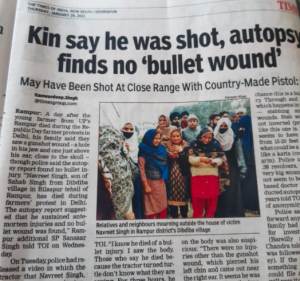
    Times of India report on dead farmer's autopsy reportThis is a link to a Times of India story, datelined Rampur:

    https://timesofindia.indiatimes.com/city/bareilly/kin-say-he-was-shot-autopsy-finds-no-bullet-wound/articleshow/80485330.cms

    I quote from the first paragraph: “A day after the young farmer from UP’s Rampur died during the Republic Day farmers protests in Delhi, his family said they saw a gunshot wound – in hole in his jaw and one just above his ear close to the skull”.

    The article goes on to say that the autopsy report says there was no bullet wound with a quote from the ADG of Bareilly zone, Avinash Chandra.

    This is not the first time that autopsy reports have been contested or overturned. Or have been spectacularly wrong.

    But Sardesai sits in the peculiar position of being both a well-known TV anchor and one who sometimes likes to do ground reports. He is also reviled by BJP supporters for being a “liberal” and by liberals for not being outspoken enough against bigotry. I myself have called him out for his fence-sitting.

    The problem with doing ground reports when you are a prominent studio personality is that you do not any more have sufficient ground contacts, and because you can get easily carried away by your own fame and experience, mistakes are easily made. Also, the more famous you are, the more people are out to get you.

    The question arises though: who was out to get Sardesai?

    In my few years of experience, the journal usually takes the flak for mistakes made by employees. Far worse errors have been made. But no media house behaved like this. You stand by your staff in public. If you feel the journalist has erred, you issue a retraction or an apology. If you think not, you issue a statement saying you stand by the contested report. If you are feeling contentious, you wait for some legal situation to arise before you decide. In this case then, the pressure came from somewhere and we all know where that could be.

    Never have I seen a media house where I have worked throw an employee under the bus for an error of this sort. Suppose it was later proved in another autopsy that Navreet Singh was indeed shot? What would India Today do then? The mysterious death of Justice Loya comes to mind, where questions are raised all the time in different sections of the media. Not very loudly, but they are.

    TV of course operates on its own rules, most of which are inexplicable to me. And yet, TV itself is notorious for pushing fake news, for inciting religion-inspired division and violence and a constant travesty of the core of journalism.

    Media watchdog Newslaundry.com (there is an inside irony here) has compiled this excellent list of gross errors by India Today anchors, for which there was no public punishment:

    https://www.newslaundry.com/2021/01/28/rajdeep-penalised-how-come-these-india-today-anchors-are-still-on-air

    You have here mixed messages from the India Today management to their staff. Although this is not the first time that India Today has done this. The case of Angshukanta Chakraborty being sacked from DailyO is top of the mind:

    https://scroll.in/article/868531/india-today-fires-journalist-over-tweet-criticising-fake-news-peddling-tv-anchors

    The latent intent in the action against Sardesai is clear: do not expect any support from us. The result will be that no one will make any effort – if indeed they do – to work on anything that might upset the Modi government for fear of losing their reputations, jobs and money. We will see more from their star anchors to push the government agenda and hide the truth of India their viewers.

    A sad comedown from India Today’s self-proclaimed “gold standard of journalism”.

    Underlying all this is the veritable collapse of Indian journalism under BJP and government pressure. Sedition cases filed against journalists of National Herald and The Caravan over the farmers protests bring that home.

    https://www.thequint.com/news/india/tharoor-sardesai-and-5-others-filed-for-sedition-by-up-police#read-more

    The Editors Guild of India has also issued a strong statement on this (See here)

    The farmers protests, especially by television, have been portrayed largely from the government’s perspective. The damage done to all journalism is incalculable. And it is only going to get worse.


    Ranjona Banerji is a senior journalist and commentator. She is also Consulting Editor, MxMIndia. Her views here are personal




  • TV9 conclave on ‘What Bengal Thinks Today’…

    By Our Staff

    Home Minister Amit Shah will attend the first ever conclave organised by TV9 Network in Bengal interestingly titled ‘What Bengal Thinks Today’ on Saturday, January 30, in Kolkata. The objective: to discuss issues related to the upcoming Assembly Elections in West Bengal, “Banga Juddho Gadir Lorai”

    TV9 Bangla and TV9 Bharatvarsh channels will telecast the conclave live. Said Gautam Sarkar, Business Head, TV9 Bangla: “TV9 Network has got six language channels Telegu, Kannada, Hindi, Gujarati, Marathi, Bangla and they are the leaders in the states. With touching nearly 30 crore impression every week in Telegu, Kannada, Hindi, Marathi and Gujrati, TV9 network makes us India’s largest news network.”

    Added Amritanshu Bhattacharya, Digital Head and Deputy Managing Editor, TV9 Bangla: “TV9 Bangla has set the international standards supported by the super active digital networks. Furnished by the world-class program offerings from TV9 Bangla, it has uplifted the standards of true journalism with its impactful contents and widespread its existence that will have a far-reaching effect among the viewers.”

  • Azmat Jagmag to head marcom at Discovery

    By Our Staff


    Azmat Jagmag

    Discovery Communications India has brought on board Azmat Jagmag as Head of Marketing and Corporate Communications. As a part of her profile, Jagmag will lead the marketing and communications teams across the network including 14 linear channels and OTT brand Discovery+ for India. Based in Mumbai, she will report to Megha Tata, Managing Director-South Asia.

    Said Tata: “These are exciting times as we strategically step up our investments to take advantage of very dynamic growth in both Digital and Linear. Azmat brings that rare combination of creative flair, a strong instinct for the Indian millennial and a cutting-edge brand expertise in heading marketing for multiple iconic brands. We are very excited to welcome Azmat into the Discovery family.”

    Added Jagmag: “Discovery is a brand with incredible people and exceptional storytelling in real-life entertainment space and to get an opportunity of being a part of this passionate brand for India is very exciting. With so many interesting initiatives and launches coming up, I look forward to working closely with the team here to take the brand to even greater heights. I am truly excited for this journey with Discovery.”

  • Mitron TV strengthens top deck

    By Our Staff


    Rumit Anand
    Rajiv Patki

    Mitron TV today announced strategic hires to the senior management team amid a period of explosive growth. Former Republic TV executive Rumit Anand joins Mitron as Vice-President of Product. Rajiv Patki, who previously was at OYO, has been appointed as Head of Product and Strategy.


    Anish Khandelwal

    Said Anish Khandelwal, Co-founder & CTO Mitron: “I am pleased to welcome both Rumit and Rajiv to the Mitron family. We are proud of the rapid strides that we have undertaken as a business and the impact that we have made in the short-format video app space in such a short period of time. At this crucial juncture of our business, our focus has been on building a strong product infrastructure. With Rumit and Rajiv coming on board, further fuels the product growth and innovation. I have no doubt that we will continue to go from strength-to-strength as we continue our journey in 2021.”