
Category: MEDIA

  • RAMcheck: Besides Mumbai, no change in #1s

    By A Correspondent


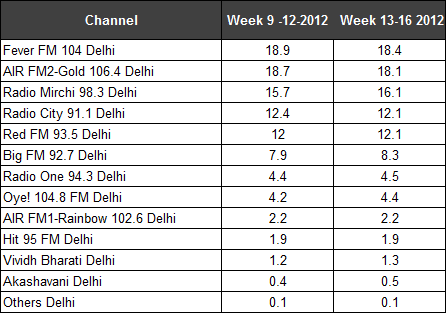
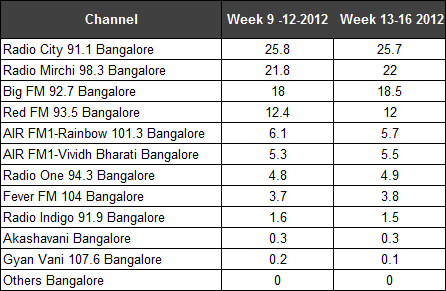
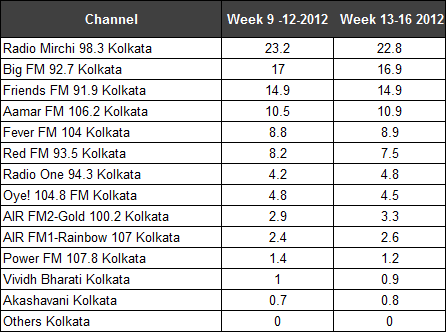
    TAM Media’s Radio Audience Measurement (RAM) – which covers four key metros, Mumbai, Delhi, Kolkata and Bengaluru – released its latest radio listenership figures for wk 13 to wk 16, 2012 (Last week of March to first three weeks of April, 2012). According to the latest RAM data, for listeners of 12 years of age and above, all places of listening, and according to radio channel shares, RadioCity, Radio Mirchi, Fever FM, Big FM, Red FM, Radio One, Oye! FM continue to be the top FM stations in the big four metros.


    Mumbai:


    Radio Mirchi emerges as the number one FM station in Mumbai with a market share of 15.3 per cent, followed closely byRadioCityat 15.2 per cent. The two FM stations are closely competing for the top spot, but what remains to be seen is which of these two FM stations retains the top spot. AIR FM2 Gold, Fever FM and Big FM make the top five FM stations in Mumbai. The other FM stations in the Mumbai market include Red FM, Radio One, Oye! FM, AIR FM1 Rainbow, Vividh Bharati and Akashavani.


    Delhi:


    Fever FM continues to be the most popular FM station in Delhi with a market share of 18.4 per cent, its nearest rival is the AIR FM2 Gold which is comfortably placed at number two with 18.1 per cent market share. Ranked three is Radio Mirchi followed by RadioCity which is ranked four and Red FM as ranked five in theDelhimarket. The rest of the FM stations in Delhi include Big FM, Radio One, Oye! FM, Hit FM, AIR FM1 Rainbow, Akashavani and Vividh Bharati.


    Bengaluru:


    RadioCity continues to maintain its leadership position in the city. RadioCity, Radio Mirchi and Big FM are the top three most popular FM stations in Bengaluru. RadioCity received a market share of 25.7 per cent whereas Radio Mirchi and Big FM received a market share of 22 per cent and 18.5 per cent respectively. Ranked four is Red FM with 12 per cent and the fifth most popular FM station is AIR FM1 Rainbow with 5.7 per cent. The other FM stations in Bengaluru include AIR FM1 Vividh Bharati, Radio One, Fever FM, Radio Indigo, Akashavani and Gyan Vani.


    Kolkata:


    Radio Mirchi is the clear winner in Kolkata with a market share of 22.8 per cent. The top three FM stations in Kolkata haven’t changed as Radio Mirchi continues to be the number one FM station of the city followed by Big FM with a share of 16.9 per cent and at the number three FM station of Kolkata, Friends FM received a share of 14.9 per cent of the share. Ranked four and five are Aamar FM and Fever FM with a share of 10.9 per cent and 8.9 per cent respectively. The other FM stations in the city are Red FM, Radio One, Oye! FM, Power FM, AIR FM1 Rainbow, AIR FM2 Gold, Vividh Bharati and Akashavani.


  • 54 Days to D-Day | Industry voices concerns on sunset date (Video)

    By Shruti Pushkarna


    With less than 60 days to go for the switch from analog to digital distribution, different stakeholders of the broadcast and cable industry are battling out their respective concerns with the government and the regulatory authority. Following the Tariff Order and Interconnection Regulations for the Digital Addressable Cable TV Systems issued by Telecom Regulatory Authority of India (TRAI), a lot of stakeholders have raised issues that will affect their business in which they deem the order to be unfair.


    While the News Broadcasters Association (NBA) protested against the carriage fee mentioned in the order, local cable operators (LCOs) carried out a black flag protest during the recent Assocham event attended by the Minister for Information and Broadcasting, Ms Ambika Soni. The LCOs have objected to the revenue share prescribed by the regulator and the Multi System Operators (MSOs) have expressed concern over the increased number of ‘must carry’ channels mandated by TRAI.


    MxMIndia spoke to a few representatives of the industry to understand their concerns in the run up to digitization.


    Ashok Mansukhani, President, MSO Alliance

    What’s your first response to the Tariff Order?

    The Tariff order has a mixture of good and bad. Fundamentally, it lays out the path for digitization but there are certain issues which worry us like the mandatory ‘must carry’ channels. We don’t think that’s a fair thing to do, if the broadcasters have the right to decide how many channels to bring to India or create within India, we should have the right to decide what should be the capacity, obviously the capacity is much larger in a big city than a small city. Apart from that, there are some issues on revenue share, which is based on a formula which is pending in the Supreme Court. Our worry is that if the Supreme Court decides otherwise, the whole business model would break down. These are the main two concerns.


    News broadcasters are objecting to the carriage fee mentioned in the order issued by TRAI, what’s your view on it?

    Now everything will be transparent. What is possibly going to happen is that carriage fee, which is creating such a big hoo-ha today, will get replaced by genuine pay channel ecosystem but that is about five years away. In the current process, we have to digitize about a 100 million homes and enormous sums of money are required but no fiscal incentive or tax incentive or infrastructure incentive has been given by the government. I think in the run up to digitization, the broadcaster should not derail the process; rather they should sit down with the cables operators and the MSOs and work packages with attractive content and at compelling rates to attract consumers. I think that’s really what they should be doing instead of writing editorials about carriage fees.


    Do you think the sunset date of June 30 is achievable?

    No, it’s not achievable. There are just 60 days left. The negotiations with broadcasters have not begun. The revenue shares are default revenue shares but no discussions with operators have taken place. No agreements are in place. Out of 10 million boxes, only 2 million boxes have been installed. Many of those boxes don’t have smartcards, in other words, they don’t have the conditional access system, and they are vanilla digital set top boxes. I think it’s high time for the government to carry out a reality check. I am sure this will be discussed in the next task force and I am sure government will fix a new date.


    Jehangir Pocha, CEO, INX News

    What’s your first response to the Tariff Order?

    The TRAI order has been a disappointment to news broadcasters because we were repeatedly told that there would be no carriage fee. We were repeatedly told that there would a mandated EPG or menu system, which has not been delivered. These two things add up to a huge financial burden on broadcasters, especially news broadcasters, an industry that is, contrary to public assumption, not doing at all well, that is facing huge financial burdens and many channels have gone bankrupt.


    Apart from carriage, do you see any other issues in the run up to digitization?

    I think the other issues are really about the willingness and commitment with which the policy can be rolled out because this is going to disrupt some vested interests, it’s going to disrupt a regular way of doing business and therefore, there is going to be a natural push back. But the concept of digitization is superb, it’s wonderful that the government and the regulator have pushed for it, but there have been some imperfections in what they have presented. Another thing that doesn’t make enough economic common sense to me is how the price was set so low for free channels and pay channels because the entire industry’s problems stem from the fact that the consumer is literally being subsidized by paying such low price for content, which in every other country, costs so much more. How this price has been set, by whom and who’s paying for the inherent subsidy in this, there hasn’t been enough transparency on this.


    Both NBA and the IBF have expressed disconcert at the carriage fee in the order issued by TRAI, but the TRAI maintains that there is no cause for dissatisfaction on carriage fee. As a news broadcaster, what will be your next step?

    I think we will have to explain to TRAI and the ministry just what the imperfections in this otherwise very positive bill are, and how they will create a huge financial burden for news broadcasters, how it will push us towards bankruptcy, how it will stop us from being able to create quality content and how it will, in fact, stop us from growing. If the government is interested in inclusive growth, news broadcasters play a very valuable role in this industry and in this nation. And our financial concerns should be addressed in some manner both by TRAI and the government.


    Do you think the sunset date of June 30 is achievable?

    Everything is achievable if the intent is there. There may be some practical concerns but let’s be realistic, while the policy is being presented now, we knew for 6 to 7 months that it was going to happen and I’m not sure if MSOs and LCOs spent adequate amounts of money, time and effort on preparing for this day, which they knew was coming. Now they are saying, this day has come and we need more time. We have seen consistent attempts to delay digitization, and I think we should have very little patience with more delays.


    Pulak Bagchi, VP, Star India

    What’s your first response to the Tariff Order?

    It’s a step towards the right direction and I think it will be path breaking in terms of the reforms it triggers in the cable space.


    What’s your view on the concerns being raised by news broadcasters over carriage fee?

    Carriage is a phenomenon which is certainly not new – it’s been around since the inception of the industry. What TRAI has done is only put a method into the madness, which should be commended. Earlier, there was no transparency in the payments that were being made, now atleast you’ll be having a foothold into the figures. You’ll also be able to determine whether they are reasonable or not. TRAI has also said that they will be intervening in cases of arbitrary levels. So there’s really no cause for concern. I think we should not be pressing the panic button; it has taken so many years for the government and the regulator to come up with these formulations. It’s important that we live up to the mandate and we must also give regard to the expectations of the people of this country. Given that digitization is a reality today, the sooner we embrace it, the better.


    Do you think the sunset date of June 30 is achievable?

    It is, because it’s targeted towards four major cities where it’s not an alien concept. Perhaps there will be some incremental approaches that will be taken in those respective areas and I’m sure that the deadline could be met. There’s no difficulty in abiding by the timelines.


    Are there any marketing initiatives or consumer awareness campaigns that you are undertaking in the run up to digitization?

    Star and IBF have made it mandatory for all members to spread awareness in their respective channels. We are carrying out marketing campaigns, we are also doing citizen focused awareness programmes where people can be brought up to speed with what digitization is all about. And we are also trying to infuse in the public sensibilities as to why it is good for them.


    Roop Sharma, President, Cable Operators Federation of India (COFI)

    What’s your first response to the Tariff Order?

    It’s very bad from LCO’s perspective. Since there is a vertical monopoly and no cross media holding, none of the MSOs will be negotiating with the cable operator and if they don’t negotiate with the cable operator, the latter will end up taking only a Rs45 share, with which the business becomes unviable and the LCO will be unable to give better quality service to the consumer. Even the set top boxes, which are going to be put, are of vanilla quality, they are very primitive boxes. Consumer will not be able to get internet, broadband or other services on the same box. Cable operator has to spend so much money in upgrading and the government has just mandated a technology. We are even ready to upgrade, but we must get a proper share. The regulator wants to be the controller of the business. As a result, lot of cable operators will be forced to sell off their network or the network will die its own death. There will be a lot of unemployment generated in the market.


    Do you think the sunset date of June 30 is achievable?

    No, the timeline is very short. First is the procurement of boxes – in Chennai none of the MSOs have given any orders for boxes. Even in Kolkata, we are hearing that the state government was not consulted.


  • Satyamev Jayate reports gr8 Chrome numbers

    By A Correspondent


    Aamir Khan’s Satyamev Jayate has reported  “unprecedented” launch episode numbers, reports Chrome Data Analytics and Media.


    Says Chrome founder Pankaj Krishna on why it’s unprecedented, “Conventionally, KBCs have premiered on weekday evening primetime when the overall TV viewership is at peak and so have most other big promotables across channels where one shows rides on the back of another during the three hours of evening peak prime (8-11pm) as against a Satyamev Jayate that’s going solo on a Sunday morning.”


    The Chrome Television Panel Audits indicate the following numbers. Note this is only Star Plus and the Hindi Speaking Market (HSM). Since SMJ was aired across various channels and languages, we could see a healthier story if those are taken into account.


    Satyamev Jayate, Sunday May 6, 2012, 11 AM, Star Plus, HSM:


    Show Distribution Availability

    99%

    Show Reach

    11.8%

    Show Average Stickiness per viewer

    39 Mins

    SHOW TVR –

    5.12


    SOURCE : CHROME TELEVISION PANEL AUDITS, C&S 4 +( DIGITAL + ANALOG) – SAMPLE 2847 Individuals, HSM


  • Nearly 10 lakh STBs ready for Kolkata

    By A Correspondent


    The Cable Television Networks (Regulation) Amendment Act, 2011 has made it mandatory for switch-over of the existing analogue Cable TV networks to Digital Addressable System (DAS) by December 2014, in a phased manner. In respect of four metros of Delhi, Mumbai, Kolkata and Chennai, the digital switch-over is to be completed by June 30.


    The ministry is very closely monitoring all the activities for the timely implementation and the quality of the Digital Cable TV service. During the high level review meetings by the Ministry, it was revealed that in the case of Kolkata, out of total requirement of about 35 lakhs STBs, over 5 lakhs STBs have already been installed, about 4 lakhs STBs are available in the stock which are being installed and the orders have already been issued for the balance requirements of STBs.


    Further it came to the notice that all the MSOs already have digital head ends and the existing channel capacity in each of the case is over 200, which is the mandatory requirement as per the Telecommunication (Broadcasting and Cable Services) Interconnection Regulation, 2012. The channel capacity is being augmented by the MSOs.


  • New Samsung home appliance TVC brings in “ek fresh soch”

    By A Correspondent


    Cheil’s new television commercial for Samsung refrigerators has a new take - ‘ek fresh soch’ on how technology works as an ally in the life of today’s contemporary working woman.


    The idea behind the campaign was to introduce the new Digital Inverter Compressor technology in the new range of Samsung frost free and side-by-side refrigerators.


    The entire campaign revolves around “ek fresh soch” that has led to happiness across different families. The films are contemporary, clutter breaking and bring together a vital element that of making both technological and emotional connects with the woman of today. The introduction of appreciation from a child is unique as not only does bring to life product features and the benefits also elaborates sensitivities in today’s home and shows how aware children are of their surroundings and their sense of appreciation of little things in their lives. This coupled with Priyanka Chopra’s role-play as the catalyst of change bringing joy into peoples’ lives makes for a great connect with the audience for Samsung home appliances.


    Speaking on the creative, Alok Agrawal, COO, Cheil Worldwide South West Asia said: “The new line of refrigerators demonstrates Samsung’s contemporary lifestyle technology that is set to provide new experiences for today’s woman. Our treatment of the campaign and the messaging is reflective of the modern Indian woman whether housewife, working or single. Key brand and product features have been translated into an emotional benefit from a child’s point of view, as expressions of appreciation for changing the child’s life. The creative leverages Priyanka Chopra as the catalyst of the change as promised by Samsung Refrigerators”


    Creative credits:

    Client: Samsung Electronics India Limited

    Agency: Cheil WorldwideSW Asia

    Creative Team: Shiva Kumar, Ayon Sarkar

    Client Servicing team: Amit Ahluwalia, Gireesh Gupta, Nitin Mahajan

    Production House: Fleet Ent. Pvt Ltd.

    Directed by: Tarun Mansukhani


    Cheil India has been on an aggressive growth plan over the last 2 years, almost doubling its size in its employee strength and billings. Significant expansion and growth has been seen particularly in BTL and Digital areas, making Cheil one of the largest fully integrated single agencies in India, executing some of the largest cross-functional integrated campaigns, providing 360°implementation across all facets of marketing services.


    Cheil Worldwide Inc is Korea’s largest and one of the world’s leading advertising groups. Cheil offers a full portfolio of marketing communications services including advertising, PR, sports marketing, exhibition and display production, and production of large-scale performance events. In 2011, Advertising Age ranked Cheil as the #11 largest creative agency in the world.


  • 53 Days to D-Day | Govt addresses industry concerns over digitization

    By A Correspondent


    The Cable Television Networks (Regulation) Amendment Act, 2011 has made it mandatory for switch-over of the existing analogue Cable TV networks to Digital Addressable System (DAS) by December 2014, in a phased manner. The digital switch-over is to be completed by June 30 in the four metros -Delhi, Mumbai, Kolkata and Chennai.


    Concerns had been raised by some stakeholders regarding the quality of Set Top Boxes (STBs) and the redressal of grievances of the cable TV subscribers. The necessary provisions have been incorporated in the Cable Television Networks (Amendment) Rules, 2012 to take care of these concerns. As per these Rules, the STBs to be supplied by the Multi System Operators (MSOs) must conform to the quality standards specified by the Telecom Regulatory Authority of India (TRAI).


    The MSOs are also required to devise a mechanism for grievance redressal, as specified by TRAI, and inform the details thereof to the subscribers. The Telecommunication (Broadcasting and Cable Services) Interconnection Regulation, 2012 has a provision that the STBs must be BIS compliant. During a Ministry review meeting with the national level MSOs, it was revealed that out of about one crore STBs required in the four metros, over 22 lakhs STBs have already been installed, about 25 lakhs STBs are available in the stock which are being installed and the orders have already been issued for the balance requirements of STBs.


    MSOs have confirmed that all the indigenously manufactured STBs conform to the BIS standard and the imported STBs not only conform to the international standard but also the BIS standard. Regarding the repair of defective STBs, the MSOs have intimated that within the warranty period of one year, a defective STB will be replaced immediately free of cost. After the expiry of warranty period, a faulty STB will be taken back for repairs by giving a replacement from the available stock.


    The MSOs have further confirmed that the Grievance Cells are being set up for resolution of disputes, if any, and the telephone numbers of the Grievance Cells would be notified.


  • Vogue announces first fashion fund with FDCI

    By A Correspondent


    After years of success in several countries, the prestigious Vogue Fashion Fund makes itsIndiadebut this year. VogueIndia, in collaboration with the Fashion Design Council of India (FDCI), is launching this annual event to give centrestage toIndia’s next generation of fashion designers. The Vogue Fashion Fund was originally conceptualised by US Vogue, spearheaded by the iconic Anna Wintour.


    Announcing the launch of the Vogue Fashion Fund inIndia, Priya Tanna, Editor, VogueIndiasaid: “For a country that takes great pride in its indigenous fashion and boasts such a stunning array of embroideries, textiles, and craftsmanship, it’s no surprise that we consistently produce exceptional design talent. With the launch of the Vogue Fashion Fund, our endeavour is to strengthen the foundation for these designers and help marry their creativity with commercial success. It is a truly special project for VogueIndiaand I look forward to the fund changing the lives of promising young designers in the years to come.”


    Mr. Sunil Sethi, President, FDCI said: “I once heard the proverb, ‘Give a man a fish and you feed him for a day, teach him to fish, and feed him for life.’ It’s an apt metaphor for the Vogue Fashion Fund, which supports the winning designer through a one-year mentorship. With this initiative, Vogue is putting its weight behind young talent-I look forward to seeing what’s in store for many years to come.”


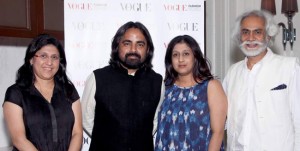
    The judging committee comprises an eclectic mix of fashion authorities, including Sunil Sethi and the Vogue India experts – Priya Tanna – Editor, Anaita Shroff Adajania – Fashion Director, Bandana Tewari – Fashion Features Director and Oona Dhabhar – Marketing Director, Conde NastIndia. The jury also features renowned fashion designers Manish Arora, Sabyasachi Mukherjee and Suneet Varma as well as retail experts like Alka Nishar and Tina Tahiliani.


    Sabyasachi Mukherjee commented: “This is a wonderful initiative. It is fantastic that Vogue India recognizes this fact and is creating the platform to nurture upcoming design talent. I feel privileged to be a part of the jury panel. Hopefully, I will be able to use my aesthetic skill and business acumen to make Vogue zero in on the right choice.”


    VogueIndiahas invited entries from emerging fashion designers based on pre-defined eligibility criteria. The judging panel will shortlist 20 designers at first from the entries, further narrowing this list down to top 5 finalists based on interviews and the creation of a special capsule collection.


    The winner will have the opportunity to be featured in VogueIndiaand also win a grand cash prize. Besides this, the design talent will also get a chance to commercialise his/her brand with a leading retailer, and gain access to prominent platforms in the industry like Wills Lifestyle Fashion Week and a one-year business mentorship with an industry professional.


    Vogue, the ultimate fashion bible, which launched inIndiaon September 22, 2007 is the 17th edition of the ultimate style bible and is a 100 per cent owned subsidiary of Conde Nast International. VogueIndiais a monthly magazine and available across 100+ towns.


  • Hungama earns Facebook’s ‘Most Preferred Marketing Developer’ badge

    By A Correspondent


    The Digital Services division of Hungama Digital Media Entertainment Pvt Ltd was conferred with the Preferred Marketing Developer (PMD) badge by Facebook. PMD is given to developers that have demonstrated value-added capabilities in one or more of the following qualification areas: Pages, Ads, Apps, and Insights. The badge is for companies that have clearly demonstrated unique capabilities that help marketers scale and achieve efficiency and extend measurably beyond the functionality of Facebook’s native tools.


    Commenting on this Siddhartha Roy, COO, Consumer Business & Allied Services, Hungama Digital Media, said: “Being among the few companies worldwide to earn ‘Preferred Marketing Developer’ badge underlines our ongoing investment in providing cross-channel interactive solutions to clients across various verticals. In a digitally connected world, it is important to engage the consumer where he spends most of his time; the social media platform, especially Facebook, has emerged as the new media real estate where brands can build greater engagement and interaction with the consumer.”


    Hungama Digital Media helps brands build awareness, engagement and loyalty, using a full range of digital skills, including campaign strategy and creative development, website design, online media planning and buying, viral marketing, social media strategy and optimization, mobile marketing, search engine marketing, gaming. On social media, specific to Facebook, the agency provides page management and publishing, community management, applications development, social plugins, advertising (ad creation, auto bid optimization, target segmentation, creative, conversion tracking, reporting), monitoring and reporting (insights).


    Hungama has built digital campaigns for clients that include Mahindra & Mahindra (Automotive), Mahindra Racing, Bacardi, Yum Restaurants, LG and Nokia amongst others; that utilizes the Facebook ads API such as Bacardi Together Club, Black List Application, Celebrate Life, ICC World Cup Fever, Zinger Application, Create Your Comic Strip, Valentine’s Day, to name a few.


    Hungama Digital is the No.1 Digital Advertising agency in 2011 according to The Economic Times Brand Equity Agency Reckoner 2011. The parent company, Hungama is the largest aggregator, developer, publisher and distributor of Bollywood and South-Asian entertainment content in the world. With partnerships with over 305 content creators, across record labels, studios, broadcasters Hungama has licensed worldwide exclusive digital rights to over 2 million music and video titles. Hungama has successfully managed more than 2,000 mobile and digital campaigns for as many as 300 brands globally.


  • Halfway through, IPL 5 ratings stabilize

    By A Correspondent


    The downward slide continues though not as stark as it is made out to be. Numbers released by TAM Sports for the first 48 matches of IPL 5 have shown the ratings to be the least recorded thus far compared to previous four seasons. At 3.40 TVR (CS 4+, all India), IPL 5 is faring poorly when compared to 2011 where it recorded a TVR of 3.54, 4.53 in 2010, 4.05 in 2009 and 4.72 in 2008.


    It may be recalled that for the first 36 matches, IPL 5 delivered a TVR of 3.41 per cent, for the first 27 matches, it delivered a TVR of 3.53 per cent and the first 16 matches, a TVR of 3.65 per cent.


    What has shown improvement is the cumulative reach for these 48 matches in IPL 5 that stands at 151 million. This is nearly the same for IPL 4 where the reach was 152 million and far better than IPL 3, 2, and 1 where the reach measured was 137 million, 118 million and 98 million respectively.


    Delving on the suggested trend, Janardhan Pandey, Associate Vice President, DDB Mudra Group said: “Despite what is being said, the sport remains most popular and the reach deliveries also seem to be in line with our expectations. Maybe it’s a period of stabilization for IPL20 viewership. It cannot be doing excellent forever after all. There were many issues to start with such as overdose of cricket & the consistent poor performance by Indian cricket team. Keeping all those factors in mind I will give thumbs up to overall performance of IPL 5.”


    On the reported rise in reach numbers, Mr Pandey said: “This shows the strong appeal that the game of cricket enjoys in India. The ever increasing eye balls for cricket are testimony to this fact.”


    Program TVR %
    IPL5 Opening Ceremony 1.16
    Viewership of IPL Seasons for first 48 matches
    Year Season No. of Matches Avg. TVR % Cum Reach 000s
    2008 IPL 1 *47 4.72 98988
    2009 IPL 2 *46 4.05 118698
    2010 IPL 3 48 4.53 137049
    2011 IPL 4 *47 3.54 152720
    2012 IPL 5 *46 3.40 151585


    (Source: TAM Sports; Market: All India; TG: CS 4+ yrs; Period: Wk 14 to 18, 2012; this data is for first 48 matches of all IPL seasons.)

    * In IPL 1 one match (47th) was abandoned due to rain

    * In IPL 2 two matches (7th & 13th) were abandoned due to rain

    * In IPL 4 one match (20th) was abandoned due to rain

    * In IPL 5 two matches (32th & 34th) were abandoned due to rain


  • Cable cos expect major hike in subscriber revs

    By A Correspondent


    TRAI’s argument that carriage fees paid by TV channels to cable MSOs are necessary to fund their digitisation appears to be falling apart scarcely a week after it was made. Instead, large cable distributors have themselves said that one factor alone – a huge six-eight times hike in subscription revenues alone as declarations spiral with addressability – would significantly buttress their already profitable balance sheets.


    With additional revenues from broadband and VAS, industry estimates also say that a bundled digital and broadband + VAS business model will result in the payback period being reduced by a year to 24 months, as opposed to 36 months under a standalone digital cable TV proposition. This comes even as industry reports –including one released five months ago– have been pointing out that all major national MSOs are already adequately funded for Phase I digital deployment (mandatory only in the four metros from July 1).


    Given that the government is also shortly planning to hike FDI for MSOs from 49 per cent to 74 per cent, industry analysts have questioned why TRAI assumed MSOs and cable distributors needed money in the form of mandatory carriage fees by TV channels – an annual recurrence – to fund their upgradation, which is only a one-time investment. This is especially inexplicable, as TRAI’s own April 30 Explanatory Memorandum to the DAS Regulations states: “In the addressable systems, due to transparency in ascertaining the number of subscribers, the subscription revenue is expected to go up. Therefore, the dependence of MSOs on the carriage fee, as a source of revenue, is likely to be reduced.”


    It has been well known that the cable distributors are the profitable, cash rich last mile, with even many smaller operators who under-declare subscribers/taxes, expanding into other activities like real estate, auto agencies, ancillary services, and so on — while most broadcasters have turned sick due to a killer combo of low ad rates, gross subscriber under-declaration and huge carriage/placement fees.


    The national MSOs, are, in fact, almost all profitable, with even newer ones like Den Networks having posted a 20.7 per cent yoy revenue growth in Q3 of the fiscal just ended, including a 6.6 per cent rise in its net profit. That is why the added bonanza of TV channels having to now mandatorily pay MSOs carriage fees caused MSO share prices to jump after the TRAI tariff order was announced– even as listed broadcaster scrips sank.


    Shares of Hathway Cable and Datacom had closed on May 2 at Rs185.40, 19.23 per cent above its previous BSE close, missing the upper circuit by a small margin, Den Networks also touched an intraday high of Rs116.90, before closing at Rs110.80, 2.12 per cent above its previous close.


    Earlier, a Media Partners Asia (MPA) report (Investing in Digital India) of December 2011 had projected a six times increase in subscriber revenues for MSOs, albeit with a 20 per cent subscriber churn to DTH – but MSOs themselves reacted very positively over the TRAI tariff order.


    Hathway Cable & Datacom MD & CEO K Jayaraman told a business daily last week, that his company expects revenue to go up by 250 per cent post-digitisation. “We have 9 million homes and, at the least, we expect to double the subscriber base as 80 to 90 per cent of the carriage revenue will go to MSO. Broadly, after taking churn and loss in the carriage fee, we expect revenue to go up by 250 per cent “, he said. The company’s CFO, G Subramaniam, said during the same interview, that while carriage fees would reduce, the subscription revenue would rise from 10-15 per cent of the revenue mix currently. “This increase is likely to be six-eight times, and will make up for the loss of carriage fee”, he added. Both said that digitisation would help them grow their broadband business – already significant, given that as per Mr Jayaraman,

    Hathway already had 4 lakh broadband subscribers and a Rs 150-crore topline, which he expected would double in the next couple of years.


    Mr Jayaraman also outlined the many sources for his company’s digitisation upgrade: IPO funds and a mix of internal accruals, debt and vendor finance. He said: “The capex will be Rs1,000 crore. Of this, Rs300 crore will be spent in Phase-I and the rest in Phase-II. Phase-I is to be financed from initial public offer proceeds. A mix of internal accruals, debt and vendor finance will be deployed in Phase-II. The funding plan for the second phase is yet to be finalised,” he added.


    The MPA report – which was released five months ago – also states clearly: “According to MPA analysis and interviews, all major national MSOs are adequately funded for Phase I digital deployment. The cost of digital software and hardware has also fallen since 2007, ensuring set top boxes plus the CA card will cost about $30-40 per unit in total including duties, compared with $60 three years ago”, and adds that a number of the MSOs (like Hathway, DEN) are also ordering digital STBs in larger volumes like 1 million per annum, by which costs are lowered to at least $30 per unit.


    For instance, this report also gave company-wise details on the impressive progress they had already made on digitisation, and outlined their excellent financial situation to achieve the same. For instance, it said that Hathway had a debt to equity of 0.3x and a high promoter holding (67 per cent), hence “the company has enough head room to raise further capital”. While it said that DEN had a “comfortable debt to equity stand of 0.2x with a net cash of Rs9.5crore”, it also had sanctioned loans of Rs200 crore, which had not been drawn at the time of the report’s release. Even regional MSOs like Ortel, which might have a comparatively higher debt to equity at 1.6x as per the report, appeared comfortable placed to take care of their digitisation upgrade.


    Source: The Economic Times
    Copyright © 2012, Bennett, Coleman & Co. Ltd. All Rights Reserved


  • ‘Content not big celebs get in numbers’

    By Meghna Sharma


    Ashish Golwalkar

    Zee TV danced its way to the #2 slot amongst Hindi GECs as its Dance India Dance Little Masters (DID L’il Masters) leapfrogged to ratings of 6.2. Commenting on the reason why kiddie reality shows work, Ashish Golwalkar, Non Fiction Head, Zee TV, said: “The kids’ versionsof both Sa Re Ga Ma Pa and DID have done well. Kids bring out the universal emotion that connects with all; and with the holiday season on, the show makes for great television viewing for families. The talent that has auditioned for the show is superlative and watching them makes it aspirational for the kids and emotional for the parents.”


    The network which has various non-fictional shows to its credit believes in focusing on different genres. “We’re the pioneers of shows like Saanp Seedi, Sa Re Ga Ma Pa, Antakshari, Khana Khazana, and others and our non-fiction has always delivered. The feeling that only big celebrities garner high ratings is not true. It’s the content that connects with the audience and that’s what gets in the numbers,” added Mr Golwalkar.


    Akash Chawla

    The channel has done extensive marketing for the show. “Understanding the power of dance as an audio-visual treat, we wanted to promote DID L’il Masters through various audio visual means and hence, strategically focused on television and active online engagement. Through this, the extreme talent, skills, intrigue and the innocent attitude of the kids was highlighted which made the promos entertaining and endearing. The ‘Dance ke baap’ philosophy from the first season was further extended to ‘Yeh Badon Ke Bas Ki Baat Nahin’,” said Akash Chawla, ZEEL – Marketing Head, National Channels.


    Exclusive dance acts were showcased on the DID Youtube channel and also promoted across active social communities of DID 3. Glimpses of the show were integrated into DID 3 and other fiction shows on Zee TV creating high anticipation for the show. Talking about retaining the same ratings for the show in the coming episodes, Mr Golwalkar said: “Due to its nature, the audition episodes always rate higher, but we will try to maintain/sustain these ratings after the Top 16 are announced.”


    The channel also has plans to launch a few more new non-fictional and fictional shows for weekdays and weekend slots. Talk shows being one of the genres which the channel doesn’t mind exploring in the near future. “The television landscape has changed since the first season with more time bands, more shows and varied reality genres,” added Mr Golwalkar.


  • Hindi Hinterland: Happenin’ & How!


    By Ritu Midha


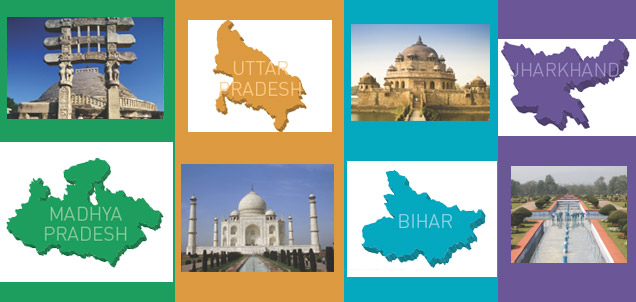
    The four key Hindi Hinterland states – Uttar Pradesh, Madhya Pradesh,Biharand Jharkhand, till less than a decade ago were considered to be sluggish in their outlook. That’s because consumers there were not really top-of-mind for marketers and if at all they became part of a media plan, especially television, it was done so by default, as Hindi television that catered to metros was available in the hinterlands too, and there was not much effort made to engage consumers there. If one looks at a broader picture, a similar tale rang true for most states across India, perhaps a decade-and-a-half ago.


    Cut to the present day, where India is the second-fastest growing market in the world, its middle class is the favoured target group of most marketers (both national and multinational), and in most global consumer surveys Indian consumers emerge to be the most gung-ho among the lot. Of the several states showing signs of speedy growth, the four states that are set for a big leap include:


    • Bihar, which is the second fastest growing economy in the country
    • Uttar Pradesh, which is the second largest contributor to the country’s GDP and also has the second largest urban populace in the country
    • Madhya Pradesh, which is touted as being an upcoming economic power centre and a major tourist destination
    • Jharkhand, which has always been an industrial hub


    One often reads of Indians leaving their cushy jobs overseas and returning to their roots to contribute to, and be a part of, the India growth story. In fact, stories of residents of Hindi Hinterland moving back home from metros too are not uncommon.


    Evolution of the Hindi Hinterland consumer

    Mayank Shah

    Consumers in these states are evolving rapidly and much of the credit for their evolution could be attributed to access to information and awareness boom. Mayank Shah, Group Product Manager, Parle Products reflects on the consumer psyche: “If you look at aspirations, there is no significant difference in Hindi Hinterland and metros. However, the urge to excel is far greater as they come from a modest background and the readiness to put in effort is definitely there. Even in semi-urban and rural areas, aspirations have grown – they are ready to consume CPG (consumer packaged groups), which is similar to their urban counterparts.”


    The increased awareness and steady GSDP enhancement has made the consumer ‘consumerist’, whereby it’s not only low-ticket items that are catching the consumer’s attention, the high-ticket ones are doing it in a big way too.


    Kamal Nandi, VP – Marketing & Sales, Godrej Appliances asserts: “Hindi hinterland is becoming an important market for consumption of durable goods. Consumer affordability has gone up, leading to a shift in lifestyle and consumers becoming more urban in their approach. Also, their top priorities are convenience and comfort.”


    Sushil Bajpai, President, Ghari Detergent, too, is of the view that it is no longer the market to be targeted sometime in future. For Mr Bajpai, the time is now: “There is excellent scope for marketers. Industries too are finding it attractive now. Consumerism is growing at a fast pace, and urban markets in Hindi heartland are no different from metros. The need right now is to understand the consumer mindset.”


    Krishna Mohan

    While the big cities in the region are getting ready to rub shoulders with metros, the semi-urban and rural areas too are getting out of dark areas. States Krishna Mohan, CEO, Sales, Emami Limited: “The great rural-urban divide in household consumption patterns has reduced drastically. Bharat is indeed keeping pace with India when it comes to spending on most fast-moving consumer goods. Rural sales contribute more than 40-50 per cent of total sales in various categories for Emami. We have increased emphasis on engaging rural consumers. The market is huge with a lot of potential.”


    Youth – Change drivers

    The change, as is expected, is being driven by the youth who are more adaptable and are akin to the youth from the metro – at least in urban areas. Having said that, awareness and information in semi-urban and rural areas is also growing and so are the aspirations.


    Somprabh Singh

    States Somprabh Singh, Head Marketing, Titan: “In attitude, they are not very different. They are independent, very ambitious and well informed. The only difference is that their exposure to many international brands is lower but that’s the function of the retail environment, which will change in sometime.” And, true to his vision, a change is currently underway across these cities.


    Harish Bijoor, CEO, Harish Bijoor Consults, believes that the booming Hindi Hinterland is the right place for marketers to be, more so for those catering to the youth. He exhorts: “The robust growth numbers in the education sector is proof enough. Add to it the entertainment market, the market for mobile phones, gadgets of every kind, clothes and accessories, cosmetics, shoes, exercise oriented products, and you have a solid market of the future emerging. There is spurring consumption of not only functional products, but products of cosmetic value as well. Products that relate to health, well-being and proactive health care, rather than just reactive care, are being craved for as well.”

     

    Harish Bijoor

    As per Mr Bijoor, there is a definite opportunity waiting, especially for brands meant for the youth, and the marketers need to make the most of it. He asserts: “The youth in these towns have a far bigger hunger quotient than the privileged youth in the bigger cities. I would segment this territory into urban, rurban and rural. The hunger deepens as you go from urban to rurban to rural. The opportunity for marketers, therefore, deepens as one penetrates down this strata.”


    Interestingly, while the debate between urban and rural might take some time to die down, it is the semi-urban areas that are attracting a lot of attention. Interestingly, the leap is expected to be bigger there, as they are keen to catch up with their urban counterparts, who themselves are always in a moving state.


    States Lloyd Mathias, the marketing honcho with experience around industries: “Youth in the urban areas of these states are quite close to metros in their awareness and aspirations, more so in case of bigger cities likeIndore,Lucknow,Bhopal,PatnaandRanchi. Though the semi-urban youth might be a little behind, they are catching up, what with the inroads being made by social media. Moreover, the influencers are the same, which are rapidly dissolving the differences.”


    Consumption pattern

    While rising aspirations is one part of the story, these regions are seeing an increase in activity by discerning marketers who are becoming more conscious of the finer nuances of the region, and are staying away from the one-size-fits-all approach.


    Explaining the phenomenon, Mr Nandi says: “While we have seen growth in double door refrigerator model in urban markets, in semi-urban markets it is the single door model that works.” However, it has not stopped Godrej from providing the entry-level consumer best value for money. He adds: “Even an entry-level consumer looks for high-end product features. A few years back, toughened glass shelves were there only in high-end model, today they are there in entry-level models as well. Brands have to seek to fulfil aspirations.” The company has also developed a refrigerator with a ‘Stay cool’ feature – powering cooling at the same temperature for 24 hours even after a power-cut.


    Coming back to the India analogy, the Indian consumer is perhaps one of the most price-conscious in the world. For him, value for money seems to be the mantra, but the consumers’ buying capacity is no longer questioned – the global marketers are tailoring India specific strategies, and the same is true of Hindi Heartland as well.


    Affirms Mayank Shah: “Instances and opportunities of buying premium products might still be less but they buy if the right quality is delivered at the right price. For example, premium biscuits like Hide and Seek cookies were rare in Hindi heartland, apart from cities likeLucknow,BhopalandAllahabad. However, now it has changed; we made it available in smaller packs, which has definitely led to sales enhancement.”


    The growth is not being noticed in purchase of a few specific product categories but across the board – a clear indication that the consumer is not seeking to fill just the need gaps, but is also looking for comfort, convenience and a bit of pampering.


    States Lloyd Mathias: “There is dramatic growth in categories like wireless broadband, consumer soft goods, mobiles and more; the consumption pattern is similar to other parts of the country. It is the sheer numbers that make it more lucrative.” He adds: “There is a homogeneity in these markets – the same is not true of any other part of the country, be it South, West or East.”


    Mr Krishna Mohan suggests that marketers look at a closer interaction with the consumer to understand him, and also to make him understand the brand. He asserts: “The way forward is to help consumers, especially in the rural areas, to make the switch from loose to branded or aid new consumption habits, either with novel products or new formats. For us, the categories of cool oil, cool talcs and fairness creams are doing extremely well with double-digit growth.”


    At this juncture, the Ghari Detergent success story can be an inspiration for many. With its origins inKanpur, it is the largest selling detergent brand in the country today. And a major focus on Hindi Hinterland has definitely propelled growth for the brand. Sushil Bajpai states: “Hindi hinterland is the biggest market for us; the brand name on our packs is prominently written in Hindi, and then in regional language. RoI in Hindi Hinterland is not lesser than other parts of the country; the key is to convey the right message accurately.”


    Key challenges

    Having assessed the scope that these markets present, one can safely assert that Hindi Hinterlands have come of age. And the marketers, of course, are in no mood to miss the bus. Thus, as per Somprabh Singh, it is important to “Act fast and act now, else be left behind. This is in terms of creating exciting products and new channels that will help reach them.”


    As per Mr Nandi, it is not just about being there; the key is to be relevant and to belong. He says: “You have a winning story in hand if you are able to provide relevant technology and play a role in them (consumers) fulfilling their aspirations.”


    Mr Bijoor agrees that relevance and market-specific approach is mandatory to be successful in these markets: “Marketers need to tailor-make themselves to the market, rather than take their tailor-made solutions to the market. Bottom-up marketing is the mantra to adopt.”


    Emerging markets indeed

    So while there exists an array of products that are being tailored to these markets, there is keen interest in interacting with the consumer there and understanding him and there definitely is an increase in the consumer spends. Are these markets ready for all the attention they are getting or would it be a case of yet another opportunity going bust?


    Laughing off the suggestion, Mr Bijoor states: “Hindi heartland is the new market that is just about emerging. What was derogatorily called the “cow belt” and the “Bimaru states” in the past, is a market that is coming to roost in the future. These states have become very progressive in their development indices. They boast of a GDP growth rate that is, at times, even more robust than the national numbers. This clearly means that these markets will see faster consumer growth in terms of demand and in terms of volumes, value and innovation.”


    Interestingly, the consumers staying in these markets are a very large demography, accounting for 20 per cent of the country’s population. And there has been a dramatic improvement in the standard of living in these states too. As these markets poise for the next big leap, it’s time the true potential of these markets is understood, and the consumer is serviced to the optimum.


    Click here for larger

    This article is part of ‘High on Hinterland’,  a special volume presented by Big Magic and produced by MxMIndia. If you wish to have  a copy of the volume, please email subscribe@mxmindia.com with your name, company details and address. We’ll courier you a copy within a week. Since we have limited stocks, we will mail a PDF to those who we are unable to send a printed copy.