Category: MEDIA

  • [60 Days to D-Day] Digitization in 4 metros will not happen by July 1: JS Kohli

    Late Monday night, Telecom Regulatory Authority of India (TRAI) announced the new tariff structure for digital cable TV services. Under the new rules, all cable operators will have to mandatorily offer a Basic Service Tier (BST) to viewers which would consist of 100 free to air channels, including 18 mandatory Doordarshan channels, as well as the Lok Sabha channel. The tariff order states that apart from the mandatory channels in the BST, cable operators and Multi System Operators (MSOs) will have to provide customers a minimum of five channels of different genres.


    The authority also stated that MSOs will have to increase their channel carrying capacity. TRAI stated: “The Authority has mandated MSOs to carry a minimum of 500 channels from January 1, 2013. However, keeping in view that smaller MSOs having less than 25,000 subscribers may need some additional time for building capacity, they have been given time up to April 1, 2013.” The TRAI has prescribed that every MSO should have a minimum capacity to carry 200 channels by July 1.


    TRAI has also established new guidelines for revenue sharing between Multi System Operators (MSOs) and Local Cable Operators (LCOs).


    MxMIndia’s Shruti Pushkarna spoke to Mr Jagjit Singh Kohli, a veteran of the cable industry and CEO of cable distribution firm Digicable, on his reading of the latest order issued by TRAI and if he thinks the sunset date of June 30 is still achievable.


    What’s your first response to the Tariff Order?

    Well, the order is on expected lines, no big surprises there. Given the circumstances, I am happy with it, in the sense that we know the regulatory has been operating under tremendous pressure from various stakeholders, so given that situation, I am actually happy with the order.


    TRAI has observed that the Order will help profitability of channels. But carriage fee exists. Do you think the bottom line will be impacted for both broadcasters and the cable trade?

    The channel capacity is increasing to 500 channels, so automatically the pressure on carriage will reduce. So, although the carriage fee remains but the channel capacity itself is increasing so much that the price per channel will come down.


    Given the status as of today, do you see the implementation happening in the four metros before July 1?

    Now, that I don’t think will happen. We will need a postponement of at least three to four months. The tariff order has just come; there are so many other issues such as DAS licenses being not issued till date. To meet the deadline the industry needs to deploy atleast 150,000 boxes every day, only then will we be able to meet that deadline, and that’s impossible.


    What about the availability of set-top boxes?

    Even that is an issue. But even if set top boxes were to be made available, it would be very difficult to meet the deadline.


    Do you think the government is doing enough to promote the switch to digitization and explain the benefits to consumers?

    Yes, you can’t blame them on this. They have been quite aggressive on the timelines and in their campaigns.


    Are there any areas of worry in the run-up to digitization (given that we have just 60 days to go)?

    The only area of worry is that we will need some more time to meet the deadline, otherwise everything is fine.


    Photograph: Fotocorp


  • By Invitation | Atul Phadnis: Will TV measurement in India finally get its logical direction?

    By Atul Phadnis


    In March this year, three industry associations that have a significant say in television broadcast and TV advertising jointly announced a new chapter in the TV Ratings Measurement initiative. Broadcast audience Research Council (BARC) is the joint venture that has been in discussion, for the longest time, between the three stakeholder associations – Indian Broadcasting Foundation (IBF), Indian Society of advertisers (ISA) and the advertising agencies association of India (AAAI) to measure nationwide TV audience viewership. BARC has taken birth where a lot of earlier industry initiatives have failed to take off – hence, a lot of folks (including me) are watching these events very closely and curiously.


    Yes. There are cynics who doubt whether the BARC initiative will be able to streamline the industry ambitions for a wider and robust TV audience measurement thereby recasting/enhancing the offerings of the current ratings provider – TAM Media Research (a joint venture between Nielsen and Kantar-WPP).


    The genuine fear is that the industry initiative will again slow down or worse – get delayed due to lack of clarity or infighting amongst the associations/players. It’s a legitimate concern based on what we have seen in the past. In fact, the recent announcement has been possible only when a formula for compromise was reached after months of stalemate on the BARC shareholding and composition of its board.


    The genesis of the industry initiative that has now taken birth as BARC has in its vision the Rs329 billion TV industry that to a large extent depends on ratings and viewership information for key decisions, growth and business. So what are the key expectations of the industry that should get addressed if BARC is the answer to the TV industry’s call on TV Ratings?


    1. The Burden of Transparency

    For years now, TAM has been criticized, publicly and privately, for alleged opaque policies relating to aspects such as third-party audits, pricing, technology R&D results and panel performance KPIs. as is the case with any competitive industry bustling with cut-throat competition, rumor mills and conflicting agendas of different players, the transparency burden had been conveniently dumped on TAM. after all, we do see from time-to-time the so-called ‘open letters’ that certain channels would send out to TAM asking for explanations on why their blockbuster programs did not do well in terms of TRPs. Irrespective of where the answers for failure lie, these occasions, nonetheless, cast all sorts of aspersions on the trading currency and are hardly constructive. I haven’t seen a single such instance over the last decade produce any positive reaction – either in providing more answers on causality nor a bettering of the ratings system. and these instances surely can’t be healthy for the industry that has dependencies on advertising that in turn needs TV measurement.


    It’s high time the industry associations, perhaps via BARC, put their necks on the block and take frontal onus and responsibilities on transparency elements that will boost confidence on TV Ratings. Not only will this sharing of burden save the industry the blushes in front of the advertisers, it will also have a correctional effect with the routine debates being laid to rest. Hopefully, BARC is able to bring in transparency by defining deliverables and quality parameters clearly to the Ratings vendor(s) in the new scheme of things.


    2. Evolving data reporting policies

    Transparency in KPIs will also have an effect on how TV ratings data should be reported in our industry. There are a host of mature markets, in particular theUK, that have a threshold viewership criteria for TV program ratings to meet; if those numbers have to be reported in the weekly data. This ensures that viewership estimates for very small channels and very niche programs inside very small market groups are not reported. However, in our market, if the 700th channel gets launched tomorrow, TV ratings for that channel for very small markets and microscopic audience definitions will be available. Lack of industry understanding and consensus has stopped from any policy to take shape and solidify in this specific issue. This, in turn, has led to a sad saga of inexplicable rating fluctuations for specialist channel genres in small markets/ audiences. With the BARC coming in, certain wise old men (and women) can roll out this policy of releasing viewership numbers of only those channels and programs that are in the permissible and acceptable error level range.


    3. Structural changes in panel construction

    The methodology for TV Ratings in India- especially the way panel homes are selected from a neighborhood has remained largely the same. The criteria is defined through Primary Control Variables, a system to carve out quotas of what sort of homes should be selected to enter the panel. However, the dramatic changes that have occurred in the last 5 years – that of DTH now forming a large part of the TV universe – requires the Primary Control Variables to reflect an acceptance of that new reality. Earlier, say 8-10 years ago, cable monopolies in a neighborhood within an area, city or town ensured homogeneity of received signals in spite of the heterogeneity of viewing. That signal homogeneity within the neighborhoods would ensure that thousands of homes within that area would receive the same input from their cablewallah into their TV sets. Today that cable structure lies shattered wherein one single neighborhood would have the cablewallah’s analogue signal in certain homes, his digital (CAS) box in certain households as well as scores of homes with DTH connections from 7 DTH providers.


    Now layer this information on the specific channels or channel packs subscribed by DTH or Digital Cable viewers – and you have a distribution complexity that snarls into existence, dramatically affecting TV viewership. This distribution factor needs to be well modeled inside the Primary Control Variables to construct the panel. It is not there at the moment and neither has there been an active industry debate on how to bring newer factors such as these into the panel construction/ panel design exercise.


    4. Critical Measurement/ Panel Decisions (including R&D, Technology)

    Consumer patterns of TV consumption are dramatically changing with the advent of set-top-boxes, recorders, mobile TV, and so on. Viewing is also happening when people are on the move rather than only in-home TV viewing. In India, ratings are reported only for in-home TV viewing. TV consumption on mobiles, tablets, IPTV, computers or outside-of-home is unmeasured. If these new patterns need to be measured, a significant emphasis would be needed on R&D. This R&D and Trial Panels have to be budgeted by a vibrant industry determined to capture every viewing instance so as to analyse and eventually monetize those audiences. It would be a disappointment and a terrible waste if BARC did not have this early in its agenda.


    5. TV Measurement Vision

    It might seem unbelievable but it is true – the largest customers and users of TV ratings info today do not have a common goal or vision for the future of TV measurement in our market. Issues such as Rural versus Urban, increase coverage vis-a-vis better representation, upscale versus mass-market – would find distinctly different views within the industry. In the absence of a common vision, the strategy to expand, enhance, improve the measurement system is clearly not going to be very effective. With a forum like BARC, the attempt should be to collectively define the vision as well as the timelines and path to attaining that goal by mobilizing opinion and the industry war-chest. This is, perhaps, the most crucial aspect of the success or failure of BARC, the failure of which would risk reducing this initiative into a rudderless and spineless wonder.


    6. CPM versus CPRP

    In the last few years, broadcasters have tried, albeit unsuccessfully, to correct a long standing trading currency aberration in our industry. While the world uses CPMs (Cost per thousand ad impressions) to price benchmark TV ad inventory, our market has erroneously got locked into CPRPs (Cost Per Rating Points) – thanks to the myopic vision of media agency AORs of the 90s. While the entire industry (including media agency heads who publicly oppose change but privately admit its fairness) wants transition to the correct trading currency, the longstanding question has been who will do it first on both ends – advertisers and channels. Perhaps with BARC, the opportunity is in planning that roll-out as a coordinated industry action.


    7. Redressal Forum

    One of the biggest opportunities for BARC is to streamline the custom arguments, debates and requirements that individual players have on TV ratings into an ever evolving bucket of policies. In the current scheme of things, individual players have their differences with the TV ratings company, but not really have an escalation route to get their views heard. These issues range from pricing (dis)parity to use of raw data to choice of ratings software to conflicting TAM’s policy of not selling their data to certain client categories. Perhaps the most common arguments relate to unexplained fluctuations and peaks-troughs in the ratings data.


    BARC would be better served to pursue an approach built on open, transparent debates and a clever commercial policy in such instances that might see lesser open issues but greater revenues into the industry kitty.


    Summing up…

    The above piece is my attempt to get a constructive dialogue out in the open on a matter that deeply concerns TV Media professionals cutting across organizational lines. I personally have tremendous respect for professionals in this stream including those within the TAM Executive team as well as the industry folks driving the BARC initiative. It is my sincere hope that a constructive dialogue followed by clear and rapid forward actions by stakeholders leads to the World’s finest and biggest TV measurement initiative! amen…


    Atul Phadnis is Chief Executive, WHAT’S-ON-INDIA


  • Govt can plug revenue leakage by banning carriage fees, says broadcasting industry

    By A Correspondent


    Industry sources have said that banning carriage fees in the new digitisation of cable distribution regime w.e.f July 1 is necessary to ensure that government can plug the huge revenue leakage upwards of Rs10,000 crore annually due to cable companies levying huge carriage fees and grossly under-declaring their subscriber base.


    Moreover, ensuring a “must carry” clause for all TV channels and putting an end to their regulatory pricing wherein TRAI mandates the price that viewers pay for every channel, are also critical to revive the sick TV broadcasting industry, which continues to reel under the triple burden of usurious carriage fees, regulated tariffs for their channels as well as getting a fraction of their due subscriber revenues.


    At present, over nine-tenths of TV channels are in the red and are unable to invest in quality programming, while many smaller/niche channels with big-ticket pedigrees – Imagine TV being the latest – have had to shut down.


    Another fallout of these distorted industry practices has been that potential new export avenues have closed, because India is not able to export television formats and finished content – while other industries like software, music and animation (which do not suffer such a usurious regulatory/industry scenario) have been big-ticket forex earners for over a decade.


    Industry sources said that TV channels collectively paid at least Rs3,500 crore last fiscal to cable companies and distributors as carriage and placement fees, of which news channels alone paid at least Rs1,500 crore. These carriage fees turned many profitable TV channels immediately into the red, thus denying the government a large income tax earning opportunity upwards of Rs1,000 crore per year.


    According to another industry estimate, given the estimated subscription revenues of all MSOs/LCOs in the country, the government has lost about Rs5,950 crore over the five-year period from 2006 to 2011 in service tax alone by reason of under-declaration while the evasion of income tax is about Rs17,413 crore over the five-year period 2006 to 2011; and loss of entertainment tax by states is in addition to that amount.


    Additionally, TRAI had, itself mentioned in a March 2010 paper that “there is evidence of tax evasion in the cable industry…the last publicly available CBEC report of 2005-06 shows only Rs75 crore of service tax being collected from the industry on a base of 68 million subscribers paying an average of Rs165 per month, the estimated service tax collection from analog cable should be in the range of Rs1,400 crore per annum”.


    Another estimate – from HSBC for 2011 – says that the government lost around Rs1,380 crore last year in entertainment and service taxes alone due to cable companies under-declaring their subscriber base by as much as four-fifths. This estimate assumed the potential revenue to government at Rs1,725.90 crore given a Rs165 ARPU for 67 million analog pay TV households and entertainment tax at Rs20 per household along with 12 per cent service tax.


    But because only 20 per cent or 13 million households are disclosed, the actual revenues collated were estimated to be only Rs 345 crore even as TV channels lost out on the bulk of their subscriber fees. These practices have ensured that India now has a cash-rich last mile; India already has the third-largest TV distribution industry in the world where viewers can and are willing to pay for content – borne out by the fact that pay TV penetration is as much as 80 per cent in India, which is amongst the highest in the world.


    On the contrary, TV channels, who actually create the content, get less than a fifth of what viewers actually pay the cable companies. However, broadcasters say that the only opportunity to correct these distortions and ensure that TV channels do not continue to close due to extraneous factors, lies in the digitisation of cable distribution, for which the government is currently putting together relevant rules.


    Under this, it will be mandatory for all viewers to get a digital set-top box and for operators to distribute channels in a digital and addressable format. This will give viewers a wider choice of channels with better viewing quality. In fact, digitisation is now being seen as the game changer for the entire Indian TV industry as it will also significantly benefit distributors the multisystem operators – (MSOs) and local cable operators (LCOs) – whose paying base will improve even further.


    In this regard, Dr Prannoy Roy, chairman, NDTV told ET, that “digitisation of cable distribution is a major step towards making India’s media achieve truly global quality”. However, Rajat Sharma, chairman, India TV, pointed out that digitisation will be “meaningless unless all channels are made available to the consumer and he is given the power to make a choice”.


    He told ET that this can be done “only if it is mandatory for the cable operators to carry all channels and ensure that set-top boxes have the capability to carry more than 500 channels” and added that the government must curb any effort to create an artificial scarcity at the head end or in the box in carrying the channels.


    Pointing to the other issue of price controls on TV channels, Uday Shankar, president, Indian Broadcasting Federation, told ET: “IBF has always believed that channel pricing should be kept under regulatory forbearance and market forces should be allowed to discover channel valuations. Internationally, apart from countries like China or Taiwan, there are no instances of government regulating the pricing of channels. Freedom in pricing is essential for channels to offer best in class, quality programming. In the absence of this freedom, broadcasters are compelled to somehow match spiraling input costs with regulated prices thereby running the risk of compromising quality”.


    He added that there is enough competition in every genre to “remove any fears of exorbitant pricing”, given that the consumer has a choice between multiple DTH platforms and cable operators and “as a result of that, we have seen that the ARPUs have been flat to down”.


    Source: The Economic Times
    Copyright © 2012, Bennett, Coleman & Co. Ltd. All Rights Reserved


  • TRAI issues tariff order for cable TV

    By A Correspondent


    The Telecom Regulatory Authority of India issued the Tariff Order and Interconnection Regulations for the Digital Addressable Cable TV Systems late yesterday.


    While the Tariff Order has been issued as an amendment to the existing Tariff Order for addressable systems, the Interconnection Regulation is comprehensive one for the Digital Addressable Cable TV Systems.


    As per the communiqué, here are the salient features:


    1. All channels (pay and free-to air) to be offered on a-la-carte basis to subscribers.


    2. There will be a Basic Service Tier (BST) consisting of a minimum of 100 free-to air (FTA) channels comprising at least 5 channels of each genre namely news and current affairs, infotainment, sports, kids, music, lifestyle, movies and general entertainment in Hindi, English and regional language of the concerned region. 18 channels of Public Broadcaster and Lok Sabha channel will also form the part of the BST. While Multi-system Operator (MSO) has to offer the Basic Service Tier, it is not obligatory for subscriber to subscribe to the BST. Instead subscriber can form his own package of a maximum of 100 FTA channels.

    In either case the MSO cannot charge the subscriber more than Rs100 per month.


    3. It shall be open to the subscriber to subscribe to the BST or one or more FTA channels or one or more Pay channels or bouquets offered by MSO or any combination of these.


    4. In case subscriber chooses Pay channel(s) with or without FTA channel(s) the MSO can fix a minimum monthly subscription not exceeding Rs150. If the total value of the channels/ bouquets opted by the subscriber exceeds Rs150 then actual subscription charges has to be paid.


    5. The basic purpose of digitisation is to ensure ample choice to the consumer as well as to enable him to budget his subscription according to his paying capacity. Accordingly, the Authority has mandated MSOs to carry a minimum of 500 channels from 1.1.2013. However, keeping in view that the smaller MSOs having less than 25000 subscribers may need some additional time for building the capacity, they have been given time up to 1.4.2013. Besides, to ensure that the consumer is not adversely affected, the Authority has prescribed that every MSO should have a minimum capacity to carry 200 channels from July 1, 2012. Authority expects that all the MSOs operating in areas of Phase-II onwards to take suitable measures to enhance the channel carrying capacity to 500 channels.


    6. Only those MSOs that have the requisite capacity, as mentioned above, can invoke ‘must provide’ clause. The broadcasters shall not provide their channels to MSOs who have channel carrying capacity of less than 200 channels immediately and less than 500 channels from 1.1.2013 or 1.4.2013 in case of smaller MSOs.


    7. The Broadcaster would enjoy ‘must carry’ provision from 1.1.2013 or 1.4.2013 as the case may be, for Hindi, English and channels in the regional language of the concerned area.


    8. The provision relating to amount charged by broadcaster to MSO remains unchanged. They can charge a maximum of 42 per cent of the rate, they charge in the non-addressable systems.


    9. The Authority has addressed the issue relating to the Carriage Fee. Keeping in view the fact that substantial investment for implementation of Digital Addressable Cable TV Systems is made by the MSO and the cost involved in carriage of channels, the Authority has decided that every MSO may fix the Carriage Fee. However, it should be published in the Reference Interconnect Offer and applied in a uniform, non-discriminatory and transparent manner. The Carriage Fee cannot be revised upward for a minimum of 2 years. The Authority would intervene in case it is felt that the Carriage Fee is unreasonable.


    10. The MSOs can fix the retail tariff and also package and price offerings. However, the sum of the a-la-carte rates of channels, forming part of a bouquet, shall not exceed 1.5 times the rate of the bouquet. Further, the a-la-carte rate of any channel shall not exceed 3 times the average channel rate of the bouquet.


    11. The July 2010 Tariff Order provides that the revenue share between the MSO and LCO shall be based on mutual negotiations. The Authority has now prescribed that in case the mutual negotiations fail, the revenue share shall be in the ratio of 55:45 (MSO: LCO) for BST or FTA channels. The revenue share for Pay channels or bouquet of Pay channels with or without FTA channels shall be in the ratio of 65:35 (MSO: LCO).


    12. Implementation of Digital Addressable Cable TV Systems will lead to better choice to consumers, variety and quality of content, adequate revenue to stakeholders and healthy environment for the industry in addition to bringing in transparency in the business transactions and subscriber base. It would also ensure that the Government receives the due revenue.


    Details of the Interconnection Regulations and Tariff Order are available on TRAI website: www.trai.gov.in.


  • No comebacks on Tariff Order: TRAI chairman

    By A Correspondent


    While the News Broadcasters Association has protested against the tariff order for digital cable TV issued by TRAI on April 30, saying that the order ‘legalized’ carriage fee, TRAI Chairman JS Sarma has maintained that there is no cause for dissatisfaction on carriage fee.


    In an interview to NDTV 24×7, Mr Sarma said: “Carriage fee is now a well-regulated issue and it should be transparent. We will intervene if required but we won’t relook at the recommendations.”


    The NBA claims, “The primary purpose of digitization was to increase the number of channels broadcasted. The objective was to give consumers greater choice and to eliminate the phenomenon of ‘carriage fees’, which were being charged due to capacity constraints. However, the NBA is distressed and disappointed that TRAI’s new notification has actually legalized the practice of ‘carriage fees’ and given distributors the freedom to unilaterally set the amount of ‘carriage fees’ broadcasters must pay.”


    The TRAI has also prescribed that the MSOs increase their channel carrying capacity. In its recommendation, MSOs have been mandated to carry a minimum of 500 channels by January 1, 2013. TRAI stated in its order, “The Authority has mandated MSOs to carry a minimum of 500 channels from January 1, 2013. However, keeping in view that smaller MSOs having less than 25,000 subscribers may need some additional time for building capacity, they have been given time up to April 1, 2013.”


    The TRAI has prescribed that every MSO should have a minimum capacity to carry 200 channels by July 1.


    The Indian Broadcasting Foundation (IBF) convened a board meeting to discuss the issues pertaining to the TRAI order. A press statement is scheduled to be released on the issue later today.


  • Divya Bhaskar’s Green Chronicles

    By A Correspondent


    Dainik Bhaskar Group’s Gujarati newspaper Divya Bhaskar has released a coffee table book – Green Chronicles – on the green initiatives adopted by corporates in Gujarat.


    Unlike what many people think that the power to curb pollution, to save precious resources, lies in the hands of experts, the real power lies in the hands of organizations which have the power to design and promote cleaner products and technologies and help society evolve to more sustainable lifestyles.


    Green Chronicles is an attempt to acknowledge the green efforts of the organisations in Gujarat. It brings alive some of the success stories of green technology and process aimed at better environment. It showcases 14 companies in Gujarat which have focused on eco-friendly sustainable development. The book talks about case studies such as AdaniPortsand Special Economic Zone, Gujarat Ambuja Exports, Naroda Enviro Projects Ltd, Gujarat State Electricity Corporation, ONCG Petro Additions Limited.


    Mr Saras Sethi, COO – Dainik Bhaskar Group, Gujarat , believes: “Green is the voluntary pursuit of any activity that encompasses concern for energy efficiency, environment management, water management, waste management and recycling. Green practices ultimately leads to sustainable development and equitable growth”.


    He commented on the release of the book: “This coffee table book is an attempt to highlight the environment-friendly approach adopted by the organizations in Gujarat, and thus, encouraging more people to understand the importance of keeping our nation green.”


    The book is circulated among the advertisers and business fraternity of Gujarat. It is one step ahead in celebrating and acknowledging the efforts of green organizations in Gujarat. Environmental responsibility is no longer just about donating money and services to needy groups. Business process, product development, and partnerships can all be perceived for better, more responsible alternatives. And if the responsible choice saves money in the long run, adds value to the product, and creates a positive culture, then it is definitely a good thing.


    The Dainik Bhaskar Group has a strong presence in newspapers, radio, event marketing, printing, short code, Digital, services andMobileapplication. Its flagship Hindi daily newspapers are Dainik Bhaskar, Divya Bhaskar, Divya Marathi and DNA. It covers 13 States with 64 editions reaching across 19 million readers every day.


    Additionally, it publishes 3 other newspaper – Business Bhaskar, DB Gold, DB Star. In magazine sphere it publishes Aha! Zindagi, Bal Bhaskar for young readers and Lakshay. The other media businesses includes MY FM ; FM Radio station network across 17 cities and IMCL (Digital services).


  • Press Freedom Day | ‘The free press can also lie’

    By Alain Gresh


    It was at the end of the 1980s, when Perestroika was in full swing. The Soviet Union was opening up towards pluralistic news coverage; discussions were raging in Moscow or in Leningrad. A delegation of Soviet journalists was invited to the US to study ‘freedom of the press’. They were brought around all the main media, travelled through various states and, at the end of the journey, received by journalists who asked them for their impressions. “It’s strange”, one of the Soviet delegation replied. “You don’t have a censor here, but still everyone thinks the same.”


    Apocryphal or not, this anecdote is revealing. It shows that the freedom of the media as well as of journalists is an issue, not just in the countries that officially limit press freedom, but also in democracies. In 2002-2003, when the US was preparing to go to war against Iraq, even such highly prestigious newspapers as the New York Times or the Washington Post uncritically published the lies of the Bush administration, thus acting as a carrier of propaganda – something which gave rise to self-criticism several months later.


    Already during the 1990-1991 war, many in the European and US media got caught up in the fabrications of the Allies’ propaganda: how Iraq had the ‘fourth-largest army in the world’, or how Iraqi soldiers unplugged incubators at a maternity hospital in Kuwait.


    These examples show that the situation of the media in the democratic world is far from simple. Two obstacles oppose their capacity to inform public opinion. Firstly, the question of ownership; some belong to private groups (Lagardere in France, General Electric in the US), others to weapons manufacturing companies. When I spoke to a colleague from Europe 1 radio about the repression of the Kurdish people under Saddam Hussein in Iraq, he answered that I must have forgotten who owns the radio station: Lagardere, a supplier of weapons to the Iraqi regime.


    The other obstacle is related to how the media operates in a ‘sensationalist society’, where nothing counts more than presentation, i.e. everything must be spectacular. How is it possible to explain, without images, in one minute on TV the crisis in Mali or the repression in Bahrain? How to generate understanding of the complex developments in Asia or the Near East when, for economic reasons, most daily newspapers are cutting their numbers of foreign correspondents?


    The question of the freedom of the press and of journalists throughout the world is important, especially in countries where colleagues are arrested, imprisoned, or even killed. But it must not distract from the fact that these questions arise, in different forms, in democracies and that they are also vital for the future of our societies.


    Footnote to the article:

    WAN-IFRA or the World Association of Newspapers and News Publishers shared with the media an editorial package of articles, analyses, photographs, cartoons and advertisements. This article by Alain Gresh, Deputy Director, Le Monde diplomatique and host of the blog ‘Nouvelles d’Orient’ is part of the package.

    Mr Gresh has published several books, including Les Cent clés du Proche-Orient, Fayard, 2011, and De quoi la Palestine est-elle le nom?, Les liens qui libèrent, 2010.

    MxMIndia stands committed to the freedom of the media and will do whatever it takes to combat any intrusion.


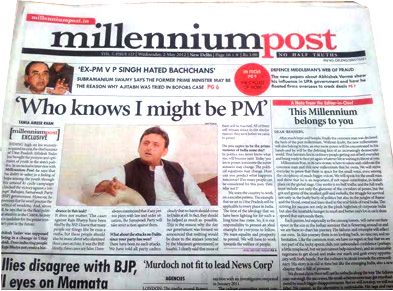
  • No half-truths with Millennium Post: Ganguly

    By A Correspondent


    Readers in New Delhi woke up to a new newspaper offering on the morning of May 2. Millennium Post, the all-colour daily was rolled out by Durbar Ganguly – promoted by Frontrow Media – who will act as the Publisher & editor-in-chief of the newspaper.


    In fact, the paper is not new and existed in a small way since 2005. Highlighting the takeover from its previous owners Mr Ganguly asserted: “The paper was in existence in a small way in 2005. We have taken over the management and the ownership of the title from its owners. Since much of the ground work for the launch had already been laid, we decided to go ahead with the same title. But having said that, the content, team and positioning would be different from what it previously was.”


    Though the team went low-profile with their promotional activities, what is assuring is the positioning that they have zeroed down on, which reads: thinking man’s newspaper. Mr Ganguly said: “We are positioning it as a thinking man’s newspaper. We don’t call it a pro-reach paper – in the sense that if you have breezed through our content you will see that this millennium belongs to the common man. When you say the thinking people they are those who believe in invention, are educated and upwardly mobile, and so on. At the same time, it is not like other large papers such as The Economic Times that are only promoting the cause of big people. So that’s how we plan to be different.”


    When asked on how they plan to measure up to the known players who have already made a mark in the capital, Mr Ganguly said: “Honestly, we are not competing in any way with any of the big players and want to create a niche of our own. If you see, people, in general, are getting fed up with the quality of journalism being provided – as I call it, sponsored corporate journalism. They have converted journalism into extension counters of PR activity. So our core focus would be to promote good quality journalism.”


    Going a step further with its promise, Mr Ganguly affirmed that one of the biggest positioning stands that it has adopted is ‘No half truths’. “Most papers today do not present the whole fact as it is and that’s what we refer to as ‘half truths.’ Our focus would be to present certain issues that others do not take up at all.”


    Alongside its physical presence, the company also plans to lay emphasis on providing content through the web. And the reason for that is rather different too. “We’d really like to promote ourselves in a big way in the digital space because we believe that after certain point of time we wouldn’t be able to expand our paper so much to other areas due to financial limitations. That’s one of the reasons we want to go heavy on the web with our content.”


    The newspaper has already found favour with advertisers, who have evinced interest and advertised in the inaugural issue itself. Mr Ganguly said: “The advertisers have been appreciative of our product and have supported us in a big way from the very first issue itself. We are very excited with the initial response that the paper has managed to evoke amongst the fraternity. We have been receiving queries from many advertisers since we launched yesterday and in the days to come you will see an increased participation from their end.”


    As of now, the paper would be circulated only in Delhi – the print run of which stands at 75,000 copies. Going ahead, the plan would be to launch it in Lucknow, Ranchi, Bhubaneshwar and Chandigarh. But that’s for later; right now the focus would be on establishing Millennium Post firmly in Delhi, affirmed Mr Ganguly.


  • Possible for ethics & profit-making to co-exist: Paranjoy Guha Thakurta (Text & Video)


    By Shruti Pushkarna


    As he launched the second expanded edition of his book, ‘Media Ethics: Truth, Fairness and Objectivity’,  in the capital last week, MxMIndia caught up with veteran independent journalist and educator,  Paranjoy Guha Thakurta for an exclusive interaction. In this candid one-on-one, Mr Guha Thakurta spoke at length about ethics in media today, self-regulation vs. regulation; the debate on the freedom of expression on the internet and the need for media to be ethically and socially responsible.


    Mr Guha Thakurta’s experience spanning nearly 35 years, cuts across different media: print, radio, television and documentary cinema. He is a writer, speaker, anchor, interviewer, teacher and commentator in three languages, English, Bengali and Hindi. His main areas of interest are the working ofIndia’s political economy and the media, on which he has authored/co-authored books and produced documentary films. He lectures on these subjects to general audiences and also trains aspiring and working media professionals.


    Mr Guha Thakurta has served as a member of the Press Council of India nominated by the University Grants Commission between January 2008 and January 2011. In April 2010, as a member of a two-member sub-committee of the Council, he co-authored a 36,000-word report entitled ‘Paid News: How Corruption in the Indian Media Undermines Democracy’.


    Does an expanded edition mean a lot more to discuss in media ethics?

    The first edition of this book came out more than three years ago, since then a lot has happened. Moreover, after the book came out, there were a lot of people who came up with suggestions on how this book could be improved. So this book is about 40 per cent bigger and thicker than the earlier edition. There are new chapters – there is an entirely new chapter on corruption in the media based quite a bit on my experience as a member of the sub-committee of the PCI, which inquired into corruption in media and how it undermines democracy, the entire phenomenon of paid news. There’s also a new chapter on reality television and some of the existing chapters have been drastically rewritten and revamped, notably the chapter on the internet because a lot has been happening in the internet space; also the chapter on advertising, which was particularly weak in the first edition – I think it has been strengthened substantially in the new edition.


    Also a whole lot of major developments have taken place concerning the media in the recent past; these have all been incorporated in the new edition. Among these would be the News of the World and Rupert Murdoch controversy in UK, the entire Wikileaks and Julian Assange phenomenon and back home here in India, the entire Niira Radia conversations; all of these have raised significant questions pertaining to media ethics and these have been incorporated in the new edition of the book.


    How important is the ‘code of ethics’ in today’s commercialized scheme of things?

    Ethics is very important in every sphere, particularly so in the case of media, because you are dealing with information which is akin to a public good. The problem essentially arises because this information is being disseminated by privately owned corporate bodies with an important goal to maximize profit; therein lies the conflicts of interest. The problem arises because there are sections of the media that are interested in profit maximization to the exclusion of other goals.


    It’s become a bit of a cliche – once upon a time it used to be said, ‘journalism is a mission’, today journalists work only for a commission. We are seeing the corporatization and commercialization of the media having an impact on the kind of content that is being produced. The viewers of television channels, the readers of newspapers, and the listeners of radio stations are being perceived more as ‘consumers’ rather as citizens. They are ‘consumers’ of products and services which are being provided by companies which advertise.


    Can journalistic ethics and profit-making can co-exist?

    I do believe it can, it’s not easy but it is possible for ethics and profit-making to co-exist.


    What is your view on the issue of regulation v/s self-regulation? What works for you?

    In an ideal world, self-regulation is the best form of regulation. But what do you do with those who cross that proverbial ‘lakshman rekha’, what do you do with those who don’t follow the code of conduct which is supposed to be self-regulatory in nature. I’ll give you an example, in the US, when Janet Jackson had a wardrobe malfunction in the middle of a live broadcast, the channel was fined immediately by the Federal Communications Commission because the wardrobe malfunction happened during a live broadcast, it happened during primetime and the channel had to first pay the fine and then appeal against the decision in a court of law.


    What happens in India? Not very long ago, there was a series of incidents involving Bhanwari Devi Maderna episode in Rajasthan and content was put out during the day on television, which many considered to be pornographic in nature. When the Ministry of Information and Broadcasting issued show cause notices against these TV channels, all of them came to Shastri Bhawan saying, ‘we apologize and we won’t do it again’. That’s the nature of self regulation in this country.


    As far as print is concerned, we have a Press Council of India which has no powers to punish anybody, it cannot impose a fine, leave alone put a person behind bars, and its recommendations are not even binding on the government. We don’t have statutory organizations which are empowered in the manner in which say the Federal Communications Commission is, or the Office of Communications in the UK is. So it’s fine to talk about self regulation but what do you do when somebody doesn’t listen to you, do you have the wherewithal to punish them?


    Do you think we need an independent official regulatory authority for television news channels as against one set up by the channels?

    Yes, I do personally believe that it is possible and desirable to have an independent regulatory authority which is independent of the government as well as the media. Such a regulatory authority can be funded by the government, but it can nevertheless be autonomous and independent of the government, in the manner in which bodies like the Supreme Court of India, or CAG or Election Commission of India function.


    So, I do believe it is possible to have such a communications commission. The problem is that for the last decade we have been debating the need for such a commission and the joke is that every time the government proposes to form such a commission, the government collapses. There have been 10 or 12 avatars of a Bill to set up such a commission; time alone will tell when and if such a commission is established in India.


    Your view on Dirty Picture not being allowed to air during the day on Sony?

    The whole Dirty Picture episode has thrown up a number of issues pertaining to censorship, pertaining to what content is appropriate or not, and if adult content can be shown on television, if so when. I think these issues are contentious and debatable and they are going to be debated for quite some time to come.


    Would you agree with Justice Katju’s view when he says people in media are of poor intellect?

    I think Justice Katju is exaggerating. There are journalists who are dumb and there are journalists who are not dumb. I think Justice Katju is not being fair to the media fraternity but that’s his personal point of view, he also thinks 90 per cent of Indians are fools, I beg to disagree with him.


    There’s a belief that the Indian media doesn’t take too kindly to criticism. Agree?

    Who among us are willingly going to accept criticism? All of us have our egos, in that sense, I don’t think the media is unique. I think there is neither any individual nor any group who likes criticism but the point is if you do believe in democracy, if you believe in fairness, and if you are in the public eye, then you better get used to criticism otherwise you’ll end up like Ms Mamata Banerjee who could not take being lampooned online. This shows not only lack of tolerance on part of individuals, especially public figures, but I think it fails to appreciate the nature of freedom of expression.


    Isn’t it upsetting that all the journalists’ organizations like Press Club, Editors Guild are tightlipped about Paid News?

    I won’t entirely go along with you on that, I mean there was a conspiracy of silence about corruption in media and paid news, even the report of the subcommittee that was prepared by me and my colleague for the PCI, was sought to be suppressed by a powerful lobby of publishers within the PCI. Finally in October 2011, the PCI was literally forced to make that report official, place it on their website with a disclaimer saying that entire council had not approved of its content. But I won’t say all journalists’ organizations conspired to put under wraps this report. There have been sections of the media who have been reticent of highlighting corruption within the media fraternity, but I don’t think it’s true for the entire media.


    Do you think that Public Relations has adversely impacted the quality of journalism?

    No, why blame the PR person…she or he is doing his or her job. You can also say the government has bribed the media, you can say that corporate captains have bribed the media. So I don’t think we need to look for excuses, I think journalists have to look within if they have to introspect about why there is corruption in the media. You can always hold somebody or the other responsible for your sins but at the end of the day, you are yourself responsible I believe.


    Your views on the ongoing debate on the freedom of expression in the internet age

    I think this is a huge debate. The internet is not just the newest medium of mass communication, it’s also a form of personalized communication, and it’s difficult to control. Issues relating to freedom of expression on the internet have acquired many new dimensions and these are very contentious and not easy to resolve. And we’ve seen this debate been going on for a while…the ‘infamous’ Danish cartoons on the prophet Mohammed were all drawn ostensibly to generate a debate on freedom of expression. Yes, that cartoon was widely circulated on the internet, as was the gruesome video showing Daniel Pearl getting beheaded. But it’s also worth remembering and underlining the fact that the mainstream media were restrained in reprinting, publicizing either the Danish cartoon or Daniel Pearl’s beheading.


    The point is, sometimes in the name of freedom of expression, you want to generate a debate but you end up generating one huge controversy which goes out of control. It was the Danish PM who argued that the cartoon controversy was the biggest crisis that small Scandinavian country faced after the Second World War and he was particularly worried because it even had an impact on the economy of Denmark because countries of West Asia stopped buying dairy products made inDenmark.


    So very often we might want to start a debate without realising its wider ramifications. But the bigger question of what constitutes the right to offend, what is freedom of expression and the new dimensions these issues have acquired in the day and age of internet, these are very important, they are being debated and I think these debates are going to go on for quite some time.


    And given all of this, your view on the future of news media in India?

    The future of news media in India is very bright. Unlike many countries in the world, all media in India continue to expand, whether it’s print, radio, TV or internet. According to 2011 census, one out of four persons in India still cannot read or write her or his name, so as more and more people become literate I think all sections of media are going to expand. At the same time, media has to become more responsible, not just socially responsible but also more ethical if it indeed has to contribute to building democracy, to building a better country.


    If you were still a kid getting out of college, would you get into journalism given the ethical standards followed?

    That’s a difficult question…when I became a journalist 35 years ago, the Emergency had just got over. That was a unique 19 month period in the history of the country where for the first and so far the only time in politically independent India, the government of the day sought to abridge freedom of expression. For 19 months, during the Emergency, freedom of expression was sought to be curbed. I don’t think that will happen again, but the very fact that I was a student during that period did influence my decision to become a journalist. If I was born 35 years later, I don’t know if I would have preferred to become a rock star, or an airline pilot or a heart surgeon instead of a journalist.

     

  • Guardian Media partners with Mediaguru

    By A Correspondent


    The Guardian, London has entered into a partnership with MediaGuru and is to hold one of its 2012 Activate Summits in India for the first time.

     
    The Guardian Activate events bring together many of the world’s brightest and most influential figures to debate how technology is driving positive social change on a global scale. The first Activate event took place in London in 2009 and the event expanded into the US market last year with the first Activate New York taking place in April 2011.


    Previous speakers have included Google executive chairman Eric Schmidt, LinkedIn founder Reid Hoffman, Arianna Huffington, editor-in-chief of The Huffington Post, Craig’sList founder Craig Newmark and NYU professor Clay Shirky.


    The 2012 Guardian Activate summit in India is currently planned to take place in October in Delhi, and will be organised in partnership with MediaGuru, the media consulting, technology and entertainment company which has a presence in London, Singapore and all across India.


    The Guardian-MediaGuru partnership will see the Activate brand expanding into other territories, including Malaysia, Hong Kong and Singapore. It will also see an ambitious expansion of the Activate digital platform on guardian.co.uk, which will become an online content and networking hub for professionals working with technology to drive global change.
    Announcing the expansion, Alan Rusbridger said: “Technology is bringing the world closer together and at the Guardian we’re committed to encouraging debate between diverse, global audiences in line with our open and digital-first strategies. We’re thrilled to be bringing the Guardian Activate summit to new countries where technology is having a real impact, and look forward to joining and facilitating more fascinating conversations about the influence of web technologies in person, as well as online.”


    Sanjay Salil, Managing Director, MediaGuru, said: “By 2020, it is predicted that India will have 600 million internet users, making it the biggest open internet access market in the world. MediaGuru is proud to be bringing the Guardian Activate platform to India, where a gathering of technology, media, and social innovation leaders can help shape India’s technology and new media agenda.”


  • Star to go solo in sports, buy ESPN from JV

    By Nandini Raghavendra & Ratna Bhushan


    Broadcast major Star Group’s 16-year-old equal joint venture with sports broadcaster ESPN is being dissolved with Star buying out ESPN’s stake in the JV, three people familiar with the development said.


    Once the transaction is complete, Rupert Murdoch-owned Star will become the owner of ESPN’s India business, the people said. Two of them said the companies were finalising details of the deal and an announcement was likely to be made shortly. They declined to disclose details.


    ESPN Software India, which operates ESPN Star Sports’ India operations, generates revenues of about Rs2,500 crore through channels that include Star Sports, ESPN and Star Cricket. ESPN Star Sports owns television broadcast rights for the ICC World Cup Cricket and T20 Champions League.


    ESPN’s Singapore office said they did not comment on speculation. A spokesperson for ESS said, “We do not comment on speculations and rumours. ESPN Star Sports continues to run the business as usual. Two partner companies frequently discuss business plans and both the companies, ESPN and News Corp, are proud of the success ESS has made since its inception, and the relationship it shares with fans and business partners. They extend complete assurance for delivering value to our partners as committed by ESS.”


    Star India Chief Executive Officer Uday Shankar did not respond to an email and text messages sent to his mobile.


    “Star wants a bigger play in the sports broadcasting space,” one of the people quoted earlier said.


    “Star’s recent Rs4,000-crore acquisition of the rights to Indian cricket from the Board of Control for Cricket in India, beating rival Sony, are indications of its ambitions in this space,” one of the people quoted earlier said.


    It is not yet clear how many of the 200 employees of ESPN, who work for the joint venture, would be retained by Star. An ESPN official, requesting not to be quoted, said employees were uncertain about their future after the deal.


    A deal between the two companies could potentially be a complex one as they have a bouquet of advertising deals and cross-sponsorships. But senior executives at two leading media-buying companies, who deal closely with both broadcasting networks, said they did not foresee any impact on advertising deals and sponsorships.


    ESPN, Star Sports and Star Cricket either sell airtime and sponsorship inventory independently or as bulk package deals, they said. An analyst from one of the big four audit firms said the battle for the rights to various cricket events will now be fought out between Star and Sony, with the latter holding the rights for Indian Premier League, the 20-overs cricket tournament. ESPN Star Sports was formed as a 50:50 JV between two of the world’s leading cable and satellite broadcasters – Walt Disney, the owner of ESPN, and Rupert Murdoch’s News Corporation – in 1996 for Asia.


    It has offices in China, Hong Kong, India, Malaysia, Taiwan and Singapore, and employs more than 650 employees across the region. Star is fast changing gears in India. In the past two months, the broadcaster has launched its second Hindi movie channel under its new brand ‘OK’, called Movies OK. It recently exited its television news business and dissolved its JV with the ABP Group. It also purchased the broadcast rights to Indian cricket for around Rs4,000 crore.


    Star seems confident of making money from its cricketing ventures. Speaking to reporters a few days ago, Mr Shankar said the deal for cricket rights would not affect the JV with ESPN. However, the market has been abuzz with the latter’s exit. “Many permutations and combinations of the deal have been worked out, which has taken this long, but ESPN is now fully exiting,” said an official from a firm with knowledge of the deal.


    Source: The Economic Times
    Copyright © 2012, Bennett, Coleman & Co. Ltd. All Rights Reserved


  • Follow us at F-T-Y-B: Hareesh Tibrewala

    By Hareesh Tibrewala


    While on a business trip to Delhi last week.  I happened to find myself in the midst of a traffic jam (so what’s new?) and while patiently waiting for the car to start crawling, my eyes fell on a large advertising hoarding. It was a well-designed hoarding for a luxury brand with some superlative creatives and the company web URL printed in the lower left hand corner. While everything on this 200 square meter hoarding looked perfect, what triggered my discomfort were four small colourful boxes in the bottom right corner, preceded by the words “Follow us on”.


    The colourful boxes were the single character brand logos for Facebook, Twitter, YouTube and Blogger, and quite obviously the brand manager was trying to invite the reader to engage with the brand on these social networks. What I saw on this billboard is a representation of what one sees in others forms of communication as well. Lots and lots of social networking site logos and lots and lots of URLs. Does this really help?


    Here are my thoughts


    • Simply putting colourful boxes with logos of social networking sites (without the full brand URL eg www.facebook.com/yourbrand) does not add any value to your communication. If at all, it only contributes to promoting the brand value of that social networking site.
    • Putting a half a dozen URLs in a communication serves no purpose either. No one has time to visit a single URL or click on a single link, leave alone click on half a dozen links. When I see a communication which has lots “Follow us on ..” links, frankly it is a bit intimidating
    • Just because you ask someone to “Follow” you is no reason to believe that that person is actually going to follow you.


    So what should be done ?


    • Sure, social networking sites are now the default place where consumers engage with brands. Also the days when consumer went to content are over. Now content has to reach the consumer. Thus continuing the engagement with the consumer, from your bill board onto a social networking site makes all the sense
    • If your brand is present on multiple social networks, choose one where you think you have the best chance of building a community or engaging with the consumer. Promote just this one link. When the consumer reaches this page, you can always provide links to your other social media presence.
    • Display the link in full (www.Youtube.com/yourbrandname). Chance of a brand recall is much higher compared to just saying : Find us on YouTube
    • Finally if you are putting out a link, see if you can build in a strong call to action. Try to answer the question, “why should the consumer follow my link”. And use that answer to trigger a strong call to action.


    Hareesh Tibrewala is Joint CEO, Social Wavelength. You can engage with him socially at linkedin.com/in/hareeshtibrewala