Category: MEDIA

  • X purges content on Rajat Sharma

    Social media platform X has removed posts by Indian National Congress leaders Ragini Nayak, Jairam Ramesh, and Pawan Khera, adhering to a directive from the Delhi High Court.

    On Wednesday, July 3, 2024, the Delhi High Court reprimanded X Corp (formerly Twitter) for challenging the court order mandating the removal of posts accusing journalist Rajat Sharma of using abusive language against Congress leader Ragini Nayak on live television.

    “We are concerned about your role. You are not acting like an intermediary,” remarked Acting Chief Justice Manmohan. “This resistance to court orders is a growing trend, not just in India but internationally as well.”

    The controversy originated from a video clip circulating on social media, allegedly depicting Sharma using offensive language towards Nayak during a discussion on India TV on the day of the Lok Sabha election results. Nayak is reported to have shared the video on X on June 10 and subsequently filed a police complaint against Sharma. Sharma has denied the allegations, labeling them as a fabricated smear campaign orchestrated by the Congress party’s media cell.

  • Ex-TIL exec Saurabh Gaur launches Performance Ace

    Saurabh Gaur
    Saurabh Gaur

    Saurabh Gaur, a seasoned executive in digital media business development,  has announced the launch of his new venture, Performance Ace.

    Gaur spent over a decade at Times Internet, where he was National Sales Head and Business Head of HYPP.

    “Performance Ace represents the culmination of my professional journey—a commitment to excellence, visionary leadership, and transformative growth,” said Saurabh Gaur, adding: “Our mission at Performance Ace is simple yet bold: to achieve the impossible and deliver unparalleled results in digital marketing services.”

  • Ranjona Banerji: Rah-rah, Mr Shadow PM

    Ranjona BanerjiThe high voltage dramatic world of Hindi television “news” is outside my comprehension as well as my mandate for this column. However, out of my commitment to you (ahem) and some insane curiosity, I dipped a toe into the muck, as Lok Sabha proceedings began.


    And I was genuinely amazed. Okay, that’s an exaggeration. I was slightly shocked. And confused. For instance, on a programme on ABP News, after Rahul Gandhi’s first speech as Leader of the Opposition, the guests seemed to actually praise Rahul Gandhi’s speech. Some pointed out that this was Gandhi’s moment of arrival, others felt his success was clear since three Government ministers stood up to counter him. And one made the suggestion that the Opposition should now create a shadow Cabinet, as is done in the UK.


    And lo and behold, India Today has apparently called Gandhi the “Shadow PM”.


    It is worthwhile to remember that many (most?) of the channels did not cover Gandhi’s Bharat Jodo Yatra, and whipped up as much Hindu-Muslim hatred as possible and have consistently given Modi 1, Modi 2 a free pass. On Modi-NDA 3, well, it’s early days yet.


    The possibility is that criticism of Modi-NDA 3 will be weak. But the India Alliance will no longer be wiped out, dismissed and ridiculed as much as earlier.


    My reason for caution is this: as Prime Minister Narendra Modi was droning on and on in his reply to the Opposition, in an extremely lacklustre speech, reports started coming in of a terrible tragedy unfolding in Hathras, Uttar Pradesh. People had been trampled to death in a stampede at a religious event organised by some godman. The casualties kept rising, but some of these channels did not shift from the PM’s speech to cover the news. Nor was the PM corrected on his most egregious assertion that his government had done a lot to “normalise” the situation in Manipur.


    On the other hand, I did watch a young female Muslim anchor (I make the religious distinction deliberately) berate a member of the BJP for the BJP’s discriminatory and violent behaviour towards Muslims. This young woman did not hold back. It was most intriguing. Not so long ago another TV anchor listened to Modi claim he was not born from biology but had divine connections, and did not even ask a mild question.


    The American media and some media across the world are currently debating the suitability of US President Joe Biden for another term. Most of the questions are based on Biden’s flat and fumbling performance in the first debate with Republican candidate Donald Trump. (“Why Joe Biden must stand aside”, is a headline in The Economist). Biden is still President. I can’t think of anyone in the legacy/mainstream Indian media who will question Modi’s many mistakes, lies and garbled speeches. O no. How dare I even ask such a question???


    There have been reports of the Indian public resisting the snide and manipulative questions asked by what TV journalist Ravish Kumar termed the “Godi media”, as in sitting in the lap of the powers that be. A clip is doing the rounds of a reporter from India TV trying to trick the family of a young man killed in combat into admitting that they got Rs one crore as claimed by Defence Minister Rajnath Singh (in answer to Rahul Gandhi). Modi’s Agniveer scheme of short-term soldiering has been much debated.

    Gandhi had stated that the scheme does not provide adequate compensation and that the family did not get the Rs one crore as claimed. The family got angry with the reporter for twisting their answers and threw him out. The need of channels to push the government line can put the lives of their staff in danger. But the need to promote Modi remains. Other TV people put out information about the claim of Rs one crore paid to the family as true. And yet their own documents showed that the family had received an insurance pay out. Not all the money the Central government had claimed. If you are so full of “Praise Modi Propagate Modi Karyakram”, you cannot even read your own information.


    Meanwhile, Modi hooked off to meet the Indian cricket team after their fabulous win at the T20 World Cup.


    And the Shadow PM went to meet the families of those killed in the stampede at Hathras.


    Ranjona Banerji is a senior journalist and commentator. She writes on MxMIndia on Tuesdays and Fridays. Her views here are personal.

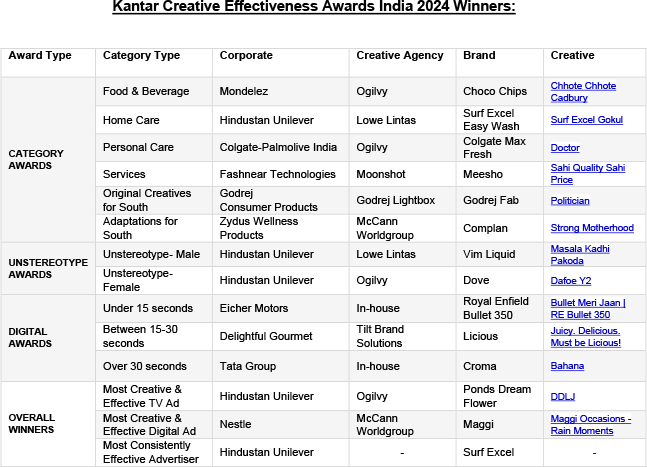
  • HUL stars in Kantar Creative Effectiveness Awards India

    HUL stars in Kantar Creative Effectiveness Awards India

    Kantar, the leading marketing data and analytics company, unveiled the ads that were most effective and creative across India in 2023.  The company tested more than 12,000 creatives for its clients around the world in 2023. Over 11% (1,400+) of those creatives were tested in India. Today,


    In the awards, consumers are the jury. The India report shortlists close to 300 ads, tested across categories, markets, TG’s and media channels.


    The winners list has doubled from last year, with Kantar awarding 10 standout performers in the television ads category and 4 in the digital ads category.


    Television categories include Food & Beverage, Home Care, Personal Care, Services and Unstereotype. New categories introduced include ‘Original Creatives for South’, ‘Adaptations for South’, Most Creative & Effective TV Ad (overall) and Most Consistently Effective Advertiser. Creatives for Digital continue to grow this year as well, with Kantar awarding standout performers in 4 categories- 3 based on ‘Ad Length’ format and one for the Most Creative & Effective Digital Ad, for bringing to life the exciting storytelling possibilities in the digital world.


    All ads exemplify essential characteristics of being creatively engaging and landing persuasive stories that enhance brand sales, notes a communique.


    Commenting on this year’s findings, Soumya Mohanty, Managing Director & Chief Client Officer- South Asia, Insights Division, Kantar said: “Earlier this year, Kantar launched the Blueprint for Brand Growth– a breakthrough understanding of how businesses build strong & profitable brands. One of the growth accelerators for building strong brands is to pre-dispose more people. Great advertising builds pre-disposition and loads the dice in favour of the brands. Creative content can and should punch above its weight”.


    Added Prasanna Kumar, Head of Creative Domain & Executive Vice President- South Asia, Insights Division, Kantar: “Truly creative ads are the ones that are effective. The journey from being just creative to being effective starts by including your key stakeholders – your target consumers, into the process by pre-testing your ads. This year we have seen some original creative ideas shine through by ensuring that they have brand and consumer at their heart.”


    Key highlights from this year’s report: 

    1. Learnings from Kantar’s Blueprint for Brand Growth indicate that great advertising is rocket-fuel for building predisposition: growing meaningfully different brands in a more effective and efficient way. Creative quality, second only to brand size, greatly influences campaign profitability, with double the impact that reach does on brand salience.


    1. Kantar research emphasizes that ads must persuade and convey messages that are novel, credible, relevant, and different to enhance short-term sales. But high-quality ads, which leave a lasting impression, generally perform well in both short-term sales and long-term brand-building (Kantar LINK database), thus reducing the need to spend money on performance marketing.


    1. Beyond brand recognition, generating a strong emotional response is key, because emotion helps build strong memory structures, and most advertising effects are not immediate. Emotion plays a critical role in effective creative- and not just in TV content. 


    Ad learnings from 2023: 

    1. Make purpose personal: 65% of Indians will buy brands that stand for something they can identify with. While purpose or value led creatives open possibilities for highly emotively engaging creatives, the effective ones execute it in a manner such that it becomes personal to the consumers.


    1. License to surprise: Consumers are open to original creative ideas- ones that are hyper creative or break existing category codes. The reward for the brand lies in the ability to integrate the persuasive and meaningful impressions into the creative idea. Pre-testing helps identify the possible risks of comprehension and resonance.


    1. Going Native: Only 28% Indians (vs Global average 75%) have watched any ‘foreign’ content. Over 25 years of Kantar Link™ ad evaluation reveal a striking truth- ad transference across Indian regions is just about a third. This challenges the assumption that a single pan-India creative approach, even with universal and validated consumer insight, will yield positive returns on objectives. Brands are now refreshingly taking on the challenge and opportunity of engaging the Southern consumers differently from Hindi-speaking markets. Investing in original creatives, by going native on multiple dimensions- insights, creative idea & treatment and execution ensures maximizing of reward for the brand.


    1. Go deep & wide: The most efficient route to optimize budgets for creating ads that effectively crossover the transference challenge across the many India’s, is to create regional adaptions by playing with backdrop, celebrity, casting, product window visualization, slogan etc. Go deep and wide is about taking a campaign pan India by starting with a pan India insight, creative idea & treatment but execute with some nativity elements to amplify the resonance with the regional markets. Pre-testing helps to identify whether the mix of insight, story & elements work together as intended and identify opportunities for improvement.


    1. Embed the Brand: The value of creativity starts with the brand. While executional elements like distinctive brand assets and consistency in advertising style are undeniable aids in ensuring that the brand takes credit for the impressions left behind by the creative, it’s potential is amplified when the brand is integral to the story.

    **In our top quartile ads compared to the bottom quartile ads, we observed more consistency (+49%), greater use of established branding devices (+14%), and the inclusion of related music (+26%).


    1. Weave in the product story: Executions that can creatively integrate the specific competitive reasons to consider the brand into the narrative tend to be impactful. The role of creativity is thus not just to entertain but also leave behind vivid impressions that make the brand more meaningful to the consumers.


    1. Specific learnings for the digital landscape: 
    1. Precision targeting is officially giving way to mass media avatar of Digital and there’s an increasing recognition of the importance of brand marketing on digital platforms. Creative Quality getting increasingly critical for ensuring ROI for digital- could unlock 35%+ incremental sales per impression.
    2. Effective content on TV does not automatically mean success in digital – Ads that perform well in TV have only a ~50% chance of performing well in digital.
    3. Emotional resonance significantly enhances digital advertising’s impact on brand building. Ads that evoke stronger emotions are 3x more likely to drive long-term brand equity and 2.75x more likely to generate impact compared to those with weaker emotional connections.


  • Rohit Sharma, Jasprit Bumrah rule T20 WC chatter

    Rohit Sharma, Jasprit Bumrah rule T20 WC chatter

    The ICC Men’s Cricket T20 World Cup garnered unprecedented social media chatter, reports Interactive Avenues, the digital arm of IPG Mediabrands India which  released its “‘apturing the Glory: A Social Listening Report on #T20WorldCup’ report on Monday.


    The report is based on data gathered from social platforms such as Twitter, Reddit, and popular cricket forums and reveals  insights on player popularity, most appreciated performances, most talked about matches, top brand partnerships and more.


    Commenting on the report, Shantanu Sirohi, COO, Interactive Avenues, said: “The Cricket T20 World Cup has once again proven the unparalleled ability of cricket to captivate audiences. This tournament has set new benchmarks for player popularity, with stars like Rohit Sharma and Jasprit Bumrah leading the conversations. Our comprehensive social listening report not only highlights the staggering number of mentions and engagements, but also delves into the elements that drove these numbers.”


    Key findings of the report:

    Social chatter highlights:

    • Overall, the tournament garnered 55.9Mn mentions and drove 461Mn engagements.
    • Rohit Sharma emerged as the most talked about player and batsman (5.5Mn mentions). Jasprit Bumrah was the most popular bowler (1.2Mn mentions), and Hardik Pandya was the top all-rounder (1.1Mn mentions).
    • The finale between India and South Africa was the most talked about match (2.2Mn mentions), followed by India vs. Pakistan (1.7Mn mentions).


    Most thrilling moments:

    • Suryakumar Yadav’s stunning catch which clinched the T20 World Cup title for India got 209K mentions.
    • Afghanistan beating Bangladesh in a low-scoring thriller to seal their semi-final spot drove 156K mentions
    • India’s victory against Pakistan by 6 runs in the low-scoring group stage match garnered 122K mentions.


    Most popular players:

    • Powered by consistently stellar performances, India’s Rohit Sharma (5.5Mn mentions), Virat Kohli (4.1Mn mentions), Suryakumar Yadav (1.3Mn mentions), Jasprit Bumrah (1.2Mn mentions) and Hardik Pandya (1.1Mn mentions) emerged as the most popular players on social media.


    Top emerging players:

    • Making their debut in a T20 World Cup, players from USA topped the popularity charts among emerging talent. Saurabh Netravalkar led the roster (163K mentions), followed by Ali Khan (67K mentions), Aaron Jones (49K mentions), and Monank Patel (30K mentions).


    Top emotional moments:

    • Rohit Sharma and Virat Kohli’s ‘bromance’, including videos of their journey together, resulted in 7.1Mn engagements.
    • Rohit Sharma and Virat Kohli announcing their retirement from T20 international matches drove 4.1Mn engagements.
    • Rohit Sharma kissing Hardik Pandya in an emotional moment after India won the cup garnered 2.3Mn engagements.


    Biggest comeback story:

    • After being booed at every match venue during IPL 2024 (92% negative mentions), Hardik Pandya made a spectacular comeback with 88% positive mentions during T20 World Cup 2024.


    Top brand partnerships:

    • Brands across diverse industries leveraged T20 CWC-based partnerships to drive engagement. Maruti got 258K mentions, Amul garnered 200K mentions, and ICICI Bank got 145K mentions.
    • Nandini Milk witnessed a whopping 390% increase in average monthly engagement, while BPCL’s “Snap The AD” contest drove a 191% spike in average monthly engagement.
  • Media.Monks strengthens leadership team

    Atif Rahman
    Atif Rahman

    Media.Monks has fortified its leadership team with the appointment of Atif Rahman as Head of Client Relationships.

    Rahman brings more than 21 years of extensive industry experience, having previously spearheaded the flagship portfolio for Samsung India at Cheil and played a pivotal role in consolidating the Coca-Cola business under the WPP banner during his tenure at Ogilvy.

    Said Robert Godinho, MD India: stating, “With Atif on board, Media.Monks India is fully charged  to deliver tech-first solutions and creative excellence,” adding:“Brands and consumers across the market are rapidly adapting to an increasingly social, digital and AI empowered world. Our unique approach is to harness the power of both creativity and technology to enable brands to gain competitive advantage in this dynamic environment. For example, innovations like Monks.Flow leverage AI and data to accelerate efficiencies and increase campaign effectiveness by up to 70%.” he added.

  • Olympics 2024: what new social media guidelines mean for athletes and their sponsors

    Olympics 2024: what new social media guidelines mean for athletes and their sponsors

    Representative pic: person taking a selfie. Courtesy: pickpik.com (Creative Commons Licene)


    By Layckan Van Gensen

    Cellphone cameras are ubiquitous at modern sporting events. Whether it’s a school swimming gala, the local rugby club squaring off against their bitter rivals or a national team fighting for tournament glory, every moment is a potential photograph.

    The Olympic Games are no exception. More than 10,000 athletes from 200 countries or regions are set to compete in 32 sports in this year’s host city, Paris, giving fans ample opportunity to fill their camera rolls with images of their favourite sporting heroes.

    And participants, too, will be able to memorialise their time in Paris – far more freely than ever before. This comes after the Games’ governing body, the International Olympic Committee (IOC), unveiled new social media guidelines in December 2023.

    Most of the guidelines are aimed at athletes; some relate to “accredited individuals other than athletes” such as coaches, technical staff and countries’ Olympic committee representatives.

    As a legal scholar specialising in sports law, with a focus on image rights, I’ve been closely following the IOC’s stance on athletes’ use of social media – especially photographs and videos. Image rights are a broad bundle which may include rights over the use of the individual’s still, moving and animated images, name, signature recorded voice, catch phrases, associated iconic acts, logos, trademark and brands.

    These rights can be worth a lot of money. For example, Indian cricketer Virat Kohli can earn anything between US$2 million and US$2.7 million per social media post.

    Overall, it appears that the IOC has tried to strike a balance between protecting the media rights holders while still recognising the value of a participant’s image rights. It allows them to show more content than before and, more importantly, to acknowledge their personal sponsors, who play an important role in commercialising their images and building their brands. Loyal fans will get a fuller picture of their favourite athletes’ Olympic journeys than they’ve been able to before.


    Social media at the Olympics

    Vancouver’s 2010 Winter Olympics have been described as “the first social media games”, marking the first time that the IOC created social media guidelines. These were refined for the London 2012 Summer Olympics.

    At the last Summer Olympics, hosted by Tokyo in 2020, athletes were not allowed to:

    • share any content from accredited areas used for a sporting competition or ceremony
    • post about their personal sponsors.

    These restrictions were designed, the IOC said at the time, to protect media rights-holders such as TV stations and other big media organisations.


    What’s changed

    Under the new guidelines accredited participants can share their experiences far more freely on social media platforms during what the IOC calls the “game period”, from 18 July to 13 August.

    They may:

    • take photographs and record audio and video inside and outside the accredited areas
    • share photographs on their personal social media platforms up to one hour before the start of the competition they’re taking part in, and after they have left the doping control areas
    • share posts from the training and practice areas, the opening and closing ceremonies and the Champions Park, where athletes gather after their competitions to meet and interact with fans.

    Of course there are still some restrictions.

    Videos may not be live streamed, may not be longer than 2 minutes and may not include actual competitions. So, coaches can’t film an athlete in action and then share the video or photos. Athletes also can’t record another athlete training, or post highlights from their personal competition on social media. They can only share such images or videos from official media rights-holders’ accounts.

    Perhaps most intriguingly, photographs and videos that use artificial intelligence may not be shared. It’s unclear how the IOC intends to police this rule.


    Not for commercial purposes

    Media rights-holders aren’t left completely unprotected by the new guidelines. Participants are not allowed to post for commercial purposes throughout the game period.

    A post will be regarded as “for commercial purposes” if its purpose is to generate financial profit or promote any third party or products or services.

    One of the main goals of the new social media guidelines is to balance the rights of media holders and those of the participants. This attempt at a balancing act can be seen in the new rules for non-Olympic partners – those who don’t sponsor or have official merchandise licensing contracts with the IOC.

    Brands or companies in this category may run generic advertising during the game period as long as it hasn’t been especially designed for the Olympics and has already been in the public eye for at least 90 days before the tournament starts. Advertisements in this category can’t be run more frequently during the Games than they have been previously. The IOC will apply these rules flexibly to enable “business-as-usual” campaigns.

    Participants are allowed to provide one “thank you” message to each of their non-Olympic partners during the games period but it may not include a personal endorsement.The Conversation


    Layckan Van Gensen is Junior Lecturer in Mercantile Law, Stellenbosch University. This article is republished from The Conversation under a Creative Commons license. Read the original article.

  • Rajat Sharma elected President of NBDA

    Rajat Sharma, Chairman of India TV, has been elected as the President of the News Broadcasters & Digital Association (NBDA), for another term in 2024-25. The appointments took place at NBDA’s board meeting held on Tuesday.

    Addressing the NBDA, Sharma remarked on the significant challenges facing news broadcasters today. “There is a concentrated effort to discredit the news broadcast industry,” he said. “A section of the digital media is being misused to constantly attack news broadcasters. We have to work together to fight this menace.”

    Sharma further emphasised the pressures faced by those in the news industry, stating, “Our editors, anchors, and reporters are being targeted. They are working under tremendous pressure as an ecosystem has been created to consistently threaten their credibility. It is our responsibility to ensure that they get a fearless atmosphere to deliver fair news.”

  • Ranjona Banerji: Dancing with Bears!

    Ranjona BanerjiAll that matters in Narendra Modi’s visit to Russia, according to some Indian news outlets, is that evidently lots of Indians who live in Moscow are very excited. For some reason, these strange outlets also showed us people in New York who are very excited by Modi, although it is not completely clear why they are excited.

    Is this excitement over the fact that in India, people showed they were not quite as excited by Modi?

    In the days since the general election results, we have seen the following things happen in India:

    An increase in lynching of Muslims by Hindutva gangs, with affiliations to the BJP/RSS.

    A number of bridges collapsing in Bihar, 12 in two weeks.

    Massive floods in Assam, with loss of life and property.

    Massive rainfall, landslides in Uttarakhand, with damage and loss of lives.

    A stampede at the religious event in UP where at least 120 people died.

    Huge consternation over leaked papers in common entrance exams, mass cancellation and students in severe distress.

    Continued violence in Manipur over a year after the near-civil war began.

    Increasing economic distress, industry slowdown, inflation high, retail sales in trouble.

    Terrorist attacks in Kashmir.

    You can add anything you want to this list, almost none of it good news.

    What is most notable is that Prime Minister Narendra Modi has been missing from action in all these problems listed. Why the Indian media thinks random people singing and dancing in Moscow and New York is of any significance is not a question worth asking. Or is it? It underlines once again how Modi’s PR machinery and his captive media continue to sing to their own tunes, regardless of the reality around them.

    Editor in Chief Chamchagiri: “Find me six Indians in Moscow and make them say they are excited about Modi.”

    Staff: “Madam, what about Manipur?”

    Editor: “Don’t talk rubbish, you Rahul Gandhi stooge. We only exist for Modi ji and dancing foreign fools.”

    Something like that must happen in these newsrooms.

    It is not that the mainstream media is out of touch with reality. Or it does not know what’s happening. But because it remains unable to disassociate itself from the Modi-means-publicity dance it has performed for so long, it cannot provide sufficient coverage to matters of pain and suffering that the average Indian may feel.

    Consider the amount of time wasted asking people whether Rahul Gandhi had “insulted” Hindus by calling them non-violent or by saying that the BJP version of Hinduism is not Hinduism. This is a total non-issue and was only drummed up because Gandhi’s speech as Leader of the Opposition showed Modi and the BJP in a poor light.

    While media outlets wasted their consumers time on stuff like this, problems over NEET exam leaks escalated, the monsoon did its damage, bridges collapsed. Is it then business as usual for the media? Regardless of the election results, regardless of the voice of the people, can the media recover from over 10 years of supine worship? Is it worth wasting newsgathering expenses on happy Indians in Moscow when you did nothing for all the Indians who died in heat waves and are now dying in monsoon fury?

    The best is, you won’t even really find out what this trip to Russia has achieved, apart from dancing Indians and some bear hugs…
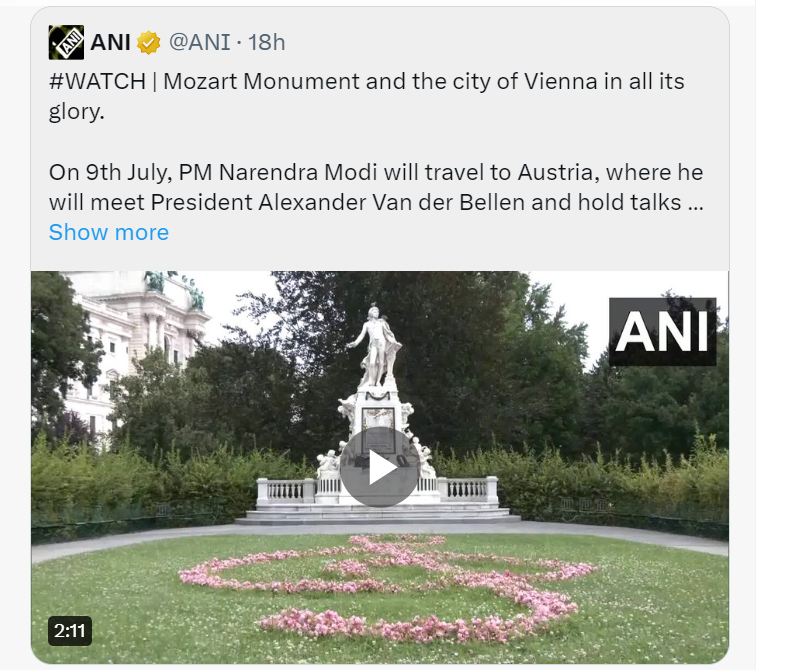
    ANI amused me the most in this “who loves Modi more” game. It put up a photo of a statue of the Mozart monument in Austria as a highlight of Modi’s impending visit to that country. How do you think ANI and other such lapdog outlets will now contrive to prove Modi’s lifelong connection to Mozart?


    Ranjona Banerji is a senior journalist and commentator. She writes on MxMIndia on Tuesdays and Fridays. Her views here are personal.

  • Approach Entertainment ropes in Tushar Gondalia as Gujarat Head

    Tushar Gondalia
    Tushar Gondalia

    Approach Entertainment Group, an integrated media and entertainment company, has appointed Tushar Gondalia as the new Head for its Gujarat operations. This move is part of the company’s ongoing efforts to expand its footprint and enhance its service offerings across the region.

    Sonu Tyagi
    Sonu Tyagi

    Said Founder and MD Sonu Tyagi on the appointment: “We are thrilled to welcome Tushar Gondalia to the Approach Entertainment Group family. His extensive experience and creative vision align perfectly with our mission to deliver top-tier entertainment and communication solutions. We are confident that under his leadership, our operations in Gujarat will reach new heights.”

  • Pocket FM partners with One Source

    Integrated marketing consultancy One Source has partnered with audio series platform Pocket FM for its public relations mandate.

    Regarding the partnership, Rahul Nag, Director – Communications and Partnerships, Pocket FM, said: “One Source impressed us with their focus on driving business impact and their commitment to partnering with brands. As we pioneered a new entertainment category globally with audio series, it was crucial to find partners who share our vision and align with our strategic approach. One Source proved to be the perfect fit, understanding our goals and aligning seamlessly with our strategy.”

    Added Sandeep Rao, Co–founder and Co-Chief Executive Officer, One Source: “This collaboration is a testament to the business impact work we have delivered with partners across the globe. Our focus as a consultancy has always been on growing our partners’ businesses, thereon growing ours. We are excited to collaborate with Pocket FM in the next phase of our mutual growth and build a category which is poised to disrupt the future of global entertainment.”

  • Food For Thought: TV’s Pop Culture Problem

    Food For Thought: TV’s Pop Culture Problem

    Shailesh KapoorScrolling through TV ratings reports a couple of weeks ago, I could not help noticing Laughter Chefs. The show, launched on Colors on June 1, 2024, is doing better numbers than most reality shows, including established franchises, have managed in the last year or so. A rating of 1.5 on the weekends, over a duration of 1.5 hours (sometimes longer), is no mean feat in a category where 1.5 is now seen as a successful number even for mainline fiction content. And here’s a low-cost non-fiction show that comes without much fanfare, and manages to score very well, largely on account of engagement (time spent).

    I ended up watching an episode, and then a few more. The show is irresistibly unapologetic about its loose format, which is in itself a loose adaptation of the iconic Tamil show Cooku With Comali, which created the most unlikely hybrid TV genre ever – comedy-based cooking competition! In Laughter Chefs, a string of TV stars, recognised via their work in fiction series, comedy shows and/or Bigg Boss, take part in a cooking competition, where the rules are limited to the bare minimum.

    There’s nothing here that can add to your knowledge, or inspire you, nor strike an emotional chord. It’s pure fun, but a lot of it at that, if you find cheesy Hindi comedy in the mainstream format palatable (all puns intended). I particularly liked the specific use of Bollywood songs in the background to enhance the comedy. It’s not a lazy selection of popular songs, but songs across the decades, including many from the 90s, that have been handpicked to dial up the humor at that very moment. I almost wanted to watch more just for this reason.

    Why is this show not being spoken about more? A search on social media only gives you fan posts, where fanbases of stars in the show are propping their favorites. But there is no media coverage in the trade media on this show, and its unexpected numbers. There’s no analysis on non-fiction comedy finally delivering in the prime-time, after The Kapil Sharma Show had faded away a couple of years ago.

    This absence of coverage is TV’s growing problem. As it is, not too many GEC properties are managing to make any impact whatsoever. But when one does, it has to rely on native channel marketing and organic buildup of word-of-mouth. There’s no social media or general media narrative at all. In an age of extreme content clutter, a worthy property may never find some of its potential audience, because television has moved out of the pop culture even for the most ‘mass’ audiences, it seems.

    Marketing departments at TV networks should be focusing on this as one of their objectives. Because programme, or even channel, marketing will only take you so far, if you are not relevant to the prevailing zeitgeist.