Category: MEDIA

  • [MJR] The night of January 16 strikes again!

    By Ranjona Banerji


    It seems to be a strange rule these days that no matter what happens, the Indian army has to upstage it in the news stakes. The Indian Express, with its story about army deployments towards New Delhi which “spooked’ the Government of India stole the focus away from the US’s $10 million bounty on Pakistan’s Hafiz Saeed.


    The newspaper has truly put the cat among the pigeons with its dramatically written story which implies that even if there wasn’t a coup attempt by the army, the government was definitely shaken.


    The timing of the movements of these two divisions, one airborne, towards the capital was also seen as suspect – January 16, the day the army chief filed his case in the Supreme Court over his age issue. According to the Express report, standard operating procedures about troop movements had not been followed.


    TV debates obviously went ballistic. But for all the bombast, the participants were skewed in favour of the army with lots of moustachioed gents pointed out how such a thing could never happen. Other participants – usually journalists – said that the Express story was not a surprise and that a website had come out with the facts in January itself. I did not manage to see Shekhar Gupta, editor of Indian Express on TV, but he was quoted by one of the channels as saying that once they got the story they could not suppress it from the people.


    This is from the Express website: “The Indian Express’ report ‘The January night Raisina Hill was spooked: Two key Army units moved towards Delhi without notifying Govt’ has, as expected, prompted widespread reaction.


    “The report is a meticulous reconstruction and a very sober interpretation of the movement of two key Army units towards New Delhi on the night of January 16-17. Investigated over six weeks and written by Editor-in-Chief Shekhar Gupta; Chief of Investigative Bureau Ritu Sarin and Deputy Editor and Chief of the National Bureau Pranab Dhal Samanta (with help from Assistant Editor in the Investigative Bureau Ajmer Singh), the report draws on highly credible sources.”


    “They have chosen to be anonymous and the newspaper is committed to protecting their identity. The Indian Express’ sent a detailed questionnaire to the Army and the Ministry of Defence and accurately reported their responses in the report. These responses were reiterated by them on Wednesday.” The note ends with: “And in the tradition of its commitment to journalism of courage and the readers’ right to know, it will continue its investigation into the events of January 16-17 and the questions these raise.”


    TV debates are often circumscribed by the need for bluster and “patriotism” of the sort that is worn on your sleeve is very common. Not a single panellist on Wednesday night could offer an explanation or even consider why a reputed newspaper would carry such a story without any proof. It is easy to understand that print journalists would be jealous of a scoop – though at a senior level you are expected to rise above that.


    It is also possible that “patriotism” even in the media means you have to draw a line somewhere about how much you can embarrass important institutions.


    I wonder. Jingoism which masquerades as love for your country is dangerous in any form. The job of the media is to ask uncomfortable questions. I find it very interesting that so many in the media are unable to ask the armed forces difficult questions.


    Members of governments and political parties are quizzed every night on TV. Why should anyone else be exempt?


    It seems apparent that there is a deep division between the army and the government. It is equally apparent that there are schisms within the army itself and different camps are batting for different generals. All this needs to be examined and exposed.


    There can be little doubt that the Indian Express has pushed a few boundaries and a few buttons here. TV is incapable of showing the depth to deal with this story. Let’s see how far print can take it.

     

  • Is the serial woman tellying it like it is?


    By Ritu Midha


    About a decade ago, we saw the emergence of Tulsi, Parvati and Kussum. Strong protagonists – but all of them set in more or less the same socio-cultural setting, grounded in traditions but fighting against the evil (another woman in most cases) trying to tear their families apart.


    Cut to the present-day GEC. The protagonist is stronger, and differentiated. She is no longer just about pacifying the mother-in-law, and mothering her growing-up children. She is aware, educated, has a mind of her own, and she speaks it too. She has the spunk, and many a time, she takes the lead in decision-making. To put it simply, she does not wait for someone to save her, she is fully capable of doing the saving. And in between all this, she has a heart too, and dotes on her family.


    There is a Pratigya fighting against the issues in her own house – a decision maker in Allahabad; there are working or aspiring-to-work women in quite a few soaps – among them Kuch Toh Log Kahenge set in Lucknow and Afsar Bitiya with a Bihar backdrop. There also is a Hitler Didi, where the protagonist, living in Delhi, is the master of the house, and of course Balika Vadhu and Diya Aur Baati Hum (both set in Rajasthan), which propagate women’s empowerment in the rural and semi-urban areas.


    Is it an accurate reflection of the real Indian woman, or are these shows akin to the funhouse mirrors that exaggerate certain parts of our collective reality? Even if it does exaggerate the social consciousness, it definitely provides an example for those women whose staple diet of entertainment is still the Hindi GEC.


    States Anamika Mehta, COO, Lodestar Universal: “Undoubtedly media, at an overall level, influences society and television has a huge role to play in that sense. While at some level, some shows and protagonists do play a role in sounding a wake-up call or instilling confidence, courage, and independence of thought, they thereby create followers or loyalists. However it’s more of media mirroring society on television essentially – witnessed for instance in the shift from ‘saas bahu’ soaps to the current lot.”


    While the woman protagonists are bolder and more intelligent now, the socio-cultural cauldron from which they emerge varies from show to show. The reason, of course, is increase in purchasing power of women across middle India – Madhya Pradesh, not a favourite setting for television serials till some time ago, suddenly finds itself as the backdrop for a number of soaps. Is the appeal of these shows universal or does it appeal to audiences in a particular geography? States Nandini Dias: “The traditional shows like Uttaran and Balika Vadhu do find better resonance in smaller towns while the talk shows like Oprah Winfrey or Barkha Dutt show a skew towards metros. The shows which do well across all towns are usually love stories like Kuch Toh Log Kahenge.”


    However, Shubha George, COO, MEC, South Asia, believes that in case the objective is to target a specific audience profile, a lot more needs to be done in this direction. She states: “Indian TV shows are fairly homogeneous and cater to a pan-India audience in most instances. I cannot think of any particular example that is more popular in metros because of a bolder woman character. Rather, this is a concept which is yet to be experimented on by Indian TV shows for mass audiences.”


    Many of these shows depict subjects like second marriages, domestic violence and other women-centric issues, but do they manage to send a message across to society? As per Anamika Mehta: “Frankly it’s little to do with evoking social consciousness and more to do with experimentation with new audiences, new generation, different content and eventually eyeballs. While many of these shows initially kicked off with a social idea and an attempt to rouse audiences, eventually, given the eyeball battle, they turn more into trials and tribulations of a woman with plot twists and turns.”


    There is a conscious attempt at creating a protagonist who wants to change the world, who would capture the attention and imagination of young women. Are these shows with the new realistic woman favoured by certain brands – or it is only TRPs that matter in the end? States Ms Dias: “Media planning is called a science and an art for exactly these reasons. Media planners do look at data , quantitative parameters. But finally when they take decisions they need to predict the future of how a show will do in the future. So the qualitative factors need to be considered too. In fact with the number of brand integrations that are done, it is detrimental to a brand if they do these brand integrations without understanding the content and relevance of the show.”


    Ms Mehta too states that brands do look at the content of the show, however, many times the storyline changes in chase of TRPs. She says, “Only if the brand’s personality is in sync with the show do they look at doing show exclusive deals. Very often the shows digress/change/derail chasing eye balls which often could defeat the rationale for association.”


    On India’s wide-ranging social canvas, there are many Indias, and the psychographics change not only from New Delhi to Basti, but also from Defence Colony to Rohini. It is not easy to depict the myriad colours of the Indian woman. However, the effort is being made towards being progressive, covering a broader spectrum, and bringing to the fore social issues that women in particular face. Does it matter that it is for the sake of eyeballs, or to get more advertisers on board, if the issues are addressed in the end?


    INDEX
    Success mantras from media captains
    All work and some play
    Riding the creative crest
    Holding up the managerial sky
    Celebrating the difference
    Managing Middle India’s Golden Lady
    Wooing vibrant India’s Wonder Woman
    Rural women – how strong is their ‘spending say’?
    Is the serial woman tellying it like it is?


  • MSM hits the ball hard for Six

    By Rishi Vora


    It’s been about two years since it was first heard that Multi Screen Media Pvt Ltd (MSM) will launch a sports channel. The wait is finally over as the channel was launched on April 7. This is MSM’s sixth channel – one of the reasons why the network chose ‘Six’ as its brand name.


    The TG for Six is skewed slightly towards the younger lot of sports fanatics and the first phase of the content plan is to  make most of the Indian Premier League’s five editions and evoke special interest among fans to watch non-cricketing sports such as mixed martial arts, basketball, badminton and football. Its main property, to begin with, is Ultimate Fighting Championship (UFC), a martial arts contest that has more than 30 events globally. The next season of IPL will be aired on Six.


    The channel will reach out to 80 million homes on DTH and analog platforms in India with a reach of 20 million in phase 1.


    Six is being promoted heavily on network channels and the on-air biggest cricketing property, IPL. Quite surprisingly, the channel has not gone for a 360-degree marketing blitzkrieg – the usual strategy adopted to support the launch. It is learnt that outdoor and radio will subsequently follow promotions on TV.


    If one looks at the sports broadcast arena as is currently placed, it makes an interesting read. Neo Sports and Ten Sports are facing a tough time sustaining business. And, of course, the fact that IPL was running on a sticky wicket as far as sponsors are concerned, tells the story – that advertisers feel there’s no point investing big monies where the returns are not very good. Plus, the recent development of Star winning the BCCI rights… something which MSM was eyeing to provide that much required impetus for the new channel, is a sure-shot big miss of opportunity.


    “We have the IPL and as we move along, we hope to acquire more rights,” said NP Singh, Network COO. He confessed that the BCCI rights was an opportunity missed, however, he also said: “It was in our long term interest to launch a sports channel. We had been talking about it, so it wouldn’t have made sense to further delay the launch just because we did not win the rights to broadcast Indian cricket.”


    According to a senior media planner who wished anonymity, the launch of Six has happened at a time where it may not be easy for the channel to make a mark. “Cricket is the only sport India loves. Besides IPL, Six doesn’t have much to offer. Also, there isn’t much left as far as rights are concerned, so the channel will really have to do well on non-cricketing sports, which is a big challenge in a country like India.”


    Ms Basabdatta Chowdhury, CEO, Platinum Media is of the opinion that though the channel might face many roadblocks, in the end it’ll be a sustainable business. “I think there is space for one more sports channel. It depends on what kind of content they bring to the channel. Football is quite popular in some sections of the country and they will look to target them. Similarly, other sports which have their specific audiences in the country. If the channel does well in targeting these niche sections, it’ll sustain. And of course, they have the IPL and the New Zealand board for cricket lovers.”


    Mr Anwesh Bose, Senior Vice President, DDB Mudra Max offers a similar view: “MSM has made very good profits this year and that would give them muscle to gain rights from other cricket boards around the world, they already have the New Zealand Cricket rights. In addition, there is football and a few other sports to look forward to. With the new channel, new vistas would open for Sony and given their past successes, they can surely make a profitable venture out of the sports channel.”


    He further added: “They still have five years of IPL left and they will make good use of it.”


    Overall, there are mixed reactions on the prospects of MSM’s new channel, Six. One major worrying factor is that there aren’t many rights left to be acquired, and those which are, are available at exorbitant prices, making sports broadcast a challenging business.


    As the Network’s COO mentioned, every time they’ll (channel execs) step out to get the much important rights, the attempt will be to go for a six.


    Time will tell how well they hit the ball.


  • Bharat Ranga to be Chief Content & Creative officer at Zee, Nittin Keni to be Head-Production

    updated from the news flashed on Saturday, April 7.


    By A  Correspondent


    Zee Entertainment Enterprises Limited (ZEE) has announced significant senior-level changes in its leadership team.


    Mr Bharat Ranga, who headed international operations at the network, will now be head of content and will be designated as Chief Content & Creative Officer. Mr Nittin Keni, National Creative Director will now look after production initiatives responsible for setting up studios and will be re-designated as Head – Production.


    Both moves are significant. Mr Ranga has been an old and loyal Zee hand and has made a success of the international operations. Given the current standings of general entertainment channels, the flagship Zee GEC needs a sound mix of content strategy and business acumen which Mr Ranga can provide. On the other hand, Mr Keni, again a Zee old-timer who returned with some fanfare last year, has some quality experience on the production sphere. While Gadar: Ek Prem Katha which he produced for Zee was a superhit, there are other projects that he was associated with: Fareb (1996), Aisi Bhi Kya Jaldi Hai (1996), Spot Boy (also 1996) and the 1993 telefilm Phir Teri Kahani Yaad Aayee.


    More on Mr Ranga, courtesy the Zee corporate site: Mr Bharat Ranga has been Executive Director – International Operations based out of Mumbai. He has been with Zee since 1998. Prior to this, he was the Business Head for Zee Cinema, Premier, Action, Classic Cinema. And before that he was major media groups including The Times of India. A commerce graduate from the University of Rajasthan, Mr Ranga has done his MBA from the University of Ajmer and an Advanced Management Program from Wharton Business School.


    Photograph courtesy Zee corporate website


  • Anita Nayyar quits Havas, to join BCCL as Head of Customer Strategy

    By A Correspondent


    Havas Media CEO – South Asia Anita Nayyar is moving on and is joining Bennett Coleman and Company Ltd (BCCL) as Head of Customer Strategy.


    A Havas Media spokesperson has confirmed the development. While a hunt is on for Ms Nayyar’s replacement, Mr Mohit Joshi, until now Managing Partner of MPG India, has now been elevated to Managing Director.


    “It is a challenging role and I will be able to utilise all the learnings of 28 years from the agency side,” Ms Nayyar told MxMIndia indicating that she will continue to be based in Delhi.


    Ms Nayyar has been with Havas since 2007 and prior to this was Executive Director at Starcom and Vice President at Mudra Communications.


    Said Mr Vishnu Mohan, CEO, Havas Media APAC, “After five years, Anita leaves behind an organization seven times stronger with several specialist brands that today are over 40% of group’s portfolio and a strong talent force that are leaders in their own right. We thank her for her stewardship and wish her every success in this new stint on the other side after 28 years in the agency business. We are at present in the process of identifying a suitable leader for this role and should make an announcement to that effect shortly.”


  • TV Today scrip rises on rumours of AV Birla group picking up stake in Living Media

    By A Correspondent


    The TV Today Network has always been making news thanks to the fact that it runs Aaj Tak, the premier Hindi news channel other than a host of others. On Monday, amidst speculation that the Aditya Birla group is picking up a sizeable minority stake in the Living Media, which in turn owns a majority (57.15%) stake in TV Today, the television news company shares surged 15.23 per cent closing at Rs 68.10 on the Bombay Stock Exchange.


  • RAMcheck: No change in #1 stations across RAM markets

    By A Correspondent


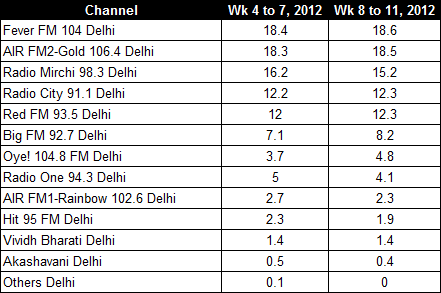
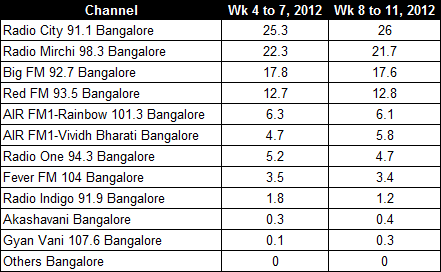
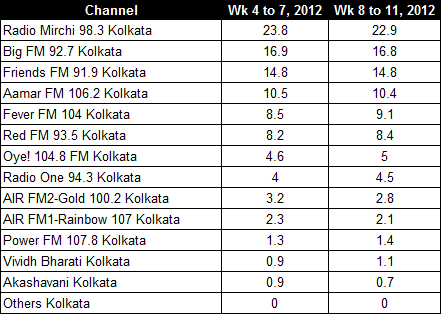
    TAM Media’s Radio Audience Measurement (RAM) – which covers four key metros, Mumbai,Delhi, Kolkata and Bengaluru – released its latest radio listenership figures for Wk 8 to Wk11 (Last two weeks of February 2012 and first two weeks of March 2012).


    According to the latest RAM data, for listeners of 12 years of age and above, all places of listening, and according to radio channel shares,RadioCity, Radio Mirchi, Fever FM, Big FM, Red FM, Radio One, Oye! FM were some of the top FM stations in the big four metros.


    WhileRadioCityretained its leadership position in Mumbai and Bengaluru, Fever FM and Radio Mirchi also continued to remain the leading FM stations inDelhiand Kolkata respectively.


    Mumbai:

    RadioCitycontinues to be the most popular FM station in Mumbai, as the FM station has maintained its leadership position in the city. Ranked second is Radio Mirchi followed by AIR FM2 Gold, Fever FM and Big FM which are ranked third, fourth and fifth respectively. These top five FM stations and Red FM, ranked sixth have secured their listenership share in double digits. The other FM stations in the city include Oye! FM, Radio One, AIR FM1 Rainbow, Vividh Bharati and Akashavani Mumbai.


    Delhi:

    According to the Wk8 to Wk 11 RAM data, Fever FM has once again retained its leadership position inDelhiwith a listenership share of 18.6 per cent followed by AIR FM2 Gold which garnered a share of 18.5 per cent. Although Fever FM is the number one FM station ofDelhi, the government owned AIR FM2 Gold is a close second. What remains to be seen is whether Fever FM is able to widen the gap between the number one and number two FM station? Or will AIR FM2 Gold claim the leadership title?  Once the undisputed leader ofDelhi, Radio Mirchi is now ranked three with a share of 15.2 per cent followed byRadioCityand Red FM with a share of 12.3 per cent respectively. The top five FM stations have received their station share in double digits. The other cluster of FM stations inDelhiincludes Oye! FM, Radio One, AIR FM1 Rainbow, Hit FM, Vividh Bharati and Akashvani Mumbai.


    Bengaluru:

    RadioCitymaintained its leadership position in Bengaluru with a share of 26 per cent, its nearest rival Radio Mirchi, on the other hand, received a share of 21.7 per cent. Ranked three is Big FM with a share of 17.6 per cent followed by Red FM which received a share of 12.8 per cent. While the top four FM radio stations in Bengaluru received a double digit share, AIR FM1 Rainbow which is ranked five received a share of 6.1 per cent. The other clusters of FM station in the city are Fever FM, Radio One, Radio Indigo, Gyan Vani, Akashavani and Vividh Bharati.


    Kolkata:

    The top five FM stations of Kolkata continue to remain the same. Radio Mirchi is unanimously the most popular FM station in Kolkata with a whopping 22.9 per cent of the station share. Its nearest rival is Big FM which received a share of 16.8 per cent followed by Friends FM and Aamar FM which are ranked four and five respectively. Kolkata is the only RAM market which perhaps has not seen a change in the top four rankings in a long time. While Fever FM and Red FM are ranked five and six respectively, other clusters of FM station in Kolkata are Oye! FM, Radio One, Power FM, AIR FM1 Rainbow, AIR FM2 Gold, Vividh Bharati and Akashavani Kolkata.


  • BIGFlix takes consumer entertainment to a new level on Micromax Funbook

    By A Correspondent


    BIGFlix, a part of Reliance Group’s digital entertainment business, and Micromax Informatics Limited (Micromax), on Tuesday announced their partnership to further advance the Movies on Demand ecosystem in the ‘now’ age of ‘Digitalization’ on the newly launched Funbook by Micromax.


    As a result of the partnership, BIGFlix has specially created an Android app for Funbook, the country’s first ever tablet operating on the latest Ice Cream Sandwich. This allows subscribers to stream HD (High Definition) quality blockbusters from a premium catalogue which comprises of  over 1,000 movies across several genres be it action, comedy, drama and many more absolutely free for a period of one month. The same is also available for a subscription fee of Rs249 per month.


    Commenting on the partnership,  Shreyash Sigtia, Business Head, BIGFlix said: “BIGFlix is India’s first and only movie on demand service that offers an exhaustive library of movies in several languages across various genres. We are very happy to partner with Micromax Funbook. This association is extremely vital for us as it will enable us to make movies on demand available to Indian masses.”


    Commenting on the association, Deepak Mehrotra, CEO, Micromax said: “Our strategy, since inception, has been to provide unique product offerings coupled with distinctive value additions to customers from time to time and our tie-up with BIGFlix, India’s first and only movie on demand subscription service underscores this. We believe that in a highly competitive atmosphere, this will allow us to replicate our growth -globally, regionally as well as locally.”

  • UTV Indiagames gets ‘IPL Cricket Fever’

    By A Correspondent


    UTV Indiagames has launched the official IPL season 5 mobile game, ‘IPL Cricket Fever’. They have made sure that all elements of the actual IPL cricket are experienced through the game including the brand associations. Brands like Volkswagen and Parle 20-20 cookies have joined hands with UTV Indiagames, to associate with ‘IPL Cricket Fever’.


    Volkswagen has extended its on-ground association with IPL Season 5 to the official game by introducing brand elements for ‘Super Sixes’ & ‘Man of the Series’. Just like the on-ground association, Volkswagen is the brand partner for every ‘6’ hit in the game. For the ‘Man of the Series’ in the mobile game, the player with maximum number of wins during the current IPL season will be presented with the ‘Volkswagen Vento – IPL Edition’.


    Parle has associated with the game with their brand Parle 20-20 cookies for various in-game branding elements like ‘4s’ and ‘Replays’. The brand is also the sponsor of the ‘Man of the Match’ reward in the game during the presentation ceremony.


    Commenting on the brand associations for the game, Vishal Gondal, CEO, UTV Indiagames said: “The IPL season is the most exciting time of the year for cricket enthusiasts, both on ground and in the digital space. With IPL Cricket Fever we wanted to offer an as close to real experience of the actual on-ground action of IPL and with Volkswagen and Parle 20-20 cookies on board we have made it happen. Now whether the player hits a 4, 6 or wins man of the match or even man of the series, the presence of these brands will give them the actual IPL feel even on their mobile phones.”


    Lutz Kothe, Head of Marketing & PR, Volkswagen Group Sales India Private Ltd. said: “The immense response we received for the IPL Edition I has prompted us to introduce the IPL Edition II and this time with both our popular carlines – the Polo and the Vento. To make this more exciting, we are introducing the official mobile game for IPL in association with UTV Indiagames giving an opportunity to all the cricket enthusiasts to win the Vento IPL Edition II. We are sure cricket enthusiasts will enjoy this game and participate to win their favorite carline.”


    Pravin Kulkarnii, General Manager – Marketing, Parle Products said: “Gaming is huge in the country today and the mix of cricket and games appeals to one and all. IPL is as popular on ground as it is in the digital space. Parle 20:20 cookies’ association with UTV Indiagames’ official IPL game is the perfect brand opportunity for us as it extends our brand recall in the digital space instantly.”


    ‘IPL Cricket Fever’ is based on the IPL Season 5 format and includes all official 9 teams – Mumbai Indians, Chennai Superkings, Deccan Chargers, Delhi Daredevils, King XI Punjab, Kolkata Knight Riders, Rajasthan Royals, Royal Challenger Bangalore and Pune Warriors.


    The users will be able to play with the official IPL players including Sachin Tendulkar, Michael Hussey, MS Dhoni, Ravindra Jadeja, Virendra Sehwag, Adam Gilchrist, Gautam Ghambir, Yousuf Pathan, Kevin Pollard, Rahul Dravid, Shane Watson, AB de Villiers, Michael Clarke and many more. There are three game modes available which include quick match, powerplay and IPL tournament. The user can play the entire season as per the actual IPL season too, 4 stadiums with 3 difficulty modes and original IPL players make this the most exciting cricket game around.


    The game is available on Android, iOS and Java to ensure that every cricket enthusiast can lay their hands on it to enjoy the IPL season.


    UTV Indiagames is India’s integrated game developer-publisher across mobile, online and the interactive television. The company has been a pioneer in the mobile gaming space and has partnered with several major game publishers and media companies in the world such as EA, Disney, THQ, Atari, Universal, Fox, Warner brothers, Sony, MTV, 2K and others whose IP has been published across global leading telecoms including Verizon, Vodafone, Airtel, AT&T, Telstra and others.


  • George P Johnson launches Audience Marketing Division

    By A Correspondent


    GPJ India, the wholly owned subsidiary of GPJ Worldwide, an experience marketing agency has announced its foray into communication marketing with a strategic focus to target the right audience with the launch of its new Audience Marketing Division. This is in line with its aggressive growth plans as part of its 10th year celebrations in India market.


    Speaking about the new division, Rasheed Sait, Country General Manager, GPJ India said: “Our top priority is to help our clients articulate their message to the right target audience and create, develop, and deliver winning campaigns that are actionable and provide measurable results. Getting the right target audience for our clients and delivery of the right message therefore is very critical which we are sure the Audience Marketing Division will address. We also believe that we can adapt the best practises of our global offices and become a One Stop service provider for experience marketing in India. ”


    The Audience Marketing team consists of young and experienced professionals having wide experience in the field of Integrated Marketing Services. The team have specialized resources for audience/lead marketing programs, registration and database management.


    “We have often heard clients asking for a 360 degree approach to events. Getting the right audience and a convenient registration process is another point of concern for most clients. GPJ strives to address these issues by a continuous evaluation process and constant improvement by applying the learning from past performances. We are also bringing in the digital method of registration and using cutting edge technology to give the customer a registration experience like none other, We are also looking to expand the team with senior strategic and planning people from the industry to strengthen the team,” added Mr Rasheed.


    GPJ isIndia’s leading experience marketing agency, built on a reputation of sound strategic thinking and innovative experience marketing solutions that has led to winning many industry and best practice awards.


    The Audience Marketing Services includes Audience Marketing for events, Onsite Registration Management, Response Management, Lead Generation, Lead Validation, Registration Micro site, Website development & Maintenance & Post event analytics


  • Pradeep Gairola quits TIL, joins Meritnation as COO

    By A Correspondent


    Pradeep Gairola, VP with Times Internet Ltd and Business Head of timesofindia.com has moved on to join Applect Learning Systems as COO. Applect runs meritnation.com which is a leader in the online school education space.


    A turnaround specialist in the print and online media with over two decades of experience, Mr Gairola has worked with The Times of India group, Aptech Internet, Mid-Day, Ananda Bazar Patrika and more recently (since October 2008) with Times Internet Limited.


    “I had a great innings at Times Internet,” he says. “The leadership team of TIL is outstanding and I have benefited tremendously from my stint with the company.” On his move to meritnation.com he says, “I am quite excited about the potential of the education sector in India. According to Technopak, the private education sector is estimated to reach US$ 70 billion by 2013 and US$ 115 billion by 2018. The team at Meritnation.com has built a solid foundation and it is well-placed to benefit from the education revolution that will sweep the country. It is great to be a part of the team that will touch lives of millions of students in India”.


    Meritnation employs more than 125 people, with a large bias toward content creation. It was started in 2009 by IIM Bangalore 1996 batch-ers Pavan Chauhan (CEO) and Ritesh Hemrajani (Director).


    Meritnation is part of the Naukri.com group and is headquarted in Delhi. It caters to the learning needs of students for Classes I-12 (K12) from CBSE, ICSE and leading state boards. Amongst pay sites in education in India, Meritnation is reported to be numero uno. It offers online and correspondence learning resources for Maths, Science, English, Hindi, Sanskrit and the Social Sciences.


  • My experiences around building brands & teams will come in handy: Haresh Chawla


    He’s had an indelible association with Network 18 and was largely responsible for the group turning into a large conglomerate today from being a wannabe a few years ago. He’s better known for effecting quite a few turnarounds across the multiple organisations that he’s worked in, especially start-ups that have gone on to become large empires today. Whether at HCL Group, where he headed business development for HCL Comnet or at ABCL, where he set up the Film Distribution Business or at the Times of India Group where he launched their music label – Times Music, Haresh Chawla has an exceptional approach in the way businesses need to function.


    Having sent the media world into a tizzy post his decision to move on from Network 18, Haresh Chawla is back in the news and will be seen reprising a role that he has advocated earlier, though in a smaller way. Chawla has joined private equity firm India Value Fund Advisors (IVFA) as Partner and will be responsible for building and scaling up businesses owned by IVFA across sectors, as well as leading media & entertainment investments at IVFA. He will resume office on June 1, 2012.


    In conversation with MxM India’s Johnson Napier, Haresh Chawla divulges his plans and responsibilities at IVFA, on the scope that private equity firms offer to mid-sized businesses and admits on missing working for the behemoth that continues to make noise even after his departure. Excerpts:


    Congratulations on your appointment as Partner, IVFA. After your announcement of moving on from Network18, many had anticipated you to be joining another large media entity but that’s obviously not the case now. What made you join a private equity firm and not take up anything else?

    My desire really was to grow from the role that I had undertaken at Network 18 and try and do something different. As I said, I have prior experiences in building businesses and brands and I can use that in a much different environment where the operating environment is different and where both capital and management coexist together and you also have to mentor teams. So it’s slightly different attempt from a pure operating point of view.


    Any other interesting offers from media entities before you took up this role at IVFA?

    I wouldn’t like to comment on that.


    While you’ve donned the role of being an entrepreneur-investor in the past, what is the newness that this role will bring to the fore at IVFA?

    It’ll be about focussing on new projects. If you see, the fund (IVFA) is a diversified fund, so it will be in a larger operating space in that sense. Also, the fund will also be about operating with mid-sized companies and scaling their businesses up. This is what will be the difference in the projects that I have undertaken in the past and what I will be doing at IVFA.


    My experiences around building brands and teams in the past will come in handy here, only this time around it will be done in a much larger space. The company is unique, in the sense that it has both capital and management, so the canvas is much larger than what I have attempted in the past.


    You’ve been seen as a leader who enjoys taking up challenges in floating new start-ups and turning them into profitable ventures. How similar or different will be your approach at IVFA?

    The approach would be pretty much similar to what I have done in the past. The challenge is that IVFA is a firm that buys businesses that are at an interesting stage in their lives and really help them scale up and build them into much larger businesses. I look forward to continuing what one has done in the past few years and build up on that.


    Your new role would see you being involved with various other sectors apart from Media & Entertainment. Having largely handled media-based clients in the past, how do you see yourself acclimatising to these new sectors?

    I actually see this as an opportunity. Whatever work I do on Media & Entertainment will clearly be an opportunity for me to put to use my past experience. As for work on firms with a non-media background, I look at it as a challenge as to how to learn a new business and how to further develop that into something more meaningful for the company.


    One of the focus areas at IVFA would be on strategic management thinking that is required to scale up mid-sized businesses into large professionally-run enterprises. Is this something that is being ignored by most other equity players of today?

    IVFA is unique in the sense that it has a very strong operating focus as well, which is not the case with other PE fund companies. The other thing about IVFA is that it tries to take majority stake in businesses. Bottomline is, the operating focus of IVFA is of a magnitude that’s very different from other PE funds.


    What do you perceive of the private equity space in India today given that the country is witnessing a slowdown where investments/spends are concerned?

    My sense is that despite the slowdown,Indiais still a growing market. One of the challenges that PE businesses had is that valuation has been prohibited in the Indian market for the last few years. But I guess that there is sensibility coming back in the valuations as the economy comes to terms with moderate growth. Therefore clearly, opportunities for private equity players are better because access to public markets is currently less buoyant. So you will find entrepreneurs and promoters turning to private equity now versus the last few years where public markets were the major source of money.


    Do you miss your association with Network 18?

    I do and I have learnt a lot at Network 18 where brand building and engagement is concerned. Hopefully I could use a lot of what I have learnt there at IVFA.


    Would you like to comment on how work is progressing at Network 18 post you moving on?

    No, I wouldn’t like to say anything on that front.


    Is there a goalpost that you have set aside for IVFA in a year from now?

    Right now I am taking a break and will join IVFA in two months’ time. You could probably call me later and ask me this question again and I’ll be able to give you a clearer picture on the road ahead.