Category: MEDIA

  • Mediaah!: Is Arnab Goswami the “over-the-top anchor” in the TOI ad?

    By Pradyuman Maheshwari


    This is not the first time that someone from within the Bennett, Coleman & Co empire has taken on Arnab Goswami and Times Now. In the past, Prashant Panday went hammer and tongs at Arnab. The post was on Prashant’s Facebook wall, and didn’t beat about the bush. I must say I was quite surprised that the CEO of a group company which runs the very popular Radio Mirchi network could write all of it so openly (read: An open letter to Arnab ).

    The fact that Prashant wrote it and still has his job speaks volumes for the internal democracy that exists in the group. Though my wicked brain thinks there’s more to it… especially when I saw this ad on the sports pages of the Mumbai edition. Chhota 15×3 ad, but very interesting.

    You must read the text… all of it.
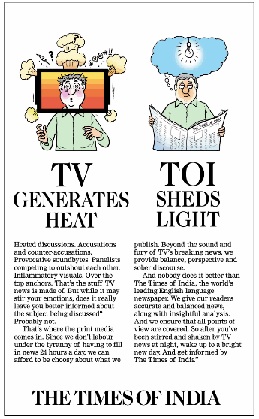
     

    Heated discussions. Accusations and counter accusations. Provocative soundbytes. Panelists competing to outshout each other. Inflammatory visuals. Over-the-top anchors. That’s the stuff TV news is made of. But while it may stir your emotions, does it really leave you better informed about the subject being discussed? Probably not.

    That’s where the print media comes in. Since we don’t labour under the tyranny of having to fill in news 24 hours a day, we can afford to be choosy about what we publish. Beyond the sound and fury of TV’s breaking news, we provide balance, perspective and sober discourse.

    And nobody does it better that The Times of India, the world’s leading English newspaper.We give our readers accurate and balanced news, along with insightful analysis. And we ensure that all points of view are covered. So after you’ve been stirred and shaken by TV news at night, wake up to a bright new day. And get informed by The Times of India.


    Not all of it is untrue. Panelists do outshout each other on news TV. Put Jayanthi Natarajan and Ravi Shankar Prasad in one discussion and there’s more noise and less discussion. Also you can be sure you won’t find all the news on television… esp the private channels. Doordarshan News has a lot more meat, but it is soooo boring.

    What deserves another look and no real reading between the lines is a bit from the first para:

    Heated discussions. Accusations and counter accusations. Provocative soundbytes. Panelists competing to outshout each other. Inflammatory visuals. Over-the-top anchors. That’s the stuff TV news is made of.

    So let’s look at the people who dominate the nightly news on the English non-business news channels, which I guess is what the TOI ad is talking about: Rahul Kanwal (Headlines Today), Rajdeep Sardesai and Sagarika Ghose (CNN-IBN), Vikram Chandra, Barkha Dutt, Prannoy Roy (NDTV 24×7) and of course Arnab Goswami on Times Now. There’s also Rahul Shivshankar on NewsX, but my cable operator doesn’t offer the channel, so would reserve comment on him.

    Rahul Kanwal is aggressive and provocative, but he is not sound and fury. Rajdeep has mellowed (and become very good once again), but Sagarika can go high-pitched. On NDTV, Dr Roy and Vikram C are exceedingly softspoken and can’t harm a fly. Barkha still attempts to ask some tough questions, but like Rajdeep isn’t what she used to be around the time of the Gujarat riots.

    The one man who fits most of the attributes described in the Times (of India) ad is Arnab Goswami. I don’t agree with him being over-the-top, though there are many who believe so. I think he asks the tough questions, and is possibly the only one to do so day after day. Yes, he gets carried away, but needs to be cruel with our politicians. And even as I join others in lampooning Arnab for his the-nation-wants-to-know-line, the fact of the matter is that we all really want to know.

    I do feel that Times Now overstretches itself on issues like Pakistan, China or racism, but heck we need it.  As for inflammatory visuals, I think the print media is also fairly irresponsible. Though the impact of television is a lot, lot more on the common man or woman.

    Let’s keep this discussion on. Email Mediaah! at pradyumanm@mxmindia.com and I will carry the best comment here when I am back on Tuesday.


    Pataudi, RIP


    But for the time when he patted me on the back and gave me an autograph, I’ve never met him. But heard loads about him.

    When the news of Tiger Pataudi’s passing came in last night, almost by reflex I called a colleague to check if we could get someone in adland to reminisce dealings with him for endorsements. Then we tried checking on his connections as editor of Sportsworld and for his stint at Dev Features. The Sportsworld team is scattered all over. There’s an interesting tribute by Derek O’Brien in The Telegraph.

    I called Vivek Sengupta on reading his tweet, and finally convinced him to write a few lines. That was around midnight. Vivek may have turned into a public affairs and PR practitioner for a while, but he’s essentially a journo. He knew I wanted him to write, and sent his copy in an hour.

    Meanwhile, we had no luck with getting an adman to write on Pataudi’s ads. But here are two of his TVC that I found on YouTube (the  first a rather long Gwalior Suitings ad and the other being the recent Lays TVC with Saif)

    [youtube width=”350″ height=”260″]http://www.youtube.com/watch?v=iei989o4l-I[/youtube]


    [youtube width=”350″ height=”260″]http://www.youtube.com/watch?v=dTVIrhnt5x4[/youtube]


    Buzz me if you have a story to tell. Confidentiality assured. There are various ways you can reach me:

    pradyumanm[at]mxmindia.com, 23050B5D, pradyumanm@gmail.com, @pmahesh, 98338 76278.
  • Meteoric rise for UTV Stars

    By A Correspondent


    The recently launched channel UTV Stars – The Official Channel of Bollywood, which went on air on August 19, 2011, has garnered a phenomenal response from audiences nationwide in a very short span of time. In just 4 weeks, UTV Stars has acquired the No1 spot in the Bollywood genre.

    Within four weeks of its launch, the channel is ahead of its competition in the Bollywood Entertainment genre, with 23.5 GRPs (HSM 1MN+ 15-24), which makes it the leader in the genre as per the TAM data for Week 38. From the time of launch, the channel has enjoyed a robust audience loyalty (derived from the TSV measure) which is already 30 per cent above the competition.

    Chalking the achievement up to superior content on the channel, Nikhil Gandhi, Business Head, UTV Stars said: “We got the formula right and implemented it bang on. Right from the brand campaign to the shows, to the eclectic programming mix, we planned meticulously and were therefore confident of becoming leaders.”

    The channel is the sixth addition to UTV’s bouquet of channels in the entertainment space, and aims to bridge the gap between superstars and their fans.

    With Preity Zinta hosting one of the prime shows of UTV Stars ‘Up Close and Personal’ and fans getting to live a starry life on ‘Live my Life’, UTV Stars has caught viewers’ fancy.

  • How well do you know India?

    By A Correspondent

    In order to engage the Youth of India, NDTV India and IDBI Bank are presenting an innovative quiz show ‘IDBI Bank Sawaal India Ka’. Debuting on Monday, September 26, 2011 at 7.30pm, the show will test the contestants’ IQ (India Quotient) and knowledge on subjects of Politics, Government & Economics, Sports, Technology & Automobiles, History & Mythology, and Bollywood and Entertainment etc. Additionally, the contenders will also be judged upon their alertness, quickness and calmness and how they manage to maintain a balance under high pressure.

    ‘IDBI Bank Sawaal India Ka’ will be hosted by the experts in their respective fields each episode will feature a special theme.

    The contestants will win cash prizes in each round and as they climb the ladder, the amount will increase.

  • The Anchor: Sanjay Reddy on 7 reasons why regional GECs should be treated differently

    #1 Ethnicity and Culture: India is a multi-cultural society, where every state has its own culture and language. Shows that do well in Hindi Speaking Markets (HSM) might not do so well in Tamil Nadu or even Andhra Pradesh. The GECs of the market need to show content that is in tandem with the culture of the masses.

     

    #2 Identification & Familiarity: Viewers like to feel associated with content that they can identify with and which feels familiar. Any major shift from this safe zone can sometimes (not always) lead to the viewer leaving the show. Most of these regional markets have their own movie Industries, showcasing their need for differentiation and attraction to what seems familiar.


    #3 Targeted Advertising: Most retailers look for the most cost-effective way to reach their target audience. If the TG is based only in Maharashtra, it does not make sense to advertise on a Hindi channel as the spillover would be tremendous. Thanks to the presence of Marathi channels in the region, the ROI is high and the spillover is limited. Having a strong GEC with content targeted at the regional market makes it a more appealing and value-for-money proposition for the advertiser.


    #4 Continued Experiments with Programming: Regional GECs speak to a smaller audience compared to the Hindi GECs. Hindi GEC need to provide content that caters across HSM giving it the chance to experiment with content and create shows that might not appeal to masses in small towns but might end up doing well in metros and big cities. In case of Regional TV GECs, yes sure here also people can experiment but anything too over the top might not go well will the audience and as most brands look at regional TV for targeted advertising, there are only a few mistakes that a channel can make, a typical chicken and egg situation.


    #5 Relationships in South and North GECs: When it comes to relationships, North and South India have a few differences. In AP a man can get married to his sister’s daughter – something that is totally unheard of in the north, similarly a marriage between a man and his bhabhi is an accepted fact, something that won’t be taken well in AP. This was just a small example but surely both GECs need to have different treatment in story structure and relationships.


    #6 Production Costs: Given the kind of advertising spends a regional channel sees, compared to a national Hindi GEC, it would be unfair to compare the two. Sets from the top Hindi shows are too high-maintenance for regional channels. There are regional channels that have spent a lot on their sets and shows but there can be only one show in the channel that can get such lavish budgets.


    #7 Influence of Western Culture: HSMs are more prone to western cultural influences, something that can be seen with successful shows like Indian Idol, India’s Got Talent, KBC, Big Boss, Masterchef India etc, which are remakes of popular international shows. Shows with a contemporary packaging haven’t done too well in regional markets.


    Sanjay Reddy is EVP – South Cluster, Zee Entertainment Enterprises Limited

  • Will Anna wave lead to media curbs?

    The Indian Government is looking at ways to curtail exaggeration in press reports, the case in point being the recent coverage of the Anna Hazare Movement.

    Media reports say the issue came up at a recent meeting of the Union Cabinet, with Urban Development Minister Kamal Nath speaking about the need to impose some restrictions on news reports to prevent exaggerations.

    Sources say that a committee to look into the issue of exaggeration in media reports might be set up, but the intention is not to curb the freedom of the press.

    As is known, earlier too the Government had raised the issue of being pressurised due to overdone coverage of events by media.

    The news media obviously is not too happy with this yet to be confirmed development.

    Mr Satish K Singh, Editor, Zee News, opined, Though we have heard about it briefly, we are not aware of the motive of proposed group. We will wait to see what it is all about. And if it is anything like clamping or strangulation  it will be opposed. However, he added that they would have no problem with regular interaction with the Government. It has happened in the past also, and we have always heard and contributed our bit.

    Mr Yatish Rajawat, Managing Editor, Dainik Bhaskar group, too was of the opinion that there is only a very remote chance of such a thing happening. He said emphatically, To begin with, I believe that the minister has been quoted out of contest. Nothing of the type would happen. He went on to question, How can the Government put in a panel? It is neither feasible nor practical or fair. How can a panel look at the news I am carrying every day?

    None of the news media professionals MxM India spoke to saw any virtue in the Government curtailing news media in any way. Mr Sanjay Prabhakar, Mumbai Bureau Chief, p7 news channel, summed up the sentiment with his argument, What is the media’s responsibility, if it is not to bring such issues into focus? Media knows its boundaries and limitations. No panel can decide for us, we are responsible enough to understand.

    And do people in the media that a section did go overboard, or gave the movement undue coverage? Yet once again the answer is a unanimous No. Mr Rajawat stated, I think the Anna coverage did not go overboard  when emotions are running high, the media has to present their angle, and reflect people’s sentiment. It is our job to discover what lies behind that sentiment.

    Mr Singh, meanwhile, was far more vociferous in his response, How can you reach the conclusion that the Anna movement was over-covered? If you see the Government’s stand itself, the Prime Minister himself has said that they are with the ideals of the Anna movement  he even saluted him in Parliament. He added, As for my channel specifically, we actually presented a very balanced view. We have spoken about the sanctity of Parliament, virtues of the Constitution, and also presented the Government’s point of view. I myself discussed these subjects more than 20 times. As a channel we have put everything on the platter.

    Clearly, this is not a debate that will die down in a hurry. Watch this space for more.

  • Freaking News by Ranjona Banerji: Where’s the fizz gone?

    Life is dull, I have to admit, when television is not having hysterics about some issue or the other. And this week has been particularly short on made-for-television news events. I know I’ve grumbled about the neglect of subjects like the civil war in Libya or the collapse of the world economy but even I know that we cannot whip ourselves into a jingoistic frenzy with such sparse material to work on. No anchors foaming at the mouth, no calls for answers and no heartfelt pleas for justice, mercy or anything at all, nothing in fact that makes television news compete with the top general entertainment channels.
    So yes, the collapse of the world’s economy did make it to Indian television at last but that’s only after the Sensex fell at the end of last week and investors lost a notional amount that ran into lakhs of crores. By now we are so used to inflation and rising interest rates that no one can drum up even one fleck of hysterical foam at the mouth.

    In fact, we seem to be so wrung out and tired by recent events that even some T20 cricket tournament has not filled us with our normal passionate exuberance. We did try to drum up some enthusiasm for that mysterious note that one finance minister wrote to another former finance minister, something to do with the 2G scam, but no one knows enough about it and the people who know aren’t telling.

    Then Headlines Today, which is trying to steal the top patriotic channel slot from Times Now, did get quite excited about the current fight between the US and Pakistan but even that didn’t go far. Shoaib Akhtar, the Pakistani cricketer, said something about Sachin Tendulkar in his new book (yes, apparently he can write). But for all the patriotic fervour which we could have shown, the only people who managed to make something of it were some political parties in Maharashtra.

    CNN IBN remained steadfast in its coverage of the earthquake in Sikkim and its aftermath while by Monday morning, the floods in Orissa and Bihar were all over television.

    Talking about Pakistan, the BBC has a fascinating Hard Talk with Imran Khan, asking some very tough questions as usual and allowing the guest to answer them.

    **

    The newspapers, obviously, were in the same boat. They also realised that the world economy was in trouble. They managed to explain something of it, throwing the collapse of Greece into the mix as well. The unfortunate plane crash in Nepal got the front pages. Patriotism is everywhere so the Hindustan Times headlined the number of Indians who had died. Lesser mortals of other nations not so fortunate to be Indian also died.

    The weekend saw some newspapers telling us that Paris Hilton, general celeb and heiress of the eponymous hotel chain, was in town. The opinion pages were still obsessed with Narendra Modi and his prime ministerial ambitions and whatever else. Am not sure that anyone else still cares, especially since we are currently in this non-news cycle.

    This morning The Times of India came to me bright yellow as if it had been dipped in haldi and this made reading it very difficult.


    **

    I can only hope that things pick up as the week moves on.

  • 9X Tashan is mobile topper too

    By A Correspondent

    After registering an unprecedented growth of over 100 GRPs in the opening week of its launch across the PHCHP Markets, 9X Tashan has set yet another milestone in the television industry. The Punjabi music channel has garnered over 1 million video views on Zenga Mobile TV across India. 9X Tashan is also available on Apalya & Mundu TV platform.

    Speaking about this, Ms Vibha Gosher, VP- Digital, 9X Media Pvt Ltd, said, “Today the viewers consume music through various platforms besides television. It’s the age of convergence. Mobile TV being an easy-to-access platform, it makes it possible for the digital natives to watch their favourite channels. We are ecstatic that just within 10days of the launch of the channel, 9X Tashan has managed to break the 1 million video views on mobile TV with Zenga, the highest in the music television space.”

    9X Tashan is available through various mobile TV platforms including Airtel Mobile TV (SMS TV to 54321), Vodafone TV (SMS TV to 111 (toll free), Zenga TV (visit http://tv.zengatv.com on your phone), Mundu TV (SMS TV to +919212401234 or visit http://m.mundu.tv on your phone) and Apalya TV (SMS TV to 58888). The 9X Tashan theme song can be set as a caller tune by dialing 505999951 from the mobile phone on operators such as Idea, BSNL, MTNL (Mum), Vodafone, Airtel, Tata GSM, Tata Docomo.

    Viewers can also access the channel online on 9xtashan.in.

  • The net is as important as air – Cisco finds

    By A Correspondent

    Demonstrating the role of the network in our lives, an international workforce study announced today by Cisco revealed that one in three college students and young professionals consider the Internet to be as important as fundamental human resources like air, water, food and shelter. The 2011 Cisco Connected World Technology Report also found that more than half of the study’s respondents could not live without the Internet and cite it as an “integral part of their lives” – in some cases more integral than cars, dating, and partying.

    These and numerous other findings provide insight into the mindset, expectations, and behaviour of the world’s next generation of workers and how they will influence everything from business communications and mobile lifestyles to hiring practices, talent retention, corporate security companies’ abilities to compete.

    Overview

    The second annual Cisco Connected World Technology Report examines the relationship between human behavior, the Internet, and networking’s pervasiveness. It uses this relationship to provoke thoughts around how companies will remain competitive amid the influence of technology lifestyle trends. The global report, based on surveys of college students and professionals 30 years old and younger in 14 countries, provides insight into present-day challenges that companies face as they strive to balance current and future employee and business needs amid increasing mobility capabilities, security risks, and technologies that can deliver information more ubiquitously – from virtualized data centers and cloud computing to traditional wired and wireless networks.

    Key Findings

    Internet as One of Life’s Fundamental Resources

    Air, Water, Internet: About one of every three college students and employees surveyed globally (33 percent) believes the Internet is as important as air, water, food and shelter. About half (49 percent of college students and 47 percent of employees) believe it is “pretty close” to that level of importance. Combined, four of every five college students and young employees believe the Internet is vitally important and part of their daily life’s sustenance.

    In India, 95 percent of college students and young employees surveyed admitted to the Internet being as important in their lives as water, food, air and shelter.

    Life’s Daily Sustenance: More than half of the respondents (55 percent of college students and 62 percent of employees) said they could not live without the Internet and cite it as an “integral part of their lives.”

    The New Way to Get Around: If forced to make a choice between one or the other, the majority of college students globally – about two of three (64 percent) – would choose an Internet connections instead of a car.

    The New Social Life: Internet over Love and Friendship?

    First Love: Two of five college students surveyed globally (40 percent) said the Internet is more important to them than dating, going out with friends, or listening to music.

    Social Life 2.0: Whereas previous generations preferred socializing in person, the next generation is indicating a shift toward online interaction. More than one in four college students globally (27 percent) said staying updated on Facebook was more important than partying, dating, listening to music, or hanging out with friends. Within certain countries, including India, updating Facebook was ranked as the highest priority, even more than hanging out with friends.

    The Use of Mobile Devices for Accessing Information…and the End of TV and Newspapers?

    Importance of Mobile Devices: Two-thirds of students and more than half of employees (58 percent) cite a mobile device (laptop, smartphone, tablet) as “the most important technology in their lives.”

    For young employees, India came second globally when it comes to importance of mobile device usage (71 percent), behind the UK (74 percent), but ahead of Australia (66 percent), China (62 percent), and the US (62 percent).

    Continued Rise of Smartphones: Smartphones are poised to surpass desktops as the most prevalent tool from a global perspective, as 19 percent of college students consider smartphones as their “most important” device used on a daily basis, compared to 20 percent for desktops – an indication of the growing trend of smartphone prominence and expected rise in usage by the next generation of college graduates upon entering the workforce. This finding fans the debate over the necessity of offices compared to the ability to connect to the Internet and work anywhere, such as at home or in public settings. In the 2010 edition of the study, three of five employees globally (60 percent) said offices are unnecessary for being productive.

    In India, 68 percent of young employees surveyed prefer using smartphones and consider it as their “most important” device.

    TV’s Decline: Both surveys indicate that the TV’s prominence is decreasing among college students and young employees in favor of mobile devices like laptops and smartphones. Globally, less than one in 10 college students (6 percent) and employees (8 percent) said the TV is the most important technology device in their daily lives.

    Paper Route’s Dead End? Only one of 25 college students and employees (4 percent) surveyed globally said the newspaper is their most important tool for accessing information.

    Saving Trees: Two of five students (21 percent) have not bought a physical book (not textbooks required for class) in a bookstore in more than two years – or never at all.

    Influence of Social Media – and Distractions in Daily Life

    Facebook Interaction: About nine of 10 (91 percent) college students and employees (88 percent) globally said they have a Facebook account – of those, 89 percent of college students and 73 percent of employees check their Facebook page at least once a day. One-third (33 percent) said they check at least five times a day.

    Of all the countries surveyed in the studies India ranked highest in the frequency of Facebook interaction, with 92 percent of students and 98 percent of employees checking it daily

    Online Interruption or Disruption? College students reported constant online interruptions while doing projects or homework from IM, social media updates and phone calls. In a given hour, more than four out of five (84 percent) college students said they are interrupted at least once. About one in five students (19 percent) said they are interrupted six times or more – an average of at least once every 10 minutes. One of 10 (12 percent) said they lose count how many times they are interrupted while they are trying to focus on a project.

    Work Is Life: Seven of 10 employees “friended” their managers and/or co-workers on Facebook, indicating the dissolution of boundaries separating work and private life. Culturally, the United States featured lower percentages of employees friending managers and co-workers – only about one in four (23 percent) – although two of five friended their co-workers (40 percent).

    In India, 85 percent of employees surveyed confirmed adding their colleagues and managers on Facebook.

    The Work Grapevine: Of employees who use Twitter, more than two of every three (68 percent) follow the Twitter activity of either their manager or colleagues; 42 percent follow both, while one-third (32 percent) prefer to keep their personal lives private.

    About the Study

    The study was commissioned by Cisco and conducted by InsightExpress, a third-party market research firm based in the United States.

    The global study focuses on two surveys – one centering on college students, the other on a group of young professionals in their 20s. Each survey included 100 respondents from each of the 14 countries, resulting in a survey pool of 2,800 people.

    The 14 countries include the United States, Canada, Mexico, Brazil, United Kingdom, France, Spain, Germany, Italy, Russia, India, China, Japan, and Australia.

  • Ruby Bana joins Madison Media

    By Ritu Midha

    Ruby Bana has joined Madison Media Group as Chief, Strategy and Insights after a long and productive stint at Havas Media (where she was designated Chief Intelligence Officer for the APAC region).

    Monday September 26 was her first day in her new organisation, which she spent hobnobbing with the senior management at Madison’s Head Office in Mumbai. Says Bana, “I had a dream first day today… spent it interacting with the senior management at Madison. About 20 of us shared thoughts and ideas. I am really looking forward to days ahead.”

    While Madison has had centralized buying, it is for the first time that a cross-functional strategic planning role has been introduced.  And as per Bana, it indeed is a challenging assignment. She explains, “Madison is very solid, the challenge would be to add value to something so large. In Contract and MPG, I was a part of their evolution, as I was there from the very beginning. To make a difference in a very well established organisation would be something else.”

    Having said that, she has the conviction that her multi-country, multi-discipline experience would come in handy. She explains, “Strategy planning has always been my forte, and I have loads of cross country and cross discipline experience.  She adds, “Madison Canvas is much larger, the kind of clients Madison has – would lead to a much wider sharing and gaining of knowledge.”

    Bana believes that it is very important for a professional to be excited about what he or she does.  Says she, “I am, of course, excited to be a part of Madison.  However, it is not to say that I was not happy in my previous job. It was a great learning phase, and an exposure to multiple markets and global strategic minds.  I am always excited about what I do – if it does not excite me more than what else I could have been doing in that time, I would not do it.”

    While Bangalore would continue to be Bana’s base, she would be travelling to Mumbai and Delhi quite frequently – and contribute to ‘Madison’s solid specialised divisions’.

    She concludes, “I am like a sponge, always absorbing knowledge.  Time to use that knowledge across a very large canvas now.”

  • Chitralekha honours best of times

    By A Correspondent

    One of the most respected publications in the field of horology, Watch World, from the Chitralekha Group hosted the second edition of Watch World Awards on September 24, 2011. The jury comprised of several eminent and accomplished members from the watch making fraternities. Other jury members included connoisseurs of watches. The day was moderated by Mr Mitrajit Bhattacharya, President and Publisher, Chitralekha Group.

    When asked how this edition of the prestigious award ceremony is any different, Mr Bhattacharya said “We have not done anything differently this year and haven’t changed the format in any way – It is only a natural progression. It’s only that more brands have participated this year and we have more nominations.  Also, the overall presence of international brands has increased.”

    When asked what kind of a market Indian watches have, Mr Bhattacharya said, “I think the frequency of buying expensive watches in a certain target segment is really increasing. I will still like to add, that if you see the size of the market, it is perhaps not as big as what China (since we like to make China a benchmark). But perhaps, in the next five to seven years our market size will grow, perhaps even comparable to china.”

    The jury members for the awards included Mr Antoine Simonin, an extremely accomplished Swiss master watchmaker and author based in Neuchatel with over 50 years of watchmaking experience; Ms Chhaya Momaya, a leading image consultant; reputed journalist and a keen observer of the luxury space Mr Ayaz Memon and distinguished jewellery designer Ms Varuna D Jani, awarded leading watches across categories like ‘Watch of the Year’, ‘Complicated Watch of the Year’, ‘Sports Watch of the Year’, ‘Watch with Best Design’, ‘Concept Watch of the Year’ and more.

    Jury member, Antoine Simonin, on his second visit to India to judge the awards, commented, “I am honoured to be a part of the jury once again. There has been an exponential increase in the brands and quality of nominations this year. Seeing the response of global brands in the second year, Watch World Award has made a mark for itself in a very short span.”

    At the gala event were spotted industry heavyweights, corporates and bureaucrats like Stephen Forsey, the co-founder of Greubel Forsey watches; Romain Dezaux, Regional Brand Manager of Baume & Mercier,  Mukhtar Mohammed, Regional Market Director of Carl F Bucherer,  Ravinder Zutshi, Deputy MD, Samsung India, Anil Rajput, Senior VP, Corporate Affairs, ITC Limited, Amitabh Kant, CEO & MD – DMIC along with socialites of the city like Sanjeev Dalmia, Maharani Uma Gajapathi Raju, Ramola Bachchan, Sharik Currimbhoy, Raja Aditya Katoch, and other dignitaries.


    Awards


    The winners in the product categories were Zenith Christophe Colomb which won the award for ‘Watch of the Year’ and the ‘Complicated Watch of the Year’, making it the most successful watch of the evening. While the Tag Heuer Heuer Carrera Mikrograph 1/100th Second Chronograph won the ‘Sports Watch of the Year’ award, Corum Golden Bridge Automatic was adjudged the ‘Watch with Best Design’, Citizen Satellite Wave won the ‘Concept Watch of the Year’ award and Greubel Forsey Invention Piece 2 which was adjudged the ‘Limited Edition Watch of the Year’.


    Also presented were the ‘Jewellery Watch of the Year’ award which went to Harry Winston Rendez-Vous and the ‘Fashion Watch of the Year’ award which was won by Harry Winston Rosebud. While ‘The Watch with Most Innovative Material’ was awarded to Hublot “Cathedral” Minute Repeater Tourbillon & Column Wheel Chronograph, the ‘Watch with Highest Utility’ award was presented to Seiko Premier Kinetic Perpetual with Seiko Seiko 5 – 130th Year Collection bagging the ‘Value for Money Watch of the Year’ award.


    On the other hand, across the Marketing categories the ‘Best Campaign in Print’ award was picked up by Romain Jerome Moon Dust DNA whilst Titan Purple picked the award for ‘Best Campaign on Television’. While ‘The Best Out of Home Campaign’ did not have a clear winner, the Tag Heuer Connaught Place Boutique picked the ‘Best Boutique’ award and Breitling Air Show – Buochs 2010 and Parmigiani Montreux Jazz Festival 2010 were jointly adjudged the ‘Best Organised Event’.


    Watch World hosted MxMIndia.com at the venue of the awards do

  • Sam Balsara’s big plans for ABC

    By A Correspondent

    The Audit Bureau of Circulation (ABC) Council of Management for 2011-12 has been announced, and as expected Chairman and Managing Director of Madison World, Mr Sam Balsara, who was the bureau’s deputy chairman in the previous year, has been entrusted with the chairman’s responsibility.

    In a brief conversation with MXM India on his key focus area as the Chairman of the Bureau, Mr Balsara elucidated, “I would have a two-pronged focus. One, to convince the media planners, who do not realize circulation data’s value, about its significance. The second focus area is to make the Audit Bureau of Circulation a more valued body in the eyes of the Government and a few others.”

    There have been a few instances where publications have exactly not been delighted about the ABC rules. Would Mr Balsara also look at softening the rules? He responds with a strong No, adding, “Any audit organisation needs to have strict rules. If the rules are not stringent, and do not need to be followed – it is better not to have them at all. In the five years or so, ABC audit has had no, or very minimal, intervention in the publishers’ marketing plans.”

    As for the readership survey and the ABC working more closely now, considering that there would be only one readership survey, Mr Balsara says, “That will happen automatically, considering that 10 members of RSCI would be from ABC.

    Mr T Venkattram Reddy of Deccan Chronicle Holdings Ltd has been elected as the Deputy Chairman of the Bureau for the year, while Mr Shashidhar Sinha, Universal McCann Erickson (India) Pvt Ltd has been elected as Honorary Secretary and Madhukar Kamath, Mudra Communications Pvt Ltd is Honorary Treasurer.

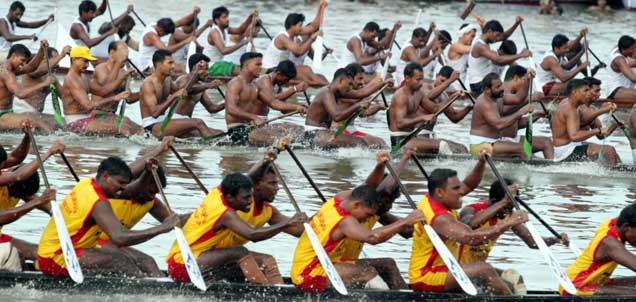
  • Can TOI win the Kerala race?


    By Tuhina Anand


    The Times of India has been giving the last-minute push to its entry into the Kerala market. Speculation was that the TOI would enter the market by early October – the launch date now seems to be October 24.  Mr Rahul Kansal, Chief Marketing Officer, Bennett Coleman & Company Ltd agreed that the TOI is looking to enter the market around this time but refused to name a date, saying that things do get delayed due to various reasons and hence he would prefer to refrain from specifics.


    The TOI in Kerala would have four main editions, he said, including Cochin, Trivandrum, Malabar and Cochin Upcountry, but in total the paper would be printed from 10 centres and would devote space to carry hyper local content.  So in that sense there will be 10 editions. However, Mr Kansal refused to divulge details about the number of print copies initially planned.


    He also said that TOI has entered into an alliance with the Mathrubhumi Group, which will aid TOI in providing logistics support. It is also possible, say sources, that there could be a combo offer available to Mathrubhumi readers.


    Mr Kansal said, “I think we are entering the Kerala market at an opportune time as it has a large literate population and English newspapers is largely a virgin market, with the presence of The Hindu as the dominant player.”


    The Kerala market is an interesting and unique market with literacy rate of close to 94 per cent and is dominated by Malayali dailies including Malayala Manorama, Mathrubhumi, Deshabhimani, Madhyamam, and Kerala Kumudam.  The English newspapers other than the Hindu include The New Indian Express and the recently-launched Deccan Chronicle. Advertisers include real estate players, but jewellery advertisers lead the pack.Players like Muthoot Finance and Manappuram Finance also have gone all out in the media lately with their gold loan schemes, and gained prominence.


    An observer of the market feels that there is a huge opportunity for an English newsppaper like the TOI in Kerala, especially with the young readers. The New Indian Express used to have a strong foothold which has declined over the years and The Hindu has following but is stronger near the Tamil Nadu border, hence there is a space for a strong English player. But it is also a tough market with the literacy rate being high, and readers well informed. So the strategy of entering the market with some sort of alliance with Mathrubhumi makes sense as by leveraging the strength of a vernacular paper, TOI could make impressive inroads. Also the challenge would be to tap the huge retail market like jewellery and textiles, where again it would help to have a regional partner. In terms of content too, the market thrives on regional content even more so than other parts of India, so even though TOI would have a strict template, its plan of having 10 centres of printing with four main editions, carrying localised content from other six markets, may prove to be smart strategy.


    Picture Credit : Fotocorp