
Category: MEDIA

  • M&E can be $100 bn if ground rules are changed to unblock capital: Star India COO Sanjay Gupta


    Sanjay Gupta

    Speaking at the CII Big Picture Summit in New Delhi on Monday, Sanjay Gupta, COO, STAR India lamented the fact that the Media and Entertainment Industry’s (M&E) target of reaching $100 billion in turnover has continued to remain out of reach.


    Addressing delegates at the CII conclave, Gupta revealed that from 0.8% of GDP three years ago, the industry had resolved to grow to 1.5% within a decade. But in the past three years, media as a percentage of GDP has instead fallen by 2 basis points and the $100 billion dream has continued to remain distant. The biggest hurdle has been the choking of investment. To meet ambitious targets, a business either needs to generate large profits internally, which are then invested back into the business or they grow on the back of external investments – national or international. But the M&E industry boasts of neither.


    During the past 15 years, the M&E sector has barely seen any new entrants and only around $4 billion FDI. To garner $100 billion, the industry needs to invest at least $50 billion over the next decade – something that seems farfetched, given the present circumstances. With M&E remaining an unattractive destination for investments, investors have no interest to invest in a fragmented and unprofitable business. Despite the 12% year-on-year growth touted for the industry, the sector is paradoxically riddled with a host of unprofitable verticals. For example, sports is a $2 billion industry that could easily grow to around $10 in the next five years. Be it Hockey, Football, Kabaddi or Badminton, the new sporting leagues are being lapped up by the audiences.


    Yet, the M&E industry has been unable to take off on the back of these investments. Although STAR India has been investing almost Rs200 crore every season for the past two years, dividends are not commensurate. For this to happen, one needs to scale up the volume of content. In other words, more teams, more players and more days of Kabaddi are required annually to capitalize on this opportunity.


    “A bizarre challenge confronts us here, however,” Gupta continued. Although Punjab and Haryana contribute large numbers of Kabaddi players, one cannot add more teams based in either of these two states because they do not have a single indoor stadium that could host a Kabaddi match. In Mumbai, the game is hosted at the NSCI Dome, but the biggest constraint is the availability of this facility for a reasonably long period of time. One venue for a city with more than 1,000 Kabaddi clubs simply does not make sense. In this case, consumer interest and the ability to invest are no hurdles, but the fact that the sporting infrastructure required is simply non-existent. Worse, there are no plans to address this situation.


    The movie business is no different. With around 7,000 screens, India has one of the world’s lowest screen densities. Despite breakthrough movies such as Queen, PK or Bajrangi Bhaijaan, revenues are stagnant, although the cost of producing these movies has soared dramatically in the past decade. Therefore, a $2 billion industry that sets a billion hearts racing earns zero profits.


    News channels fare no better. Without a robust business model, news channel have no money to invest in their business. Whether English or regional, number one channel or last, none of the channels make any money because none earn any money from subscription. Globally, subscription contributes as much as 60-70% of the total earnings of a news channel.


    Television distribution is roughly a third of the total value of the media industry. In the past few years, immense investments have been made in both DTH and the cable business. But the tragedy of this sector is that even after many years of continued investment not a single company or business makes any money. Since the sector is considered a basic need from a consumer viewpoint, the prices at which content is sold by creators to platforms is regulated – prices frozen in 2003 haven’t changed in the past 12 years. In the same 12-year period, even the price of milk has jumped from Rs12-15 a litre to Rs35-40 a litre!


    Such anomalies are making the sector bleed. But no one seems to care, lamented Gupta. In Delhi, for example, the new government has doubled entertainment tax. Consequently, almost 30% of revenue is paid as entertainment tax. The lack of political alignment and consistency of policy in the sector makes it impossible to plan a sustainable business model.


    In 2015, where millions across the country receive their daily dose of news from Facebook feed, radio broadcasters can only air news snippets from All India Radio. In the US, radio has gone hyper local and people spend an hour daily listening to radio. This gives a fillip to local brands since a quick and cheap platform is available to build their business. In India, conversely, there are a limited number of radio stations and limited content that can be aired – and without any news. It is no surprise then that even in large cities where FM exists, the time spent on radio per person is five minutes. Can any industry on Earth make money in such circumstances?


    Gupta concluded by asserting that unless we “unblock minds” we cannot “unblock capital”. Accordingly, there is an urgent need to make distribution profitable, position animation as the next wave of export-oriented growth, support a serious scale-up of exhibition screens and sports stadiums and allow content innovation in radio. A hugely attractive pitch for domestic and international investors is required, giving them clarity on the policy environment for the next 10 years and confidence of generating sizeable returns on the investments.


    All stakeholders, businesses, policymakers and regulators need to stop being happy with the status quo and incrementalism. In the new era backed by technology, every sector from automobiles to financial institutions and even grocery shopping have witnessed dramatic growth and serious disruptions on the back of serious flow of capital. Media and Entertainment too need to see brave new entrepreneurs, disruptive ideas and unconventional business models, stresses Mr Gupta, but this will only happen if we unblock the capital.
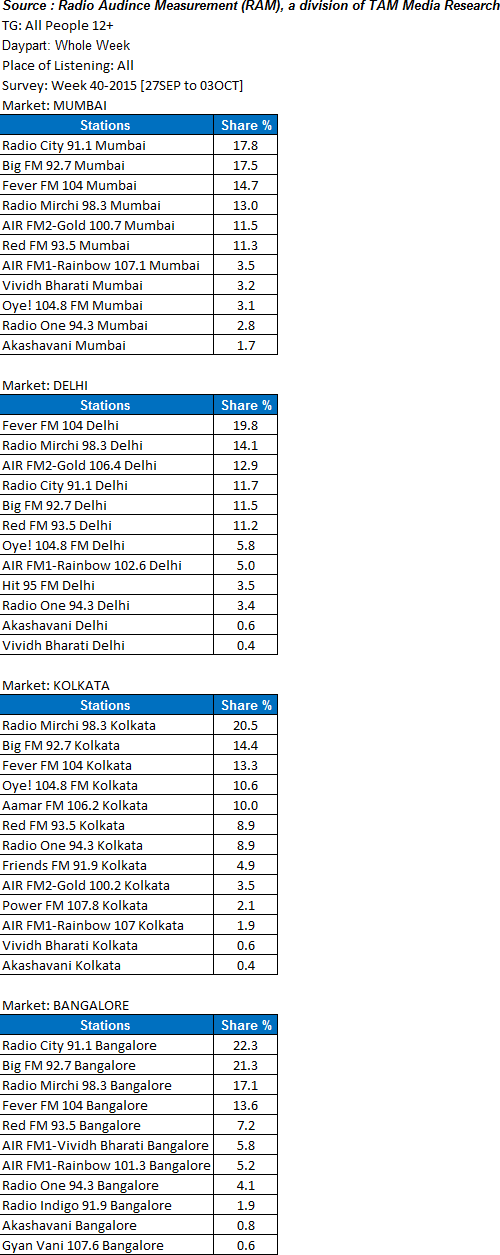

     

  • RAM Ratings for Week 40 Sept 27-October 3, 2015


    Hello. This should’ve appeared yesterday, but we were full up with stories so couldn’t accomodate it. So here we are again with Radio Audience Measurement (RAM) Ratings for Week 40 of 2015… that’s September 27 to October 3, 2015. Sourced directly from RAM. It may be noted that this is topline data which may be insufficient for taking business decisions on booking ads on radio stations. We urge advertisers to buy the research findings or ask radio stations and/or media agencies for detailed numbers​.​


  • Hachette India hands over digital mandate to Isobar

    By A Correspondent


    Hachette Book Publishing India (Hachette India) has appointed Isobar, a full-service digital agency from the Dentsu Aegis Network, as their digital agency. The agency won the account following a multi-agency pitch.


    Sharing his thoughts on the association, Thomas Abraham, Managing Director, Hachette India said, “As a part of our larger commitment to exploring newer ways of reaching our readers we’ve brought Isobar on-board to help us with our social media presence. Isobar’s pitch captured the heart of why books endure and how people connect with books. Their clear understanding of what we need and the enthusiasm of the team assures us that our brand and our books are in good hands.”


    Shamsuddin Jasani

    Shamsuddin Jasani, Managing Director, Isobar India, “We are very happy to be associated with Hachette India, as we are always looking at experiences across different sectors and different types of clients. This win adds a very important category of books and publications to our ever expanding repertoire.”


    Hachette India publishes general, literary and commercial fiction, children’s and reference books as well as non-fiction, covering memoirs, self-help, travel, history, business, popular culture, lifestyle and sport. Hachette India commenced operations in 2008 and began its local publishing programme in May 2009 with Amit Varma’s My Friend Sancho, the highest selling fiction debut of the year. Hachette India is the publisher of legends like J.K. Rowling, John Grisham, Stephen King, Nicholas Sparks, Stieg Larsson, Neil Gaiman, Gregory David Roberts among others. Hachette’s Playing it My Way by Sachin Tendulkar, published in 2014 is the highest selling nonfiction in hardback in India.


  • Sony SIX extends partnership with NBA in India

    By A Correspondent


    The National Basketball Association (NBA) and Multi Screen Media (MSM) announced a multiyear extension of their partnership that will provide fans with up to 14 live NBA games per week on Sony SIX. The NBA and MSM first announced their partnership during the 2010-11 NBA season.


    With the expanded partnership, Sony SIX will broadcast up to two regular-season games per day, in addition to NBA All-Star, the playoffs and The Finals. Sony SIX will also create customized lifestyle-oriented, off-the-court programming that engages Indian youth by bringing together talent from the NBA, Sony Entertainment and Bollywood.


    Prasana Krishnan

    “Our partnership with the NBA has seen basketball become the fastest growing sport in India over the last few years. This clearly indicates that the TV viewing audience for the NBA will continue to rise,” said Sony SIX and KIX Business Head Prasana Krishnan. “The launch of our customized local LIVE NBA wraparound program will also bring sports fans closer to the on-court action.”


    “We are excited to extend our partnership with Sony SIX to continue delivering comprehensive coverage of the NBA to our fans,” said NBA India Managing Director Yannick Colaco. “The popularity of the NBA continues to grow and, through the diversity of NBA programming on Sony SIX, we will continue attracting and engaging with existing and new viewers alike across India.”


    Sony SIX will continue to broadcast daily and weekly NBA highlight shows and integrate daily content from NBA TV, including team previews and recap shows. The daily 30-minute highlight programs will be broadcast in primetime every day of the season. The weekly highlight shows, hosted by a local anchor, will recap all the happenings around the NBA during the past week. For the first time in India, the NBA and Sony SIX will introduce a customized, local live NBA wraparound program every weekend throughout the season, bringing viewers closer to the game. The program will be hosted by a panel of basketball experts that will provide analysis and insight on all of the latest NBA news.


    The NBA and Sony SIX will also continue their focus on the development of basketball in India, beginning with the return of NBA Jam – the league’s annual basketball festival – on Oct. 24. With the expanded partnership, more NBA players, legends and dance teams will visit India throughout the year.


  • Appie to empower retailers fight e-commerce festive sale war

    By A Correspondent


    Bates CHI&Partners Mumbai has launched festival initiative for recently acquired client Appie. This festive season, brick and mortar retailers have found their ally in the form of an app to fight the e-commerce sale war. Appie for Retailers – an App that will help empower retailers to stay competitive against e-commerce  players. The newly launched application – Appie, helps connect customers and retailers in a more efficient and personal manner. Most often when customers order something through an e-commerce portal, many become victim to either delayed deliveries or wrong /damaged products. Though there is a return policy in place for all online shopping websites but what is not returned is the valuable time customers lose out in the bargain.


    In all situations, one community that has always been at the losing end is the retailer community, who in spite of having better or similar products with door-step delivery capabilities get marginalized due to the noise created by e-commerce players by use of mass media. However, this festive season retailers have an ace up their sleeve with the help of partnering with a startup that is promising them to win back their lost customers.


    Appie Mobiquity, a startup that has developed the app Appie, promises convenience  and instant gratification to customers as well as power to retailers. This mobile application presents a path breaking solution for making the real world retail shops / to thrive in the increasingly Digital and Mobile First world.


    How Appie works:

    • Customers downloads Appie app on mobile phones
    • Search for the product of their choice on the application or simply share product from other ecommerce sites.
    • Appie helps discover the product in the vicinity of the customer, right there
      where the customer is searching  on any major
      e-commerce sites
    • Appie helps the customer find quickest possible source to get the product
      along with price, availability and retailer’s information. Essentially helping the
      customers get the product in as quick as 30 minutes.
    • Appie puts the retailer’s identity right in front and centre to the consumer
      and enables a direct transaction between the retailer unlike e-commerce portals
    • This option also helps retailers with increased footfalls as many customers even today will prefer to touch, feel and experience the product before buying and more importantly want their purchase faster.
    • Additionally Appie has decided to stand with retailers in their war with e-commerce players this festive season and offer full cash back to retailers on winning back customers from e-commerce portals.
    • The Mobile App is free to download and works on any Android Phone.


    Research by Google and other prominent organizations suggests that customer who research online often buy 3-5 five times more than regular shopper. Appie wants to enable a level playing field for retail shops and consumers thereby creating a win-win situation


    Benefits to Retailers:

    1. Affordable – No investment fee and retailers pay as low as Re 1/- for each transaction
    2. Easy – User-friendly and easier than Whatsapp that enables retail shops to win customers in less than three clicks and three seconds.
    3. Identity – Highlights merchant’s name and contact. Brand recall for next use
    4. Quality: No discount and deals to attract customers and increase burden on retailers. Customers sent to stores are purely driven by their intent to buy.


  • Ranjona Banerji: Is every journalist asking probing questions anti-national?

    By Ranjona Banerji


    Ravish Kumar of NDTV, certainly one of India’s most brave and forthright television journalists, has given a visceral and honest interview to the website scroll.in on the state of the nation. He has discussed the Bihar elections, the rivers of hate running through India, the violence and the laziness of the Indian liberal. The liberal, all too often, he contends is comfortable in its fortress away from the hoi polloi, sometimes abroad, commentating from afar. Too many he feel even cosy up to the environment. Not enough speak out to stop the hatred and viciousness.


    But for this column and to my mind, it was Ravish Kumar’s comments on the media which are the most pertinent.


    This is what he says about the atmosphere today:

    “For decades, journalists have asked uncomfortable questions. They have either been answered with a smile or not at all. But it’s only recently that every journalist asking a probing question has been labelled as presstitute or anti-national. So let’s make a rule then, let journalists ask only good questions and print only nice answers – because it seems that is what the government wants.


    Many journalists who have slogged all their lives with a pittance as salary are being branded as traitors and dalals. While those who really have done such stuff are walking with their heads high. Why?”


    I would have liked to hear more of his views on the journalists who “are walking with their heads high”, as he puts it. Because these are the journalists who are giving a bad name to the rest. They are bigger opportunists than the “liberals” that he attacks, because journalists have signed a special covenant. To want to cosy up to the establishment is the death of journalism, no matter who the establishment is. This includes every award, every flat by special quota, every special invitation, every phone call that does not amount to a story. As journalists, our personal lives are precarious and everything can be fodder to the greater cause.


    It is those journalists who do not support the Hindutva cause who get the most public flak for being anti-national, “presstitutes”, “newstraders” and so on, all names used by the rightwing and sometimes important members of the Bharatiya Janata Party. Ravish Kumar reminds us that it is journalists who reported on all the scams of the UPA government, the same journalists who get called these names.


    But the problem runs deeper than that. Any media watcher (I do not mean rightwing websites like mediacrooks and so on which are clearly sponsored by an agenda) can see a disturbing shift in senior journalists, where criticism of the current dispensation is taken personally. This is not about journalists who are by inclination rightwing themselves. This is about those journalists who want to be part of the establishment to stoke their own sense of importance. The damage that they do to the media’s primary responsibility is incalculable.


    Veteran journalists who have become commentators and TV Talking Heads have limited leverage – even when (or especially when) they join a party like MJ Akbar or Minhaz Merchant. But there are many editors of publications, who are not TV regulars or columnists and therefore beyond public knowledge who wield huge powers and use them increasingly without responsibility. They also seem to carry an incredible pettiness within which reflects in their public comments.


    The situation is dire and even worse than Ravish Kumar’s interview points out. In 30 years, I have not seen journalists crawling like this when they have not even been asked to bend, to paraphrase LK Advani’s classic comment on the media during the Emergency. And I include the media division between the Rightwing and the Rest that happened during the Ramjanmabhoomi Movement in the late 1980s and early 1990s culminating in the demolition of the Babri Masjid.


    We live in bad times as far as the media in India is concerned.


    Ravish Kumar’s interview:

    http://scroll.in/article/762857/the-ravish-kumar-interview-our-lazy-liberal-class-was-always-opportunistic


    **


    Having said that, some better news. For over a year now I have criticised The Week That Wasn’t, the news satire show on CNN-IBN for going easy on the BJP and Narendra Modi. This was particularly evident in the run-up to the general elections and just after the government was sworn in.


    However, I now revise my view. The last episode of TWTW, where Kunal Vijaykar did a masterful impersonation of Modi giving an election speech in Bihar was once of the funniest I have ever seen!


    I salute you guys, too good!


    **


    And then another thought occurs to one: have the new owners of Network 18 changed their policy re: this government? Hmmm.


  • Panel-based measurement is better: LV Krishnan


    Last week, the Kantar Media-Nielsen jv TAM Media and Kantar-owned IMRB announced the TeleWeb ratings for an integrated study of viewership on television screens and the internet – desktop/laptops as well as on devices. We caught up TAM CEO LV Krishnan to understand the finer details of the offering…


     

    You had spoken about the multiscreen measurement earlier. But do you think it could’ve come in a year or two earlier?

    Well, it required a lot of work to put it together because one is a non-linear medium and the is a linear one. To bring together both into the same database and be able to tell an advertiser that using a combined medium maybe better than using one medium etc requires work. We did a lot of groundwork. If only publishing numbers in terms of saying which sites were getting hits and which sites were getting what kind of profile of audiences. it could’ve been easy. It could’ve happened much before than now. Probably about 4-5 months back. But to integrate both, this is the earliest we could’ve got to.


    Given that there is an MoU with BARC on meters the merger move is work in progress, what happens after the merger happens?

    We’ll see it at that time.


    BARC is also doing something similar, it is also looking at multiple screen measurement.

    From our perspective we are looking at the present moment of time. We’ve done almost a year-and-a-half of work into this exercise. Obviously, since we are still running the television panel, the idea was to launch it and help the industry use it. What will happen a couple of months down the road is something we haven’t thought about at all. From our perspective, the work on TAM BARC integration is going well at a high speed level. That’ll continue.


    Since IMRB’s digital measurement exercise has been on for some five years now, couldn’t this have happened earlier?

    Two important things. Before we launched something like the integrated data we also needed to ensure the fact that the two panels are stable. TV was completely stable. The online one was a new one launched around 2011-2012. So it took time for that panel to settle down and get used on a regular basis because at that time if you look at it the advertising online was hardly around 2-3% of the advertising that was going over there. So, even if we had launched at that particular moment of time, the integrated quotient, the usage could’ve been very low. The demands coming in from the advertisers that we need do it the integrated way. Only in the last one year, in the beginning of 2014, when we were interacting with advertisers that there was a huge push going towards digital. Probably also because of the fact that most of the advertisers were MNCs were also being pushed by the global directors saying that let’s get starting investing on digital because globally digital was picking up strongly.


    What we previewed at the press conference last week was about English channels and the Hindi news channels. But I’m sure the difference is significant with English GECs.

    English GECs are basically international sites. So, we need to see what you want to track within that and how much of it is with the Indian audience largely. So, probably with time we’ll look at English entertainment also as a next step.


    Do you see a lot of viewing happening online in the case of all GECs?

    There is dailymotion.com, Hotstar, Sonyliv, Ditto, all of them are coming in the Top 50 sites. Platforms like Hotstar are among the Top 5.


    Now a channel like Colors has ‘Comedy Nights With Kapil’ which is among the most watched as per your numbers, but a channel like Colors which targets urban audiences is not in top channels list in tele-web, vis-à-vis Zee which is on the list?

    That’s because of Ditto TV. Ditto is the push for Zee. It has certainly got some audience in the metro markets. Colors is yet to have a platform that could be visible and for which audiences are walking in.


    So, will you say OTT is playing a big role?

    Yeah, certainly.


    What is the kind of response that you’ve seen from the advertising community, from the advertising agencies and media agencies?

    We don’t know yet the response because we just launched today but we’ve been working with the advertisers on this for almost a year now. We connected with them and we realised what they are looking for. So, therefore from that perspective this is exactly matching up to what their expectation was from a feasibility perspective of trying to alleviate a campaign on a multimedia level.


    There is no joint industry body to contend with the way you work. There is no industry association as such…

    No, there is no industry association involved in this. We are on our own and like any other research we are marketing it on our own for users to take their independent decisions whether they want to buy it or not or use it or not.


    There have been views on the entire element of panels. In the case of television, the cost of set-top boxes ensured that the sample size of panel homes couldn’t grow. But no such thing exists for the internet, so why only 6-8000 sample size? Do you think it can be browser-driven so that anyone can download and install?

    There are two different kinds of measurements that happen across all media. One is measurement based on universe and second one is measurement based on panels and specific sub-groups of profiles. The problem comes in when the universe study is when you don’t know who the individual is, who is responding to a particular viewing. So, most of the dynamics related to the universe measurement is already available with the publishers themselves like a Google or a Facebook knows about their customers largely and to that extent Facebook I could say knows it even better because age and gender is something they capture apart from the geographic location which is universally available to them. So, therefore, from a universe perspective, limitation is a fact that while you’ve a larger base you don’t know who that base is, who that individual is in terms of profile. So when you are targeting it, you are targeting more based on the behaviour pattern of the respondent rather than on the basis of demographics. In a panel0based exercise you are able to measure demographics as well as in terms of behaviour patterns together. So you know individually what the profile of the guy is, what profile of home he comes from, what are the numbers in the home, what are the platforms they have in the home that can be access point or a competitive perspective, a competitive touchpoint. So, all this kind of information is available on a panel-based exercise. Therefore, we are able to integrate between two mediums very effectively in this kind of a panel-based exercise. In a universe level it’ll be very difficult to integrate two measurement systems. So, largely speaking, for an understanding of a consumer behaviour and trying to monitor it on the basis of his behaviour, a panel makes sense actually. But in the longer run, we could actually do it the way it happens in television where the set top box data and the panel data work together. To therefore use a panel data is to optimize the set top box data. Similarly here too the panel-based data can be worked on to the universe data. You could mine better data at smaller discreet levels. These things will happen in future.


    How much of the TAM sample are you looking here?

    Six metros put together will be about 10,000 individuals actually, which is close to 2500 paneled homes.


    On a lighter note, had the news on NDTV scoring so high on TeleWeb come in earlier, things would’ve been much nicer for TAM?

    No, we take it as it comes. For us the most important thing is to indicate what is happening in the behaviour front. Business decisions are taken by users.


  • CMRSL receives GCPP accreditation

    By A Correspondent


    CyberMedia Research and Services Ltd. (CMRSL), a CyberMedia Group company, has been conferred the status of Google Certified Publishing Partner (GCPP) on October 1, 2015. CMRSL as a partner is helping the content and publishing industry in India embrace digital marketing in a scientific manner. CMRSL, Google’s first and largest AdSense Partner in India, also marks this occasion with the successful completion of one year of AdSense partnership in the country.


    Says Dhaval Gupta, Executive Director- New Initiatives, CyberMedia, “In simple terms, we help publishers set up ads, manage and optimize them, and analyze the results. In doing that, our account managers have helped our clients increase their revenues anywhere from 40 percent to even doubling it within a span of four to six months.”


    Says Monica Badhwar, Business Head, CMRSL, “We’re proud to be one of the select few agencies recognized by Google for our cross-product expertise. Our mission is to help publishers flourish and grow.” CMRSL account managers are all Adsense-certified, have deep experience and expertise in technologies such as AdX and DoubleClick for Publishers, and are experts in optimizing traffic and revenue using advanced analytic tools.


    CMRSL’s key publisher clients include Delhi Press, Diamond Comics, Vikatan, Open Magazine, RajnikantvsCIDjokes, Wittyfeed, Fresherslive, Raftar etc.


  • Fork Media acquires equity in wi-fi ad network Spid

    By A Correspondent


    Fork Media has recently invested in Wi-Fi ad network Spid Info Media Pvt. Ltd. The partnership is in line with Fork’s vision of becoming the leading player in the alternate ad inventory space and is synergistic with its vision of broadening its core offerings. Fork Media will leverage Spid’s technology for advertisers and publishers by offering them one of the largest audience platforms, targeting on-the-go consumers.


    Spid currently has a bouquet of over 1,200 locations including all major airports, QSRs like McDonalds, KFC, Starbucks, and Costa Coffee, malls and other retail locations. This number is rapidly growing as it partners with ISPs and telecom providers to help monetize their inventory. Fork Media aims to use Spids platform to leverage the locational behavior of consumers and target them for relevant advertising.


    Samar Verma, CEO – Fork Media, says about the acquisition, “Having Spid as a part if the Fork Media group is a strategic move for us. We see Wi-Fi as an alternative eco-system – a parallel economy, that’s growing rapidly. With the onset of 4G, a lot of telecom players are investing in Wi-Fi infrastructure to offset the costs involved in setting up 4G. Additionally, the Wi-Fi ecosystem takes location targeting to the next level by not only delivering relevant content to the consumer in and around a certain location, but also offering destination targeting. We are steering Fork Media to be less device-centric and more consumer-centric in our ad solutions. Therefore, this is an extremely important link in the chain for us in the consumer’s journey.”


    The acquisition of equity in Spid is a part of Fork Media’s larger expansion plans. It had recently made its foray into international markets with the launch of its operations in Dubai – targeting the GCC Region. Through its tie-up with Spid, the company is now better equipped to provide well-timed offers that consumers are seeking. Fork Media is now poised to tap the immense opportunity that exists in the digital marketing space in India. By acquiring equity in Spid, Fork Media will be positioned across advertisers, publishers, as well as ISPs.


    Harsh Nagpal, CEO, Spid, said, “Our partnership with Fork Media is a marriage of strengths. Fork’s reach and expertise in business development will enable us to leverage this unique proposition, further enabling brands to reach out to relevant audiences. With Samar and the entire Fork team’s collective experience and expertise, we foresee Spid deriving maximum value and growing manifold.”


  • Ranjona Banerji: Did the North Indian media underplay a Hindutva activist’s death in Karnataka? (+ Winds of change @ CNN-IBN)

    By Ranjona Banerji


    There is some anguish going around in rightwing circles and among members of the media who see themselves as “true” liberals, that the murder of Bajrang Dal activist Prashant Poojary is being ignored in the mainstream media. Poojary was a flower-seller in Karnataka and an active anti-cow slaughter campaigner and activist. He was attacked, allegedly by six (or four?) men on motorcycles, as he and his uncle were setting up their flower shop on the morning of October 9. Some men have been arrested in connection with Poojary’s murder, all Muslims and action has been demanded by Hindutva rightwing organisations against an outfit called the PFI or Popular Front of India.


    I write all this but with almost no conviction of whether my facts are correct because the rightwing is, well, right: news on this murder has been thin on the ground in newspapers and television, especially papers which come out of North India. I have scraped through the internet and till last week, most references to the Poojary murder came from The Hindu and from assorted non-media websites.


    The “facts” are therefore all over the place. Was it four men or six? Have the police claimed the death was a suicide? Was the victim shot or beaten up? I was even more confused by one website which datelined the accident to one year ago: October 2014.


    Karnataka has clearly become a breeding ground for incidents of religion-based hatred of all kinds. Perhaps that in itself requires extra media scrutiny. But, apart from the media’s late arrival to this gruesome crime there is one more intriguing factor: The number of journalists who work in large mainstream organisations who took to social media to complain that the media was not covering this death and concentrating only on Mohammed Ikhlaq. The accusation, by these journalists, was that other journalists were not true liberals like them and only covered the death of Muslims but not Hindus. I repeat: these accusations were made not by members of Hindutva organisations who are legion on social media but by journalists, mainly from the print media, who hold important and responsible positions.


    There is a terrible irony at work here: most of the stories on Poojary’s death did not appear in the newspapers these journalists work for. If they felt so strongly about this murder, as they should have, what stopped them from carrying them in their own newspapers and journals? It is impossible for commentators like me, for instance, who do not work in newsrooms any more, to outrage about matters that are not given press coverage.


    Any Google search done up to a week ago showed the most consistent coverage in The Hindu. Yesterday’s print edition had a follow-up as well, even in the early edition which comes to Dehradun. But I spent some time in Gurgaon last week and saw nothing in the North Indian print editions of some major Indian newspapers.


    I would request these true liberal journalists to please provide their readers with a wider coverage of India before making accusations which only expose their own incompetence as media people.


    **


    Former chief of army staff and current Union minister of state for external affairs VK Singh once more demonstrated his remarkable knack for insensitive and insulting statements by comparing the burning of a Dalit family in his Lok Sabha constituency to persons throwing stones at dogs.


    His remark was rightly the subject of much discussion on television on Thursday night. However on many panels, several non-BJP invitees felt that the BJP spokesperson was being given more time than them. At first glance, this accusation appeared to be true. However, on closer analysis it just appeared as if the anchors were unable to control their guests.


    Of course, this is not new on Indian TV but surely even a public weaned on sensationalism is tired of trying to decipher what various screaming people are saying? I am now genuinely surprised that people with something to say actually agree to appear on these channels.


    **


    I end again with CNN-IBN where Zakka Jacob was an exception to the rule: he was tougher than most and did not allow the BJP spokesperson to run his show. There is a slight perceptible change in the way CNN-IBN presents news. Is it the elevation of Bhupendra Chaubey to executive editor or some other winds of change flowing from the new inductees to top editorial and management positions at Network 18.


  • Zee Anmol is the new #3 Hindi GEC as BARC goes rural

    On Friday, the Broadcast Audience Research Council (BARC) India released the much awaited rural India. Data for Week 41 was released today for October 10 to 16, 2015 and the combined numbers for rural and urban were presented among the toplines.  BARC India, a joint industry body comprising the broadcasters, media agencies and advertisers, started rolling out ratings from April, 2015, and the release of rural numbers has been hailed as a significant achievement, even as there was a section of influential broadcasters who were trying to get it delayed.


    With the release of the All India data, BARC India has expanded its reach to 153.5 million TV households, representing All India and all modes of signal. Of this 77.5 million are urban TV households and 76 million are rural TV households. BARC India will now be reporting Megacities, 10-75 lakh towns, less than 10 lakh urban areas and rural.


    The BARC India survey shows that lesser time is spent on TV in rural areas. Two in five rural audiences fall in the NCCS AB category, rural India gives younger audiences in the age group of 15-40 years. Last but not the least, with rural India’s ‘Early to bed and Early to rise’ philosophy, the conventional definition of prime time for channels may change.


    Highlights of BARC India Week 41 (October 10-16) ratings:

    • Star Plus maintains its leadership with 804214 Rat (000s) followed by Colors at 708747 Rat (000s).
    • Zee Anmol jumps to number 3 with 609189 Rat (000s).
    • DD National registered an Average Time Spent (ATS) of 53 Min 39 Sec highest among Hindi GECs.
    • Rishtey is amongst top 10 Hindi GECs with 270072 Rat (000s).
    • In the news genre, Times Now maintains its leadership with 560 Rat (000s) followed by CNN IBN at 233 Rat (000s).
    • Sports sees major spike in ratings. Star Sports 1 holds number 1 position with 162592 Rat (000s) on the back of Paytm ODI Trophy 2015- India vs South Africa.
    • Star Gold becomes No 1 Hindi Movie channel with 486374 Rat (000s) with the premier of Bajrangi Bhaijaan.
    • Aaj Tak is number one in Hindi News genre with 72067 Rat (000s).
    • Sun TV with 1092231 Rat (000s) topped the Tamil GEC genre. It also becomes the No 1 channel on All India basis ahead of Star Plus and Colors.
    • ETV Telugu maintains No 1 position in Telugu GEC market with 424252 Rat (000s).
    • Colors Kannada maintains its ranking order in the Kannada GEC space with 211268 Rat (000s).
    • Zee Marathi with 116598 Rat (000s) leads the Marathi GEC genre.
    • In the Malayalam GEC genre, Asianet topped the chart with 413385 Rat (000s).
    •  Star Jalsha tops Bengali GEC space with 241463 Rat (000s).
    • Discovery Channel stays ahead of competition with 6433 Rat (000s).
    • Kids genre sees spike in ratings, Nick is the number one kids channel with 97227 Rat (000s).
    •  MTV is the No 1 Youth channel with 14219 Rat (000s).
    • ET Now tops the English Business news genre with 484 Rat (000s).
    • Movies Now maintains its leadership in English Movies genre with 3200 Rat (000s) followed by Sony Pix at 1893 Rat (000s).
    • Zee Café maintains its leadership in English Entertainment genre with 103 Rat (000s).


    “I am delighted to present to the Broadcast and Advertising industry the All India Ratings. We have been able to give to the country a view of “What India Watches” as promised,” said BARC India CEO Partho Dasgupta.


  • Shailesh Kapoor: With Rural Ratings, India is Split Wide Open


    By Shailesh Kapoor


    BARC India released the first rural ratings data Friday morning. There have been some delays in the rural rollout, and they have been understandably under some pressure here. But now, that’s all a thing of the past. We are in the rural data regime. October 23, 2015 could go down in our television history as the before-after date. Congratulations to those who made it happen.


    The data itself has enough meat to keep conversations going. That FTA (free-to-air) channels will benefit from rural data was evident, but the extremity of this “benefit” was perhaps underestimated by everyone. Sample this:

    1. In Rural HSM, four private FTA channels (Zee Anmol, Star Utsav, Rishtey and Sony Pal) have more combined viewership than the seven Hindi GECs that run original content.


    2. These FTA channels get 71% of their viewership from rural India, while the “mainline” Hindi GECs get only 37% of their viewership from rural India.


    3. As a result of this turnaround, Sun TV (despite just 1 GRP in HSM) is the No 1 channel at an All India level, and by a clear margin too.


    5. Zee Anmol, the No. 38 channel in the big metros, is the No. 1 channel in rural HSM.


    The dichotomy is apparent. India has been split wide open, into rural and urban India. This will change many things in and around the television business. For starters, it will change the idea of how data is viewed and analysed. Each genre has an operating TG in which the leading players measure their performance. It’s been CS 4+ HSM (Hindi-speaking markets) for Hindi GECs and Hindi Movie Channels for ages, and CS 4+ state equivalent for mass regional channels (e.g. CS 4+ TN for Tamil channels).


    HSM is no longer HSM, though. It is a combination of HSM Urban and HSM Rural. Many advertisers are understandably not interested in the rural ratings, addressing a target audience that’s still predominantly urban. E-commerce is one such category. However, categories like FMCG and telecom would be interested in rural India too. But even for them, the messaging in rural India and urban India (especially the bigger towns) would tend to differ significantly. Imagine Vodafone running the same commercial to entice a Mumbai customer and a rural customer in UP.


    Hence, a logical outcome could be that GECs would get naturally classified as Urban GECs and Rural GECs. The Rural GECs will attract brands targeting rural India, and will be measured in their “category”, while the Urban GECs will continue to operate much like they used to, in the pre-rural era.


    One could argue that rural penetration of pay channels will increase with time, and the gap between the two types of GECs may look much smaller a year from now. But an Urban GEC playing in the Urban+Rural space would bring its own share of confusion, like that commercial that would target a Mumbai customer or a UP rural customer, but play out to both. Having said that, technology solutions to localized ad targeting are available and likely to become a lot more relevant now than ever before.


    The dust will settle down over the next few weeks and a broad consensus on working definitions of categories and their target audiences is likely to emerge with time. For once, niche channels (not targeting rural India) would have more clarity on how to use the ratings data than their mass counterparts.